LUISTER NAAR DE JOODSE STEMMEN OVER
DE ISRAELISCHE MEGA-MISDRIJVEN TEGEN
HET INTERNATIONAAL HUMANITAIR RECHT
JEGENS DE PALESTIJNEN !
THE JEWISH VOICE FOR PEACE - JVP
LEES "THE WIRE" !
PALESTINA BERICHTEN NA 31 december 2025 staan hier

30 januari 2026
Gaza Humanitarian Response
Situation Report No. 65
30 January 2026
(As of 18:00 on 29 January 2026, unless otherwise noted)
HIGHLIGHTS
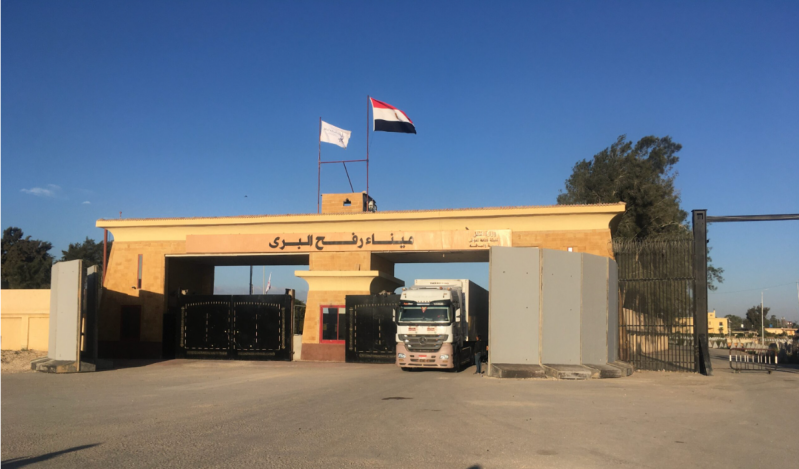
- On 30 January, the Israeli authorities have announced the reopening of the Rafah Crossing in both directions from 1 February, for limited movement of people.
- Between 21 and 28 January, Shelter Cluster partners provided emergency shelter materials and other essential items to 11,826 households. In parallel, as part of the storm-response efforts, partners assisted 772 households affected by heavy rainfall with tents, sealing‑off kits, clothing kits, and other essential items.
- OCHA and partners continue to support municipalities in the temporary relocation of populations living in high-risk areas, prioritizing families exposed to flooding risks, unsafe structures, and unexploded ordnance contamination, particularly where mitigation measures are not feasible.
- A lack of basic tools such as shovels, rakes, and wheelbarrows is severely hampering floodwater clearance works across displacement sites, with accumulated debris and rubble causing mice infestations.
SITUATION OVERVIEW
On 30 January, the Israeli authorities informed that the Rafah Crossing would reopen in both directions on 1 February for limited movement of people following prior Israeli security clearance. The crossing will be coordinated with Egypt and under the supervision of the European Union, similar to the mechanism implemented in January 2025. It was also stated that returns to Gaza from Egypt will be allowed only for residents who left the Strip during the war and after prior security clearance by Israel, EU screening at the Rafah Crossing, and a second identification and screening process in a designated corridor operated by the Israeli military in an area under Israeli army’s control.
Earlier this week, on 26 January, the Israeli military reported that the body of the last Israeli hostage in Gaza was recovered and returned to Israel. This was followed by the reported release of 15 deceased Palestinian detainees on 29 January, bringing the total since the start of the ceasefire to 360.
Between 22 and 28 January, airstrikes, shelling and gunfire continued to be reported across the Gaza Strip. According to the Ministry of Health in Gaza (MoH), 28 Palestinians were killed, and 62 others injured during the reporting period, bringing the total casualty toll reported by MoH since the announcement of the ceasefire to 492 killed and 1,356 injured.
A military incursion in the Bani Suhaila neighborhood of Khan Younis forced 33 households to flee on 25 January. These households had only recently returned to displacement sites close to their former homes along the “Yellow Line” and have now been displaced again to nearby designated emergency shelters, where they require urgent clothing and emergency food assistance. Additionally, partners report that approximately 100 families were displaced in the last week due to military operations east of Gaza city, in the vicinity of Al Sanafour area. They sought refuge in an industrial building, in a stadium, and within damaged or partially destroyed homes. After the operation was concluded, families began returning to their previous locations despite ongoing risks and extensive structural damage across the neighborhood.
Population presence remains significant in areas near the “Yellow Line”, with an estimated 14,133 households now situated between the “Orange” and “Yellow” Lines, including a newly identified cluster in North Gaza. Partners are working to identify underserved locations, including areas where distribution points are distant, and access to basic services remains limited.
On 27 January World Health Organization (WHO) highlighted that 10 children had reportedly died from hypothermia in Gaza since the onset of the winter. An additional death has since been reported by MoH, bringing the total hypothermia-related deaths to 11. As cold temperatures and heavy rains intensify, families sheltering in poorly insulated and overcrowded makeshift structures are facing extreme exposure, increasing the risk of illness and death. WHO warns that winter conditions, combined with inadequate water and sanitation, are driving a rise in acute respiratory infections, including severe cases requiring intensive care, and reiterates the urgent need for sustained humanitarian access and the timely entry of medical, winterization, and shelter supplies.
Site management partners continue to face challenges across displacement sites, with piles of debris and rubble obstructing stormwater drainage and contributing to frequent flooding. These floods have resulted in water entering tents and shelters, placing the displaced populations at greater risk of exposure and property damage. Currently, site management partners are active in only 387 out of 970 active sites, amounting to approximately 40 per cent coverage. Efforts to mobilize residents for flood water clearance are ongoing, but a critical shortage of basic site improvement tools such as shovels, rakes, and wheelbarrows has severely hampered progress. As a result, large heaps of collected debris remain on-site, posing additional hazards. Of growing concern is the recent rise in mice infestations reported within several sites. Observations suggest that the unremoved debris and rubble have become ideal hiding and breeding grounds for rodents, further exacerbating hygiene risks for site residents. Immediate action is needed to provide adequate resources for debris removal and to address the rodent problems.
Adverse weather conditions also affect the food security response. Stock losses from spoilage and rain damage during entry into the Strip are increasing and are expected to persist throughout winter in the absence of improved access conditions. This is placing additional strain on limited warehouse capacity and already constrained disposal mechanisms.
OCHA and partners continue to support municipalities in the temporary relocation process of families living in multiple high-risk areas, such as shoreline and basin areas, as well as those living in unsafe or compromised buildings. Ongoing efforts prioritize families exposed to flooding risks, unsafe structures, and unexploded ordnance (UXO) contamination, particularly where mitigation measures are not feasible. Identified at-risk areas include:
- Khan Younis shoreline: Approximately 1,000 households were targeted for last‑resort relocation due to direct exposure to high tides and coastal flooding. To date, 750 households have been relocated to East Hamad city, and 125 households to Al Matahen area. Additional relocations are ongoing north of Hamad city, pending mobilization of shelter support.
- Gaza city: Around 1,600 households are exposed to significant UXO contamination. Relocation remains pending due to community reluctance; initial intention surveys, conducted to gauge people’s tendency to relocate, have been completed, and joint engagement is ongoing with UNMAS, local authorities, and partners focused on reinforcing risk communication and community outreach.
- Deir al Balah: Case‑by‑case assessments for approximately 300 at-risk households were conducted by partners. Some families agreed to relocate, while others expressed a preference to return to their areas of origin or remain temporarily in place. Coordination with municipalities is ongoing to identify suitable relocation spaces.
Partners are currently working on six potential relocation sites in northern Gaza. Preparatory activities are at varying stages, including site planning, ground levelling, explosive hazard assessments, and service mobilization.
Overall, relocation efforts remain constrained due to limited land availability, community reluctance to relocate, and the need to sequence site preparation with service mobilization. Coordination with relevant authorities and clusters continues to ensure feasible and timely solutions for populations facing immediate risk. Several hundred households across the Gaza Strip remain inside unsafe or compromised buildings, with surveys currently underway to validate needs and confirm relocation options. So far, just 20 households have been relocated to East Hamad due to their buildings being at high risk of collapse.
Efforts to respond to immediate weather-related needs also continue. Between 22 and 28 January, 566 families identified during the previous week received multisectoral packages that included tents, tarpaulins, bedding or blankets, hygiene and dignity kits, cereals, plastic sheeting, and clothing kits. Beneficiaries were displaced families residing across multiple camps in Khan Younis (south of Al Mawasi), Deir al Balah, and Gaza city. During the same reporting period, OCHA received another weather-related alert affecting 61 families in the Az-Zaytoun area of Gaza city. OCHA is coordinating with clusters to mobilize timely assistance.
The latest WFP Market Monitoring and Food Security Analysis show that, during the first half of January, prices for most food items were lower than pre‑ceasefire levels recorded in early October 2025. However, most prices remain above pre‑crisis levels (September 2023), with increases ranging from 3 per cent to over 200 per cent for some items. Although food availability has improved significantly since the ceasefire, extremely high unemployment in Gaza exceeding 80 per cent continues to limit household purchasing power and access to food. Food diversity remains well below pre‑conflict levels, but steady month‑to‑month improvements in availability and consumption suggest a slow yet meaningful recovery. Although food consumption patterns continued to improve in January, with households averaging two meals per day compared to just one in July, one in five households still consumes only one meal daily. This highlights the importance of market revitalization and sustained humanitarian assistance to maintain and accelerate progress.
The Food Security Sector continues to advocate for safe access of fishers to the sea and for the entry of agricultural supplies, including seeds, nutrient soil, and fertilizers, through the private sector. This is critical as humanitarian partners continue to face challenges in bringing in aid supplies due to NGO registration issues. Resuming agricultural activities is essential for restoring local food production and reducing food gaps in Gaza. This includes reactivating vegetable and fruit production, supporting household‑level small animal rearing, restocking and providing livestock support, rehabilitating productive assets, and supporting non‑agricultural livelihoods through conditional assistance, whether cash‑based or in kind.
UNITED NATIONS-COORDINATED AID ENTRY*
Between 23 and 29 January, at least 13,808 pallets of aid administered by the UN and its partners were offloaded at Gaza’s crossings, based on data retrieved from the UN2720 Mechanism dashboard at 19:00 on 30 January. About 61 per cent of these pallets contained food (61 per cent), followed by shelter items (19 per cent), WASH assistance (9 per cent), education supplies (3 per cent), health items (3 per cent), fuel (3 per cent), and nutrition supplies (2 per cent).
During the same reporting period, UN Office for Project Services (UNOPS) international monitors deployed at Gaza’s crossings verified the collection of at least 15,365 pallets of aid – 8,178 through Kerem Shalom Crossing and 7,187 through Zikim Crossing. These comprised inter alia over 11,235 pallets of food assistance, more than 1,909 pallets of shelter items including tents, blankets, tarpaulins and kitchenware, 501 pallets of health items such as medicine and disposables, over 1,420 pallets of WASH items, 245 pallets of education supplies, 28 pallets of solid fuel and 3 pallets of animal feed.
Overall, between the announcement of the ceasefire on 10 October 2025 and 29 January 2026, at least 272,977 pallets of humanitarian cargo were offloaded, and 270,085 pallets were collected from the various crossings. Some 1,532 pallets, less than one per cent of all uplifted aid, were intercepted during transit within Gaza.
The above data does not include bilateral donations and the commercial sector.
Between 22 and 27 January, UNOPS distributed 897,460 litres of diesel to partners - 681,003 litres in the south and 279,457 litres in the north - to support critical water and sanitation, health, logistics, rubble removal, shelter, site management, telecommunication, education, nutrition and protection operations. Additionally, more than 1.2 million litres of fuel entered the Gaza strip during the same period.
Between 23 and 29 January, 50 humanitarian missions inside Gaza were coordinated with Israeli authorities, of which 30 (62 per cent) were facilitated, while 12 (24 per cent) - most of them reconnaissance missions to Rafah and assessments in northern Gaza - were denied by the Israeli authorities. Four other missions (eight per cent) were approved but faced impediments, two of which were eventually fully accomplished, and two only partially. Another three missions were cancelled by the requesting organizations due to operational, logistical, or security reasons.
HUMANITARIAN RESPONSE
The below are preliminary updates shared by Clusters at the time of reporting and will be reconciled and aggregated in the coming days as Clusters receive more data from the capillary network of partners active on the ground.
Food Security
- As of 25 January, Food Security Sector (FSS) partners reached more than 240,000 families (1.2 million people) with household-level general food assistance through 52 distribution points across the Strip as part of the monthly distribution cycle. Each family received a full ration consisting of two 25-kg wheat flour bags and two food boxes.
- As of 27 January, partners continued preparing and distributing 1,740,000 million meals daily through 181 kitchens; 522,000 meals through 45 kitchens in northern Gaza and 1,218,000 meals by 136 kitchens in southern Gaza. Food safety during storage and meal preparation remains a major concern. While some partners are improving meal quality by adding protein and fresh produce, the lack of proper refrigeration due to lack of electricity continues to cause spoilage of perishable foods.
- It is estimated that every day, partners together produce bread for more than 43 per cent of the population in the Strip. Some bread bundles are distributed for free, while others are sold at a subsidized price across 146 contracted retailers. While not all camps or displacement sites can be served directly with free bread distributions, the setup of a wide network of retailers aims to improve accessibility to bread across the Strip. This is also complemented by ongoing large scale flour distribution at household level and revived commercial bread production/sale.
- As of 28 January, partners had brought in approximately 650 metric tons of animal feed since the start of the year. One round of distribution was completed in the first half of January, reaching more than 2,000 herders across the Strip, with each animal holder receiving three 50‑kilogram bags of feed. A second round targeting the same group began this week. In addition, feed distribution to 200 donkey owners who support essential services is planned to take place.
Health
- On 26 January, WHO facilitated the medical evacuation of 24 children from Gaza to Jordan along with 36 companions. Overall, more than 18,500 patients, including 4,000 children, are still awaiting medical evacuation outside Gaza to access treatment not available in the Strip.
Shelter
- Between 21 and 28 January, Shelter Cluster partners reached over 11,826 households with emergency shelter and non-food items assistance through both in-kind and voucher-based modalities. Distributions included 2,261 tents, 3,136 tarpaulins, 21,955 bedding items and kits, 1,061 kitchen sets, 320 sealing-off kits, and vouchers.
- In addition, as part of the inter-sectoral joint response to storm-related incidents, partners distributed at least 440 tents, 152 sealing-off kits and 276 clothing kits, along with blankets, tarpaulins, and remaining items in stock to 772 households across the Strip, providing support to families whose shelter was affected by heavy rainfalls.
- Last week, UNDP received 208 Refugee Housing Units in addition to the 28 received earlier this month. Part of these RHUs will continue to support health facilities while three plots of land are being identified for RHU installation, and UNDP is carrying out levelling operations and site preparations. Beneficiary selection will follow strict prioritization criteria.
Site Management
- Between 22 and 25 January, Site Management Cluster partners carried activities across more than 40 displacement sites, focusing on identifying priority care and maintenance needs following recent extreme weather. Committees with 279 members, including 63 women, were established and oriented, and service mapping was conducted to strengthen referral pathways and identify follow‑up needs, including rubble removal.
- In Gaza city, partners implemented maintenance activities in 30 displacement sites, mobilized 150 cash‑for‑work laborers, and supported flood‑mitigation efforts through site cleaning and sandbag distribution. Community‑led initiatives and risk‑reduction awareness sessions were conducted in 10 displacement sites, alongside actions to mitigate Gender-Based Violence (GBV) risks, including solar lighting installations, mobile team training, and the establishment of community complaints and feedback mechanisms.
Protection
- General Protection
- Between 22 and 28 January, partners reached almost 15,000 people - children, caregivers, women, persons injured and with disabilities, frontline workers and communities in displacement sites and shelters - with protection related services across Gaza city, North Gaza, Deir al Balah and Khan Younis governorates. These included Mental Health and Psychosocial Support (MHPSS), Explosive Ordnance Risk Education (EORE), community‑based protection, case management, physical rehabilitation services, and winterization assistance integrated with protection monitoring at aid distribution points.
- Child Protection
- Between 22 and 25 January, Child Protection (CP) partners reached over 5,000 children and more than 1,000 caregivers with psychosocial support and psychological first aid across Gaza city, Deir al Balah and Khan Younis.
- As part of ongoing winterization support, over 1,400 children under the age of 10 were provided with winter clothing items, along with shoes and blankets. However, adolescents remain under-reached, with a persisting gap in support for this age category.
- During the same period, assistive devices were provided to 87 children with disabilities, supporting improved access and mobility.
- Partners report an increase in complex child protection cases such as family violence and child labour with at least 20 children identified as high-risk receiving case management support during the period.
- Children in high‑density areas and along humanitarian access routes face increased safety risks from moving vehicles, made worse by prolonged stress and the lack of safe spaces. Ten high‑risk hotspots were identified, with the highest concentration in Rafah. The CP Area of Responsibility distributed bilingual Child Safety Guidance and coordinated outreach through 10 partners - 148 staff and 13 volunteers - who conducted almost 20 awareness sessions under the “My Life Matters. I Choose Safety.” campaign.
- Gender-Based Violence
- Between 22 and 25 January, partners addressing Gender-Based Violence (GBV) provided psychosocial support to almost 1,400 women and girls across the Strip. Support focused on psychological first aid, emotional care, and strengthening coping mechanisms in a safe and confidential environment.
- During the same period, partners addressed 15 new GBV cases through Women and Girls’ Safe Spaces. Survivors received counselling, follow‑up services, and referrals to specialized support in line with survivor‑centred approaches.
- The GBV helplines processed 93 calls, offering immediate guidance, reporting support, referrals, and psychosocial assistance, ensuring safe connections to relevant GBV and protection services.
- Partners addressing GBV also distributed 1,200 menstrual hygiene management kits and 63 dignity kits, supporting women’s and girls’ hygiene and basic needs. Assistance was further tailored to address the impact of harsh winter conditions.
- Legal awareness sessions, mediation support, and individual legal consultations have also been provided to 39 women, improving their access to information about rights, legal pathways, and available services.
- Mine Action
- Between 22 and 28 January, three Mine Action partners conducted 317 Explosive Hazard Assessments (EHAs) in support of debris removal activities in Deir al Balah, while EORE sessions reached over more than 4,900 people across Gaza city, Deir al Balah, and Khan Younis.
- During the same period, five accident involving explosive ordnances were recorded in Gaza city and Deir al Balah, resulting in the killing of one person and injury of another four people.
Multi-Purpose Cash Assistance (MPCA)
- Between 22 and 28 January, Cash Working Group partners distributed multi‑purpose cash assistance (MPCA) to over 23,000 households across the Gaza Strip. Each household received 1,250 NIS (approximately US$378) through digital payment modalities, in line with the agreed Minimum Expenditure Basket transfer value. Since the beginning of the year approximately 106,000 households have been supported with at least on MPCA transfer.
- At the household level, affordability challenges persist, and financial access remains limited. Digital payment modalities continue to support the delivery of cash assistance, with increasing use of e-wallets and electronic transactions, helping ensure safer and more efficient transfers. Cashout services remain available across the Strip, with commissions fluctuating between 13 to 15 per cent in January 2026. These trends highlight the need for continued monitoring of market conditions, crossings, and transaction costs, alongside more consistent and predictable entry of goods to sustain cash-based assistance.
Emergency Telecommunications
- On 20 January, the internet service provider reported a major fiber break between the “Yellow Line” and the Israeli border, east of Khan Younis, further threatening already fragile connectivity in Gaza. Following coordination by the Cluster, access was granted on 23 and 24 January, allowing repair works and full restoration of the internet connection.
All figures solely refer to UN and partner assistance dispatched through the UN-coordinated system. They are preliminary and will be reconciled in the course of the ceasefire. Supplies entering through bilateral donations and the commercial sector are not reflected.
2054.
30 januari 2026
AMP Relaunches Annual Date Boycott Campaign
"It's a crisis the likes of which we have never experienced."
Those are the words of an Israeli farmer quoted in a recent Mondoweiss article describing the collapse of Israel's export of agricultural goods amid global boycotts. "Brand Israel" has become too toxic, even for the usual European markets that consume much of Israel's agricultural output. Israel is finally paying the price for genocide.
The Mondoweiss piece describes Israeli reports on the collapse of mango and citrus exports and how farmers are pleading with the Israeli government to intervene to save their industries. International boycotts and the closure of access to the Red Sea have decimated Israel's agricultural exports globally, and AMP's annual date boycott seeks to drive the last nail in the coffin.

The Campaign
AMP's annual date boycott campaign, which has run for more than 13 years, has decimated Israel's market share in the US date market. What used to be the largest share of imported dates to the US has now diminished to number five or six on the list of imported dates, eclipsed by dates from Mexico, Tunisia, Algeria, Turkiye, and Saudi Arabia. Consumers are well aware of Israel's rebranding techniques and have pushed both retailers and distributors away from Israeli dates.
This year, join us to end the import of Israeli dates once and for all. Find more information about the national date boycott on boycottguide.org
Brands
We get a lot of questions about brands to boycott. All of the brands we highlight are based on our research team’s meticulous study of the US market. However, because Israeli date companies have been white-labeling products (allowing other brands to stick their name on the dates) to avoid boycotts, there may be more brands we are unaware of.
We also often get questions about which dates to buy. Our mantra is that everything is fair game for purchase unless it's explicitly not. Many companies sell dates across the US and globally, and they are great to buy from. Our objective is to make you, the consumer, aware of what not to buy.
Take Action
You can find all the resources you need to boycott Israeli dates here on our site, including graphics, brand names, social media materials, and more. Play a role in advancing the boycott of Israel through your boycott of Israeli dates.
In solidarity,
American Muslims for Palestine (AMP)
2053.


30 januari 2026

Calls to abolish ICE, defund militarized policing, and defend civil liberties cannot be separated from demands to end U.S. support to Israel
AJP Action stands with our immigrant brothers and sisters and with communities in Minnesota and across the United States who are organizing, protesting, grieving, and demanding accountability in the face of aggressive federal enforcement. We unequivocally condemn ICE’s murder of Renée Nicole Good and Alex Jeffrey Pretti, as well as the countless people who have been killed by ICE or who have died in ICE custody and detention centers due to brutal conditions, medical neglect, and systemic abuse. These deaths are part of a broader pattern of state violence that disproportionately harms Black, Brown, immigrant, and working-class communities.
We’re sharing a new explainer that lays out the connections between U.S. policing and Immigration and Customs Enforcement (ICE), and Israel’s occupation of Palestine, and why these cannot be treated as separate or siloed issues.
The explainer examines:
- How policing, deportation, incarceration, and surveillance in the U.S. function as a single system of state violence rooted in American history
- What is unfolding in Minnesota under “Operation Metro Surge,” including the killings of Renée Nicole Good and Alex Jeffrey Pretti by federal immigration agents during enforcement operations in Minneapolis, Minnesota
- How U.S. law enforcement agencies train with and adopt tactics developed by Israel’s occupation forces
- The shared playbook of repression, including the use of “terrorism” labels to retroactively justify lethal force and shut down accountability
- Why calls to abolish and defund ICE are inseparable from demands to end U.S. military aid to Israel
This is intended to help make sense of what many are witnessing right now: repression tested abroad and normalized at home, justified through the same language of “security” and “terrorism.” It is also a call to reject fragmentation, to refuse the idea that Palestine, immigration enforcement, policing, and surveillance are separate struggles when they are deeply interconnected.
You can read and share the explainer here.
In solidarity,
Americans for Justice in Palestine Action
2052.

30 januari 2026
Vandaag is de regeringsverklaring van het nieuwe minderheidskabinet gepubliceerd. Het bevat hoogdravende woorden over het bevorderen van internationaal recht en het volgen van uitspraken van het Internationaal Gerechtshof en het Internationaal Strafhof. Die beloften blijken echter hol zodra het over Palestina-Israël gaat.

De tweestatenoplossing wordt herhaald als beleidsdoel, terwijl zij door decennia van Nederlandse medeplichtigheid, voortdurende nederzettingenbouw, annexatie en projecten als E1 feitelijk een sprookje is geworden.
Straffeloosheid bestrijden zonder het woord genocide te durven noemen, en spreken over 'blijvende sancties' terwijl er nauwelijks betekenisvolle maatregelen zijn genomen, ondermijnt juist de rechtsorde die de partijen zeggen te verdedigen.
Het enige positieve punt is de aankondiging van herstel van de samenwerking met UNRWA. Maar ook dat blijft vaag en zonder duidelijke toezeggingen. Dit beleid oogt vooral als een voortzetting van een decennialange mislukking.
Uiteraard zal The Rights Forum de nieuwe regering blijven wijzen op hun verantwoordelijkheden om het internationaal recht na te leven, óók als het om Palestina-Israël gaat.
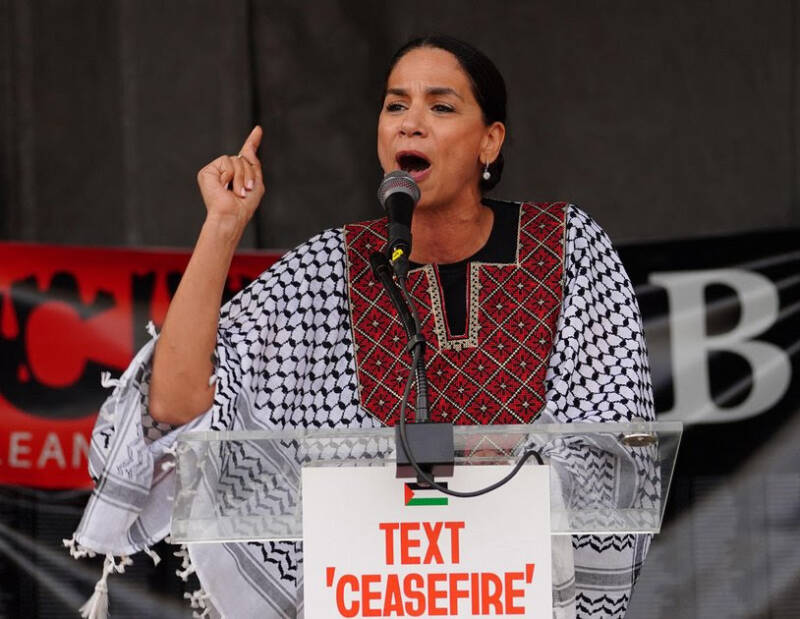
Interview | ‘Zionisme is geen emancipatieproject, maar een genocideproject’
Maandagavond spreekt mensenrechtenadvocaat en hoogleraar Noura Erakat op de Dries van Agt-lezing, naast de voormalig minister van Internationale Samenwerking van Zuid-Afrika, Naledi Pandor. The Rights Forum sprak haar van tevoren.
‘Wat ik wil benadrukken is de bijna genormaliseerde manier waarop Palestijnse sterfgevallen worden geaccepteerd. Dat gebeurt niet zomaar. Racisme, kolonialisme als project, bereidt het publiek voor op deze verwachting [van stervende Palestijnen].'
Nog enkele kaartjes beschikbaar voor de Dries van Agt-lezing 2026!
Er zijn nog enkele kaarten beschikbaar voor de Dries van Agt-lezing in Den Haag aanstaande maandag, waar naast professor Erakat ook dr. Naledi Pandor zal spreken.
Pandor is de voormalig minister van Internationale Betrekkingen van Zuid-Afrika. Onder haar leiding nam Zuid-Afrika het historische besluit om de genocidezaak tegen Israël aan te spannen bij het Internationaal Gerechtshof.
Samen zullen Erakat en Pandor zich buigen over de vraag: hoe kan internationaal recht nog bijdragen aan rechtvaardigheid voor Palestina?
Maandag 2 februari 2026
Deur open 19:00 deuren | Aanvang 19:30
Amare, Spuiplein 150, Den Haag
Na afloop van de bijeenkomst bieden wij u graag een drankje aan.
Raad van onderwerping: oorlogsmisdadigers, miljardairs en zionisten
Het was een glorieus moment voor de Amerikaanse president Donald Trump vorige week tijdens het World Economic Forum in Davos, Zwitserland: de ondertekening van het handvest voor de ‘Raad van Vrede’ (Board of Peace) die Gaza moet gaan heropbouwen en controleren.
In de Gazastrook zelf stierf op de dag van de ceremonie een zuigeling van de kou en werden vier Palestijnen gedood bij een Israëlisch bombardement. Gezinnen verbranden plastic en andere rommel om warm te blijven en te kunnen koken.
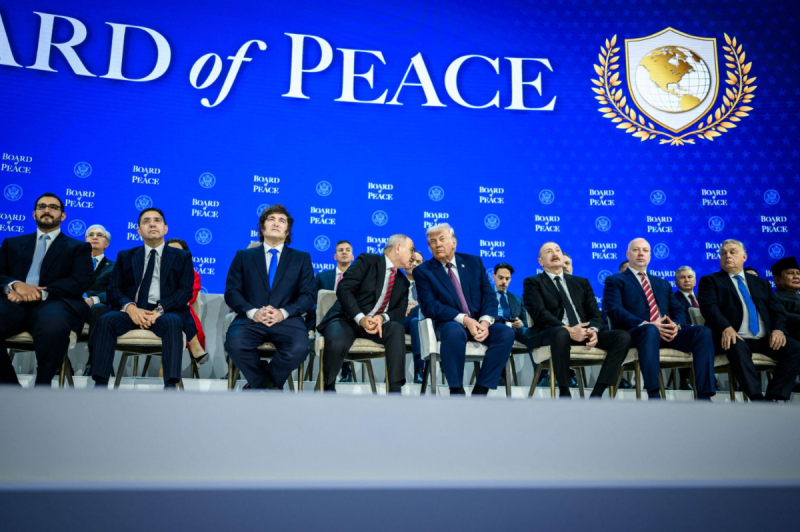
De Amerikaanse president Donald Trump te midden van andere regeringsleiders bij de oprichting van zijn ‘Raad van Vrede’ op het World Economic Forum in Davos op 22 januari. © Witte Huis / Alamy'
Onvervalst kolonialisme'
Dit contrast tussen de meest machtigen op aarde in Davos en de verworpenen in Gaza wordt verder versterkt door de invulling van de raad en het handvest waarop die is gebaseerd. Mensenrechtenadvocaat Noura Erakat, één van de sprekers van de Dries van Agt-lezing van aanstaande maandag, noemde het plan ‘onvervalst kolonialisme zonder enige humanitaire schijn’.
Vóór Palestijnen, zónder Palestijnen
Het essentiële gebrek: Palestijnen worden niet genoemd in het handvest, Palestina wordt niet genoemd, Gaza wordt niet genoemd, het recht op terugkeer voor Palestijnen niet, en het recht op zelfbeschikking niet. Palestijnen waren ook niet betrokken bij de oprichting van de raad en zijn er niet in vertegenwoordigd. Alle macht ligt in handen van president Trump, wiens termijn als voorzitter van de organisatie onbegrensd is.
Kortom: de Raad van Vrede garandeert Palestijnen niets, behalve onderwerping aan een Amerikaanse supermacht.
Hoe kijken de Palestijnen naar de Raad? Wie zijn daar wel in vertegenwoordigd? En wat zijn de plannen van de Amerikanen voor de Gazastrook?

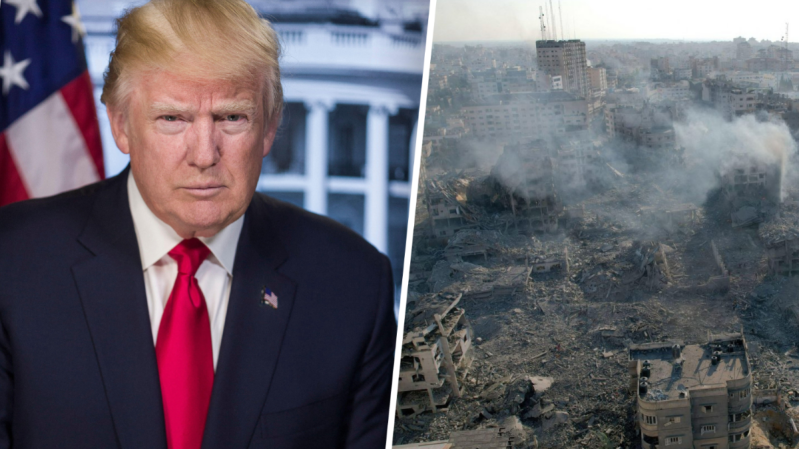
Analyse | Van Gaza naar Venezuela en Groenland: de ontmanteling van de internationale rechtsorde
Het straffeloos terzijde schuiven van het internationaal recht in Gaza maakte de weg vrij voor Trumps acties tegen Venezuela en Groenland, zo betogen deskundigen. ‘Om de wereld te behoeden voor een dystopie, moeten eerst de daders van de Gaza-genocide ter verantwoording worden geroepen.’
Palestina in de Nederlandse politiek
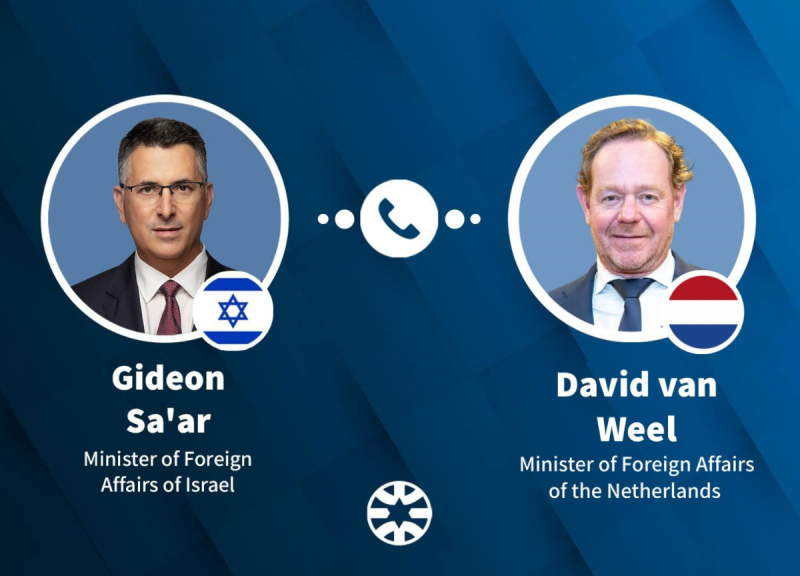
Pro-Israëlisch sentiment domineert Buitenlandse Zaken
Het politiek kleuren van documenten voor ministers in het voordeel van Israël, is iets wat structureel gebeurt op het ministerie van Buitenlandse Zaken. Dat blijkt uit onderzoek van Vrij Nederland.
Buitenlandse Zaken wil evacuatie Gazanen met Nederlands visum niet ondersteunen
Het ministerie vindt dat de omstandigheden in Gaza zijn verbeterd en wil niet helpen bij de evacuatie van 42 Palestijnen met een geldige Nederlandse verblijfsvergunning. Zij kunnen daardoor niet naar Nederland afreizen om aan hun baan of studie te beginnen.
Lichamen vijftien Palestijnen overgedragen, honderden gijzelaars nog vast
In ruil voor het lichaam van de laatste Israëlische gijzelaar die deze week vanuit Gaza naar Israël is overgebracht, heeft Israël de stoffelijke overschotten vrijgegeven van vijftien Palestijnse gegijzelden die in gevangenschap omkwamen. Dat is maar een klein deel van de 776 lichamen van Palestijnse gegijzelden die Israëlische gevangenschap niet hebben overleefd, onder wie 77 kinderen en 10 vrouwen, en die Israël weigert over te dragen aan hun families.
Sommige vermoorde Palestijnen worden al jaren door Israël achtergehouden, dan wel in mortuaria, dan wel in massagraven. Dat is een flagrante schending van het internationaal recht. De Vierde Geneefse Conventie, die burgers in bezet gebied beschermt, bepaalt dat doden met respect behandeld moeten worden, en dat de bezetter geen lichamen mag vasthouden om druk uit te oefenen of te straffen.
Op onze website publiceerden wij een reeks verhalen van Palestijnen die door Israël worden of werden gegijzeld.
Protestmars | Wereldwijde dag van solidariteit met de Palestijnse gijzelaars
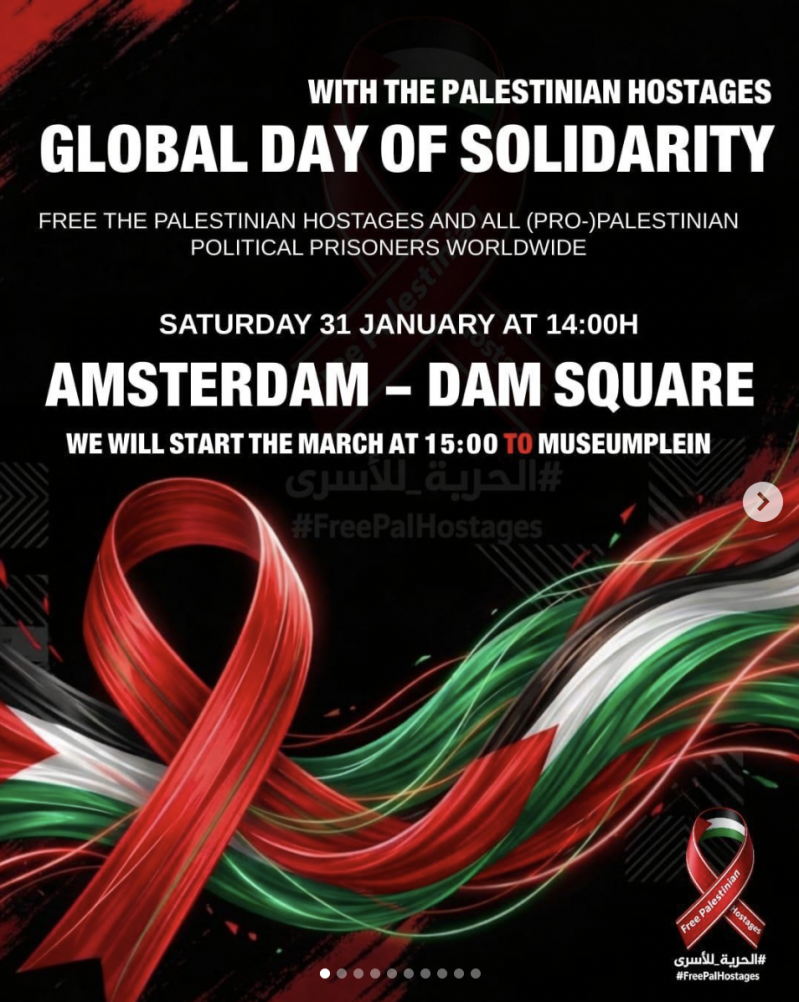
Aanstaande zaterdag 31 januari vindt in Amsterdam een demonstratie plaats voor vrijheid van de Palestijnse gijzelaars en alle (pro-)Palestijnse politieke gevangenen. De demonstratie is onderdeel van een wereldwijde beweging.
Zaterdag 31 januari om 14.00 uur
De Dam, Amsterdam
De mars naar het Museumplein begint om 15.00 uur

Gisteren was het precies twee jaar geleden dat Hind Rajab werd vermoord. Een onschuldig meisje van vijf, gedood door zwaarbewapende bezettingstroepen die toen – en nog altijd – een genocide uitvoeren. Zoals in de afgelopen 28 maanden tienduizenden andere onschuldige kinderen in Gaza zijn vermoord.
Ook de ambulancemedewerkers van de Palestijnse Rode Halve Maan die haar probeerden te redden, werden gedood. Net als duizenden andere zorgverleners en hulpverleners die de afgelopen jaren omkwamen door Israëlisch geweld.
The Rights Forum zal zich blijven inzetten voor rechtvaardigheid voor Hind en alle andere Palestijnen die het slachtoffer zijn geworden van Israëls genocidale campagne. Dat doen we onder meer door in Nederland de aandacht te vestigen op verhalen als die van Hind. Op NPO Start is de documentaire Close Your Eyes Hind te zien, die mede door de The Rights Forum werd gefinancierd.

Dans, muziek en culturele veerkracht in Palestina
Een krachtig project van Musicians Without Borders
In een steeds moeilijker wordende situatie waarin Palestijnse culturele expressie onder druk staat — met beperkingen op protesten, evenementen en zelfs openbare optredens — blijft muziek en dans een vitale manier om identiteit, geschiedenis en veerkracht levend te houden.
Op het Ghirass Cultural Center in Bethlehem leren kinderen via een muziekprogramma dat Musicians Without Borders ondersteunt traditionele instrumenten zoals oud, qanun, viool, percussie en zang. Deze lessen geven hen niet alleen muzikale vaardigheden, maar ook een manier om hun cultuur en persoonlijke verhalen te laten horen.
Op de website Waging Nonviolence is nu een mooie reportage te lezen over het project, met foto's van Kaia Lola.

Uit onze agenda
zaterdag 30 januari t/m zaterdag 7 februari
DEMONSTRATIES EN WAKES
UTRECHT DOORDEWEEKSE DAGEN 08.30 - 09.30 | Dagelijks stilteprotest voor Palestina, tegen genocide en bezetting (Neude, langs het fietspad)
GRONINGEN ZA 31 JAN 13.00 | Tweewekelijkse wake van Vrouwen in het Zwart (Waagplein)
NIJMEGEN ZA 31 JAN 14.00 | Maandelijkse wake uit protest tegen Israëls voortdurende misdaden tegen het Palestijnse volk en haar land (Koningsplein - Marienburg)
AMSTERDAM ZA 31 JAN 14.00 | Protestmars – Global day of solidarity with Palestinian hostages (De Dam)
HAARLEM ZO 1 FEB 14.00 | Wekelijks protest tegen de onderdrukking van de Palestijnen (Grote Markt)
AMSTERDAM ZO 1 FEB 17.00 | Stil protest tegen de onderdrukking van de Palestijnen (Spui, bij ‘t Lieverdje)
UTRECHT ZO 1 FEB 17.00 | Protest – Doorbreek de stilte (Stationsplein)
HUIZEN WO 4 FEB 11.30 | Wekelijkse sit-in voor Gaza (Gemeentehuis)
DEN HAAG DO 5 FEB 12.00 | Sit-in van Rijksambtenaren bij het ministerie van Buitenlandse Zaken, Rijnstraat 8
STATIONS IN NEDERLAND DO 29 JAN 18.00 | Wekelijkse lawaaidemonstratie op stations in heel Nederland: Stations Almelo, Almere Centrum, Amersfoort, Arnhem, Assen, Ede-Wageningen, Enschede, Groningen (mars vanaf Grote Markt 17.30 uur, sit-in station 18.30 uur), Hengelo, Hilversum (17.30 uur), Leiden, Maastricht, Nijmegen, Rotterdam, Tiel, Tilburg, Utrecht, Veenendaal, Zaandam (17.00 uur), Zutphen
Let op: The Rights Forum probeert de verschillende stationsacties in Nederland zo goed mogelijk bij te houden, maar dat is niet altijd goed mogelijk. Houd de sociale media-pagina's van de plaatselijke solidariteitsorganisaties in de gaten voor de meest actuele informatie.
DOETINCHEM VR 6 FEB 10.00 | Lawaaidemo en speech (op het plein voor het gemeentehuis)
AMERSFOORT VR 6 FEB 09.30 | Wekelijks stilteprotest tegen genocide (Varkensmarkt)
AMSTERDAM VR 6 FEB 12.45 | Maandelijkse publieke wake uit protest tegen Israëls voortdurende misdaden tegen de Palestijnen (Spui, bij 't Lieverdje)
MAASTRICHT ZA 7 FEB 16.00 | Maandelijkse publieke wake uit protest tegen Israëls voortdurende misdaden tegen de Palestijnen (Markt, bij het standbeeld van J.P. Minckelers)
CULTURELE EN ANDERE EVENEMENTEN
DOETINCHEM 31 JAN en 1 FEB | Vertoning The Voice of Hind (Amphion Theater)
ALKMAAR ZO 1 FEB 15.00 | Muziek voor Gaza. Een concert op elke eerste zondag van de maand, de opbrengsten gaan naar de kinderen in Gaza. Met deze keer muziek van Jawa Manla - zang en oud. Toegang: € 25 + vrijwillige donatie, reserveren kan door een mail te sturen naar heiligland@protonmail.com. (Heiligland 7)
BUSSUM MA 2 FEB 20.30 | Speciale vertoning The Voice of Hind door Gooi4Gaza in samenwerking met Filmhuis Bussum, incl. nagesprek met projectleider Israël-Palestina van PAX, Thomas van Gool (Filmhuis Bussum, Brediusweg 1)
HAARLEM DI 3 JAN 19.30 | Don’t stop talking about Palestine: een avond in het teken van Palestina, met inspirerende sprekers, muziek en kunst (Patronaat Haarlem)
UTRECHT WO 4 FEB 19.00 | Land van Woorden: Avond over Palestijnse poezie met voordracht in Arabisch, Engels en Nederlands (De Bibliotheek Utrecht, Neude 11)
AMSTERDAM DO 5 FEB 18.30 | Protest as Counterpower: Paneldiscussie en boekpresentatie, met muziek en eten (OCCII, Amstelveenseweg 134)
AMSTERDAM, DRIEBERGEN & ZWOLLE 6 - 8 FEB | Ontmoetingen met Daoud Nassar van Tent of Nations in Bethlehem. Klik op deze link voor meer informatie over alle bijeenkomsten.
Onze agenda wordt doorlopend aangevuld. Bekijk de hele agenda
2051.

30 januari 2026
Eyewitness Palestine x The Olive Guardians: Expanding Our Commitment to Accessibility in 2026
As part of our ongoing commitment to accessibility, Eyewitness Palestine is proud to partner with The Olive Guardians to provide American Sign Language (ASL) interpretation for all of our virtual visits in 2026. This commitment began with our recent Virtual Visit to Wadi Fouqin and will continue throughout the year.
The Olive Guardians is a Palestinian-led international organization based in the US that provides critical accessibility for global Deaf empowerment, providing consultations, advocacy, spoken and signed interpretation services. Proceeds from their services support critical needs on the ground in Palestine, across Gaza and the West Bank, including food and other necessities.
If you joined us for our Deaf Resilience in Gaza webinar featuring Omar Nabil from Deaf Relief Gaza, as well as the first Palestinian Deaf journalist Basem Alhabel, and The Olive Guardians’ founder Ranem Shhadeh, you witnessed firsthand the power of inclusive programming. Uplifting Deaf Palestinian voices and ensuring that members of the Deaf community in North America can access educational events about Palestine is important to our mission of training advocates for Palestine.
Donations raised from our Deaf Resilience in Gaza webinar funded fresh produce for the community in Gaza
We invite you to share this news with your networks so that as many people as possible can benefit.
Thank you, as always, for your continued support and steadfast commitment to Palestinian liberation.
In solidarity,
Eyewitness Palestine
P.S. If you haven't already, head over to our brand new website to learn more about what we're up to and how you can get involved!

2050.
29 januari 2026
Real Cases. Real Courts. Real Consequences.
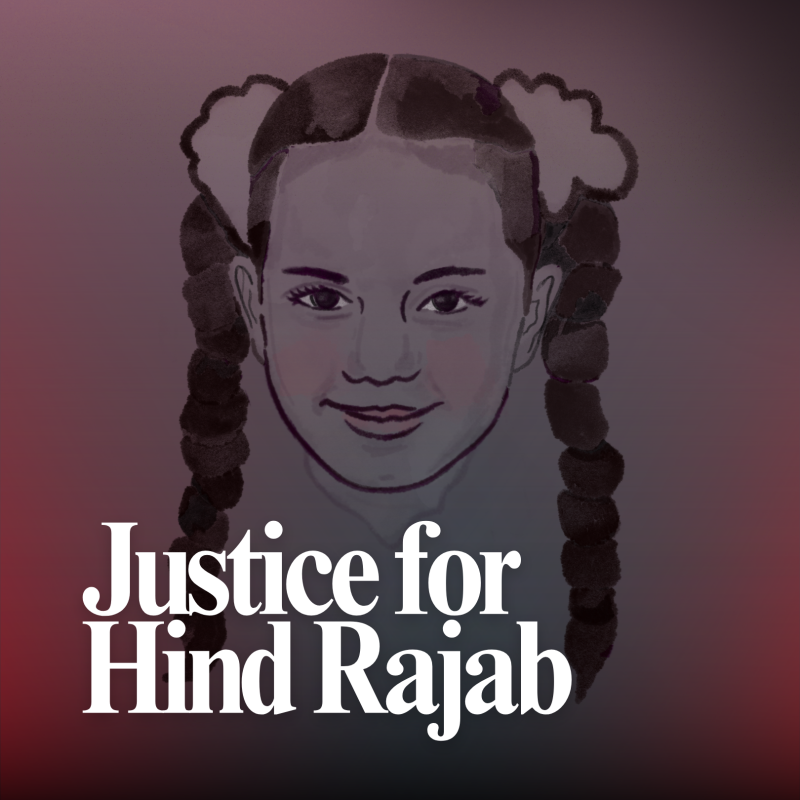
January 29, 2026 marks the second anniversary of the killing of five-year-old Hind Rajab — the child whose name now carries our mission, and whose life remains the light behind our work.
On January 29, 2023, Hind was killed while trying to flee to safety after the car she was traveling in with her relatives was targeted by Israeli tank fire. Everyone in the vehicle was killed except Hind and her 15-year-old cousin, Layan, who called the Palestinian Red Crescent pleading for help. Layan was then killed, leaving Hind alone on the line. Two medics dispatched to rescue Hind were targeted and killed.
The recording of Hind's pleas and the 335 bullets that silenced her shook the world.
The Hind Rajab Foundation has identified the 24 perpetrators involved in the murder of Hind, her relatives, and the medics who tried to save her.
We know their names, ranks, units, and locations, including the heads of the snake:
-
Beni Aharon: Sr. Commanding Officer of the 401st Armored Brigade operating in Gaza City during the attack
-
Daniel Ella: Lt. Colonel and battalion-level commander of the 52nd Battalion, directly under the 401st Brigade at the time of the murders.
-
Sean Glass: Commander of the "Vampire Empire" Company, 52nd Battalion, 401st Armored Brigade, responsible for the unit that committed the murders.
There are 21 additional IDF soldiers and tank crew members from the same unit whose cases are currently active. Their accountability is not optional.
We are closing in on each of them. Case by case.
The day Hind's surviving mother, Wessam, stands in a courtroom and sees her daughter's killers face justice, HRF will be standing beside her — wherever that court is, in whatever country it takes, at whatever cost.
For HRF, today is not only about remembrance and grief. It is about justice and accountability.
Hind is one of the over 20,000 children killed in Gaza. At least 42,000 children have been injured, with over 17,000 children having lost both parents and over 22,000 children having lost one parent.
This is not a conflict.
This is not a war.
This is genocide.
Justice for Hind
Justice for Hind — and for every victim of genocide — is not a slogan.
It is our mission.
2049.

29 januari 2026
In the streets: Notes from the fight against ICE.
This week's Wire is excerpted from JVP Executive Director Stefanie Fox's blog, The Voice Memo:
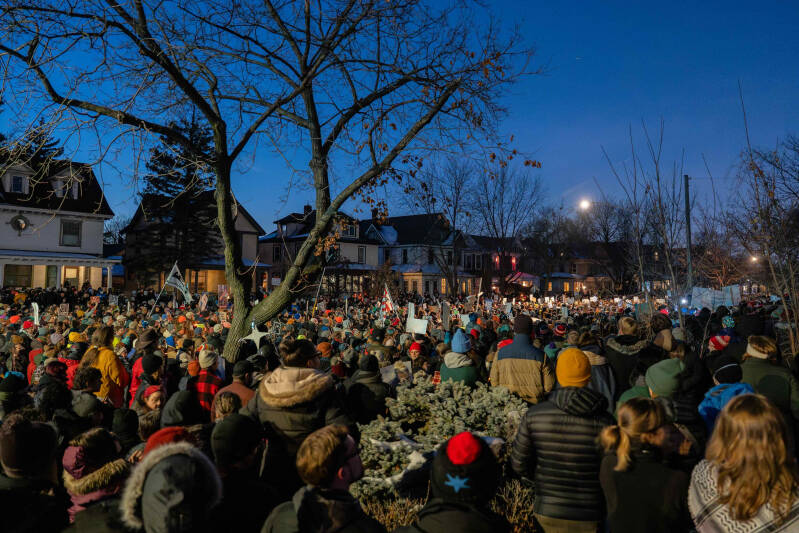
The people of Minneapolis and Saint Paul organized a historic general strike on Friday, the likes of which have been unseen in this country for 80 years. Tens of thousands of Minnesotans protested in minus 20 degree weather, hundreds of businesses shut down, and scores of unions striked, all making the demand: ICE OUT FOR GOOD.
This unprecedented show of force was a culmination of incredibly beautiful and powerful organizing Twin Cities residents have been mounting to defend their city since ICE agents killed local mom Renee Nicole Good and Trump subsequently sent federal forces to lay siege to the city, abducting adults and children all day and night. The day after the general strike, ICE agents executed another Minneapolis resident: 37-year-old nurse Alex Pretti.
Trump’s unprecedented investment in ICE machinery for deportation and detention has made the agency the largest law enforcement entity in the country, with a bigger budget than most of the world’s militaries, and with it, Trump is able to escalate this campaign of terror.
The ICE assault in Minnesota builds on similar invasions of federal forces across the country, including a steady escalation of ICE presence since Trump surged ICE into Los Angeles this past summer. LA community members are being snatched from every corner of the huge and sprawling city. On New Year’s Eve, an off-duty ICE agent murdered local father Keith “Pooter” Porter Jr. outside his home in Los Angeles.
Around the country, JVP members, trained and skilled from Palestine solidarity organizing, are showing up to community defense efforts resisting ICE. Last week, I sat down to talk to some of our local JVP member leaders on the ground in Minneapolis and Los Angeles.
On the ground in Minneapolis
In the weeks since Porter and Good were murdered, the response from thousands of everyday people has been to show up to help resist. Our LA member remarked on the energy of a recent community defense training put on by a coalition the JVP chapter is active in. “I was so moved to be in the room with all these everyday people who just saw someone get murdered for doing this work, and their response is to show up and ask where they can sign up.”
Every neighborhood in Minneapolis, and sometimes each block in the neighborhood, has a communication thread for rapid response. Tens of thousands of people are working together: assessing safety, patrolling for ICE agents, checking license plates, alerting each other, dispatching protective presence where it is needed. There are masses of people that will show up at any hour of the day or night to try to get between ICE and their neighbors.
In addition to rapid response community protection, Minneapolis neighbors have built mutual aid structures to care for one another abundantly. There are systems for delivering food and supplies to neighbors that are unsafe to leave their homes; organizing rides to and from work. During our conversation, one of the JVP-Twin Cities members let out an excited “yes!” when a text came through: A huge pallet of diapers and menstrual pads had just been delivered to one of the community organizations serving as a hub for resource distribution.
Throughout it all, there are easy ways for new people to get trained up and find a role, and for communication among and between all these systems...
Call your Senators: Cut funding for ICE!
In the next few days, the Senate will vote on a bill that continues funding immigration enforcement and detention, including violent ICE and Border Patrol operations across the country.
Use these tools from our sister organization JVP Action and our partners at Detention Watch Network to call and email your Senators now and demand they vote NO on this funding.
Defend student protestors standing up for Palestine.

As the federal government escalates its war on our neighborhoods, nationwide repression of those brave enough to stand up to this violence is also accelerating. At Stanford University, 11 students are facing felony charges at trial after being arrested in a non-violent sit-in demanding divestment from Israeli genocide. At UCLA, more than a dozen students still face disciplinary charges for their divestment advocacy.
Email now to demand that all charges are dropped and these universities stop advancing the U.S. government's repressive agenda and persecuting their own students.
Drawing connections: Fighting fascism from Minneapolis to Palestine.
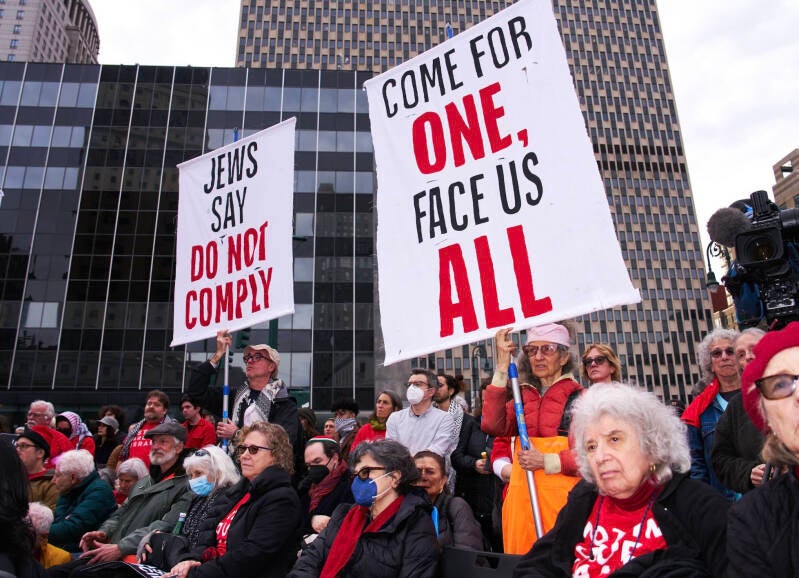
For +972, Amahl Bishara writes that to understand and fight fascism, we must "insist on drawing connections across time and place — from the Holocaust to Gaza, or ICE detention to Israeli prisons."
2048.

29 januari 2026
Real Cases. Real Courts. Real Consequences.
January 29, 2026 marks the second anniversary of the killing of five-year-old Hind Rajab — the child whose name now carries our mission, and whose life remains the light behind our work.
On January 29, 2023, Hind was killed while trying to flee to safety after the car she was traveling in with her relatives was targeted by Israeli tank fire. Everyone in the vehicle was killed except Hind and her 15-year-old cousin, Layan, who called the Palestinian Red Crescent pleading for help. Layan was then killed, leaving Hind alone on the line. Two medics dispatched to rescue Hind were targeted and killed.
The recording of Hind’s pleas and the 335 bullets that silenced her shook the world.
The Hind Rajab Foundation has identified the 24 perpetrators involved in the murder of Hind, her relatives, and the medics who tried to save her.
We know their names, ranks, units, and locations, including the heads of the snake:
-
Beni Aharon: Sr. Commanding Officer of the 401st Armored Brigade operating in Gaza City during the attack
-
Daniel Ella: Lt. Colonel and battalion-level commander of the 52nd Battalion, directly under the 401st Brigade at the time of the murders.
-
Sean Glass: Commander of the “Vampire Empire” Company, 52nd Battalion, 401st Armored Brigade, responsible for the unit that committed the murders.
There are 21 additional IDF soldiers and tank crew members from the same unit whose cases are currently active. Their accountability is not optional.
We are closing in on each of them. Case by case.
The day Hind’s surviving mother, Wessam, stands in a courtroom and sees her daughter’s killers face justice, HRF will be standing beside her — wherever that court is, in whatever country it takes, at whatever cost.
For HRF, today is not only about remembrance and grief. It is about justice and accountability.
Hind is one of the over 20,000 children killed in Gaza. At least 42,000 children have been injured, with over 17,000 children having lost both parents and over 22,000 children having lost one parent.
This is not a conflict.
This is not a war.
This is genocide.
Justice for Hind
Justice for Hind — and for every victim of genocide — is not a slogan.
It is our mission.
2047.

29 januari 2026
Waar pensioenfonds ABP eerder de goede kant op leek te bewegen door te desinvesteren in een aantal bedrijven die profiteren van de onderdrukking van Palestijnen, blijkt vorige week juist een bizarre investering in Palantir. Ook bij het ministerie van Buitenlandse Zaken gaat het flink mis. Lees er alles over in deze nieuwsbrief.
Volgens een uitgebreid onderzoeksartikel van Follow the Money (FTM) investeert het Nederlandse pensioenfonds ABP honderden miljoenen euro’s in het Amerikaanse techbedrijf Palantir, een onderneming die al jaren in verband wordt gebracht met mensenrechtenschendingen.
Palantir ontwikkelt software en AI-systemen die worden ingezet door krijgsmachten en veiligheidsdiensten. In januari 2024 kondigde het bedrijf een strategische samenwerking aan met het Israëlische leger (IDF) ter ondersteuning van diens genocide.
Mensenrechtenorganisaties en de VN-rapporteur voor de Palestijnse gebieden stellen dat Palantir-technologie bijdraagt aan grootschalige surveillance van Palestijnen in Gaza en op de Westelijke Jordaanoever en mogelijk wordt gebruikt voor doelwitselectie voor bombardementen tijdens de genocide. Andere institutionele beleggers, waaronder Storebrand en CANDRIAM, hebben Palantir daarom uitgesloten van hun beleggingsportefeuilles.
Desondanks bouwde ABP zijn belang in Palantir in 2025 op tot circa 825 miljoen euro. Dat is opmerkelijk, omdat ABP zegt te beleggen volgens de OESO-richtlijnen en de VN-principes voor mensenrechten, die juist extra zorgvuldigheid vereisen bij investeringen in conflictgebieden en bij risicovolle AI-toepassingen. ABP heeft echter geen transparantie gegeven over risicoanalyses of gesprekken met Palantir.
Deskundigen stellen dat investeren zonder aantoonbare risicobeperking en openheid niet in lijn is met deze richtlijnen en ABP medeverantwoordelijk kan maken voor mensenrechtenschendingen.
Op maandag 2 februari brengt The Rights Forum twee van de meest invloedrijke stemmen samen in de wereldwijde strijd voor gerechtigheid voor Palestina:
- Dr. Naledi Pandor, voormalig minister van Internationale Betrekkingen van Zuid-Afrika. Onder haar leiding nam Zuid-Afrika het historische besluit om de genocidezaak tegen Israël aan te spannen bij het Internationaal Gerechtshof.
- Prof. Noura Erakat, mensenrechtenjurist en universitair docent aan Rutgers University, en auteur van Justice for Some: Law and the Question of Palestine. Zij laat zien hoe het internationaal recht niet neutraal is, maar een terrein van politieke strijd.
Onder leiding van Nadia Bouras gaan ze in gesprek over één urgente vraag: kan het recht nog recht doen aan Palestina?
Koop nu je kaartjes voor de Dries van Agt-lezing 2026 in Amare (Den Haag) op de website van The Rights Forum.
Uit onderzoek van Vrij Nederland blijkt dat ambtenaren van het ministerie van Buitenlandse Zaken doelbewust informatie over Palestijnse burgerslachtoffers hebben verwijderd uit interne documenten die bedoeld waren om premier Schoof te informeren. Dit gebeurde onder meer bij de voorbereiding van een telefoongesprek in het najaar van 2024 tussen de premier en de leider van een Arabisch land.
Diplomaten in het veld namen feitelijke cijfers op over slachtoffers: zes dode Israëlische gijzelaars, circa 40.000 Palestijnse doden en ongeveer 2.000 Libanese burgerslachtoffers. De cijfers over Palestijnse en Libanese doden werden echter door de afdeling Midden-Oosten Vredesproces in Den Haag herhaaldelijk geschrapt, terwijl de Israëlische slachtoffers wel prominent bleven staan.
Volgens meerdere betrokken ambtenaren is dit geen incident, maar een structureel patroon. Ook in andere adviesdocumenten, zoals na een zogenaamde staakt-het-vuren in Gaza, verdwenen cijfers over Palestijnse slachtoffers uit de definitieve versies. Ingewijden stellen dat documenten die vanuit het veld feitelijk en volledig worden opgesteld, in Den Haag een politieke kleuring krijgen, met als gevolg dat bewindspersonen onvolledig worden geïnformeerd.
Daarnaast beschrijft het artikel een angstcultuur binnen BZ. Ambtenaren en diplomaten die zich kritisch uitlaten over Israëlisch optreden worden gewaarschuwd dat dit hun carrière kan schaden, terwijl uitingen die als pro-Israëlisch worden gezien minder risico lijken te dragen.
Dit komt scherp naar voren in de aanstelling van Marit de Roij als toekomstige landenmedewerker Israël. De Roij verdedigde jarenlang publiekelijk het Israëlische geweld op X, maar haar uitgesproken standpunten vormden geen belemmering voor deze sleutelpositie in de informatievoorziening over Israël en Palestina.
Binnen het ministerie heerst het gevoel dat er met twee maten wordt gemeten. Een diplomaat met sterke banden met de Palestijnse gemeenschap werd geadviseerd niet te solliciteren op de functie landenmedewerker Palestijnse Gebieden wegens "te veel persoonlijke betrokkenheid", terwijl De Roij's pro-Israëlische opvattingen haar promotie niet in de weg stonden.
Deze onthulling wringt met het beeld van een ministerie dat zegt te staan voor het internationaal recht en zorgvuldige diplomatie, terwijl feiten over Palestijnse slachtoffers systematisch worden verzwegen.
2046.


29 januari 2026
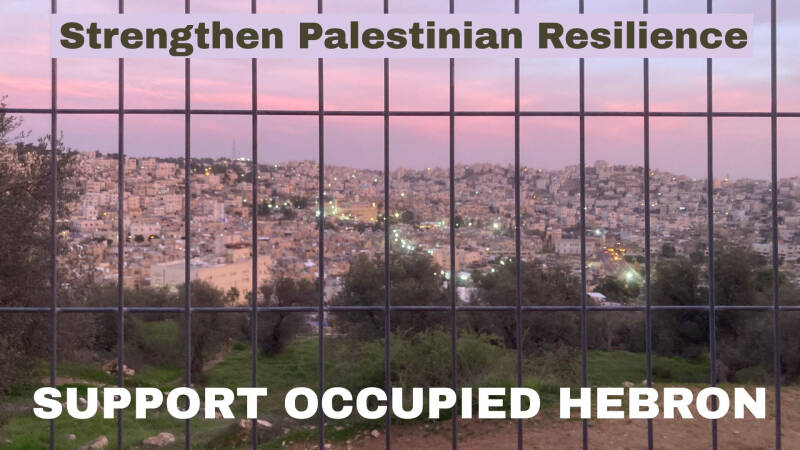
We are just coming out of an invasion of a Palestinian neighborhood in Hebron. Israeli soldiers closed down a quarter of the city in order to raid and occupy the Palestinian neighborhood of Jamal Johar in a multi-day operation, terrorizing the population there.
This year is shaping up to be incredibly difficult for Palestinians on the ground, particularly with the Israeli elections coming up. We are bringing you an update of the current situation as well giving you updates on how you can support Palestinian resilience going forward. It is more important than ever to strengthen the work on the ground so that our Palestinian team can continue to support the families in the city.
Soldiers Invading Jabal Johar
The city of Hebron is divided into two parts, H1 and H2. The former is under the primary control of the Palestinian authorities, whereas H2 is under the control of the Israeli military. Palestinians in H2 live under heavy restrictions, military governing, and the presence of ideologically extreme Israeli settlers. However, the neighborhood of Jabal Johar lies in H1, which signifies that the Israeli invasion and multi-day occupation
"They are acting like Mafia, not like soldiers." says Muhanned, a journalist with Youth Against Settlements. "They are raiding every home and smashing cars."
Soldiers finally retreated, leaving Palestinians to try to account for the damage to property in wake of the occupation.
Starting Strong
We have started out the year strong and already running multiple projects, continuing our work from last year with the next and exciting projects, campaigns and advocacy promoting Palestinian human rights.
Ahmad Film House
In December, we opened a community cinema in Hebron that is now in full swing. This month, we invited people for a screening of Soldier on the Roof, a documentary by Dutch-Israeli film maker Esther Hertog. In Soldier on the Roof, she documented the lives of Israeli settlers in Hebron, exposing the cultures of radicalism and impunity in the subjugation of the Palestinian population.
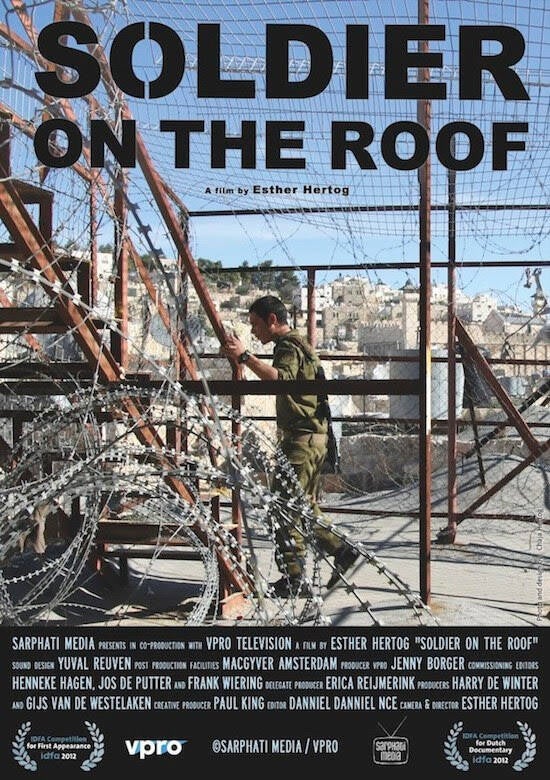
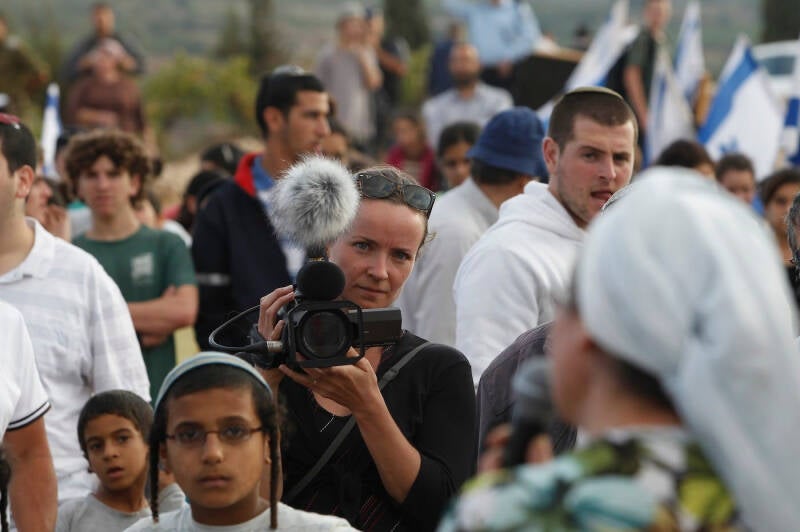
Ahmad Film House is a community space for Palestinians and internationals in coming together and screening educational material like documentaries, as well as movies and short film to keep up the spirit of local residents. Creating community spaces protects the social life in the area, combatting the Israeli occupation's policy of population transfer. Help support our community cinema now!
Advocacy and Tours
This month of January, we have been welcoming delegations to our community center in Hebron, often several times per day.
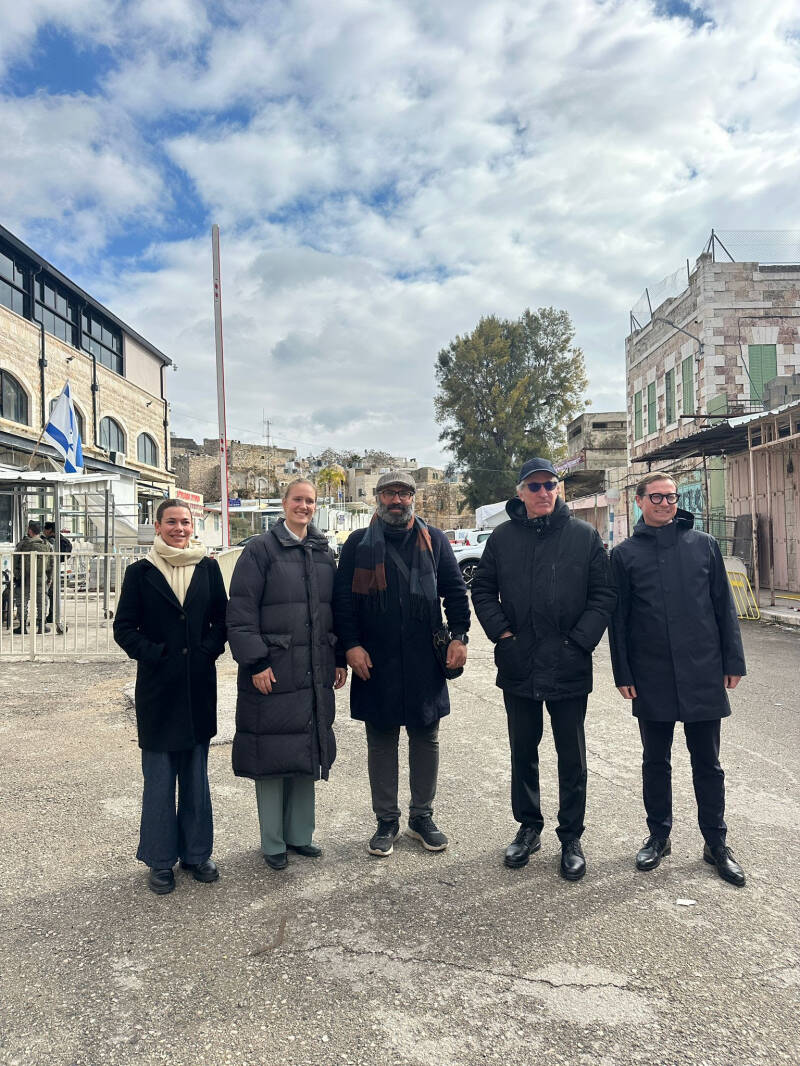
We gave a tour of Hebron to the European Union Special Envoy to show them the recent advancements in illegal settlement expansion and militarization and the impact on the Palestinian community and human rights defenders.
We also met with the Canadian Consul and presented him with a Palestinian ceramic plaque that contains a line from a poem by the Palestinian national poet, Mahmoud Darwish: On this land is what makes life worth living to remind the diplomats of the Palestinian connection to the land and the desire to be treated as a nation.
We have been hosting numerous delegations at our community center in Hebron, including delegations from the Al Sabeel organization.
We are planning a set of new projects in addition to continuing our other work. In particular, we want to open a women's gym for Palestinian women living in the restricted area of Hebron who have limited access to the outside. Confined to the home, often unable to leave the area at all due to closed checkpoints, many women do not get the opportunity to exercise at all.
✓ Open a women's gym
✓ Protect and restore Palestinian homes
✓ Support a Kindergarten
✓ Research and Countersurveillance
✓ Summer Internship Program
We also want to restore Palestinian houses for rehabilitation and help protect Palestinian homes by installing fences, secure windows and gates, cameras and alarm systems to ward off Israeli settler attacks. Furthermore, with the establishment of Ahmad Film House, we are planning to start a Film Making initiative to support Palestinian living in the area — including women, youth and children — to create their own films and tell their stories, whether in the form of documentaries or fictional narratives. We need funds for camera equipment and trainings, and to run professional filmmaking making workshops covering script writing, cinematography and video editing.
We are also supporting a local kindergarten in Tel Rumeida to help vulnerable parents and children persevere through the toll of living under occupation. Furthermore, we are running our Eyes on Hebron project that consists of using CCTV cameras as a tool of resistance and protection, as well as funding research to better understand the Israeli military's use of artificial intelligence and surveillance in Hebron. We will also soon be announcing our summer internship volunteer program in Hebron — So please stay tuned for updates!
2045.

28 januari 2026
Humanitarian Situation Update #355
Gaza Strip
28 January 2026

Palestinian children gather in Jabaliya for recreation and learning activities. Photo by OCHA
Key Highlights
- Attacks, shelling, and shooting continue across Gaza, raising serious concerns over the continued killing of civilians, according to the UN Human Rights Office.
- Over 100,000 tents have entered Gaza through UN coordination and bilateral donations since October, but tents are not a durable solution: winter storms and material restrictions have left hundreds of thousands exposed to winter-related risks. Eleven children have reportedly died from hypothermia.
- Food and cash assistance reached hundreds of thousands of households in January, while fragile markets, low purchasing power, and prevalent malnutrition continue to drive extreme risks for children.
- Health services have expanded with more functional health points and the first open-heart surgeries since 2023, yet a surge in communicable diseases driven by winter, poor shelter, and unsafe water continues to strain Gaza’s fragile health system.
- As 60 per cent of school-aged children in Gaza remain without access to in-person learning, UNICEF and education partners are scaling up temporary learning spaces and delivering the first recreational and school kits allowed into Gaza in over two years to support children’s learning and wellbeing.
Context Overview
- Airstrikes, shelling and gunfire continue to be reported across the Gaza Strip, resulting in casualties. The Israeli military remains deployed in over 50 per cent of the Gaza Strip beyond the “Yellow Line” where access to humanitarian facilities and assets, public infrastructure, and agricultural land is either restricted or prohibited. Access for Palestinians to the sea remains prohibited. Detonations of residential buildings and bulldozing activities continue to be reported, including near or east of the “Yellow Line.” According to the latest Protection monitoring report, people described recurrent incidents, including movement restrictions and displacement pressures, linked to the unclear and unstable demarcation of the “Yellow Line.” According to the UN Human Rights Office (OHCHR), repeated Israeli military operations into areas west of the redeployment (Yellow) line have also led to the displacement of civilians and the demolition of residential buildings.
- According to the Ministry of Health (MoH) in Gaza, between 14 and 28 January 2026, 43 Palestinians were killed, 110 were injured and five bodies were recovered from under the rubble. This brings the casualty toll among Palestinians since 7 October 2023, as reported by the MoH, to 71,667 fatalities and 171,343 injuries. According to the MoH, the total number includes 180 fatalities who were retroactively added between 2 and 23 January after their identification details were approved by a ministerial committee. The MoH reported that since the ceasefire, 492 Palestinians have been killed, 1,356 injured, and 715 bodies retrieved from under the rubble.
- On 23 January, OHCHR in the Occupied Palestinian Territory (OPT) stated that it documented trends since the ceasefire came into effect on 11 October 2025 that “include the continued killing of civilians in Israeli aerial attacks, shelling, and gunfire across all five governorates of Gaza, including incidents both far from and in the vicinity of the ‘Yellow Line’.” Between 11 October 2025 and 21 January 2026, OHCHR recorded at least 216 Palestinians killed, including 46 children and 28 women, in Israeli attacks far from the "Yellow Line," primarily affecting shelters for internally displaced persons (IDPs) and residential buildings, and at least 167 Palestinians reportedly killed in the vicinity of the “Yellow Line,” including 26 children and 17 women. During the same period, OHCHR recorded at least 80 reported killings of Palestinians by Hamas since the ceasefire, mostly in clashes with rival families and in summary executions. On 21 January, according to OHCHR, at least 11 Palestinians were killed in a series of attacks, including an Israeli strike on a car near Netzarim area that reportedly killed three journalists. According to the Palestinian Journalists Syndicate (PJS), this brings the total number of journalists killed in Gaza to 258.
- According to the Israeli military, between 14 and 28 January 2026, as of noon, one Israeli soldier died of wounds sustained on 19 October 2025 in the Gaza Strip. The casualty toll among Israeli soldiers since the beginning of the Israeli ground operation in October 2023 stands at 471 fatalities and 2,995 injuries. According to Israeli forces and official Israeli sources cited in the media, more than 1,671 Israelis and foreign nationals have been killed, the majority on 7 October 2023 and its immediate aftermath. On 26 January, official Israeli sources reported that the body of the last Israeli hostage in Gaza was recovered and returned to Israel.
- With 81 per cent of structures in Gaza damaged as of 11 October, hundreds of thousands of Palestinians remain displaced while housing, land and property rights remain severely compromised by widespread documentation loss and legal barriers. According to the Palestinian Housing Council’s assessment conducted between May and July 2025, up to 83 per cent of women and 72 per cent of men in Khan Younis and Rafah reported losing ownership documents, with around 70 per cent affected in Gaza city. Between 48 and 80 per cent of women across governorates face discrimination in claiming or retaining property due to inheritance laws and social norms, while 57 to 87 per cent reported unresolved inheritance disputes. To address tenure insecurity, prevent evictions and enable equitable recovery, particularly for female-headed and displaced households, the Housing, Land and Property Technical Working Group (HLP TWG) continues to support documentation retrieval, legal aid, and gender-responsive interventions.
- According to the UN 2720 Mechanism, between 1 and 26 January, about 37,000 metric tons (MT) of humanitarian aid were collected by the UN and its partners from Gaza’s crossings, compared with more than 62,300 MT of aid collected in December. Most of the aid (75 per cent) continued to be collected from the Kerem Shalom Crossing. Humanitarian movements inside Gaza continue to require coordination with Israeli authorities to and from crossings and in or near other areas where Israeli forces remain deployed. Between 13 and 26 January, 95 humanitarian missions were coordinated with the Israeli authorities, of which 60 were successfully facilitated, 10 were impeded, 13 were denied and 12 were cancelled by the requesting organizations due to operational, logistical or security reasons.
- According to the Education Cluster, as of 28 January, 4,400 recreational kits and 240 school-in-a-carton kits have entered Gaza for use by both Education and Child Protection partners, marking a significant step in supporting children after more than two years of restrictions on the entry of educational materials. These kits, containing learning and play materials such as pencils, exercise books, slates and teaching aids, are intended to support children’s learning and wellbeing amid widespread destruction of school infrastructure and limited access to formal education. Sixty per cent of school-aged children currently lack access to some form of in-person learning, and over 335,000 children under five face severe developmental delays as early childhood services have collapsed. Education partners continue to expand the number of temporary learning spaces to reach more children, though demand is overwhelming and waiting lists are long.
Winter and Displacement
- For the third consecutive year, Gaza’s population is facing winter amid widespread displacement, substandard shelter conditions, and overcrowded displacement sites. According to the MoH in Gaza, as of 27 January, 11 children (seven boys and four girls) have died due to hypothermia. On 22 January, the Palestinian Civil Defence (PCD) warned that harsh weather conditions could lead to a further collapse of damaged buildings.
- According to the Site Management Cluster (SMC), more than 100 displacement sites have been established since the ceasefire, including 55 sites in North Gaza to accommodate people who have returned to the area. As of 26 January, some 1.3 million people are estimated to be living at 970 displacement sites across Gaza, including 598 makeshift sites and 76 collective centres, compared with 862 sites prior to the October ceasefire. Seventy-two per cent (674 sites) are in Deir al Balah and Khan Younis and the rest in northern Gaza. Since the first winter storm in November, harsh weather conditions have damaged several displacement sites, some of which have been destroyed and subsequently reconstructed, while additional sites have emerged in response to winter-related population movements and increased movements to northern Gaza.
- Due to increasing needs and limited capacity, 381 of 970 displacement sites in Gaza (40 per cent) receive site management support. Site management ensures that sites are safe, meet minimum standards, and that people have access to assistance. Displacement sites with active site management enable coordinated service delivery, clear communication with IDPs, and systematic identification of protection, health, and water, sanitation and hygiene (WASH) risks. Most sites with active site management are at full capacity and cannot accommodate newly displaced families. Of the total, the United Nations Relief and Works Agency for Palestine Refugees in the Near East (UNRWA) manages 85 displacement sites, including UNRWA schools and installations converted into emergency shelters, that are hosting more than 75,000 people and serving over one million people in the surrounding areas.
- According to the Shelter Cluster, more than 100,000 tents have entered Gaza since October, through bilateral donations and UN coordination, benefiting over 560,000 people. However, winter conditions are accelerating the deterioration of tents, increasing replacement needs and reinforcing reliance on repeated tent distributions. Since the beginning of 2026, due to limited stocks of tents and tarpaulins, Shelter partners are reaching about 20,000 households per week, primarily with non-food items, including clothing, kitchen kits and mattresses. The Shelter Cluster reiterates the urgent need to accelerate durable transitional shelter solutions that limit dependency on tents and help address the enormous needs in Gaza.
Market Access, Cash Assistance, and Child Nutrition
- Since the ceasefire of 10 October 2025, market conditions across the Gaza Strip have continued to improve gradually, supported by increased entry of goods and the resumption of commercial activity. By December, open markets were functioning in most governorates, with improved availability of fresh produce, dry food items and basic hygiene supplies, although access remained uneven, particularly in North Gaza and the thinly populated Rafah governorate. Prices continued to decline for a fifth consecutive month, with many essential food and non-food items falling below levels observed during the January-February 2025 ceasefire (including most vegetables, hygiene items and clothing), and for some commodities, such as vegetable oil and flour, below pre-October 2023 escalation levels.
- Between 1 and 25 January, Food Security Sector (FSS) partners reached about 1.2 million people through household-level general food assistance delivered via 52 distribution points across the Strip, with each family receiving a full ration consisting of wheat flour and food boxes. According to UNICEF, limited access to markets has led some households to maintain small-scale home gardens near shelters as a coping mechanism to supplement food consumption, including growing vegetables such as eggplant, potatoes and herbs. UNICEF underscores the importance of diversified food sources alongside sustained food and nutrition assistance. As market activity gradually resumes, FSS partners plan to further expand cash and voucher assistance to support local food systems and contribute to economic recovery.
- Despite gains, market structures and household purchasing power remain fragile. According to UNICEF’s Gaza humanitarian cash transfer monthly bulletin covering December 2025, more than half of vendors continue to operate from informal or temporary stalls, and supply gaps persist for animal products, fuel, basic medicines and chronic disease treatments. Marked geographic disparities are evident: Deir al Balah has seen a significant shift towards more stable retail infrastructure, with 70 per cent of vendors operating from permanent shops (up from 54 per cent in November), followed by Gaza city at 55 per cent (up from 44 per cent in November). Khan Younis remains dominated by informal, tent-based vending (82 per cent), and North Gaza continues to rely heavily on temporary market arrangements, with moving street vendors accounting for 40 per cent of vendor activity. At the household level, financial access remains a key constraint; according to the World Food Programme (WFP), after peaking at an unprecedented NIS 11,984 (US$3,594) in July, the Minimum Expenditure Basket (MEB) cost stabilized at NIS 1,989 ($623) in November, but was still 16 per cent above the pre-October 2023 baseline of NIS 1,717 ($431), reflecting ongoing affordability challenges in meeting basic needs.
- According to the Cash Working Group, humanitarian partners significantly scaled up multi-purpose cash assistance (MPCA) following the October 2025 ceasefire, delivering 330,000 MPCA payments between 10 October 2025 and 25 January 2026, an average of 85,000 payments per month, compared with 41,900 per month during the first nine months of 2025. MPCA was delivered primarily through digital modalities, with a transfer value of NIS 1,250 NIS ($391) per payment, supporting market-based responses as digital transfers became the predominant delivery mechanism. However, UNICEF reports that only 27 per cent of families receiving cash assistance list work-related income as a main source of support, underscoring continued reliance on humanitarian assistance and the need for predictable, sustained cash support alongside measures to support livelihood recovery.
- Cash assistance has contributed to improved food consumption and modest gains in dietary diversity. While children’s diets remain dominated by staple foods such as bread, rice and potatoes, with minimal consumption of fruits, vegetables, vitamin A–rich foods and animal-source proteins, UNICEF reports that, in December 2025, households receiving multiple cash transfers were able to diversify children’s diets more than those receiving a single transfer. Still, based on post-distribution monitoring, they found that nearly 97 per cent of children between 6 and 23 months remain below the Minimum Dietary Diversity (MDD) threshold, indicating continued vulnerability to micronutrient deficiencies. According to WHO and UNICEF, MDD entails the consumption of at least five out of eight defined food groups for children aged 6-23 months.
- Nutrition Cluster screening data from the first three months of the ceasefire (October-December 2025) indicate that approximately 317,000 children were screened for acute malnutrition, with nearly 22,400 enrolled in treatment, including 4,515 cases of severe acute malnutrition. Admissions show a decline, with almost 50 per cent fewer cases in December compared with September just before the ceasefire. No child deaths from acute malnutrition have been reported since early October 2025. Overall, in 2025, 94,000 children aged 6-59 months were admitted for the treatment of acute malnutrition, compared with fewer than 40,000 admissions in 2024.
- With more than 100,000 children under five in Gaza projected to face acute malnutrition and require long-term care in 2026, since the ceasefire, UNICEF has supported the establishment of 72 new nutrition facilities, bringing the total to 196 across the Strip. Yet, the nutrition response faces significant operational risks: 11 Nutrition Cluster partners at risk of deregistration conducted approximately 25 per cent of malnutrition screenings in 2025 and provided a large share of treatment for severe malnutrition, as well as support for stabilization centres, blanket feeding, and infant formula. According to the Nutrition Cluster, any suspension of their operations could affect children relying on these services, while poor living conditions and winter-related illnesses further heighten malnutrition risks and threaten recent improvements.
Access to Health Care
- The second round of a routine immunization catch-up campaign in Gaza, led by UNICEF, UNRWA, WHO and the Palestine Red Crescent Society (PRCS) and partners in collaboration with the MoH, was launched on 18 January. Running until 29 January, the campaign targets children under three to strengthen protection against vaccine-preventable diseases following two years of hostilities and disrupted health services. According to WHO and UNICEF, vaccinations are being delivered by 170 teams at 129 health facilities, with seven mobile teams reaching hard-to-reach areas. As of 27 January, based on preliminary results, about 13,000 children had been vaccinated out of around 18,000 targeted. The first round in November 2025 reached over 14,000 children, and a third round is planned for April 2026 to complete the full schedule and reach a total of 44,000 children.
- Since the ceasefire, Health Cluster partners have supported the establishment or restoration of services at 16 health service points, of which 13 are in Gaza city, including Al Rantisi Hospital that had been out of service since September 2025. Médecins Sans Frontières (MSF) reported that, following debris clearance and rehabilitation of the emergency department at Al Rantisi, in coordination with the MoH, the facility is now treating more than 300 children daily, while another new MSF-supported clinic in Az Zaytoun receives nearly 300 patients per day, many requiring wound care and follow-up amid inadequate shelter conditions that increase the risk of infection. Notwithstanding these efforts, the health system remains severely constrained, with 60 per cent of health service points still non-functional, compared with 65 per cent prior to the October 2025 ceasefire.
- Humanitarian partners have also enhanced bed and service capacity at functional health facilities. PRCS, with support from the International Committee of the Red Cross (ICRC), upgraded the Emergency Department at Al Amal Hospital in Khan Younis, adding beds, expanding capacity, and establishing a new triage area. At PRCS-operated Al Quds Hospital, pacemaker implantation resumed, alongside cardiac and peripheral catheterization services that restarted in late August 2025. On 23 January, the MoH announced three successful open-heart surgeries at Al Quds Hospital – the first since late 2023, following their suspension across Gaza due to the destruction of cardiac surgery facilities at Al Shifa and European Gaza hospitals, damage to critical equipment at Al Quds, and prolonged shortages of essential medications. With about 45,000 patients in Gaza previously estimated to suffer from cardiovascular diseases, surgeries are now performed daily. However, only one cardiac surgery room is operational and equipment shortages continue to limit advanced procedures, leaving hundreds of patients still in need of cardiac operations, with cases prioritized based on urgency. In parallel, specialized medical imaging services have been partially restored with the reactivation of colour imaging at Ad Daraj Health Center in Gaza city, supporting diagnosis and treatment follow-up, though major gaps persist with no functional MRI machines and only six CT scanners available across the Strip.
- As of 28 January, approximately 31 emergency medical teams (EMTs) are deployed in Gaza, including 98 international and 270 national staff, delivering medical consultations and emergency surgeries, alongside trauma and non-communicable disease care. WHO has coordinated EMTs since December 2023 to provide surge capacity amid hostilities, staff shortages and severe supply constraints, including by supporting internal patient transfers, response to mass casualty incidents and medical evacuations outside Gaza.
- Notwithstanding ongoing efforts to revitalize Gaza’s health system, communicable disease burdens continue to strain the system. Between 4 and 17 January, health partners carried out nearly 497,000 consultations, with over 25 per cent related to communicable diseases, including more than 88,600 acute respiratory infection (ARI) cases (or over 70 per cent of all communicable disease consultations) and about 11,000 acute watery diarrhoea (AWD) cases, of which 80 per cent were children. This represents a sharp increase from 44,000 ARI cases and 9,500 AWD cases in the preceding two weeks. According to the International Rescue Committee (IRC), recurrent “exposure to cold, damp environments sharply increases the risk of respiratory infections and water-borne diseases, while the lack of adequate shelter leaves families with no protection from further storms.”
- On 26 January, WHO facilitated the medical evacuation of 24 children from Gaza to Jordan along with 36 companions. In another recent medical evacuation on 19 January, WHO facilitated the transfer of 21 patients and 36 companions from Gaza to Jordan. WHO also welcomed the recent approval for one patient to travel from Gaza to the West Bank for treatment – the first since October 2023, underscoring the need to re-open this route, including East Jerusalem, as the most time- and cost-effective way to access specialized care. Since the October 2025 ceasefire, and as of 26 January, WHO facilitated the medical evacuation of 377 patients (including 310 children) and 1,032 companions. These are among more than 10,700 patients evacuated for specialized treatment since October 2023, yet over 18,500 people, including 4,000 children, still urgently require medical evacuation for care not available in Gaza. On 27 January, the MoH in Gaza said that 1,268 patients had reportedly died while waiting to leave Gaza for urgent medical care, and approximately 4,000 cancer patients are registered on critical waiting lists for evacuation.
Funding
- As of 26 January, Member States disbursed approximately $211 million out of the $4 billion (5 per cent) requested to meet the most critical humanitarian needs of nearly 3 million out of 3.6 million people identified as requiring assistance in Gaza and the West Bank, including East Jerusalem, under the 2026 Flash Appeal for the OPT. Nearly 92 per cent of those required funds are for the humanitarian response in Gaza, with just over eight per cent for the West Bank. In December, the oPt Humanitarian Fund managed 111 ongoing projects, totalling $61.1 million, to address urgent needs in the Gaza Strip (89 per cent) and the West Bank (11 per cent). Of these projects, 54 are being implemented by international non-governmental organizations (NGO), 44 by national NGOs and 13 by UN agencies. Notably, 48 out of the 67 projects implemented by international NGOs or the UN are being implemented in collaboration with national NGOs. For more information, please see OCHA’s Financial Tracking Service webpage and the oPt HF webpage.
2044.


26 januari 2026
Over precies één week, op maandag 2 februari, is het zover: de Dries van Agt-lezing 2026 in Amare (Den Haag).
Ik heb de eer om deze avond te modereren, en ik wil u graag persoonlijk uitnodigen om erbij te zijn.

De Dries van Agt-lezing staat voor morele moed, internationale rechtsorde en solidariteit met het Palestijnse volk. Juist nu is de vraag urgent: hoe kan internationaal recht nog bijdragen aan rechtvaardigheid voor Palestina?
Tickets bestellen >
Dit jaar brengen we twee uitzonderlijke sprekers samen:
Dr. Naledi Pandor
Voormalig minister van Internationale Betrekkingen van Zuid-Afrika. Onder haar leiding nam Zuid-Afrika het historische besluit om de genocidezaak tegen Israël aan te spannen bij het Internationaal Gerechtshof — een krachtig signaal dat staten niet mogen wegkijken bij grove schendingen van het internationaal recht.

Dr. Naledi Pandor voor het Internationaal Gerechtshof na afloop van de voorlopige uitspraak in de genocide-zaak tegen Israël.
Prof. Noura Erakat
Mensenrechtenjurist en universitair docent aan Rutgers University, en auteur van Justice for Some: Law and the Question of Palestine.
Erakat laat zien hoe Israël de wet gebruikt om Palestijnen buiten te sluiten en te verdrijven. Internationaal recht is niet neutraal maar politiek, zegt Erakat, en kan daarmee zowel onrechtvaardigheid in stand houden als rechtvaardigheid bevorderen.

Prof. Erakat tijdens een rally voor Palestina in Washington DC, 4 november 2023.
Tijdens de avond gaan Pandor en Erakat met elkaar in gesprek over vragen die ons allemaal aangaan:
► Wat kunnen we leren van de zaak bij het Internationaal Gerechtshof?
► Welke rol spelen staten, maatschappelijke organisaties en internationale instellingen?
► Hoe zorgen we ervoor dat recht wordt ingezet voor bescherming van mensenrechten, in plaats van voor het legitimeren van macht?
De voertaal van de avond is Engels.
We merken dat er veel belangstelling is voor deze lezing. Omdat de bijeenkomst al over een week plaatsvindt, nodig ik u uit om nu uw ticket te kopen.
Maandag 2 februari 2026
Deur open 19:00 deuren | Aanvang 19:30
Amare, Spuiplein 150, Den Haag
Na afloop van de bijeenkomst bieden wij u graag een drankje aan. Ik hoop u op 2 februari in Den Haag te verwelkomen!
Hartelijke groet,
Nadia Bouras
Raad van Advies van The Rights Forum
Moderator Dries van Agt-lezing 2026
2043.

25 januari 2026
The shock doctrine is being deployed everywhere we look
This week, our coverage followed the U.S. and Israel's push to shape Gaza's political future, and the widening backlash against Palestinians and Palestine solidarity across the West.
Trump's so-called "Board of Peace" offers a clear window into Washington's effort to sideline international law and impose a new "stability" architecture across the region. We dug into how Israel and the U.S. are using the devastation of Gaza as leverage; a "shock doctrine" approach aimed at forcing a new administrative order onto the Strip. And from the West Bank, we published an intimate report on Palestinian teenagers, capturing the daily pressure, fear, and defiance shaping a generation coming of age under occupation.
Outside Palestine, two pieces traced the tightening repression facing Palestinians and solidarity movements in Europe and Australia. One looks at what it means to live as an Arab in Germany right now, and the other is Randa Abdel-Fattah's account of institutional silencing at Australia's Adelaide Writers' Week. Another report tracked the growing material consequences of the Gaza genocide for Israel itself, as agricultural exporters warn of a looming collapse with international buyers increasingly rejecting Israeli products.
In the United States, our reporting examined the Democratic Party's intensifying conflict over its ties to Israel and laid out concrete steps Zohran Mamdani can take in New York City to end financial support connected to Israeli settlements. The discussion over the proper role for Jews in the Palestine solidarity movement continued with an essay arguing that the Palestinian liberation must stay at the center of the narrative.
About the events in the United States over the last few days: The murder of Alex Pretti by federal agents in Minneapolis is shocking, but not surprising. It's the predictable outcome of decades of militarized policing, and of decades in which the United States has funded and politically protected Israel's brutal occupation of Palestine. That support hasn't just been rhetorical or diplomatic. For years, U.S. police and other law enforcement agencies at the local, state, and federal levels have sent personnel to Israel for "training," where they learn tactics honed through occupation and apartheid. These tactics are then brought back and used against communities across the U.S.
Your eyes are not lying: the Trump regime is hollowing out what democratic institutions still exist and trying to impose authoritarian control through fear, raids, and violence.
If you're in the U.S., now is the time to plug into local organizing and rapid response in your community, build real networks that can show up, protect people, and make it harder for repression to operate in silence. Click here for an updated list of protests and actions in your area.
David Reed, Publisher
In 2026, this is what an ethnically cleansed Palestinian community looks like, and that is one of several Israeli settlements that have forcibly displaced the people here.

The Board of Peace and the new imperial court
Trump formally announced the "Board of Peace" at Davos, pitching it as a path to stability while critics describe it as a direct attempt to undermine the U.N. and replace international law with a pay-to-play club of vassals, billionaires, and strongmen.
READ MORE → Trump unveils so-called "Board of Peace"
READ MORE → A world on its knees: Trump's "Board of Peace" and the darkness it promises
READ MORE → The Middle East is at a tipping point as the U.S. fuels crisis across the region
🇵🇸 Applying the shock doctrine in Gaza
A new U.S.-sanctioned "technocratic committee" framed as administrative relief, but built to answer to Trump's "peace" board, is preparing to enter Gaza. Qassam Muaddi explains why Palestinian factions have shifted toward accepting an arrangement they previously rejected, and how the "shock doctrine" logic is being applied to Gaza after the obliteration of civilian life, infrastructure, and political space.
READ MORE → How Israel and the U.S. are using the "shock doctrine" to impose a new administration in Gaza
🇵🇸 The genocide generation in the West Bank
A reported, intimate look at Palestinian teenagers in the West Bank — their music, their habits, their fear, their bravado — and the daily reality of coming of age while watching Gaza burn and while Israel kills the people around them.
READ MORE → Energy drinks, cigarettes, and Molotovs: Inside the lives of Palestinian teenagers in the West Bank
🇮🇱 Israel's collapsing brand
Israeli farmers and exporters are warning of a looming "collapse" in agricultural exports as international buyers avoid Israeli products and shipping routes get harder and more expensive.
READ MORE → Israeli agricultural exports face looming "collapse" as world rejects products over Gaza genocide
🚫 The West's crackdown on Palestine solidarity
Jara Nassar writes about what it means to live as an Arab in Germany amid what she describes as an authoritarian restructuring since October 7, 2023. And Randa Abdel-Fattah details the censorship, smear campaigns, and institutional repression that followed her cancellation from Adelaide Writers' Week, and the backlash that eventually forced the festival's collapse.
READ MORE → What it means to live as an Arab in Germany today
READ MORE → Paraglides, Cultural Safety and Decolonization: Randa Abdel-Fattah on her ban from Adelaide Writers' Week and the silencing of Palestinians
🇺🇸 The Israel lobby is exposed & more
Founder and Senior Editor Philip Weiss reports on comments from Kamala Harris's Jewish outreach director defending the campaign's decision to question Josh Shapiro over his Israel ties. It's a sign that the Democratic Party's internal war over Israel is no longer containable. Meanwhile, Zohran Mamdani faces an immediate test in New York City to end city financial support tied to Israeli settlements. Rima Najjar offers a sharp warning to the movement that Jewish anti-Zionist visibility matters, but it can't become the story. Palestinian demands and political strategy must be the center of the narrative.
READ MORE → Kamala Harris's Jewish outreach director says her campaign was right to question Josh Shapiro over Israel ties
READ MORE → Here are four ways Zohran Mamdani can end financial support in New York City for Israeli settlements, and he must act soon
READ MORE → When Jewish moral reckoning overshadows Palestinian liberation
2042.
25 januari 2026
Support War Refusers
“What is the role of Israeli activists now?”
“Israeli anti-occupation activists have a double role now: we need to show up to be a protective presence in the occupied territories and assist communities being attacked by settlers, and we must keep the occupation on the agenda of Israeli society by any means we have”. - Anat, Standing Together.
“At this dark and bleak moment, our role is to continue voicing dissent and humanity loudly and publicly. We must remember and remind those around us that that those who oppose apartheid are NOT a minority in this land and as such we must continue to build, maintain and grow resistive relationships with other Israelis and Palestinians who believe in freedom and that an end to apartheid is not only possible and but the only way forward out of this darkness.” - Dee, Protective Presence activist from a Jerusalem-Based Collective
“We that live here are obligated to raise a strong and clear voice of resistance, despite the fear, despite the reactions from those around us, we must not remain silent and mustn't give up” - Adi, One ClimateSupport War Refusers
We continued to ask “What gives you hope to continue the struggle for justice?”
“Hope comes from knowing that nothing can last forever and that often seemingly indestructible regimes fall suddenly after many grueling and difficult years of sacrifice, thankless work, resistance, and people not giving up on each other and themselves. Hope comes from knowing that our own minds, choices, friendships and loves are absolute proof that a different life is possible and achievable for us all.” - Dee, Protective Presence activist from a Jerusalem-Based Collective
“I'm not sure I act out of hope, but rather out of the importance of resisting genocide even if I can't succeed in combating it, and out of solidarity with those who are harmed by this murderous violence. I act because I was taught never to stand on the sidelines when atrocities occur, especially when they are my responsibility.” - Adi, One Climate
“What gives me hope is joint Jewish-Arab action for a better reality in Israel, even after two exhausting years of relentless activism against the genocide in Gaza.” - Anat, Standing Together
Israeli activists accompany, participate in protective presence, they protest and they strive to create alternatives to repression. At Refuser Solidarity Network,, we work to promote civil resistance in Israel and Palestine, and we strongly encourage you to join us in sharing the voices of Israeli activists through all platforms. Please consider forwarding this newsletter to your communities to let them know about the work that is taking place here on the ground.
In solidarity,
Shahaf Weisbein
Refuser Solidarity Network
2041.

24 januari 2026

New year, new military occupations. Federal agents in Minneapolis. Invasion in Venezuela. Empire abroad, occupation at home.
And despite a so-called “ceasefire” announced in October, Israel has killed over 440 Palestinians since1, blocked aid, and banned 37 humanitarian organizations from operating in Gaza2. The fight continues. With your support, we're advocating in our communities and changing the political landscape day by day.
So far this year, the very first candidate USCPR Action endorsed, New York City Mayor Zohran Mamdani, was sworn in on January 1st. Meanwhile, three states—Michigan, Minnesota, and North Carolina—have sold off their holdings in Israel bonds3.
You're part of this fight, Nico. When we come together, we find our collective power to push for justice. Read the latest updates below.
Your Activist Scoop
OUR GOVERNMENT'S GUILT
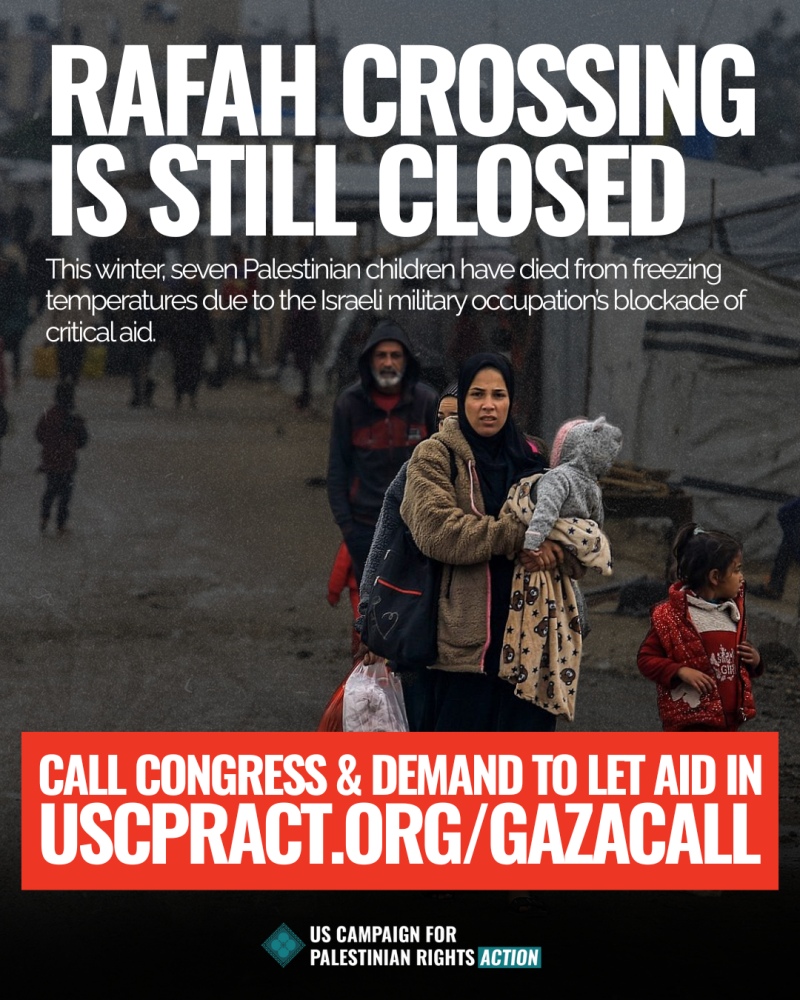
-
This week, Israel bulldozed UNRWA's Jerusalem headquarters4, demolishing the UN agency's offices and raising an Israeli flag over the rubble.
-
Trump is threatening military occupation of Minneapolis. After relentless ICE raids, killing of 37-year-old Renee Good, and community protests, Trump flooded Minneapolis with over 3,000 federal agents5.
-
Trump is escalating war around the world, launching an illegal military strike on Venezuela and threatening to "wipe Iran off the face of the earth."6
-
Israel is violating the ceasefire by blocking the Rafah crossing—the most critical lifeline for entry and exit from Gaza—over 100 days after agreeing to open it. Seven children7 have frozen to death this winter while Israel blocks tents, blankets and other vital aid. Call Congress now to demand Rafah crossing reopens.
-
Jared Kushner announced colonial plans to turn Gaza into a luxury development starting in Rafah8. They aren’t even pretending anymore—they are building a colonial board to profit off of the genocide and build real estate on the land where tens of thousands of Palestinians were murdered.
YOUR IMPACT
-
NYC is now governed by a BDS supporter. On his first day in office, Mayor Zohran Mamdani, the first candidate USCPR Action endorsed, revoked Eric Adams' anti-BDS order and canceled the adoption of the IHRA definition.9
-
The Block the Bombs Act (H.R. 3565) now has triple the number of representatives cosponsoring, from 21 in May 2025 to 61 representatives today10, thanks to over 750,000+ emails and 38,000+ calls you made to elected officials over the past year through USCPR Action tools.
-
Break Israel Bonds campaigns are winning. After sustained grassroots pressure, Michigan, Minnesota, and North Carolina have sold off nearly $30 million in Israel bonds from their state pension funds.11
LEARN MORE
WHAT YOU CAN DO NEXT
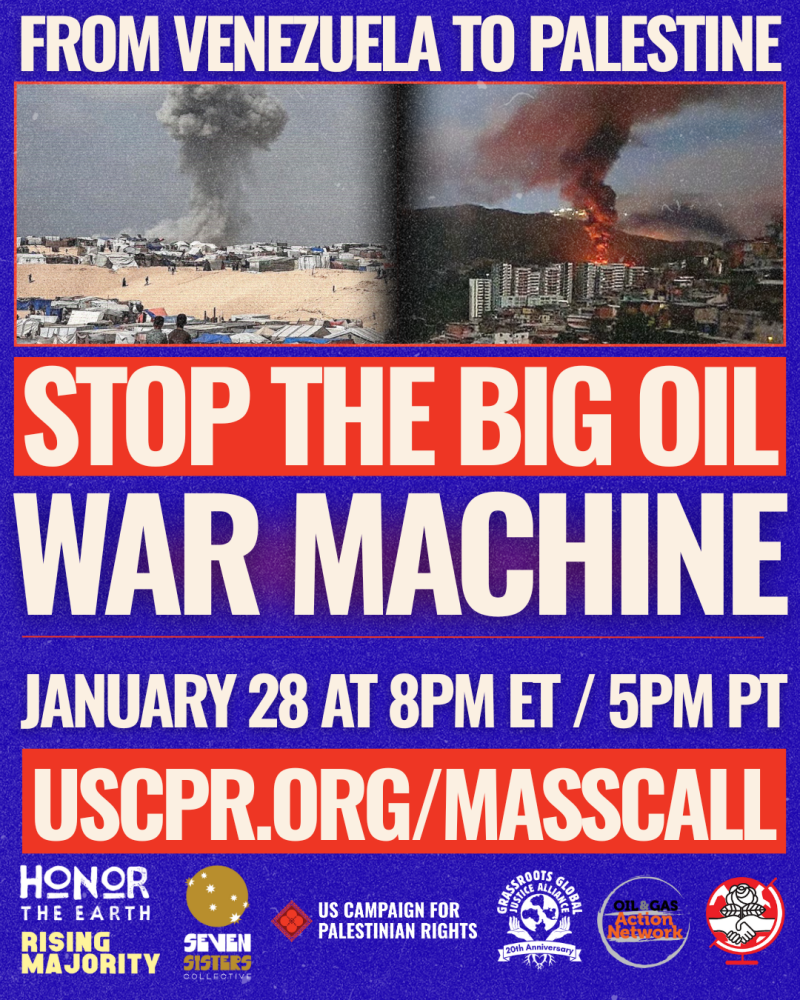
-
Attend “From Venezuela to Palestine: Stop the Big Oil War Machine,” next Wednesday, Jan. 28 at 8PM ET, organized by our sister organization USCPR and Boycott Chevron partners. Join us to connect the dots between Big Oil’s corporate profits and U.S. militarism around the world and get trained on new tactics for taking action.
- Protest Big Oil at a local, corporate-owned Chevron or Citgo gas station this Saturday. Join the national day of action to stop Big Oil’s war profiteering from Venezuela to Palestine. Find an action near you.
-
Find a theater near you screening All That’s Left of You, a powerful film following a Palestinian teenager in the occupied West Bank, tracing seven decades of an uprooted Palestinian family’s story of hopes and heartache.
-
Tell institutions to #DropChevron. Chevron, one of the primary energy providers to the Israeli apartheid state, is now also cashing in on Trump's invasion of Venezuela. Use USCPR’s new action tool to demand institutions cut ties with this war profiteer.
-
Fuel the fight ahead for Palestinian liberation in 2026.
TAKE ACTIONRSVP TO THE CALL
Thank you for taking action with us.
Onward to liberation,
AHMAD ABUZNAID
Executive Director
USCPR Action
2040.

23 januari 2026
Gaza Humanitarian Response
Situation Report No. 64
23 January 2026
(As of 18:00 on 22 January 2026, unless otherwise noted)
HIGHLIGHTS
- For the first time in more than two years, nearly 5,170 recreational kits comprising notebooks, pencils, erasers, and crayons, entered Gaza and will support the learning of more than 375,000 children.
- According to preliminary figures, health partners vaccinated nearly 6,400 children in the first four days of the second round catch up child immunization campaign.
- Nine additional Temporary Learning Spaces were established across the Gaza Strip, bringing the total to 449, allowing more than 271,500 school-aged children to access in‑person education across the Strip.
- Most of the population remains displaced. At least 1.3 million people are estimated to be staying in 970 sites across the Strip, mostly in Deir al Balah and Khan Younis.
SITUATION OVERVIEW
Between 19 and 22 January, airstrikes, shelling and gunfire continued to be reported across the Gaza Strip, particularly east of Jabalya in North Gaza, south-east of Gaza city, in northern and eastern Deir al Balah, east and south of Khan Younis, and west of Rafah.
The second round of the catch-up child immunization campaign (SitRep #63 refers), begun on 18 January, is proceeding apace. During the first four days of the campaign, health partners vaccinated almost 6,400 out of 17,892 targeted children, according to preliminary figures.
After more than two years of restrictions, UNICEF has been allowed to bring recreational kits to the Gaza Strip to support children’s learning. Since 15 January, nearly 5,170 such kits have entered the Strip, supporting more than 375,000 children, including 1,000 children with disabilities. The materials, which include notebooks, pencils, erasers, and crayons, will help children develop language, motor, problem-solving and socio-emotional skills, and will equip caregivers and educators with practical tools to engage children in age‑appropriate activities. UNICEF calls for sustained entry of all other education and Early Child Development supplies into Gaza, highlighting their importance for uninterrupted learning.
Recent adverse weather, including heavy storms, continues to impede access to education. Over the past week, five TLSs were impacted - three in Deir al Balah, one in Khan Younis, and one in Gaza city - affecting 3,346 school-aged children. While efforts are ongoing to repair damaged tents, there remains an urgent need for adequate quantities of high‑performance tents, which provide better resilience to severe weather.
Most of the population in Gaza remains displaced, with some 1.3 million people estimated to be sheltering in over 970 sites, the majority of which are located in Deir al Balah and Khan Younis. To support ongoing efforts to meet urgent shelter needs, partners reached more than 13,000 families since 18 January with tents, tarpaulins, mattresses, blankets and winter clothing kits.
Between 19 and 21 January, Site Management Cluster (SMC) partners reported 18 weather-related damage alerts across displacement sites in Gaza, with the highest concentration in Deir al Balah and Khan Younis. Seasonal hazards such as strong winds damaged more temporary structures, shattering windows, and breaking doors. Approximately 3,000 people (597 households) were affected, the vast majority living in Designated Emergency Shelters where inadequate sealing further increases exposure to cold. Partners highlighted persistent challenges in accessing essential shelter‑sealing materials, including nails, timber and other basic items required to repair window frames, reinforce doors, and enhance protection from the elements.
Between 19 and 21 January, a SMC partner conducted rapid assessments across four high‑risk makeshift displacement sites in Deir al Balah comprising 931 households: Al Bahri (207 households), Badir/Abar Al Tahleiah (280 households), Shat At‑Tal (164 households), and Zeina (280 households). The assessment confirmed that households are living in areas exposed to severe and unmitigable environmental hazards. All four sites lie along unstable coastal cliffs between Al Rasheed Road and the shoreline, putting residents at risk of cliff collapse, soil erosion, storm‑driven wave surges, recurrent flooding, extreme winds, and unsafe shelter structures, including documented fatalities in Shat Al‑Tal linked to a recent landslide. Due to the geographical configuration, ongoing erosion, and lack of feasible engineering and site‑level mitigation options, the assessment concluded that relocation is the only viable measure to reduce risk and protect the affected population.
SMC partners continue to work closely with affected communities to assess needs, coordinate emergency repairs, and prioritize the most affected locations as winter weather intensifies.
UNITED NATIONS-COORDINATED AID ENTRY*
Between 20 and 22 January, at least 11,239 pallets of aid administered by the UN and its partners were offloaded at Gaza’s crossings, based on data retrieved from the UN2720 Mechanism dashboard at 14:00 on 23 January. About 76 per cent of these pallets contained food, followed by shelter (9 per cent), nutrition (6 per cent), health (4 per cent), WASH (2 per cent), education (1 per cent) and protection supplies (1 per cent).
During the same reporting period, UNOPS international monitors deployed at Gaza’s crossings verified the collection of at least 6,796 pallets of aid from Kerem Shalom Crossing. These comprised inter alia over 4,440 pallets of food assistance, more than 1,470 pallets of shelter items including tents, blankets, tarpaulins and kitchenware, 725 pallets of health items such as intravenous solutions and medical consumables, over 144 pallets of WASH items, such as soap and cleaning supplies, 96 tons of animal feed and 3 pallets of generator spare parts.
Overall, between the announcement of the ceasefire on 10 October 2025 and 22 January 2026, at least 256,874 pallets of humanitarian cargo were offloaded, and 244,938 pallets were collected from the various crossings. Some 1,532 pallets, less than one per cent of all uplifted aid, were intercepted during transit within Gaza.
The above data does not include bilateral donations and the commercial sector.
Between 20 and 22 January, a total of 22 humanitarian movements requiring coordination with Israeli authorities were reported. Of these, 15 movements (68 per cent) were facilitated, enabling inter alia the collection of medical, food, and nutrition supplies, more than 900,000 litres of fuel, as well as the evacuation of an international Emergency Medical Team staff member for treatment in Jordan. Three movements (14 per cent) faced impediments, two of which were eventually fully accomplished, and one partially accomplished. Two other movements (9 per cent) were cancelled by the organizing agencies, while two others - assessment missions to Rafah (9 per cent) - were denied by the Israeli authorities.
HUMANITARIAN RESPONSE
The below are preliminary updates shared by Clusters at the time of reporting and will be reconciled and aggregated in the coming days as Clusters receive more data from the capillary network of partners active on the ground.
Food Security
- As of 19 January, Food Security Sector partners reached more than 172,000 families (860,000 people) with household-level general food assistance through 52 distribution points across the Strip as part of the monthly distribution cycle. Each family received a full ration consisting of two 25-kg wheat flour bags and two food boxes.
Health
- Although medical evacuations of patients outside Gaza continue (SitRep #63 refers), more than 18,500 people, including 4,000 children, remain on the list of patients to be evacuated to receive medical treatment not available inside the Strip. WHO continues to call for more Member States to accept these patients and for the reopening of the medical evacuation route to the West Bank, including East Jerusalem. In this context, WHO welcomes the recent approval of one patient from Gaza – the first since October 2023 – to travel to the West Bank following a Jerusalem District Court ruling.
Water, Sanitation and Hygiene
- As of 22 January, the electricity supply to the Southern Gaza Desalination Plant (SGDP) experienced an interruption east of Salah ad-Deen Road. Although partners were able to assess the damage, carry out repairs, and restore service by 14:00, power supply collapsed again shortly thereafter. As of the morning of 23 January, the plant continued to rely on backup generators with water production capacity dramatically reduced from 15,000 cubic metres (m3) to about 2,500 m3 daily.
- During the same period, cluster partners distributed more than 2,700 hygiene kits, 1,100 chlorine bottles, 700 anti-lice kits, 137 latrine kits, and 7 squatting slabs across the Strip.
Nutrition
- The Nutrition Cluster is finalizing updated guidelines on inpatient admission and the management of nutritionally vulnerable children under the age of five to help ensure more consistent case management across partners, aligned with WHO/UNICEF recommendations.
- Nutrition service delivery continues to face significant operational risks, notably the potential reduction of partner presence and coverage linked to INGO registration issues. Additionally, the shortage of therapeutic milks (F‑75 and F‑100) is limiting inpatient treatment for severe acute malnutrition. While the Cluster has identified an interim solution, it will only mitigate the gap through February and March.
Site Management
- Between 19 and 21 January, a SMC partner conducted rapid assessments across four high‑risk makeshift displacement sites in Deir al Balah comprising 931 households: Al Bahri (207 households), Badir/Abar Al Tahleiah (280 households), Shat At‑Tal (164 households), and Zeina (280 households). The assessment confirmed that households are living in areas exposed to severe and unmitigable environmental hazards. All four sites lie along unstable coastal cliffs between Al Rasheed Road and the shoreline, putting residents at risk of cliff collapse, soil erosion, storm‑driven wave surges, recurrent flooding, extreme winds, and unsafe shelter structures, including documented fatalities in Shat Al‑Tal linked to a recent landslide. Due to the geographical configuration, ongoing erosion, and lack of feasible engineering and site‑level mitigation options, the assessment concluded that relocation is the only viable measure to reduce risk and protect the affected population.
Protection
- Between 19 and 21 January, partners reached nearly 10,000 people – children, caregivers, women, persons injured and with disabilities, frontline workers and communities in displacement sites and shelters – with protection related services across Gaza city, North Gaza, Deir al Balah and Khan Younis. These included Mental Health and Psychosocial Support (MHPSS), Explosive Ordnance Risk Education (EORE), community‑based protection, case management, physical rehabilitation services, and winterization assistance (distribution of winter clothing, blankets, tents, tarpaulins, and dignity-related items) integrated with protection monitoring at aid distribution points.
- Child Protection
- Between 19 and 21 January, Child Protection partners reached over 3,500 children and more than 1,500 caregivers with psychosocial support and psychological first aid across Gaza city, Deir al Balah and Khan Younis. Partners also identified and provided dedicated case management services to more than 200 children facing heightened protection risks, such as family separation and unsafe shelter conditions. Meanwhile, risk‑mitigation and safety messaging were further intensified, with six partners reaching over 1,000 children and caregivers through 15 awareness raising sessions.
- As part of ongoing winterization support, over 1,300 children under the age of 10 were provided with winter clothing items, along with shoes and blankets. However, significant gaps remain, especially for children aged 11 to 17, with the current winter response reaching only about 32 per cent of children due to funding limitations.
- In addition, assistive devices were provided to 87 children with disabilities, supporting improved access, mobility, and functionality.
- Mine Action
- Between 19 and 21 January, partners conducted 121 Explosive Hazard Assessments (EHAs) in support of debris removal activities in Deir al Balah, while Explosive Ordnance Risk Education sessions reached over 11,200 people across Gaza city, Deir al Balah, and Khan Younis.
While 289 EHAs have thus far been conducted since the start of the year, sustaining this scale would be a challenge if INGO presence were to reduce due to deregistration.
- Between 19 and 21 January, partners conducted 121 Explosive Hazard Assessments (EHAs) in support of debris removal activities in Deir al Balah, while Explosive Ordnance Risk Education sessions reached over 11,200 people across Gaza city, Deir al Balah, and Khan Younis.
Education
- Between 19 and 21 January, with support from the WASH Cluster, approximately 500,000 soap bars were distributed to 100,000 school-aged children to help strengthen hygiene practices within learning spaces and at the household level.
- During the same period, nine additional Temporary Learning Spaces (TLSs) were established, accommodating more than 4,500 students. In total, 449 TLSs are now operational across the Strip, providing about 271,500 learners with access to in‑person education, as well as MHPSS services, recreational activities, and other essential multisectoral support. Almost 6,400 teachers are currently facilitating learning across all operational TLSs.
- Efforts to rehabilitate existing learning infrastructure continue. As of this week, one school in Deir al Balah with 10 classrooms is undergoing renovation to enable more children to access education in durable structures, an especially critical need during the harsh winter season.
Multi-Purpose Cash Assistance (MPCA)
- Between 19 and 21 January, Cash Working Group partners distributed Multi-Purpose Cash Assistance (MPCA) to over 8,700 households across the Gaza Strip. Each household received 1,250 NIS (approximately US$378) through digital payment modalities, in line with the agreed Minimum Expenditure Basket transfer value.
2039.

23 januari 2026
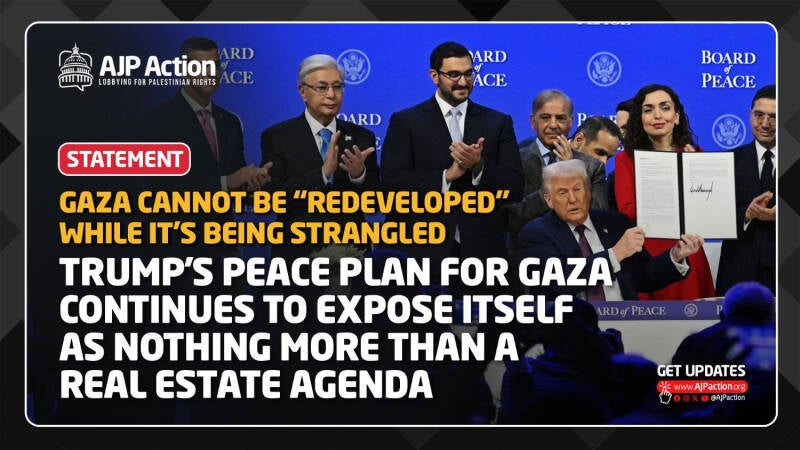
Trump's peace plan for Gaza continues to expose itself as nothing more than a real estate agenda
Wednesday’s (January 21st) announcements at the World Economic Forum in Davos, including Jared Kushner’s presentation of a so-called “New Gaza” plan and the creation of a U.S.-backed “Gaza Peace Board,” are deeply dishonest, dangerous, and untethered from realities on the ground.
What Kushner presented in Davos, and Trump named a real-estate project, imagines Gaza “rebuilt from scratch,” filled with luxury residential towers, seaside resorts, industrial zones, and tech infrastructure, a vision fundamentally disconnected from reality. It deliberately sidesteps the most basic questions that any legitimate reconstruction process needs to confront: who owns the land being redeveloped; what happens to Palestinians whose homes, neighborhoods, and livelihoods were destroyed; where displaced families are expected to live while rebuilding takes place; and who, if anyone, will guarantee compensation, restitution, and enforceable legal rights for Palestinians, the natives of the land.
Most glaringly, the plan proceeds as though reconstruction can occur while Gaza remains under genocide and siege, with Israel continuing to restrict movement, obstruct humanitarian aid, and violate the very ceasefire meant to enable recovery. Rebuilding cannot be achieved while a population continues to be bombed, starved, and displaced. When redevelopment is discussed in the absence of rights, restitution, and Palestinian self-determination, it is not reconstruction. It is dispossession repackaged as investment, a vision that treats Gaza not as a home to millions of people with legal and political rights, but as a blank slate for outside interests once the destruction is deemed “manageable.” This has a name: colonialism. It mirrors the foundational logic of Zionist settler colonialism in Palestine, when the land was falsely framed as empty, underutilized, or lacking legitimate political life to justify its seizure.
The only difference here is that this iteration cloaks itself in the language of “peace,” “stability,” and “economic opportunity,” presenting foreign control and imposed restructuring as benevolent intervention. It advances the same colonial premise: that Palestinians are incapable of governing themselves, that their political agency is a threat rather than a right, and that salvation must come from external actors empowered to decide Gaza’s future without its people.
Historically, framing domination as rescue has been a core feature of colonial projects. By casting Palestinians as inherently disorderly, violent, or unfit for self-determination, this process attempts to legitimize permanent control, erase Palestinian sovereignty, and normalize the transfer of power, land, and decision-making to outside forces under the guise of peacebuilding.
This Davos spectacle, and the broader “peace plan,” is all about such power: who gets to define “peace,” who gets a seat at the table, and which institutions get pushed aside. From the outside looking in, this Board is being created as a new global mechanism, with rhetoric that has gestured toward supplanting UN functions, a posture that reinforces what much of the world already recognizes: the United States repeatedly undermines multilateral accountability when it conflicts with its political agenda, isolating itself further from global consensus and weakening the international system meant to uphold law and protect civilian life.
And then there is the most grotesque detail of all: the likes of Netanyahu, a wanted war criminal, being invited to and accepting a seat on a “peace” body tasked with shaping Gaza’s future. The International Criminal Court issued an arrest warrant issued for him on November 21, 2024. Elevating a leader who should be arrested for committing genocide in and destabilizing Gaza into a “peace board” meant to help “stabilize” the same territory is institutionalized impunity. The Board itself is stacked with political actors and private-sector power brokers who have helped launder denial, repression, and the dismantling of accountability into “policy.”
Peace is not a brand. Gaza is not a development opportunity. And Palestinians are not an obstacle to be managed while the elites workshop maps and renderings. Trump’s plan continues to expose itself for what it is: a real-estate fantasy and a political project built on denial, impunity, and the attempted erasure of Palestinian rights. Nothing here is signaling an actual path to peace.
In solidarity,
Americans for Justice in Palestine Action
2038.

23 januari 2026
De Tweede Kamer heeft een motie aangenomen over het afbouwen van Nederlandse afhankelijkheid van de Israëlische wapenindustrie. De motie van Christine Teunissen van de Partij voor de Dieren kreeg 81 stemmen. Het is de eerste keer dat de Kamer een motie aanneemt tegen militaire afhankelijkheid van Israël.
De motie werd gesteund door Partij voor de Dieren, GroenLinks-PvdA, D66, CDA, SP, DENK, Forum voor Democratie, en Volt. De verantwoordelijke staatssecretaris, Aukje de Vries van Buitenlandse Handel en Ontwikkelingshulp, had de motie ontraden. Ze wilde de afhankelijkheid ‘natuurlijk verminderen’, zei ze, ‘net als afhankelijkheid van alle landen buiten Europa’, maar: ‘We willen echt in Europa kijken of we een eigen defensie-industrie kunnen opbouwen. Dat heeft tijd nodig. Het nu beëindigen gaat echt veel te ver.’ Het is nu afwachten hoe ze gehoor gaat geven aan de wens van de Kamer.
Getest op Palestijnse burgers
Uit onderzoek van NRC ruim een jaar geleden blijkt dat Nederland in vijf jaar tijd voor bijna twee miljard euro aan Israëlische wapens kocht. De helft daarvan werd aangeschaft na 7 oktober 2023, het begin van de genocide in Gaza. De wapens werden (en worden) geleverd door de bedrijven Elbit Systems, Rafael en IAI, de pijlers onder het Israëlische regime van bezetting, verdrijving, kolonisatie, apartheid en genocide. De nieuwste snufjes worden in Gaza en op de Westelijke Jordaanoever getest op Palestijnse burgers.

Activisten beklimmen de ingang van de kantoren van Allianz in Londen nadat ze het gebouw met rode verf hebben bespoten. De activisten roepen de verzekeringsgigant op om de banden met wapenfabrikant Elbit Systems te verbreken. [c] Vuk Valcic via Alamy

Uitnodiging | Dries van Agt-lezing
Op maandag 2 februari 2026 organiseert The Rights de tweede Dries van Agt-lezing: de jaarlijkse bijeenkomst die staat voor morele moed, internationale rechtsorde en solidariteit met het Palestijnse volk.
Dit jaar brengen we twee uitzonderlijke stemmen samen: Naledi Pandor (1953), oud-minister van internationale samenwerking van Zuid-Afrika en Noura Erakat (1980), Palestijns-Amerikaanse mensenrechtenadvocaat en hoogleraar.
Al meer dan 600 mensen kochten een kaartje. Bent u er ook bij? Bestel dan hier uw tickets.
ABP investeert 825 miljoen in techbedrijf betrokken bij genocide in Gaza
Het Nederlandse pensioenfonds ABP heeft afgelopen jaar 825 miljoen euro geïnvesteerd in het Amerikaanse softwarebedrijf Palantir. Dat blijkt uit onderzoek van platform Follow the Money.
Palantir levert software aan het Israëlische leger, die wordt gebruikt bij de bombardementen op de Gazastrook. Het bedrijf profiteert hiermee van de genocide, en is er medeplichtig aan, stelde VN-rapporteur Francesca Albanese in haar rapport From economy of occupation to economy of genocide uit juni 2025.
AI als wapen
Israël heeft verschillende AI-programma’s die zelfstandig doelwitten selecteren om te bombarderen. Deze programma’s waren ontworpen om Hamas-leden te identificeren en als doelwit te markeren, juist als ze thuis bij hun families waren. Door AI-geselecteerde doelwitten werden vrijwel zonder uitzondering geaccordeerd door het leger, waarbij hele families, of alle bewoners van een appartementencomplex in feite door de beslissing van een computer werden uitgeroeid.
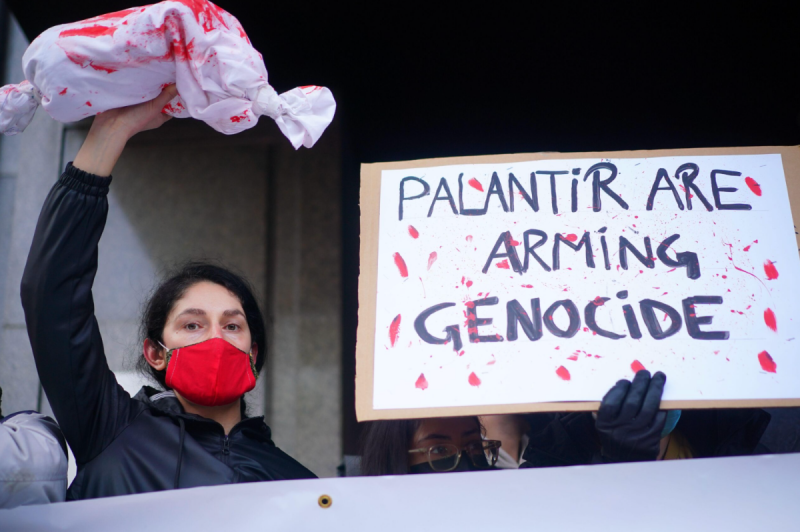
Een demonstrant in het Verenigd Koninkrijk eist in april 2024 dat de Britse gezondheidszorg de samenwerking met Palantir beëindigt. © Vitoria Jones / PA Images / Alamy
Het rapport van Albanese stelt dat ‘op redelijke gronden’ kan worden aangenomen dat Palantir deze AI-systemen heeft aangeleverd. Na 7 oktober 2023 werd de samenwerking tussen Palantir en het Israëlische leger uitgebreid.
Actie vereist
The Rights Forum voert al langer actie tegen de foute investeringen van ABP, dat het grootste pensioenfonds van Nederland is. Het nieuws over de investeringen in Palantir sterkt ons in de overtuiging dat verdere stappen noodzakelijk zijn. In dat verband kijken we onder meer naar de juridische aansprakelijkheid van ABP. Over enige ontwikkelingen op dit gebied houden wij u uiteraard op de hoogte.

Israël vermoordt opnieuw journalisten in Gaza
Bij een Israëlische luchtaanval op een auto in centraal-Gaza zijn woensdag drie Palestijnse journalisten vermoord. De Palestijnse Journalistenbond zei in een verklaring dat de drie bezig waren met een ‘humanitaire, journalistieke missie om het lijden van burgers te filmen en te documenteren’.
Volgens persbureau Reuters gaat het om Mohammed Salah Qashta, Abdul Raouf Shaat and Anas Ghneim. De freelancers waren in opdracht van een Egyptische hulporganisatie op weg om een reportage te maken over een nieuw vluchtelingenkamp. Het logo van die organisatie was zichtbaar op hun auto, blijkt uit beelden die na het bombardement werden gemaakt.
Het totaal aantal vermoorde journalisten in Gaza sinds 7 oktober 2023 ligt inmiddels op minstens 207 (volgens het Committee voor de Bescherming van Journalisten). Er blijven zo steeds minder lokale journalisten over die de dagelijkse werkelijkheid van de genocide naar buiten kunnen brengen. Israël blijft weigeren buitenlandse journalisten tot het gebied toe te laten.
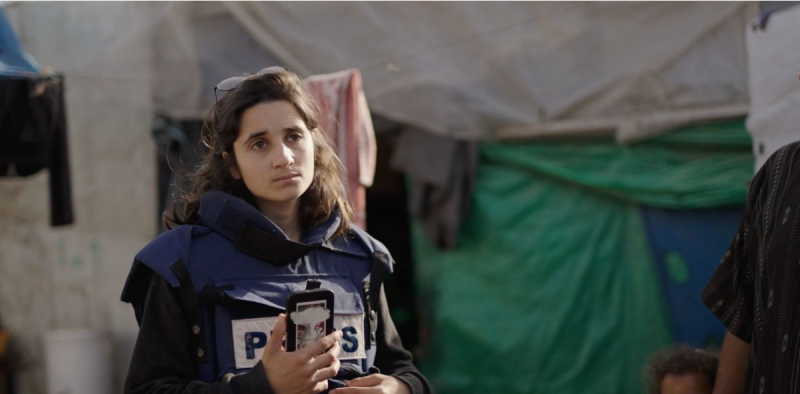
Rita Baroud | Gaza buiten de wet gesteld: Israël ontmantelt humanitaire hulp
Het verbieden van 37 hulporganisaties in Gaza, waaronder Artsen zonder Grenzen en Oxfam Novib, is een politieke daad en zal uitdraaien op een totale sociale en medische ineenstorting, schrijft de Palestijnse journalist Rita Baroud in haar nieuwste essay voor The Rights Forum.
'Ik schrijf van buiten Gaza, maar niet van buiten de realiteit in Gaza. Niet van buiten de angst, de ingehouden adem of het gebruikelijk geworden wachten op dingen die al of niet komen: voedsel, medicijnen, elektriciteit, een telefoontje dat bevestigt dat iemand nog in leven is. De afstand maakt Gaza geen abstract gebied. De afstand scherpt alleen het besef dat wat daar wordt besloten over levens gaat, niet over documenten.'

Petitie | Zet Gaza in het regeerakkkoord!
Vredesorganisatie PAX is een nieuwe petitie gestart om concrete acties rondom Gaza op te nemen in het regeerakkoord.
Op dit moment werkt D66 samen met CDA en VVD aan een regeerakkoord. Over Gaza wordt echter met geen woord gerept, schrijft PAX.
Ondanks het zogenaamde staakt-het-vuren valt Israël Gaza bijna dagelijks aan. Daardoor zijn honderden mensen gedood en gebouwen verwoest. Er komt nog steeds te weinig humanitaire hulp binnen. Terwijl Gaza steeds minder aandacht krijgt, pakt Israël steeds meer land af. De genocide gaat door.
Nu is het moment om verschil te maken en eindelijk de geloofwaardigheid van Nederland te herstellen. Het nieuwe kabinet moet breken met het verleden en zich wél inzetten voor vrede.
Met de petitie roept PAX op om de volgende eisen in het regeerakkoord op te nemen:
- Inzet voor een écht staakt-het-vuren
- Onbeperkte toegang voor humanitaire hulp
- Erkenning van en optreden tegen genocide
- Stevige economische en diplomatieke maatregelen tegen Israël
- Een breed handelsverbod gericht op het tegengaan van bezetting, apartheid en genocide
- Een volledig (export en import) wapenembargo
- Het bestrijden van straffeloosheid
Teken de petitie
Uit onze agenda
zaterdag 17 januari t/m zaterdag 24 januari
DEMONSTRATIES EN WAKES
UTRECHT DOORDEWEEKSE DAGEN 08.30 - 09.30 | Dagelijks stilteprotest voor Palestina, tegen genocide en bezetting (Neude, langs het fietspad)
HAARLEM ZO 25 JAN 14.00 | Wekelijks protest tegen de onderdrukking van de Palestijnen (Grote Markt)
AMSTERDAM ZO 25 JAN 17.00 | Stil protest tegen de onderdrukking van de Palestijnen (Spui, bij ‘t Lieverdje)
HUIZEN WO 28 JAN 11.30 | Wekelijkse sit-in voor Gaza (Gemeentehuis)
DEN HAAG DO 29 JAN 12.00 | Sit-in van Rijksambtenaren bij het ministerie van Buitenlandse Zaken, Rijnstraat 8
STATIONS IN NEDERLAND DO 29 JAN 18.00 | Wekelijkse lawaaidemonstratie op stations in heel Nederland: Stations Almere Centrum, Amersfoort, Arnhem, Assen, Ede-Wageningen, Enschede, Groningen (mars vanaf Grote Markt 17.30 uur, sit-in station 18.30 uur), Harderwijk, Hengelo, Hilversum (17.30 uur), Leiden, Nijmegen, Rotterdam, Tiel, Tilburg, Utrecht, Zaandam (17.00 uur), Zutphen
Let op: The Rights Forum probeert de verschillende stationsacties in Nederland zo goed mogelijk bij te houden, maar dat is niet altijd goed mogelijk. Houd de sociale media-pagina's van de plaatselijke solidariteitsorganisaties in de gaten voor de meest actuele informatie.
DOETINCHEM VR 30 JAN 10.00 | Lawaaidemo en speech (op het plein voor het gemeentehuis)
AMERSFOORT VR 30 JAN 09.30 | Wekelijks stilteprotest tegen genocide (Varkensmarkt)
GRONINGEN ZA 31 JAN 13.00 | Tweewekelijkse wake van Vrouwen in het Zwart (Waagplein)
NIJMEGEN ZA 31 JAN 14.00 | Maandelijkse wake uit protest tegen Israëls voortdurende misdaden tegen het Palestijnse volk en haar land (Koningsplein - Marienburg)
CULTURELE EN ANDERE EVENEMENTEN
DOETINCHEM 24, 25, 26, 27 & 31 JAN en 1 FEB | Vertoning The Voice of Hind (Amphion Theater)
AMSTERDAM ZO 25 JAN 13.00 | Café Palestine, een maandelijkse bijeenkomst met ruimte voor thematische gesprekken en lezingen over de voortdurende genocide in Gaza. De vierde editie zal zich richten op consumentengedrag en hoe dit invloed heeft op politiek (Cinetol)
UTRECHT MA 26 JAN 19.30 | The Palestine Book Club, een maandelijkse leesclub met deze keer The Parisian van Isabella Hammad. Met Rana Rashid & Marianne Dagevos (De Bibliotheek Utrecht)
AMSTERDAM DI 27 JAN 20.00 | Boeklancering: De grote koloniale oorlog part II. Een gesprek met de auteur van het boek Chris de Ploeg over kolonialisme, kapitalisme en fascisme (Pakhuis de Zwijger)
Onze agenda wordt doorlopend aangevuld.
2037.

22 januari 2025
Since 2022, the Palestinian-led BDS movement has called for a consumer boycott of Chevron. This Big Oil corporation supplies gas to fuel nearly half of Israel’s electricity grid, including Israeli military bases.1
Now, Chevron is raking in the profits from Trump’s military invasion of Venezuela as the only U.S. oil corporation currently operating there.2
Throw sand in the gears of genocide and war! This is the time to escalate pressure to stop the Big Oil war machine worldwide—starting in your neighborhood.
Join me for our Boycott Chevron action training on Wednesday, Jan. 28 at 8PM ET / 5PM PT to learn how you can plug in and organize an effective protest.
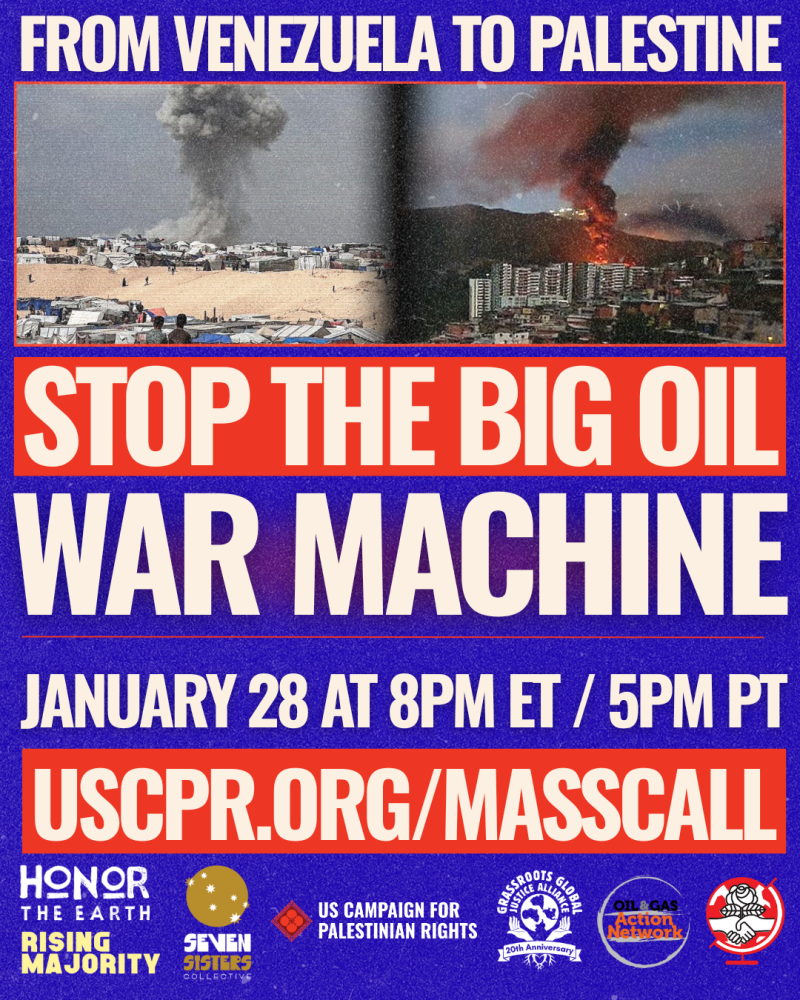
RSVP NOW: STOP THE BIG OIL WAR MACHINE
Together, we’ll explore creative new tactics to flex our economic power—the backbone of BDS (Boycott, Divestment, and Sanctions).
You’ll learn about:
- Trump’s invasion of Venezuela to steal oil and advance U.S. domination
- Connections between Big Oil’s corporate profits and U.S. militarism
- Chevron’s complicity in climate destruction and war, from polluting the Gulf South to fueling Israel’s genocide against the Palestinian people.
Then, we'll dive into a training on a new kind of action building the grassroots BDS movement: economic slowdowns. Learn from ordinary people who took on Big Oil in their neighborhood about how you can organize to slow down business at Chevron.
Take action to stop Big Oil’s war profiteering and destruction! Register now for the Boycott Chevron action training on Wednesday, Jan. 28 at 8PM ET / 5PM PT.
RSVP NOW: STOP THE BIG OIL WAR MACHINE
I hope you can join me next week, Nico, and please invite your friends to come too. Share this call in all your group chats! I’ll see you then.
Onward to liberation,
LEAH
Manager of Congressional & Grassroots Advocacy
US Campaign for Palestinian Rights
2036.
22 januari 2026
British Mandate of Palestine: Dismissing the Native Population
Last week, AMP launched a special 5-week teach-in series titled “Contextualizing The Palestinian Relationship With Zionism,” live on Zoom with our education coordinator, Tarek Khalil, where each session will have a particular focus.
Join us tonight, January 22nd @ 7:30 PM EST, for our 2nd episode “British Mandate of Palestine: Dismissing the Native Population."

This session will focus on British colonial rule post-WW1. The Zionist project accelerated during this period thanks to British facilitation and implementation of the Balfour Declaration, and suppression of the native population. The British Mandate for Palestine set the stage for the Nakba (Catastrophe). This formative period is essential to understanding the present moment.
Please register here to get access to the teach-in link.
In solidarity,
American Muslims for Palestine (AMP)
2035.
22 januari 2026
As Eyewitness Palestine has evolved over the years, we’ve wanted a website that reflects who and where we are today, our growth, our passion, and the powerful community that has shaped us for nearly a quarter century. We’ve long envisioned a digital home that feels true to us, honoring our history while making room for the future we are fighting for. But like so much of our work, limited capacity has often required us to pause.
Today, that changes.
As we step boldly into our 25th year, I am thrilled to unveil the new Eyewitness Palestine website, a new digital home built with love, intention, and a renewed sense of purpose. For the first time in a long time, I am excited to invite people to visit our website, not to simply learn about us, but to connect.
This new site is a place where:
- Palestine comes alive through your screen
- Our virtual delegations and stories can be experienced by anyone, anywhere
- Our community can gather, learn, and feel rooted in our shared commitment
- Our work, our team, and our transformation are visible and celebrated
It feels like home. And it feels like the future.
Nothing we do has ever been easy. And none of it, none of it, would be possible without you. Whether you have walked with us for the full 25 years, joined us somewhere along the way, or found us recently through your own journey of solidarity, you are part of this family. You have helped carry Eyewitness Palestine through moments of heartbreak, clarity, courage, and growth. You have believed in us, pushed us, supported us, and given us the strength to keep moving.
As we continue to grow, evolve, and fight for the liberation of Palestine, we want this new website to be a place you return to, a place that inspires, informs, and keeps you connected to the work and to each other.
If you have not yet donated, I’m asking, humbly and sincerely, if you would consider giving today. Any amount you can share will help us continue elevating Palestinian voices, supporting our partners on the ground, and organizing the life-changing trips that have shaped thousands of people, and will shape thousands more.
Here’s to 25 years behind us, a bold future ahead, and a new home to welcome us all.
Thank you for every step you’ve taken with us. Thank you for your faith in our mission. Thank you for helping us reach this milestone.
Toward liberation,
Nancy Mansour
Executive Director
2034.

22 januari 2026
Deze nieuwsbrief bevat wat meer achtergrond over de betrokkenheid van Microsoft bij Israëls misdaden tegen de menselijkheid. Uiteraard hebben we ook adviezen hoe Microsoft onder druk te zetten.
We publiceren een stuk over welke moorddadigheden Israël pleegt op de half vergeten Westoever van de Jordaan en een oproep het Europese burgerinitiatief te tekenen tegen de verlenging van het Israël-EU Associatieverdrag. Zoals gebruikelijk ziet het er naar uit dat we het niet aan regeringen kunnen overlaten om het juiste te doen.
De BDS beweging roept op om Microsoft te boycotten. Het bedrijf – en andere IT giganten evenzeer – zit tot z´n hals in het bloed van onderdrukking. In Israël, in de VS, in Europa. In Israël had de beruchte inlichtingeneenheid Unit 8200 tot september jl. volop toegang tot Microsofts cloud dienst Azure. Ook VS “Gestapo” ICE is zeer afhankelijk van Microsoft. En Frontex’ repressie draait op Palantir en Microsoft.
2033.

22 januari 2026
Justice Prevails as Court Upholds Constitutional Rights of Palestinian Advocates
In a victory for justice, American Muslims for Palestine (AMP) celebrates the dismissal of yet another case in the Central District of California. Those who stand against free speech can continue attempting to criminalize us for advocating for the truth and educating Americans, but the truth will always prevail.
“We are deeply grateful to the Muslim Legal Fund of America (MLFA) and its legal team for their steadfast representation,” said Dr. Osama Abu Irshaid, Executive Director of AMP. “Additionally, we extend our sincere gratitude to Attorney Christina Jump from the Jump Start Legal Justice Center. This victory adds to our long record of legal triumphs. Malicious and hostile lawsuits may find temporary resonance in biased media, but they collapse entirely in the courts. These cases are nothing more than attempts to damage reputations and distract us from our mission.”

Judge Mark Scarsi agreed with AMP that the complaint “contains no factual allegations raising an inference that AMP was involved” in any conspiracy to harm the Plaintiffs. The court rejected the attempt to substitute speculation and inflammatory rhetoric for evidence, making it clear that conclusory accusations do not meet even the most basic legal standard. Once again, despite a campaign of baseless claims and deliberate mischaracterizations aimed at smearing our organization and leadership, the facts will win in the end.
"I remain incredibly honored to continue representing American Muslims for Palestine in federal courts across the country," said our lead counsel, Christina Jump. "They make my job easy: they tell the truth, and I point out the law. This victory, like the four others we've achieved together before it and even more still to come, proves that courts do read what litigants write, and do care about following the law. Sometimes the road is longer than we want, but when we stick to it, we get there together."
This decision makes clear that the courts will not allow themselves to be used as a tool for settling political vendettas. When real evidence and constitutional standards are applied, attempts to dress up propaganda and repression as legal claims fall apart on their own. We will continue to do what we have always done: speak the truth, educate the public, and advocate unapologetically for Palestinian rights and accountability for Israel’s war crimes, genocide, and apartheid. And we will continue to utilize the full extent of the legal system to defeat baseless claims like these and so many others.
In solidarity,
American Muslims for Palestine (AMP)
2032.

22 januari 2026
Humanitarian Situation Update #354
West Bank
22 January 2026
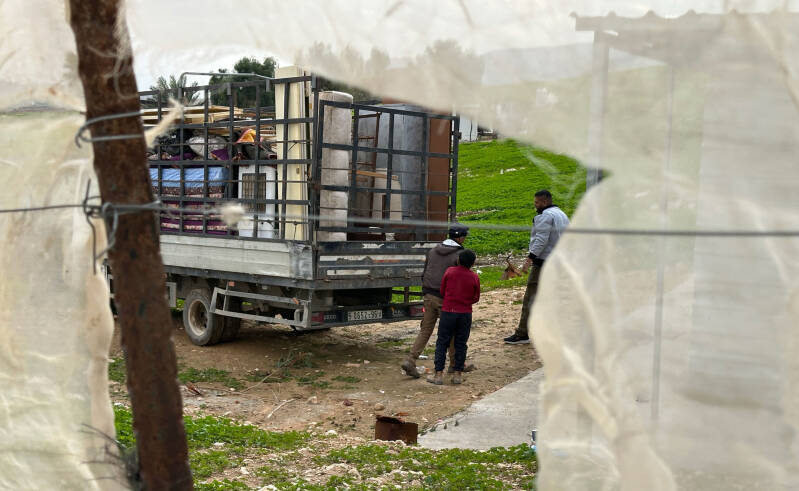
Residents of the Palestinian Bedouin community of Ras Ein al ‘Auja preparing to leave following repeated attacks, threats and acts of intimidation by Israeli settlers. Photo by OCHA
Key Highlights
- Some 25,000 residents of Hebron’s H2 area have been placed under curfew and severe movement restrictions since 19 January, as part of a large-scale Israeli operation, disrupting access to food, health care, and education.
- The UN Secretary-General strongly condemned the unlawful entry into and demolition of UNRWA facilities in occupied East Jerusalem, warning that these actions violate the inviolability of United Nations premises and raise concerns about the continued delivery of essential services to Palestine refugees.
- Ongoing settler attacks, threats, and intimidation, which have disrupted access to homes, pastures, and water and undermined residents’ sense of safety, have displaced over 100 Palestinian Bedouin and herding households from five communities across the West Bank over the past two weeks, the majority from Ras Ein al ‘Auja in Jericho governorate.
- More than 72,000 farming and herding families, nearly two-thirds of all agricultural families, require urgent emergency agricultural assistance, according to a recent Food and Agriculture Organization survey.
Humanitarian Developments
- Between 6 and 19 January 2026, two Palestinians, including one child, were killed by Israeli forces in the West Bank, including East Jerusalem. Another 87 Palestinians, including four children, and three Israelis, were injured. Of the injured Palestinians, 67 were by Israeli forces and 20 by Israeli settlers. The following are details of the incidents that resulted in fatalities during the reporting period:
- On 10 January 2026, Israeli forces shot and killed a Palestinian man, who was driving with his daughter and three grandchildren in the H2 area of Hebron city, outside of the restricted area. According to local sources, Israeli forces prevented medical teams from providing medical assistance. Initially, Israeli forces alleged that the man attempted to ram his car into a group of Israeli soldiers present in the area but later stated that no evidence was found indicating that it was an intentional attack and that the incident remained under review. No Israeli soldiers were injured during the incident. After withholding the body, Israeli forces returned it to the family for burial on 12 January. The four passengers who were in the vehicle at the time of the shooting were transported to the hospital and treated for psychological trauma.
- On 16 January, Israeli forces shot and killed a 15-year-old Palestinian child during a raid in Al Mughayyir village, in Ramallah governorate. The raid took place during Friday prayers as Palestinian residents were leaving mosques. Palestinians threw stones and Israeli forces fired live ammunition, striking the child in the chest. According to local sources and video footage, Israeli forces also physically assaulted a person with a disability during the raid. Following the incident, Israeli forces restricted movement in and out of the village until the following day by sealing off the village’s western entrance, the only entrance usually open following the closure of the village’s main eastern entrance with a road gate since mid-2023.
- Between 6 and 19 January 2026, three Palestinians were shot and injured by live ammunition, and one was physically assaulted by Israeli forces while attempting to cross the Barrier to reach East Jerusalem and Israel. Three of the incidents occurred near Ar Ram and Dahiyat al Bareed and one near Qalandiya, both in Jerusalem governorate. While not exhaustive, OCHA has documented the killing of 16 Palestinians and the injury of more than 249 others while attempting to cross the Barrier since 7 October 2023, when Israeli authorities revoked or suspended most permits that had allowed Palestinian workers and others to access East Jerusalem and Israel.
- On 11 January 2026, Israeli forces conducted a large-scale operation in the Old City of Nablus, primarily in the Al Yasmina and Al Qaryoun neighbourhoods. Israeli media reports indicate that one Israeli soldier was shot and wounded by live ammunition. Overall, 26 Palestinians were injured; three were shot and injured by live ammunition, one was injured by rubber-coated metal bullets, and two were physically assaulted and transferred to hospital for treatment. Twenty additional people, including journalists, suffered from tear gas inhalation and were treated on site by medical teams. The Palestine Red Crescent Society (PRCS) reported evacuating 12 Palestinians from a mosque, where they had been detained by Israeli forces for about six hours following dawn prayers. Medical sources further reported that their teams came under Israeli forces’ fire while providing assistance in the Old City and were subsequently detained for about two hours. Israeli forces also detained two Palestinian journalists.
- During two raids in the Nablus governorate, Israeli forces temporarily took over two residential buildings for military use. On 6 January, Israeli forces took over an inhabited two-storey residential building in Al Lubban ash Sharqiya village for three days, during which they used it as a military post and confined the Palestinian family residing in the building to a single room. On 8 January, Israeli forces took over a three-storey residential building in Madama village for about eight hours, confining the family to one floor while the remainder was used as a military post.
- On 19 January, Israeli forces began a large-scale operation in Jabal Johar in the H2 area of Hebron city, part of which is located in the restricted area, that remains ongoing as of the time of reporting. According to the Israeli military, the operation’s objective is to dismantle militant infrastructure and seize illegal weapons. The forces have imposed a curfew and severe movement restrictions on about 25,000 residents, who have had limited access to food, medicine and fuel and constrained access to the area’s two primary health care centres and main hospital. Israeli forces deployed armoured vehicles and snipers on rooftops, closed at least six internal roads with earth mounds, gates and roadblocks, and detained at least eight Palestinians. About 7,200 students at 18 schools in the area and nearby have since shifted to e-learning modalities. As of 20 January, PRCS carried out emergency evacuations of seven kidney dialysis patients and delivered essential injections to two chronic patients inside the closed area. More than 460 chronic patients are estimated to live there. Prior to the operation, armed clashes among Palestinian families had resulted in damage to transmitters which resulted in a power outage. Electricity supply was only restored on 20 January after a 30-hour outage, once Hebron municipality technicians were permitted by Israeli forces to access the area and repair transmitters. On 21 January, the curfew was temporarily lifted from 17:00 to 20:00, allowing residents to purchase essential items. During this three-hour period, four bakeries, grocery shops, and pharmacies were permitted to operate and pedestrian movement was allowed, while vehicular movement remained prohibited.
- According to the UN Population Fund (UNFPA), approximately 232,000 women and girls, including 14,800 pregnant women, are estimated to have limited access to reproductive health services in the West Bank due to ongoing operations by Israeli forces, record levels settler violence, and movement restrictions, particularly in Jenin, Tulkarm, and Tubas governorates. Between October and December 2025, UNFPA and partners continued to deliver critical services, reaching nearly 19,000 people with comprehensive sexual and reproductive health (SRH) services through five UNFPA-supported mobile clinics in Area C and the northern West Bank. They also trained 318 health professionals in maternal and SRH service provision. Protection and mental health interventions were scaled up, including the operation of six mobile safe spaces, the distribution of dignity, adolescent and postpartum kits to vulnerable women, girls and new mothers, and the provision of mental health and psychosocial support to more than 9,000 people.
- On 12 January, Israeli forces forcibly entered a health centre run by the United Nations Relief and Works Agency for Palestine Refugees (UNRWA) in Bab az Zahira, in Jerusalem’s Old City, and ordered the removal of UN signage. A temporary closure order was issued for one month. Open for more than seven decades, the clinic is the primary health facility for some 36,000 Palestine refugees in East Jerusalem. On 20 January, Israeli forces forcibly entered and demolished buildings within the UNRWA compound in Sheikh Jarrah, in East Jerusalem, on land leased by UNRWA from the Government of Jordan since 1952, in what the United Nations Country Team described as a “grave violation” of the privileges and immunities afforded to UN property. These developments follow amendments to the anti-UNRWA laws passed by the Israeli parliament in December 2025 that prohibit the provision of electricity, water, and other utilities to UNRWA facilities and grant the Government of Israel authority to expropriate the land on which two UN properties in East Jerusalem are located.
- In two separate statements, the UN Secretary-General strongly condemned actions taken by Israeli authorities against United Nations premises in occupied East Jerusalem, including the unlawful entry into the UNRWA Jerusalem Health Centre and demolition of buildings in UNRWA’s compound in Sheikh Jarrah. He urged the Government of Israel to restore access and essential services to UNRWA sites and to uphold its obligations under international law, emphasizing that: “These measures are a violation of the inviolability of United Nations premises, and an obstacle to the implementation of the clear mandate of the General Assembly for UNRWA’s continued operations in the Occupied Palestinian Territory, including East Jerusalem. As recently confirmed by the International Court of Justice, any executive, administrative, judicial or legislative action against United Nations property and assets is prohibited under the Convention on the Privileges and Immunities of the United Nations.”
Forced Displacement Risks, Demolitions and Israeli Settler Attacks
- On 8 January, according to official Palestinian sources, the Israeli authorities formally notified lawyers representing Bedouin communities and the municipality of Al Eizariya of their intention to begin, with a 45-day-notice, the construction of a road intended to reroute Palestinian traffic away from the area designated for the E1 settlement plan. Approved by the Israeli Security Cabinet on 29 March 2025, the road forms part of a broader, alternative road network designed to divert Palestinian traffic from Road 1, which connects Jerusalem and Jericho. The area is also slated to be encircled by the Barrier, which was approved by the Israeli Cabinet in 2006 but not yet completed. Last month, on 10 December 2025, Israeli authorities published a tender for 3,401 settlement housing units in the area, following approval in August 2025 to advance the E1 settlement plan. According to Peace Now, a record 9,629 settlement housing units were tendered in 2025, more than the previous six years combined, including over 6,700 units in Ma’ale Adumim settlement. The UN and its partners are concerned these settlement expansion plans would further isolate East Jerusalem from the rest of the West Bank, severely undermine territorial contiguity between the northern and southern West Bank, and heighten the risk of forced displacement for some 18 Bedouin communities, comprising over 4,000 people, living in the area. Referring to these and other recent developments related to forced displacement and settlement expansion in and around East Jerusalem, the UN Human Rights Office (OHCHR) reiterated that the International Court of Justice has “called on Israel to bring to an end its unlawful presence in the Occupied Palestinian Territory, including ceasing all new settlement activities immediately and evacuating all settlers from the territory.”
- Between 6 and 19 January, OCHA documented the demolition of 27 Palestinian-owned structures for lacking Israeli-issued building permits, which are almost impossible for Palestinians to obtain. Twenty-five (25) of the structures were in Area C of the West Bank and two in East Jerusalem. In total, 50 Palestinians, including 23 children, were displaced and more than 70 people were otherwise affected. Demolished structures included 10 residences (of which nine were inhabited), 15 agricultural and livelihood structures, and two water and sanitation and other structures. Among those displaced, nine families comprising 35 people, including 14 children, were due to two major demolition incidents in Nablus governorate: the demolition of multi-unit residential buildings on the southern outskirts of Nablus city as well as residential and livelihood-related structures in Duma village.
- Between 6 and 19 January, Israeli forces demolished two homes on punitive grounds in the West Bank, resulting in the displacement of two families.
- On 14 January, Israeli forces detonated an apartment on the second floor of a three-storey building in Qabatiya town, in Jenin governorate. The home belonged to the family of a Palestinian man who killed two Israelis in Israel on 26 December 2025. The man was arrested and remains in Israeli custody. As a result, one Palestinian family of six, including three children and a pregnant woman, was displaced.
- On 15 January, Israeli forces, accompanied by the Israeli Civil Administration, demolished a two-storey residential building in the Wadi al Hariyah area of Hebron city. The house belonged to the family of a Palestinian man who killed one Israeli and injured two others in a ramming and stabbing attack in the Gush Etzion settlement area on 18 November 2025. The perpetrator was killed during the attack. As a result, a Palestinian family comprising a mother and her three children was displaced.
- Between 6 to 19 January 2026, OCHA documented at least 55 Israeli settler attacks against Palestinians that resulted in casualties, property damage, or both. The attacks led to the injury of 30 Palestinians, including one child, and two Israeli settlers. Of the wounded Palestinians, 20 were injured by Israeli settlers and ten by Israeli forces. Palestinians physically assaulted and injured two Israeli settlers on 12 January in Al Mughayyir village in Ramallah governorate, after settlers attacked Palestinian farmers ploughing their land. During the same period, settler attacks led to large-scale displacement in five communities in Ramallah, Jerusalem and Jericho governorates (see below).
- In multiple settler attacks over the past two weeks, Israeli settlers targeted water and education-related structures, as illustrated in the following examples:
- On 6 January, Israeli settlers severed the main water pipe supplying a compound of Palestinian houses on the outskirts of Turmus’ayya town and diverted the water toward a nearby settlement outpost in Area B. According to local source, the disconnection affected seven households comprising 31 people, including 13 children, who have since been forced to rely on on-site water wells.
- On 9 January, Israeli settlers, believed to be from the Ahiya and Esh Kodesh settlement outposts, cut the fence and broke into Jalud’s secondary mixed school, which serves about 210 students. Settlers threw flammable materials into a classroom and spray-painted slogans on the walls.
- On 14 January, Israeli settlers threw stones at a vehicle carrying educational staff in Khirbet Ibziq, in Tubas governorate, causing damage.
- On 14 January, Israeli settlers damaged water network cables in Ein Samiya, east of Ramallah, disrupting a primary water source serving at least 20 villages and affecting an estimated 100,000 Palestinians from 22:00 to 9:00 the next morning, when the damage was repaired. According to the Jerusalem Water Undertaking, settlers have repeatedly damaged water wells in the area. In 2025, OCHA documented nine incidents in which settlers caused damage to surveillance cameras and other equipment connected to the water stations and wells in Ein Samiya – an area where a Bedouin community was fully displaced following settler attacks in May 2024.
- On 19 January, at least 77 Palestinian Bedouin and herding households, comprising 375 people (including 186 children and 91 women) began dismantling their structures and relocating from the Ras Ein al ‘Auja community, in Jericho governorate, following intensified attacks, threats and intimidation by Israeli settlers, particularly during night-time hours. This displacement followed the forcible displacement of 21 families (110 people, including 61 children) on 8 January, after a series of settler attacks that included the physical assault and injury of an elderly man, cutting of solar electricity cables, and ploughing of privately owned land. Settlers continued to trespass into the community and graze livestock near residential shelters while families dismantled their homes, issuing threats that forced some households to abandon structures and belongings. Some families have fully relocated, others are in the process of moving, and additional households remaining in the community are assessed to be at imminent risk of displacement.
- Ras Ein al ‘Auja Bedouin community is surrounded by four settlement outposts, all established since April 2024, including one located approximately 700 metres southwest of the community and another near Al ‘Auja Spring. Between 2017 and 2023, OCHA recorded only two settler attacks resulting in casualties and/or property damage in Ras Ein al ‘Auja. By contrast, 36 such attacks were documented in 2024 and at least 38 in 2025. Over the past two years, residents have endured near-daily settler incursions, resulting in injuries, property damage, restricted access to pastures and the nearby Al ‘Auja Spring, and the theft of hundreds of livestock. Access to water has been especially compromised; settlers believed to be from these settlement outposts have repeatedly cut or damaged water pipes connected to Al ‘Auja spring, blocked access roads used for water collection and delivery, emptied households’ water tanks, and intimidated or assaulted residents and herders attempting to collect water, severely undermining livelihoods, living conditions and the community’s ability to sustain traditional herding activities. According to the Food Security Sector (FSS), the ongoing displacement is rapidly deteriorating food security and livelihoods in Ras Ein al ‘Auja, severely disrupting access to food, markets, and livestock-based livelihoods. The FSS assesses a high risk of acute food insecurity among displaced households and those at imminent risk, and highlights the urgent need for immediate food assistance, protection of remaining livestock assets (including veterinary care and fodder), and improved access to water and shelter for livestock in relocation areas to prevent further irreversible losses.
- On 17 January, dozens of masked Israeli settlers attacked the Mikhmas Bedouin community in Jerusalem governorate, injuring two Palestinians and two foreign activists, burning four residential structures, and displacing a Palestinian household of two people. According to local sources, at around 21:00, settlers broke into a residential structure while the couple was inside, sprayed them with pepper spray, beat them with clubs, dragged them outside and set the structure on fire. During the same attack, settlers assaulted other community members and the two foreign activists, who were providing protective presence following repeated settler attacks in the area, set fire to two vehicles, burned additional residential structures and water tanks, damaged an animal shelter, and partially damaged other structures and solar panels.
- Following the establishment of an Israeli settlement outpost near Atara village in August 2025, a series of settler attacks resulted in the forcible displacement of Palestinian herders across three villages in Ramallah governorate. Affected families in all three locations reported repeated raids, trespassing, intimidation, and direct threats, which forced them to dismantle their residential and herding structures and relocate to more densely populated village areas, where access to grazing land and livelihoods is severely constrained.
- On 6 January, four Palestinian herders, all men from the same extended family, including one person with a disability, were displaced from a traditionally used seasonal herding site in Area B of Ein Siniya village and relocated to Dura al Qare’, following near-daily threats, intimidation, and attacks by settlers believed to be from a newly established settlement outpost near Atara village.
- On 13 January, six Palestinian herders from an extended family were forcibly displaced from Area B at the entrance of Atara village and relocated to Burham village, after settlers established an outpost adjacent to their residential and herding structures and carried out repeated incursions and harassment, grazed livestock between shelters, damaged fodder, obstructed access to grazing land, and issued threats to kill and steal livestock.
- On 13 January, four Palestinian herding households, comprising 21 people including 12 children and two elderly persons, were displaced from Area B on the eastern outskirts of Bir Zeit town to a more central location in the town, following sustained settler attacks linked to the same outpost.
- For key figures and additional breakdowns of casualties, displacement and settler violence between January 2005 and December 2025, please refer to the OCHA West Bank December 2025 Snapshot.
Food Security and Livelihoods
- According to the World Food Programme (WFP) Market Monitor covering December, the economic situation in the West Bank throughout 2025 unfolded against a backdrop of escalating protection and displacement pressures, coupled with increased movement and access restrictions. These dynamics further disrupted livelihoods, trade flows, and access to markets, compounding the economic strain on households and undermining already fragile coping mechanisms. Citing the Palestinian Central Bureau of Statistics and the Palestine Monetary Authority, WFP noted that the West Bank economy experienced a significant contraction, with Gross Domestic Product (GDP) declining by 13 per cent between 2023 and 2025, despite a 4.4 per cent increase between 2024 and 2025. With an unemployment rate of 28.5 per cent (293,000 people) in the third quarter of 2025, total consumption fell by 12 per cent compared with 2023, reflecting weakened purchasing power, reduced incomes, and continued uncertainty affecting household spending and market activity.
- WFP further highlighted that the cost of living continued to rise. By November 2025, the Minimum Expenditure Basket increased by two per cent compared with pre-October 2023 levels, driven primarily by higher shelter and food costs. While most food prices remained stable or declined on a month-to-month basis in 2025, this stabilization occurred at levels that were already elevated compared with pre-October 2023. As a result, despite limited monthly price changes, in November the Consumer Price Index remained 0.6 per cent above pre-October 2023 levels, indicating a continued erosion of household affordability and purchasing power.
- Agriculture remains a critical livelihood and food security pillar; of approximately 700,000 families living in the West Bank, about 16.4 per cent (115,000 households) depend on agriculture for their livelihoods. Based on the results of an October survey conducted by the UN Food and Agriculture Organization (FAO), agricultural and herding families in the West Bank are facing acute and compounding pressures. Nearly 90 per cent of agricultural households, about 100,000 families, have experienced at least one recent shock, most commonly conflict and violence, rising living costs, or job loss. Income losses are widespread, with about 90 per cent of families working in agriculture reporting reduced earnings, driven by declines in crop and livestock production and sales. Moreover, the loss of off-farm employment since October 2023, combined with water scarcity, movement and land-access restrictions, limited availability of affordable inputs, and high fuel and transport costs, has significantly undermined household resilience. As a result, more than 72,000 farming and herding families, nearly two-thirds of all agricultural households, were found to require agricultural assistance to stabilize livelihoods, protect productive assets, and prevent further deterioration of food security.
- According to WFP, in December alone, more than 137,000 people (26,700 households) received emergency food vouchers under the shock response plan in the West Bank, while the regular voucher programme assisted more than 197,000 vulnerable people (about 46,200 households). Additionally, more than 40,600 Bedouin and herders in Area C of the West Bank received food vouchers or in-kind assistance. Meanwhile, 14,646 people (3,283 households) displaced by operations carried out by Israeli forces in the northern West Bank received digital cash transfers (ILS 1,680 / US$450 per household) to meet essential needs. About 4,000 workers from Gaza who are still stranded in the West Bank continued to receive regular cash assistance.
Funding
- As of 20 January, Member States disbursed approximately $1.7 billion out of the $4 billion (42 per cent) requested by the UN and partners through the 2025 Flash Appeal for the OPT to meet the most critical humanitarian needs of 3 million out of 3.3 million people identified as requiring assistance in Gaza and the West Bank, including East Jerusalem. On 8 December 2025, the UN and its humanitarian partners launched the 2026 Flash Appeal seeking $4.06 billion to address the humanitarian needs of 2.97 million out of 3.62 million people identified as requiring assistance in Gaza and the West Bank, including East Jerusalem. Nearly 92 per cent of those required funds are for the humanitarian response in Gaza, with just over eight per cent for the West Bank. In December, the oPt Humanitarian Fund managed 111 ongoing projects, totalling $61.1 million, to address urgent needs in the Gaza Strip (89 per cent) and the West Bank (11 per cent). Of these projects, 54 are being implemented by international NGOs, 44 by national NGOs and 13 by UN agencies. Notably, 48 out of the 67 projects implemented by international NGOs or the UN are being implemented in collaboration with national NGOs. For more information, please see OCHA’s Financial Tracking Service webpage and the oPt HF webpage.
2031.

22 januari 2026
Big Oil corporation Chevron is raking in the profits from Trump's invasion of Venezuela, Israel's genocide against the Palestinian people, and climate destruction around the world.
Did you know Trump tipped off Big Oil—not Congress—before invading Venezuela?1
On January 3, President Trump launched a military operation that murdered more than 100 people in Venezuela and kidnapped President Maduro without consulting a single member of Congress.2
Trump did tip off oil executives a month before the attack. Chevron stock rose over 6% in value just days after the invasion.3 While our elected representatives were kept in the dark, Big Oil was getting insider information to maximize their profits.
This is how Trump's administration operates: taxpayer dollars fund violence abroad and corporations cash in, while communities here at home lack basic necessities.
Chevron is first in line to profit from Trump's oil theft. Take action to demand local institutions drop this Big Oil war profiteer as a corporate sponsor.
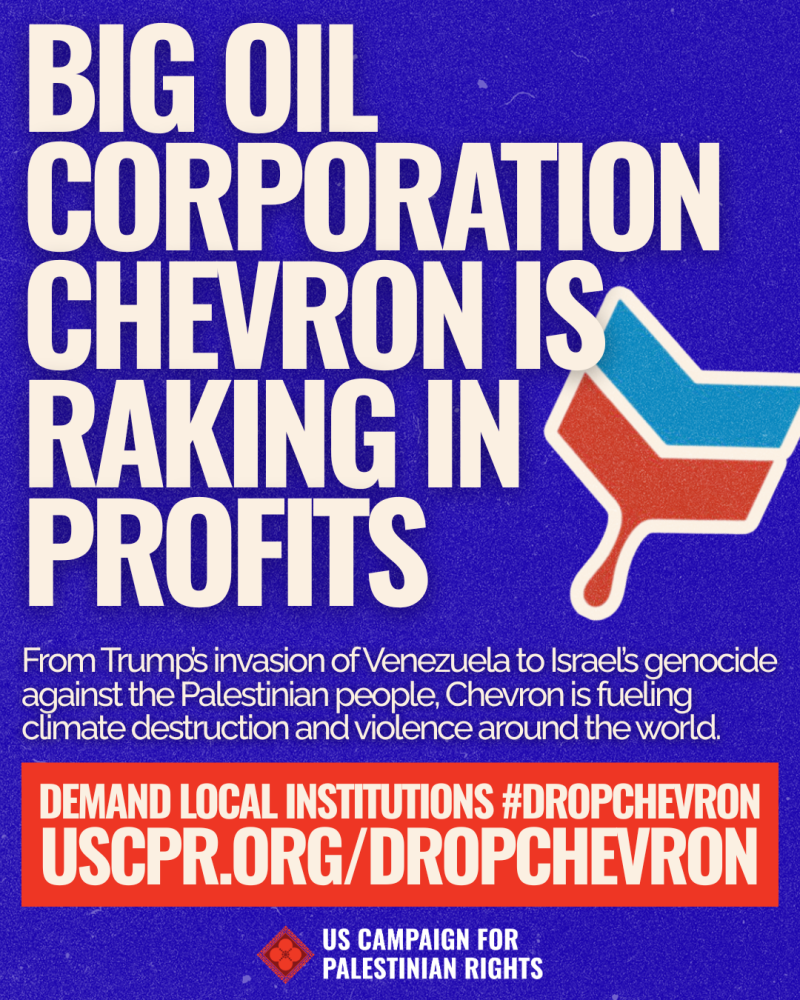
BOYCOTT CHEVRON NOW
Chevron is the only U.S.-owned oil corporation still operating in Venezuela, positioning it to be first in line to profit after Trump's invasion to steal Venezuelan oil. Trump has promised oil executives "total safety" and government protection for their investments as they move to exploit Venezuela's resources.4
Meanwhile, the communities bearing the brunt of Chevron's operations get nothing but pollution and violence.
Chevron has a long history of harming people and the planet, from fueling electricity for Israeli military bases, to processing heavy oil with devastating pollution in U.S. Gulf Coast marginalized communities, to dumping 16 billion gallons of toxic wastewater in the Amazon rainforest.5
Chevron continues to operate business as usual because it can reliably launder its brand image through sponsorships. By affiliating with sports teams, cultural institutions, and community events that do real good work, Chevron tries to clean up its blood-soaked reputation.
But organizers are fighting back… and winning.
The Denver Colfax Marathon, the LGBT Center on Colfax, the California State Fair, and City Club Portland have all cut ties with Chevron. These groups dropped Chevron after their communities raised concerns about its complicity in global systems of harm, colonial violence, climate destruction, and violations of human rights.
The pressure is working. Every sponsorship Chevron loses is another blow to their ability to greenwash genocide and climate destruction. Now we need to raise the stakes.
Take action: It's time for institutions everywhere to #DropChevron
DEMAND INSTITUTIONS #DROPCHEVRON
It only takes a few minutes to pressure multiple entities to drop Chevron as a sponsor—from universities to sports leagues to cultural institutions.
Your message will tell these organizations: It is your duty to listen to your community. Join the ranks of good faith organizations who have rightfully chosen to cut ties with this Big Oil war profiteer.
Every institution that cuts ties sends a message: Profiting from violence and destruction is unacceptable. Take action now.
Onward to liberation,
AHMAD ABUZNAID
Executive Director
US Campaign for Palestinian Rights
2030.

21 januari 2026
Gaza Humanitarian Response
Situation Report No. 63
20 January 2026
(As of 18:00 on 19 January 2026, unless otherwise noted)
HIGHLIGHTS
- As of 17 January, 25 Food Security partners continued to prepare and deliver 1,672,000 hot meals daily, including 512,000 meals in northern Gaza and 1,160,000 meals in the south.
- Between 14 and 17 January, Shelter Cluster partners reached 12,637 households with emergency shelter and non-food items through in-kind and voucher-based modalities. Assistance included tents, tarpaulins, bedding items, and kitchen sets.
- The second round of the catch‑up child immunization campaign began on 18 January and will run for 10 days. The campaign, conducted through 170 fixed and mobile teams, aims to reach about 18,000 children under the age of three during this round.
- On 19 January, WHO facilitated the evacuation of 21 patients and 36 companions out of Gaza for treatment in Jordan.
SITUATION OVERVIEW
Between 15 and 18 January, reports of airstrikes, shelling and gunfire continued across the Gaza Strip.
On 21 January, the Israeli military dropped leaflets in Bani Suhaila, eastern Khan Younis, located east of the so-called “Yellow Line” ordering people to evacuate immediately. OCHA estimates that more than 400 families remain in the area and partners have not yet observed any movement.
According to the Site Management Cluster’s (SMC) winter alert dashboard, an additional 89 displacement sites have been affected by strong winds, heavy rains, and flooding between 12 and 16 January, beyond the 106 sites that already reported storm-related impact at the end of last week. Overall, an additional 4,000 households, or nearly 17,000 people, have been affected, and approximately 1,400 have been displaced from Khan Younis to Gaza city. The Ministry of Health in Gaza also reports that a 27-day old infant and a six-months-old baby died due to the cold between 17 and 20 January, bringing total reported child deaths from the cold to nine since the beginning of the winter season.
Recent adverse weather conditions also continue to impact the food security response. Partners have reported that home gardening sites have been damaged by flooding or become inaccessible to families. Stock losses caused by spoilage or rain exposure during entry into the Strip have also increased and are expected to continue throughout the winter unless access impediments are lifted. This has added pressure on partners’ already limited warehouse capacity and further saturated existing disposal mechanisms in the Strip.
The Shelter Cluster and the Cash Working Group, in collaboration with REACH-IMPACT, published the results of a recent market monitoring exercise on shelter and household items. The assessment, conducted between 13 and 18 December, covered 55 markets and included interviews with 732 vendors of shelter and household items across the Gaza Strip.
Market monitoring indicates that supply conditions remained relatively stable during the reporting period, supported by the continued entry of both humanitarian and commercial commodities. Despite this, prices of basic food and non‑food items remain high, with ongoing short-term volatility. The Gaza Consumer Price Index continues to register prices well above the pre‑war baseline, signaling sustained pressure on household purchasing power and reinforcing the crucial role of MPCA in enabling access to essential goods. However, liquidity constraints persist, and cash‑out commissions remain elevated (around 15 per cent in January), continuing to erode the real value of assistance received by households.
In a statement issued on 19 January, the World Food Programme (WFP) stressed that critical progress has been made in pushing back famine, with the agency and its partners assisting more than one million people every month through food parcels, bread bundles, hot meals and school meals, supporting 60,000 households monthly through digital cash assistance to buy food from local markets and reaching 200,000 pregnant and breastfeeding women and children under five with malnutrition prevention and 14,000 women with treatment every month, while warning that food security gains remain fragile. WFP called for additional safe humanitarian corridors from Egypt and Jordan, and the reopening of Salah Ad Deen Road inside Gaza, to increase volumes and reduce insecurity.
The Mekorot pipeline serving Gaza city – the largest single water source for the north -- was damaged, and an assessment identified the need for a 30‑meter section of 24‑inch steel pipe that is not available in Gaza. As a result, 60 per cent of Gaza city has been affected by water service disruptions
UNITED NATIONS-COORDINATED AID ENTRY*
Between 16 and 19 January, at least 2,857 pallets of aid administered by the UN and its partners were offloaded at Gaza’s crossings, based on data retrieved from the UN2720 Mechanism dashboard at 17:00 on 20 January. About 60 per cent of these pallets contained food, followed by shelter (19per cent), WASH supplies (9 per cent), health items (8 per cent), education (3 per cent) and nutrition assistance (2 per cent).
During the same reporting period, UNOPS international monitors deployed at Gaza’s crossings verified the collection of at least 7,136 pallets of aid – 6,039 from Kerem Shalom Crossing and 1,097 from Zikim Crossing. These comprised inter alia over 4,120 pallets of food assistance, more than 2,230 pallets of shelter items including tents, blankets, tarpaulins and kitchenware, over 650 pallets of WASH items, such as water tap stands and hygiene kits, 93 pallets of animal feed, and 37 pallets of educational kits.
Overall, between the announcement of the ceasefire on 10 October 2025 and 19 January 2026, at least 246,264 pallets of humanitarian cargo were offloaded, and 239,927 pallets were collected from the various crossings. Some 1,532 pallets, less than one per cent of all uplifted aid, were intercepted during transit within Gaza.
*The above data does not include bilateral donations and the commercial sector.
On 18 January, UNOPS conducted a major fuel collection and delivery operation via Kerem Shalom as part of its humanitarian fuel import framework. The mission involved UNOPS fuel staff, UN 2720 monitors, two UNOPS vehicles and 12 fuel tankers. A total of 390,450 litres of diesel were loaded, transported and secured at a UNOPS-affiliated fuel facility, for onward distribution following partner prioritization and allocation.
Between 16 and 19 January, a total of 20 humanitarian movements requiring coordination with Israeli authorities were reported. Of these, 11 movements (55 per cent) were facilitated, enabling inter alia the movement of food, health, WASH and fuel supplies, as well as the medical evacuation of patients to Jordan for specialized treatment (see below). Four movements faced impediments (20 per cent) but were eventually fully accomplished. Four other movements (20 per cent) were cancelled by the organizing agencies, while one mission -- an exploratory mission to assess the feasibility of upcoming medical evacuations from Rafah -- was denied by the Israeli authorities.
HUMANITARIAN RESPONSE
The below are preliminary updates shared by Clusters at the time of reporting and will be reconciled and aggregated in the coming days as Clusters receive more data from the capillary network of partners active on the ground.
Food Security
- As of 17 January, 25 Food Security Sector partners continued to prepare 1,672,000 hot meals daily through 183 kitchens; these include 512,000 meals through 48 kitchens in northern Gaza and 1,160,000 meals through 135 kitchens in southern Gaza. To promote and strengthen hygiene practices at cooking facilities, partners are coordinating with Health and WASH actors to ensure an adequate supply of soap and its proper use by workers in community kitchens.
- Household-level general food distributions continue. As of 11 January, partners had reached more than 86,000 families (410,000 people) with a full ration of two wheat flour bags and two food boxes as part of the monthly distribution cycle.
- In January, partners brought in approximately 370 metric tons (mt) of animal feed, with additional shipments arriving each week. One round of distribution to around 2,050 herders, providing three 50‑kg bags of feed per animal holder, was completed in the first half of January, and a second round targeting the same group began on 18 January. In addition, 242 donkey owners supporting essential services also received fodder and veterinary kits.
- Partners continue working to strengthen communication with beneficiaries, ensuring families receive sufficient notice to collect their assistance once they are notified and clearly understand the type and quantity of assistance, they are eligible to receive, particularly given the frequent changes in available items over the past two months, which has challenged information sharing.
Water, Sanitation and Hygiene
- The Mekorot pipeline serving Gaza city – the largest single water source for the north -- was damaged, and an assessment identified the need for a 30‑meter section of 24‑inch steel pipe that is not available in Gaza. As a result, 60 per cent of Gaza city has been affected by water service disruptions. In response, WASH partners are scaling up water trucking and identifying alternative sources. Meanwhile, a partner’s request for access to repair the Safa wells, another major water source for Gaza city, was denied on 19 January by the Israeli authorities.
- Between 16 and 18 January, cluster partners facilitated the entry of enough water treatment chemicals to meet needs until the end of March. However, pesticides needed for vector control activities have been denied entry.
- In recent weeks, partners have facilitated the entry of 16 tipper trucks, 75 solid waste containers, and tires for solid waste vehicles, which will help scale up waste collection across the Strip, noting that capacity varies significantly between the south and the north. In southern Gaza, solid waste collection is currently keeping pace with waste production. However, two of the temporary dumpsites are now full, and the two largest sites have only two months of capacity left, with the cluster requiring decongestion to transport waste to long‑term sites. In northern Gaza, no viable solid waste sites are currently available, and waste collection does not meet production levels. The temporary sites in use are already over capacity but continue to receive waste. Development of a new site in Abu Jarad, in Gaza city, is underway but will take at least one month before it can begin receiving waste.
- Between 16 and 18 January, selected shelter sites received a range of services, including 1,247 cubic metres (m³) of water delivered through trucking, more than 7,000 m³ of water produced from wells, 976 tons of waste transported, 12 pest control campaigns held, 115 hygiene promotion sessions delivered, and 118 storm drain manholes cleared.
- Between 16 and 18 January, cluster partners distributed 1,610 latrines for people with disabilities, 1,400 hygiene kits, and 494,000 bars of soap across the Strip.
Health
- The second round of the catch‑up immunization campaign began on 18 January and will run for 10 days. The campaign aims to improve the immunization status of children under three years of age. Vaccinations are being provided through 170 fixed and mobile teams, with the target of reaching 17,892 children during this round. A third and final round is planned for April.
- On 19 January, WHO facilitated the evacuation of 21 patients and 36 companions out of Gaza for treatment in Jordan.
- As part of ongoing health facility expansion efforts, partners expanded the emergency department and triage area of the Al Amal Hospital in Khan Younis. The facility has also begun providing inpatient and outpatient ophthalmology services. Furthermore, a number of prefabricated structures have been installed in hospitals and primary healthcare centres across the Strip to increase capacity.
- Following the launch of Limb Reconstruction Screening Programme at Nasser Medical Complex on 7 January, 120 patients have thus far been screened. At least 30 patients (25 per cent), were identified as having complex limb injuries requiring major reconstructive surgeries. It is estimated that around 20,000 patients require major limb reconstruction interventions and long‑term rehabilitation, while orthoplastic supplies remain limited.
Shelter
- Between 14 and 17 January, Shelter Cluster partners delivered emergency shelter and non-food items (NFIs) assistance through in-kind and voucher-based modalities, reaching a total of 12,637 households. Distributions included 1,389 tents, 6,866 tarpaulins, 25,070 bedding items, 2,271 kitchen sets and 2,348 clothing kits and vouchers.
- In addition, as part of an inter-sectoral joint response to storm-related incidents, partners distributed 661 tents and 319 clothing kits, along with blankets and tarpaulins, to 661 households across the Strip, providing support to families whose shelter was affected by heavy rainfalls.
Site Management
- Between 16 and 18 January, Site Management Cluster (SMC) partners actively carried out site improvement and maintenance works across 184 sites across the Strip, engaging 894 displaced people through Cash for Work (CFW) initiatives. Activities included constructing water channels, backfilling areas with sand, particularly where soil conditions are poor, cleaning and removing debris. Site committees with 899 participants, including over 292 women, played a key role in identifying needs and implementing these community‑driven activities. Additional community-led initiatives, supported by US$5,000 cash grants per site across 40 sites, focused on lighting installations, waste decommissioning, and minor shelter repairs for vulnerable families.
- SMC partners also continued winter response efforts distributing 293 baby kits to infants across 27 sites across the Strip, with another 94 kits yet to be distributed. Referrals were made to Shelter and Protection partners for incident follow‑up and support with birth certificates. In collaboration with WASH partners, awareness sessions were held on the risks of open pit usage and safe decommissioning of unused pits. Safety audits in nine sites in Deir Al Balah resulted in targeted improvement interventions, including shelter and lighting installations, some of which are scheduled for completion within the week.
- Despite progress, several challenges continue to hinder winterization efforts. A major obstacle is the difficulty in securing fuel required for sand trucking and solid‑waste management operations. Another pressing issue is the shortage of sandbags: supplies are unavailable, and the flour bags used as substitutes are in limited supply. Ongoing market shortages and poor quality of locally available tools further reduce the efficiency of maintenance work. In response to increased needs, Food Security partners notified SMC of 20,000 additional flour sacks available for collection, and SMC will coordinate distribution among partners to help address these gaps.
Protection
- Between 15 and 18 January, partners conducted activities across Gaza city, North Gaza, Deir al Balah and Khan Younis, reaching over 20,000 people.
- Over 7,500 people participated in protection against sexual exploitation and abuse and safeguarding awareness sessions. Partners delivered 186 legal consultations, 39 legal awareness workshops, over 1,000 individual and group mental health and psychosocial support sessions, and more than 500 rehabilitation and therapy sessions. They also distributed more than 350 food parcels and more than 400 protection‑sensitive NFIs, health, and dignity kits. Fifty protection practitioners were trained, and more than 30 staff received wellbeing and self‑care support.
- Demand for explosive ordnance risk education (EORE), safeguarding and legal awareness remains high amid continued displacement. Persistent gaps in shelter, NFIs, WASH and energy supplies are increasing protection risks, reinforcing the need for integrated responses and ongoing support for staff wellbeing.
- Child Protection
- Between 15 and 18 January, Child Protection partners reached over 4,400 children and more than 2,600 caregivers through psychosocial, recreational and rehabilitation, as well as case management services.
- As part of ongoing winterization support, partners reached over 1,900 children with winter clothing, and over 3,800 with blankets in Khan Younis, while 466 winterization kits were distributed in Al Shatea Camp in northern Gaza. Additional winter support included the provision of shoes to 217 children aged 4–7 years in multiple displacement camps and clothing kits for 229 children aged 2–4 years in Gaza City, with blankets also provided to their families.
- Prevention and awareness activities benefited more than 3,800 children and caregivers across all areas. Sessions covered family separation risks, reporting of child protection concerns, exploitation, and abuse risks, and EORE messages tailored to children, caregivers and children with disabilities.
- Prevention of Gender-Based Violence (GBV):
- Between 15 and 18 January, activities addressing Gender-Based Violence (GBV) continued across the Strip through the coordinated efforts of partners:
- Menstrual Hygiene Management (MHM) support was scaled up through the distribution of 6,700 MHM materials to women and girls across Gaza.
- Targeted assistance was also extended to female‑headed households at heightened risk of GBV, including the provision of 15 emergency tents. This support contributed to improved safety, privacy and living conditions for women and girls facing increased protection risks.
- Multi‑sectoral GBV prevention and addressing services continued through 56 Women and Girls’ Safe Spaces across Gaza, reaching approximately 5,699 women and girls. Services were delivered in line with survivor‑centered and do‑no‑harm principles and included psychosocial support, GBV case management, legal awareness and information on GBV risks, available services, and referral pathways.
- Between 15 and 18 January, activities addressing Gender-Based Violence (GBV) continued across the Strip through the coordinated efforts of partners:
- Mine Action
- Between 15 and 18 January, partners conducted 74 Explosive Hazard Assessments in support of debris removal activities, while also conducting critical access route assessments in Deir al Balah.
- During the same period, four EORE sessions were conducted across the Strip, reaching 5,600 people.
- No new explosive ordnance incidents were recorded.
Multi-Purpose Cash Assistance (MPCA)
- Between 15 and 18 January, Cash Working Group (CWG) partners distributed Multi‑Purpose Cash Assistance (MPCA) to over 6,800 households across the Strip. Each household received NIS1,250 (approximately US$378) through digital payment modalities, in line with the agreed Minimum Expenditure Basket transfer value.
2029.

21 januari 2026
West Bank Monthly Snapshot
Casualties, Property Damage and Displacement
December 2025


2028.
20 januari 2026
Israeli Genocide Propagandist Detained in Canada After HRF Complaint: Step by Step, the Net Is Closing

Brussels, 20 January 2026
Yesterday, following a filing by the Hind Rajab Foundation (HRF) and its partners CLAIHR, ICJP, and LCP, genocide propagandist and former soldier Guy Hochman was detained in Canada. This is a small but real victory: a concrete sign that the wall of impunity can be pierced, and that those who glorify, promote, or participate in crimes linked to Gaza can no longer assume they will move freely without consequence. Coming after the arrests in Belgium, warrants issued in Brazil, and investigations opened in several countries, Hochman's detention confirms a widening shift: accountability is no longer a slogan.
Today, HRF has taken the next step by filing a criminal complaint in New York, extending legal scrutiny into the United States as Hochman continues to travel internationally. Over the past two weeks, HRF has filed several additional cases against soldiers and officiers across multiple jurisdictions. For strategic and legal reasons, most cannot yet be disclosed. At this stage, HRF is communicating publicly only on three of those filings, presented below. Step by step, case by case, jurisdiction by jurisdiction, we will end Israeli impunity.

After Canada Detention, HRF Files Complaint Against Guy Hochman in the United States
Brussels, 20 January 2026
The Hind Rajab Foundation (HRF) has escalated legal action against Guy Hochman, an Israeli propagandist and suspected war criminal, by filing an urgent request for prosecution in the United States, supported by an extensive evidentiary dossier documenting war crimes, direct incitement to genocide in connection with Israel's crimes in Gaza.
The seriousness of these allegations was underscored yesterday in Canada, where Hochman was detained and subjected to a prolonged interrogation at Toronto Pearson International Airport following the submission of our complaint and the handover of its investigative dossier to the authorities. Hochman was reportedly released only after intervention by the Israeli embassy, highlighting both the gravity of the allegations and the pressures aiming to obstruct justice and accountability.
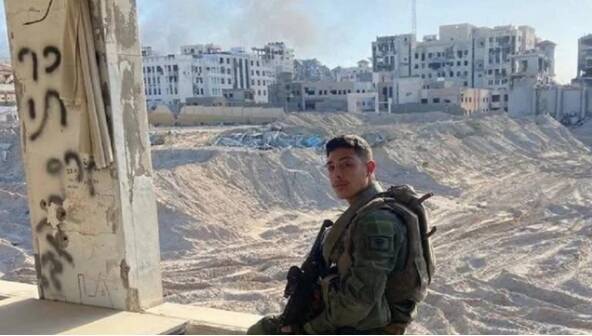

HRF Files Criminal Complaint in Prague Against IDF Soldier Hagay Monsonego
Israeli soldier Hagay Monsonego took part in Gaza's devastation—homes burned, hospitals and universities destroyed, civilians kidnapped and abused.
HRF Files Complaint in Italy Against IDF Soldier Israel Yitzhki for Genocide
HRF moves against IDFer Israel Yitzhki in Italy, accusing him of war crimes, crimes against humanity, and acts contributing to genocide in Gaza.
HRF Files Criminal Complaint in Austria Against Israeli Soldier Yonatan Akriv
HRF files a criminal complaint in Austria against Israeli soldier Yonatan Akriv, accusing him of war crimes and acts contributing to genocide in Gaza.
2027.


19 januari 2026
Welcome to our Weekly Briefing newsletter
Our Weekly Briefing is published every Sunday with a roundup of the stories we covered, put into context you can only find in the newsletter. You can find an archive of past Weekly Briefing's here.
Mondoweiss has been an integral part of the Palestine solidarity movement for years. The movement is growing like never before and movement journalism is essential to those seeking to create social and political change.
Today more than ever, we are committed to informing the Palestine movement from our on-the-ground reporting from Palestine and providing a platform to voices from across the world who are shifting the discourse on Palestine.
Thanks for subscribing, and welcome to Mondoweiss.
2026.

18 januari 2026
Support War Refusers
We, refusers, are often quiet about the social and emotional consequences of refusing to serve the army. As a public-facing activist, I forced myself to put on a brave face and not show the impact prison had on me. I wanted the public to focus on my message: a stop to the endless occupation. I also felt guilty to admit I was struggling because I felt that I could not complain while Palestinians suffer horrendous abuses and crimes against humanity in Israeli prisons and under the occupation at large. But today, I understand that this perspective is unproductive, for myself and for the anti-war movement, as it prohibits self-care, causes burnout, and makes resistance unsustainable. Mental health is not a luxury, but an essential part of resistance and social change.
As a result of my refusal many years ago, I was facing the brunt of social exclusion at the hands of a thoroughly militarised Israeli society. I was forced out of my youth movement and the commune I was living. I lost friends who did not understand and had heated discussions with family members. Military prison, of course, was in itself difficult to bear. In prison I was alone, forced to follow military procedures, and fellow inmates were often violent toward me. The hardest part was that I didn't know when I would be released. I remember a time when I started to feel like I could not handle it anymore. I was conflicted because while I was hurting, It was my own decision to be there by publicly refusing. Until today I carry with me scars from my time in prison.There was no support system for activists at the time. I felt so alone.
Support War Refusers
ack then I thought that I was the only refuser who struggled. Later on, I realized my struggles were not mine – they are shared by all refusers. In conversations with younger refusers, we decided to form a support circle. We offer an emotional support system through trained therapists that build a support group for past, present and future refusers, where bravery and heroism can be put aside. Our support circle equips refusers with a necessary infrastructure of support and care: they receive emotional and social support, learn coping strategies and hear about each other's experiences. We help refusers to transform their experience from emotional struggles to sources of empowerment. We change the culture of the movement from toxic heroism to self and community-care, and compassion. We also plan to use the knowledge garnered from our support group to publish a self-care handbook with emotional and practical advice for future refusers.
When I refused, our movement did not yet offer this type of crucial support. We need potential refusers to know that if they refuse, we will be there for them. Our psychosocial support forum is only possible because of you, Nico, and your support.
We ask all our friends abroad to make a donation today to make this program possible for the long-haul. Only with these kinds of long-term support structures can we give our movement longevity If we want to build long-term opposition to the military-industrial complex and demilitarize the world over, we need structures of care.
Support War Refusers
In solidarity,
Mattan Helman
Refuser Solidarity Network
2025.

16 januari 2026
Gaza Humanitarian Response
Situation Report No. 62
16 January 2026
(As of 18:00 on 15 January 2026, unless otherwise noted)
HIGHLIGHTS
- Between 12 and 15 January, severe weather affected 106 displacement sites across the Gaza Strip, impacting over 19,000 people. At least 34 people were reported injured and seven killed amid widespread damage to shelter and water and sanitation networks.
- Overall, as of 14 January, 31 storm-related deaths, including seven children who died from hypothermia, were reported by the Ministry of Health (MoH) since the onset of the winter season.
- Between 10 and 14 January, Cash Working Group partners distributed multi-purpose cash assistance to more than 2,500 households and confirmed 52,000 households pre-booked for January 2026.
SITUATION OVERVIEW
Between 12 and 15 January, airstrikes, shelling and gunfire continued to be reported across the Gaza Strip. According to the MoH in Gaza, 14 Palestinians were killed and 23 others injured over the last 48 hours, bringing the total casualty toll reported by MoH since 11 October 2025 to 463 killed and 1,269 injured.
During the reporting period, heavy rain, strong winds and flooding continued to affect civilians across the Gaza Strip, particularly displaced families living in makeshift shelters and flood-prone areas. According to the Site Management Cluster (SMC), 106 displacement sites reported storm-related impact, with 86 per cent of all incidents recorded after 13 January. A total of 4,136 households (approximately 19,230 people) were affected, with 34 injuries and seven fatalities reported, and at least 287 people newly displaced. Field reports confirmed extensive structural damage, including 3,455 tents and makeshift shelters destroyed or severely damaged, as well as 253 water, sanitation and hygiene (WASH) facilities rendered non-functional.
Priority needs in affected sites include emergency shelter materials—particularly tents, tarpaulins, ropes and sandbags—as well as essential non-food items such as bedding and winter clothing. Urgent WASH intervention needs were also identified, including drainage improvements, wastewater management, and repairs to damaged latrines to improve people’s living conditions.
UNITED NATIONS-COORDINATED AID ENTRY*
Between 13 and 15 January, at least 7,571 pallets of aid administered by the UN and its partners were offloaded at Gaza’s crossings, based on data retrieved from the UN 2720 Mechanism dashboard at 18:00 on 15 January. About 72 per cent of these pallets contained food, followed by shelter (14 per cent), WASH supplies (8 per cent), health items (4 per cent), and education and nutrition assistance (1 per cent).
During the same reporting period, UNOPS international monitors deployed at Gaza’s crossings verified the collection of at least 3,495 pallets of aid – all collected from Kerem Shalom Crossing. These comprised inter alia over 1,370 pallets of food assistance, more than 750 pallets of shelter items including tents, blankets, tarpaulins and kitchenware, over 640 pallets of WASH items, such as water chemicals and hygiene kits, and 550 pallets of health supplies.
Overall, between the announcement of the ceasefire on 10 October 2025 and 15 January 2026, at least 244,623 pallets of humanitarian cargo were offloaded, and 236,063 pallets collected from the various crossings. Only 1,532 pallets, or one per cent of all uplifted aid, was intercepted during transit within Gaza.
The above data does not include bilateral donations and the commercial sector.
Between 13 and 15 January, a total of 26 humanitarian movements requiring coordination with Israeli authorities were reported. Of these, 17 movements (65 per cent) were facilitated, enabling inter alia the movement of food, health, WASH, and fuel supplies. Three movements faced impediments (11 per cent), of which one was ultimately fully accomplished, while two could only be partially completed. Four other movements (15 per cent) were cancelled by the organizing agencies, while two (8 per cent) were denied by the Israeli authorities.
HUMANITARIAN RESPONSE
The below are preliminary updates shared by Clusters at the time of reporting and will be reconciled and aggregated in the coming days as Clusters receive more data from the capillary network of partners active on the ground.
Water, Sanitation and Hygiene
- WASH Cluster partners continued priority life-saving activities across the Gaza Strip, including water trucking and repairs to water and sewage networks. Despite ongoing fuel constraints, prioritized interventions continued, although service levels remained below those recorded prior to the fuel crisis.
- Between 12 and 15 January, partners distributed 500,000 bars of soap, 6,660 dignity kits, 200 chlorine bottles, 12 hygiene kits, and 17 water tanks to support hygiene and water access across affected areas.
- Partners repaired damages at the Mekorot North water connection and conducted emergency maintenance on the Emirati desalinated water carrier line. Inspections identified 13 leaks along the HDPE pipeline, all of which were repaired during the reporting period.
- As of 15 January, solid waste accumulation remained critical, particularly north of Wadi Gaza. While technical planning for the Abo Jarad temporary dump site continued, the Feras Market remains the only operational dump site in the area, with dangerously high levels of waste posing risks of collapse onto Omar Mukhtar Street. South of Wadi Gaza, the two remaining operational temporary dump sites are projected to reach capacity within approximately two months.
Health
- As of 14 January, 31 storm-related deaths have been reported by MoH, including seven children who died due to hypothermia and 24 people killed by collapsing structures. Between 12 and 14 January, an inter-sectoral assessment was initiated to investigate hypothermia-related deaths. The Sexual and Reproductive Health Technical Working Group has also begun to coordinated case identification to refer vulnerable newborns and pregnant women for inter-sectoral support, including shelter and storm-related assistance.
- Since the ceasefire, health partners established 26 new Health Service Points (HSPs) and resumed operations in 36 others, increasing HSP functionality from 33 per cent prior to the ceasefire to 40 per cent currently. Approximately 70 per cent of this increase was in northern Gaza.
- Between October 2025 and 15 January 2026, hospital expansion efforts continued. The Nasser Medical Complex in Khan Younis increased its capacity by 140 beds for specialized surgeries and rehabilitation, while Al-Awda Hospital in Deir al Balah established a neonatal intensive care unit with a capacity of five incubators.
- Between 18 and 29 January, Health Cluster partners plan to conduct the second round of the catch-up immunization campaign targeting children under three years across all governorates.
Shelter
- Between 12 and 14 January, Shelter Cluster partners delivered emergency shelter and non-food items (NFIs) assistance through in-kind and voucher-based modalities, reaching a total of 14,801 households. Distributions included 202 tents, 7,675 tarpaulins, 3,552 bedding items, 15,003 blankets, 1,558 kitchen sets, 1,843 clothing kits and vouchers, 391 solar lights, and 664 sealing-off kits.
- In addition, as part of an inter-sectoral joint response to storm-related incidents, partners distributed 1,370 tents, along with blankets and tarpaulins, to 1,370 households across the Gaza Strip. Shelter Cluster partners reported that tents allocated for joint distributions are nearing depletion.
- Repeated winter storms have caused severe damage to tents and makeshift shelters, particularly in areas with weak foundations and water-saturated soil. Given the limited availability of shelter materials and the absence of durable housing solutions, these impacts are expected to persist, with temporary materials often deteriorating within weeks.
- Field observations indicate that displaced families are trying to reinforce shelters using improvised methods, including tying tents together and securing tarpaulins with metal wires due to the unavailability of ropes. Beyond the critical need for shelter and NFIs, heavy equipment for debris removal, rubble crushing, and site levelling, as well as plastic sandbags and basic tools, are also urgently required.
Protection
- Between 12 and 14 January, protection partners conducted activities across Gaza city, North Gaza, Deir al Balah and Khan Younis, reaching over 17,900 people.
- Partners report that protection needs continue to outpace available resources, resulting in gaps in mental health and psychosocial support, rehabilitation services, winterization assistance and sustained case management, particularly for families experiencing repeated displacement.
- Child Protection
- Between 12 and 14 January, Child Protection partners reached over 1,300 children and nearly 190 caregivers through psychosocial, recreational, and rehabilitation services in Gaza city, and Deir al Balah, including in displacement sites.
- More than 440 children received winterization assistance, including clothing kits for children aged 2–4 years and winter shoes for children aged 4–7 years, alongside blankets for their families.
- Prevention of Gender-Based Violence (GBV):
- Between 12 and 14 January, partners working on addressing and preventing GBV reached 1,353 people with group and individual counselling, psychological first aid (PFA), and awareness sessions.
- Mental health awareness activities reached 283 women and girls, including 37 women and girls with disabilities. PFA was provided to 102 women, while individual counselling was provided to 64 women.
- Legal services reached 709 women through legal awareness sessions, consultations, and mediation support.
- Partners distributed over 900 health kits to women and adolescent girls across Deir al Balah and Gaza city, alongside 110 winter blankets for vulnerable families in the same governorates.
- Three awareness workshops on sexual violence and GBV were also delivered, benefiting 55 participants.
- Mine Action
- Between 12 and 14 January, mine action partners conducted 63 Explosive Hazard Assessments in An Nuseirat, northern Deir al Balah, in support of debris removal activities.
- During the same period, no new explosive ordnance (EO) incidents were recorded; however, backdated data continued to be received. Since October 2023, 207 EO-related incidents have been recorded, resulting in 470 casualties (73 killed and 397 injured).
Multi-Purpose Cash Assistance (MPCA)
- Between 10 and 14 January, Cash Working Group (CWG) partners distributed MPCA to approximately 2,550 households (around 14,000 people). As of mid-January, CWG confirmed that 52,000 households were pre-booked for MPCA in January, of which 23,000 were reached during the first two weeks of the year.
- During the same period, CWG partners called for sustained scale-up to maintain an average reach of at least 100,000 households per month, building on the 113,240 households assisted in December 2025.
All figures solely refer to UN and partner assistance dispatched through the UN-coordinated system. They are preliminary and will be reconciled in the course of the ceasefire. Supplies entering through bilateral donations and the commercial sector are not reflected.
2024.

16 januari 2026
Nieuwe plannen van de Israëlische regering zullen er waarschijnlijk toe leiden dat Israël nog dit jaar de Westelijke Jordaanoever in tweeën zal knippen, en Palestijns Oost-Jeruzalem verder zal isoleren. Het project past in het plan van Israël om een Palestijnse staat onmogelijk te maken.
E1
Eén van die plannen is de bouw van ruim 3400 woningen voor kolonisten in het gebied dat E1 (East 1, ten oosten van Jeruzalem) wordt genoemd. Als het af is, wordt de al bestaande illegale nederzetting Ma’ale Adumim verbonden met Joodse nederzettingen in bezet Palestijns Oost-Jeruzalem.
Ook in Oost-Jeruzalem zelf wordt de Palestijnse bevolking verdreven: in de Palestijnse wijk Sheikh Jarrah, bijvoorbeeld, moet van Israël de buurt Um Haroun tegen de vlakte om plaats te maken voor ruim 300 huizen voor kolonisten.
De Israëlische mensenrechtenorganisatie Peace Now zegt daarover: ‘Dit zijn destructieve plannen die, als ze worden uitgevoerd, verhinderen dat Oost-Jeruzalem als Palestijnse hoofdstad kan fungeren, en Oost-Jeruzalem loskoppelen van de omliggende gebieden. Daardoor wordt de mogelijkheid van een vreedzame oplossing tussen Israëli’s en Palestijnen praktisch uitgesloten.’

De situatie rondom de plannen voor de E1 en de ‘Soevereiniteitsweg’. Kaart gemaakt door Peace Now.
Apartheidsweg
Deze week werd bekend dat ook de aanleg van een weg van start gaat, waarschijnlijk nog voor de lente. Die weg, die alleen Israëli's mogen gebruiken en dus een apartheidsweg is, maakt een deel van de Westelijke Jordaanoever onbereikbaar voor Palestijnen. Israël noemt de weg ‘Soevereiniteitsweg’. Als die er eenmaal ligt, moeten Palestijnen via een flinke omweg én via nieuwe checkpoints en blokkades, van het zuiden van de Westoever naar het noorden, of andersom.
Palestijnse staat onmogelijk gemaakt
De plannen tezamen maken een levensvatbare Palestijnse staat en daarmee de tweestatenoplossing definitief onmogelijk. Dat dit precies de bedoeling is, maken Israëlische politici keer op keer duidelijk. Bij een bezoek aan Ma’ale Adumim afgelopen september, zei Netanyahu: ‘Wij gaan onze belofte waarmaken dat er geen Palestijnse staat zal komen. Deze plek behoort ons toe. Wij gaan de bevolking van de stad verdubbelen.’
Europees Burgerinitiatief | Eis een einde aan het EU-Israël-associatieakkoord
Een nieuw Europees Burgerinitiatief dat inmiddels al door ruim 200 duizend Europeanen is ondertekend, roept de Europese Commissie op om het EU-Israël Associatieakkoord volledig op te schorten.
Volgens de Europese Commissie en het Internationaal Gerechtshof schendt Israël op grove wijze het internationaal recht in Gaza, onder meer door het veroorzaken van massaal burgerleed, de vernietiging van medische infrastructuur en het blokkeren van humanitaire hulp. Desondanks blijft de EU dit akkoord handhaven, waardoor Israël kan blijven profiteren van onder meer de handelsvoordelen die daarin zijn opgenomen.
Met dit initiatief eisen burgers dat de EU haar medeplichtigheid stopt en concrete gevolgen verbindt aan de ernstige mensenrechtenschendingen in Gaza en op de Westelijke Jordaanoever. Steun het initiatief
Goede voorbeeld | Spanje eist dat platforms advertenties voor accommodaties in illegale nederzettingen verwijderen
Spanje heeft zeven multinationals laten weten dat ze advertenties voor vakantie-accommodaties in Israëlische nederzettingen in bezet Palestina moeten verwijderen van hun platforms. Dat heeft het Spaanse ministerie van Sociale Rechten en Consumentenzaken gezegd.
Als de bedrijven deze niet verwijderen, zullen er vervolgstappen worden genomen, aldus het ministerie. In de verklaring staat niet om welke zeven bedrijven het gaat. Kijkend naar welke multinationals in Spanje actief zijn én welke advertenties voor accommodaties in illegale Israëlische nederzettingen op hun websites hebben staan, kan het haast niet anders dat het ook Booking.com en Airbnb betreft.
Spanje koploper
Spanje geeft ook op andere wijze het goede voorbeeld. Vorige maand kondigde het land een verbod op de import van producten uit de nederzettingen en een wapenembargo aan. In mei 2024 erkende Spanje bovendien de Palestijnse staat samen met Noorwegen en Ierland, als een van de eerste West-Europese landen. Het sloot zich ook als eerste Europese land aan bij de genocide-zaak van Zuid-Afrika tegen Israël.
Rechtszaak
In Nederland heeft The Rights Forum samen met Al-Haq, SOMO en ELSC in 2024 een aangifte gedaan tegen het in Nederland gevestigde Booking.com vanwege activiteiten in bezet gebied. De Israëlische nederzettingen op de Westelijke Jordaanoever zijn illegaal onder internationaal recht en behelzen een oorlogsmisdaad.

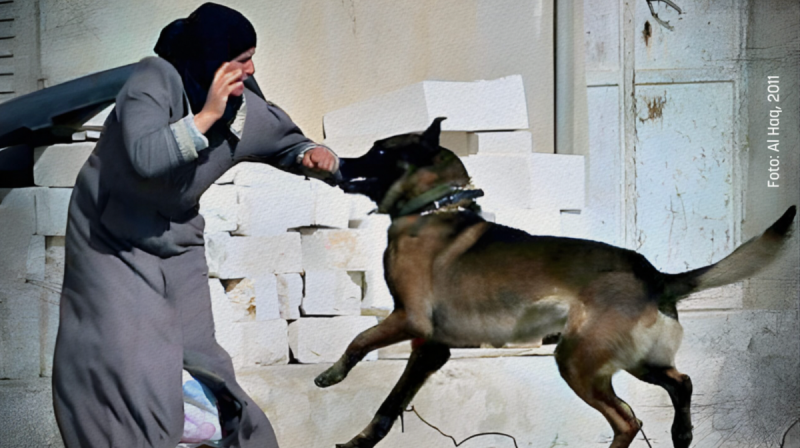
Kabinet wacht Israëlisch onderzoek af naar moord op twee Palestijnen die zich overgaven
Eigen onderzoeken van het Israëlische leger naar misdaden tegen de Palestijnse bevolking lopen steevast op niets uit. De weigering van demissionair minister Van Weel om zich uit te spreken over de executie van twee Palestijnen past naadloos in een jarenlange traditie van straffeloosheid en politieke lafheid.
Hondenleverancier Four Winds heft zichzelf op om vervolging te voorkomen
The Rights Forum, Al-Haq, Al Mezan en SOMO wilden de Brabantse hondenleverancier Four Winds voor de rechter slepen om de export van honden naar Israël te stoppen. Four Winds heeft zichzelf van de weeromstuit opgeheven.
Boek | De Schatkamers van Jiddo
De Palestijns-Nederlandse rapper Stryder brengt binnenkort zijn eerste boek uit: De schatkamers van Jiddo. In dit ontroerende verhaal over verlies, herinnering en de hoop op vrijheid volgen we Amal en haar opa, door wiens ogen een persoonlijke en universele geschiedenis wordt verteld.
Het boek markeert het schrijversdebuut van Stryder. Een onverwacht debuut, zo noemt hij het zelf, 'geboren uit de urgentie om onze eigen verhalen te vertellen — omdat niemand anders dat voor ons kan doen.' De schatkamers van Jiddo is geïllustreerd door Omar Al Sayed en verschijnt bij uitgeverij Tiny Travelers.
Het boek is vanaf nu te pre-orderen en is verkrijgbaar in zowel het Nederlands als het Engels. Van de opbrengst wordt 99% gedoneerd aan het Palestina Fonds van Stichting Plant een Olijfboom, ter ondersteuning van projecten die hoop en leven in Palestina versterken.
Uit onze agenda
zaterdag 17 januari t/m zaterdag 24 januari
DEMONSTRATIES EN WAKES
UTRECHT DOORDEWEEKSE DAGEN 08.30 - 09.30 | Dagelijks stilteprotest voor Palestina, tegen genocide en bezetting (Neude, langs het fietspad)
GRONINGEN ZA 17 JAN 13.00 | Tweewekelijkse wake van Vrouwen in het Zwart (Waagplein)
DEN BOSCH ZA 17 JAN 12.00 | Wake voor Palestina (Burgemeester Loeffplein)
HAARLEM ZO 18 JAN 14.00 | Wekelijks protest tegen de onderdrukking van de Palestijnen (Grote Markt)
AMSTERDAM ZO 18 JAN 17.00 | Stil protest tegen de onderdrukking van de Palestijnen (Spui, bij ‘t Lieverdje)
HUIZEN WO 21 JAN 11.30 | Wekelijkse sit-in voor Gaza (Gemeentehuis)
DEN HAAG DO 22 JAN 12.00 | Sit-in van Rijksambtenaren bij het ministerie van Buitenlandse Zaken, Rijnstraat 8
STATIONS IN NEDERLAND DO 22 JAN 18.00 | Wekelijkse lawaaidemonstratie op stations in heel Nederland: Stations Amersfoort, Assen, Ede-Wageningen, Groningen (mars vanaf Grote Markt 17.30 uur, sit-in station 18.30 uur), Harderwijk, Hengelo, Nijmegen, Tiel, Tilburg, Utrecht, Zaandam (17.00 uur), Zutphen
Let op: The Rights Forum probeert de verschillende stationsacties in Nederland zo goed mogelijk bij te houden, maar dat is niet altijd goed mogelijk. Houd de sociale media-pagina's van de plaatselijke solidariteitsorganisaties in de gaten voor de meest actuele informatie.
AMERSFOORT VR 23 JAN 09.30 | Wekelijks stilteprotest tegen genocide (Varkensmarkt)
DOETINCHEM VR 23 JAN 10.00 | Lawaaidemo en speech (op het plein voor het gemeentehuis)
CULTURELE EN ANDERE EVENEMENTEN
DIEREN ZA 17 JAN 10.00 - 17.00 | 2 jaar geleden werden Hind Rajab en haar familie door het Israëlische leger vermoord. Hun auto werd doorzeefd met kogels. In Dieren wordt een auto tentoongesteld als monument (Callunaplein)
ZWOLLE ZO 18 JAN 14.00 | Opening van Stichting Bisan, een nieuwe organisatie die zich inzet voor cultuur, gemeenschap en solidariteit in Zwolle en omgeving (Wresinski Theater)
TILBURG ZO 18 JAN 13.30 | Hart voor Gaza: workshops & fundraising (Kapel Mariengaarde)
DOETINCHEM DO 22 JAN 20.00 | Vertoning The Voice of Hind, met nagesprek. De film draait ook op 24, 25, 26, 27 en 31 januari en op 1 februari (Amphion Theater)
Onze agenda wordt doorlopend aangevuld. Bekijk de hele agenda
2023.

16 januari 2026
Upcoming Events You Want to Be a Part Of
If you were with us for our October Virtual Visit to Gaza, "3 Days Under the Rubble," you met Ghina, the little girl who survived when her family's building was bombed, martyring her father and brothers.
You also met her mother, Umm Abed, who repeated the words "There's fire inside me" - a mother's intuition that her daughter was still alive.
Before the webinar, Umm Abed was hesitant to appear on camera. But during the event, she grew empowered to share her voice and her story. By the end of it, she was asking us if we could give her another opportunity to speak.
Umm Abed on our October Virtual Visit to Gaza
Next Wednesday, January 21st at 12pm EST, at her request, we are having a webinar: “We Can Speak for Ourselves: A Conversation With Palestinian Women” where Umm Abed from Gaza will be joining us as well as former political prisoner and powerful poet Dareen Tatour from Reineh, occupied Palestine.
The event will be moderated by another powerful Palestinian woman, Ashira Darwish, a motivational speaker, investigative journalist, and the creator of Ashira Active Meditation - a trauma integration modality rooted in embodied movement, ancestral wisdom, liberation psychology, and neuro-somatic healing. Ashira was featured in the film "Where the Olive Trees Weep" and is the founder of Catharsis Holistic Healing, where she provides free therapy for Palestinian children who were imprisoned in military detention.
We hope to see you there!
2022.

15 januari 2026
From Palestine to Venezuela, Iran to Minneapolis, the Trump regime has threatened war, funded war, or is actively waging war — all to line his and his billionaire friends' pockets.
Fascists want us to feel too overwhelmed to resist. But we've shown time and time again that when we act together, we are a force to be reckoned with.

Masked ICE agents are abducting members of our communities from their homes, schools, and places of work. Billions are being spent bankrolling Israel's genocide in Gaza and Trump's war on Venezuela while millions in the U.S. can't access healthcare, food benefits, and other basic necessities. Our communities suffer while the Trump regime makes deals for corporations and billionaires to profit.
The answer, as always, is solidarity. At this moment of escalating fascist violence, each of our movements cannot afford to act alone. We must join forces and collectively refuse to comply. Come for one, face us all.
Join us online tonight to learn from partners about the upcoming Weekend of Action to hold corporations like Hilton accountable for enabling ICE's war on our communities.
RSVP for the mass call
Co-sponsors of tonight's mass call include Rising Majority, May Day Strong, Sunrise Movement, Showing Up for Racial Justice, Scholars for Social Justice, Care in Action, PowerSwitch Action, and Organizing Revival Network.
I hope to see you there tonight and on the streets this weekend,
Jemma
Director of Grassroots Organizing
P.S. Find an action near you this weekend.
2022.

15 januari 2026
I am just coming back from two months in Brazil and Mexico, engaging with key actors, from Indigenous people to parliamentarians and investigative journalists, in two countries that have not been consumed yet by far-right governments.
In an era of rapidly evolving international power dynamics, we at PIPD are pioneering Palestinian engagement with emerging blocs and new power configurations. We recognize that active participation in these transformations ensures informed decision-making and maximizes success for our ultimate goal: liberation from Zionist colonialism.
How do we do that?
Throughout 2025 at PIPD we significantly broadened operations to connect struggles and map common interests between Palestine and strategic parts of the Global Majority (aka Global South). This strategic approach is rooted in our understanding of the extensive networks among powers of oppression. Zionism is an ideology that actively strives for growth and influence across nationalist movements worldwide, forging alliances and creating dependency relationships through their advancements in research, intelligence and technology to carve out spaces of supremacy.
Under these evolving conditions, PIPD has operated and will continue to operate, recognizing that Israel and the United States have demonstrated how their unity fuels their oppression and piracy across the globe. Consequently, the only rational response is to unite fronts against dominance and colonization.
Our approach to interconnection extends beyond recognizing shared oppressors — it also involves understanding our own experiences through the lens of others and enriching our methods of resistance and steadfastness to build a model based on justice and unity. We have discovered that millions around the world view our people not merely as victims and survivors, but as inspiration for dignity and unwavering resolve.
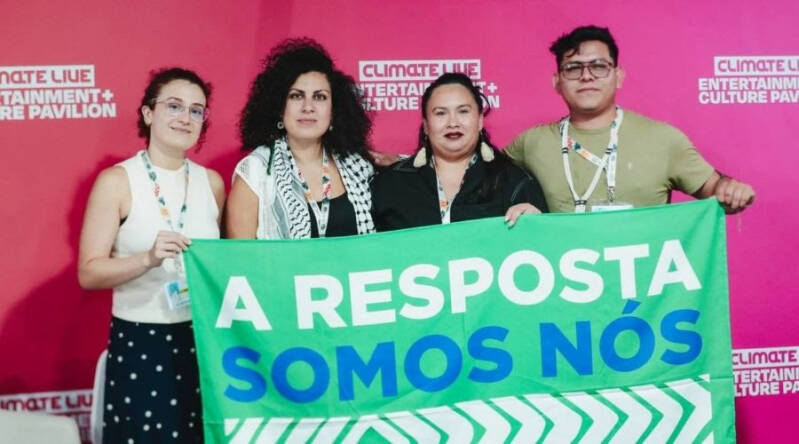
True interconnected struggles means reciprocal learning and understanding among the oppressed, finding connections, building common strategies based on shared interests and principles of justice, and forming meaningful alliances by illustrating relatability. While Mekorot, the Israeli national water company, displaces Palestinians and Indigenous peoples from their homeland and steals water resources in both Palestine and Patagonia, Argentina, and while Glencore - a Swiss multinational commodity trading and mining company founded by a Zionist Israeli is exploiting lands and committing crimes against hundreds of communities, we in the oppressed communities must confront these struggles jointly.
Our Achievements and Direction forward
Despite the challenging landscape and inevitable risks, PIPD remains steadfast in our belief that experiencing change requires active and organized participation in that change. We have been operating strategically within key majority arenas and have already observed tangible results—achievements uncommon in our type of long-term work of strengthening an actual infrastructure for perennial and strategic intervention, which typically requires time to yield favorable outcomes.
Our accomplishments have included contributing to advancing energy embargoes or energy disruption, introducing bills in parliaments, raising mass awareness, setting agendas and demands for executive decision-makers worldwide, and influencing narratives and concrete decisions among movements, unions, journalists, and policymakers.
In 2026, PIPD will continue this long-term endeavour by building strategic alliances and bringing Palestinian public diplomacy to international forums and national change-makers, in the language they understand. We remain committed to a form of public Palestinian diplomacy with no agenda other than liberation from colonialism — a diplomacy that serves the people and their quest for freedom and self-determination.
In that journey, we hope to continue counting with your thoughts, energy, networks, actions to free people from colonial greed.
With determination,
Rula
Co-Director
2021.

14 januari 2026
Gaza Humanitarian Response
Situation Report No. 61
13 January 2026
(As of 18:00 on 12 January 2026, unless otherwise noted)
HIGHLIGHTS
- Over 3,000 people have been affected by a new wave of heavy rains and strong winds across the Gaza Strip since the evening of 12 January, with at least 47 injuries and six reported fatalities caused by hypothermia and collapsing shelter structures, according to the Site Management Cluster.
- Despite sustained response efforts and the relatively increased entry of shelter items since the October 2025 ceasefire, recent rainstorms have reversed gains made.
- A shipment of chemicals, including antiscalant and sodium hypochlorite, was delivered to the Southern Gaza Desalination Plant and is being distributed to desalination facilities across the Strip to ensure safe and continued production of potable water.
- To strengthen Gender-Based Violence prevention and response services, 20 new Women and Girls’ Safe Spaces (WGSS) have been established, bringing the total number of operational WGSSs to 56 across the Gaza Strip.
SITUATION OVERVIEW
Between 8 and 12 January, airstrikes, shelling and gunfire continued to be reported across the Gaza Strip.Harsh weather conditions are taking a heavy toll on civilians, especially families living in makeshift shelters, flood-prone areas, or war-damaged buildings, further compounding their vulnerabilities and exposing them to cold temperatures and contaminated floodwaters.
Between 9 and 10 January, the Site Management Cluster (SMC) received urgent alerts from 34 sites in northern Gaza, where heavy rains affected more than 1,300 households whose shelters were destroyed and who are now in immediate need of tarpaulins and tents.
New heavy rainfalls and strong winds have been recorded since the evening of 12 January, causing extensive damage across multiple displacement sites. Field teams report that 597 tents and makeshift shelters were blown off or heavily damaged, directly impacting more than 3,000 people and leaving many exposed to severe weather conditions.
As of 13 January, Site Management partners report 47 injuries, while six fatalities have been confirmed: three children who succumbed to extreme cold in Khan Younis and Gaza city and three other people who lost their lives in the Al Shati area of Gaza City due to the collapse of the structure in which they were sheltering. In addition, SMC partners recorded 18 distress calls relating to critical site maintenance and hazard mitigation. These included opening clogged manholes, cleaning drainage systems, clearing blocked gullies, reinforcing shelters with tarpaulins, and garbage removal. In response, rescue and emergency teams coordinated by Site Management partners responded to multiple life-threatening incidents affecting families in Khan Younis, Rafah, and Gaza city.
While the overall shelter gap was expected to decrease due to sustained response efforts and the increased entry of shelter items – albeit limited - recent rainstorms have significantly reversed these gains, with thousands of households affected, preventing a reduction of shelter needs as anticipated.
The latest WFP Market Monitor indicates food consumption patterns in December remained broadly similar to November, reflecting a modest recovery from October but continuing to remain well below pre-conflict levels. While further improvements are possible with increased humanitarian and commercial entries, overall access to food remains severely constrained, particularly for meat and eggs, with most households relying primarily on cereals, pulses, and limited amounts of dairy and oil. Availability of cooking gas remains critically constrained. The limited entry of cooking gas covers the needs of less than 3 per cent of the population. As a result, 46 per cent of households continue to rely on waste burning for cooking, while others use raw materials such as wood.
Recent market monitoring by the Gaza Market Monitoring Committee (GMMC) indicates continued improvement in the flow of commercial and humanitarian goods, with no reported looting incidents during the reporting period (5–11 January) and sustained entry through Kerem Shalom Crossing and other crossings. Food markets remained generally supplied, with stable or slightly declining prices for key staples. However, non-food and winter-related items, including shelter materials, bedding, and heating-related goods, remained limited and costly, particularly in northern Gaza.
Despite improved market supply, household access continued to be constrained primarily by limited income and purchasing power rather than market availability. GMMC price and index trends confirm that while prices have moderated compared to previous months, the overall cost of the consumer basket remains well above pre-October 2023 levels.
Preliminary analysis indicates further improvement in the nutritional status of children and pregnant and breastfeeding women (PBW). Preparations are underway to conduct a Standardized Monitoring and Assessment of Relief and Transitions (SMART) survey to gain deeper insights into malnutrition levels across the Gaza Strip. Although the number of acute malnutrition cases has decreased compared to previous months, levels remain significantly higher than those recorded in February–March of last year’s ceasefire and the pre-war period.
Child Protection risks remain elevated, including increasing child labour involving hazardous activities such as collecting plastic and firewood; heightened exposure to explosive remnants of war, particularly in newly accessed or return areas; health risks linked to overcrowding, poor hygiene, and limited access to medical care; and psychosocial distress due to prolonged displacement and insecurity. Access to education is severely limited in several locations due to overcrowded or inaccessible schools and the absence of recreational or safe spaces.
UNITED NATIONS-COORDINATED AID ENTRY*
Between 9 and 12 January, at least 2,708 pallets of aid administered by the UN and its partners were offloaded at Gaza’s crossings, based on data retrieved from the UN 2720 Mechanism dashboard at 18:00 on 13 January. About 55 per cent of these pallets contained food, followed by nutrition (16 per cent), shelter (15 per cent), water, sanitation and hygiene (WASH) items (8per cent), health items (5 per cent) and protection supplies (1 per cent).
During the same reporting period, UNOPS international monitors deployed at Gaza’s crossings verified the collection of at least 10,277 pallets of aid – all collected from Kerem Shalom Crossing. These comprised inter alia over 6,000 pallets of food assistance, and more than 2,800 pallets of shelter items including tents, blankets, tarpaulins and kitchenware.
The above data does not include bilateral donations and the commercial sector.
Between 9 and 12 January, 14 out of 17 humanitarian movements inside Gaza that required coordination with Israeli authorities were fully facilitated, of which 11 were accomplished and two partially, enabling inter alia the collection of food, nutrition, shelter, medical, hygiene supplies and fuel from the crossings, while one – the attempted rescue of an injured minor from the Az-Zaytoun area of Gaza city – could not be completed. Two movements faced impediments: one was eventually completed, while the other was only partially accomplished. In addition, one mission was cancelled by the organizer.
HUMANITARIAN RESPONSE
The below are preliminary updates shared by Clusters at the time of reporting and will be reconciled and aggregated in the coming days as Clusters receive more data from the capillary network of partners active on the ground.
Food Security
- As of 10 January, Food Security Sector (FSS) partners continued to prepare and deliver 1,622,000 hot meals daily through 190 kitchens across the Strip, including 482,000 meals through 50 kitchens in northern Gaza and 1,140,000 meals through 140 kitchens in southern and central Gaza.
- As of 11 January, approximately 170,000 two-kilogram bread bundles were produced and distributed daily. One third of this bread is distributed for free to more than 400 shelters and community sites, while two thirds are sold through 148 retailers at a subsidized price of 3 NIS ($0.95) per bundle. The subsidized bread distribution network continues to expand, with 30 more retailer shops contracted by FSS partners as of 1 January 2026, compared to 118 as of late 2025.
Nutrition
- In December, Nutrition Cluster partners screened over 76,000 children and identified 4,971 cases of acute malnutrition, including 822 with the most severe form. This brings the total number of acute malnutrition cases identified in 2025 to 94,455, including approximately 19,000 children with severe acute malnutrition (SAM).
- To strengthen response efforts, partners have continued expanding nutrition service sites, including in the North Gaza governorate, where two additional sites were opened by a Cluster partner this week.
Water, Sanitation and Hygiene
- Between 8 and 12 January, WASH Cluster partners distributed 744,000 bars of soap, 3,400 water jerry cans, 1,750 hygiene kits and 795 latrine kits, as well as laundry and dishwashing powder, benefiting approximately 400,000 people in northern and southern Gaza.
- A shipment of water chemicals, including antiscalant and sodium hypochlorite, was delivered to the Southern Gaza Desalination Plant and is being distributed to other desalination facilities across the Strip to ensure safe, and continued production of potable water.
- Solid waste collection activities have resumed to previous levels following the securing of sufficient fuel this week, with partners collecting 1,100 cubic meters of solid waste daily. However, waste collection in North Gaza and Gaza city remains insufficient to meet daily needs due to increased population pressure and the significant waste accumulation that built up during the two-week reduction in services caused by fuel shortages.
- WASH partners have received eight new dump trucks, which are currently being operationalized, with an additional 14 dump trucks expected by the end of the month to further support solid waste collection activities.
Health
- Over the past four days, Health Cluster partners launched the Limb Reconstruction Screening Programme at the Nasser Medical Complex in Khan Younis, with 40 cases screened during the first outpatient clinic day, of which 13 were identified as complex cases requiring major limb reconstruction. Such treatment typically spans six months to three years, involving 2–8 surgeries and 12–30 physiotherapy sessions, with costs reaching up to $40,000 per patient. However, essential surgical items, including advanced imaging, power drills, and carbon fiber fixators, remain unavailable in Gaza. Plans are ongoing to expand screenings to the Al-Aqsa Hospital in Deir al Balah, and Al-Shifa Hospital in Gaza city to cover patients in the two northern governorates.
- During the first few days of 2026, Health Cluster partners resumed operations at one Primary Healthcare Center (PHC) for Non-Communicable Diseases in Gaza city and established a new PHC in the same governorate. As of 10 January, 91 out of 197 PHCs were partially functional across the Gaza Strip, including 27 in Gaza city.
Shelter
- Between 8 and 12 January, Shelter Cluster partners distributed 369 tents, 2,400 tarpaulins, 10,992 blankets and other bedding items, 1,656 kitchen sets, and 350 clothing kits and vouchers, benefiting 7,773 households cumulatively
- The Shelter Cluster continues to coordinate and support the relocation of households living in locations at high risk of flooding, including shoreline areas, and structures at risk of collapse. However, limited land availability remains one of the most significant challenges affecting the scale and speed of shelter interventions.
Site Management
- From 9 to 11 January, site care and maintenance activities were integrated into the winterization response, with Cash-for-Work and community mobilization focusing on winter preparedness and flood risk mitigation, including the clearing of clogged water channels to address cold-season risks. Fire safety awareness campaigns were launched, alongside three community-led initiatives addressing critical needs such as fire prevention, though progress remains constrained by the high cost and limited availability of suitable materials.
- Lighting systems were installed in two displacement sites to improve safety and living conditions, with procurement underway for eight additional units, while site maintenance toolkits were distributed to support ongoing operations. Help desks and site management committees were established in 10 camps, with efforts ongoing to create dedicated coordination spaces for winterization and risk reduction, and collaboration with the Health Cluster is underway to provide first aid training to site committees.
Protection
- Child Protection
- Between October 2025 and 11 January 2026, Child Protection partners distributed approximately 320,000 winter clothing sets and 112,503 pairs of children’s shoes, primarily targeting younger children. They also installed 150 high-performance tents at child protection service delivery points, including child-friendly spaces (CFS) and safe spaces, to support service continuity across the Gaza Strip.
- Community feedback highlighted appreciation for psychosocial and awareness activities, alongside persistent concerns regarding limited education access, insufficient winter assistance, and critical gaps in winter clothing for adolescents aged 11–17.
- Gender-Based Violence (GBV)
- Between 8 and 11 January, GBV response partners continued providing multisectoral services through Women and Girls’ Safe Spaces (WGSSs) across Gaza, which serve as a critical entry point for psychosocial support, case management, cash assistance, and referrals to other essential services. Efforts to scale up GBV services resulted in the establishment of 20 new WGSSs, bringing the total number to 56. Of these, 25 per cent are located in the north and 75 per cent in the south, extending GBV response services across the governorates.
- Between 8 and 11 January, approximately 1,500 people were reached with multisectoral GBV services, including case management, MHPSS, legal awareness, cash for protection, and recreational activities.
- Forty-three consultations with women across multiple governorates to support navigating legal procedures.
- GBV response partners distributed menstrual hygiene and dignity kits to meet the essential hygiene needs of women and girls to 872 people across Gaza, as well as others distributed through the UN-led joint distribution platform.
- Mine Action
- Between 8 and 11 January, two Explosive Hazard Assessments (EHAs) were conducted in Gaza city in support of ongoing humanitarian operations by assessing the risks posed by the presence of explosive ordnance (EO).
- During the same period, mine action partners conducted 62 Explosive Ordnance Risk Education and Conflict Preparedness and Protection (EORE-CPP) sessions, reaching 1,394 people and four targeted EORE training sessions for 89 humanitarian workers
Education
- Cluster partners established 18 additional temporary learning spaces (TLSs) across the Gaza Strip over the past four days, serving 35,479 school-aged children, with the assistance of 768 teachers. Overall, a total of 440 TLSs are now operational across Gaza, serving 268,000 learners supported by 6,308 teachers.
- Damage assessments of accessible public-school buildings aimed at identifying sites eligible for tent installation and light rehabilitation for TLSs have assessed 160 schools to date.
- As part of winterization preparedness efforts, cluster partners dispatched to the Ministry of Education and Higher Education:
- 7,500 lice-treatment shampoos for 14 learning sites across the Gaza Strip. The intervention targets approximately 7,500 students, including 3,500 in Khan Younis, 1,000 in Deir al Balah, and 3,000 in North Gaza. In addition, 2,500 anti-lice kits were dispatched to Khan Younis for distribution across five learning centers.
- 370 mattresses to equip 30 unfurnished classrooms in three learning spaces in Khan Younis, and 4,000 blankets to support 53 learning sites across the Gaza Strip.
Multi-Purpose Cash Assistance (MPCA)
- Between 9 and 11 January, Cash Working Group (CWG) partners distributed Multi-Purpose Cash Assistance (MPCA) to over 2,600 households. Each household received 1,250 NIS (approximately US$378) in digital payments, in line with the minimum expenditure basket (MEB) transfer value.
Emergency Telecommunications
- To enhance VHF coverage in southern Gaza, the ETC relocated a repeater from Deir al Balah to Khan Younis. Installation was completed on 7 January with coordination ongoing to reconfigure and test the secure link to the Jerusalem Security Operations Centre (JSOC).
All figures solely refer to UN and partner assistance dispatched through the UN-coordinated system. They are preliminary and will be reconciled in the course of the ceasefire. Supplies entering through bilateral donations and the commercial sector are not reflected.
2020.

14 januari 2026
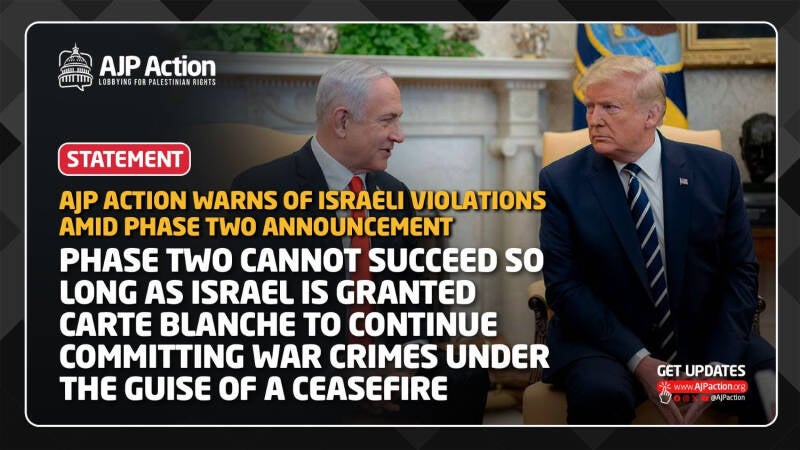
Phase two cannot succeed so long as Israel is granted carte blanche to continue committing war crimes under the guise of a ceasefire
[WASHINGTON D.C., JANUARY 14, 2026] — Americans for Justice in Palestine Action (AJP Action) cautiously welcomes Special Envoy Steve Witkoff’s announcement today launching Phase Two of the Gaza ceasefire plan, which envisions the establishment of a “transitional technocratic Palestinian administration” in Gaza and would supposedly trigger reconstruction after more than two years of Israel’s devastating and brutal war on the Strip. At the same time, we must also reiterate Israel’s deliberate and systematic efforts to undermine the ceasefire, enabled by continued U.S. complicity. The Trump administration’s demand that Palestinians alone comply with the agreement’s twenty points, despite their consistent adherence for months, while ignoring Israel’s routine violations, calls into question the Trump administration’s credibility and its commitment to the agreement it claims to uphold.
It is inaccurate and dishonest for Witkoff to claim that Phase One “delivered historic humanitarian aid” to Gaza or that it “maintained the ceasefire.” From the implementation of the ceasefire on October 10, 2025, through January 10 of this year, human rights organizations in Gaza documented 1,238 Israeli violations, an average of 13.2 violations per day. These violations included killings and injuries, strikes, home demolitions, live fire, military incursions, and 50 arrests. As a result, at least 460 Palestinians have been killed since the agreement took effect, 52.1% of all fatalities being children (161), women (61), and the elderly (17). Data further shows that 96.9% of those killed were targeted inside areas supposedly under de-escalation, in clear violation of the principle of civilian protection under international humanitarian law. Additionally, 1,246 injuries have been recorded, including 728 injuries to children, women, and elderly people, with civilians constituting 99.2% of all injuries. All injuries occurred within areas designated for the ceasefire, reinforcing that Israel is pursuing a deliberate and militarily unjustifiable shoot-to-kill/harm policy.
On aid delivery, Israel is meeting less than half of its obligation, allowing an average of only 260 trucks per day, 43.3% of the agreed 600. Fuel trucks have not exceeded 12.5% of total entries, directly crippling essential sectors, especially health, water, and energy. In recent weeks, at least 24 Palestinians, including children and infants, have died from the severe cold. Over 1.5 million displaced Palestinians are left exposed to rain and freezing temperatures, forced to survive in flimsy, flood-prone tents, as Israel blocks the entry of mobile homes into Gaza and the international community, especially Washington, refuses to exert meaningful pressure.
Phase two of the so-called peace deal cannot succeed so long as Israel is granted carte blanche to continue committing war crimes under the guise of a ceasefire. AJP Action calls on the United States to respect the Palestinian people’s inherent, inalienable, and non‑negotiable right to self‑determination; to compel Israel to halt its aggression and fully withdraw from the Gaza Strip; to allow the unrestricted entry of humanitarian aid, mobile homes, fuel, and medicine; to ensure that reconstruction begins immediately and without conditions; to grant full political authority to the transitional technocratic Palestinian administration; and to prevent the so‑called “Peace Council” from becoming a trusteeship imposed on the Palestinian people.
In solidarity,
Americans for Justice in Palestine Action
2019.

14 januari 2026

Discussing Zionism as an Ideology of Dispossession & Supremacism
American Muslims for Palestine (AMP) presents a special 5-week teach-in series titled “Contextualizing The Palestinian Relationship With Zionism,” live on Zoom with our education coordinator, Tarek Khalil, where each session will have a particular focus.
Join us tomorrow, January 15th @ 7:30 PM EST, for our 1st episode “Zionism: An Ideology of Dispossession & Supremacism.”
Corporate media, and many politicians have romanticized Zionism, and removed the historical context of settler-colonialism. This session will flesh out a definitive meaning of Zionism, utilizing the statements and utterances of the founding fathers of Zionism, Zionist institutions, and various leaders within the movement, and how the Zionist project was carried out against the native Palestinian Arabs.
Please register here to get access to the teach-in link.
In solidarity,
American Muslims for Palestine (AMP)
2018.

14 januari 2026

Israeli militias are not above the law, nor is any administration that enabled them
American Muslims for Palestine (AMP) welcomes the settlement put forth , holding Betar US accountable for its pattern of violence, harassment, intimidation, and bias-motivated conduct against Muslim, Arab, Palestinian, and Jewish New Yorkers, particularly during protests tied to the ongoing Israeli genocide in Gaza. The agreement requiring Betar to cease these practices and wind down its New York operations represents a tangible step toward defending civil rights and public safety, and acknowledges harms that many activists and communities have long raised.
The AG’s investigation found that Betar engaged in conduct more consistent with a militia than a civic nonprofit, including encouraging members to bring weapons to protests, posting inflammatory content celebrating violence, and repeatedly targeting individuals based on religion and national origin, all in violation of New York civil rights law.
While this action is an important step in the right direction, and we thank Attorney General James for her leadership, it is not sufficient on its own. Independent reporting has documented that Betar US openly admitted to submitting names of pro-Palestinian students and faculty to the Trump administration, urging immigration enforcement and deportation. These admissions raise serious questions that fall beyond the scope of the New York inquiry and demand a federal investigation into whether and how Betar’s targeting, doxing, and intimidation of activists intersected with or were enabled by U.S. government agencies. The federal government must fully account for any role it played in allowing a private extremist group to weaponize immigration enforcement against protected political speech.
Betar is a far-right, pro-Israel organization. The group, both in the U.S. and internationally, has publicly promoted violence, harassment, and intimidation against, particularly, Palestinians and pro-Palestine activists. Even organizations that firmly align themselves with Zionist centered advocacy have distanced themselves from Betar. The Anti-Defamation League (ADL) has explicitly condemned the organization.
We reaffirm our support for the protection of free expression, the safety of protest movements, and the fundamental rights of all people, including Palestinian and pro-Palestinian advocates, to engage in peaceful political dissent without fear of intimidation, persecution, or state-aligned retaliation.
In solidarity,
American Muslims for Palestine (AMP)
2017.

14 januari 2025
Humanitarian Situation Update #351
Gaza Strip
14 January 2026
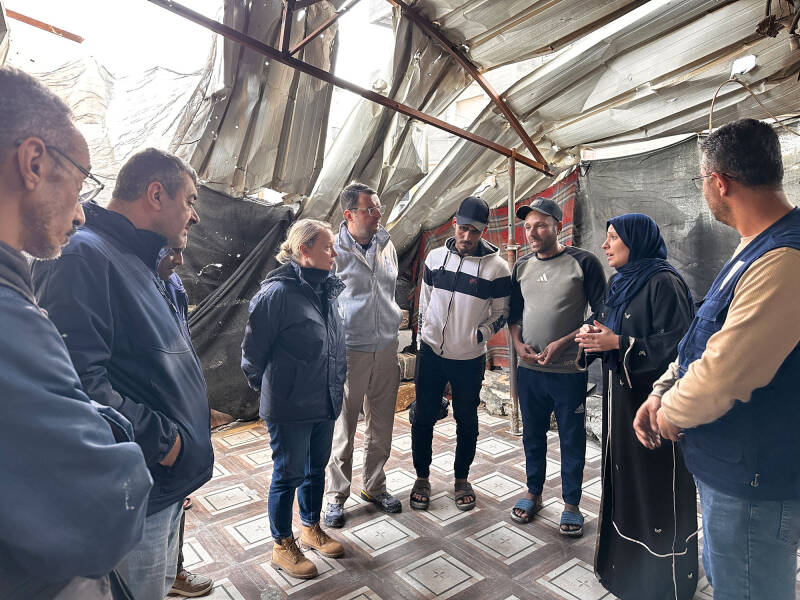
UN team, led by the Deputy Humanitarian Coordinator, speaks with one of the families in Khan Younis as part of ongoing assessments to guide lifesaving assistance. Photo: OCHA
Key Highlights
- Heavy rains and flooding have rendered thousands of tents uninhabitable and placed nearly 800,000 people, almost 40 percent of the population, in flood-prone sites at heightened risk.
- UNICEF reports that over 100 children have been killed in Gaza since the ceasefire, highlighting that children remain at grave risk.
- Humanitarian aid entry has nearly tripled since the ceasefire, but damaged roads, limited storage capacity and restricted materials continue to impede effective delivery, response quality and durability, and longer-term response.
- Improved food deliveries have enabled monthly food rations with full coverage of minimum caloric needs for the first time since October 2023 and a 70-per-cent increase in meal and bread production over the past three months.
- Nearly 500,000 children received child protection services between October and December 2025, while winterization coverage for adolescents remains extremely limited, at four per cent, including among adolescents with disabilities.
Context Overview
- Airstrikes, shelling and gunfire continue to be reported across the Gaza Strip, resulting in casualties. The Israeli military remains deployed in over 50 per cent of the Gaza Strip, beyond the “Yellow Line,” where access to humanitarian facilities and assets, public infrastructure and agricultural land are either restricted or prohibited. Detonations of residential buildings and bulldozing activities continue to be reported, including near or east of the “Yellow Line.” Access for Palestinians to the sea remains prohibited and reports of Palestinian fishers being killed or detained at sea continue, including the reported killing of two fishers on 4 January and the reported detention of five fishers by Israeli forces on 6 January.
- According to the Ministry of Health (MoH) in Gaza, between 29 December 2025 and 14 January 2026, 36 Palestinians were killed, 100 were injured and 26 bodies were recovered from under the rubble. This brings the casualty toll among Palestinians since 7 October 2023, as reported by the MoH, to 71,439 fatalities and 171,324 injuries. According to the MoH, the total number includes 110 fatalities who were retroactively added between 26 December 2025 and 2 January 2026 after their identification details were approved by a ministerial committee. MoH reported that since the ceasefire, 449 Palestinians have been killed, 1,246 injured, and 710 bodies retrieved from under the rubble.
- On 8 January, the Israeli military announced that a failed projectile was launched from Gaza towards Israel and reported to have struck Palestinian armed groups and infrastructure in response. The spokesperson of the Palestinian Civil Defence (PCD) stated that multiple strikes were reported in the southern and northern Gaza Strip, where tents and homes sheltering displaced people were hit, adding that seven civilians, including five children, the youngest of whom was five years old, were killed. In total, according to the MoH in Gaza, 14 people were reportedly killed and 17 others injured between 8 and 9 January.
- On 13 January, the UN Children’s Fund (UNICEF) reported that more than 100 children have been killed in Gaza since the ceasefire in early October, roughly equivalent to one child killed every day during this period. These figures include at least 60 boys and 40 girls for which sufficient details were available, and the actual number of child fatalities is expected to be higher. Hundreds of children have been wounded. UNICEF Spokesperson, James Elder, emphasizes: “This is the time to turn reduced violence into real safety: open access for aid, massively increase medical evacuation, and make this the moment when the killing of children in Gaza truly ends.”
- According to the Israeli military, between 29 December 2025 and 14 January 2026, as of noon, no Israeli soldiers were killed in Gaza. The casualty toll among Israeli soldiers since the beginning of the Israeli ground operation in October 2023 stands at 471 fatalities and 2,995 injuries. According to Israeli forces and official Israeli sources cited in the media, more than 1,671 Israelis and foreign nationals have been killed, the majority on 7 October 2023 and its immediate aftermath. As of noon on 14 January, the remains of one hostage are in the Gaza Strip.
- On 11 January 2026, the Palestinian Prisoner’s Society announced the death of a detainee from Gaza while in Israeli custody. According to the Society, the 67-year-old prisoner was detained in November 2024, and his death was reported to have occurred in September 2025. As of January 2026, according to data provided by the Israel Prison Service (IPS) to Hamoked, an Israeli human rights NGO, there are 9,243 Palestinians in Israeli custody, including 1,293 sentenced prisoners, 3,328 remand detainees, 3,385 administrative detainees held without trial, and 1,237 people held as “unlawful combatants.” These figures do not include Palestinians who have been detained from Gaza since 7 October 2023 and are still held by the Israeli military. Between 7 October 2023 and 13 January 2026, the UN Human Rights Office (OHCHR) verified that at least 87 Palestinians (86 men and one boy), including 55 from the Gaza Strip, died in Israeli custody, with documented concerns about torture, ill-treatment, denial of medical care and restricted access for families and independent monitors. On 11 January, Israeli authorities reportedly released 12 Palestinian detainees, including one woman, who were transferred to Al Aqsa Hospital in Deir al Balah for medical examinations.
- Between 1 and 31 December 2025, the Protection Cluster, in coordination with the protection from sexual exploitation and abuse (PSEA) network, deployed 100 mobile protection teams to carry out 68 safeguarding-focused field visits, reaching approximately 5,300 people across 21 aid distribution sites in the Gaza Strip. Since the ceasefire, these visits have reached nearly 7,000 people and aimed to monitor risks of sexual exploitation and abuse, assess adherence to safe and dignified distribution standards, disseminate PSEA and protection messaging (including information on complaints and feedback mechanisms), reinforce accountability to affected populations, and mitigate protection risks during aid distributions. Through ongoing training and technical support, the Protection Cluster coordinates over 500 emergency protection responders who support safeguarding, protection monitoring, and service delivery in Gaza, helping ensure protection services and the safe and dignified delivery of assistance for people in need.
- In the first 10 days of January, 10 classrooms were renovated to serve as temporary learning spaces (TLS) in Gaza governorate. In total, over the past three months, renovation of 76 classrooms and installation of over 100 high-performance tents have enabled further expansion of TLS for children across the Gaza Strip, the Education Cluster reports. As of 13 January, more than 6,300 teachers are deployed across 449 TLS, serving over 270,900 children. To maximize coverage, and in line with minimum standards agreed with the Ministry of Education (MoE), each TLS operates two daily shifts (morning and evening) and two three-day rotations per week. However, the restoration of learning continues to face critical challenges that limit overall coverage; only about 42 per cent of Gaza’s school-aged population is enrolled in TLS for the 2025-2026 academic year.
- On 2 January, the UN Secretary-General expressed deep concern over the Israeli authorities’ announcement to suspend the operations of several international non-governmental organizations (INGOs) in the Occupied Palestinian Territory (OPT) and called for the measure to be reversed, stressing the essential role of INGOs in delivering life-saving humanitarian assistance. Separately, 53 INGOs warned that recent registration measures, including notifications to 37 INGOs that their registrations would expire at the end of 2025, could force organizations to cease operations within 60 days, potentially causing significant disruptions to humanitarian assistance at a time of extreme needs, despite the ceasefire. INGOs deliver more than half of food assistance in Gaza, support about 60 per cent of field hospitals, implement three quarters of shelter and non-food item activities, and provide all treatment for children with severe acute malnutrition. The suspension of their operations would substantially reduce the reach and continuity of life-saving services and undermine coordinated humanitarian response efforts and local partnerships.
Humanitarian Access
- On 11 January, for the first time since 7 October, a patient from Gaza in need of life-saving treatment was reportedly permitted to travel to the West Bank for urgent care, following a Jerusalem District Court ruling. On 5 January 2026, 18 patients and 36 accompanying persons were evacuated to Jordan for trauma care and treatment for cancer, gastrointestinal, renal, immunological, and other serious conditions. In 2025, the World Health Organization (WHO) facilitated the medical evacuation of 2,718 patients from the Gaza Strip for treatment abroad, out of more than 10,700 evacuated since October 2023 for specialized care in over 30 countries. Half of the evacuated patients were children (1,368), 30 per cent were men (805), and 20 per cent were women (545). The largest category of evacuated patients were trauma cases (29 per cent), followed by cancer patients (24 per cent). Sixty-one per cent of patients (1,673) were evacuated during the ceasefire period between 19 January and 17 March 2025 via Rafah Crossing, which has remained otherwise closed, and the rest were evacuated via Kerem Shalom Crossing. More than 18,500 patients in Gaza, including about 4,000 children, continue to urgently require medical evacuation, and WHO continues to call on additional countries to receive patients from Gaza and for evacuations to the West Bank, including East Jerusalem, to be restored. In November 2025, five human rights organizations petitioned Israel’s High Court of Justice to immediately resume medical evacuations from Gaza to hospitals in the West Bank, including East Jerusalem, citing the near-collapse of Gaza’s health system and the risk of preventable deaths.
- According to the UN 2720 Mechanism, three months into the ceasefire, more than 164,000 metric tons (MT) of humanitarian aid were collected by the UN and its partners from Gaza’s crossings, including nearly 19,000 MT in the first 10 days of January. This is a monthly average of about 54,000 MT, nearly three times the monthly average collected between 19 May 2025, when limited aid entry resumed after a 78-day blockade on the entry of supplies into Gaza, and the 10 October ceasefire. During the ceasefire period, reported incidents of looting declined significantly, with the last incident reported on 6 November 2025. While three crossings are operational, 74 per cent of aid (121,100 MT) was collected from Kerem Shalom Crossing. Zikim Crossing, which has allowed for direct aid entry into northern Gaza since 12 November 2025, is open three days per week. Aid continues to arrive via Egypt, Jordan, Israel, the West Bank and Cyprus, with the Israel route (including Ashdod port and Ben Gurion airport) accounting for 55 per cent of offloaded aid over the past three months.
- Marking continued efforts to improve food security in Gaza, Food Security Sector (FSS) partners report that, in January 2025 and for the first time since October 2023, stocks are sufficient to provide monthly food rations covering 100 per cent of minimum caloric needs of a household. As of 11 January, more than 86,000 households have received two food parcels and two 25-kilogramme bags of flour, supported by continuous food truck deliveries, particularly food parcels. Despite progress, operational challenges remain, notably fuel shortages affecting all partners. As of 10 January 2026, partners report the daily provision of about 1.6 million meals through 190 kitchens, alongside the production of about 170,000 two-kilogramme bread bundles. One third of bread bundles are distributed free in more than 400 shelters and two thirds are sold at a subsidized price of 3 NIS (US$0.32) through a retailer network, which has expanded to 146 shops in January 2026 from 118 in December 2025. This represents a nearly 70 per cent increase in cooked meal and bread production over the past three months, up from 954,000 meals through 177 kitchens and over 100,000 bread bundles produced daily as of 11 October 2025.
- While humanitarian truck deliveries have improved and food prices remained broadly stable, data from the Gaza Chamber of Commerce and Industry cited by the World Food Programme (WFP) in the December Market Monitor indicate that commercial truck entries declined by 25 per cent between 1 and 28 December compared with November. According to WFP, sustained commercial imports are critical to increase the diversity of food and other essential items on local markets, complementing humanitarian assistance, supporting supply continuity, and helping to reduce prices.
- Humanitarian movements inside Gaza continue to require coordination with Israeli authorities to and from crossings and in or near other areas where Israeli forces remain deployed. Between 30 December 2025 and 12 January 2026, 78 humanitarian missions were coordinated with the Israeli authorities, of which 43 were successfully facilitated, 19 were impeded, 12 were denied and four were cancelled by the requesting organizations due to operational, logistical or security reasons. In December, 56 per cent of coordinated movements (121 out of 217) were related to the collection of cargo from operational crossings (Kerem Shalom, Zikim and Kissufim), in addition to 10 road repair, assessment and debris-clearing missions to facilitate humanitarian and commercial truck movements.
- According to the Logistics Cluster, aid collection operations and onward delivery of aid continue to face multiple constraints, including limited access routes, road congestion and deterioration of road conditions due to adverse weather. These challenges hinder efficient movement planning, cause significant operational delays, and increase operational costs. WFP reports that road access remains extremely fragile; the southern section of Salah ad Din Road remains inaccessible and the coastal road is currently the only viable route for both humanitarian and commercial truck movements into Gaza and has sustained heavy damage during hostilities. Recent heavy rains have further degraded the road, increasing the risk of disruptions amid high daily truck volumes. WFP teams are undertaking emergency road repairs using basic equipment to prevent the route from becoming impassable, as any prolonged closure would severely disrupt humanitarian assistance and commercial supply flows.
- As of December 2025, the Logistics Cluster consolidated information from 20 humanitarian organizations on their warehouse capacity across Gaza. A total storage capacity of 183,594 square metres (m²) was reported, of which 101,494 m² (55 per cent) across 77 warehouses is operational, while 82,100 m² (45 per cent) across 10 warehouses remains non-operational due to access constraints and infrastructure damage. While the December mapping shows incremental improvements compared with October, largely due to improved access and repair works, overall capacity remains insufficient and unevenly distributed across locations. Rafah governorate continues to have no operational humanitarian warehouses, while North Gaza faces critically limited functional storage capacity. Overall, limited capacity, geographic imbalances, and access restrictions continue to constrain the scale-up and pre-positioning of humanitarian assistance.
Winter Storms
- Rain and stormy weather conditions persisted into the new year, worsening emergency shelter needs amid an already fragile shelter situation and limited access to heating. Nearly the entire population remains displaced, many multiple times, and more than one million people are estimated to be in need of emergency shelter assistance. According to the Shelter and Site Management clusters, storm impacts include tents being blown away, fabric tearing, structural failures under wind and water loads, and widespread flooding of displacement sites due to poor drainage and low-lying terrain, rendering thousands of tents uninhabitable. Since early December, humanitarian partners have reached about 128,000 households with tents and other shelter and non-food items brought into Gaza through UN Coordination or bilateral channels and have supported the relocation of 821 families, mainly from the shoreline and damaged buildings, in Khan Younis.
- In response to forecast heavy rainfall, humanitarian partners have issued flood alerts for high-risk areas, particularly low-lying and coastal displacement sites. Based on pre-winter flood-risk mapping, the Site Management Cluster (SMC) estimates that nearly 795,000 people (almost 40 per cent of the population) are sheltering across 761 displacement sites located in flood-prone areas, with coastal communities among the hardest hit as families pitch makeshift shelters on low, sandy land vulnerable to flooding from both rainfall and the sea. The cluster further notes that, prior to winter, some 4,400 families (24,500 people) were estimated to be living in high-risk coastal areas; while efforts were made to relocate the most vulnerable (see above), limited availability of safe land has meant that many families remain in exposed locations, including sites located directly on the beach.
- The UN Population Fund (UNFPA) reports that winter conditions are intensifying hardship, with families sheltering in flooded tents, newborns facing heightened risk of hypothermia, and pregnant women lacking safe spaces to rest or give birth, and has called for an urgent scale-up of assistance to protect health and support women and girls. According to the MoH in Gaza, between 1 December 2025 and 14 January 2026, seven children died of hypothermia, including four since the beginning of 2026. As rainwater has mixed with sewage, on 8 January 2026, Save the Children highlighted the especially severe impact flooding has had on children, leaving them exposed to water-borne diseases, such as hepatitis, diarrhoea and gastroenteritis. According to the Health Cluster, between 14 and 27 December, health partners carried out over 365,000 consultations, of which more than 21 per cent were related to communicable diseases. Of those, acute respiratory infections (ARI) accounted for over 56 per cent (some 43,600 consultations), while acute watery diarrhoea accounted for over 23 per cent (about 18,000), including 10 per cent among children under five.
- With no viable alternatives, people in Gaza remain in structurally compromised buildings, where recurrent rainstorms and winds significantly increase the risk of collapse. According to the MoH in Gaza, 25 people, including children, died since mid-December due to the collapse of previously damaged buildings due to weather conditions. PCD reported that on 5 January, a four-storey building collapsed in Al Maghazi Camp, in Deir al Balah, killing two Palestinians, including a man and his eight-year-old son and injuring five other Palestinians. According to the Shelter Cluster, as of 13 January, 67 inhabited buildings have been identified as being at risk of collapse in Gaza city. While no preventive evacuations have yet taken place due to severe space and land availability constraints, the Shelter Cluster has allocated tents for the affected families, and coordination with the local municipality on potential evacuations is ongoing.
- Additional storms are expected, but humanitarian partners remain limited to short-term, emergency fixes and are unable to implement sustainable flood-mitigation or recovery measures and families have limited supplies to winterize or rebuild shelters. This is due to the restricted entry of shelter and site-improvement materials, including drainage equipment (e.g. pumps, drainage pipes), heaters and solar equipment, and reconstruction items (e.g. cement, timber), many of which are classified as “dual-use” items, the Shelter and Site Management clusters report. Without these, displacement sites flood repeatedly, and shelters must be replaced. Over the past two years, SMC partners have been unable to bring in sufficient quantities or types of materials to carry out even basic site preparation, relying instead on improvised solutions, such as flour sacks repurposed as sandbags. Challenges are compounded by shortages of fuel, heaters and solar lights and by extremely limited safe, dry land for new displacement sites, as displaced populations are now effectively confined to less than half of the Gaza Strip. The Shelter Cluster emphasizes that tents cannot continue to serve as the primary shelter modality, and there is an urgent need to accelerate the transition to more durable and context-appropriate shelter solutions, alongside essential site-level interventions such as drainage, communal heating spaces, and solar lighting to improve safety and mobility at night.
Child Protection: Adolescents Face Heightened Risks
- Over one million children under 18 years of age in Gaza are estimated to require child protection and mental health and psychosocial support (MHPSS), including more than 58,000 children who have lost one or both parents, according to UNICEF. Amid widespread destruction and significantly weakened protective environments and coping capacities, economic hardship has worsened, forcing one in four families to resort to hazardous and exploitative child labour, including children as young as six. In this context, the Child Protection Area of Responsibility (AoR) led by UNICEF cautions that adolescents aged 11–17 years, including adolescents with disabilities, face heightened and distinct risks amid limited structured activities and age-appropriate support. Underscoring these protection, accessibility and inclusion risks, a situational analysis commissioned by the Global Disability Fund on persons with disabilities in the OPT highlights that over 25 per cent of those injured in Gaza are expected to have long-term disabilities, and that more than 5,000 children have already been identified as requiring life-long rehabilitation.
- Between 1 October and 31 December 2025, Child Protection partners reached nearly half-a-million children with a range of child protection services, including winterization support, distributing over 311,000 winter clothing sets, 112,000 pairs of shoes, 747,000 blankets, as well as thousands of mattresses, mats, plastic tarpaulins and family tents. At approximately 180 child-friendly spaces (CFS) and safe spaces, including 150 high-performance tents installed during the same period, partners delivered a range of services, including psychological first aid, counselling, group and individual sessions and recreational activities. However, funding constraints and insufficient supplies have limited the ability of partners to adequately expand services to address the needs of all children, including adolescents. These challenges were compounded by severe winter weather that caused damage to 40 CFS, interrupting MHPSS and protection services. As of 31 December 2025, according to the Child Protection AoR, humanitarian partners received only about 24 per cent of the funding (US$29.6 million out of US$121.2 million) requested under the 2025 Flash Appeal to address child protection needs in the Gaza Strip.
- Child Protection partners estimate, based on available information, that only about four per cent of adolescents between 11 and 17 years of age in Gaza were reached through household-level winter distributions, leaving the vast majority of this age group unserved – this is approximately 15,000 out of an estimated 400,000 adolescents, all of whom are assessed to require winter support. Coverage gaps affect both girls and boys, with additional barriers affecting adolescents with disabilities, such as mobility constraints, lack of adapted items, and limited inclusive programming. Analysis further indicates that the widespread loss of assistive devices has significantly restricted access to services and humanitarian assistance for persons with disabilities, including adolescents. During the first two months of the ceasefire, humanitarian partners distributed assistive devices to 467 children.
- To mitigate winter-related and protection risks affecting adolescents, Child Protection partners aim to scale up targeted, age-appropriate interventions, including: adolescent-focused MHPSS addressing stress, anger, trauma and risk-taking behaviours; life-skills, peer support, and peer-to-peer learning activities to strengthen positive coping and social cohesion; vocational orientation and skills-building initiatives, where feasible; expanded outreach and mobile programming for adolescents who do not regularly access CFS; and strengthened community-based awareness and protective presence, including engagement around risky behaviours such as unsafe street activities. However, partners warn that without additional and dedicated funding, these adolescent-specific interventions will remain limited in scale, leaving a significant proportion of adolescents without adequate protection, psychosocial support, and winter assistance during the current season and beyond.
Funding
- As of 14 January, Member States disbursed approximately $1.7 billion out of the $4 billion (41 per cent) requested to meet the most critical humanitarian needs of 3 million out of 3.3 million people identified as requiring assistance in Gaza and the West Bank, including East Jerusalem, under the 2025 Flash Appeal for the OPT. On 8 December 2025, the UN and its humanitarian partners launched a Flash Appeal for $4.06 billion to address the humanitarian needs of 2.97 million out of 3.62 million people identified as requiring assistance in Gaza and the West Bank, including East Jerusalem, in 2026. Nearly 92 per cent of those required funds are for the humanitarian response in Gaza, with just over eight per cent for the West Bank. In December, the oPt Humanitarian Fund managed 111 ongoing projects, totalling $61.1 million, to address urgent needs in the Gaza Strip (89 per cent) and the West Bank (11 per cent). Of these projects, 54 are being implemented by international NGOs, 44 by national NGOs and 13 by UN agencies. Notably, 48 out of the 67 projects implemented by international NGOs or the UN are being implemented in collaboration with national NGOs. For more information, please see OCHA’s Financial Tracking Service webpage and the oPt HF webpage.
Online version
Recent publications
- Reported impact snapshot | Gaza Strip (14 January 2026)
- Gaza Humanitarian Response | Situation Report No. 60
- Humanitarian Situation Update #352 | West Bank
- Humanitarian Situation Update #351 | Gaza Strip
- Humanitarian Situation Update #350 | West Bank
- West Bank Monthly Snapshot - Casualties, Property Damage and Displacement | November 2025
2016.
11 januari 2025
Support War Refusers
Your support over the past year made it possible for Refuser Solidarity Network to help shift the political landscape inside Israel. By investing in field organizers, legal defense, and long-term coordination, you helped turn refusal from a marginal act into a public issue that Israeli society was forced to confront. Conscience was made visible. Taking a side became unavoidable. That work is not finished. But the terrain is changing.
In the West Bank, violence has become bolder, more public, and more normalized. Settler attacks now take place in broad daylight as part of everyday life. Homes are burned, roads are blocked, farmers are assaulted while tending their land, often in full view of soldiers who enable or participate. Just recently, a video circulated of a settler running over a Palestinian praying on the side of the road in the middle of the day. These are not isolated incidents. They are signals of a system that is testing how much it can do openly, and how little the public will be made to reckon with it.
What we have learned from our work over the past two years is that systems like this do not crack under pressure alone. They crack when people refuse to accept the unacceptable, and when people are forced to choose whether they will look away or take responsibility. This is the strategy going forward.
In the same way that we invested in infrastructure and capacity to bring refusal and anti-war organizing into the mainstream, we are now committing to do the same around settler military violence in the West Bank. That means supporting organizers, activists, and groups already doing the work on the ground with the resources they need to grow, coordinate, and remain visible. It means treating this not as a humanitarian crisis to be managed, but as a pressing ethical issue that Israeli society must be forced to face.
Moments like this matter. Violence that becomes routine depends on indifference to survive. Breaking that indifference requires sustained organizing, not one off responses. Because of you, we are able to make that investment. And we need you to continue supporting us, so that we can continue to do this work, and force Israeli society to make choices. Not perfect choices, but the kinds that make a material differences in Palestinians’ lives. Please help us by letting your communities know about our work, and forward them this email so that they might receive our updates too.Support War Refusers
In solidarity,
Didi Remez
Executive Director
Refuser Solidarity Network
2015.


10 januari 2025
Gaza Humanitarian Response
Situation Report No. 60
9 January 2026
(As of 18:00 on 8 January 2026, unless otherwise noted)
HIGHLIGHTS
- Between 5 and 8 January, Shelter Cluster partners delivered shelter assistance to more than 21,700 families affected by heavy rainstorms across Gaza. This included tents, tarpaulins, sealing-off kits, kitchen sets, mattresses and bedding sets, and non-food item (NFI) assistance.
- Over the past four days, Cash Working Group partners provided multi-purpose cash assistance to over 5,000 households in Gaza, each receiving NIS1,250 (US$378) via digital payments. In 2025, more than 340,000 households benefited from multi-purpose cash assistance, reinforcing its role as a critical life-saving intervention.
SITUATION OVERVIEW
Airstrikes, shelling and gunfire continued to be reported across the Gaza Strip between 6 and 8 January with multiple civilian casualties reported.
Following a reported rocket launch from Gaza city towards Israel which fell short inside the Strip on the morning of 8 January, the Israeli military announced in a statement that they would conduct strikes on the launch site and related infrastructure.
Winter storms and consequent flooding on 30 December and on 9 January exposed families to cold temperatures and contaminated floodwaters. Shelter supplies remain insufficient to meet the immense needs further exacerbated by the recent rains; an estimated one million people across Gaza still urgently require emergency shelter assistance. Aid organizations have repeatedly stressed the need to shift from temporary tents to more durable shelter solutions, including repairs to damaged houses, as winter conditions intensify. Since the ceasefire, at least five children have died from exposure to the elements, amid widespread destruction of homes and critical civilian infrastructure On 27 December, a seven-year-old child reportedly drowned when an improvised displacement site flooded in the north-west of Gaza city, illustrating the extreme risks for children.
More than 7,702 population movements were recorded by Site Management partners between 21 December and 3 January, including 750 within Gaza governorate. Since the onset of the ceasefire on 10 October, nearly 815,000 movements have been documented, of which approximately 678,600 were from southern to northern Gaza.
UNITED NATIONS-COORDINATED AID ENTRY*
Between 6 and 8 January, at least 10,213 pallets of aid administered by the UN and its partners were offloaded at Gaza’s crossings, based on data retrieved from the UN 2720 Mechanism dashboard at 18:00 on 9 January. About 56 per cent of these pallets contained food, followed by shelter (29 per cent) and nutrition (5 per cent) supplies, water, sanitation and hygiene (WASH) items (5 per cent), health supplies (3 per cent) and operational equipment (2 per cent).
During the same timeframe, UNOPS international monitors deployed at Gaza’s crossings verified the collection of at least 10,579 pallets of aid – 9,092 from Kerem Shalom Crossing and 1,487 from Zikim Crossing. These comprised inter alia 7,797 pallets of food assistance; 1,860 pallets of shelter items including tents, blankets, tarpaulins and kitchenware; 851 pallets of WASH supplies; and 46 pallets of health supplies.
The above data does not include bilateral donations and the commercial sector.
Between 6 and 9 January, 10 out of 20 humanitarian movements inside Gaza that required coordination with Israeli authorities were fully facilitated and completed. Seven movements faced impediments - three were eventually completed, while the other four were only partially accomplished. In addition, two missions were outright denied and one was cancelled by the organizers.
Humanitarian movements and aid delivery into and within the Gaza Strip face persistent challenges, including heavy congestion on roads, which significantly delays the transport of essential supplies. Sudden changes to crossings’ operational schedules further complicate missions, creating uncertainty and disrupting planned movements. Security checks for staff can delay missions, and occasional security incidents further disrupt operations.
HUMANITARIAN RESPONSE
The below are preliminary updates shared by Clusters at the time of reporting and will be reconciled and aggregated in the coming days as Clusters receive more data from the capillary network of partners active on the ground.
Shelter
- Between 5 and 8 January, Shelter Cluster partners provided shelter assistance to approximately 21,735 households affected by the recent rainstorms across the Gaza Strip. This included tents, tarpaulins, sealing-off kits, kitchen sets, mattresses and bedding sets, and non-food item (NFI) assistance through in-kind and voucher-based modalities. The comprehensive response was an intersectoral joint intervention that included regular distributions targeting vulnerable families.
Water, Sanitation and Hygiene
- Between 5 and 8 January, 36 WASH Cluster partners trucked 21,530 cubic metres (m3) of drinking water and 10,453 m3 of domestic water daily to displaced families through 2,350 water points across the Strip. This effort involves collecting water from three seawater desalination plants, up to 64 brackish water desalination plants, more than 100 groundwater wells, and deploying a fleet of 250 water trucks.
- On 8 January, the Cluster completed the installation of the Beit Lahia Desalination Plant. The plant consists of three units with a total production capacity of 35 m3 per hour and has begun distributing water to various areas across Beit Lahiya, in North Gaza Governorate.
- Over the past few days, one partner distributed 7,000 dignity kits, more than 5,600 dignified family hygiene kits, and 1.3 million bars of soap to some 200,000 people across Gaza.
- Critical challenges include severe limitations on fuel access for WASH services, which affect water production and distribution, solid waste management, stormwater management and repair activities. There is also a shortage of essential humanitarian items such as generators, reverse osmosis systems, and spare parts for pumps, generators and vehicles. Slow approvals for the entry of water reservoirs and pipes are preventing WASH actors from installing safe water collection points, forcing communities to collect water directly from water trucks.
Protection
- Child Protection
- Between 5 and 8 January, Child Protection (CP) partners reached at least 3,500 children and over 2,500 caregivers with mental health and psychosocial support (MHPSS), child protection awareness, case management, recreational activities, winter-related assistance, and community-based programming across Khan Younis, Deir al Balah and northern Gaza. These services targeted displaced children and families living in shelters, informal camps and flood-affected areas.
- MHPSS interventions supported at least 1,611 children, including 1,085 girls, and 593 female caregivers through group psychosocial sessions, individual counseling, psychological first aid, recreational activities and resilience-building programmes. Caregivers attended sessions on stress management, positive parenting, and supporting children in distress. Additionally, 42 frontline workers received targeted psychosocial support to strengthen coping capacity and sustain service delivery.
- Child protection awareness and prevention messaging was integrated across activities, engaging more than 2,200 caregivers and over 1,200 children in sessions on child protection risks, prevention of family separation, explosive ordnance risk education, bullying, and reporting mechanisms. Community-based child protection activities reached approximately 270 community members, promoting positive protective behaviours.
- Case management support was provided to around 30 children with identified protection concerns, including counseling, home visits and referrals to specialized services, although partners reported that needs continue to exceed available capacity.
- Winter-related assistance remained critical, with over 1,000 winterization kits and items - including clothing, shoes, and blankets - distributed to vulnerable children and families to mitigate protection risks linked to cold exposure.
Multi-Purpose Cash Assistance (MPCA)
- Between 5 and 8 January, Cash Working Group partners distributed multi-purpose cash assistance (MPCA) to more than 5,000 households. Each household received NIS1,250 (approximately US $378) via digital payments, in line with the minimum expenditure basket transfer value. In total, over 340,000 households in Gaza received at least one MPCA transfer in 2025, underscoring its role as a core, life-saving modality.
- Cash assistance continues to be delivered primarily through digital mechanisms, reflecting beneficiary preferences and ongoing liquidity and cash shortages. In December, 168 cash-out agents were operating across Gaza, up from 155 in early November. Cash-out commissions ranged from 17 to 20 per cent, showing a gradual reduction since the ceasefire but remaining high. The continued circulation of old and damaged banknotes, combined with the lack of regular physical cash inflows, further constrains liquidity and market acceptance, reinforcing reliance on digital payments.
- Market monitoring indicates improved availability of basic food commodities and price stabilization compared to previous months. This includes decrease in the price of several staple items since pre-ceasefire levels in October. However, limited household income and liquidity constraints continue to impact effective access, with food consumption and dietary diversity remaining below pre-conflict levels. Persistent shortages of cooking gas continue to drive unsafe cooking methods such as burning waste to cook, with implications for health, nutrition, and household expenditure.
* All figures solely refer to UN and partner assistance dispatched through the UN-coordinated system. They are preliminary and will be reconciled in the course of the ceasefire. Supplies entering through bilateral donations and the commercial sector are not reflected.
2014.

9 januari 2026
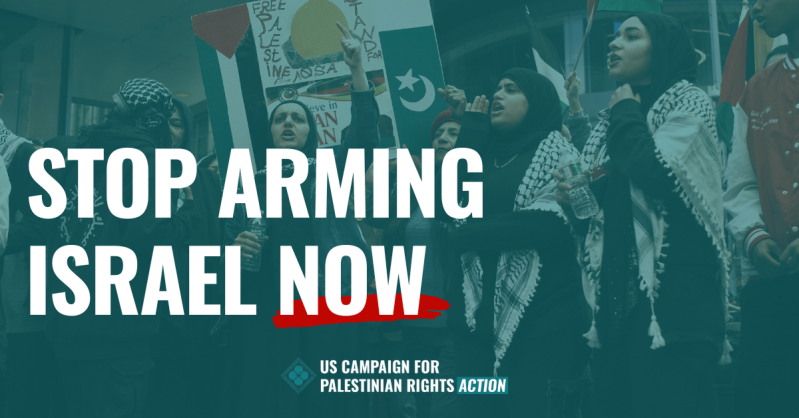
So much of the state violence you’re witnessing—both here in the U.S. and around the world—is funded by your tax dollars by the billions.
From Venezuela to the U.S. to Palestine, our liberation is intertwined.
Whether it’s ICE’s fatal shooting of legal observer Renee Nicole Good in Minneapolis, to Trump’s illegal invasion and occupation of Venezuela, to Israel’s ongoing horrific genocide of the Palestinian people, we’re seeing what happens when our government pours billions into violence instead of addressing the needs of our communities.
No more dollars spent on America’s forever wars and deadly state violence! Remember we are powerful when we rise together for justice and liberation. Read the latest updates below.
Your Activist Scoop
OUR GOVERNMENT'S GUILT
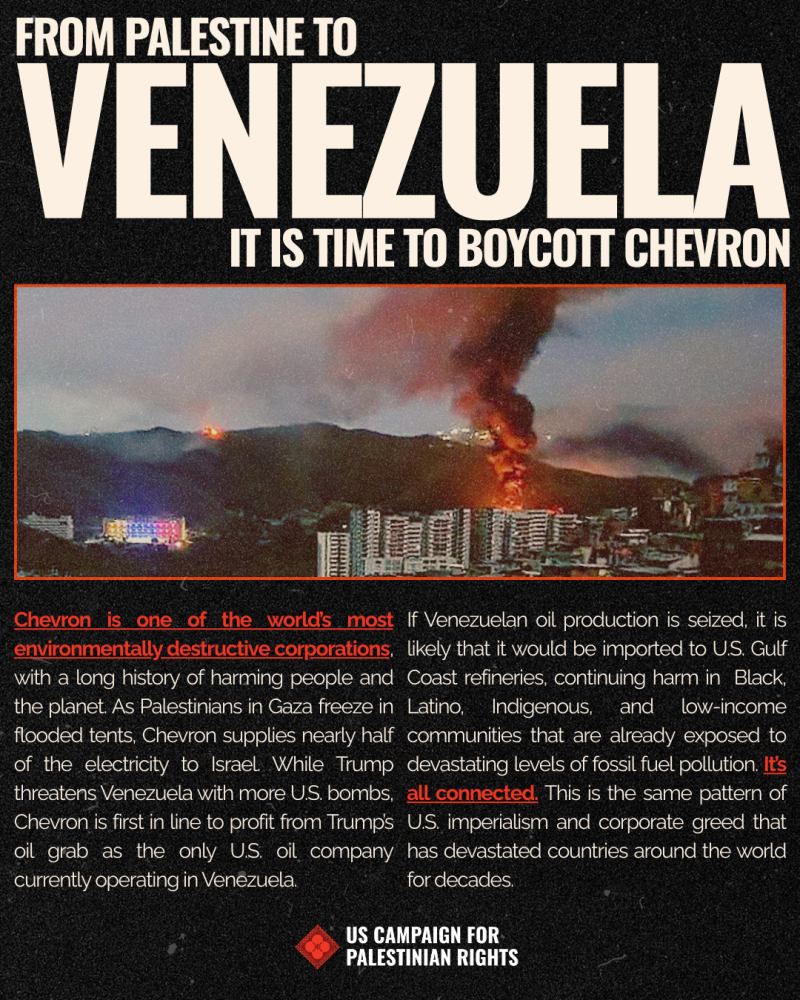
- Trump launched an illegal attack on Venezuela to advance U.S. imperialism and steal vast oil reserves for Big Oil’s profits. Chevron, which is also a major BDS target, is first in line to profit.1
- Israel has banned 37 aid organizations from entering Gaza in a cruel effort to further restrict aid and choke off Gaza from any resource that could potentially sustain life.2
- At Mar-a-Lago last week, Trump rolled out the red carpet for Israeli war criminal Netanyahu. Afterward, his administration announced an $8.6 billion contract with Boeing to supply F-15 fighter jets to the Israeli military.3
READ MORE ABOUT CHEVRON'S COMPLICITY
YOUR IMPACT
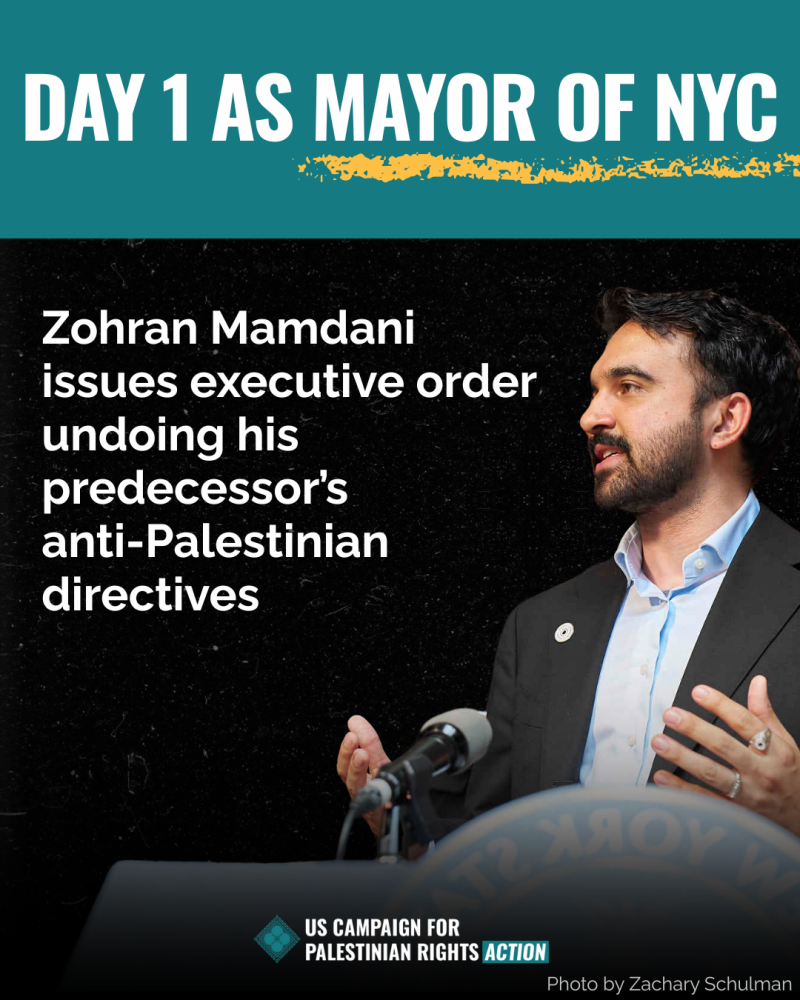
- Together you’ve collectively sent over 15,000 letters to Congress to demand freedom for Palestinian political prisoners like Dr. Hussam Abu Safiya and Marwan Barghouti.
- The first candidate ever endorsed by USCPR Action, Zohran Mamdani, has become the mayor of New York City. One of his first acts was to revoke his predecessor’s racist, anti-Palestinian directives.
- Thanks to your support, USCPR and USCPR Action hosted the Local Palestine Campaigns convening this fall, equipping 100+ grassroots organizers to build effective strategies for their campaigns.
SEE A RECAP OF THE CONVENING
WHAT YOU CAN DO NEXT

- Protest Big Oil at a local, corporate-owned Chevron or Citgo gas station this Saturday. Join the national day of action to stop Big Oil’s war profiteering from Venezuela to Palestine. Find an action near you.
- Pass out Boycott Chevron flyers this weekend. Raise awareness about Chevron’s war profiteering at local protests, events, and high-traffic locations. Print this new Boycott Chevron flyer from our sibling organization USCPR.
- Watch, which releases today in select theaters. This film is a sweeping and deeply human epic following three generations of a Palestinian family bound together by memory, love, and an unyielding will to survive 75 years of political upheaval.
PRINT BOYCOTT CHEVRON FLYERS
Thank you for taking action with us.
Onward to liberation,
AHMAD ABUZNAID
Executive Director
USCPR Action
2013.

9 januari 2026
Wadi Fouqin: Suffocated Between Illegal Israeli Settlements and the Apartheid Wall
Wadi Fouqin is a Palestinian village of about 1,300 residents, located five miles southwest of Bethlehem in the occupied West Bank. The village is known for its fruits and vegetables, olive trees, honey production, grazing land, and natural springs that have sustained generations of farming families.
However, the livelihoods of the people of Wadi Fouqin have been threatened due to the village's location on the "Green Line." It is surrounded and suffocated by Israeli towns and settlements, including Tzur Hadassa and the rapidly expanding settlement of Betar Illit, on one side, with the Apartheid Wall on the other. Because of this, what should be a 5 minute drive to Bethlehem could take from 30 minutes to over an hour. Movement in and out of the village is tightly restricted by Israeli military checkpoints, road closures, and Israeli-only bypass roads, severely limiting access to markets, jobs, schools, and healthcare.
Plans for further expansion of the separation barrier threaten to completely encircle Wadi Fouqin and neighboring villages, cutting them off from the rest of the Bethlehem governorate. Once completed, the barrier and surrounding settlements would isolate entire communities from hospitals, universities, and each other.
The village has steadily lost its land to settlement construction, bypass roads, and Israel’s segregation barrier, all illegal under international law. Since 1948, approximately three-quarters of Wadi Fouqin’s land has been annexed, with hundreds of additional acres confiscated since 1987 alone. Betar Illit, now home to roughly 50,000 settlers and planned to double in size, continues to encroach on village farmland and grazing areas.
Settlement expansion has also caused severe environmental damage. Construction and dynamiting have destroyed irrigation networks and dried up natural springs, while untreated sewage and construction waste from Betar Illit have flowed into Wadi Fouqin’s agricultural lands. This pollution has rendered fields unusable, contaminated groundwater, and contributed to respiratory and digestive illnesses among residents, deepening poverty and unemployment.

Map courtesy of Friends of Wadi Foquin
Nearly all of Wadi Fouqin (92.7 percent) lies in Area C, under full Israeli civil and military control. Palestinians living in Area C are governed by military law and have little ability to challenge land confiscations or protect their rights. Israeli authorities have announced plans to seize an additional 400 acres at the northern entrance of the village to build an industrial zone serving nearby settlements, a move that would severely restrict access to Wadi Fouqin’s only main road.
For our Virtual Visit this month, we will be going to Wadi Fouqin, led by our tour guide Ata Manassra. Ata's career began as a teacher, where he cultivated a passion for education and community development. After a decade of service with the International Committee of the Red Cross, he transitioned to a new role as a tour guide. In this capacity, Ata shares his extensive knowledge of his homeland with visitors, fostering a deeper appreciation for the culture and history of the region. In addition to his professional endeavors, Ata is a devoted farmer who cherishes his land and the connection it provides to his roots.
2012.

9 januari 2026
Het jaar is nog geen week oud of de VS misbruiken hun machtspositie om Venezuela binnen te vallen, Colombia, Cuba en Iran te bedreigen. Wij spreken ons ferm uit tegen dit rauwe imperialisme dat ook de basis is van Israëls straffeloze positie: olie eerst!
Onder het mom van een wapenstilstand is de aandacht van de wereld weer verslapt en gaat de genocide in Palestina nog steeds door. We zetten nog eens op een rijtje wat we allemaal kunnen doen. Alleen is maar alleen, maar een groep telt voor tien.
Strijdbare groet van het DocP team
BDS Nederland, onderdeel van de internationale BDS-beweging voor Boycot, Desinvesteringen en Sancties tegen Israel, veroordeelt de agressie van de Verenigde Staten tegen Venezuela en eerder tegen Nigeria. Dit rauwe imperialisme is een volgend stadium in pogingen het internationale recht te begraven.
De ‘beschaafde’ wereld noem het een wapenstilstand, het plan dat de VN Veiligheidsraad op 17 november jl. heeft goedgekeurd. Wie de werkelijkheid volgt weet beter. Het is een verbrokkeling en verdere kolonisatie van Palestina. Van heel Palestina. Uitroeiing is alles behalve van de tafel.
2011.

9 januari 2026
De genocide op de Palestijnen in Gaza is niet gestopt. Hoewel er sinds oktober wordt gesproken over een ‘staakt-het-vuren’, is dat vooral een fictie die door de politiek en media in stand wordt gehouden. Op de grond gaat het geweld door.
Israël heeft sinds zondag zeker 21 Palestijnen in de Gazastrook gedood, onder wie zeven kinderen. Het aantal slachtoffers sinds het ingaan van het bestand ligt ruim boven de vierhonderd. Toch halen deze dodelijke aanvallen nauwelijks de Nederlandse media. Het doden van Palestijnen is zo genormaliseerd geraakt dat het nauwelijks nog als nieuws wordt beschouwd. Amnesty International waarschuwde al in november dat de genocide ‘onverminderd’ voortduurt en dat het idee van normaliteit in Gaza een gevaarlijke illusie is.
Gaza doelbewust onleefbaar
Bommen en kogels zijn bovendien niet de enige wapens. Israël blijft structureel hulpgoederen blokkeren. Daardoor leven honderdduizenden Palestijnen nog altijd in kapotte tenten, zonder materialen om huizen te herstellen of noodwoningen te bouwen. Artsen zonder Grenzen waarschuwde recent dat baby’s lijden onder extreme kou, terwijl essentiële goederen zoals tenten en dekzeilen worden tegengehouden of vertraagd.
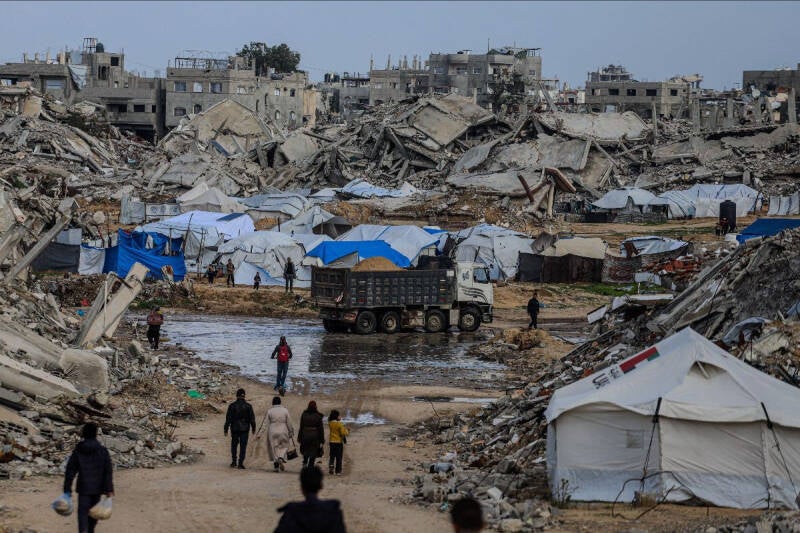
Palestijnen proberen te overleven in barre weersomstandigheden in een tentenkamp tussen de de ruïnes van Jabalia in het noorden van de Gazastrook © Habboub Ramez/ Abaca press / Alamy
Tegelijkertijd maakt Israël Gaza doelbewust onleefbaar door hele stadsdelen op te blazen. Sinds het bestand zijn al meer dan 1500 gebouwen gesloopt in bezet gebied. Inmiddels controleert het Israëlische leger circa 56 procent van de Gazastrook en breidt dat gebied verder uit. De legerleiding heeft duidelijk gemaakt dat deze bezetting blijvend is. De ‘gele lijn’ die Palestijnen niet mogen naderen, dreigt de definitieve grens te worden. Palestijnen die te dichtbij komen, worden beschoten.
Naast dat Israël ook hiermee de afspraken van het bestand schendt – het zou zich namelijk op termijn vrijwel geheel terugtrekken uit de Gazastrook – betekent dit ook dat het merendeel van de landbouwgrond in Gaza onder controle van het Israëlische leger valt en dus niet meer toegankelijk is voor Palestijnen.
Hulp verboden
Het is een volgend kenmerk van de genocide: bestaansmiddelen om zichzelf in leven te houden worden de Palestijnen ontzegd. Een gevolg is dat Palestijnen – nog meer dan ze al waren – afhankelijk worden van hulp. Maar ook dat wil Israël niet. Net voor de jaarwisseling verbood het zevenendertig internationale hulporganisaties te opereren in de Gazastrook, waaronder Oxfam Novib, War Child Holland en Artsen zonder Grenzen Nederland.
Nederlandse media herhaalden braaf de Israëlische propaganda dat dit gedaan zou zijn omdat de hulporganisaties medewerkers met banden met Hamas zouden hebben. De eigenlijk reden en cruciale context om het nieuws echt te begrijpen werd niet vermeld: dat het de zoveelste actie van Israël is om Palestijns leven onmogelijk te maken.
Dat het een onderdeel is van de voortdurende genocide op de Palestijnen.
Lees het hele artikel

Uitnodiging | Dries van Agt-lezing 2026
Op maandag 2 februari 2026 organiseert The Rights de tweede Dries van Agt-lezing: de jaarlijkse bijeenkomst die staat voor morele moed, internationale rechtsorde en solidariteit met het Palestijnse volk.
Dit jaar brengen we twee uitzonderlijke stemmen samen: Naledi Pandor (1953), oud-minister van internationale betrekkingen en samenwerking van Zuid-Afrika en Noura Erakat (1980), Palestijns-Amerikaanse mensenrechtenadvocaat en hoogleraar.
Lees hier alles over de lezing
Maandag 2 februari 2026
19.00 deuren open, aanvang 19.30
Amare, Spuiplein 150, Den Haag
Rita Baroud | Een generatie sterft in slow-motion
Al bijna twee jaar ziet de wereld de kinderen van Gaza sterven in slow-motion, schrijft journalist Rita Baroud in haar nieuwe essay voor The Rights Forum. Niet alleen als de bommen ontploffen, maar ook in het stille maar voor iedereen zichtbare en afwendbare tekort aan medische zorg. Wat in Gaza plaats heeft gevonden is geen ‘ineenstorting van de gezondheidszorg’. Het is de vernietiging van elke vorm van medische hulp.
Geen ziekenhuis functioneert nog naar behoren. Geen intensive care-eenheid. Geen reguliere chirurgische voorziening. Geen couveuses. Geen oncologische zorg. Geen betrouwbare dialysevoorziening. Geen brandwondencentra. Geen traumazorg.
In Gaza schiet de gezondheidszorg niet te kort – ze is vernietigd. En kinderen sterven door die vernietiging – niet omdat hun lichaam niet bestand is tegen ziekten of verwondingen, maar omdat de wereld heeft toegestaan dat de tijd zelf een wapen werd.
Lees het hele essay
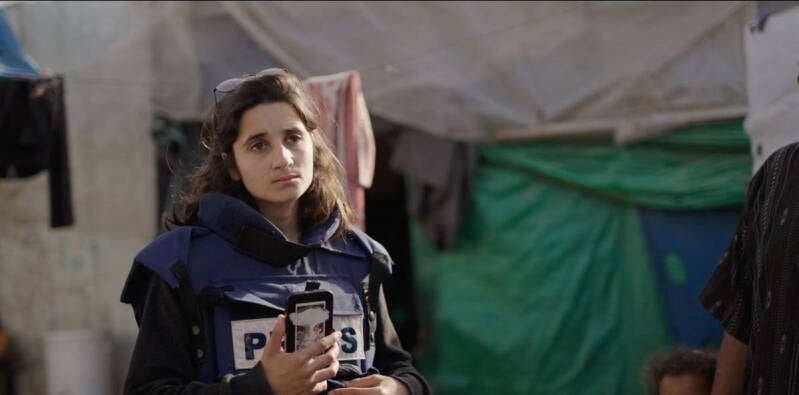
Rita Baroud
Op de Westoever | ‘Als de kolonisten onze bomen omzagen, planten wij nieuwe’
Onlangs ging een groep Nederlanders op reis naar Palestina. Dat deden ze om solidariteit te tonen met de Palestijnen en ze – ook letterlijk – te beschermen, én om zichzelf te verdiepen in de theologie van het verzet. Journalist Fréderike Geerdink ging mee en doet verslag.
'Het klinkt als een onwrikbaar mantra als de Palestijnse Amal Nassar de christelijke basis van haar strijd deelt: ‘We moeten hoop houden, vertrouwen hebben, handelen vanuit liefde. Dat is wat ons geloof ons leert. Ze zit na de dienst op zondagochtend in de ontmoetingsruimte van de Evangelisch-Lutherse Kerk in hartje Bethlehem, waar haar hele familie elke zondag samenkomt. Tenminste, als de slagbomen open zijn die de Israëlische bezetter tussen hun familieboerderij, negen kilometer buiten de stad, en de kerk heeft geplaatst.'
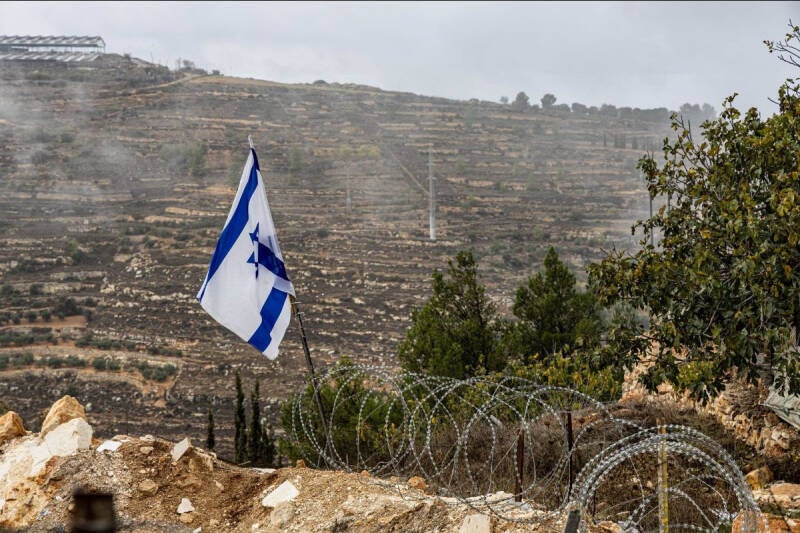
Israëlische blokkade pal bij de ingang van de boerderij van de familie Nassar, even buiten Bethlehem. © @Jack_perspective
Vriendendag Tent of Nations
De boerderij en het vredesproject van de familie Nassar in Bethlehem staat ook wel bekend als Tent of Nations. Op 7 februari organiseert Vrienden van Tent of Nations Nederland een openbare middag met masterclasses, gespreksgroepen, muziek, creativiteit en ontmoeting. Het is de bedoeling dat Daoud Nassar daar ook aanwezig zal zijn.
Uit onze agenda
zaterdag 9 januari t/m zaterdag 17 januari
DEMONSTRATIES EN WAKES
UTRECHT DOORDEWEEKSE DAGEN 08.30 - 09.30 | Dagelijks stilteprotest voor Palestina, tegen genocide en bezetting (Neude, langs het fietspad)
HOORN ZA 10 JAN 12.00 | Demonstratie voor Palestina (Station)
HAARLEM ZO 11 JAN 14.00 | Wekelijks protest tegen de onderdrukking van de Palestijnen (Grote Markt)
AMSTERDAM ZO 11 JAN 17.00 | Stil protest tegen de onderdrukking van de Palestijnen (Spui, bij ‘t Lieverdje)
TILBURG DI 13 JAN 12.35 | Wekelijkse demonstratie van Tilburg4Palestine (Universiteit Tilburg, op de hoofdweg van de campus onder de brug)
HUIZEN WO 14 JAN 11.30 | Wekelijkse sit-in voor Gaza (Gemeentehuis)
STATIONS IN NEDERLAND DO 15 JAN 18.00 | Wekelijkse lawaaidemonstratie op stations in heel Nederland: Stations Amersfoort, Assen, Groningen (mars vanaf Grote Markt 17.30 uur, sit-in station 18.30 uur), Harderwijk, Hengelo, Tiel, Tilburg, Utrecht, Zaandam (17.00 uur), Zutphen
Let op: The Rights Forum probeert de verschillende stationsacties in Nederland zo goed mogelijk bij te houden, maar dat is niet altijd goed mogelijk. Houd de sociale media-pagina's van de plaatselijke solidariteitsorganisaties in de gaten voor de meest actuele informatie.
DEN HAAG DO 15 JAN 12.00 | Sit-in van Rijksambtenaren bij het ministerie van Buitenlandse Zaken, Rijnstraat 8
AMERSFOORT VR 16 JAN 09.30 | Wekelijks stilteprotest tegen genocide (Varkensmarkt)
DOETINCHEM VR 16 JAN 10.00 | Lawaaidemo en speech (op het plein voor het gemeentehuis)
GRONINGEN ZA 17 JAN 13.00 | Tweewekelijkse wake van Vrouwen in het Zwart (Waagplein)
CULTURELE EN ANDERE EVENEMENTEN
UTRECHT ZA 10 JAN 17.00 | Palestine Café | Shahd Alnaami’s zine launch event, ‘However Fragile: Where Hope Becomes Resilience’
DIEREN ZA 17 JAN 10.00 - 17.00 | 2 jaar geleden werden Hind Rajab en haar familie door het Israëlische leger vermoord. Hun auto werd doorzeefd met kogels. In Dieren wordt een auto tentoongesteld als monument.
Onze agenda wordt doorlopend aangevuld. Bekijk de hele agenda
2010.

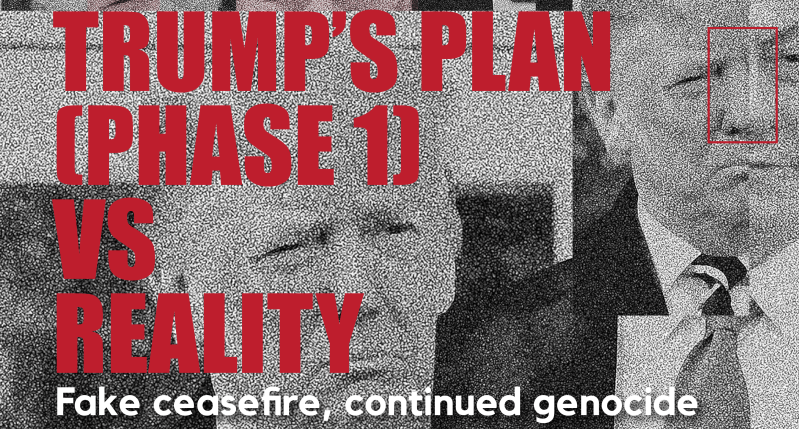
9 januari 2026
Three months ago, US President Trump imposed a so-called "peace" plan for Gaza on his and Israeli terms, a plan which, despite its flaws, at least promised to alleviate Palestinian suffering in the short term during its first phase.
Today, Trump and Netanyahu are still aligned in pursuing genocide and colonial control through different means, while the international community eagerly buys into the next act of their diplomatic theater further drowning international law.
The "Board of Peace" is set to be announced soon as the foreign entity to control Gaza, so that the Israeli colonial grip over Palestine tightens.
In our latest short blog we compare the plan phase 1 with what actually happened on 5 points:
1. Cease‑Fire and Military Withdrawal
2. Prisoner and Remains Exchange
3. Disarmament and Amnesty
4. Humanitarian Aid
5. Rafah Crossing Status
2009.

8 januari 2026
Humanitarian Situation Update #352
West Bank
7 January 2026
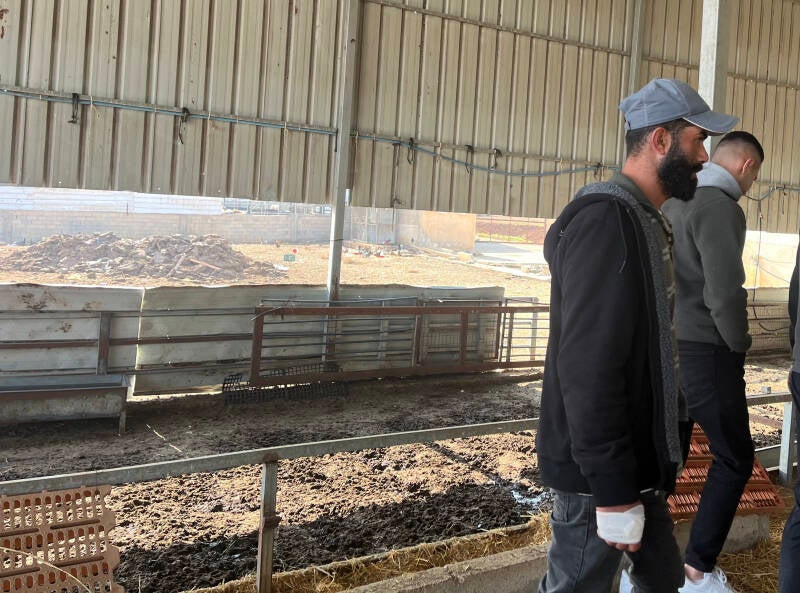
One of 12 Palestinians injured by Israeli settlers in Deir Dibwan, Ramallah governorate, on 26 December 2025. The man was beaten while guarding livestock overnight, with his hands and feet tied, as settlers stole nearly 150 sheep. Photo by OCHA
Key Highlights
- The Inter-Agency Standing Committee and Spokesperson for the UN Secretary-General urged the Israeli authorities to revoke their plan to suspend the operations of many international non-governmental organizations working in the Occupied Palestinian Territory.
- Severe winter weather damaged or destroyed dozens of tents and makeshift shelters in Bedouin and herding communities across the West Bank.
- In 2025, more than 830 Palestinians were injured by Israeli settlers in settler attacks – an average of two Palestinians injured per day.
- Over the past two weeks, Israeli authorities demolished 50 structures in Area C and East Jerusalem for lacking building permits.
- Israeli authorities forcibly evicted two Palestinian families from their homes in Batn al Hawa area of Silwan, in East Jerusalem, in favour of an Israeli settler organization.
- The six last remaining families were displaced from Khirbet Yanun in Nablus governorate, where they had lived for more than 60 years, due to settler attacks.
Humanitarian Developments
- On 31 December 2025, the Inter-Agency Standing Committee (IASC) urged the Israeli authorities to revoke their plan to ban many of the international non-governmental organizations (INGOs) operating in the Occupied Palestinian Territory (OPT), noting that they collectively deliver close to US$1 billion in assistance each year. The Committee emphasized: “Humanitarian access is not optional, conditional or political.” Calling for this measure to be reversed, Spokesperson for the UN Secretary-General underscored that, pursuant to its obligations under international humanitarian law, Israel must allow and facilitate rapid and unimpeded passage of humanitarian relief for all civilians in need and reiterated that all humanitarian partners must be able to operate safely and in line with humanitarian principles.
- Between 23 December 2025 and 5 January 2026, two Palestinians were killed by Israeli forces and 94 were injured, including 35 children, in the West Bank, including East Jerusalem. In addition, one Palestinian succumbed to wounds sustained earlier in December 2025. During the reporting period, two Israelis were killed and two were injured in Israel by a Palestinian man from the West Bank, who was injured and arrested. The following are details of the incidents that resulted in fatalities during the reporting period:
- On 23 December 2025, a Palestinian man from Salfit died of wounds sustained on 14 December, after he was shot by Israeli forces while attempting to cross the Barrier to reach East Jerusalem and Israel near Ar Ram and Dahiyat al Bareed in the Jerusalem governorate.
- On 26 December 2025, a Palestinian man killed two Israelis, including a woman, and injured another two, including one boy, in two consecutive attacks in Israel. According to Israeli media, a Palestinian man from Qabatiya town rammed and killed an elderly Israeli man and injured an Israeli boy with his employer’s car near Bet She'an city and then stabbed and killed an Israeli woman and injured an Israeli man in Afula city. Israeli forces shot, injured and arrested the man, and carried out an operation in the man’s hometown of Qabatiya, in Jenin governorate (see below).
- On 30 December 2025, Israeli forces opened live fire at a vehicle travelling on the main road between ‘Urif and Einabus towns, in Nablus governorate, shooting and injuring four Palestinian men in their twenties, one of whom later succumbed to his wounds. According to the Israeli military, soldiers shot, killed and withheld the body of a Palestinian man, claiming that he had attempted to carry out a ramming attack against them in the area. No Israeli soldiers were reported injured.
- On 1 January 2026, Israeli forces opened fire and injured two Palestinians in Al Lubban ash Sharqiyya village in Nablus governorate. One of the injured Palestinians was arrested by Israeli forces and later pronounced dead in an Israeli hospital. According to the Israeli military, its troops conducted an ambush where they shot at people throwing stones at them. The other man fled the scene.
- In 2025, a total of 240 Palestinians, including 55 children (23 per cent), were killed by Israeli forces or settlers, including 225 by Israeli forces, nine by Israeli settlers, and six where it remains unknown if they were killed by Israeli forces or settlers (see graph below). During the same period, Palestinians killed 17 Israelis, including one child and six members of Israeli forces, in the West Bank. In Israel, attacks by Palestinians from the West Bank killed three Israelis and one Palestinian perpetrator, in addition to a Palestinian killed in an attack by Israelis in West Jerusalem.
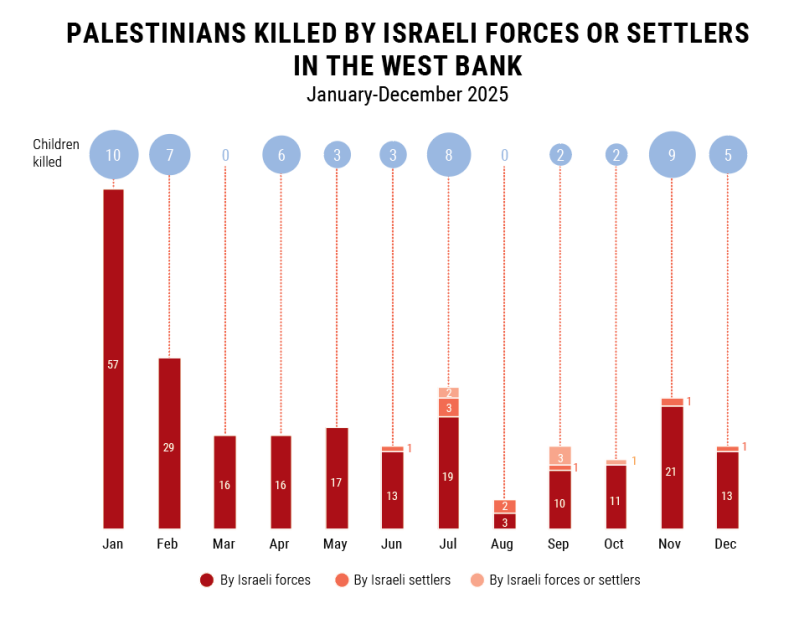
- Between 23 December 2025 and 5 January 2026, Israeli forces shot and injured six Palestinians with live ammunition while they attempted to cross the Barrier to reach East Jerusalem and Israel, including four near Ar Ram and Dahiyat al Bareed in Jerusalem governorate and two in Qalqiliya city. In a separate incident, on 28 December 2025, a Palestinian man from Izbat Salman village in Qalqiliya governorate, fell down while attempting to cross the Barrier near Ar Ram town. The man was transported to a hospital in Israel before being pronounced dead, and his body has been withheld by Israeli forces (not counted in the total number of Palestinians killed by Israeli forces). Since 7 October 2023, when Israeli authorities revoked or suspended most permits that had allowed Palestinian workers and others to access East Jerusalem and Israel, OCHA has documented the killing of 16 Palestinians and the injury of more than 240 others while attempting to cross the Barrier, reportedly in search of employment opportunities amid a severe economic downturn in the West Bank.
- Between 23 December 2025 and 5 January 2026 Israeli forces conducted two operations in Jenin governorate, resulting in displacement, movement restrictions and injuries. On 26 December, Israeli forces carried out a one-day operation in Qabatiya town, in Jenin governorate, the hometown of a Palestinian who killed two Israelis and injured two others in Israel (see more details above). Israeli forces raided multiple neighbourhoods, imposed a curfew, conducted field interrogations, and ordered shops to close. The family home of the man was raided and sealed, displacing five people (On 4 January, Israeli forces again raided Qabatiya town and delivered a military order to demolish the same house within 72 hours). Additionally, at least two multi-storey buildings and five houses in different locations across the town were taken over as military posts, displacing nearly 15 families, comprising about 75 people. Israeli forces blocked five of the town’s seven entrances with earth mounds, severely restricting movement, while ambulances were allowed to enter and exit the town via longer, alternative routes and only following coordination with the Palestinian District Coordination Liaison (DCL). In another 10-hour operation on 31 December, Israeli forces raided Jaba’ town, southwest of Jenin city, searched homes, forcibly evacuated two families, and converted one house into a field interrogation centre. Approximately 50 Palestinians, including the head of the village council, were arrested and interrogated, of whom four were physically assaulted and injured by Israeli forces.
- Between 28 and 30 December 2025, severe winter weather, including heavy rainfall, strong winds and flash flooding, affected vulnerable communities across large parts of the West Bank. On 29 December 2025, the Palestinian Civil Defense reported 115 incidents over an 11-hour period, including firefighting and rescue incidents across multiple governorates. Moreover, dozens of shelters and makeshift structures in Bedouin and herding communities sustained damage by flooding and storms – many of these families had already experienced repeated displacement due to settler violence and access restrictions, leaving their shelters fragile and highly exposed to weather hazards. Between 28 and 30 December 2025, OCHA triggered emergency response to assist at least 66 households (about 300 people) in 18 mainly herding and Bedouin communities who had their residential tents, livestock barracks, fodder storage and animal shelters damaged or destroyed. In several cases, structures that had been recently reconstructed following settler attacks were again damaged or rendered unusable.
- Under the 2026 Flash Appeal, approximately 63,000 people in the West Bank are targeted with emergency shelter assistance, including inter alia urgent shelter rehabilitation and weatherproofing works to protect vulnerable households from extreme weather as well as assistance to families displaced or affected by demolitions, forced evictions, or military incursions. Activities include the distribution of temporary shelter solutions, rental support, structural repairs and insulation, and the provision of essential seasonal items such as heaters and blankets, prioritizing families in damaged or exposed shelters.
Demolitions and Evictions
- On 31 December 2025, Israeli forces began demolishing 25 buildings in Nur Shams refugee camp, in Tulkarm governorate, which were targeted with demolition in an order issued by the Israeli military on 14 December. According to local community sources, Israeli authorities rejected a legal request submitted on behalf of the families to suspend the demolitions that targeted both single-family houses and multi-unit residential buildings, affecting approximately 70 households, all of whom had already been displaced from the camp. The structures are largely located in and near Jabal As Salhin, Al Manshiyeh, and Al Maslakh neighbourhoods. Already in May 2025, according to a preliminary analysis of satellite imagery conducted by the United Nations Satellite Centre (UNOSAT) that had not been validated in the field, a total of 280 structures had been destroyed or damaged in Nur Shams Camp, or about 35 per cent of all structures. Since then, Israeli forces have continued to carry out demolitions in Nur Shams Camp, as well as Jenin and Tulkarm camps, but the areas have remained inaccessible for further assessments.
- Between 23 December and 5 January, OCHA documented the demolition of 50 Palestinian-owned structures for lacking Israeli-issued building permits, which are almost impossible for Palestinians to obtain. Twenty-seven (27) of the structures were in East Jerusalem and 23 were in Area C of the West Bank. In total, 53 Palestinians, including 28 children, were displaced and more than 14,000 people were otherwise affected. The demolished structures included 10 residences (of which seven were inhabited), 31 agricultural and livelihood structures, and nine water and sanitation and other structures. Among the demolished structures were walls surrounding a children’s park in Al Mughayyir village in Ramallah governorate, where the land was also bulldozed and about 100 saplings uprooted, and 23 shops, signboards, kiosks and other commercial structures in Kafr ‘Aqab, in East Jerusalem, during a 12-hour operation by Israeli forces that also resulted in the injury of 24 Palestinians and the destruction or confiscation of large quantities of commercial equipment, tools and other property.
- Eleven of the 20 structures demolished in Area C of the West Bank during the reporting period were demolished by Israeli authorities in Az Za’ayyem Bedouin community, in Jerusalem governorate, on 24 December; eight were agricultural structures and three were residential shelters. The demolition displaced 31 Palestinians, including 17 children, and affected 17 additional people, including six children. Az Za’ayyem Bedouin is among 18 communities of over 4,000 people residing in an area designated for the E1 settlement plan in eastern Jerusalem governorate by Israeli authorities to create a continuous built-up area between Ma’ale Adumim settlement and Jerusalem. Since the Israeli government decided to proceed with the E1 settlement expansion plan in late August 2025, a total of 15 structures have so far been demolished, all in Az Za’ayyem Bedouin community.
- On 24 December, Israeli forces bulldozed on punitive grounds a one-storey residential house in Bizzariya village, northwest of Nablus city, displacing four people, including a child. The house belonged to the family of one of two Palestinians who stabbed and killed an Israeli security guard outside a supermarket at the Gush Etzion settlement Junction in Bethlehem governorate on 10 July, before they were both killed. During the demolition, the Israeli bulldozer destroyed the entrance of another house, affecting eight people, including four children.
- On 4 January 2026, the Israeli police forcibly evicted two Palestinian families from their two-storey residential building (containing two apartments) in the Batn Al Hawa area of Silwan, in East Jerusalem. As a result, eight people, including three children, were displaced, in favour of the Israeli settler organization Ateret Cohanim. According to the family, in November 2025, the Israeli Supreme Court rejected their appeal against the eviction. The family subsequently filed another petition and had a hearing scheduled for 21 December 2025. However, prior to the court’s ruling, the Israeli Enforcement and Collection Authority issued a final eviction notice, ordering the family to vacate the property by 5 January 2026. Following the eviction, Israeli settlers took over the building, sealed its doors and windows with metal sheets, and raised Israeli flags on the structure.
- This is the sixth eviction incident in Batn al Hawa since February 2024, which in total resulted in the displacement of 13 Palestinian families comprising 57 people, including 27 children. These families are among more than 90 families in Batn al Hawa, comprising over 450 people including about 200 children, who have been at risk of forced displacement due to eviction cases filed against them by Ateret Cohanim settler organization. Evictions have grave physical, social, economic and emotional impact on Palestinian families concerned. In addition to depriving the family of a home – its main asset and source of physical and economic security – evictions frequently result in disruption in livelihoods, increased poverty and a reduced standard of living. The high legal fees families incur when defending a case in court further strain already meagre financial resources. The impact on children can be particularly devastating, including post-traumatic stress disorder, depression, anxiety and diminished academic achievement. Moreover, the establishment and continued presence of settlement compounds within Palestinian areas have significantly affected the daily lives of Palestinian residents, contributing to an increasingly coercive environment that may place additional pressure on them to leave. The main elements of this environment include increased friction; restrictions on movement and access; and a reduction on privacy due to the presence of private security guards and accompanying surveillance cameras.
Israeli Settler Attacks
- Between 23 December 2025 and 5 January 2026, OCHA documented 44 Israeli settler attacks against Palestinians that resulted in casualties, property damage or both. The attacks led to the injury of 33 Palestinians, including 11 children; 28 were injured by Israeli settlers and five by Israeli forces. During the same period, settler attacks led to the large-scale displacement of the entire Palestinian herding community of Khirbet Yanun, in Nablus governorate (see below). In multiple attacks, Israeli settlers targeted Palestinian residential structures, as illustrated in the following examples:
- On 24 December, in Al Mazraa ash Sharqia in Ramallah governorate, Israeli settlers set fire to a Palestinian-owned residential building under construction, damaging its staircase, doors and façade, and sprayed slogans in Hebrew on the walls.
- On 27 December 2025, in Hammamat al-Maleh herding community in Tubas governorate, Israeli settlers attempted to trespass into residential shelters, vandalized at least two structures, destroyed furniture and water tanks, and physically assaulted a family, injuring a 12-year-old child. Israeli forces subsequently arrived, arrested four family members, and delayed ambulance access to the injured child for several hours.
- On 3 January, Israeli settlers from a nearby outpost attacked a house in Burin village in Nablus governorate, throwing stones that broke windows and struck a 16-year-old boy on the head, further exacerbating fear among two families residing in the building, which has been repeatedly targeted.
- On 3 January, Israeli settlers broke into the shelter area of a family in East Taybeh Bedouin community in Ramallah governorate, damaging and stealing a metal gate and intimidating nearby households, amid an escalation of attacks following the establishment of a settlement outpost adjacent to the community.
- On 3 January, Israeli settlers broke into and vandalized a secondary residence on the northern outskirts of Sinjil village in Ramallah governorate, destroying furniture and household property.
- In one key incident on 26 December, Israeli settlers, believed to be from a settlement outpost on the southern outskirts of Deir Dibwan village in Ramallah governorate, carried out two consecutive attacks against Palestinians and their property in Area B of the village. According to community sources and video footage, the first attack occurred at about 01:00, when a group of masked Israeli settlers, some armed, cut the electricity supply and broke into a Palestinian-owned farm. The settlers assaulted two workers while they were sleeping, tied their hands and feet, and stole 148 sheep before fleeing towards the nearby outpost. The second attack took place around noon time on the same day, when dozens of masked settlers, some armed, attacked Palestinians who were ploughing their land and others who had gathered near the farm following the earlier incident. During the attack, settlers fired live ammunition, injuring one man with bullet shrapnel in the leg, and physically assaulted nine Palestinians, including four children and a 70-year-old man, using clubs and metal chains. In total, settlers injured 12 Palestinians and stole livestock, two agricultural tractors and two other vehicles.
- On 28 December 2025, following a series of settler attacks and intimidation, the six last remaining Palestinian families comprising 22 people, including two children and 11 women, were displaced from Khirbet Yanun in Nablus governorate, where they had lived for more than 60 years. According to community sources, the displacement followed repeated attacks by Israeli settlers from Itamar settlement and nearby settlement outposts, targeting residents and their property, blocking their access to grazing areas, preventing them from planting fodder crops, and restricting their access to agricultural areas, including olive groves. On 21 December, settlers took over two of the village’s abandoned houses as well as bulldozed and ploughed parts of Sahel Yanun that had already been cultivated by Palestinians, causing damage to 130 dunums (32 acres). These attacks also disrupted access to education, with teachers reporting repeated harassment by Israeli settlers and Israeli forces while commuting to and from the community. Amid ongoing threats by Israeli settlers, the Palestinian Ministry of Education temporarily relocated 16 students (Grades 1–6) and six staff members to a neighbouring school in Aqraba. The families were displaced over the course of several days, with the last remaining family reportedly given a seven-hour deadline to leave on 28 December. Following the full displacement of the community, Israeli forces installed a road gate, blocking access to the area.
- In 2025, OCHA has documented over 1,800 settler attacks that resulted in casualties or property damage in about 280 communities across the West Bank, primarily in Ramallah, Nablus and Hebron governorates. This is an average of five incidents per day, marking the highest daily average since OCHA began recording such incidents in 2006. These attacks have resulted in the injury of 1,190 Palestinians, including 838 (70 per cent) injured by Israeli settlers, 339 (28 per cent) by Israeli forces, and 13 where it remains unknown whether they were injured by Israeli settlers or forces. Of the 838 Palestinians injured by Israeli settlers in 2025 – an average of two Palestinians injured per day – nearly 60 per cent were in Ramallah (267 injuries) and Hebron (223) governorates.
- For key figures and additional breakdowns of casualties, displacement and settler violence between January 2005 and November 2025, please refer to the OCHA West Bank November 2025 Snapshot.
Funding
- As of 6 January 2026, Member States disbursed approximately $1.6 billion out of the $4 billion (40 per cent) requested to meet the most critical humanitarian needs of 3 million out of 3.3 million people identified as requiring assistance in Gaza and the West Bank, including East Jerusalem, under the 2025 Flash Appeal for the OPT. On 8 December 2025, the UN and its humanitarian partners launched a Flash Appeal for $4.06 billion to address the humanitarian needs of 2.97 million out of 3.62 million people identified as requiring assistance in Gaza and the West Bank, including East Jerusalem, in 2026. Nearly 92 per cent of those required funds are for the humanitarian response in Gaza, with just over eight per cent for the West Bank. In December, the oPt Humanitarian Fund managed 111 ongoing projects, totalling $61.1 million, to address urgent needs in the Gaza Strip (89 per cent) and the West Bank (11 per cent). Of these projects, 54 are being implemented by international NGOs, 44 by national NGOs and 13 by UN agencies. Notably, 48 out of the 67 projects implemented by international NGOs or the UN are being implemented in collaboration with national NGOs. For more information, please see OCHA’s Financial Tracking Service webpage and the oPt HF webpage.
2008.

7 januari 2026
Gaza Humanitarian Response
Situation Report No. 59
6 January 2026
(As of 18:00 on 5 January 2026, unless otherwise noted)
HIGHLIGHTS
- Fuel shortages and road closures severely slowed the humanitarian response in December. While fuel deliveries have resumed, ongoing access restrictions, congestion, and storage gaps continue to drive up costs and delay assistance.
- As of 4 January, partners were able to resume full monthly food rations distributions for the first time since October 2023, reaching 100,000 people.
- Since the October ceasefire, 35 health service points were reactivated and 25 new ones established, including 12 primary health care centres, with most being located in northern Gaza.
- Temporary Learning Spaces (TLSs) expanded to 424 sites, including two TLSs that opened between 3 and 4 January. The TLSs are now serving more than 232,000 children with about 5,550 teachers.
SITUATION OVERVIEW
Israeli airstrikes, shelling and gunfire continued to be reported across the Gaza Strip between 3 and 5 January with casualties reported. According to the Gaza Ministry of Health, 16 Palestinians were killed and 28 others injured across the Gaza Strip over the last 72 hours.
On 30 December 2025, 37 international non-governmental organizations (INGOs) were officially notified by an Israeli interministerial committee that their registrations would expire on 31 December 2025, triggering a mandatory 60-day wind down period. These INGOs are integral to food, shelter, health, and nutrition services across the occupied Palestinian territory, and this development may force them to cease operations unless registrations are renewed.
UNITED NATIONS-COORDINATED AID ENTRY*
Between 30 December and 5 January, at least 17,534 pallets of aid administered by the UN and its partners were offloaded at Gaza’s crossings, based on data retrieved from the UN 2720 Mechanism dashboard at 15:00 on 6 January. About 72 per cent of these pallets contained food, followed by water, health and sanitation (WASH) items (15 per cent), shelter supplies (8 per cent), health items (4 per cent), and others, including nutrition and protection aid, as well as fuel (less than 1 per cent).
Between 31 December and 5 January, UNOPS international monitors deployed at Gaza’s crossings verified the collection of at least 15,243 pallets of aid – 8,712 from Kerem Shalom Crossing and 6,531 from Zikim Crossing. These comprised inter alia 12,497 pallets of food assistance, including 3,691 pallets of nutrition supplies; 1,448 pallets of WASH supplies, 319 pallets of shelter items including tents, clothing, kitchenware and bedding items; and eight pallets of health supplies. Monitoring missions to Zikim were denied access on 1 and 4 January and no humanitarian cargo was collected on 2 January.
The above data excludes bilateral donations and the commercial sector.
Salah ad Deen Road remains closed to humanitarian convoys uplifting cargo from Karem Shalom crossing, forcing humanitarian convoys to use the Philadelphi and Al Rasheed roads, resulting in severe congestion and delays. Due to irregular truck routing, frequent supplier cancellations, and denials of movement requests, transportation costs have increased. Additionally, the lack of appropriate storage facilities has caused some goods to spoil, undermining the efficiency and effectiveness of the response.
HUMANITARIAN RESPONSE
The below are preliminary updates shared by Clusters at the time of reporting and will be reconciled and aggregated in the coming days as Clusters receive more data from the capillary network of partners active on the ground.
Food Security
- As of 4 January, Food Security Sector partners had reached 20,000 families (100,000 people) with monthly general food assistance via 50 distribution points with a ration size adjusted to two food parcels and two 25-kilogram bags of flour. These rations are covering 100 per cent of the minimum caloric needs for the first time since October 2023 thanks to sufficient stock.
- Hot meal distribution continues. As of 3 December, 25 partners delivered 1,627,000 hot meals through 209 kitchens: 452,000,000 meals by 49 kitchens in northern Gaza and 1,175,000 meals by 160 kitchens in southern Gaza.
Health
- Since the ceasefire and as of 31 December, health partners reactivated 35 health service points and established 25 new ones, including 12 primary health care centres. This expansion increased the availability of partially functioning health service points across the Gaza Strip from 33 per cent before the ceasefire to 40 per cent since the ceasefire. About 70 per cent of these newly established or re-opened facilities are in northern Gaza.
- Despite these improvements, two major challenges persist. First, 55 per cent of active health partners are international NGOs, and any de-registration would severely disrupt access to essential health services. Second, disruptions in the fuel supply threaten the continuity of care across all hospitals and primary health care centres, putting lifesaving operations at risk.
- On 5 January, WHO facilitated the evacuation of 18 patients and their 36 companions from Kerem Shalom Crossing for medical treatment outside Gaza.
Shelter
- Between 3 and 4 January, Shelter Cluster partners reached almost 16,400 families with life-saving shelter and non-food item assistance across Deir al Balah, Gaza city and North Gaza Governorate.
- In Deir al Balah, partners delivered 435 tents to families in urgent need of shelter. In addition, 1,764 blankets and 1,764 mattresses were distributed to 294 households to address urgent winter needs. Partners provided clothing assistance to 489 vulnerable households in Gaza city and North Gaza, and 732 framing kits were delivered to support the safety and stability of makeshift shelters, reaching 732 families.
- About 2,000 tarpaulins were distributed in Gaza city and North Gaza, while 2,000 blankets were distributed to families across the Strip aiming to strengthen protection against harsh weather conditions and improve living conditions for affected people.
- As part of an intersectoral joint response to rainstorm incidents, 1,792 tents were distributed to 1,792 families across the Gaza Strip, along with by blankets and tarpaulins. This integrated package provided urgent shelter solutions for families whose homes were severely affected by heavy rainfall, ensuring immediate relief and improved resilience against further weather-related challenges.
Water, Sanitation and Hygiene
- WASH Cluster partners continue maintenance work at the Azqoula Booster Station in Gaza city, which is expected to be completed by the end of January. The project involves installing an online booster station with a capacity of 450 cubic metres per hour. Once completed, this will significantly improve water pressure in the main and transmission networks, ensuring that the Mekorot pipeline water reaches wider areas with adequate pressure, particularly in Sheikh Radwan and western Gaza city.
- Water trucking operations continue, with 36 partners distributing daily more than 21,500 cubic metres of drinking water and 10,400 cubic metres of domestic water to 2,350 water collection points across the Strip.
- In December, 12 partners installed 1,192 communal latrines and 1,003 household latrines in 105 locations across the Strip. However, this remains far below the required target of 10,000 latrines per month, primarily due to shortages of latrine slabs and other critical supplies needed for installation in high-priority areas.
Protection
- Protection and protection-linked activities continued across the Strip on 3 and 4 January, reaching at least 2,900 people. Core support included psychosocial support (PSS) and risk awareness interventions. Adult-focused group PSS sessions reached 110 people, complemented by large-scale mental health and psychosocial support (MHPSS) and awareness activities benefiting more than 2,166 people. These included Psychological First Aid (PFA) for 34 people, emotional release sessions for 1,198 participants, structured and unstructured PSS for 385 people, group and individual counseling for 120 people, and protection awareness sessions reaching 1,652 people.
- Specialized and disability-inclusive services were also provided, including speech therapy for 85 children, physiotherapy for 19 persons with disabilities or war-related injuries, and individual case management for 63 people. In addition, cash assistance supported 143 vulnerable households, while significant winterization efforts, such as clothing parcels, blankets and vouchers, benefited several thousand people, with distributions still ongoing.
- Child Protection
- Between 3 and 5 January, Child Protection (CP) partners reached at least 6,000 children and more than 2,000 caregivers through child protection and MHPSS services across the Gaza Strip. These figures represent a minimum aggregate reach across multiple service modalities, noting that some children and caregivers may have accessed more than one service.
- During the same period, at least 3,500 children participated in structured and unstructured MHPSS activities, including group sessions, individual counseling, expressive arts, recreational activities and PFA. More than 1,500 caregivers and adults received MHPSS support through individual counseling, group sessions, parenting support, and stress-management activities.
- At least 50 children received general CP case management during the reporting period, while over 2,000 children remained under ongoing case management follow-up across multiple locations. Under family tracing, reunification, and care arrangements, at least 75 follow-ups were conducted with unaccompanied and separated children to assess well-being support and monitor outcomes, including follow-up linked to cash-based assistance.
- Through child protection awareness and community engagement initiatives, more than 1,200 children and over 1,000 caregivers and community members participated in sessions addressing child safety, prevention of family separation, and child protection risks.
- In addition, CP partners reached at least 4,800 children with winter-related protection assistance, including blankets, jackets, winter clothing, tarpaulins and cash for protection, to mitigate cold-related protection and health risks.
- More than 200 children and adolescents also engaged in structured recreational, arts-based, and psychosocial activities, including initiatives under the “Gaza We Want” framework, promoting expression, coping and safe participation.
- Prevention and Addressing of Gender-Based Violence
- Between 3 and 4 January, partners addressing gender-based violence (GBV) continued delivering multisectoral services across Gaza through women and girls safe spaces (WGSSs). These services included MHPSS, recreational activities for women and girls, case management, legal assistance, and awareness sessions on GBV and available services. During this period, 3,285 people accessed support through WGSSs.
- The GBV Area of Responsibility partners assisted women and girls affected by recent flooding. In northern Gaza, 300 dignity kits and 5,800 menstrual hygiene management (MHM) kits were distributed to partners. In Khan Younis and Deir al Balah governorates, partners received 4,500 dignity kits, 20,000 MHM kits, and 2,100 blankets to strengthen the ongoing response. A portion of these supplies, particularly dignity kits, was allocated to the rapid response for flood-affected women and girls.
- To maintain continuity of services, 12 partners received tents to repair and restore WGSSs damaged by storms. Severe weather remains a major challenge, as many GBV service delivery points have been destroyed, halting operations. Temporary tents have become the only viable solution to ensure service continuation.
- Services were further expanded with the establishment of three new WGSSs: two in Gaza city and one in Khan Younis. As of 5 January, 59 WGSSs have been scaled up since the ceasefire.
- Mine Action
- Between 3 and 5 January, Mine Action partners conducted 12 Explosive Hazard Assessment in Khan Younis, Deir al Balah, Gaza city and North Gaza in support of rubble removal efforts and partners activities.
- Four Explosive Ordnance Risk Education (EORE) training sessions were held for UNDP engineers.
Education
- TLSs continue to expand across the Gaza Strip. Between 3 and 4 January, two additional TLSs were established in Khan Younis and Deir Al Balah, providing in-person learning opportunities for 203 school-aged children supported by 12 teachers. This brings the total to 424 operational TLSs, with a current capacity of 232,724 learners supported by 5,552 teachers. Scaling up TLSs remains a critical priority, however, progress is heavily dependent on the timely entry of essential supplies.
- Renovation works are advancing in public schools. Ten classrooms, two administrative rooms and two storage facilities have been completed in two schools in Gaza city, enabling access to learning opportunities for more than 1,800 children (half of them being girls).
- Innovative recycling efforts are underway with 10 furniture sets manufactured by recycling wooden pallets. Each set includes one table and six stools, serving 240 learners in Altaawon TLS in Khan Younis. Despite these achievements, needs remain high, and shortages of furniture and teaching/learning materials continue to pose significant challenges. The Cluster continues to encourage partners across sectors to donate wooden pallets for recycling into furniture to scale up production.
2007.
AVAAZ
7 januari 2026
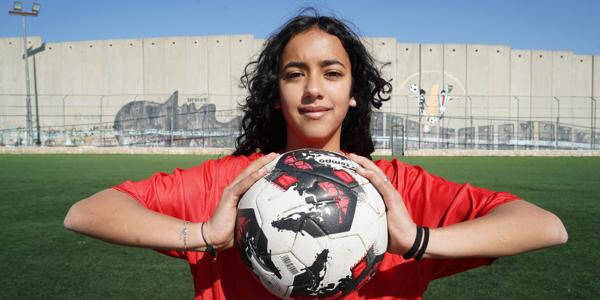
Ons voetbalveld betekent alles voor ons. Het is de plek waar we lachen, trainen, en ons even kind voelen.
Hier kunnen we alle haat en al het geweld vergeten, al is het maar voor even. Het is een van de weinige plekken waar we ons nog veilig voelen te midden van Israël's militaire invallen, waaraan vaak traangas en kogels te pas komen.
Maar nu willen de Israëlische autoriteiten ons ook deze plek ontnemen, en de bulldozers kunnen elk moment beginnen met afbreken.
We hebben nog minder dan een week, en jij kunt ons helpen: als duizenden mensen wereldwijd nu hun stem laten horen, zullen voetbalfans, spelers en atleten volgen. Mensen zoals Infantino en Čeferin, de voorzitters van FIFA en UEFA, kunnen dan niet langer wegkijken -- en zij hebben genoeg invloed om ons voetbalveld te redden.
Teken nu en deel onze oproep aan Gianni Infantino en Aleksander Čeferin:
Sommige van onze meisjes hebben Palestina zelfs vertegenwoordigd en wonnen de derde plaats bij het West-Aziatische O-14 voetbalkampioenschap tot 14 jaar! En veel van onze spelers zijn uiteindelijk voor professionele teams gaan spelen. Maar ons veld geeft ons vooral een stukje kindertijd.
Dit veld is onze plek om adem te halen in een vluchtelingenkamp dat wordt omsingeld door muren en uitkijktorens.
Laat alsjeblieft niet toe dat bulldozers onze plek kapotmaken -- niet terwijl de wereld toekijkt.
De kinderen van het Aida-kamp, het Aida jongerencentrum en Avaaz
2006.

6 januari 2026
On Saturday morning, Trump bombed Caracas, Venezuela's capital, and forcibly captured President Maduro in an illegal military operation conducted without congressional authorization. The U.S. military killed dozens of civilians, military personnel, and officials in the strikes.
Trump isn't even hiding why he did it. At his press conference, he said the U.S. would "run" Venezuela, "rebuild the oil infrastructure," and "take out a tremendous amount of wealth out of the ground." He openly discussed U.S. oil companies going into Venezuela to extract and sell the country's oil—the largest proven reserves in the world.
This war is about seizing Venezuela’s wealth and handing it to Big Oil corporations like Chevron, which are already being enriched by rising stock prices after Trump’s attack. All in the interest of U.S. imperialism.
The same corporations that donated millions to Trump's campaign. The same corporations that have been lobbying for access to Venezuela's oil for decades. Trump's aide Stephen Miller explicitly framed Venezuela's nationalization of its oil industry in the 1970s as "the largest recorded theft of American wealth," revealing this administration's true goal: corporate plunder.
Chevron is also notoriously the primary energy provider for Israel, and a major international target of the Palestinian-led Boycott, Divestment and Sanctions movement since 2022.
In this critical moment from Venezuela to Palestine, we must step up the Boycott Chevron campaign across the world. Sign the pledge to Boycott Chevron and get involved now.
Chevron is one of the world’s most environmentally destructive corporations, with a long history of harming people and the planet. While Palestinians in Gaza freeze in flooded tents, Chevron supplies nearly half of the electricity to Israel.
While Trump threatens Venezuela with more U.S. bombs, Chevron is first in line to profit from Trump’s oil grab as the only U.S. oil company currently operating in Venezuela.
If Venezuelan oil production is increased, it is likely that more Venezuelan heavy oil would be imported by U.S. Gulf Coast refineries, largely located where Black, Latino, Indigenous, and low-income communities are already exposed to devastating levels of fossil fuel pollution.
It’s all connected. This is the same pattern of U.S. imperialism and corporate greed that has devastated countries around the world for decades. Meanwhile Trump is threatening to attack Iran (known for its large oil reserves), Colombia, and Cuba. He warned that he's "locked and loaded" to intervene in Iran after meeting with Israeli Prime Minister and ICC-wanted war criminal Netanyahu last week.
Take a stand against Big Oil’s profiteering from genocide and war. You can join us on the upcoming action call “Stop Big Oil’s War on Venezuela,” this Thursday, Jan. 8 at 8PM ET / 5PM PT.
LEARN MORE ABOUT CHEVRONJOIN THE ACTION CALL THURSDAY
Onward to liberation,
AHMAD ABUZNAID
Executive Director
US Campaign for Palestinian Rights
2005.

6 januari 2026
Humanitarian Situation Update #350 on the West Bank contained an error regarding the age of a Palestinian fatality, who was initially reported as a child. He was subsequently confirmed to have been 18 years old.
All figures and related references have been corrected accordingly, with asterisks in the text indicating where changes were made.
The updated report is available here: ochaopt.org/content/humanitarian-situation-update-350-west-bank
Best regards,
OCHA OPT team
2004.

5 januari 2026
New report and snapshot on humanitarian response during the second month of the ceasefire
5 January 2026
Today, we release a narrative report and a snapshot (infographic) on humanitarian response delivered by the UN and its partners during the second month of the October 2025 Ceasefire.
ReportInfographic
During the second month of the ceasefire, the UN and its partners:
- brought into Gaza nearly 85,000 pallets of humanitarian supplies;
- served up to 1.5 million cooked meals daily and reached nearly 1.3 million people with household-level monthly general food assistance in November;
- supported almost 321,000 pregnant and breastfeeding women and children under five with nutrient supplements to prevent malnutrition;
- set up 120 intensive care and emergency beds, and provided 30 anaesthesia machines and 40 portable vital-sign monitors to health facilities, alongside critical medicines and consumables;
- assisted over 237,750 children under the age of 11 with winter clothing kits; and
- reached nearly 62,000 additional households with US$24 million-worth of multi-purpose cash assistance.
Despite a significant increase the volume of supplies entering Gaza, administrative and bureaucratic impediments continued during the second month of the ceasefire. These impediments slowed the response and prevented the entry of aid and restoration of services at the scale to meet immense needs following two years of intense conflict, destruction and displacement. While the amount of emergency food and nutrition supplies increased significantly, the entry of shelter items, water and sanitation equipment, agricultural inputs, construction materials and education supplies has remained limited.
An earlier report and snapshot covering the first month of the ceasefire can be found here.
We hope you find this useful.
Best regards,
OCHA OPT team
2003.

5 januari 2026
Gaza Humanitarian Response
Situation Report No. 58
3 January 2026
(As of 18:00 on 29 December 2025, unless otherwise noted)
HIGHLIGHTS
- Heavy rains have damaged and overwhelmed water infrastructure in the Gaza Strip, raising water levels in Wadi Gaza and Sheikh Radwan lagoon. To keep de-watering pumps operational, the humanitarian community is engaging with Israeli authorities to allow entry of specialized equipment.
- January 2026 food assistance has seen rations adjusted to two parcels and two 25-kilogram flour bags per family, meeting 100 per cent of caloric needs for the first time since October 2023.
SITUATION OVERVIEW
Israeli airstrikes, shelling and gunfire continued to be reported across several areas of the Gaza Strip between 30 December and 2 January with several casualties reported. Strikes reportedly struck several locations in North Gaza, Gaza city, Deir al Balah, Khan Younis, and Rafah, involving multiple airstrikes and ground fire.
Partners working in water, sanitation and hygiene say that heavy rains have affected damaged and unmaintained water-related infrastructure. For example, recent rains raised water levels in Wadi Gaza in Deir al Balah and Sheikh Radwan lagoon in Jabalya. In order to ensure the operation of de-watering pumps, the humanitarian community is engaging with the Israeli authorities to allow the entry of specialized equipment.
According to the Gaza Ministry of Health, as of 13:00 hrs on 1 January, five Palestinians were reported killed and eleven others injured across the Gaza Strip over the previous 48 hours.
UNITED NATIONS-COORDINATED AID ENTRY*
Between 31 December and 2 January, according to preliminary data, at least, 2,101 pallets of ready-to-use complementary foods, hygiene kits, soap, diapers, winter clothing, blankets, mattresses, and baby kits, 93 metric tons (mt) of animal fodder entered the Gaza Strip.
Verified data on aid cargo offloads and collection between 30 December and 2 January are not available yet at the time of reporting.
The above data excludes bilateral donations and the commercial sector.
Between 30 December and 2 January, nine out of 24 humanitarian movements inside Gaza that required coordination with Israeli authorities were fully facilitated and completed. Six movements faced impediments—three were eventually completed, while the other three were only partially accomplished. In addition, three missions were cancelled, and six were outright denied.
Fuel shortages remain a critical challenge. Several organizations report relying on reserve fuel stocks to sustain essential operations, as the general fuel supply continues to be severely limited.
HUMANITARIAN RESPONSE
The below are preliminary updates shared by Clusters at the time of reporting and will be reconciled and aggregated in the coming days as Clusters receive more data from the capillary network of partners active on the ground.
Food Security
- The January 2026 monthly general food assistance has begun with an adjusted ration size of two food parcels and two 25-kg bags of flour per family, covering 100 per cent of the minimum caloric requirement. This marks the first time since October 2023 that partners have sufficient stock to meet this standard. Rations had been varying between 50 and 75 per cent of caloric needs since the October 2025 ceasefire. Partners continue working to mitigate food quality and safety risks associated with commodities entering under adverse weather, ensuring the widest possible reach of general food assistance.
- As of 2 January, approximately 170,000 2-kilogram (kg) bread bundles are produced daily. The subsidized bread distribution network continues to expand, with the number of contracted retailers increasing from 118 shops in late 2025 to 148 as of 1 January 2026. About one-third of the bread is distributed free of charge to more than 400 shelters and community sites, while the remaining are sold through the 148 retailers at a subsidized price of 3 NIS (US$ 0.94) per bundle.
Protection
- Gender-Based Violence
- On 31 December, partners addressing Gender-Based Violence (GBV) delivered multisectoral services across the Strip. These included 33 individual legal consultations and 180 hotline calls, providing support and guidance to survivors in need. Additionally, partners distributed 25 dignity kits and 824 menstrual hygiene management (MHM) kits to women and girls as part of the ongoing response to communities affected by flooding.
- On the same day, psychosocial support remained a core priority. Psychological First Aid (PFA) sessions were provided to 20 women individually, while 80 women participated in group PFA sessions across safe spaces. Awareness and life skills sessions reached 1,173 participants, covering topics such as sexual exploitation, GBV prevention, and personal protection. Stress-relief activities engaged 150 women and girls, while handicraft and coffee circle activities offered emotional and social support to 38 participants within women and girls’ safe spaces.
- To strengthen community resilience, partners conducted four community engagement meetings aimed at raising awareness on GBV and reinforcing protection networks. In total, these activities reached 569 people across different governorates, contributing to improved safety, psychosocial well-being, and timely access to essential services for survivors.
- Mine Action
- Between 30 and 31 December, Mine Action partners conducted five Explosive Hazard Assessment in Khan Younis and North Gaza in support of rubble removal efforts and partners activities.
- Explosive Ordnance Risk Education (EORE) continued across Gaza city, Deir al Balah and Khan Younis, reaching 11,256 people through four partners.
Education
- Since the October ceasefire and as of 21 December, 16,678 students sat for the second cycle of the Tawjihi General Secondary Examination. This cycle was organized by the Ministry of Education and Higher Education (MoEHE) for students from the 2023/24 and 2024/25 academic years who were unable to sit for the first cycle or who failed one or more subjects. The second cycle aimed to enable students to complete their secondary education requirements and pursue further educational pathways.
- As part of ongoing efforts to expand access to education for school-aged children and establish Temporary Learning Spaces (TLSs), UNICEF conducted assessments at 15 sites in northern Gaza. Of these, 10 sites were recommended for use as TLSs. At the selected sites, a total of 43 classrooms will be established and housed in 10 high-performance tents.
2002.
Breaking the silence
1 januari 2026
As a new year begins, attention is shifting to the next phase of President Trump’s 20-point plan. “Phase Two” is being presented as a step toward stability in Gaza, but key elements remain undefined to this day. No clear timelines and enforcement mechanisms, with Hamas still holding the body of police officer Ran Gvili, and no clarity about Israel’s future military presence on the ground. These uncertainties raise serious concerns about what this next phase will mean in practice.
A Peace Plan?
According to the plan, the IDF will withdraw from the Yellow Line to a more distant perimeter within the Gaza Strip and will be replaced by an International Stabilization Force. But key details remain unclear, including the role that Palestinian leadership would play in the eventual governing structure.
The plan’s ambiguities present serious risks - chief among them that the Yellow Line could become the new border between Gaza and Israel, leaving around 56% of Gaza’s territory under Israel’s permanent military control.
Photo: Brice Le Borgne
East of the Yellow Line, Israel has been continuously carrying out demolitions in a manner that suggests no intention of further withdrawal. At the same time, Israel has built over a dozen new military outposts along the Yellow Line and now maintains a total of close to 50 military outposts there, alongside continued construction of roads and supporting infrastructure.
Satellite imagery further shows that the IDF is actively shaping its own version of a new border inside Gaza. Yellow markers installed by the military indicate that the line is being drawn deeper into the enclave, deviating from the route announced in October. These markers now delineate the area under Israeli control, extending IDF presence ever deeper into Gaza.
Additionally, the commitment to remain in Gaza was expressed by senior Israeli officials: Eyal Zamir, the IDF chief of staff, who stated that “the Yellow Line is a new borderline” and Israel Katz, Israel’s defense minister, said that Israel will never withdraw from all of Gaza, and has hinted at his support for establishing settler outposts in the northern Strip. All the while, the IDF continues flattening the area proximate to the Yellow Line.
Satellite images indicate that amid the ceasefire, hundreds of buildings have been destroyed in Shujaiya alone. According to Haaretz, nearly 100 percent of the buildings in Rafah, Abasan al-Kabira, Khirbet Khizeh, Jabalya, and other areas had been systematically razed. And of course, the Yellow Line pushes most of Gaza’s population into an incredibly small patch of territory. Nearly all agricultural land remains on the other side of the border, perpetuating Gaza’s life-sustaining dependence on international aid and on Israel’s approval for its entry. In recent days, Israel has further deepened this crisis by barring the operations of 37 humanitarian aid organizations in the occupied Palestinian territories.
Not Just a Border
The Yellow Line also marks a kill zone. Live fire is used against anyone who crosses it in order to “eliminate any threat.” No arrest procedure, no warning - and this includes children. Earlier this month, for example, a drone was deployed to kill Fadi and Juma Abu Assi, aged 10 and 12. The IDF stated that the children had approached the forces in a way that posed an immediate threat. This was not the first time Palestinians have been shot dead near or beyond the Yellow line.
Over 400 Palestinians have been killed over two months of a so-called “ceasefire." Their deaths are not tragic mistakes or an unavoidable byproduct of the fighting. They are the result of an indiscriminate open-fire policy that produces indiscriminate killing.
As many of our testifiers who served in the Perimeter and the Netzarim corridor previously recounted, the rules of engagement in these areas are extremely permissive.
“There are no clear rules of engagement. [...] There is no system of accountability in general. Anyone who crosses a certain line, that we have defined, is considered a threat and is sentenced to death.”
In the West Bank: Settler Terror and Outposts Supported by the State
Since October 7th, there has been a drastic surge in settler violence in the West Bank, with this past year proving unprecedented in both frequency and intensity. This violence, including daily arson attacks, the slaughter of livestock, assaults and sometimes the use of live fire, is organized settler terror, fully backed by the state.
In a recent documentary by Israeli public broadcaster Kan 11, senior military and intelligence officials admit that the illegal outposts, from which a large share of the attacks originate, are essentially a project that is fully supported by the Head of the Central Command in the IDF, Major General Avi Bluth.
The establishment of these violent outposts, illegal under Israeli law, is in many cases coordinated with the IDF, which either directly deploys soldiers to protect the outposts or arms local settlers. As revealed this week by Matan Golan in Haaretz, settler terror has recently spread into Area B of the West Bank — areas that are formally under Palestinian civil administration, and it is being carried out with the cooperation of the Israeli military.
In recent weeks, Israel has approved the establishment of 19 new settlements, most of which started as illegal outposts and have now been approved retroactively. This is not a coincidence; it’s a method.
State of the Occupation Report 2025
Together with partner NGOs from Israeli civil society, we compiled an extensive report, summarizing the two years of Israel's war of destruction in Gaza as well as the grave violations of human rights in the West Bank over the past two years.
The report is available on our website.
Amir Ziv, Breaking the Silence, at the Haaretz Conference on the 2025 State of the Occupation Report, Tel Aviv.
Solidarity Human Rights Film Festival
Earlier this month, we screened our new collection of video testimonies, titled “The Day Before”, at the Solidarity Film Festival in Tel Aviv. Filmed before these horrifying two years, this collection is part of a larger project featuring testimonies from soldiers who served in the Gaza Strip and the West Bank prior to October 7. Although far smaller in scale, the cruel routine exposed in these testimonies offers a chilling glimpse into an immoral and unsustainable reality — one that was bound to explode at any point.
The testifiers interviewed for this project bravely chose to put a face to their testimonies, despite the public backlash and silencing faced by those who speak about the occupation.
In the coming weeks, we will be sharing the full collection of testimonies from this project across our channels. Stay tuned.
After two years of violence that crossed every imaginable line, a “ceasefire” came into effect in October. We must not allow that term to dull our efforts to expose what took place, nor our opposition to the atrocities that are still being carried out as these lines are written.
2026 will be a year that will determine whether the extreme level of violence reached over the past two years will become the new status quo. But there is another, plausible possibility: that this level of violence will be a breaking point. One that could lead to meaningful action within Israeli society and across the international community, and push us all toward a different future. This is the possibility we choose to believe in; this is the future we are fighting for. This is why we will continue to break the silence.
2001.