LUISTER NAAR DE JOODSE STEMMEN OVER
DE ISRAELISCHE MEGA-MISDRIJVEN TEGEN
HET INTERNATIONAAL HUMANITAIR RECHT
JEGENS DE PALESTIJNEN !
THE JEWISH VOICE FOR PEACE - JVP
LEES "THE WIRE" !
PALESTINA BERICHTEN NA 31 oktober 2025 staan hier
30 november 2025
Launching our community cinema!

we are launching our new community film house! After nine years, our dream is finally becoming true and we are opening a cinema for the local community in Tel Rumeida, Hebron. The cinema is part of our initiative to provide local film makers—often youth, women and children—with a place to show your work. These include documentaries, short films, and fiction. We will also be screening movies for entertainment to help keep up the spirit of people living in some of the harshest conditions of occupation, as well as documentaries with educational value.
You can read about the history of the cinema here and learn about what it means to try to build community projects while living under occupation.
Attacked at night
As we are writing you this email, the community center and house of Issa Amro was attacked by Israeli settlers last night who began cutting the metal roof of the building. They had brought a ladder and a metal cutter, and we suspect that they were trying to cut a hole in the roof to throw fire inside in order to burn the house. The perpetrators were caught on camera. This incident follows a long line of vandalism, attacks, assaults in recent times. Settler violence is committed with impunity most often in full view of Israeli soldiers who assist them. This is an almost daily reality for people living in Hebron.
With peace,
Friends of Hebron
Working for Peace and Justice
www.hebronfriends.org/
2014.

29 november 2025
Strength in Community, Clarity in Purpose: Day Two Recap
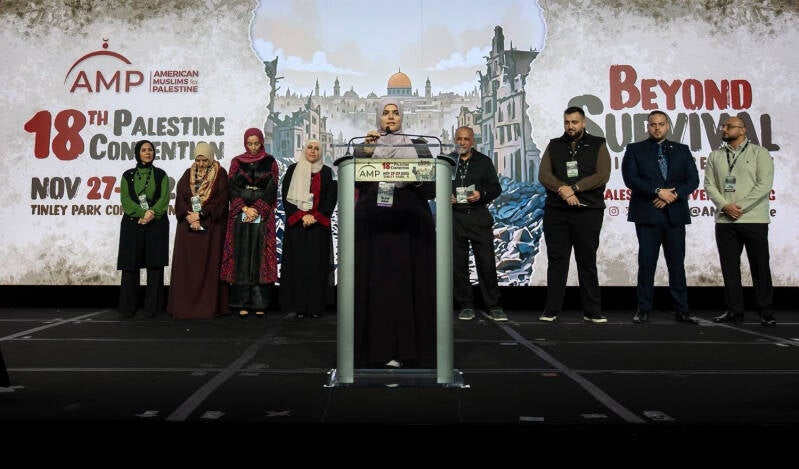
AMP’s 18th Palestine Convention entered Day Two with an energizing opening session featuring Noam Perry and Dr. Allison Tanner, who unpacked American corporate complicity in Israel’s genocide and emphasized how BDS offers a tangible avenue for collective action. A dynamic panel on state-level legislation followed, during which Munira Abdullahi, Andrew Herrera, and Dr. Manal Fakhoury explored how local advocacy is reshaping policy nationwide. At the same time, Arabic-language sessions provided crucial geopolitical context, examining the ongoing war on Gaza and the broader regional implications of the Syrian revolution.

The morning paused for Friday prayer led by Imam Suhaib Webb, grounding attendees in reflection before the afternoon turned to a powerful conversation with Jamaal Bowman, Cori Bush, Dr. Osama Abuirshaid, and Munira Abdullahi on power, pressure, and accountability in the face of the Israel lobby. Later, “Breaking the Bonds,” with Meredith Aby, Jawhara Quteifan, and Noam Perry, celebrated recent divestment victories and revealed the organizing strategies that helped secure them.


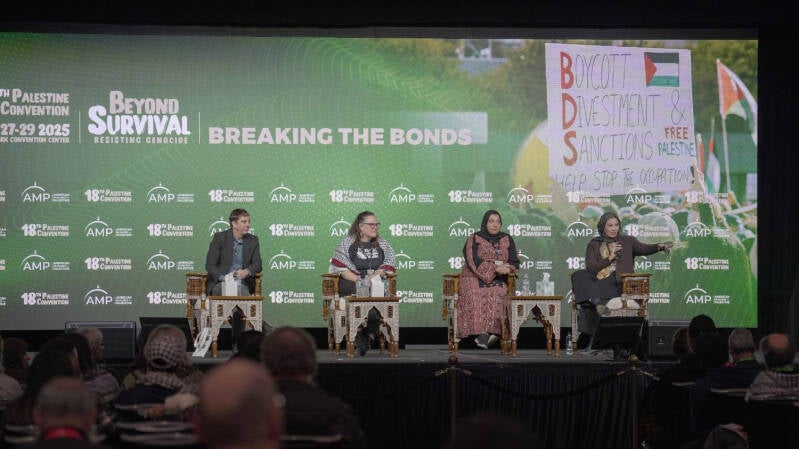
After Maghreb prayer, Salem Furrha, Guy Christensen, and Summer Homayed led a compelling session on the digital battlefield, unpacking how today’s social media landscape is shaping narratives and political realities around the genocide.

AJP Action then presented a forward-looking discussion with Dr. Osama Abuirshaid, Dr. Josh Ruebner, Jamaal Bowman, Cori Bush, and Basim Elarra, focusing on preparing for the upcoming election season and outlining long-term strategies to build lasting electoral power in the movement for Palestinian liberation and representation.

The evening continued with Dr. Mohamad Abbasi’s lecture on transforming community relationships, skills, and networks into sustained institutional strength. Day Two concluded with a moving Gaza Roundtable featuring Laila El-Haddad, Dr. Zarefah Baroud, William Asfour, Alaa Abusamra, and Dr. Thaer Ahmad, accompanied by a screening of The Voice of Hind Rajab—a haunting reminder of the human cost carried by Gaza’s children and the volunteers who stood by them.

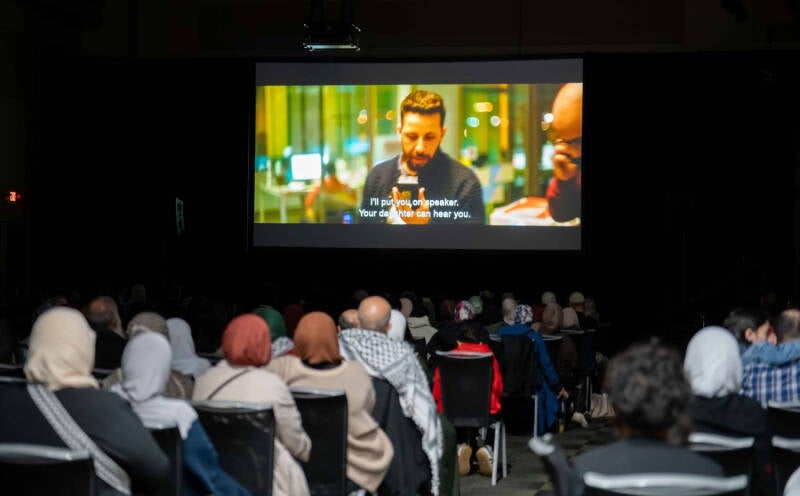
We look forward to seeing you all tomorrow for the final day of the Palestine Convention, which will conclude with the much-anticipated Night of Sumud.
In solidarity,
18th Palestine Convention Team
2013.

29 november 2025
Despite what Trump and major media outlets say, there is no ceasefire.
The Israeli military keeps bombing Palestinian families in Gaza on a daily basis. Meanwhile in the West Bank, Israeli forces are violently invading northern refugee camps and demolishing Palestinian homes in a large-scale assault, while settlers rampage and attack Palestinian communities. Rather than hold Israel accountable for countless crimes, Trump has concocted his own colonial plans to chair a foreign board to govern Gaza.
Yet the Palestinian people endure, fighting to survive and refusing to be uprooted from our beloved homeland. As we always have.
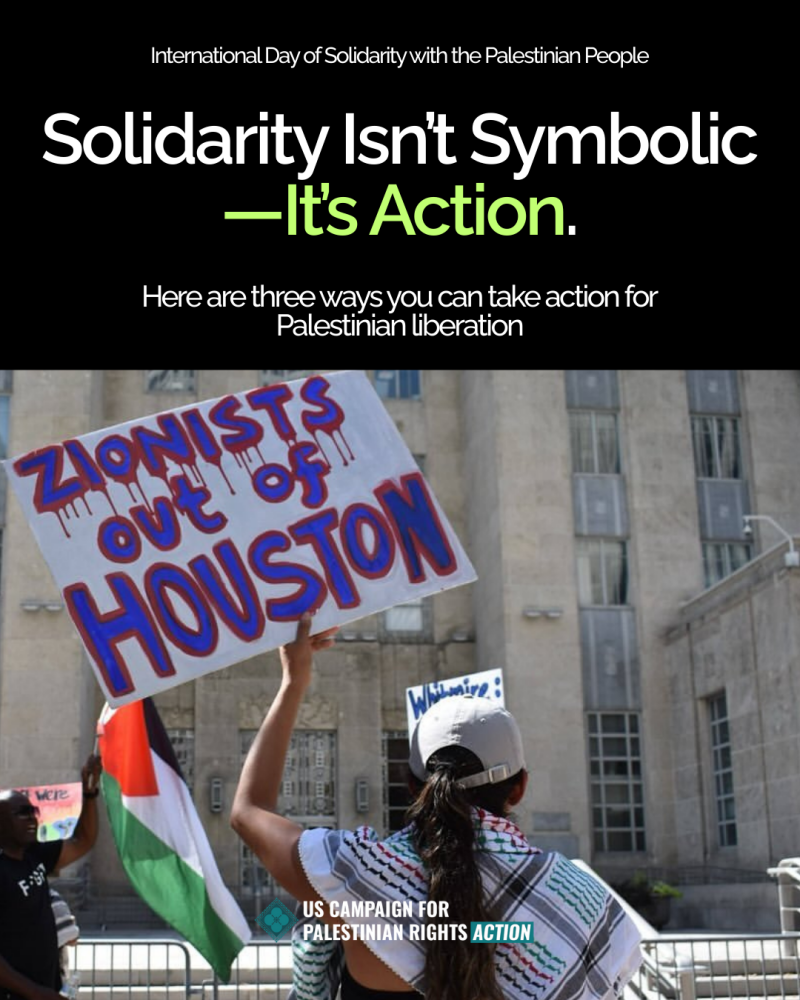
On this International Day of Solidarity with the Palestinian People, I’m reminded every movement victory in history has been hard-won, resulting from decades of organizing against systemic oppression.
The fight to free Palestine is no exception. Like the anti-apartheid, civil rights, and anti-imperialist activists who came before us, we’re in this struggle for as long as it takes—and we know we will win.
Nico, if you want to be an integral part of that fight, the most powerful action you can take is to plug in to a strategic campaign for the long haul.
Move dollars away from the genocide machine at every level of government, from your city council to the halls of Congress. Join or start a campaign to:
- Push for an arms embargo to halt U.S. weapons to Israel at the federal level
- Pressure your local government to divest from weapons manufacturers and other corporations complicit in genocide
- Break the bonds to stop institutions from investing in Israel Bonds.
Find all the resources you’ll need to get started in the new campaign pages below.
JOIN AN ARMS EMBARGO CAMPAIGN
JOIN A LOCAL DIVESTMENT CAMPAIGN
JOIN A BREAK ISRAEL BONDS CAMPAIGN
You can also check out the following BDS and educational campaigns, which our sister organization USCPR is actively involved in.
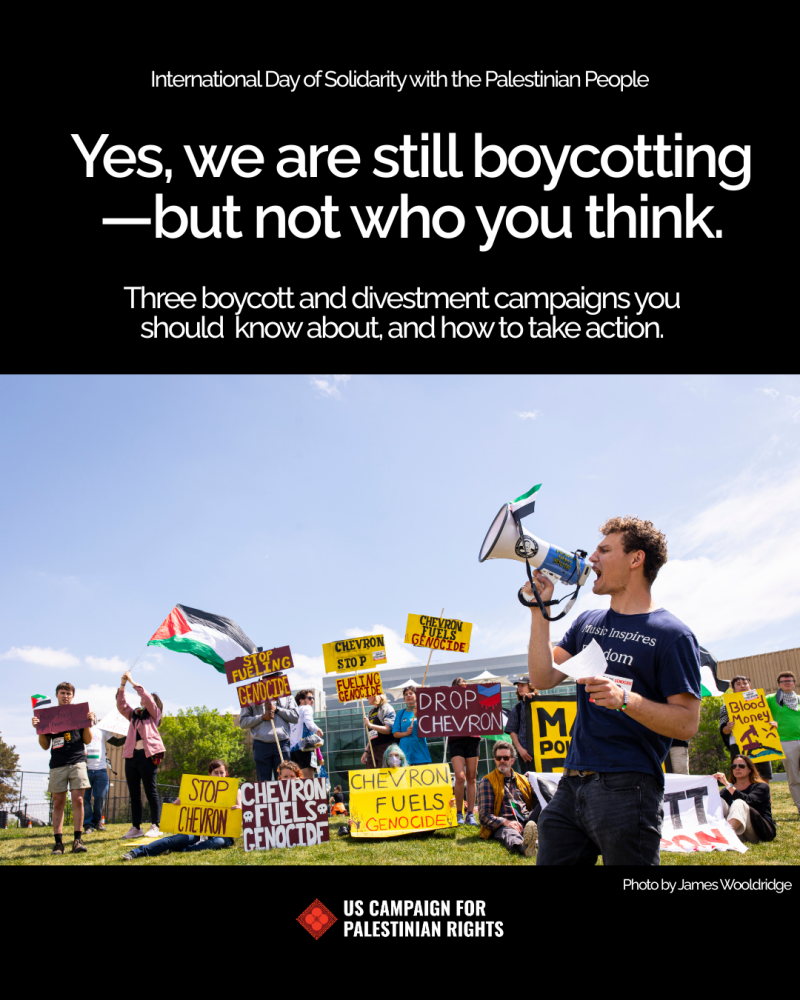
BOYCOTT CHEVRON
MASK OFF MAERSK
DROP THE ADL
Take the time to do your research, read these resources, explore which campaigns are already running in your area, and consider where you can make the biggest impact. Together we’ll fight for a liberated future, in which we’re all free.
Onward to liberation,
IMAN ABID
Organizing & Advocacy Director
2012.

29 november 2025
Gaza Humanitarian Response
Situation Report No. 34
29 November 2025
(As of 18:00 on 28 November 2025, unless otherwise noted)
HIGHLIGHTS
- Between 1 and 27 November, partners distributed monthly general food parcels to more than 230,000 families (1,150,000 people) through 59 distribution points across the Gaza Strip, including 21 in northern Gaza.
- On 26 November, Shelter Cluster partners distributed 4,800 blankets to 1,200 families in Deir al Balah; 4,000 blankets to 1,000 families in northern Gaza; and 324 tents, 10 kitchen sets, and ropes to 352 families in Khan Younis Al Mawasi sites.
SITUATION OVERVIEW
With cold weather intensifying and heavy rainfall becoming more frequent, Site Management Cluster (SMC) partners remain focused on winterization efforts. One partner distributed 30,000 sandbags to 41 sites to support flood mitigation and launched additional flood-prevention activities through cash-for-work initiatives. Meanwhile, partners are collecting empty flour sacks from aid organizations to further strengthen emergency and winter preparedness measures. SMC teams continue to monitor winter and rain conditions and follow up on unresolved gaps to ensure timely support and response.
UNITED NATIONS-COORDINATED AID ENTRY*
On 28 November, based on preliminary data, at least 180 of dignity kits, 69 pallets of menstrual health management items, 15 pallets of medical supplies, and four pallets of adolescent kits were collected from the crossings under the United Nations-coordinated mechanism. This data excludes bilateral donations and the commercial sector.
As of 29 November, Kerem Shalom, Zikim and Kissufim crossings remained operational, with humanitarian cargo offloading and uplifting alternating days between Zikim and Kissufim.
HUMANITARIAN RESPONSE
Food Security
- Between 1 and 27 November, partners distributed general monthly food parcels to more than 230,000 families (1,150,000 people) through 59 distribution points across the Strip, including two in North Gaza and 19 in Gaza city. Lack of transportation options, or means to cover its costs, and poor road conditions continue to hinder access for communities and partners in northern Gaza.
Protection
- Child Protection
- In close collaboration with the WASH cluster, Child Protection Cluster partners continued the distribution of hygiene kits and other non-food items for the most vulnerable cases. As part of these joint interventions, on 28 November, two child-friendly spaces were also equipped with improved sanitation facilities, including safe latrines and water tanks. This intervention will help ensure a healthier and more protective environment for children to learn, play and receive psychosocial support.
- Gender-Based Violence Prevention and Response
- On 28 November, Gender-Based Violence (GBV) service provision continued across Gaza, with partners reaching 671 people with multi-sectoral services including psychosocial support, case management, legal awareness, and psychological first aid within women and girls safe spaces (WGSSs.
- On 26 November, GBV partners distributed 31 tents to eight partners who are scaling up GBV activities in northern Gaza. In addition, some partners whose WGSS facilities were destroyed by flooding also received tents, enabling them to restore services in Deir al Balah and Gaza city.
- On 25 November, the 16 Days of Activism campaign was launched at Al Shifa Hospital, Gaza city. Key messages highlighted community resilience, dedication of humanitarian actors, a commitment to expand services and support women and girls to reclaim their safety, dignity and leadership. Similarly, GBV partners including women-led organizations-initiated campaign launches across all governorates within their safe spaces, with the participation of communities.
Shelter
- On 26 November, Shelter Cluster continued distributions as follows:
- A partner distributed 4,800 blankets to 1,200 families in Deir al Balah and 4,000 blankets to 1,000 families in northern Gaza.
- A partner distributed 324 tents and 10 kitchen sets and ropes to 352 families in Khan Younis Al Mawasi sites.
- On the same day, cluster partners received 7,919 tarpaulins, 2,078 mattresses, and 9,080 blankets which will be distributed in the coming days.
2011.

28 november 2025
A Day of Learning, Strength, and Solidarity
Today we opened the doors to AMP’s 18th Palestine Convention, and it was a day of powerful learning, critical conversation, and community strength.
Day one of the event opened with a session on Palestinian political prisoners. The evening then moved into a conversation on navigating the media and media literacy, underscoring the urgency of critical media engagement in the context of genocide.

Attendees also learned about the growing role of artificial intelligence in warfare in Gaza from Mohamad Habehh, followed by reflections from speakers Watfae Zayed, Hasna El-Nounou, Aqil Farooqui, and Sana Wazwaz on Muslim students’ uniquely challenging position on college campuses amidst a turbulent political atmosphere.
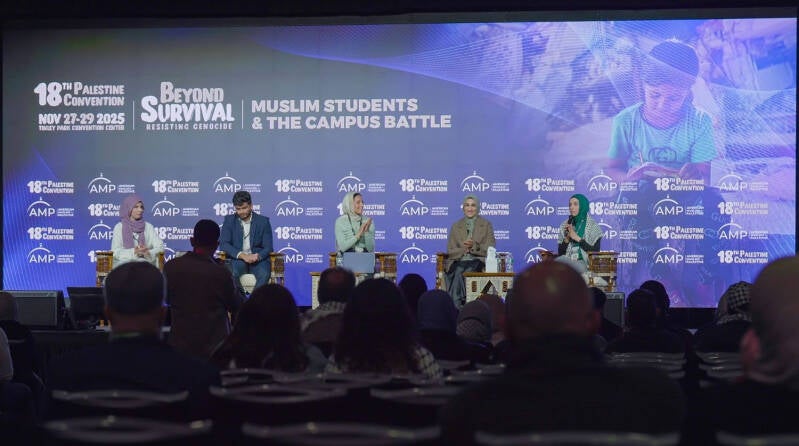
The first day concluded with a discussion with Dr. Hatem Bazian that urged attendees to embrace the ummah’s duty to speak out against injustice as silence amounts to complicity, and a final session that screened The Encampments. Hosted by Watermelon Pictures, the acclaimed documentary featured the student movement for Gaza at Columbia University among other student uprisings in America and was paired with an exceptional discussion with film producer Hamza Ali.

In between sessions, our vibrant bazaar is alive with culture and creativity, featuring nearly one hundred vendors from food and fashion, to art and cultural items.

The best is yet to come. We invite you to be part of Day Two.
The program resumes tomorrow, Friday, November 27th, at the Tinley Park Convention Center. Join us for the Friday Khutbah and prayer at 12:00 PM, led by the esteemed Imam Suhaib Webb.
Throughout the day, we'll continue with:
- Engaging Main Sessions
- A dedicated Campus Activism Track
- Dynamic Youth & School Programs
- On-site Babysitting

This is more than a convention; it's a space for our community to unite, learn, and strengthen our collective voice for Palestine.
In solidarity,
18th Palestine Convention Team

2010.

28 november 2025
Gaza Humanitarian Response
Situation Report No. 33
28 November 2025
(As of 18:00 on 27 November 2025, unless otherwise noted)
HIGHLIGHTS
- As of 26 November, 1,558,000 meals were being delivered daily by 28 partners through 213 kitchens: 343,000 in northern Gaza and 1,215,000 in the south.
- Between 20 and 26 November, partners distributed WASH supplies across Gaza, including over 2.23 million baby diapers, 1,300 dignity kits, 5,070 tarpaulins, 1,000 soap bars, and 93 litres of chlorine.
SITUATION OVERVIEW
Following more rains and subsequent flooding in Gaza on 25 November, the Site Management Cluster (SMC) carried out rapid assessments in Designated Emergency Shelters (DESs) across the Gaza Strip. The assessments revealed that 32 DESs were affected: one in North Gaza, four in Gaza city, seven in Deir al Balah, and 20 in Khan Younis. In total, more than 3,000 people were affected: 25 in northern Gaza, 205 in Gaza city, 1,333 in Deir al Balah, and 1,438 in Khan Younis. Damages and gaps identified were promptly referred to the Water, Sanitation and Hygiene (WASH) Cluster, which responded by pumping water from flooded yards and clearing blocked manholes and drainage collectors. Site care and maintenance teams repaired damaged tents, while tarpaulins were distributed to affected families through partner organizations. SMC teams continue to monitor conditions and follow up on unresolved gaps to ensure timely support and further response.
UNITED NATIONS-COORDINATED AID ENTRY*
On 27 November, 3,918 pallets of aid administered by the UN and its partners were offloaded at Gaza’s crossings, based on data retrieved from the UN 2720 Mechanism dashboard at 18:00 on 28 November. About 57 per cent of these pallets contained food supplies, followed by shelter (32 per cent), water, sanitation and hygiene supplies (9 per cent), and health supplies (2 per cent). At least 120 truckloads were offloaded in Kerem Shalom and 47 in Zikim crossing.
On 27 November, between 09:27 and 16:04, the United Nations Office for Project Services (UNOPS) international monitors deployed at Kerem Shalom crossing reported the collection of 1,397 pallets of aid. These comprised 688 pallets of food supplies, 201 pallets of winter clothes, 158 pallets of hygiene kits, 138 pallets of tents, 104 pallets of medical supplies, 42 pallets of water tanks, 36 pallets of tarpaulins, and 30 pallets of blankets.
On the same day, the UNOPS monitoring team was advised that no UN or INGO cargo was present at the crossing.
Overall, between 10 October, when the ceasefire entered into effect, and 27 November, at least 120,193 pallets of humanitarian cargo were offloaded, and 103,933 pallets were collected, from the different crossings. Of the collected cargo, 1,838 pallets (2 per cent) were intercepted during transit within Gaza.
All the above data excludes bilateral donations and the commercial sector.
As of 28 November, Kerem Shalom, Zikim and Kissufim crossings remained operational, with humanitarian cargo offloading and uplifting alternating days between Zikim and Kissufim.
HUMANITARIAN RESPONSE
Food Security
- As of 26 November, 1,558,000 meals were being delivered daily by 28 partners through 213 kitchens: 343,000 in northern Gaza and 1,215,000 in the south. This represents an over 137 per cent increase in overall meal production compared to late September.
Water, Sanitations and Hygiene (WASH)
- Between 20 and 26 November, cluster partners distributed a wide range of essential supplies to support affected communities across the Strip. These included more than 2.23 million baby diapers, 1,300 dignity kits, 14,186 sanitary pads, 1,000 soap bars, 45,390 towels, and 3 first aid kits. Partners provided 5,070 tarpaulins, 302 squatting plates, and 28 plumbing traps. To improve hygiene and water access, partners distributed 1,150 handwashing stations, 1,300 buckets (18L), 70 rigid jerry cans (18L) and 25,567 jerry cans (10L), along with 93 litres of chlorine, 131 communal water tanks (1,000L) and 13 tanks (2,000L). Additionally, partners delivered 16 conductivity metres and 233 chlorine/pH testers to ensure water quality.
- In Gaza city, the emergency repairs of the Sheikh Radwan stormwater lagoon pump station and outlet have been completed. The pump capacity is 2,000 cubic metres per hour and the 630-, and 500-millimetres pressurized pipeline was completed over the total length of 1,100 metres.
- An electric generator has been installed in Beit Lahia central water well, in northern Gaza, which now has the capacity to provide 220 cubic metres of water per hour and serve 30,000 people in Beit Lahia city.
- The Al Ahli water desalination plant in Gaza city has undergone maintenance, to reduce salinity levels and will produce enough water for the hospital operations.
- Winter preparation activities are ongoing in Gaza city to clear blockages in the sewage network and clean manholes and pipelines. However, progress remains incomplete due to shortages of pre-cast concrete manholes, manhole covers, and cement needed for their production. As a result, open sewers continue to pose a significant health risk to the population.
- Water pipeline repairs continue in several areas of Gaza city.
Protection
- Child Protection
- Child protection (CP) partners continued delivering services across the Strip, including in multiple sites for displaced people, such as Asdaa, Al Motahabeen, Al Arab, Barbara and Ard Harb. Cold weather and heavy rainfall have significantly impacted shelter conditions in multiple parts of Gaza.
- Between 25 and 26 November, approximately 1,500 children received child protection and mental health and psychosocial support (MHPSS) services, including structured psychosocial sessions, recreational activities, psychological first aid, and awareness sessions on safe and unsafe touch, bullying, and coping with distress. At least 970 caregivers participated in MHPSS sessions, positive parenting support, and child protection awareness. Case management continued, with referrals for high-risk cases and follow-up for newly displaced families.
- Between 25 and 26 November, partners distributed winter assistance, including blankets, winter clothing, diapers, hygiene kits, dignity kits, and 500 winter kits for children in several sites and shelters in the Strip.
- Last week, a partner completed two separate five-day Play and Heal training sessions for partners in Gaza city and Khan Younis, with 50 participants. In addition, Caring for Child Survivors training was delivered to 20 child protection and gender-based violence case managers in Khan Younis, with the final round planned for northern Gaza area next week.
- Emerging concerns include increasing reports of harassment and sexual abuse, including cases involving boys, in informal settlements in Deir Al Balah. Exposure to winter weather, overcrowded shelters, and disrupted schooling are exacerbating the risks. Community engagement continued across operational areas, with more than 500 children and caregivers reached through MHPSS activities, awareness sessions, and community training. Communities consistently report that psychosocial and recreational activities provide essential emotional relief during times of stress.
Shelter
- On 26 November, Shelter Cluster continued distributions as follows:
- A partner distributed kitchen sets and ropes to 465 families in Deir al Balah and Khan Younis.
- Partners distributed nearly 1,600 tarpaulins to more than 530 families in Al Mawasi and Khan Younis.
- A partner distributed 196 tents in Gaza city, 387 clothes vouchers to internally displaced persons in northern Gaza, as well as 724 blankets to 181 households in above-mentioned areas.
2009.

28 november 2025
Nederlandse financiële instellingen investeerden in totaal 68 miljard euro in bedrijven die bijdragen aan de Israëlische bezetting en genocide. Ruim twee derde daarvan kwam voor rekening van elf pensioenfondsen.
Don't Buy Into Occupation
Dat blijkt uit een deze week verschenen rapport van de Don’t Buy Into Occupation-coalitie (DBIO), die bestaat uit 25 Europese en Palestijnse ngo’s en vakbonden. The Rights Forum hoort ook bij de coalitie.
Het nu verschenen rapport is het vijfde sinds de coalitie in 2021 zijn onderzoek startte naar de relaties tussen Europese financiële instellingen en bedrijven die betrokken zijn bij de bouw, uitbreiding, onderhoud en/of instandhouding van de illegale Israëlische nederzettingen in de bezette Palestijnse gebieden.
Criteria aangepast aan realiteit
Voor het vijfde rapport heeft de coalitie de criteria uitgebreid door niet alleen meer te kijken naar betrokkenheid van bedrijven bij de nederzettingen, maar bij activiteiten die bijdragen aan de Israëlische bezetting als geheel, aan apartheid en/of aan de genocide in Gaza.
Wat zijn de belangrijkste bevindingen van het rapport? Wat houden de investeringen in de bedrijven die bijdragen aan de bezetting precies in? En is er ook goed nieuws? Die vragen beantwoorden we in een toelichting op het rapport, die hier te lezen is.
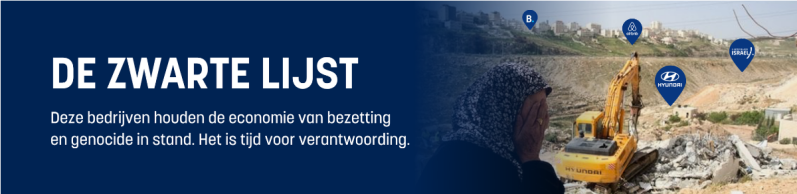
Het DBIO-rapport valt samen met de zwarte lijst die The Rights Forum vorige week publiceerde. Daarop staan 92 bedrijven en instellingen die op uiteenlopende wijze bijdragen aan wat door de Speciale VN-Rapporteur Francesca Albanese de ‘economie van genocide’ wordt genoemd. Het gaat hierbij uitsluitend om bedrijven die in de Nederlandse markt actief zijn.
Vacature | Eindredacteur The Rights Forum (fulltime)
Ben jij een ervaren journalist met een passie voor mensenrechten, internationale politiek en rechtvaardigheid? Heb je een scherpe nieuwsblik, een strategische visie op mediacommunicatie en de leiderschapskwaliteiten om een redactie aan te sturen? Weet jij hoe je journalistieke producties vernieuwend en impactvol maakt, zowel op traditionele als sociale media platforms? Dan zijn we mogelijk op zoek naar jou.
Om onze groei in activiteiten en publicaties op te vangen is The Rights Forum op zoek naar een fulltime eindredacteur. De volledige vacature is hier te vinden.
Uitnodiging | Internationale dag van solidariteit met het Palestijnse volk
Ter gelegenheid van de Internationale dag van solidariteit met het Palestijnse volk op 29 november 2025 nodigt de Palestijnse Gemeenschap in Nederland (PGNL) iedereen van harte uit voor een avond in Amsterdam, bedoeld om de Palestina solidariteitsbeweging in Nederland te verbinden en te versterken.
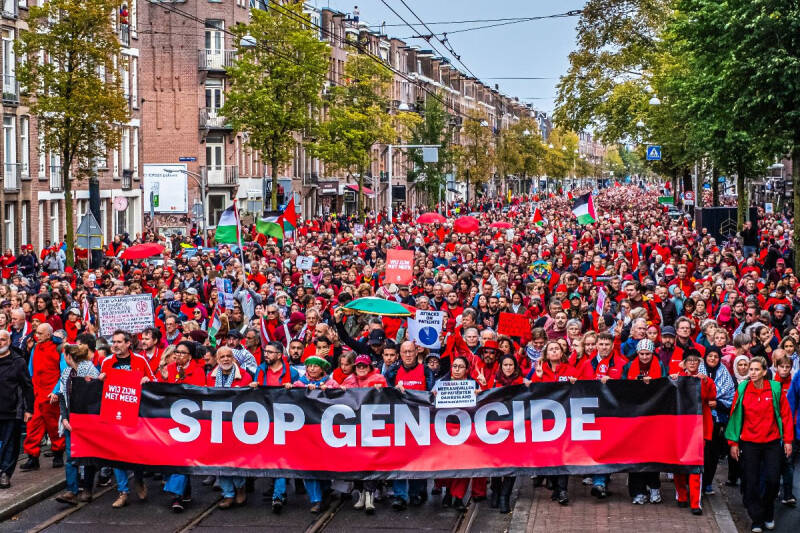
Tijdens de bijeenkomst wil de organisatie stilstaan bij de afgelopen twee jaar van gezamenlijke inzet en solidariteit in Nederland en de vele organisaties, initiatieven en individuen bedanken die afgelopen twee jaar onvermoeibaar naast het Palestijnse volk stonden.
Datum: zaterdag 29 november 2025
Tijd: 18:30 tot 21:30 uur
Locatie: Amsterdam (de exacte locatie wordt gedeeld na bevestiging van uw deelname)
Het programma bestaat onder andere uit:
• Een gezamenlijke terugblik op de afgelopen twee jaar
• Dank aan ondersteunende organisaties en individuen
• Een blik vooruit op de gezamenlijke koers van de Palestina-beweging in Nederland
• Vertoning van de film The Voice of Hind Rajab
Aanmelden kan door 'JA, IK KOM' en uw naam + organisatie te mailen naar events.pgnl@gmail.com. U ontvangt een bevestiging zodra uw aanmelding is verwerkt.
Onze verslaggeving:


Nieuw VN-rapport: vrije val Palestijnse economie moet gestopt
De economie van Palestina is volledig ineengestort, zegt een nieuw rapport van de VN. Decennia van economische ontwikkeling is tenietgedaan. Nog nooit eerder is een economie zó vernietigd als nu in Gaza.
Palestijnen in Israëlische detentie: ondergrondse kerkers, verkrachtingen en bijna 100 doden
Er komen steeds meer weerzinwekkende details naar buiten van de brute behandeling van Palestijnen in Israëlische detentie. Bewijs om Israël aan te klagen voor marteling bij het Internationaal Gerechtshof is er voldoende; het ontbreekt aan politieke wil.
Uitnodiging | Vertoning en nagesprek Close Your Eyes Hind
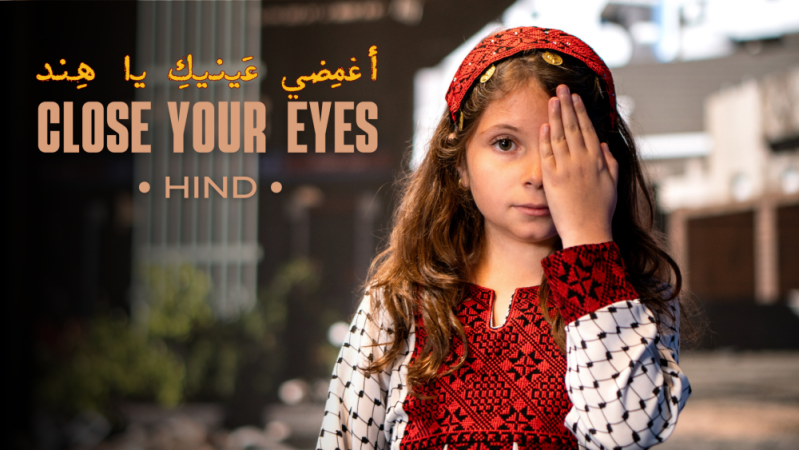
Op 30 november organiseert Amersfoort4Palestine een vertoning van de korte film Close Your Eyes Hind in De Lieve Vrouw in Amersfoort.
De vertoning wordt ingeleid door regisseur Amir Zaza, die het ontstaan van de film zal toelichten. Na afloop zal er een nabespreking zijn, begeleid door Lydia de Leeuw van stichting Kifaia, en Gerard Jonkman, directeur van The Rights Forum. De middag nodigt uit tot bezinning en dialoog over de vraag: 'Wat kunnen wij – als individuen en als samenleving – doen voor Palestina?'
De volledige opbrengst van deze vertoning gaat naar de familie van Hind Rajab, als directe steun aan hen en als blijk van solidariteit met het Palestijnse volk.
Datum: zondag 30 november 2025
Tijd: 11:30 tot 13:30 uur
Locatie: De Lieve Vrouw, Lieve Vrouwestraat 13, Amersfoort
Koop je kaartjes
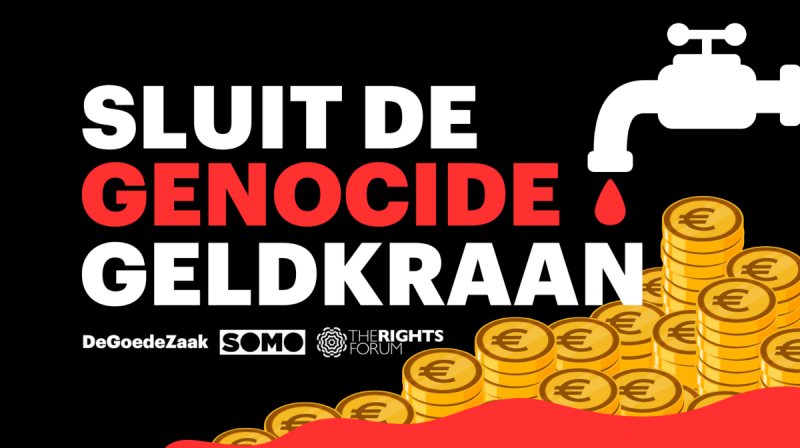
Petitie | Nederland: Sluit de genocide geldkraan!
Komende week zullen we samen met onze partners De Goede Zaak en SOMO de petitie Sluit de genocide geldkraan aanbieden aan de Tweede Kamer. Met de petitie roepen we de Nederlandse regering op om de volgende acties te nemen:
Sancties tegen Israël;
Een einde aan Nederlandse handel en investeringen die bijdragen aan de Israëlische genocide in Gaza en de illegale bezetting van Palestijns gebied;
Een volledig verbod op handel die bijdraagt aan het in stand houden van de illegale nederzettingen.
We hebben inmiddels bijna 40 duizend handtekeningen opgehaald! Helpt u ons die grens te passeren?
Uit onze agenda
zaterdag 29 november t/m zaterdag 6 december
DEMONSTRATIES EN WAKES
UTRECHT DOORDEWEEKSE DAGEN 08.30 - 09.30 (donderdagen vanaf 08.00) | Dagelijks stilteprotest voor Palestina, tegen genocide en bezetting (Neude, langs het fietspad)
NIJMEGEN ZA 29 NOV 14.00 | Maandelijkse wake van Vrouwen in het Zwart (Koningsplein - Marienburg)
AMSTERDAM ZA 29 NOV 14.00 | Protestmars voor de Internationale Dag van Solidariteit met het Palestijnse Volk (De Dam)
HUIZEN WO 3 DEC 11.30 | Wekelijkse sit-in voor Gaza (Gemeentehuis)
DEN HAAG DO 4 DEC 12.00 | Sit-in van Rijksambtenaren bij het ministerie van Buitenlandse Zaken, Rijnstraat 8
STATIONS IN NEDERLAND DO 4 DEC 18.00 | Wekelijkse lawaaidemonstratie op stations in heel Nederland: Stations Almere, Amersfoort, Amsterdam CS, Arnhem, Assen, Bergen op Zoom, Breda, Deventer, Doetinchem, Driebergen-Zeist, Ede/Wageningen, Enschede, Gouda, Groningen, Haarlem (17.30), Harderwijk, Hengelo, Hilversum (17.00), Leiden, Lelystad (17.30), Maastricht, Nijmegen, Purmerend, Sassenheim (17.00), Sittard, Tiel, Utrecht, Veenendaal, Zaandam (17.00), Zutphen
Let op: The Rights Forum probeert de verschillende acties in Nederland zo goed mogelijk bij te houden, maar dat is niet altijd goed mogelijk. Houd de sociale media-pagina's van de plaatselijke solidariteitsorganisaties in de gaten voor de meest actuele informatie.
AMSTERDAM VR 5 DEC 12.45 | Maandelijkse wake van Vrouwen in het Zwart (Spui)
GRONINGEN ZA 6 DEC 13.00 | Tweewekelijkse wake van Vrouwen in het Zwart (Waagplein)
MAASTRICHT ZA 6 DEC 16.00 | Maandelijkse wake van Vrouwen in het Zwart (Markt, bij het standbeeld van J.P. Minckelers, aan de kant van de Boschstraat)
CULTURELE EN ANDERE EVENEMENTEN
DEN HAAG ZA 29 NOV 19.00 | Opening fototentoonstelling ‘No Right To Life’ (Amare, Spuiplein 150)
AMSTERDAM ZA 29 NOV 18.30 | Bijeenkomst Internationale dag van solidariteit met het Palestijnse volk
AMERSFOORT ZO 30 NOV 11.30 | Benefiet: vertoning en nagesprek ‘Close Your Eyes Hind’ (De Lieve Vrouw)
AMSTERDAM MA 1 DEC 16.00 | Lezing Two Palestinian Journalists from Gaza: Insights About their Experiences during the Genocide (IISG, Cruquiusweg 31)
ONLINE DI 2 DEC 19.30 | Boekbespreking van het boek Namesake geschreven door Nuzha Nuseibeh, georganiseerd door Podium voor Palestina
AMSTERDAM DI 2 DEC 20.00 | Workshop & film screening: Mapping Artistic Solidarity for Palestine (Pakhuis De Zwijger)
Onze agenda wordt doorlopend aangevuld.
2008.
28 november 2025
In deze nieuwsbrief delen we twee positieve berichten en een actieoproep. De coördinatie van de BDS-beweging deelt met ons allemaal hoe hard de beweging is gegroeid en we hebben nog een stuk dat specifiek naar de universiteiten kijkt.
Daarbij delen we de oproep om vooral (juist als bedrijf) HP, Cisco en Microsoft onder druk te zetten, medeplichtig als ze zijn aan alle bewakingssystemen en afluisterpraktijken.
Tot slot: zaterdag is er in Leeuwarden een actie in het kader van de Internationale Dag van Solidariteit met het Palestijnse Volk.
Een strijdbare groet van het docP team; blijf BDS-en!
Een bemoediging: we zijn aan de winnende hand
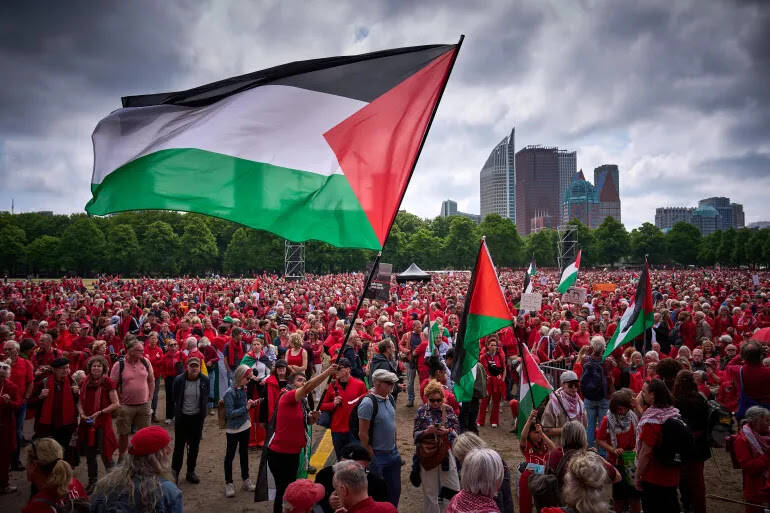
Verklaring van de internationale BDS-beweging
De zaden die we jarenlang samen hebben geplant en gevoed, beginnen nu te bloeien. Ondanks het voortdurende onbeschrijfelijke verdriet over het immense verlies als gevolg van de aanhoudende genocide van Israël op 2,3 miljoen Palestijnen in Gaza, hebben de standvastigheid van ons volk en jullie voortdurende steun een […]
HP, Microsoft, Cisco steunen Israëls gevangeniswezen

Intensifieer nu de BDS-campagnes, in het bijzonder tegen HP, Microsoft en Cisco, om bedrijven verantwoordelijk te houden voor hun steun aan het Israëlische gevangeniswezen.
Op maandagavond 10 november 2025 keurde het apartheidsparlement van Israël in eerste lezing een wetsvoorstel goed dat de doodstraf voor Palestijnse en andere Arabische gevangenen toestaat. Het wetsvoorstel, dat eerder deze […]
Academische boycot van Israël in een jaar verdrievoudigd
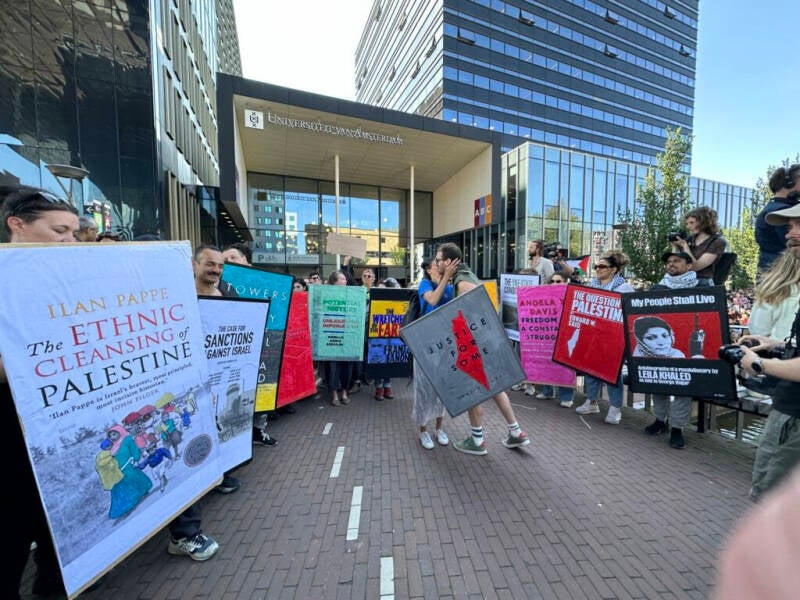
De website van Middle East Monitor meldt dat de academische boycot van Israël heel goed loopt. Het laatste jaar zijn de boycots en weigeringen tot samenwerking verdrievoudigd. De academische boycot van Israëlische onderzoekers en instellingen heeft de afgelopen twee jaar een ongekende stijging gekend,. Daarbij is het aantal gevallen van weigering en opschorting van academische […]
29 november: Dag van Solidariteit met het Palestijnse volk

Stop genocide, sancties tegen Israël! Doe mee aan de Europese mobilisatie op 29 november! Op de Internationale Dag van Solidariteit met het Palestijnse Volk, 29 november, roepen wij op tot Europese mobilisatie om een volledig einde te eisen aan de Israëlische genocide in Gaza, een einde aan de bezetting, kolonisatie en apartheid in Palestina, en volledige […]
2007.

28 november 2025
Gaza Humanitarian Response
Situation Report No. 32
27 November 2025
(As of 18:00 on 26 November 2025, unless otherwise noted)
HIGHLIGHTS
- Between 23 and 25 November, partners assisted 18,000 families with monthly food parcels through 59 distribution points across Gaza. Since the start of November, over 204,000 families (1,020,000 people) have received food parcels as part of the monthly assistance cycle.
- Nutrition Cluster partners continue to expand malnutrition treatment sites in northern Gaza. Eight new sites were opened last week, bringing the total number of functional sites in the north to 31 and more than 140 across the Strip.
SITUATION OVERVIEW
Based on an initial observation by the Food Security Cluster Partners, as of 24 November, market conditions remain fragile. Firewood prices have risen sharply due to increased winter demand and limited supply. While prices of some vegetables, such as tomatoes, cucumbers, eggplant, onions, and potatoes, have decreased, they remain roughly three times higher than pre-war levels. Wheat flour availability has improved due to aid distributions, with prices currently ranging from three to four NIS (1.2 US$) per kilogram and 40 to 45 NIS (14$) for a 25 kg bag.
People across Gaza are facing growing challenges as winter worsens. Many families live in worn-out tents that offer little protection from cold or rain, while financial hardship makes purchasing winter essentials nearly impossible. These conditions are increasing stress for children and caregivers. Meeting the needs of vulnerable families is even harder as shelters deteriorate, leak, and sustain damage, while field teams operate in harsh conditions with minimal heating. Heavy rain has damaged tents used as safe spaces for women and children, disrupted activities at several sites, and delayed winter clothing distributions.
UNITED NATIONS-COORDINATED AID ENTRY*
On 26 November, 4,431 pallets of aid administered by the UN and its partners were offloaded at Gaza’s crossings, based on data retrieved from the UN 2720 Mechanism dashboard at 18:00 on 27 November. About 47 per cent of these pallets contained food supplies, followed by shelter (43 per cent), water, sanitation and hygiene supplies (7 per cent), health supplies (2 per cent), and protection supplies (less than 1 per cent). At least 190 truckloads were offloaded in Kerem Shalom.
On 26 November, the United Nations Office for Project Services (UNOPS) international monitors deployed at Gaza’s crossings reported the collection of 7,286 pallets of aid from Kerem Shalom (6,320 pallets) and Zikim (966 pallets) crossings. These comprised 4,256 pallets of food supplies, including food parcels, fresh vegetables, canned chicken and vegetables, and wheat flour; 603 pallets of winter clothes, 631 pallets of tents, 837 pallets of emergency shelter materials, including blankets, kitchen kits, and tarpaulins; 42 pallets of water tanks, and 647 pallets of health and dignity kits.
Overall, between 10 October, when the ceasefire entered into effect, and 26 November, at least 116,468 pallets of humanitarian cargo were offloaded, and 100,909 pallets were collected, from the different crossings. Of the collected cargo, 1,838 pallets (2 per cent) were intercepted during transit within Gaza.
All the above data excludes bilateral donations and the commercial sector.
As of 27 November, Kerem Shalom, Zikim and Kissufim crossings remained operational, with humanitarian cargo offloading and uplifting alternating days between Zikim and Kissufim.
HUMANITARIAN RESPONSE
Food Security
- Between 23 and 25 November, partners assisted more than 18,000 families with monthly food parcels through 59 distribution points across the Gaza Strip, including two in northern Gaza and 19 in Gaza city. Overall, since the start of November, over 204,000 families (1,020,000 people) have received general food parcel distributions as part of the monthly assistance cycle. Transportation and poor road conditions continue to hinder access to communities and partners in northern Gaza.
Nutrition
- Nutrition Cluster further expanded malnutrition treatment sites in northern Gaza. Eight new sites were opened last week, bringing the total number of functional sites in the north to 31 and more than 140 across the Strip.
Education
- Education Cluster partners continued fencing works in three schools in eastern Gaza city to demarcate and secure learning spaces within school yards. Tent installation is progressing, with 14 high-performance tents allocated to establish safe spaces for learning and mental health and psychosocial support (MHPSS).
- Heavy rains continue to disrupt operation of the Temporary Learning Spaces (TLSs). One TLS in Deir al Balah serving 5,773 students, was affected on 25 November, and 38 TLSs have now been affected by the recent rainfalls. Repair efforts remain limited due to severe shortages of tents and tarpaulins.
- Relocation of internally displaced people (IDPs) from schools that serve as shelters remains a major advocacy priority to free up space for learning. Given the limited available sites and the sensitivities involved, any relocation must be undertaken in a safe, dignified, and appropriate manner. Education partners, together with the Ministry of Education in Gaza, continue efforts to bring children back to learning spaces, although options remain constrained.

Water, Sanitations and Hygiene (WASH)
- The Sheikh Radwan well has been restored, and another well in Beit Lahiya is already operating with system installation underway. A new pipeline is being extended to Mawasi to serve the IDP site. These efforts are expected to significantly reduce reliance on water trucking.
- Repairs to sewage installation and water drainage network are ongoing as part of the winterization efforts. Work also continues at the Saftawi Lagoon to manage wastewater collection in Jabalya. Despite these efforts, the Coastal Municipalities Water Utility reported localized flooding across the Gaza Strip, which is expected to persist if repairs are not completed promptly.
Protection
- Child Protection
- On 24 November, CP partners successfully reunited 32 unaccompanied and separated children (UASC) with their families.
- Case management teams have referred high-risk cases affected by the current wave of storms and supported the distribution of 100,000 winter kits for children, with further distributions planned in the coming days.
- Mine Action
- On 26 November, partners conducted five explosive hazard assessments.
- During the period from 23 to 27 November, four partners carried out explosive ordnance risk education sessions in Deir al Balah, Khan Younis, Gaza City, and the Middle Area, reaching a total of 13,941 people.
Site Management Cluster
- Site Management Cluster partners remain focused on winterization activities, including sandbagging with flour bags and other food security sector food bags, which remain the primary tools available for flood mitigation.
- Following recent mapping of flooding risks in sites, partners are conducting on-site assessments to identify additional interventions based on agency capacity. Coordination continues with partners to relocate households at highest risk along the shoreline.
2006.
27 november 2025
After 9 months of unjust imprisonment in Israel and neglect by his own government, Mohammed Ibrahim is finally coming home
[WASHINGTON D.C., NOVEMBER 27, 2025] — Nine months ago, more than 30 Israeli occupation soldiers stormed the Ibrahim family’s home in the West Bank in the dead of night and tore Mohammed Ibrahim, only 15 years old at the time, away from his family. Today, November 27, 2025, we are relieved and overjoyed to share the news of his release.
We send our deepest congratulations to Mohammed’s family. After months of fear, uncertainty, and waiting, he is finally going home to his mom and dad.
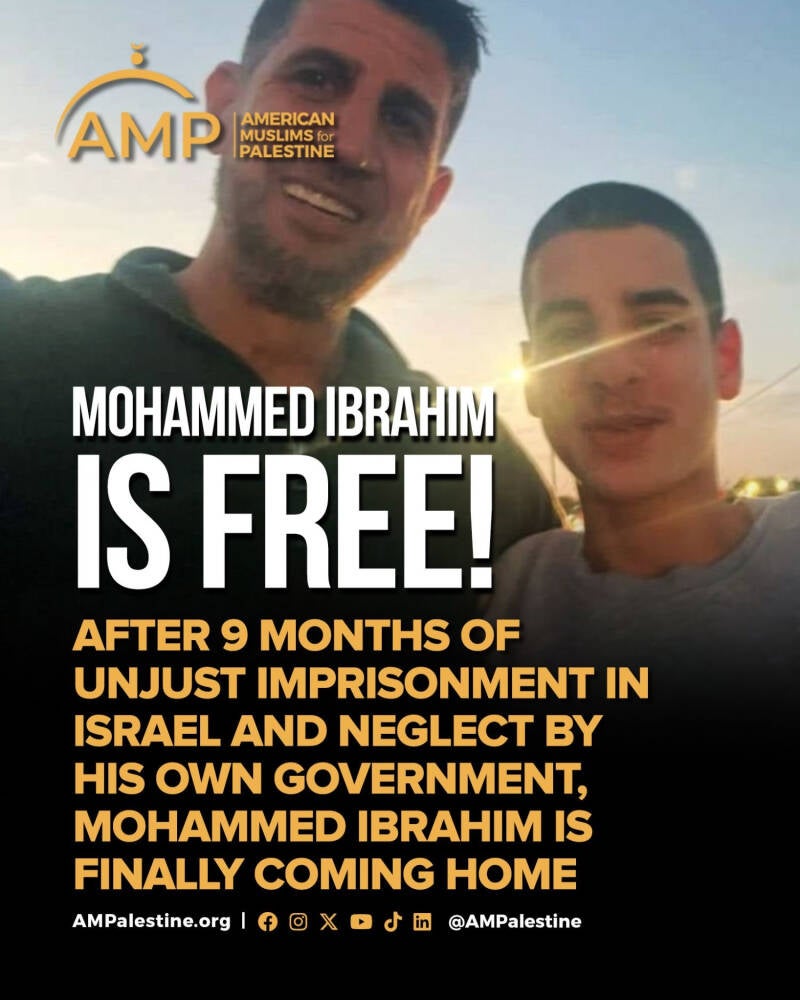
Mohammed is a Palestinian-American child from Florida. He should have been protected by his government, but instead, he was abandoned. The U.S. government let a 15-year-old, now 16, American citizen languish in an Israeli prison for nine months before lifting a finger.
Mohammed’s freedom came after sustained, unrelenting pressure from grassroots organizers, advocates, and communities across the country, including the efforts of AMP’s 501(c)(4) affiliate organization, Americans for Justice in Palestine Action (AJP Action), which was the first to bring Mohammed’s case to light back in July of this year and to launch a campaign demanding his release. His release is a reminder that persistent, collective action makes a difference, even when the odds feel stacked against us.
During his time in Israeli prison, Mohammed endured systemic abuse at the hands of the apartheid state. He lost more than half his weight, was beaten by soldiers, held in solitary confinement, and even contracted scabies because of the prison’s inhumane conditions. Israeli authorities also barred Mohammed from any contact with his family. He wasn’t allowed a single phone call, nor were his parents allowed to visit him. For months, the only information his loved ones had came through U.S. officials who were given limited access to him. No child deserves this kind of treatment.
Mohammed’s family is now focused on getting him the urgent medical care he needs after months of surviving such inhumane conditions. Our hope, alongside his family’s, is that his health is fully restored and that he’s given the chance to step back into his childhood, something that was violently taken from him over the last nine months.
Mohammed’s release is the bare minimum, as he should never have been detained in the first place. And while we’re relieved he’s finally free, his freedom does not account to justice. As Mohammed and his family begin to heal from this trauma, we remain steadfast in our commitment to fight for real accountability. We will continue pushing for justice for Mohammed, for his cousin Sayfollah, who was killed by Israeli settlers over the summer, and for every Palestinian child being held as a political prisoner.
Mohammed and his family’s experience is just one of hundreds. As of June 30 of this year, at least 360 Palestinian children were being held in administrative detention by Israel, nearly half of them without any charge or trial. Israel remains the only state in the world that prosecutes children in military courts. If anything, Mohammed’s case simply exposed, yet again, the scale of Israel’s abuses against Palestinian children.
We are unwavering in our commitment to fight back. Everyone responsible, from the Israeli government to the U.S. administration that neglected this family and waited nine months before applying enough pressure to secure his release, must be held accountable.
In solidarity,
American Muslims for Palestine (AMP)
2006A.

27 november 2025
Humanitarian Situation Update #344
Gaza Strip
27 November 2025
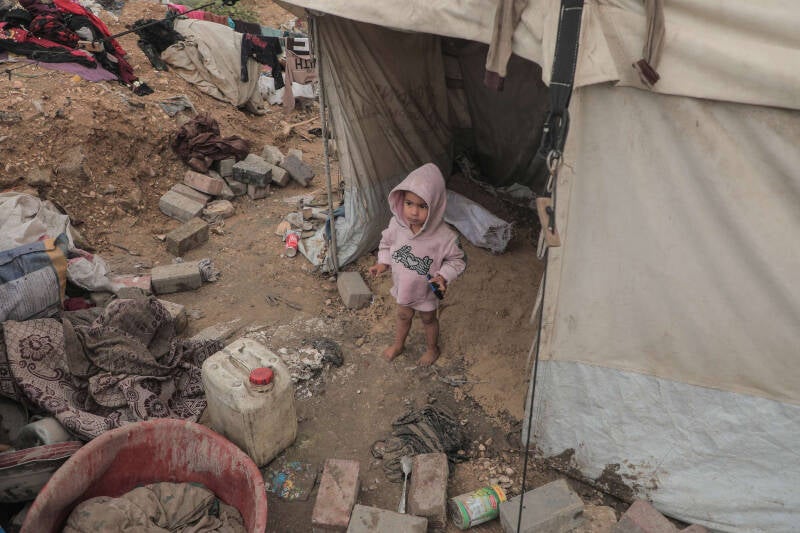
A toddler stands amid debris and personal belongings outside a tent in the Gaza Strip. Photo by UNICEF.
Key Highlights
- For the hundreds of thousands of children living in tents or amid the rubble of their former homes, the winter season is a threat multiplier, UNICEF warns.
- Winter weather is straining collective winterization efforts, driving additional emergency shelter needs and necessitating the evacuation of shoreline sites where on-site mitigation is not viable.
- During the first two weeks of November, reported acute watery diarrhoea cases increased by 13 per cent compared with the previous two-week period, while jaundice cases more than doubled, highlighting a continued deterioration in the state of public health.
- Since October 2023, more than 10,600 patients were medically evacuated from the Gaza Strip, WHO reports.
- A recent UNCTAD report finds that two years of military operations and restrictions have driven the Palestinian economy to a near-total collapse, plunging Gaza’s entire population into multidimensional poverty.
Context Overview
- Over the past week, Israeli military strikes near or east of the so-called “Yellow Line” as well as areas of the Gaza Strip from which Israeli forces withdrew under the ceasefire agreement were reported, resulting in casualties. In areas beyond the “Yellow Line,” where the Israeli military remains deployed (over 50 per cent of the Gaza Strip), daily detonations of residential buildings continue to be reported and access to humanitarian assets, public infrastructure and agricultural land remains restricted or altogether barred. Access to the sea remains prohibited. The Site Management Cluster (SMC) reports that more than 17,000 displacement movements were recorded between 19 and 25 November, compared with over 34,000 movements in the preceding week. Most population movements continued from southern to northern Gaza, with some reverse movements and some movements from North Gaza toward Gaza city.
- In a press briefing on 21 November, the United Nations Children’s Fund (UNICEF) reported that at least 67 children have been killed in conflict-related incidents in the Gaza Strip since the ceasefire took effect, an average of nearly two children killed per day, and dozens more have been injured. For the many children with severe burns, shrapnel wounds, spinal injuries, traumatic brain injuries, or cancer (who have lost months of treatment), or those who need surgeries that cannot be performed in Gaza today, UNICEF Communication Manager and Deputy Spokesperson, Ricardo Pires, emphasized that “safe, fast and predictable medical evacuations are the difference between life and death and between recovery and life-long disability.” For the hundreds of thousands of children living in tents or amid the rubble of their former homes, he warned that the winter season is a threat multiplier, noting that UNICEF is responding at scale, but a lot more can be done if the aid was entering faster. “Our colleagues in Gaza describe what they see every day from children sleeping in the open and living with amputations to children orphaned and trembling in fear while living in flooded, makeshift shelters, stripped of their dignity […] respiratory infections are on the rise while contaminated water fuels the spread of diarrhoea,” he stated, stressing that the stakes are incredibly high especially in relation to the entry of winter and shelter supplies.
- On 22 November, the Israeli military reported that its troops came under fire from an armed individual who crossed the “Yellow Line” in southern Gaza, in response to which it carried out multiple strikes across the Strip. On 23 November, the Ministry of Health (MoH) in Gaza reported that 21 Palestinians were reportedly killed and 83 were injured in the preceding 24 hours. According to the PCD spokesperson, the fatalities included children, women, and older persons who were killed in multiple strikes targeting residential buildings and a vehicle over a two-hour period.
- On 25 November, according to official Israeli sources, the body of one deceased hostage was returned from Gaza to Israeli authorities, bringing the overall number of returned bodies of Israeli and other hostages since the ceasefire to 26. On 26 November, MoH in Gaza reported that the bodies of 15 Palestinians were returned to the Gaza Strip, bringing the total number of released bodies since the ceasefire to 345, of which 99 were identified.
- According to the MoH in Gaza, between 19 and 26 November, 65 Palestinians were killed, 217 were injured and 25 bodies were recovered from under the rubble. This brings the casualty toll among Palestinians since 7 October 2023, as reported by the MoH, to 69,785 fatalities and 170,965 injuries. According to the MoH, the total number includes 180 fatalities who were retroactively added between 14 and 21 November after their identification details were approved by a ministerial committee. MoH reported that since the ceasefire, 347 Palestinians were killed, 889 were injured and 596 bodies were retrieved from under the rubble.
- According to the Israeli military, between 19 and 26 November, as of noon, no Israeli soldiers were killed in Gaza. The casualty toll among Israeli soldiers since the beginning of the Israeli ground operation in October 2023 stands at 471 fatalities and 2,982 injuries. According to Israeli forces and official Israeli sources cited in the media, more than 1,671 Israelis and foreign nationals have been killed, the majority on 7 October 2023 and its immediate aftermath. As of noon on 26 November, it is estimated that the bodies of two deceased hostages remain in the Gaza Strip.
- The UN Conference on Trade and Development (UNCTAD) reports that two years of military operations and extensive damage to infrastructure and productive assets have reversed decades of socioeconomic progress and development gains in the Occupied Palestinian Territory (OPT). Against a backdrop of long-standing economic and institutional fragility, this has triggered an unprecedented economic collapse. In Gaza, per capita Gross Domestic Product (GDP) in 2024 fell to US$161 – among the lowest globally – unemployment rose to 80 per cent, and the entire population plunged into multidimensional poverty. Over 2023-2024, GDP shrank by 87 per cent, dropping to $362, and 98 per cent of banks had ceased operations by April 2025. In a press release, UNCTAD called for immediate and substantial intervention by the international community to halt the economic freefall, address the humanitarian crisis, enable meaningful recovery – including access to healthcare, education, clean water and critical infrastructure – and lay the groundwork for lasting peace and development.

Humanitarian Access
- Between 14 November, when Zikim crossing was re-opened following a two-month closure, and 25 November, the UN and its partners collected over 19,800 metric tons (MT) of aid from three operational crossings, according to the UN 2720 Mechanism. This is compared with about 23,500 MT collected from two operational crossings in the preceding 12 days and 18,700 MT during the corresponding period in October (14-25 October). Located in the north, the Zikim crossing is now one of three points for the entry of aid into Gaza and has been operating on an alternating offload-and-uplift schedule with Kissufim crossing.
- As of 25 November, more than 179,000 metric tons (MT) of the aid positioned across the region were approved and cleared by Israeli authorities for transfer into Gaza, of which about 71 per cent are food supplies, according to the UN 2720 Mechanism. The Mechanism further reports that out of 560 requests submitted for the entry of aid in October, 121 requests (24 per cent) were rejected as of 26 November. In comparison, 47 out of 438 requests (11 per cent) for aid entry into Gaza were rejected in September. The 121 rejected requests in October comprise more than 5,600 MT of humanitarian aid, of which 64 requests (nearly 3,000 MT of aid) were rejected on the grounds that the organizations were not ‘’authorized’’ or ‘’approved’’ to bring relief items into Gaza. The majority (50 requests) concern the entry of health, shelter, and water and sanitation supplies. The remaining requests were denied by the Israeli authorities either on the basis that the items did not fall within the “humanitarian” category, or because they were classified as “dual-use.” In October, such rejected requests included frozen meat, pesticides, vehicles, power equipment, construction materials, specialized machinery, and learning and recreational materials for children.
- Coordination with Israeli authorities continues to be required for humanitarian convoy movements in Gaza, to crossings as well as in or near other areas where Israeli forces remain deployed. Between 19 and 25 November, humanitarian organizations coordinated 55 missions with the Israeli authorities, of which 29 were facilitated, four were cancelled, 11 were impeded and 11 were denied.
- According to the Emergency Telecommunications Cluster (ETC), based on information from the telecom operator, on 22 and 23 November, after repeated denials in previous weeks, the Internet Service Provider’s technical team was granted access to repair the severed main fibre line near the Erez crossing reported on 3 November. During the mission, the team identified three additional fibre cuts requiring repair. Two were repaired, but subsequent denials, most recently on 25 and 26 November, prevented full restoration. Coordination is ongoing to facilitate continued operator access, as the backup redundancy internet communication links remain fragile and further damage could trigger a full connectivity blackout in Gaza.
- On 24 November, the World Health Organization (WHO) facilitated the medical evacuation from Gaza of 33 patients, in addition to 109 companions. WHO expressed concerns “about the long delays patients faced moving from the Kerem Shalom crossing out of Gaza to Allenby [Bridge border] crossing, where, together with the WHO team, they waited over four hours before being allowed to proceed, putting their fragile health at further risk.” According to WHO, since October 2023, more than 10,600 patients were evacuated along with over 12,000 companions. More than 16,500 patients, including 4,000 children, still require medical evacuation, as the advanced care they need is not available in the Strip. WHO called for additional support, as well as the opening of all evacuation routes, particularly to the West Bank, including East Jerusalem, and for movements of medical evacuation convoys to be expedited at crossings.
Growing Winterization Needs
- According to the Shelter Cluster, collective efforts to prepare for the winter season are under strain due to new winter storms, driving a cycle of renewed emergency needs. The UN and its partners continue to address widespread shelter needs arising from the 17 November rainstorm. Between 17 and 26 November, Shelter Cluster partners distributed UN-coordinated shelter assistance across the Gaza Strip, including more than 5,500 tents, over 71,000 tarpaulins, and more than 133,000 bedding items to more than 20,000 households. In addition, clothing vouchers were distributed to about 2,800 households. The Shelter Cluster estimates that 1.48 million people are in need of emergency shelter assistance across the Strip. Partners who can bring shelter materials into Gaza warn that existing efforts cannot meet the scale of need.
- Most people in Gaza continue to reside in a range of inadequate shelter types that fail to meet basic emergency standards, including tents, makeshift tents, and partially or heavily damaged buildings. According to the SMC, although the need for tents remains critical, structural conditions in some sites are such that the provision of tents alone does not provide an adequate or sustainable shelter solution. Where feasible, SMC partners are undertaking winter preparedness measures in displacement sites to reduce flooding risks, such as drainage improvements and sandbag reinforcements. However, according to SMC, most available flood-mitigation efforts remain largely ineffective due to severe shortages in the needed materials and tools over the past two years. In addition, many sites are situated in low-lying, debris-laden areas without drainage or protective perimeters, leaving them highly exposed and limiting the effectiveness of any on-site mitigation. Particularly, for the shoreline displacement sites estimated to be hosting 4,300 people and facing heightened flooding risks, discussions are underway with municipal authorities and affected communities on possible evacuation, as no viable on-site mitigation measures exist.
- On 23 November, the PCD reported that its teams had been mobilized, despite extremely limited resources, to respond to the anticipated impacts of the harsh weather, particularly for the thousands of displaced families living in tents and temporary shelters. However, PCD warned that the lack of fuel for its operations, compounded by extensive damage to infrastructure and public services, is threatening to deepen the suffering of displaced communities, especially in sites at high risk of flooding from rainwater or seawater surges. Gaza Municipality also reported that it is facing the winter season with extremely limited resources, including a severe shortage of heavy machinery required to address rainwater accumulation and sewage overflows. This is compounded by the unavailability of pipes, cement, and essential materials needed to repair damaged manholes and stormwater drainage networks amid extensive infrastructural damage that has increased the risk of flooding. The destruction of wastewater treatment facilities and rainwater pumping stations has slowed the discharge process and led to rainwater pools and flooding in several neighbourhoods and displacement shelters, especially those located in low-elevation zones.
- According to the Protection Cluster, winter challenges are aggravating deplorable water and sanitation conditions as well as privacy and safety risks faced by women and girls in displacement sites. In recent remarks, Sofia Calltorp, the UN Women Chief of Humanitarian Action highlighted the particularly harsh impact of the winter season on women and girls in the Gaza Strip. Calltorp reported that entire neighbourhoods lie in ruins and that women are facing hunger, fear, repeated displacement and winter conditions in makeshift shelters that offer little protection. Describing severe destruction and the struggles facing women, especially more than 57,000 who now head their households amid high prices and a lack of income, Calltorp said: ''We arrived in Gaza just after a weekend of severe rain and cold. Women showed me how water soaked through their makeshift tents, leaving their children shivering through the night. This is what it means to be a woman in Gaza today: to know that winter is coming, and to know you cannot protect your children from it.''
- Winter conditions are additionally exposing temporary learning spaces (TLSs) to deterioration, heightening the risk of further disruptions to learning and constraining already limited options for school-aged children, according to the Education Cluster. Between 14 and 17 November, flash floods caused damage to at least 38 TLSs in Gaza city, Deir al Balah and Khan Younis, affecting 103 tents and 10 latrines and preventing in-person learning for an estimated 9,528 students and 235 teachers, the Education Cluster reported. Out of the total affected TLSs, 14 TLS serving 2,2500 students have resumed operations. Over the past week, two TLSs have been newly established, bringing the overall number of TLSs as of 26 November to 305, serving over 155,800 children, or only a quarter of some 637,000 school-aged children. The Cluster emphasizes that the extent of damage has increased the need for more durable shelter materials and reinforcement of existing structures to maintain safe access to education.

Public Health Conditions and Risks
- The first round of the catch-up immunization campaign, conducted from 9 to 20 November, reached more than 13,700 children across the Gaza Strip. According to UN agencies, less than two per cent of participating children had never received any vaccines, while a quarter had missed scheduled doses, reflecting immunity gaps following two years of hostilities. Sustaining this momentum, 1.6 million syringes procured for subsequent vaccination rounds successfully entered the Strip this week, and UNICEF and WHO already have the nutrition supplies and medicines required to treat all malnourished children into early 2026. During the first vaccination round, about 500 children were identified to be acutely malnourished and referred to treatment, out of more than 6,800 screened children. To expand vaccine coverage, UN agencies call for the entry of additional cold chain equipment.
- According to the Health Cluster, Acute Respiratory Infections (ARIs) remain the most frequently reported conditions, accounting for 68 per cent of all reported cases in 2025. Moreover, overcrowding due to displacement across the Gaza Strip, a collapse of water and sanitation systems and the resulting spread of infectious diseases have triggered an uptick of Guillain-Barré Syndrome (GBS) cases, according to the Rehabilitation Task Force. GBS cases, a rare autoimmune condition affecting the nerves, have now reached 141, including nine cases reported during November. Three suspected leptospirosis cases are under investigation, of whom two are currently in intensive care. Leptospirosis is a blood infection caused by bacteria and is often called “rat fever.” No new polio cases have been reported; the Health Cluster reports that analysis of September and October environmental samples was negative for Polio, marking seven consecutive months with no detected cases in Gaza.
- Acute Watery Diarrhoea (AWD) and Acute Jaundice Syndrome (AJS, Hepatitis A) are on the rise, reflecting ongoing public health risks of overcrowded shelters and poor access to clean water and limited hygiene supplies, the Health Cluster reports. In the first two weeks of November, over 25,500 AWD cases were recorded by health partners, compared with about 22,600 cases in the previous two weeks, constituting a 13-per-cent increase and accounting for 8.4 per cent of all reportable disease consultations. AJS cases more than doubled, increasing to 307 from 132 in the preceding two weeks. According to the latest WASH Cluster assessment between 17 August and 5 September, 63 per cent of households across the Strip did not have soap at their shelters.
- At least three Hepatitis A cases in community kitchens in southern Gaza were recently identified, according to the Health Cluster. Following this development, the Food Security Sector (FSS) highlighted the urgency of strengthening safe food handling and infection prevention and control measures across all cooking facilities. FSS is working with the WASH and Health clusters to develop a harmonized minimum infection prevention and control package, including hygiene items, cleaning supplies and water-testing consumables, to support cooked-meal partners in quantifying needs and advocating for the humanitarian entry of essential infection prevention and control supplies, many of which remain restricted for humanitarian partners, such as chlorine-based surface disinfectants.
- On 23 November, the MoH in Gaza announced that the Public Health Laboratory has been reactivated following its destruction during the escalation, enabling the resumption of many essential tests. According to the Director of the Public Health Laboratory, testing has restarted for medicines, drinking water, wastewater, and a range of food items, including infant formula and nutritional supplements. Microbiological and chemical analyses have also been restored, with plans to further expand testing capacity once destroyed critical equipment is replaced.
Funding
- As of 27 November, Member States disbursed approximately $1.6 billion out of the $4 billion (40 per cent) requested to meet the most critical humanitarian needs of 3 million out of 3.3 million people identified as requiring assistance in Gaza and the West Bank, including East Jerusalem, under the 2025 Flash Appeal for the Occupied Palestinian Territory. Nearly 88 per cent of the requested funds is for the humanitarian response in Gaza, with just over 12 per cent for the West Bank. In October, the oPt Humanitarian Fund managed 135 ongoing projects, totalling $77.7 million, to address urgent needs in the Gaza Strip (87 per cent) and the West Bank (13 per cent). Of these projects, 63 are being implemented by international NGOs, 56 by national NGOs and 16 by UN agencies. Notably, 69 out of the 79 projects implemented by international NGOs or the UN are being implemented in collaboration with national NGOs. For more information, please see OCHA’s Financial Tracking Servicewebpage and the oPt HF webpage.
2005.

27 november 2025
Humanitarian Situation Update #343
West Bank
27 November 2025
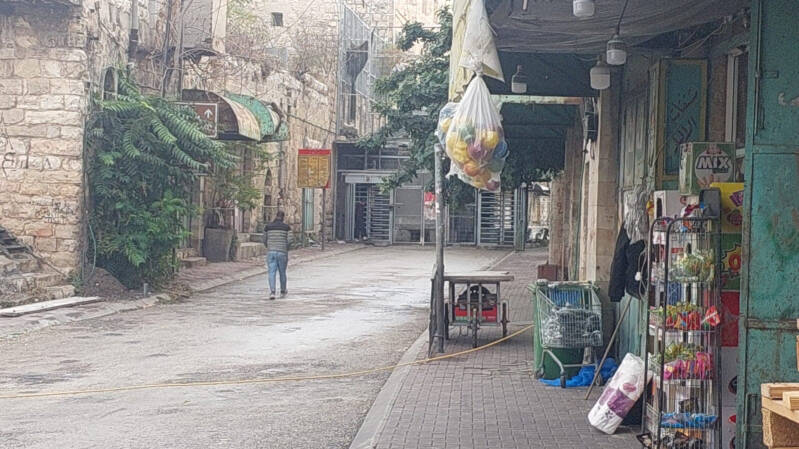
An Israeli checkpoint, kept closed since 23 November 2025, outside Ash Shuhada Street in the H2 area of Hebron city. Photo courtesy of a resident.
Key Highlights
- Israeli forces killed eight Palestinians, including one child, and Palestinians killed one Israeli across the West Bank, including East Jerusalem, during the reporting period.
- More than 1,000 Palestinians have been injured in settler attacks so far in 2025, more than double the number of Palestinians injured in settler attacks in 2024.
- Thousands of Palestinians have been affected by the intensification of movement restrictions in the Hebron governorate since 23 November.
- Since October 2023, Israeli forces have killed 14 Palestinians and injured more than 200, while they were attempting to cross the Barrier, amid a severe economic downturn in the West Bank.
Humanitarian Developments
- Between 18 and 24 November, Israeli forces killed eight Palestinians, including a child, and one Palestinian killed one Israeli man, in the West Bank, including East Jerusalem. During the same period, 61 Palestinians and four Israelis were injured. The following are details of the incidents that resulted in fatalities:
- On 18 November, two Palestinians attempted to run over a crowd of Israelis at Gush Etzion settlement junction along Road 60, in Bethlehem governorate. One of the Palestinians reportedly exited the vehicle and began stabbing people, killing an elderly Israeli man and injuring two others, including a child. Israeli forces opened fire and killed both Palestinian men and reported finding explosive materials in their vehicle. Their bodies were withheld by the Israeli authorities. An Israeli woman was reportedly injured by Israeli fire, according to the Israeli media. Following this attack, Israeli forces closed all four road gates leading to Hebron city, leaving thousands of Palestinians stranded for many hours, and carried out raids in Beit Ummar town and Hebron city, the hometowns of the assailants. In Beit Ummar, Israeli forces sealed the entrance of the family home of one of the assailants, displacing three families residing in the same building, imposed a three-day curfew, and closed internal roads with 12 earth mounds, which were removed on 22 November by the municipality. Since 23 November, Israeli forces have continued to close seven main gates, three of which control access to Hebron city and four that lead to nearby communities, isolating two towns and one refugee camp (Halhul, Beit Ummar and Al Arrub refugee camp) and leaving only one entrance open to and from the city. The closures have caused severe traffic congestions and long delays for thousands of Palestinians seeking to enter or exit Hebron city, the main service provider for surrounding towns and villages. These access restrictions remain in place as of the time of reporting.
- On 21 November, Israeli forces killed and withheld the body of a Palestinian man after surrounding his house during a raid in Tell village, in Nablus governorate. Local sources reported that the man was killed upon leaving his house by snipers positioned on nearby rooftops. According to an Israeli military statement, the man had shot and wounded a soldier during an overnight raid in Nablus city the previous day.
- On 21 November, Israeli forces shot and killed two Palestinians, including a child and a young man, during an overnight raid in Kafr Aqab, in East Jerusalem. Israeli forces reportedly broke into several buildings and positioned snipers on rooftops, while Palestinians threw stones at the Israeli forces.
- On 23 November, Israeli forces shot and killed a Palestinian man with live ammunition in Deir Jarir village, in Ramallah governorate, after Israeli settlers raided the outskirts of the village and Palestinians threw stones toward the settlers to push them back. This is the third fatality during settler attacks reported in the past three months in the same area of Deir Jarir and comes amid a marked rise in settler attacks since early 2025.
- On 24 November, Israeli forces killed and withheld the body of a Palestinian man in an exchange of fire during an overnight raid that lasted for 10 hours in Mirka village, in Jenin governorate. In a statement, the Israeli military announced that the man was responsible for the killing of an Israeli settler in Kedumim settlement, in Qalqiliya governorate, on 18 August 2024.
- On 24 November, a Palestinian man was killed in an exchange of fire with Israeli forces, including undercover forces, who reportedly surrounded the house he was in and fired shoulder-launched missiles toward it in Nablus city. According to an Israeli military statement, the man perpetrated a ramming attack against soldiers at Nablus-Awarta checkpoint on 29 May 2024, killing two soldiers.
- Between 1 and 24 November, 12 Palestinians were injured while they were attempting to cross the Barrier to reach East Jerusalem and Israel, including 11 in Jerusalem and one in Hebron. Since 7 October 2023, when Israeli authorities revoked or suspended most permits issued for Palestinian workers and others to gain access to East Jerusalem and Israel, OCHA has documented the killing of 14 Palestinians and the injury of over 200 others while trying to cross the Barrier, reportedly to access workplaces in East Jerusalem and Israel, against the backdrop of a severe economic downturn in the West Bank. The monthly average of Palestinians injured by Israeli forces while attempting to cross the Barrier has significantly increased in 2025 to nearly 12 Palestinians injured per month, double the monthly average for 2024 (six) and up from about one Palestinian injured per month within this context in the last three months of 2023.
- The UN Conference on Trade and Development (UNCTAD) reports that two years of operations by Israeli forces and extensive damage to infrastructure and productive assets have reversed decades of socioeconomic progress and development gains in the Occupied Palestinian Territory (OPT). According to UNCTAD, the West Bank has experienced the worst economic decline since the organization began to maintain records in 1972. In 2024, Gross Domestic Product (GDP) shrank by 17 per cent, and GDP per capita by 18.8 per cent, erasing 17 years of economic progress. By the end of 2024, total GDP had fallen to 2014 levels, GDP per capita to 2008 levels, and unemployment rose to 35 per cent. In a press release, UNCTAD stressed: “The expansion of settlements and movement restrictions continue to fragment the West Bank, disrupt the economy, trade and investment, and reduce access to land, resources and markets. These restrictions affect over 3.3 million people, raising transport costs, lengthening travel times and disrupting access to markets, employment, education and health services.”
- Between 18 and 24 November, OCHA documented the demolition of 21 Palestinian-owned structures, all by Israeli authorities, for lacking Israeli-issued building permits, which are almost impossible for Palestinians to obtain. These included 15 structures in eight villages and towns in Area C and six structures in Beit Hanina, in East Jerusalem. The structures comprised six residential structures, 11 agricultural and livelihood structures, and four other structures. In total, two Bedouin families comprising 18 Palestinians, including 13 children, were displaced in one incident on 21 November in An Nabi Musa community, in Jericho governorate, in an area designated as a "firing zone” by the Israeli military. During the incident, three residential structures, two animal shelters and a solar panel system provided as humanitarian assistance were demolished. Also in Jericho, an 800-square-metre chicken pen and a 3,500-square-metre agricultural water tank were demolished in Marj al Ghazal village, affecting 14 families comprising 87 people, including 53 children.

Update on H2 Movement Restrictions
- Since 23 November, Israeli forces have continued to intermittently close Ash Shuhada Street checkpoint (CP 56) in the direction of the Tal Rumeida and Ash Shuhada Street neighbourhoods within the restricted zone of the H2 area of Hebron city, severely hindering the movement of approximately 800 Palestinian residents, 125 students and 19 teachers. Exit from the area continues to be permitted. Between 23 and 26 November, the checkpoint was closed between six and nine hours each day. During the times when the checkpoint was closed, residents were unable to directly access their homes and were forced to take long detours through alternative routes. Students and staff of Qurtuba School, one of 34 schools in H2 serving about 125 students and 19 teachers, were also required to use alternative, longer routes, including through Mashhad al Arba’in checkpoint, which adds approximately 20 minutes by car. The detour also requires passing through an olive grove frequently used by settlers, increasing residents’ sense of insecurity.
- Since October 2023, Israeli forces have imposed a new system regulating the movement of Palestinian residents of the restricted area of H2 through the three main designated checkpoints, with daily opening hours from 07:00 to 20:00. This system has further restricted movement between Palestinian neighbourhoods within the closed areas of H2 (with a population of about 7,000 Palestinians) and access to key sites, including the Ibrahimi Mosque and its charity soup kitchen. Since 7 October 2023, OCHA has documented the detention of at least 427 Palestinians, including 52 children, in the H2 area, including at established checkpoints or at ‘flying’ or mobile checkpoints.
- Movement restrictions in the H2 area of Hebron city have further intensified since July 2025 due to the placement of additional closures in the area by Israeli forces. On 21 July, Israeli forces placed barbed wire and sealed the doors at the two main entrances leading to Palestinian homes in the As Salaymeh neighbourhood, located in the restricted area of H2. The closures prevent the entry and exit of 11 families comprising 66 people, including 26 children, into and from their homes. The only remaining routes require the families to pass through neighbours’ homes, walking across fields, and climbing ladders over walls of surrounding buildings. Among those affected are two people with chronic illnesses and one person with a mobility disability who requires regular hospital visits. In a separate incident on 2 October, Israeli forces welded shut another main entrance to a residential building in the same neighbourhood, severely affecting the movement of seven families comprising 38 people, including 23 children, as well as 25 children who attend a kindergarten in the same building – forcing them to similarly rely on indirect, improvised and unsafe routes.
Operations by Israeli Forces in the Northern West Bank
- Israeli forces continued to carry out large-scale operations across the northern West Bank, particularly in parts of Tubas, Tulkarm and Jenin governorates, resulting in casualties, displacement and disrupted access to essential services.
- In Tubas governorate, on 26 November, Israeli forces launched a large-scale operation, deploying military jeeps and bulldozers in Tubas city and the surrounding villages of Tammun, Aqqaba, Tayasir, and Wadi al Fara’. The operation remains ongoing at the time of reporting. At least 30 Palestinian families across Tubas, Tammun, and Tayasir were forcibly evacuated and displaced from their homes, which Israeli forces also used as observation points, and have been hosted by relatives and friends since then. Israeli forces have closed about a dozen main and secondary roads, imposing severe movement restrictions across the governorate. According to the Palestinian District Coordination Office (DCO), Israeli forces announced and enforced an open-ended curfew across the governorate and continue to conduct search operations and detentions. The operation has significantly disrupted access to essential services, with initial reports indicating that bulldozers damaged the water network between Tammun and Khirbet ‘Atuf on 26 November, disconnecting water supply serving residential areas and agricultural land.
- In Nur Shams refugee camp in Tulkarm governorate, Israeli forces shot and injured two Palestinians, including one child and one journalist on 18 November, during a protest. About 100 displaced Palestinian residents from Nur Shams refugee camp had gathered to demand a return to their homes and an end to the Israeli forces’ operation that has been ongoing since January 2025 and that has resulted in the displacement of about 8,700 Palestinians from Nur Shams Camp, according to UNRWA.
- In Jenin governorate, Israeli forces carried out multiple operations resulting in injuries, detention, and significant movement restrictions. On 24 November, at the entrance to Jenin refugee camp, Israeli forces detained a Palestinian family from Silat al Harithiya village, including a three-year-old child and his two parents, who mistakenly walked toward the camp while leaving a medical appointment at the nearby Jenin governmental hospital. Despite interventions by the Palestinian District Coordination and Liaison Office (DCL), forces held the family for about 10 hours (10:00 – 20:00) and physically assaulted the father before releasing them near the hospital. Earlier, on 18 November, Israeli forces shot and injured a 14-year-old boy with live ammunition while he was inside his home in Al Yamun village during a raid in which no confrontations or arrests were reported. On 20 November, Israeli forces raided Zububa village, northwest of Jenin city, and installed six earth mounds on two main roads and four side roads, severely restricting movement for the village’s 2,700 residents. As a result, residents were forced to use narrow, unpaved dirt roads to reach their homes. The earth-mounds were removed by the village council on 26 November, following coordination between the Israeli and Palestinian DCLs.

Israeli Settler Attacks
- Between 18 and 24 November, OCHA documented 36 Israeli settler attacks against Palestinians that resulted in casualties, property damage or both in the West Bank, including East Jerusalem. The attacks led to the injury of 22 Palestinians, including 20 by Israeli settlers. More than 180 Palestinian-owned (mainly olive) trees and saplings were vandalized. Additionally, two families comprising 12 Palestinians, including eight children, were displaced citing settler violence. The number of settler attacks during this past week has been consistent with the weekly average of approximately 35 attacks recorded since the beginning of 2025.
- On 23 November, two Palestinian households comprising 12 people, including eight children, were forcibly displaced from Al Hathroura Bedouin community (with a population of about 200 people), in Jericho governorate, and relocated to Area B, following repeated settler attacks that followed the establishment of a new settlement outpost two days earlier less than 50 metres from their homes. The outpost reportedly consists of a metal structure placed on a hill overlooking the community. Immediately after its establishment, settlers reportedly carried out repeated attacks, including breaking into homes, ransacking property, and issuing threats. Children were particularly affected, as settlers chased them several times, forcing them to remain indoors out of fear. During the night, settlers broke into the homes while residents were sleeping and, at dawn, assaulted the men with sticks and threatened to kill the families if they did not leave within hours. The families began relocating the next morning under settlers’ direct observation and harassment, managing to take only basic personal belongings and limited furniture, while leaving behind residential structures and most possessions. Settlers occupied the abandoned structures shortly afterwards. With the establishment of this outpost, Al Hathroura Bedouin community is now surrounded by six settlement outposts.
- This is the second displacement incident reported in Al Hathroura this month. On 6 November, Israeli settlers believed to be from an outpost located east of the community, approximately 700 metres away, destroyed 12 Palestinian structures using a bulldozer, including seven residential structures, two bathrooms, and three animal shelters. The attack displaced five households comprising 16 people, including seven children, and affected three additional households of 14 people. Many families had temporarily relocated women and children during the night due to fear generated by previous settler attacks. The demolition destroyed donor-funded structures, personal belongings, and shelters used for seasonal winter movement.
- Since the beginning of 2025, OCHA documented more than 1,600 attacks perpetrated by settlers against Palestinians that led to casualties and/or property damage, affecting over 270 communities across the West Bank, primarily in Ramallah, Nablus and Hebron governorates. Among others, these incidents led to the injury of over 1,000 Palestinians, mainly due to physical assault, stones or tear gas inhalation. About 70 per cent were injured by Israeli settlers and the rest by Israeli forces or where it remains unknown if they were injured by Israeli forces or settlers. Of more than 700 Palestinians injured by Israeli settlers during settler attacks so far this year, more than 40 per cent were injured in June, July and October, when at least 100 Palestinians per month were injured by Israeli settlers. This is double the number of Palestinians injured by Israeli settlers during settler attacks in all of 2024, when about 360 such injuries were documented (see graph).
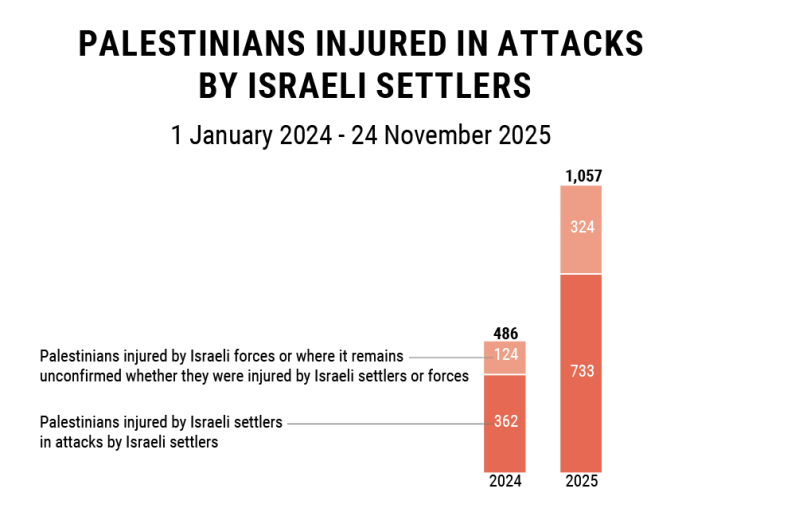
- For key figures and additional breakdowns of casualties, displacement and settler violence between January 2005 and October 2025, please refer to the OCHA West Bank September 2025 Snapshot.
Funding
- As of 27 November 2025, Member States have disbursed approximately US$1.6 billion out of the $4 billion (40 per cent) requested to meet the most critical humanitarian needs of three million out of 3.3 million people identified as requiring assistance in Gaza and the West Bank, including East Jerusalem, under the 2025 Flash Appeal for the OPT. Nearly 88 per cent of the requested funds is for the humanitarian response in Gaza, with just over 12 per cent for the West Bank. During October 2025, the oPt Humanitarian Fund managed 135 ongoing projects, totalling $77.7 million, to address urgent needs in the Gaza Strip (87 per cent) and the West Bank (13 per cent). Of these projects, 63 are being implemented by international NGOs, 56 by national NGOs and 16 by UN agencies. Notably, 69 out of the 79 projects implemented by international NGOs or the UN are being implemented in collaboration with national NGOs. For more information, please see OCHA’s Financial Tracking Service webpage and the oPt HF area webpage.
2004.

27 november 2025
Ondanks het staakt-het-vuren gaat de genocide in Gaza gewoon door [1]. Ook neemt het geweld van kolonisten tegen Palestijnen op de Westelijke Jordaanoever toe [2]. Nederland is de grootste investeerder in Israël [3] en draagt daarmee bij aan genocide en illegale bezettingen. Daarom zijn wij samen met SOMO en The Rights Forum in juli een petitie gestart. Dinsdag bieden we deze aan in de Tweede Kamer. teken en deel de petitie?
Teken deze petitie
Met bijna 40.000 handtekeningen, hebben vele van jullie deze petitie waarschijnlijk al ondertekend. Samen kunnen we er voor zorgen dat de petitie over de 40.000 handtekeningen heen gaat en echt serieus wordt genomen door de Tweede Kamer. Deel daarom nu de petitie!
We hebben al vaak samen een rode lijn getrokken. Of dit nou tijdens een van de rode lijn demonstraties was of met lokale petities. Toch neemt onze regering nog geen verantwoordelijkheid. Door deze petitie aan te bieden aan de nieuwe Tweede Kamer, zorgen we er samen voor dat de Palestijnen niet van de politieke agenda verdwijnen!
Strijdbare groet,
Jasmijn van DeGoedeZaak
2003.
27 november 2025
This Black Friday and Cyber Monday don’t buy into genocide, boycott these brands enabling Israel’s ongoing genocide against Palestinians.
Xbox
Microsoft is perhaps the most complicit tech company in Israel’s illegal apartheid regime and ongoing genocide against 2.3 million Palestinians in Gaza.
Disney+
Cancel your Disney+ subscription. Disney and its subsidiary Marvel are complicit in glorifying Israel’s regime of genocide and apartheid against Indigenous Palestinians.
Amazon
In May 2021, Amazon Web Services and Google Cloud signed a $1.22 billion contract to provide cloud technology to the Israeli government and military.
HP
HP provides services to the offices of genocide leaders. HPE has provided technology for Israel’s Population and Immigration Authority, a pillar of the Israeli apartheid regime.
Dell
Dell supplies servers and maintenance services to the genocidal Israeli military. Most Dell computers are powered by Intel microprocessors too.
Reebok
Reebok sponsors the Israel Football Association (IFA), which includes in its official leagues teams in Israel’s illegal settlements on occupied Palestinian land.
Share our call to boycott these BDS targets:
Intel
For decades, Intel has been the largest international investor in apartheid Israel. Intel remains deeply complicit in feeding Israel’s genocidal war chest.
ZARA
ZARA has chosen to open many stores in Israel during the ongoing genocide, fashion-washing the genocide and underlying apartheid. The fast fashion outlet is also devastating the planet.
Sodastream
SodaStream is actively complicit in Israel's policy of displacing Indigenous Bedouin-Palestinians and has a long history of racial discrimination against Palestinian workers.
McDonald's
Its Israeli franchisee has openly supported apartheid Israel’s Gaza genocide by donating generous food packages to the Israeli military that is actively starving 2.3 million Palestinians.
Carrefour
The France-based multinational retailer is involved in war crimes committed by the Israeli regime of settler-colonialism and apartheid over the Palestinian people.
2002.
AVAAZ
27 november 2025

Maar hij bleef levens redden -- totdat Israëlische troepen hem ontvoerden en naar verluidt martelden.
Nu worden hij en zo’n 94 andere zorgverleners gevangen gehouden. Velen van hen zijn opgepakt terwijl ze voor hun patiënten zorgden. Vijf van hen zouden achter de tralies zijn omgekomen, anderen worden mishandeld en geslagen.
Terwijl wereldleiders zich richten op een staakt-het-vuren, staan artsen wereldwijd op om vrijheid te eisen voor hun moedige collega’s, zodat zij duizenden gewonde kinderen in Gaza in leven kunnen houden.
Laten we ons bij hen aansluiten! Sluit je aan bij de oproep voor de vrijlating van dr. Abu Safiya en zijn collega’s, die hebben laten zien waartoe mensen in staat zijn, en help om ze met hun familie te herenigen:
Net als dr. Hussam Abu Safiya, directeur van het laatste nog functionerende ziekenhuis in Noord-Gaza tot het werd aangevallen, zitten bijna 100 medische zorgverleners nog steeds gevangen in Israël. Veel van hen werden tijdens hun werk in Palestijnse ziekenhuizen of ambulances ontvoerd.
Laten we het verhaal van dr. Abu Safiya wereldnieuws maken en de wereld laten zien welk onrecht de mensen wordt aangedaan die alles op het spel hebben gezet om levens te redden.
Een wereldwijde petitie met honderdduizenden handtekeningen van over de hele wereld kan kracht bijzetten aan de druk om hen vrij te laten en de publieke aandacht op deze zaak gericht houden totdat Gaza’s artsen vrij zijn. Sluit je nu bij ons aan.
Met onvermoeibare hoop,
Julian, Mo, Harriet, Marco, Nadia, Liliana, Christoph en het hele Avaaz-team
Bronvermelding: een opname van Al Jazeera en een door NBC News geverifieerde video waarop dr. Abu Safiya voor zijn arrestatie een militair voertuig benadert.
- Dokter Abu Safiya verliest 40 kilo gewicht door onmenselijke omstandigheden in Israëlische cel (Rights Forum)
2001.

27 november 2025
This Saturday 29th of November marks the UN International Day of Solidarity with the Palestinian People. On this day, we are reminded of the colonial Partition plan of Palestine in 1947 and Trump’s 20-point plan to divide Gaza through a Yellow Line. We know these plans all too well, the UN also approved the Green Line in the past and hindered Palestinian rights to self-determination. But the UN continues to fail because 78 years later, the Palestinian people are still resisting the occupier for freedom in their homeland.
Solidarity with Palestinians is synonymous with liberation everywhere, and beyond the complicity of big powers, real change is coming from the people. Today, as new plans repackage colonial rule of our people, the need to escalate our organizing is greater than ever. Our Communicating Palestine Guide offers a practical checklist for advocates to amplify Palestinian narratives and confront apathy, censorship and repression.
There is no ceasefire nor peace. We are building an infrastructure for organized action.
2000.

26 november 2025
Gaza Humanitarian Response
Situation Report No. 31
26 November 2025
(As of 18:00 on 25 November 2025, unless otherwise noted)
HIGHLIGHTS
- On 24 and 25 November, partners distributed 5,328 tarpaulins to 1,776 households and 2,232 blankets to 558 households in Deir al Balah and Khan Younis. On 25 November, a partner resumed tent distribution in Gaza city, aiming to provide one tent to each of the 258 families identified to need shelter in one of the sites in that area.
- On 24 November, 816 children and 596 caregivers received mental health and psychosocial support (MHPSS) services, including structured six-session programmes, group and individual counselling, as well as guidance for caregivers on supporting children’s emotional wellbeing.
SITUATION OVERVIEW
On 25 November, the remains of a deceased Israeli hostage were reportedly transferred to the Israeli authorities. The bodies of another two hostages from Israel are believed to still be in the Gaza Strip.
On 26 November, the Gaza Ministry of Health reported receiving the bodies of 15 Palestinian detainees. This brings the total number of bodies received since the start of the ceasefire to 345, 99 of which have been identified by the Ministry’s medical teams.
UNITED NATIONS-COORDINATED AID ENTRY*
On 25 November, 3,538 pallets of aid administered by the UN and its partners were offloaded at Gaza’s crossings, based on data retrieved from the UN 2720 Mechanism dashboard at 16:00 on 26 November. About 51 per cent of these pallets contained food supplies, followed by shelter (35 per cent), health supplies (9 per cent), and water, sanitation and hygiene supplies (6 per cent). At least 117 truckloads were offloaded in Kerem Shalom and 36 truckloads in Zikim.
On 25 November, between 08:35 and 15:00, UNOPS international monitors deployed at Kerem Shalom crossing recorded the collection of 265 pallets of aid. These comprised 183 pallets of medical supplies, 60 pallets of animal feed, and 22 pallets of stretchers and ICU beds.
On the same date, UNOPS monitors were unable to be present at Kissufim crossing due to the absence of a mission security commander.
Overall, between 10 October when the ceasefire entered into effect and 25 November, at least 111,869 pallets of humanitarian cargo were offloaded, and 97,433 pallets were collected, from the different crossings. Of the collected cargo, 1,838 pallets (3 per cent) were intercepted during transit within Gaza.
All the above data excludes bilateral donations and the commercial sector.
As of 26 November, Kerem Shalom, Zikim and Kissufim crossings remained operational, with humanitarian cargo offloading and uplifting alternating days between Zikim and Kissufim.
HUMANITARIAN RESPONSE
Protection
- Child Protection partners continued delivering mental health and psychosocial support services (MHPSS), case management follow up, individual support for high-risk cases, and awareness services across the Gaza Strip.
- On 24 November, 816 children and 596 caregivers received MHPSS services, including structured six-session programmes, group and individual counselling, as well as guidance for caregivers on supporting children’s emotional wellbeing. Protection messages continue to be integrated into all activities, with regular awareness and information sessions reaching 170 caregivers and 150 children with key safety and prevention messages. Case management teams also made referrals for high-risk cases and supported the distribution of 100 winter kits for children, with further distributions planned in the coming days.
- People across Gaza are facing growing challenges as winter worsens. Many families are living in worn-out tents that don’t protect them from cold or rain, and financial hardship makes it prohibitive to purchase winter essentials. These conditions are increasing stress for children and caregivers. Meeting the needs of vulnerable families is even more challenging as shelters become damaged, leak and deteriorate, while field teams work in harsh conditions with little heating. Heavy rain has damaged tents being used as safe spaces for women and children, disrupted activities in several sites, and delayed winter clothing distributions.
Shelter
- Between 24 and 25 November, Shelter Cluster distribution proceeded as follows:
- 5,328 tarpaulins distributed to 1,776 households in Deir al Balah and Khan Younis.
- 2,232 blankets distributed to 558 households in Deir al Balah and Khan Younis.
- On 25 November, a partner resumed distribution of tents at a site in Gaza city, west of Al Shifa Hospital, aiming to distribute one tent to each of the 258 families that have been identified to need shelter.
1999.

26 november 2025
Gaza Humanitarian Response
Situation Report No. 30
25 November 2025
(As of 18:00 on 24 November 2025, unless otherwise noted)
HIGHLIGHTS
- Over 186,000 families have been reached with general food parcel distributions since the start of November. Daily meal production by partner-supported kitchens has increased by over 136 per cent compared to late September, with more than 1.55 million meals now distributed daily across Gaza.
- A recent mass screening campaign of 7,930 children identified 575 with acute malnutrition, including 128 with the most severe form. All affected children were referred to treatment sites.
- On 24 November, WHO facilitated the medical evacuation of 33 patients, alongside their 109 companions, from the Gaza Strip to receive necessary treatment abroad.
SITUATION OVERVIEW
On 23 November, due to reported Israeli military advances east of Gaza city, an estimated 50 additional families were displaced from the At-Tuffah and Ash-Shuja'iyya neighbourhoods, bringing the total number of affected families to approximately 650 (SitRep No. 28 refers). Most displaced households moved towards central Gaza city, with some seeking refuge in nearby shelters and others staying temporarily with relatives within the city. Several families had only recently returned to these neighborhoods and have now been displaced again, many leaving without any belongings.
On 24 November, a partner conducted an incident assessment following an unexploded ordnance (UXO) explosion in the Mushtal area of Gaza city. Ten tents were destroyed, affecting 10 families that lost their shelter and all their belongings. An additional 10 tents were partially damaged to varying degrees based on their proximity to the incident. Three people were injured, including one in severe condition. Affected families need new tents, blankets, mattresses, clothing, and psychosocial support.
UNITED NATIONS-COORDINATED AID ENTRY*
On 24 November, 3,504 pallets of aid administered by the UN and its partners were offloaded at Gaza’s crossings, based on data retrieved from the UN 2720 Mechanism dashboard at 19:00 on 25 November. About 52 per cent of these pallets contained food supplies, followed by shelter (37 per cent), health supplies (6 per cent), water sanitation and hygiene supplies (4 per cent), and operations, logistics and communication items (1 per cent). At least 152 truckloads were offloaded in Kerem Shalom and 6 truckloads in Kissufim.
On 24 November, UNOPS international monitors deployed at Gaza’s crossings observed the collection of 3,090 pallets of aid – 2,001 from Kerem Shalom and 1,089 from Zikim. These comprised 1,940 pallets of food supplies, including parcels, fortified biscuits, canned and dry food and flour; 652 pallets of winter clothes; 417 pallets of tarpaulins, blankets and jerry cans, 61 of bedding items, 13 of wood pellets, and 7 of diapers.
Overall, between 10 October when the ceasefire entered into effect and 24 November, at least 109,530 pallets of aid cargo were offloaded, and 95,372 pallets collected, from the different crossings, while 1,838 pallets (three per cent of uplifted) were intercepted during transit in Gaza.
All the above data excludes bilateral donations and the commercial sector.
As of 25 November, the Kerem Shalom, Zikim, and Kissufim crossings remained operational, with humanitarian cargo offloading and uplifting alternating days between Zikim and Kissufim.
HUMANITARIAN RESPONSE
Health
- On 24 November, WHO facilitated the medical evacuation of 33 patients, alongside their 109 companions, from the Gaza Strip to receive necessary treatment abroad.
Food Security
- In three days between 21 and 23 November, partners assisted more than 62,000 households with monthly food parcels via 59 distribution points across Gaza. Overall, since the start of November, over 186,000 families have been reached with general food parcel distributions as part of the monthly assistance cycle. The Food Security Sector is working to strengthen coordination with bilateral aid actors that bring in supplies outside of the UN-coordinated mechanism.
- As of 22 November, 1,556,000 meals were being produced daily by 28 partners through 206 kitchens: 307,000 in northern Gaza and 1,249,000 in the south. This represents an over 136 per cent increase in overall meal production compared to late September.
- Between 15 October and 23 November, about 800 metric tons of concentrated animal fodder was collected from the crossings. The distribution of three 50-kg bags of fodder to around 1,700 herders in Deir al Balah has already been completed.
Education
- On 23 November, four learning spaces, two in eastern Gaza City and two in Khan Younis, were equipped with 1,000-litre water storage tanks to enhance basic services. This support is part of ongoing efforts to improve conditions ahead of reopening the spaces for in-person learning.
Nutrition
- In recent days, the Cluster conducted a mass malnutrition screening of over 7,930 children across Gaza. Among those screened, 575 children were identified with acute malnutrition, including 128 with the severe form. The prevalence of malnutrition ranged from 9.6 per cent in Gaza city to 8.8 per cent in Deir al Balah and 4.6 per cent in Khan Younis. Children identified with acute malnutrition have been referred to functioning treatment sites.
Protection
- Between 22 and 24 November, partners reported the distribution of 766 clothing parcels in northern Gaza, while in Deir al Balah and Khan Younis, partners reached 7,508 people with Psychological First Aid (PFA), family support, legal consultations, child protection activities, community outreach sessions, group sessions, protection and outreach services, referrals, and distribution of dignity kits, food parcels, hygiene kits, and tarpaulins. Ninety-three vulnerable people also received Cash for Protection assistance via SMS redemption codes as part of individual protection assistance and protection case management services.
- Cluster partners monitoring included risk of flooded displacement sites, reduced safe access, weather-related disruption of activities, unstable shelter and displacement among beneficiaries and staff, unsafe or blocked routes, and safety-related access restrictions in contaminated or insecure areas.
- Child Protection
- Between 23 and 24 November, more than 1,500 children and caregivers were reached through case management, mental health and psychosocial support services (MHPSS), recreational activities, PFA sessions, positive parenting, community initiatives, counselling, life skills sessions, child protection awareness, and safe-space programming in the Al-Wahedi, Al-Saraya, and Al-Yarmouk Camps, in Gaza city.
- During the same period, 91 children at risk were newly registered for case management and supported with tailored assistance. Moreover, 81 personal care kits and 8 medical eye glasses were provided to children with specific needs, alongside referrals to physiotherapy, speech therapy, and psychosocial services. A total of 113 children were referred for shelter and non-food item support.
- Between 19 and 29 November, partners distributed 270 identification bracelets to support family tracing. Protection risks remain high due to unsafe shelters, explosive hazard contamination, child labour, and poor education access, with recent child injuries reported in Al-Najat and Al-Rowad Camps in Khan Younis. Gaza city and the northern areas continue to face major service interruptions, while community feedback highlights growing fear linked to collapsing shelters, exposure to cold winter weather, and worsening living conditions.
- Gender-Based Violence (GBV)
- Between 19 and 21 November, GBV partners continued delivering essential case management, psychosocial, and legal support for women and girls across the Strip. More than 5,600 women and girls accessed services through women and girls’ safe spaces (WGSS) and outreach activities across the Strip, which included structured group counselling session, GBV awareness, yoga, life-skills and PFA.
- During the same period, legal services continued through three workshops for 30 women, alongside 34 individual legal consultations delivered through centers and hotlines. Legal requests focused on personal status issues such as marriage, divorce, custody, guardianship, and documentation.
- Material assistance also remained a key component of protection support. Partners distributed 282 dignity kits, 317 menstrual hygiene management kits, and 1,254 food parcels to women and girls. Four tents were provided to vulnerable families through case management referrals.
- Mine Action
- On 25 November, eight explosive hazard assessments were completed to identify and map contamination for safe access and clearance planning.
- Explosive ordnance risk education also continued through five partners in Deir al-Balah, Khan Younis, and Gaza city, to raise awareness and promote safe behavior.
Shelter
- Between 23 and 24 November, cluster partners distributed 4,158 tarpaulin sheets to 1,386 households in Khan Younis and Deir al Balah.
- On 24 November, partners reported the distribution of 500 tents across three displacement sites in Khan Younis, targeting vulnerable households without shelter or with very deteriorated tents. Moreover, partners distributed 4,158 tarpaulin sheets to 1,386 households, kitchen sets and ropes to 973 families, and 632 blankets to 158 households in Khan Younis and Deir al Balah.
Site Management Cluster
- Site Management partners continue to focus on flood mitigation measures and updating demographics data for those displacement sites in which they work.
1998.
26 november 2025
Atalya here. I’m a refuser who objected to military service in 2017 and spent 110 days in jail. This olive harvest season, Palestinians have faced the deadliest harvest in recent memory at the hands of Israeli settlers and the military, working in unison to maim and kill Palestinians while displacing them from their lands and livelihoods. Earlier this fall, I was in Beita, a town well-known in the West Bank and in the world for their struggle against settlement expansion as part of Zaytoun 2025, which connects Palestinian farmers to activists. As I picked olives, a massive group of masked men appeared. These were settlers, and they often cover their faces despite the army’s willing participation in their terror. The sight of them is an image Palestinians and activists are very familiar with, the sign of a possible pogrom. Before we knew it, 8 cars had been burned, more than 20 people were hospitalized and one was shot. The next day, a 13-year-old child from Beita, Aysam Mualla, fell into a coma after he inhaled tear gas fired by the Israeli military. Two weeks ago, he died. The genocide may be declared over in Gaza by some, but we know that the violence has only expanded, albeit in a different form. The call is clear: we have no choice but to bring more people into protective presence work in the West Bank, just as we did with war refusal by bringing it into the mainstream over the last two years. We need your support, and are asking you: tell your communities to follow our updates from the ground by signing up at this link. We need to expand our global circle of supporters, now is the time for solidarity.
Support War Refusers
I was in Beita as part of a Palestinian campaign called Zaytoun 2025, which helped connect activists to Palestinian farmers tending to their land. I was regularly faced with the reality that I was also in danger. While Palestinians are the main targets, solidarity activists doing protective presence work are also the targets of settler-military violence at unprecedented levels. Risk has always been part of this work, but we knew that our presence helped to deescalate. But as photos of bloodied activists circulated the internet in recent months, their skulls fractured by armed settlers’ rocks in the presence of soldiers, it became clear to me that we need to expand current efforts. We need more people, local and international, showing up, in the olive grove and in villages, where most people’s only line of defense are their cameras.
If we are to launch a real challenge to the settler-military enterprise, we need to widen our ranks and grow our camp. That is why right now, RSN is focused on shifting our work beyond just war refusal: we are starting to work with the very same people to invite them into other realms, notably solidarity work in the West Bank. We cannot allow more Palestinians to be killed while picking olives, let alone stand idly by as they are pushed off of the lands they’ve lived on and tended to for generations. We hope you can support us: help us begin to expand our work into the West Bank. Tell your community to sign-up for our updates at this link or by forwarding this newsletter.
In solidarity,
Atalya Ben-Abba
Media Coordinator
Refuser Solidarity Network
Support War Refusers
1997.

Today's headlines
Israel is launching its campaign for a massive increase in U.S. aid – will it succeed?
Mitchell Plitnick

Israel wants to start negotiations over a massive new aid deal that could shape the U.S.-Israeli relationship for the next 20 years. But it is far from certain, as support for Israel is at an all-time low. The time to stop the deal is now.
Israel assassinated Hezbollah’s top military chief, threatening a return to war with Lebanon
Qassam Muaddi

Israel's assassination of Hezbollah's top military commander threatens the collapse of the ceasefire with Lebanon and the return to war.
1996.

25 november 2025
Gaza Humanitarian Response
Situation Report No. 29
24 November 2025
(As of 18:00 on 23 November 2025, unless otherwise noted)
HIGHLIGHTS
- Under the Nutrition Cluster, 4,000 cartons of Ready-to-Use Therapeutic Food (RUTF) and 50,000 bags of Super Cereal Plus were dispatched across Gaza last week to treat acutely malnourished children below and above the age of five. Malnutrition treatment sites in Gaza city have risen to 23.
- More than 13,700 children under the age of three have already been vaccinated through the ongoing catch-up immunization campaign.
- On 23 November, health partners retrieved critical medical equipment from the non-functional European Gaza Hospital in Khan Younis.
SITUATION OVERVIEW
Findings from the World Food Program (WFP) Market Monitor covering the first ten days of November show that, despite the ceasefire, most households in Gaza still face challenges in accessing markets due to lack of cash and in affording basic food items. While meal frequency for most surveyed households has improved compared to previous months, food consumption remains far below pre-conflict levels. Diets are dominated by cereals, pulses, and moderate amounts of dairy and oil, with very limited access to meat, vegetables, and fruits. Cooking gas shortages persist, forcing many families to rely on alternative methods like waste burning. The report shows an improvement in the prices of basic food commodities, which nonetheless remain higher than prior to 7 October 2023 levels and beyond the reach of most people.
Population movements continued across Gaza, with more than 21,300 recorded by Site Management partners between 16 and 22 November. Overall, since the onset of the ceasefire on 10 October, over 753,500 movements have been observed, of which more than 624,000 have been from southern to northern Gaza. As winter sets in, displaced households continue to face significant challenges in securing adequate shelter and reliable heating sources, with the risk of flooding further exacerbating their vulnerability.
UNITED NATIONS-COORDINATED AID ENTRY*
On 23 November, 3,959 pallets of aid administered by the UN and its partners were offloaded at Gaza’s crossings, based on data retrieved from the UN 2720 Mechanism dashboard at 11:00 on 24 November. About 68 per cent of these pallets contained food supplies, followed by shelter (30 per cent), operations, logistics and communication items (1 per cent), and health supplies (1 per cent). At least 109 truckloads were offloaded in Kerem Shalom and 61 truckloads in Zikim.
On 21 and 23 November, UNOPS international monitors deployed at Gaza’s crossings observed the collection of 4,106 pallets of aid – 2,866 from Kerem Shalom and 1,240 from Zikim. These comprised 2,503 pallets of food supplies, including 1,011 of wheat flour; 559 pallets of blankets; 330 of winter clothes; 248 of hygiene items; 169 of cleaning supplies; 90 of animal feed; 88 of Lipid-based Nutrient Supplements for malnutrition programming; 45 of kitchenware; 26 of medical consumables; 20 of sleeping bags; 18 of tents, and 10 of wood pellets.
On 22 November, the UNOPS monitors were not able to obtain access to Kerem Shalom due to military activity. There was equally no mission to Zikim on 22 November as all planned cargo had already been collected.
Overall, between 10 October when the ceasefire entered into effect and 23 November, more than 104,606 pallets of aid were offloaded, and 88,958 pallets collected, from the different crossings, with only 1,838 pallets (three per cent of all collected) intercepted during transit in Gaza.
All the above data excludes bilateral donations and the commercial sector.
As of 24 November, the Kerem Shalom, Zikim, and Kissufim crossings remained operational, with humanitarian cargo offloading and uplifting alternating days between Zikim and Kissufim.
HUMANITARIAN RESPONSE
Health
- During the first 11 days of the catch-up immunization campaign launched on 9 November, more than 13,700 children under the age of three were vaccinated. Discussions are ongoing for another potential round of vaccinations in the first quarter of 2026.
- On 23 November, a health partners’ mission to the European Gaza Hospital in Khan Younis was approved, allowing the recovery of critical cardiac medical equipment.
Food Security
- Approximately 80,000 metric tons (MT) of food supplies – both staple and fresh food stock – are required to enter Gaza each month to enable a diverse diet for acceptable food security for 2.1 million people, given the extremely limited local production capacity and higher needs compared to pre-crisis levels. This is an increase from the previous estimate of 62,000 MT for minimum emergency assistance requirements before 10 October 2025. Current humanitarian assistance provided under the Food Security Sector framework mainly entails basic staples (mostly carbohydrates), while commercial supply of fresh produce remains insufficient to guarantee adequate dietary diversity. Due to months of restricted access for both humanitarian and commercial deliveries, food quantities must be scaled up to compensate for the accumulated gap, support recovery efforts, and meet urgent needs—requiring both higher volumes of staples and greater diversity of food items.
- In addition to the 42,000 empty flour and rice sacks donated during previous weeks, another batch of 40,000 sacks have been donated to the Site Management Cluster partners to support community-led flood mitigation efforts.
Nutrition
- The Nutrition Cluster continues to ensure early detection and treatment of acute malnutrition. Last week, 4,000 cartons of Ready-to-Use Therapeutic Food (RUTF) were dispatched to partners to support the treatment of all acutely malnourished children expected to be admitted in the second half of November. Available stocks of RUTF in Gaza may now cover all needs among under-five children through the end of the first quarter of 2026.
- Over 50,000 1.5-kilogramme bags of Super Cereal Plus have also been dispatched to partners, sufficient to meet the nutritional needs of 33,000 acutely malnourished children above the age of five for one quarter.
- On 19 November, a Cluster partner opened a field hospital in Gaza city that provides outpatient treatment for acute malnutrition. In addition, two more health centres offering nutrition services were established, bringing the total number of functional malnutrition treatment sites in Gaza city to 23.

Shelter
- Between 20 and 22 November, Shelter Cluster partners distributed 900 tents, 5,100 tarpaulins, 2,300 blankets and clothing vouchers to vulnerable households.
- The entry of shelter materials under the Cluster framework remains limited and insufficient. While more than 5 million bedding items, 800,000 tarpaulins, 56,000 tents and 29,000 solar lights are in the humanitarian pipeline, registration issues for international NGOs continue being a major obstacle for material entry.
Site Management
- Site Management partners are working continue to work in makeshift sites to prepare the population for winter and implement measures to reduce the impact of potential flooding, using primarily flour and food sacks for these efforts. For the most at-risk populations living along the shoreline, discussions are ongoing regarding possible relocation, as no effective mitigation measures exist. Partners continue to collect and share updates on site changes to ensure all stakeholders remain informed.
Protection
- Between 19 and 22 November, cluster partners facilitated 250 referrals to the Shelter Cluster and Cash Working Group. During the same time period, over 5,600 individuals were supported with different protection activities.
- Child Protection
- Child Protection partners have continued distributing winter items, providing around 10,000 winter clothing items between 22 and 23 November, along with additional winter supplies for families of children with protection concerns. In northern Gaza, partners still face warehouse capacity constraints, which limit their ability to expand distributions.
- Three child-friendly spaces in Khan Younis that had temporarily suspended operations due to damage from the recent heavy rains have now resumed activities, restoring children’s access to essential protection and support services.
- Gender-Based Violence (GBV)
- Cluster partners established a new Women and Girls’ Safe Space in Al Kateeba, Gaza city, increasing access to GBV and psychosocial support in the area.
- A partner-operated safe shelter for vulnerable women and GBV survivors in Gaza city sustained significant damage following an airstrike on a nearby apartment. The GBV Area of Responsibility (AoR) is actively working to rehabilitate the facility to ensure the continuity of essential services.
- Mine Action
- On 24 November, Mine Action partners completed 11 Explosive Hazard Assessments across the Strip.
- Explosive ordnance risk education sessions continue being implemented daily by four partners in Deir al Balah, Khan Younis and Gaza city.
Education
- Two learning spaces, set up in the course of November in Khan Younis and serving more than 3,100 school-aged children, have received stationery kits to improve the quality of learning. Despite escalating efforts to reach all pre-school and school-aged children, the entry restrictions on learning supplies continue to be a major bottleneck. Advocacy and coordinated efforts are urgently needed to facilitate the entry of these materials.
- An additional learning space opened on 22 November in Deir Al Balah: it is now supporting 240 learners and is staffed by 14 education personnel. Hundreds more learning spaces are still required to meet the needs of all children, and their establishment is contingent on the entry of high-performance tents and the relocation of displaced families from the remaining school buildings.
Fuel
- Between 21 and 24 November, the UN Office for Projects and Services (UNOPS) distributed 715,814 litres of diesel to partners – 536,017 litres in the south and 179,797 litres in the north – to support critical WASH, health, logistics, rubble removal, education, nutrition, cash, and protection operations. During the same timeframe, UNOPS collected 531,750 litres of diesel and 51,100 litres of petrol from the Kerem Shalom crossing, with no uplifts occurring on 21 and 22 November.
1995.

25 november 2025
Every fourth Thursday of November, Indigenous peoples native to settler colonial states of the U.S. begin the day in silent prayer and ceremony at sunrise, and fast to mourn the genocide violently enacted on them to steal the land they were in stewardship with since time immemorial. Genocide that is still active today as land and water are still abused and stolen.
The struggle of the native Palestinian people is directly connected to the struggle of Indigenous peoples here on Turtle Island, and our liberation is intertwined.
This Thursday, Nov. 27, observe the National Day of Mourning with me in resistance of genocide from Turtle Island to Palestine. Wherever you are, and whoever you’re gathering with, hold space to mourn and take action in solidarity with Indigenous peoples.
You can find ideas in this National Day of Mourning resource, cocreated by the Indigenous frontline storytelling organization Seven Sisters Collective and USCPR.

Onward to liberation,
Organizing & Advocacy Director
US Campaign for Palestinian Rights
1994.
24 november 2025
The seeds we have planted and nourished together for years have started to bloom.
Despite the continuing unspeakable grief over the immense loss resulting from Israel’s ongoing genocide against 2.3 million Palestinians in Gaza, our people’s steadfastness and your continued support have played a significant role in isolating Israel’s 77-year-old colonial regime. It is what gives our people – and humanity – hope.
We are now seeing visible signs that our movement is effectively changing policies of states, and making complicit corporations and institutions pay a dear price for their complicity with apartheid Israel. We will maintain the pressure until Israel and all those complicit in its crimes are brought to justice. The following are a few examples of how your sustained solidarity has had a meaningful impact globally.
The recent wave of “S”anctions, from Spain to Türkiye, from Malaysia to Colombia, from Slovenia to Antigua and Barbuda, and many more, was possible because of your pressure on your governments. As a result, Israel is more isolated globally than ever before.
You have also helped us achieve major “D”ivestment impacts. Leading European pension funds have divested from companies implicated in Israel’s crimes, including Denmark’s public pension fund, which fully exited the Israeli economy citing serious human rights concerns.
Finally, your efforts have strengthened our “B”oycott campaigns, contributing to important wins against complicit corporations, such as Carrefour’s exit from Bahrain and Kuwait, following its earlier pullout from Jordan and Oman.
1993.

24 november 2025
Today's headlines
After the Ceasefire: What next for global solidarity with Palestine?
Shatha Abdulsamad and Linah Alsaafin
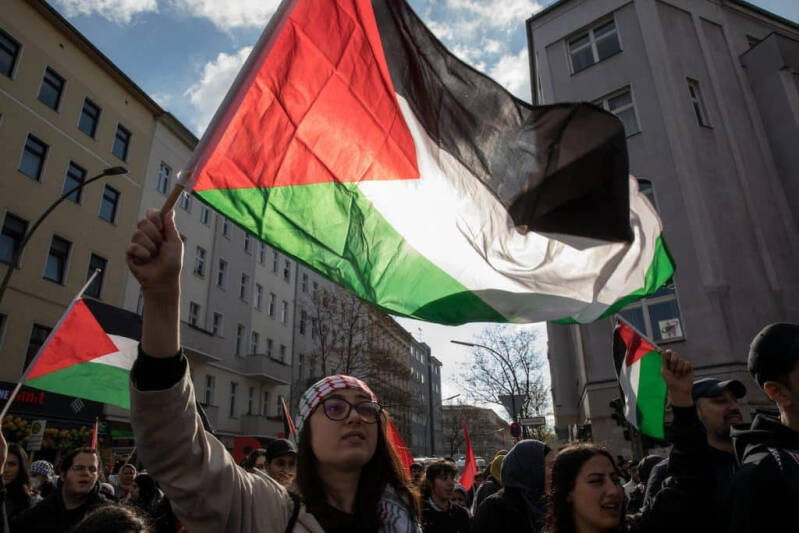
The global Palestine solidarity movement is at a crossroads as traditional forms of advocacy have become too easy for governments to ignore. Moving forward, the movement must shift from reactive protests to building lasting political power.
Germany is offering asylum to donkeys from Gaza. Gaza’s children? Not allowed.
Leon Wystrychowski
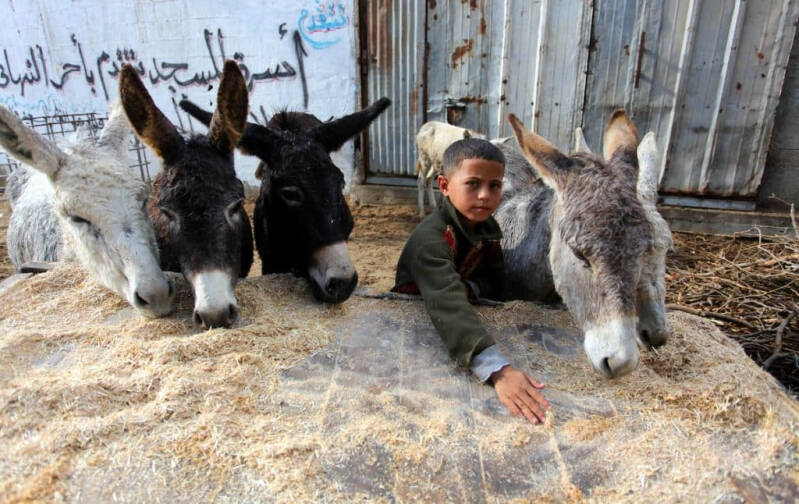
Germany is now taking in animals from Gaza while refusing entry to injured and sick Palestinians. The message is clear: in Germany’s hierarchy of “valuable” life, Palestinians are valued less than
1992.

23 november 2025
Gaza Humanitarian Response
Situation Report No. 28
22 November 2025
(As of 18:00 on 21 November 2025, unless otherwise noted)
HIGHLIGHTS
- On 22 November, all UN missions aimed at collecting aid cargo from the Kerem Shalom crossing were denied.
- As of 20 November, Food Security Sector partners had supported more than 124,000 households (620,000 people) with general food parcel distribution as part of the November monthly assistance cycle.
- On 20 November, the Education Cluster distributed two high-performance tents of 72 square metres each to expand capacity at two learning spaces in Khan Younis.
SITUATION OVERVIEW
On 20 November, Israeli military advances east of Gaza city reportedly displaced approximately 400 families from the Ash-Sha'af, At-Tuffah, Ash-Sharqi, and Al-Jadeeda neighbourhoods. Most of the displaced have moved towards central Gaza city, with some seeking refuge in nearby shelters while others have found temporary accommodation with relatives within the city.
UNITED NATIONS-COORDINATED AID ENTRY*
On 22 November, all three UN missions aimed at collecting tents, food, and other aid supplies from Kerem Shalom, as well as the deployment of UN2720 international monitors to the crossing to verify the uplifting, were denied by the Israeli forces, citing operational considerations.
The evening before, UN return missions from Kerem Shalom back to Deir al Balah were also severely delayed due to Israeli military activities in Rafah.
In the north, while the collection of food aid supplies from the Zikim crossing and the deployment of UN2720 monitors to the platform were both facilitated on 21 November, an attempt by the UN and partners to reach the non-functional Kamal Adwan Hospital in North Gaza governorate to plan the resumption of primary healthcare services was outrightly denied.
HUMANITARIAN RESPONSE
Food Security
- As of 20 November, Food Security Sector partners have supported more than 124,000 households (620,000 people) via 54 distribution points with general food parcel distribution as part of the November monthly assistance cycle. Since 16 November, the ration size has been expanded, with each family receiving two food parcels and one 25-kilogramme bag of flour.
Education
- On 20 November, the Education Cluster distributed two high-performance tents of 72 square metres each to two learning spaces in Khan Younis to expand capacity and accommodate the growing student population. This intervention responds to the high number of school-aged children on waiting lists due to severe shortages of learning spaces. Additional alternative learning spaces remain urgently needed, particularly given the continued restrictions on the large-scale entry of tents.
- Currently, enrolled students can attend classes for three hours a day, three days per week. While limited, this provides consistent access to learning, fortified snacks, and other essential services. However, the majority of pre-school and school-aged children remain unenrolled due to insufficient space and the lack of learning materials.
- Progress is being made on recycling wooden pallets into furniture. One cluster member has completed furnishing a Temporary Learning Space in Khan Younis using steel-frame tables with wooden tops. Despite this progress, needs remain high, and additional pallets are required to scale up production.
Fuel
- Between 11 and 20 November, UNOPS collected over 1,782,000 litres of diesel from Kerem Shalom, with no fuel received on 14, 15 and 16 November. During the same time period, UNOPS distributed 1,681,623 litres of diesel - 1,205,614 litres in the south and 476,009 litres in the north - to support critical health, food, WASH, education, nutrition, protection, site management, emergency telecommunication, logistics, and rubble removal efforts.
1991.

22 november 2025
The UN, Trump’s Gaza plan, and the media battle lines
Mondoweiss is one of the founding members of the Movement Media Alliance, along with other independent outlets such as Truthout, Prism, and many others. It is a coalition of grassroots-aligned, social justice-driven journalism organizations committed to accurate, transparent, accountable, principled, and just media, and to working collaboratively to amplify our impact.
MMA organizers Lara Witt and Maya Schenwar wrote an article this week that I think clearly situates our role in the current media landscape. The right has treated the media as core infrastructure for its project, and it has been investing accordingly for decades. Far-right billionaires have been buying up legacy outlets, building whole networks of propaganda platforms, and reshaping mainstream newsrooms in line with Christian white nationalist and authoritarian politics. The result is not just bad coverage. It is a media ecosystem that actively normalizes fascist ideas, erases Palestinian life, and trains people to distrust any source that challenges U.S. and Israeli power.
Mondoweiss, like the other members of the Movement Media Alliance, exists to push back. We are part of an independent media ecosystem that views journalism as a tool for liberation, not a commodity for billionaires. When we publish reports from Gaza’s ruins or cover the crackdowns on Palestine solidarity in the United States, we are doing more than filling a “gap” in mainstream coverage. We are documenting genocide, tracking how power actually operates, and amplifying the organizers and movements who are building something different. Our work sits alongside outlets like Truthout, Prism, and others that are naming fascism clearly and refusing to pretend that “both sides” are equal when one side is carrying out mass murder.
Witt and Schenwar put it plainly, “Reporting takes money. Editing takes money. Distribution and amplification of truthful journalism take money.” Every article you read at Mondoweiss depends on a chain of labor and care. Journalists risking their lives in Gaza, editors shaping stories, fact-checking, translating, and the infrastructure that keeps our site online and our newsletters going out. We are not backed by corporations or oligarchs. We are funded by people, our readers, who believe that telling the truth about Palestine, about U.S. empire, and about rising fascism is part of how we fight back.
We are about to enter the final month of the year, and we’ll be launching our critical end-of-year fundraising drive. This year, we need our readers to step up and support us, as this work is only becoming more challenging. If you donate before December 3, you will get an invitation to our Frontline Briefing with Phil Weiss and Michael Arria, where they will discuss the political implications of the recent election of Zohran Mamdani in New York City, and other political figures who are questioning the role of Israel in U.S. politics like never before.
In our coverage his week, Craig Mokhiber explains how the UN Security Council’s endorsement of Trump’s plan for Gaza turns “peacekeeping” into a U.S. colonial administration that punishes Palestinians and rewards the governments responsible for genocide.
Tareq Hajjaj shows what that looks like on the ground, reporting that Israel killed 33 Palestinians in a single night, including 12 children, many of them families trying to return home. Hajjaj also reports that people in Gaza see the proposed “International Stabilization Force” as nothing more than a new occupation.
Jonathan Ofir examines testimonies from Palestinian rape survivors that reveal how sexual violence functions as a deliberate weapon of genocide.
Qassam Muaddi and Michael Arria unpack how the same Security Council vote handed Washington and Tel Aviv a mandate over Gaza’s future with no input from Palestinians.
Michael Arria’s interview with American Conservative editor Andrew Day digs into the growing battle over Israel on the U.S. right, the grip of neoconservatives on the Trump administration, and whether a “post-Israel” Republican Party is possible. Michael also spoke to Peter Feld about Zohran Mamdani’s victory in New York and its potential impact on national politics.
In a separate conversation about the new book No Neutrals There: U.S. Labor, Zionism, and the Struggle for Palestine, Michael explores how U.S. labor unions helped build and sustain the Israeli state, and how today’s rank and file are challenging that legacy in solidarity with Palestinians.
David Reed, Publisher
Must read: The UN Embraces Colonialism: Unpacking the Security Council’s mandate for the U.S. colonial administration of Gaza
Craig Mokhiber: The Security Council’s backing of the Trump plan for Gaza ignores international law, punishes the Palestinians, and rewards those responsible for genocide.

Security Council adopts resolution 2803 during the UN Security Council meeting on November 17, 2025, approving U.S. President Donald Trump’s “peace plan” for Gaza. (Photo: UN Photo/Loey Felipe)
Genocide in Gaza
Tareq Hajjaj: On Wednesday, Israel killed 33 Palestinians, including 12 children, in its latest violations of the Gaza ceasefire. Those killed include Palestinian families trying to return home and others caught in Israeli attempts to assassinate Hamas leaders.
Qassam Muaddi and Michael Arria: The UN Security Council voted in favor of Trump’s “peace plan” for Gaza, effectively giving the U.S. and Israel the mandate to push forward their vision for Gaza’s future – a future that, notably, features no consideration for what Palestinians want.
Tareq Hajjaj: On Monday, the UN Security Council voted to endorse the Trump administration’s “International Stabilization Force” in Gaza. Palestinians in Gaza say it is just a new face of the same Israeli occupation.
Jonathan Ofir: Recent testimonies from the Palestinian Center for Human Rights share shocking stories of Palestinian rape victims released from Israeli detention. The stories are horrifying to read but essential for understanding Zionism and Israeli apartheid.
Catch-up
Michael Arria: Mondoweiss interviews Andrew Day, senior editor at American Conservative, about the fierce debate over Israel (and Epstein) happening on the right, neoconservatism’s role within the Trump administration, and what a “post-Israel” GOP might look like.
Michael Arria: Political consultant Peter Feld discusses how Zohran Mamdani’s historic win will impact beyond New York and how the Israel lobby will respond.
Michael Arria: The author of the new book, “No Neutrals There: U.S. Labor, Zionism, and the Struggle for Palestine,” discusses how U.S. labor unions have played a key role in building and maintaining the state of Israel.
1990.

22 november 2025
Today's headlines
Israeli airstrike on Palestinian refugee camp in Lebanon kills 13 young boys,
Layla Yammine

An Israeli airstrike on the Palestinian refugee camp of Ain al-Hilweh in Lebanon killed 13 people amid escalating Israeli bombardment across Lebanon, threatening the ceasefire with Hezbollah - which Israel has already broken dozens of times.
How Zohran Mamdani’s mayoral win in NYC could impact national politics
Michael Arria

Mondoweiss interviews political consultant Peter Feld about how Zohran Mamdani’s historic win will impact beyond New York and how the Israel lobby will respond.
1989.

21 november 2025
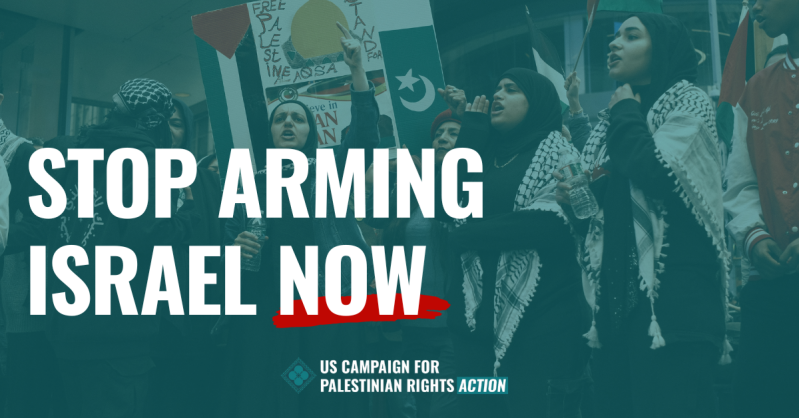
Between Black Friday sales and holiday shopping, there's a brutal truth: the U.S. has sent over $30 billion to fund Israel's genocide in Gaza, while cutting food assistance and terrorizing immigrant communities.
Our boycott campaigns are gaining momentum—from Chevron to Hollywood—proving that consumer power can challenge corporate complicity in genocide. This holiday season, BDS is our most effective strategy.
Read the latest updates below.
Your Activist Scoop
OUR GOVERNMENT'S GUILT
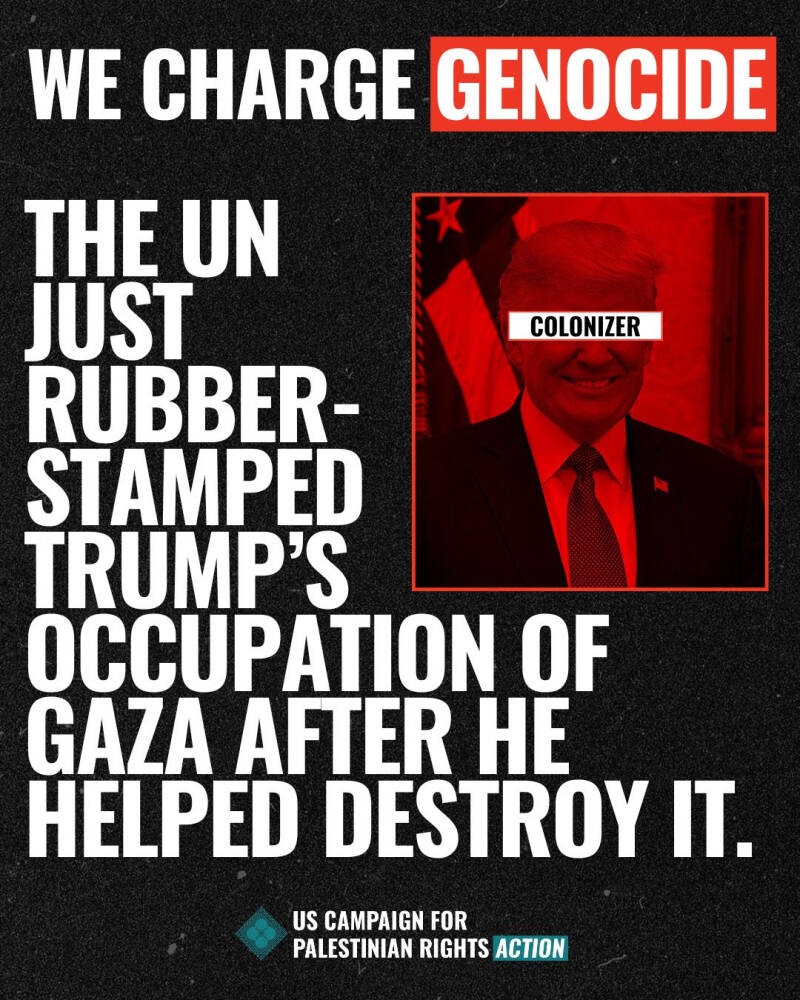
- The UN Security Council voted 13-0 to endorse Donald Trump's colonial plan for Gaza—a proposal that amounts to a land grab disguised as diplomacy, stripping Palestinians of their right to self-determination.1
- ICE has continued conducting military-style raids in major U.S. cities, targeting undocumented immigrants using tactics that mirror the Israeli military's occupation of Palestine—turning neighborhoods into zones of fear and systematic intimidation.2
- Israel's relentless bombing campaigns have caused catastrophic flooding in Gaza, destroying what little infrastructure remains and further weaponizing environmental conditions against Palestinian survival.3
- With impunity, Israel has broken the ceasefire nearly 400 times and of the agreed upon daily 600 humanitarian aid trucks from entering Gaza.
READ MORE ABOUT TRUMP'S COLONIAL PLAN
YOUR IMPACT
- Zohran Mamdani won a historic victory in his NYC campaign, proving the transformative power of grassroots organizing, progressive political mobilization, and affordable living policies to fund care not killing.
- 58 House representatives now support the Block the Bombs Act (H.R. 3565), signaling growing congressional resistance to unconditional military funding to Israel.
- Boycott Chevron actions have spread across the country, with about 20 locations planned for the November 22 Global Day of Action tomorrow, building momentum for corporate accountability. Our sibling organization USCPR has been active in the Boycott Chevron campaign.
JOIN THE BOYCOTT CHEVRON DAY OF ACTION TOMORROW
WHAT YOU CAN DO NEXT

- Attend our next Mass Movement Call, “AIPAC Out of US Politics,” on Tuesday, November 25 to understand and challenge anti-Palestinian lobbying.
- Join the People’s Embargo for Palestine Webinar tomorrow, November 22 to learn critical strategies for advancing arms and energy embargoes.
- Send a letter in support of H.Res.876, a new resolution that calls for prosecuting those committing genocide against Palestinians and ending U.S. weapons to Israel.
- In select theaters from November 28 to 30, check out a special sneak preview of "Palestine 36" from Watermelon Pictures—the first film to tell the powerful story of the 1936 anti-colonial revolt. For organizations interested in holding a screening outside of a traditional theater, you can request a screening.
- Subscribe to Watermelon+: a streaming platform amplifying bold voices from marginalized and underrepresented communities, including an expansive collection of Palestinian cinema.
- Check the BDS Movement's Comprehensive Boycott Guide to ensure your holiday shopping supports Palestinian liberation and challenges corporate complicity in genocide.
JOIN THE "AIPAC OUT OF US POLITICS" CALL
Thank you for taking action with us.
Onward to liberation,
AHMAD ABUZNAID
Executive Director
USCPR Action
1988.

21 november 2025
Gaza Humanitarian Response
Situation Report No. 27
21 November 2025
(As of 18:00 on 20 November 2025, unless otherwise noted)
HIGHLIGHTS
- Health partners continue to deliver life-saving health services across 220 Health Service Points out of a total of 590 in the Gaza Strip, with 217 partially functional and three fully functional.
- On 18 and 19 November, shelter partners distributed more than 23,500 tarpaulins, 5,100 tents, 68,300 bedding items, and 1,000 kitchen sets, reaching approximately 27,000 affected households.
SITUATION OVERVIEW
The Site Management Cluster (SMC) currently has records of 925 active displacement sites across the Gaza Strip, with a total recorded population of just under 1.5 million people. Of these sites, 767 are makeshift sites hosting over 1.1 million people and 158 are partner-managed collective centres with a population of about 350,000. Through recent mapping, SMC has identified 214 active makeshift sites that are at particularly high risk of flooding over the winter period due to their locations and site typology.
UNITED NATIONS-COORDINATED AID ENTRY*
On 20 November, 4,853 pallets of aid administered by the UN and its partners were offloaded at Gaza’s crossings, based on data retrieved from the UN 2720 Mechanism dashboard at 11:00 on 21 November. About 63 per cent of these pallets contained food supplies, followed by shelter (24 per cent), water, hygiene and sanitation items (10 per cent), and nutrition supplies (3 per cent). At least 123 truckloads were offloaded in Kerem Shalom and 69 truckloads in Zikim.
On the same day, between 07:25 and 14:13 hours, UN2720 international monitors present at the Palestinian side of the Kerem Shalom and Kissufim crossings verified the collection of at least 2,029 pallets of UN and partner aid. These comprised 1,010 pallets of food supplies, 423 pallets of blankets, 100 pallets of hygiene items and 84 of diapers, 83 pallets of kitchen kits, 37 of tents, 32 of wood pellets, 31 of medical items, 8 of water tanks, and one pallet with fan heaters. According to preliminary data, 220,00 litres of fuel were also collected from Kerem Shalom.
Overall, between 10 October when the ceasefire entered into effect and 20 November, based on preliminary, partial data, 100,627 pallets of aid cargo were offloaded at Gaza’s crossings under the UN 2720 Mechanism, and 87,500 were collected into Gaza for onward distribution to people in need. All the above data excludes bilateral donations and the commercial sector.
As of 21 November, the Kerem Shalom, Zikim, and Kissufim crossings remained operational, with humanitarian cargo offloading and uplifting alternating days between Zikim and Kissufim.
HUMANITARIAN RESPONSE
Health
- Health partners continue to deliver life-saving health services across 220 HSPs out of a total of 590 in the Gaza Strip, with 217 partially functioning and three fully functioning. These include 18 out of 36 hospitals, 10 out of 16 field hospitals, 82 out of 194 primary healthcare centers, and 110 out of 344 medical points.
- The catch-up child immunization campaign continues to make progress. In nine days, more than 11,100 children under the age of three were vaccinated. Out of the total, 1.5 per cent received a dose for the first time, 25 per cent received a late dose, while the rest received an on-schedule dose.
Water, Sanitations and Hygiene (WASH)
- An electricity disruption to the Southern Gaza Desalination Plant (SGDP) resulted in a one-third reduction in the plant's water production.
- The connection of 19 shelters to the UAE water line in southern Gaza is nearly completed; it will reach more than 5,800 families through 121 tap stands.
- As part of ongoing WASH winterization and repair efforts, cluster partners completed the repair of two 110mm sewage pipes in Gaza city, desludged sewage lines in West Jabalya, in North Gaza governorate, and maintenance of sewage pump stations in Khan Younis.
- Ninety-five per cent of the works on the Sheikh Radwan stormwater lagoon outlet are now completed; the pumping is running at half capacity with water levels dropping.
Protection
- On 19 November, Protection partners delivered 17 Psychological First Aid (PFA) sessions, provided family support to five households, conducted 50 legal awareness sessions, and offered an estimated 75 legal consultations. These efforts reached approximately 147 people in northern Gaza.
- On the same day, in southern Gaza, activities included family-based sessions for 16 households, two case follow-ups, seven remote consultations, and counseling sessions and group consultations for 198 people. Additionally, relief items were distributed to 256 people, bringing the total reach in southern Gaza to approximately 456 people.
- Child Protection
- Between 19 and 20 November, more than 1,400 children and 620 caregivers across Khan Younis, Deir Al Balah and Gaza city received Mental Health and Psychosocial Support (MHPSS) through fixed and mobile teams.
- Over the past week, an average of 950 children joined daily activities including PFA, individual and group counselling, recreational sessions, and emotional support. Caregiver engagement increased, with around 300 caregivers per day attending parenting support and stress-management sessions aimed at strengthening family coping and improving children’s well-being.
- Case workers identified and supported around 45 to 50 at-risk children each day across the Strip, including unaccompanied and separated children, children without parental care, children with disabilities, and children requiring urgent follow-up. They carried out assessments, safety planning, and referrals for specialized services including health, MHPSS, legal assistance, and emergency family tracing and reunification.
- Winterization support continued across multiple locations, with more than 2,200 distributions reaching families ahead of colder weather. This included 312 winter clothing kits across two camps in Khan Younis, 1,368 clothing packages for children aged three to nine in Gaza city and Deir al Balah, and winterization kits for 538 families in Barbara Camp in Khan Younis, with additional distributions planned in Al Shati Camp, Jabalya.
- Heavy rainfall affected several partners’ child-friendly spaces. In response, the cluster is equipping child protection service providers with 30 new high-performance tents to ensure safer spaces and expand access for children to MHPSS services.

Shelter
- Shelter Cluster partners continue to support people affected by the recent rainstorm by assessing multiple sites and locations affected by flooding.
- On 18 and 19 November, shelter partners distributed more than 23,500 tarpaulins, 5,100 tents, 68,300 bedding items, and 1,000 kitchen sets, reaching approximately 27,000 affected households.
1987.

21 november 2025
Ambassador Huckabee has betrayed his duty to protect Americans; he must be removed from his position immediately
Ambassador Mike Huckabee’s recent secret meeting with convicted traitor and Israeli spy Jonathan Pollard is a profound betrayal of the United States and the office he is supposed to hold. Pollard is a former U.S. intelligence analyst who sold American secrets to a foreign government, spying against his own country for cash and gifts. By embracing this spy within the walls of the U.S. Embassy in Jerusalem, and without any transparency with the American people, Huckabee has disgraced his post and insulted every American.

For context: in 1987, Pollard was sentenced to life in prison for violations of the Espionage Act. Successive U.S. officials from both political parties, as well as leaders within the defense and intelligence communities, consistently opposed any form of clemency. They maintained that the damage Pollard inflicted on U.S. national security through his espionage was far more severe, wide-ranging, and enduring than publicly acknowledged. Pollard was released from prison on November 20, 2015, in accordance with federal sentencing guidelines. Five years later, on November 20, 2020, his parole expired, lifting all remaining restrictions. Shortly after, on December 30, 2020, Pollard and his second wife relocated to Israel, settling in Jerusalem.
Since moving to Israel, Pollard has publicly aligned himself with far-right political figures, including Minister Itamar Ben-Gvir. He has also advocated for extreme measures, such as the forced population transfer of Palestinians from Gaza to Ireland.
Huckabee’s meeting with traitor Pollard presents a grave question: whom does Mike Huckabee represent? Is he the U.S. Ambassador to Israel, or is he a representative of Israeli interests embedded deep within the American establishment? His actions consistently suggest the latter.
He has actively lobbied a U.S. President to enter a foreign war, recklessly endangering American lives and regional stability within the Middle East for the benefit of another nation, which is Israel. In a breach of diplomatic protocol, he wrote a message to President Trump in June framing an attack on Iran as an act of "divine providence," openly urging a conflict that would serve Israeli, not American, interests. Furthermore, he is a vocal proponent of Israel's illegal annexation of the West Bank, deliberately using the term "Judea and Samaria" to signal his endorsement of an expansionist agenda that directly undermines official U.S. policy and international law.
Meanwhile, Huckabee has neglected his most fundamental duty: to protect American citizens. While he fraternizes with a traitor, American citizens like Mohammad Ibrahim (16 years old) have been left to deteriorate in Israeli prisons for nearly ten months without due process. This was followed by Israeli soldiers shooting and killing a 14-year-old Palestinian-American teenager, Amer Rabee, in the West Bank town of Turmus Ayya in April. No justice has been granted to Amer’s family. Huckabee also offered no meaningful justice or accountability for Mohammed's cousin, Sayfollah Musallet, also an American citizen, who was murdered by Israeli settlers this past July. Justice has been denied in both cases, and Mohammad remains imprisoned despite reports of his declining health and the documented abuses within the Israeli detention system. These victims represent a brutal pattern of American citizens being killed and detained by a foreign entity with zero accountability. An ambassador's primary duty is to be their shield; Huckabee has instead been an accomplice to their suffering.
There is something profoundly corrupt about an administration that consistently aligns itself with, enables, and protects criminals, from convicted traitors like Pollard to the Israeli state and settler forces who kill and imprison Americans with impunity. Mike Huckabee has demonstrated that he is unfit to serve as a representative of the United States. His conduct is an insult to our nation's security and its citizens. He must be removed from his position immediately and expelled from his post.
A valid "America First" policy means putting American interests and American citizens first. It cannot be a hollow slogan used to mask an "Israel First" agenda that excuses the embrace of traitors and abandons our own people to injustice. Huckabee’s actions are not just an embarrassment; they are a subversion of American sovereignty, and they must end now.
In solidarity,
Americans for Justice in Palestine Action
1986.

21 november 2025
The Rights Forum publiceerde deze week een overzicht van 92 bedrijven en instellingen die direct of indirect bijdragen aan de illegale Israëlische bezetting en kolonisering van bezet Palestijns gebied – en daar zelf van profiteren. Het gaat om zowel Nederlandse bedrijven als internationale bedrijven die ook actief zijn in Nederland.
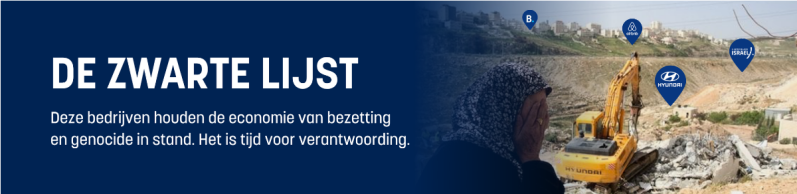
Falende overheid
Wij maakten het overzicht naar aanleiding van de grote vraag van Nederlandse burgers om meer inzicht te krijgen in welke bedrijven bij de bezetting betrokken zijn. Die vraag komt voort uit het besef dat van politiek Den Haag niets te verwachten valt. De illegale bezetting en kolonisering worden al decennia gedoogd, en bedrijven wordt niets in de weg gelegd om ervan te profiteren.
Economie van genocide
Deze politiek van gedogen, participeren en profiteren heeft nu zelfs kunnen leiden tot medeplichtigheid aan Israëls genocide. Niet alleen in Gaza, maar in heel bezet Palestina, inclusief Oost-Jeruzalem en de Westelijke Jordaanoever. Overal is het voortbestaan van de Palestijnen als groep in acuut gevaar.
Laat je horen
Daarom is het nú tijd voor actie, voor het letterlijk te laat is. Bedrijven en instellingen, waaronder pensioenfondsen en universiteiten, is keer op keer uitgelegd welke misdaden zij faciliteren. Nu daar genocide bij is gekomen, is de tijd van ‘onderzoek’ of andere excuses voorbij. De eis is dat zij hun activiteiten direct en zichtbaar beëindigen. Veel van de 92 profielen in ons overzicht bieden de mogelijkheid hen dat per e-mail te laten weten.
Bekijk de lijst en kom in actie!
Veiligheidsraad akkoord met Amerikaans bezettingsplan voor Gaza
De VN-Veiligheidsraad heeft deze week een angstaanjagende resolutie aangenomen over de toekomst van Gaza. De resolutie, gepresenteerd als een vredesplan voor Gaza, gaat lijnrecht in tegen het zelfbeschikkingsrecht van de Palestijnen. Ook lijkt het plan ervoor te zorgen dat de Israëlische premier Benjamin Netanyahu, zijn kabinetsleden en de Israëlische militaire leiding straffeloos weg kunnen komen met genocide.
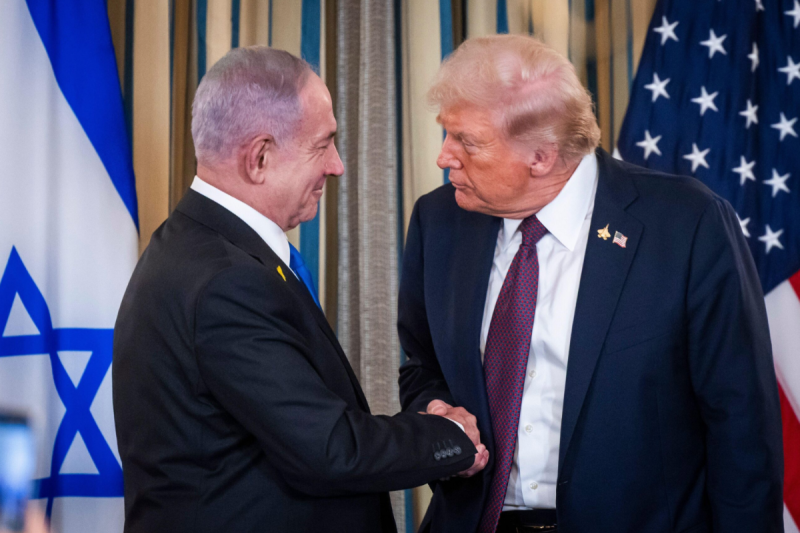
Benjamin Netanyahu en Donald Trump presenteerden hun slikken-of-stikkenplan voor Gaza op 29 september in het Witte Huis. © MediaPunch Inc/Alamy
Als onderdeel van de resolutie komt de Gazastrook onder direct gezag van de Amerikaanse president Donald Trump. Hij wordt voorzitter van wat de resolutie een ‘raad van vrede’ noemt. Deze raad gaat Gaza besturen en toezicht houden op alles – van humanitaire hulp en wederopbouw tot het opzetten van een internationale troepenmacht en de ontwapening van Palestijnen.
Kortom, Gaza wordt een Amerikaans protectoraat, dat doet denken aan de protectoraten waarmee de Britten en Fransen na de Eerste Wereldoorlog het Midden-Oosten onder elkaar verdeelden.
‘De Veiligheidsraad zet met deze stap een stempel van goedkeuring op de facto kolonisatie en het begraven van een genocide’, schrijft Berber van der Woude, bestuursvoorzitter van The Rights Forum, op LinkedIn.

No Other Land te zien op NPO Doc
De Oscar-winnende documentaire No Other Land is een maand lang gratis te zien op NPO Doc. De documentaire werd gemaakt door een Palestijns-Israëlisch collectief van vier jonge activisten, en wordt gezien als een daad van creatief verzet tegen apartheid en een zoektocht naar een weg naar gelijkheid en rechtvaardigheid.
Human Rights Watch: ‘Ontruiming kampen op Westelijke Jordaanoever is etnische zuivering’
Israël heeft zich schuldig gemaakt aan misdaden tegen de menselijkheid door het ontruimen van drie vluchtelingenkampen op de Westelijke Jordaanoever. Dat schrijft mensenrechtenorganisatie Human Rights Watch (HRW) in een deze week gepubliceerd rapport. De ontruimingen van de kampen in Jenin, Tulkarem en Nur Shams, in januari en februari dit jaar, komen neer op etnische zuivering, schrijft HRW.

De ravage achtergelaten door het Israëlische leger in het vluchtelingenkamp Tulkarem. © Sipa USA / Alamy
In totaal zijn 32.000 mensen van de ene op de andere dag uit hun huizen verdreven. Volgens HRW is dit de grootste ontheemding van Palestijnen op de Westelijke Jordaanoever in één operatie sinds de oorlog van 1967; het is sinds die oorlog dat de Westelijke Jordaanoever bezet is door Israël.

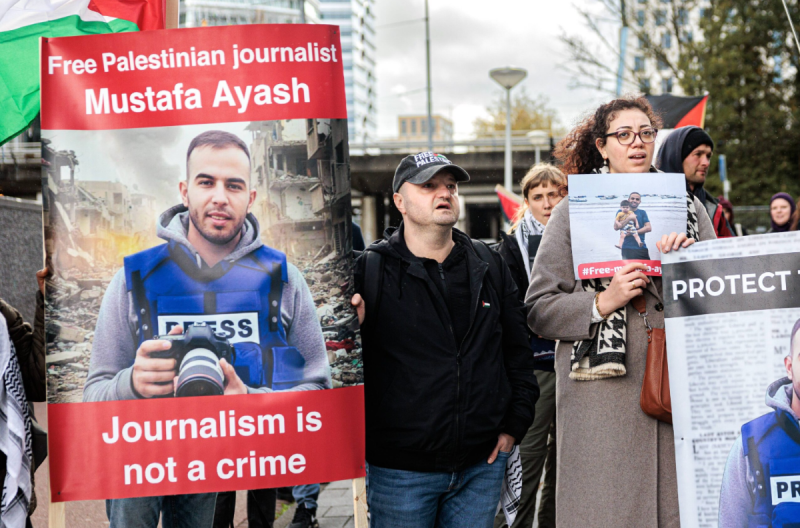
Voorlopig geen Nederlandse F-35-onderdelen naar Israël, beslist kabinet
De Hoge Raad dwong het kabinet te beoordelen of de levering van F-35-onderdelen aan Israël in lijn is met internationaal recht. Het antwoord is negatief, maakte het kabinet vorige week vrijdag bekend. Maar voor hoe lang?
Palestijnse journalist Mustafa Ayyash overgeleverd aan Oostenrijk
Ayyash wordt zonder bewijs beschuldigd van banden met Hamas: een beproefde Israëlische tactiek om Palestijnse stemmen het zwijgen op te leggen. De vrees bestaat dat hem in Oostenrijk geen eerlijke behandeling wacht of dat hij aan Israël wordt uitgeleverd.
Uit onze agenda
zaterdag 22 november t/m zaterdag 29 november
DEMONSTRATIES EN WAKES
GRONINGEN ZA 22 NOV 13.00 | Tweewekelijkse wake van Vrouwen in het Zwart (Waagplein)
HUIZEN WO 26 NOV 11.30 | Wekelijkse sit-in voor Gaza (Gemeentehuis)
DEN HAAG DO 27 NOV 12.00 | Sit-in van Rijksambtenaren bij het ministerie van Buitenlandse Zaken, Rijnstraat 8
STATIONS IN NEDERLAND DO 27 NOV 18.00 | Wekelijkse lawaaidemonstratie op stations in heel Nederland: Amersfoort, Amsterdam CS, Arnhem, Bergen op Zoom, Breda, Dieren, Doetinchem, Driebergen-Zeist, Ede/Wageningen, Enschede, Groningen, Heerlen, Hengelo, Hilversum, Leiden, Maastricht, Nijmegen, Purmerend, Regensburg DE, Sassenheim (17.00 uur), Sittard, Tiel, Tilburg, Utrecht, Veenendaal, Zaandam (17.30 uur), Zutphen.
Let op: The Rights Forum probeert de verschillende acties in Nederland zo goed mogelijk bij te houden, maar dat is niet altijd goed mogelijk. Houd de sociale media-pagina's van de plaatselijke solidariteitsorganisaties in de gaten voor de meest actuele informatie.
NIJMEGEN ZA 29 NOV 14.00 | Maandelijkse wake van Mrouwen in het Zwart (Koningsplein - Marienburg)
CULTURELE EN ANDERE EVENEMENTEN
AMSTERDAM ZA 22 NOV 14.00 | Samen voor Gaza: een middag over rouw en verzet (Ru Paré)
LEEUWARDEN ZA 22 NOV | Nomadisch monument voor Gaza (Stadsschouwburg de Harmonie)
UTRECHT MA 24 NOV 19.00 | Palestine Book Club (Boekwinkel Savannah Bay, Telingstraat 13)
AMSTERDAM DI 25 NOV 20.00 | Boekpresentatie: Angstaanjagend normaal – over daders en omstanders bij de genocide in Gaza (Pakhuis de Zwijger)
DELFT WO 26 NOV | Presentatie tentoonstelling Endless Grief (Theater de Veste)
AMSTERDAM VR 28 NOV 16.30 | Introduction Palestinian literature (Boekwinkel Het Fort van Sjakoo, Jodenbreestraat 24)
DEN HAAG ZA 29 NOV 19.00 | Opening fototentoonstelling ‘No Right To Life’ (Amare, Spuiplein 150)
Onze agenda wordt doorlopend aangevuld. Bekijk de hele agenda
1985.

21 november 2025
Reebok sponsors apartheid and genocide. Reebok is the Worst. Gift. Ever.
Reebok sponsors the Israel Football Association (IFA), which includes in its official leagues teams based in illegal Israeli settlements on occupied Palestinian land.
The IFA has also created a new “Reservist League” of 32 teams and hundreds of soldier players who have served in Israel’s Gaza genocide, which has killed more than 800 Palestinian sportspeople.
The IFA has dedicated matches to Israeli soldiers committing genocide in Gaza.
IFA clubs have sent care packages to those same soldiers and used videos of soldiers as “motivation” before matches.
What’s worse? Reebok knows it is on the wrong side of history. In late September, Reebok actually called for its logo to be removed from the IFA. Reebok immediately caved to pressure from Israel, backtracking on its decision and saying it continues to “proudly” sponsor the IFA despite its well-documented complicity in Israel’s apartheid and genocide.
Don’t put Israeli apartheid and genocide in your shopping cart!
Ahead of Black Friday and Cyber Monday, groups around the world are mobilizing tomorrow, Saturday, November 22, for the Global Boycott Reebok Day of Action.
Join them!
-
Join the global social media storm on November 22 at 8pm your local time.
-
Jam Reebok’s inbox. Send a message to Reebok HQ.
-
Print flyers to hand out at Reebok shops and resellers. Download Boycott Reebok signs.
-
Print out pocket drops and put them inside Reebok clothing and shoes. Take a photo and send it to us: pacbi.coord@bdsmovement.net
-
File a complaint with Reebok Customer Service.
-
Contact Reebok’s parent company Authentic Brands.
-
Already own Reebok gear? Rebrand it! Write “Boycott” over the logo and send us a photo: pacbi.coord@bdsmovement.net
Take action now. BDS campaigns forced PUMA to end its sponsorship of the IFA and US running shoe brand Saucony to withdraw as sponsor of Israel’s so-called Jerusalem marathon.
We can do this again. Boycott Reebok!
1984.

21 november 2025
Today's headlines
Israel kills 33 Gazans in a single night. It’s part of a new deadly status quo, Palestinians say.
Tareq S. Hajjaj
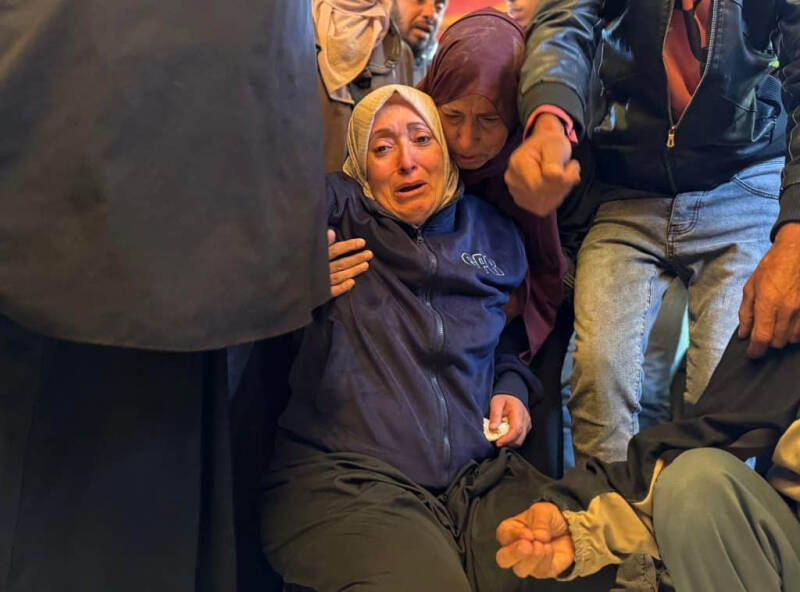
On Wednesday, Israel killed 33 Palestinians, including 12 children, in its latest violations of the Gaza ceasefire. Those killed include Palestinian families trying to return home and others caught in Israeli attempts to assassinate Hamas leaders.
The ongoing battle over Israel within the U.S. labor movement
Michael Arria

The author of the new book, "No Neutrals There: U.S. Labor, Zionism, and the Struggle for Palestine," discusses how U.S. labor unions have played a key role in building and maintaining the state of Israel.
1984.

21 november 2025
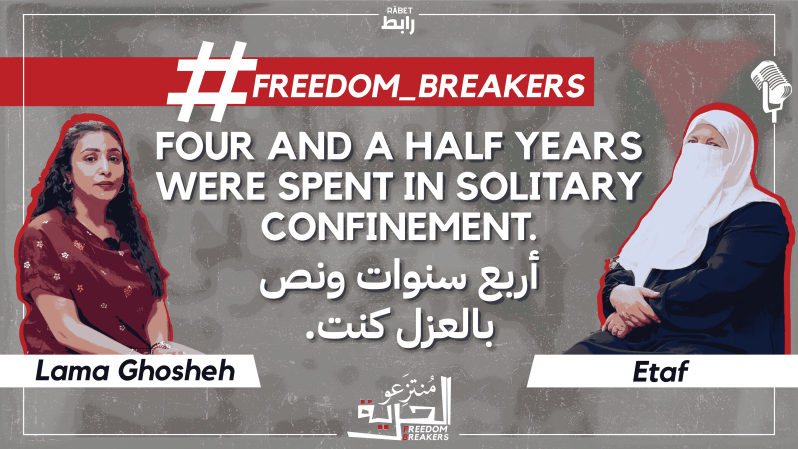
A powerful new episode of Freedom Breakers, is now live. Lama Ghosheh meets Etaf Alayan, a woman whose story embodies unwavering Sumoud (steadfastness) and deep community spirit. Etaf was first imprisoned in 1987 and spent more than 15 years in Israeli colonial jails.
Etaf’s journey reveals what it truly means to place collective care and struggle above individual interest. In this episode, she retraces key moments of her life as a political prisoner and the battles she waged from within the cell to challenge the Zionist colonial rule.
“It wasn't Oslo that freed us, it was the resilience of the women”.
This is a story of resistance, sacrifice, patience and sisterhood.
1983.

20 november 2025
Humanitarian Situation Update #342
Gaza Strip
20 November 2025

Najat stands outside of her tent in Gaza city, which was flooded after a sewage system nearby overflooded due to heavy rain. Photo by WFP/Maxime Le Lijour
Key Highlights
- As heavy rains flooded thousands of tents and makeshift shelters, the UN and its partners are supporting joint winterization, flood-mitigation and hygiene-enhancement efforts and calling for the entry of more humanitarian assistance.
- Access to markets and food consumption continued to show modest improvements in the first 10 days of November, but dietary diversity remains low and 25 per cent of households reported eating only one meal daily, according to the World Food Programme.
- While efforts are ongoing since 3 November to gain access to and repair the damaged main fibre line near Erez crossing, further delays can lead to a complete communications blackout and disrupt humanitarian operations.
- With about 93 per cent of school buildings damaged, learning cannot resume at scale in Gaza without reconstruction or the ability to establish new learning spaces, the Education Cluster reports.
Context Overview
- Following the withdrawal of Israeli forces from parts of the Gaza Strip under the ceasefire agreement, Israeli military strikes near or east of the so-called “Yellow Line” continue to be reported, resulting in casualties. Access to the sea remains prohibited. In areas beyond the “Yellow Line,” where the Israeli military remains deployed (over 50 per cent of the Gaza Strip), daily detonations of residential buildings continue to be reported and access to humanitarian assets, public infrastructure and agricultural land remains restricted or altogether barred. On the evening of 19 November, the Israeli military reported that its troops came under fire in Khan Younis, in response to which it carried out multiple strikes across the Strip. According to the Ministry of Health (MoH) in Gaza, as of 20:00 on 19 November, 25 Palestinians were reportedly killed and over 77 others were injured due to the strikes. According to the Palestinian Civil Defence (PCD) spokesperson, casualties, mostly women and children, were reported in eastern Gaza city and Khan Younis.
- As recent rains and floodwaters destroyed what little shelter and belongings thousands of Palestinians in Gaza had left (see more information below), the UN Under-Secretary-General for Humanitarian Affairs and Emergency Relief Coordinator, Tom Fletcher, stressed that while the UN and partners are working to respond and reach those affected, much more is needed. He called for the immediate lifting of remaining restrictions to enable the entry of more humanitarian assistance into Gaza.
- The Site Management Cluster (SMC) reports that population movements have decreased over the past week, likely due to unfavourable weather conditions. More than 34,000 displacement movements were recorded between 10 and 17 November, compared with over 46,000 movements in the preceding week. Overall, between 10 October and 17 November, more than 730,000 movements of people were recorded by SMC partners, including more than 637,000 movements crossing from southern to northern Gaza, primarily through Al Rasheed Road. Over 113,000 movements were observed from western to eastern Khan Younis during the same period.
- On 13 November, according to official Israeli sources, the body of one hostage was returned from Gaza to Israeli authorities, bringing the overall number of returned bodies of Israeli and other hostages since the ceasefire to 25. On 15 November, according to the MoH in Gaza, the bodies of 15 Palestinians were returned to the Gaza Strip, bringing the total number of released bodies since the ceasefire to 330, of which only 97 were identified.
- According to the MoH in Gaza, between 12 and 14:30 on 19 November, eight Palestinians were killed, 41 were injured and 18 bodies were recovered from under the rubble. This brings the casualty toll among Palestinians since 7 October 2023, as reported by the MoH, to 69,513 fatalities and 170,745 injuries. According to the MoH, the total number includes 279 fatalities who were retroactively added between 7 and 14 November after their identification details were approved by a ministerial committee. MoH reported that since the ceasefire, 280 Palestinians were killed, 672 were injured and 571 bodies were retrieved from under the rubble.
- According to the Israeli military, between 12 and 19 November, as of noon, no Israeli soldiers were killed in Gaza. The casualty toll among Israeli soldiers since the beginning of the Israeli ground operation in October 2023 stands at 471 fatalities and 2,978 injuries. According to Israeli forces and official Israeli sources cited in the media, more than 1,671 Israelis and foreign nationals have been killed, the majority on 7 October 2023 and its immediate aftermath. As of noon on 19 November, it is estimated that the bodies of three deceased hostages remain in the Gaza Strip.
- According to a recent assessment by the Education Cluster, which relies on satellite imagery collected on 11 October, about 93 per cent of school buildings in the Gaza Strip (526 out of 564) were directly hit or damaged and are estimated to require either full reconstruction or major rehabilitation work to be functional again. These include 95 school buildings in North Gaza, 208 in Gaza, 70 in Deir al Balah, 125 in Khan Younis and 66 in Rafah governorates. North Gaza and Rafah governorates are the most affected, with 100 per cent of their school buildings either directly hit or damaged. About one-third of school buildings that were directly hit or damaged are operated by UNRWA. Eighty-seven per cent of damaged school buildings (459) were directly hit, including 267 that served as emergency shelters. This is an increase of 27 school buildings compared with the last assessment – which was based on satellite imagery collected on 8 July – and includes schools that were previously classified as damaged. Of the 27 newly hit schools, 18 are government-run schools, five are UNRWA schools and four are private schools. Of schools that served as shelters for internally displaced people (IDPs), 77 per cent (267 out of 459) were directly hit. According to the Education Cluster, without reconstruction or the ability to establish new learning spaces, learning cannot resume at scale in Gaza.

Humanitarian Access
- Coordination with Israeli authorities continues to be required for humanitarian convoy movements in Gaza, to crossings as well as in or near other areas where the Israeli military remains deployed. Between 12 and 18 November, humanitarian organizations coordinated 51 missions with the Israeli authorities, of which 27 were facilitated, five were cancelled, 15 were impeded and four were denied. Movements included, among others, 28 movements to collect cargo from the three operational crossings (Kerem Shalom, Zikim, and Kissufim), one search-and-rescue mission, two road repair, assessment and clearance missions, and four movements related to the crossing of humanitarian personnel.
- According to the Emergency Telecommunications Cluster (ETC), the main fibre line near the Erez crossing, where Israeli ground forces remain deployed, was damaged on 3 November and remains unrepaired. Since 3 November, all coordination requests submitted to facilitate an urgent repair mission have been denied. Cluster partners warn that given the fragility of the remaining backup fibre, any delays in repairs can lead to a complete communications blackout across the Gaza Strip. Such a blackout will significantly disrupt humanitarian operations, impede emergency response mechanisms, and further isolate people, the majority of whom are displaced and have limited access to essential information and services. Repair efforts are made difficult by a lack of locally available spare parts compounded by restrictions on the entry of Information and Communication Technology (ICT) equipment. The Cluster is exploring alternative solutions, such as long-distance radio links, to strengthen secure communication systems and to mitigate the risk of further disruptions to humanitarian operations.
- Between 12 and 18 November, according to the UN 2720 Mechanism, more than 10,600 metric tons (MT) of aid were collected by the UN and its partners, including nearly 6,800 MT from Kerem Shalom crossing, over 1,600 MT from Kissufim crossing, and about 2,200 MT from the recently re-opened Zikim (Erez West) crossing. None of the supplies collected over the past week were reportedly intercepted en route, and the last such reported incident took place on 6 November. Zikim crossing, which allows aid to enter directly to the north, resumed operations on 14 November following a two-month closure. The crossing is operating on an alternating entry and collection schedule, rotating with Kissufim crossing. Collected aid movements continue to be directed through the Philadelphi Corridor and Al Rasheed Road while Salah ad Din Road remains closed to humanitarian movements. According to the Logistics Cluster, the Al Rasheed route is congested and exposes trucks to operational challenges, such as extended mission durations and heightened risk of opportunistic looting, while limiting the size of the convoys.
Growing Winterization Needs
- According to the Shelter Cluster, on 14 and 15 November, heavy rains and stormy weather flooded thousands of tents and makeshift shelters across the Gaza Strip, leaving an estimated 13,000 tents completely damaged and exacerbating already crisis-level shelter needs. The SMC estimates that the weather events affected more than 740,000 people across 715 displacement sites, including 384 located in high flood-risk areas. Of the affected sites, 130 were in northern Gaza, 264 in Deir Al Balah, 308 in Khan Younis, and 13 in Rafah. Streets and low-lying areas were flooded, restricting movement and flooding tents and makeshift shelters. Many returning families, particularly to northern Gaza, have no choice but to remain in unsafe, destroyed structures, with winter rains further heightening risks as weakened walls and roofs deteriorate and water intrusion increases. Ahead of the storm, the PCD issued public guidance urging residents to clear drainage paths between tents, secure shelters against strong coastal winds, avoid unsafe or damaged buildings, refrain from lighting fires inside tents, and avoid flooded or hazardous roads. Still, people living in overcrowded and exposed sites, many in makeshift tents, were ill-prepared for the season’s first rains, exposing severe gaps in winter readiness amid deplorable living conditions, the Shelter Cluster reported.
- At the beginning of October, the Shelter Cluster launched a winterization plan for the Gaza Strip. The plan entailed the distribution of winterized tents as well as Emergency Shelter Kits (ESKs) and other essential materials for building shelters or enhancing waterproofing and insulation, such as plastic sheeting, ropes and tools. In addition, partners planned to distribute winter clothing alongside other non-food items (NFIs), such as blankets and mattresses. The full rollout of planned activities, however, requires the entry of shelter materials at scale, which, despite some improvements, continues to be severely constrained by Israeli authorities’ restrictions on the entry of shelter supplies coordinated through the UN. Between 6 and 17 November, the Cluster collected from crossings 8,000 tents, 98,000 tarpaulins and 110,000 blankets through UN coordination, bringing the total number of tents and tarpaulins collected since 10 October to more than 13,000 tents and roughly 290,000 tarpaulins.
- Municipalities across Gaza have carried out emergency repairs to sewage and stormwater infrastructure to drain rainwater and manage overflows despite extremely limited resources, equipment, and machinery. Due to extensive damage to stormwater and sewage systems across the Strip, heavy rainfall resulted in overflows mixed with untreated sewage, heightening health risks. According to the water, sanitation and hygiene (WASH) Cluster, partners have prioritized a range of preparedness measures for flood mitigation, including the repair or rehabilitation of numerous wastewater pumping stations and infrastructure, cleaning and clearing stormwater drains, gullies and wadis vulnerable to flooring, as well as emptying and rehabilitating critical stormwater basins, such as Al Amal, Al Qarara, Ash Sheikh Radwan, Abu Rashed and Al Saftawi. However, this requires the urgent entry of critical specialized equipment, such as pumps, pipes and other electromechanical components, which continue to be denied entry, and a consistent supply of fuel.
- In response to the rains, between 14 and 17 November, Shelter partners were able to distribute more than 3,600 tents, 129,000 tarpaulins and 87,000 blankets and other NFIs, reaching nearly 130,000 people in need. The Cluster estimates that available stocks are expected to be depleted within a week. Separately, between 14 and 17 November, the Shelter Cluster, in collaboration with several partners, supported the Qatari Committee in the distribution of 9,500 tents brought into Gaza through bilateral donations. Meanwhile, partners across the humanitarian system are supporting joint winterization, flood-mitigation and hygiene-enhancement efforts. For example, WASH Cluster partners are distributing hygiene items and specialized kits, installing and repairing of latrines, desludging septic tanks, clearing stormwater drainage systems, and collecting and managing solid waste, among other emergency interventions. Food Security partners are donating empty flour and rice bags from bakeries and community kitchens to SMC partners for use as sandbags in emergency shelters. Child Protection partners have distributed over 7,000 winter clothing kits to affected families and maternity hospitals, bringing the number of these kits distributed since the ceasefire to over 48,000. Recognizing the urgent winter needs, the UN is rapidly mobilizing additional funding to support ongoing response efforts. The Humanitarian Coordinator for the Occupied Palestinian Territory, Dr. Ramiz Alakbarov, allocated US$18 million from the oPt Humanitarian Fund to sustain critical operations across Gaza as winter sets in.
- According to the Protection Cluster, winter weather has worsened protection risks across Gaza and disrupted services, causing damage to tents used to run protection activities. Protection Cluster partners report that deteriorating conditions have increased psychological distress and created mobility challenges, particularly affecting women, children, older persons and persons with disabilities. Despite these challenges, service providers are adapting by shifting sessions closer to displacement sites, opening new safe spaces, and employing mobile and remote models to maintain crucial support services related to child protection, mental health support, and addressing gender-based violence.
- Partners continued to mobilize efforts to conduct assessments in areas severely affected by the heavy rain. For example, on 16 November, an assessment conducted by SMC partners found that more than 4,300 displaced households living along the shoreline of Khan Younis and Al Mawasi area of Rafah were facing extremely severe conditions. During the assessment, families voiced serious concerns about overcrowding and unsafe living conditions, particularly due to inadequate shelter with the onset of rainy and cold weather. Heavy rainfall flooded tents and threatened to submerge entire areas, while strong coastal winds collapsed shelters and latrines. The situation was further compounded by a lack of adequate heating and limited WASH facilities. Proper faecal waste disposal was absent, forcing families to resort to unsafe alternatives and posing additional water contamination and public health risks. According to the latest WASH Cluster assessment between 17 August and 5 September, only 53 per cent of households had access to basic sanitation, while nine per cent relied on unimproved facilities (such as pit latrines without a slab or platform, hanging latrines, or bucket latrines) and four per cent practiced open defecation.
- Save The Children reported that after two years of bombardment and a collapsed sanitation system, rainwater no longer drains and is now mixing with sewage, soaking clothes, blankets, food and shelter materials. It noted that about 700,000 children are living in worn-out tents that cannot withstand winter conditions, with very little access to shoes, warm clothes, mattresses or blankets: “Despite the past month seeing more items in the markets, blankets and mattresses are almost nowhere to be seen, new clothes are also near-impossible to come by, with children still wearing summer clothes of shorts and t-shirts, and most of them barefoot. With families desperate for the basics to survive, they spend what little they have on food rather than new clothes.”
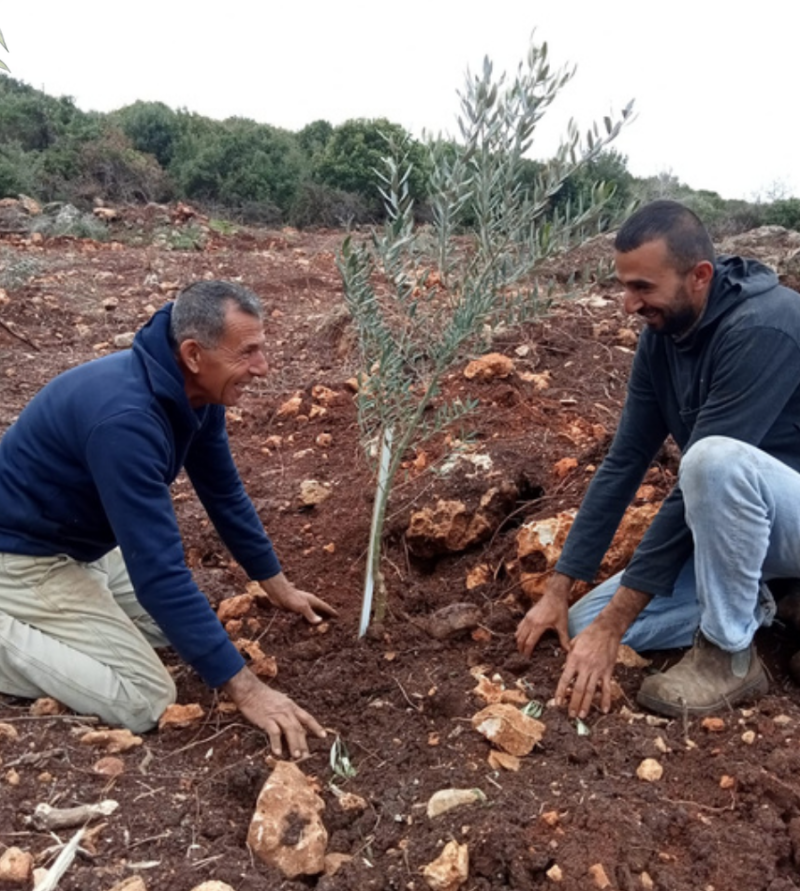
Access to Markets and Emergency Food Assistance
- Access to markets has generally improved, according to the market monitoring report of the World Food Programme (WFP) covering the first 10 days of November. While prices generally remain significantly above October 2023 levels, there were noticeable decreases in the prices of vegetables, and wheat flour prices stabilized across governorates at about NIS 4-5 (US$1-1.4) per kilogramme (kg). Compared with the second week of October, several staple food items saw notable price decreases. For example, three litres of sunflower oil dropped from NIS 30 ($8) to NIS 24 ($7). Similarly, in Khan Younis, tomato prices fell sharply, decreasing from NIS 25 ($7.6) in the second week of October to NIS 7 ($2) in early November. In Deir al Balah, prices for cucumbers decreased by half over the past month, to NIS 14 ($4). Nonetheless, drastic price fluctuations continue to pose a major challenge to market functionality, with 75 per cent of surveyed shops reporting facing this issue in November. WFP noted that “this price instability makes it harder for people to purchase and for shops to keep essential goods in stock.” Two-thirds of surveyed households reported difficulty in accessing markets, of whom 98 per cent cited a lack of cash and 39 per cent said they could not afford basic food items despite recent price drops.
- According to the Cash Working Group (CWG), Gaza’s financial and market conditions continued a gradual yet noticeable recovery throughout November, supported by improved banking services, expanded digital payment channels, and the entry of both humanitarian and commercial goods. The Palestine Monetary Authority reports that five banks are now operating through nine active branches, up from five branches in October. Banks have resumed opening new accounts, re-activating frozen ones, and issuing digital wallets, while financial service providers have restarted wallet creation. These developments are strengthening the digital payment ecosystem and improving household access to electronic liquidity. Average cash-out commissions have also dropped to 19 per cent, compared with 35-40 per cent in September. Between 10 October and 19 November, CWG partners delivered multi-purpose cash assistance to more than 93,000 households, which comprises about 78 per cent of the ceasefire response target of 120,000.
- Between 1 and 18 November, Food Security Sector (FSS) partners reached more than 530,000 people (106,000 households) with monthly general food assistance. In northern Gaza, between 12 and 15 November, food parcel shortages forced partners to alter rations mid-month and use contingency wheat flour and high energy biscuits, instead of providing each family with two food parcels (covering 50 per cent of daily caloric needs). Following the slight improvement in daily cargo inspection speed at Ashdod port, more food parcels have arrived, and starting from 16 November, the ration size across the Strip has been adjusted to two food parcels and one 25-kilogramme (kg) flour bag per family (covering 75 per cent of daily caloric needs), FSS reported. This is in addition to some 160,000 bread bundles and 1.4 million meals distributed per day, as of 17 November, through 18 UN-supported bakeries and 199 community kitchens run by partners. About 87 per cent of daily meals are distributed in central and southern Gaza, with the remaining 13 per cent in northern Gaza.
- Food consumption continued to show modest improvements in the first 10 days of November, according to WFP. About 10 per cent of surveyed households reported going an entire day without eating at least once during the 30 days preceding the survey, down from 20 per cent in the first two weeks of October. One in four households consumed only one meal daily during the first 10 days of November. Overall, similar to October, households reported eating an average of two meals per day, up from one daily meal in July, and dietary diversity remains low, with access to vegetables, fruits and protein still out of reach for many families. Essential protein-rich items like eggs and meat remain scarce or unaffordable. This is also linked to the fact that commercial imports often consist of high-cost, low-nutritional-value goods, such as soft drinks and chocolate. To assess the current severity and scale of food insecurity and malnutrition across Gaza, a new joint Integrated Phase Classification (IPC) acute food insecurity and acute malnutrition analysis began on 17 November and is expected to conclude on 21 November.
Access to Health Care
- On 12 November, the World Health Organization (WHO) facilitated the medical evacuation of 19 patients, including 12 children, three women and four men, in addition to 33 companions. This brings the total number of patients evacuated since the ceasefire to 184 patients, including 117 children, 31 women and 36 men. According to WHO, more than 900 patients have died while waiting for medical evacuation from Gaza, underscoring the critical gaps in access to life-saving care. More than a month into the ceasefire, WHO reports that efforts to rebuild the health system and facilitate evacuations continue. Over 8,000 patients, including more than 5,100 children, have been evacuated outside Gaza in the past two years, with 30 countries receiving patients in need of care, and 119 missions have been coordinated by WHO since May 2024. WHO called for additional support, as well as the opening of all evacuation routes, particularly to the West Bank, including East Jerusalem. More than 16,500 people, nearly 4,000 of them children, remain on the medical evacuation waiting list.
- On 17 November, the Palestine Red Crescent Society (PRCS), in coordination with the Augusta Victoria and Al Makassed hospitals in East Jerusalem, transferred 76 patients, and their companions to the Kerem Shalom/Karam Abu Salem crossing for their return to the Gaza Strip. These patients had been in East Jerusalem since before 7 October 2023.
- On 11 November, the Health Cluster and WHO visited Al Rantisi and Al Shifa hospitals in Gaza city to assess progress in reactivating essential health services. At Al Rantisi Hospital, partners are supporting the refurbishment and resumption of Outpatient Department (OPD) services and inpatient care, with a capacity of 80 beds currently functional. According to the Health Cluster, significant repair work, equipment, and supplies are still required to achieve full operational capacity and resume suspended services. Required support includes an extra generator and solar systems, and a restored oxygen supply system to support intensive care services for children and neonates. Similarly, services at Al Shifa Hospital are being reactivated: OPD services and 300 inpatient beds are now available and five operating rooms and 32 haemodialysis units are now operational. To achieve full functionality, surgical care, advanced diagnostics services, emergency care, oncology and multidisciplinary in-patient services are among some of the critical services that must be resumed.
- The first round of the immunization campaign, scheduled from 9 to 20 November, is ongoing across 114 health facilities throughout the Gaza Strip, supported by 145 medical teams. According to the Health Cluster, a total of 7,119 children under three were reached during the first five days. Among them, 132 children (two per cent) received their first dose (zero dose), 1,799 children (25 per cent) caught up on missed doses, and 5,188 children (72 per cent) were vaccinated according to their schedule. Additionally, 355 children were referred for malnutrition treatment following identification during the campaign. Despite continuous population movements during the planning phase, partners aimed to maximize outreach and ensure no child is missed through a range of communication channels, including mosque announcements, SMS messages, motorized megaphones, as well as banners and posters displayed in key locations.
Funding
- As of 19 November, Member States disbursed approximately $1.51 billion out of the $4 billion (37 per cent) requested to meet the most critical humanitarian needs of three million out of 3.3 million people identified as requiring assistance in Gaza and the West Bank, including East Jerusalem under the 2025 Flash Appeal for the Occupied Palestinian Territory. Nearly 88 per cent of the requested funds is for the humanitarian response in Gaza, with just over 12 per cent for the West Bank. In October, the oPt Humanitarian Fund managed 135 ongoing projects, totalling $77.7 million, to address urgent needs in the Gaza Strip (87 per cent) and the West Bank (13 per cent). Of these projects, 63 are being implemented by international NGOs, 56 by national NGOs and 16 by UN agencies. Notably, 69 out of the 79 projects implemented by international NGOs or the UN are being implemented in collaboration with national NGOs. For more information, please see OCHA’s Financial Tracking Service webpage and the oPt HF webpage.
1982.

20 november 2025
Humanitarian Situation Update #341
West Bank
20 November 2025

One of five Palestinian-owned vehicles set on fire by Israeli settlers in Beit Lid on 11 November 2025. Photo courtesy of a community member.
Key Highlights
- Three Palestinian children and one man were killed by Israeli forces in the West Bank between 11 and 17 November, raising the 2025 child fatality toll to 49.
- One Israeli man was killed in a ramming and stabbing attack at Gush Etzion settlement junction, in Bethlehem, carried out by two Palestinians, who were shot and killed.
- Israeli forces continued large-scale operations across the northern West Bank, resulting in casualties, displacement, school closures, and movement restrictions.
- The Humanitarian Coordinator allocated US$100,000 to support displaced families in the northern West Bank with e-vouchers to purchase winter clothing.
- Thirty Palestinians are at risk of displacement in Qalandiya village in an area where the Israeli authorities have reactivated decades-old expropriation orders and approved the construction of a waste treatment facility.
- Within a week, 29 documented settler attacks across the West Bank caused injuries and damage to Palestinian homes, mosques, vehicles, and agricultural assets.
Humanitarian Developments
- Between 11 and 17 November, Israeli forces killed four Palestinians, including three children, in the West Bank, including East Jerusalem. Seven out of nine Palestinians killed by Israeli forces between 1 and 17 November were children. In addition, on 11 November, a Palestinian child died after spending a month in hospital in a coma, after inhaling tear gas fired by Israeli forces at olive harvesters in the Jabal Qamas area near Beita village, in Nablus governorate. The boy was with his family on 11 October when groups of Israeli settlers, accompanied by Israeli forces, assaulted the harvesters, resulting in injury to about 60 Palestinians. This brings the total number of Palestinian children killed by Israeli forces in the West Bank between 1 January and 17 November to 49, accounting for approximately 24 per cent of all Palestinian fatalities (201) by Israeli forces during this period. Among them were 47 boys and two girls. The following are details of the incidents that resulted in fatalities:
- On 13 November, Israeli forces shot and killed two boys (aged 14 and 15 years) near Karmei Tzur settlement, in Hebron governorate. According to the Israeli military, the boys were ambushed by Israeli forces while they were reportedly on their way to carry out an attack. Their bodies have been withheld by the Israeli authorities.
- On 16 November, during a raid in Askar Camp, northeast of Nablus, Israeli forces shot and killed a young man and injured another one. According to the Palestinian District Coordination Office and community sources, Israeli forces chased Palestinian stone throwers, hitting two young men in the back with live ammunition, killing one and injuring the other. In an official statement, the Israeli military said that the man had thrown an explosive device at its forces before they shot him and there were no casualties among the forces. According to medical teams, Israeli forces held the injured man near the camp’s main entrance and prevented ambulance crews from reaching him for approximately 30 minutes, after which they allowed an ambulance to take him to hospital, where he was pronounced dead.
- On 17 November, Israeli forces shot and killed a 14-year-old Palestinian boy and injured two other boys during a raid in Al Far'a Camp, in Tubas governorate. During the raid, Palestinians threw stones at Israeli forces, who shot live ammunition, resulting in the injury of three children. According to medical sources, the Palestine Red Crescent Society took two of the children to hospital but was prevented by Israeli forces from reaching the third child, who was later detained by the forces and then announced dead in an Israeli military statement. His body was withheld by the Israeli authorities.
- On 18 November (not included in the above reporting period), two Palestinian men attempted to run over Israelis at the Gush Etzion settlement junction along Road 60, in Bethlehem governorate. One of them then reportedly exited a vehicle and began stabbing people, killing an elderly Israeli man and injuring two others, including a 15-year-old child. Israeli forces opened fire and killed both Palestinian men and reported finding explosive materials in their vehicle. An Israeli woman was reportedly injured by Israeli fire, according to Israeli media. Following the incident, Israeli forces closed all four road gates leading to Hebron city, leaving thousands of Palestinians stranded for many hours. Israeli forces also carried out raids in Beit Ummar, the hometown of one of the assailants, damaged property in his family home, and forcibly displaced three families living in the same building before sealing the entrance. Israeli forces declared a four-day curfew in the town, closed internal roads with earth mounds, and detained hundreds of Palestinian men in a school, where three men were physically assaulted and injured by Israeli forces. The home of the second assailant in Hebron city was also raided, resulting in property damage.
- Between 11 and 17 November, OCHA documented the demolition of 13 Palestinian-owned structures, all in Area C of six villages and towns, for lacking Israeli-issued building permits, which are almost impossible for Palestinians to obtain. In one incident, the Israeli Civil Administration demolished two structures in a public park in Biddu town, in northwestern Jerusalem governorate, affecting approximately 12,000 people. In Hebron governorate, on 12 November, Israeli authorities demolished six structures in Khirbet al Fakheit, located within “Firing Zone 918” in Masafer Yatta, which resulted in the displacement of one family of seven people, including four children, and otherwise affected two families comprising 16 people, including 12 children. The other demolition incidents took place in Duma village in Nablus, Arraba village in Jenin, Beit Sira village in Ramallah, and Al Walaja village in Bethlehem. In total, 12 people, including seven children, were displaced.
- On 23 October, Israeli authorities delivered eviction notices to Palestinian residents of two residential buildings in Qalandiya village, in an area located within East Jerusalem, on the “West Bank” side of the Barrier. The notices require the families to vacate their homes and adjoining agricultural lands within 20 days, placing five Palestinian households comprising about 30 people at risk of displacement. The evictions have not been implemented to date, and the families have indicated their intention to file a legal case. In April, according to Peace Now, an Israeli NGO, the Israeli Minister of Finance reactivated two old expropriation orders in the same area; the orders were initiated in the 1970s and 1980s and affect approximately 150 dunums (37 acres) of land. A month later, the Israeli government approved the construction of a waste treatment and energy-recovery facility and the re-routing of the Barrier in the same area, Peace Now added.
- Palestinian access to agricultural lands behind the West Bank Barrier during the current olive harvest season has remained highly restricted. These constraints are compounded by the Israeli government’s stated intention to make permanent the sweeping ban on access to the “Seam Zone” between the Barrier and the 1949 Armistice Line, or “Green Line”, in place since October 2023, which has prevented thousands of farmers from reaching their lands over the past three seasons despite olive groves requiring year-round cultivation and care. Initial field information indicates that most agricultural gates and checkpoints were either closed or operated for a very limited number of days and hours, often without prior notice or under inconsistent coordination arrangements. According to HaMoked, which had petitioned the Israeli High Court in May 2024 to challenge the ban on access to the ‘Seam Zone’, in many cases, only one family member received a permit, and gate openings were sharply reduced — two and a half weeks in Qalqilya, ten days in Tulkarm, and one day in Jenin — preventing many families from harvesting most, or any, of their olives. During the Israeli High Court hearing in September 2025, the court noted the absence of any expert security opinion justifying the ban and instructed the State to submit updated permit data and a security assessment by 15 November. The State has since requested a three-week extension.
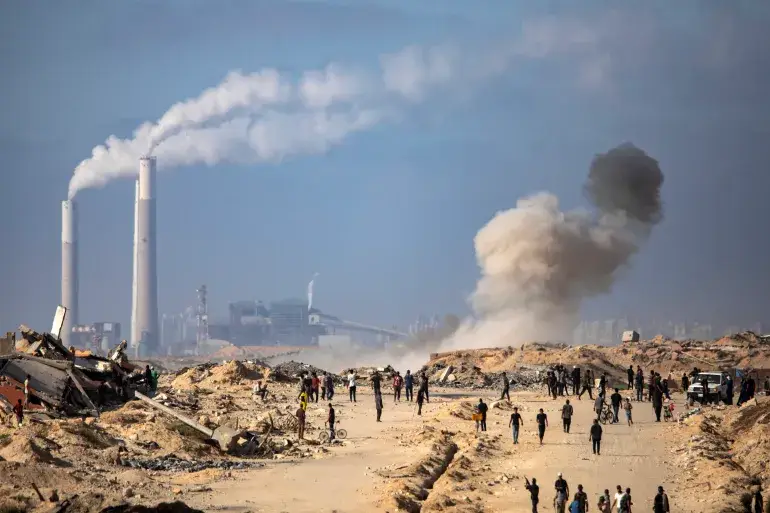
Operations by Israeli Forces in the Northern West Bank
- Israeli forces continued to carry out large-scale operations across the northern West Bank, particularly in parts of Jenin and Nablus governorates, resulting in casualties, displacement, and disrupted access to essential services. In Ya’bad town, in Jenin governorate, Israeli forces have been conducting an extensive operation since 7 November, which was ongoing as of the time of reporting. On 11 November, Israeli forces forcibly displaced two families comprising 10 people from two residential buildings, which they converted into military observation posts. Concentrated in the southwestern area of the town, the operation has to date involved the displacement of at least 11 families comprising about 55 people, some of whose homes were taken over by Israeli forces. According to community sources, the forces blocked nine roads with earth mounds, some of which were reportedly re-opened. For 11 days, all 12 schools in Ya’bad town were closed, affecting nearly 4,000 students who switched to online learning. Displaced families have been staying with relatives and friends in the town.
- Also in Jenin governorate, Israeli forces conducted raids in Jenin city, Qabatiya, and Birqin between 12 and 14 November. During these raids, Palestinians threw stones and Israeli forces fired live ammunition. Four Palestinians, including two children, were injured; three were injured by live ammunition, while one was struck by a military vehicle. These operations, lasting from one to several hours, are among many similar operations conducted by Israeli forces across different villages and towns in Jenin governorate since late September, with frequent daytime patrols and raids into residential and commercial buildings, contributing to heightened fear and insecurity among residents.
- In Nablus governorate, Israeli forces conducted three raids between 11 and 16 November in Beit Furik village and Askar refugee camp, during which Israeli forces fired live ammunition and Palestinians threw stones. One Palestinian man was killed (see details above), and another one was injured by live ammunition during the raid in Askar Camp. A Palestinian child was reported injured during one of the other two raids in Beit Furik, where Israeli forces closed the Beit Furik checkpoint in both directions for nearly eight hours on 11 November, only permitting the evacuation of three patients from the town. This checkpoint controls access to Beit Furik and Beit Dajan towns, with about 20,000 residents. During these operations, Israeli forces searched multiple homes and arrested two Palestinians.
- Humanitarian partners continue to scale up multi-sectoral assistance to internally displaced persons (IDPs) in the northern West Bank ahead of the winter season. According to the Cash Working Group (CWG), between January and early November, over 10,000 households in the northern West Bank have received at least one round of multi-purpose cash assistance, including IDPs and other people directly affected by the crisis. In addition, the Humanitarian Coordinator, Dr. Ramiz Alakbarov, allocated $100,000 from the occupied Palestinian territory Humanitarian Fund (oPt HF) to support displaced families in the northern West Bank with e-vouchers to purchase warm clothing ahead of the rainy season.
Israeli Settler Attacks
- Between 11 and 17 November, OCHA documented 29 Israeli settler attacks against Palestinians that resulted in casualties, property damage or both in the West Bank, including East Jerusalem. The attacks led to the injury of 11 Palestinians, all except one were by Israeli settlers. More than 1,000 Palestinian-owned (mainly olive) trees and saplings were vandalized, in addition to livestock losses and damage to seasonal crops, 23 Palestinian-owned vehicles, at least 10 homes, two mosques, and livelihood structures, including a dairy factory warehouse.
- Some of the settler attacks entailed damage to Palestinian agricultural lands and livelihood structures across five governorates. Among the key incidents was an attack on 11 November in Beit Lid village, in Tulkarm governorate, by Israeli settlers believed to be from a newly established outpost; settlers burnt a dairy factory warehouse and five vehicles, shattered the windows of two homes, and injured three Palestinians after physically assaulting Palestinian Bedouin families. In Jenin governorate, armed settlers attacked a livestock farm in Imreiha village on 13 November and physically assaulting two Palestinians. In Nablus governorate, settlers damaged agricultural lands in Area B of Beit Furik village on 15 November, destroying at least four dunums of seasonal crops and causing damage to two agricultural farms.
- In Hebron governorate, two settler attacks in Umm al Butm village resulted in some of the most extensive damage reported this week, including one attack that occurred following the evacuation by Israeli authorities of Tzur Misgavi settlement outpost on 17 November. In the 17 November incident, settlers broke into a house, where women and children were present, physically assaulted and injured two women, threw flammable materials inside the home, and later cut trees in nearby olive groves. In total, settlers cut or destroyed olive and apricot trees, set fire to two vehicles, and caused damage to seasonal vegetable crops, several homes, five water tanks and five solar water-heating systems.
- Other settler attacks entailed damage to homes and two mosques. For example, in Al Jab’a village, in Bethlehem governorate, Israelis settlers believed to be from Bat Ayin settlement, and its adjacent outpost threw flammable materials at homes and vehicles. Three vehicles, including a minibus, were burnt, and four other vehicles and seven homes sustained damage, directly affecting at least nine families. In another arson attack, Israeli settlers raided Bariyyet al Shuyukh, in Hebron governorate, and set fire to two recently constructed structures provided as humanitarian assistance. In Salfit governorate, Israeli settlers vandalized and set fire to a mosque in Deir Istiya village and spray painted anti-Palestinian graffiti on its walls. The main door of another mosque was vandalized by Israeli settlers in Khirbet Tana herding community, in Nablus governorate.
- For key figures and additional breakdowns of casualties, displacement and settler violence between January 2005 and September 2025, please refer to the OCHA West Bank September 2025 Snapshot.
Funding
- As of 20 November 2025, Member States have disbursed approximately $1.5 billion out of the $4 billion (37 per cent) requested to meet the most critical humanitarian needs of three million out of 3.3 million people identified as requiring assistance in Gaza and the West Bank, including East Jerusalem, under the 2025 Flash Appeal for the OPT. Nearly 88 per cent of the requested funds is for the humanitarian response in Gaza, with just over 12 per cent for the West Bank. During October 2025, the oPt Humanitarian Fund managed 135 ongoing projects, totalling $77.7 million, to address urgent needs in the Gaza Strip (87 per cent) and the West Bank (13 per cent). Of these projects, 63 are being implemented by international NGOs, 56 by national NGOs and 16 by UN agencies. Notably, 69 out of the 79 projects implemented by international NGOs or the UN are being implemented in collaboration with national NGOs. For more information, please see OCHA’s Financial Tracking Service webpage and the oPt HF webpage.
1981.

20 november 2025
Israel’s genocide isn’t over. It’s been expanded.
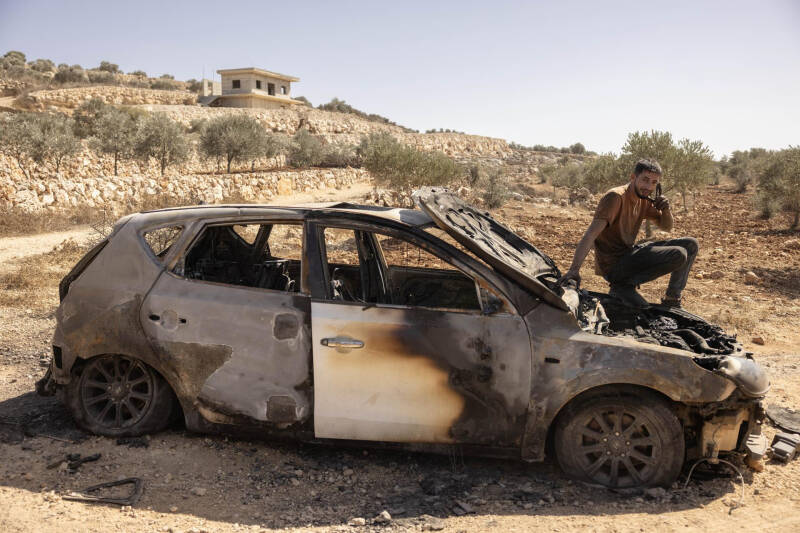
Israel's genocide isn’t over. In the days and weeks after a ceasefire was declared, many Israeli soldiers were withdrawn from Gaza — and then deployed back to the West Bank.
Right now, Palestinians in the West Bank are experiencing the highest rates of settler and state violence in recent history, all while the mainstream media continues to push Palestine out of the news.
The Israeli government is rapidly expanding its project of ethnic cleansing, making it abundantly clear that its intention is not simply to erase Palestinians in Gaza, but to erase all Palestinians from their land.
In this Wire, we shine a spotlight on the unfolding crisis in the West Bank…
Stop arming Israel.

The U.S. continues to back Israel’s genocide and ethnic cleansing of Palestinians, sending billions of dollars of weapons to the Israeli military carrying out a genocide across Gaza and the West Bank.
Use this tool from our sister organization JVP Action to demand that Congress act to block the bombs now.
Tell Congress: Israel is committing genocide.

280 Palestinians in Gaza have been killed by the Israeli government since the ceasefire deal was signed. It’s clear that this deal did not end the genocide, but began a new phase of it.
Rep. Rashida Tlaib just introduced a crucial resolution in the House to recognize the Israeli government's genocide against Palestinians in Gaza, to end U.S. complicity in these atrocities, and to demand accountability. Use this tool from our sister organization JVP Action to demand your representative join the call for justice.
"A quiet genocide" in the West Bank

Writing for Middle East Eye, Shahd Taha describes what life is like now in the West Bank amid "Israel's unrelenting war on Palestinian life" — sharing stories from the mass destruction of refugee camps, daily raids, and the murder of children and family members.
1981.

20 november 2025
Gaza Humanitarian Response
Situation Report No. 26
20 November 2025
(As of 18:00 on 19 November 2025, unless otherwise noted)
HIGHLIGHTS
- During the first eight days of the ongoing catch-up immunization campaign, more than 10,000 children under the age of three received a first round of essential vaccinations. The campaign aims to protect over 40,000 children across the Gaza Strip.
- Between 1 and 18 November, partners assisted more than 106,000 households with monthly food parcel distributions. Since 16 November, following improvement in aid cargo inspection speed at Ashdod port, rations have expanded, now covering 75 per cent of daily caloric needs.
SITUATION OVERVIEW
The heavy rains and flash floods have, affected displacement sites and education facilities. The Site Management Cluster (SMC) reports worsening conditions as winter storms limit access and damage infrastructure. The floods also hit temporary learning spaces (TLS), disrupting education for tens of thousands of children. The SMC has mapped all displacement sites deemed at highest flooding risk across the Strip to assess possible support options. In the meantime, partners continue to support basic winterization activities in sites they are directly managing, utilizing primarily recycled food bags as well as sand and soil from the sites and surrounding areas, given the continued entry restrictions on essential materials for minimum site maintenance. For more updates on the floods, please refer to OCHA SitReps #22 to #25.
UNITED NATIONS-COORDINATED AID ENTRY*
On 19 November, 3,806 pallets of aid administered by the UN and its partners were offloaded at Gaza’s crossings, based on data retrieved from the UN 2720 Mechanism dashboard at 11:00 on 20 November. About 54 per cent of these pallets contained food supplies, followed by shelter (32 per cent), health supplies (7 per cent), water, hygiene and sanitation items (6 per cent), and operations, logistics and telecommunication material (1 per cent). At least 168 truckloads were offloaded in Kerem Shalom and 1 truckload in Kissufim.
On 19 November, based on preliminary data, at least 242 pallets of diapers, blankets, tarpaulins, tents and vaccines, 116 pallets of Ready-to-Use Therapeutic Food and family tents, 152 pallets of medical supplies, and 330,200 litres of fuel were collected from the crossings under the United Nations-coordinated mechanism. This data excludes bilateral donations and the commercial sector.
As of 20 November, the Kerem Shalom, Zikim, and Kissufim crossings remained operational, with humanitarian cargo offloading and uplifting alternating days between Zikim and Kissufim.
The reopening of Salah ad-Deen Road has been postponed by the Israeli authorities until further notice. The road’s closure since 27 October has been a significant constraint on aid cargo movements into Gaza from the Kerem Shalom crossing, causing congestion as well as increased insecurity around convoys.
HUMANITARIAN RESPONSE
Food Security
- As of 18 November, partners had supported more than 106,000 households (530,000 people) with general food parcel distributions as part of the November monthly assistance cycle. Between 12 and 15 November, partners in northern Gaza had to alter rations due to food parcel shortages, replacing the two food parcels per family distributed previously, which covered 50 per cent of daily caloric needs, with contingency stocks of wheat flour and high energy biscuits to continue distributions. Following a slight improvement in daily aid cargo inspection speed at Ashdod port, more food parcels have arrived, and starting from 16 November, the ration size across the Strip has been adjusted to two food parcels and one 25-kilogramme (kg) flour bag per family, therefore covering 75 per cent of daily caloric needs.
- The Food Security Sector is working with the Health and WASH Clusters to develop a harmonized minimum Infection Prevention and Control (IPC) package, comprising inter alia hygiene items, cleaning materials and water testing consumables, to support cooked meal partners in strengthening IPC measures across community kitchens and advocate jointly for the steady entry of IPC supplies.
Health
- During the first eight days of the catch-up immunization campaign launched on 9 November, more than 10,000 children under the age of three were vaccinated. The campaign, which has been extended until 22 November, aims to protect over 40,000 children against measles, mumps, and rubella, diphtheria, tetanus, pertussis, hepatitis B, tuberculosis, polio, rotavirus and pneumonia. Rounds two and three are planned for December 2025 and January 2026.
Water, Sanitations and Hygiene (WASH)
- Partners continue desludging operations for the sewage line in Basha Street, in Gaza city, while the Saftawi lagoon pump station in northern Gaza is now operational while the pipeline is still under repair. Partners are also working on wastewater repairs in As-Shati Camp, Al Rantisi and six other flood hotspots across the Strip.
- Partners also finished repairs on two wells in Al-Bureij in northern Deir al Balah, while continuing to work on water pipe reparations in Gaza city.
- Between 17 and 18 November, partners distributed over 1.8 million baby diapers, 121,000 towels, 2,550 dignity and 275 hygiene kits, 4,792 handwashing stations, 1,000 18-litre buckets, 225 18-litre jerry cans, and 13 water tanks, benefiting approximately 400,000 people in northern and southern Gaza.
Nutrition
- Last week, a Cluster partner conducted a Training of Trainers on Community-based Management of Acute Malnutrition and Infant and Young Child Feeding (IYCF) practices, targeting 21 participants from 20 organizations who will cascade the training within their respective entities.

Education
- The 14 November floods damaged 38 TLSs serving around 10,000 school-aged children. Although the winterization plan had identified these risks, partners lacked the capacity to fully mitigate the impact. Efforts are underway to reinstall the spaces, but more tents are urgently needed.
- In Gaza City, 12 new sites have been identified for learning spaces. So far, 37 high-performance tents have been provided, but additional spaces are still urgently needed.
- The distribution of High-Energy Biscuits and Fortified Date Bars across TLSs has continued to increase, with 172,100 children reached thus far in November across 218 TLSs in northern, central, and southern Gaza.
Protection
- Between 16 and 18 November, protection partners continued delivering a wide spectrum of interventions across the Strip. Collectively, partners reached more than 12,000 people through different services and activities, including children, caregivers, women, at-risk adults, persons with disabilities, and frontline workers.
- Gender-Based Violence
- Between 15 and 18 November, Gender-Based Violence (GBV) partners provided multisectoral services to 2,780 women and girls across the Gaza Strip, including case management, psychosocial support, and other essential assistance.
- Flooding in North Rafah has disrupted multisectoral GBV services in two Women and Girls’ Safe Spaces, causing damage and limiting access. Despite these challenges, partners rapidly established temporary tents to restore services and ensure the continuity of essential case management, psychosocial support, and other critical GBV assistance.
- Mine Action
- Between 13 and 20 November, mine action partners conducted 32 Explosive Hazards Assessments of critical humanitarian sites.
- More than 16,600 people were reached with Explosive Ordnance Risk Education activities implemented by five partners in Gaza city, Deir al Balah and Khan Younis.
- Between 13 and 20 November, mine action partners conducted 32 Explosive Hazards Assessments of critical humanitarian sites.
Shelter
- Partners have continued emergency assistance to families affected by last week’s floodings, distributing more than 10,600 tents, 130,000 tarpaulins, and 150,000 bedding items between 13 and 18 November. During the same period, partners distributed 1,025 kitchen sets and some 340 winter clothing vouchers to identified vulnerable households.
- Shelter and non-food item stocks available through the Cluster are currently limited and expected to deplete shortly without approval for entry of additional items.
Site Management Cluster
- The rapid intention survey conducted among displaced families living along the Gaza Strip shoreline (OCHA SitRep #25 refers) revealed a strong willingness among residents to relocate to safer areas. However, concerns were raised about the need for destinations to be free of charge and the availability of humanitarian assistance in the new locations. Key needs highlighted include transportation, tents, blankets, and heating sources. These findings align with field experience: one partner supported 300 households to move from the shore to a offered site, but many returned due to a lack of basic services. Partners are working on the readiness of sites that could accommodate some of the mentioned population.
1980.

20 november 2025
Today's headlines
The UN Embraces Colonialism: Unpacking the Security Council’s mandate for the U.S. colonial administration of Gaza
Craig Mokhiber
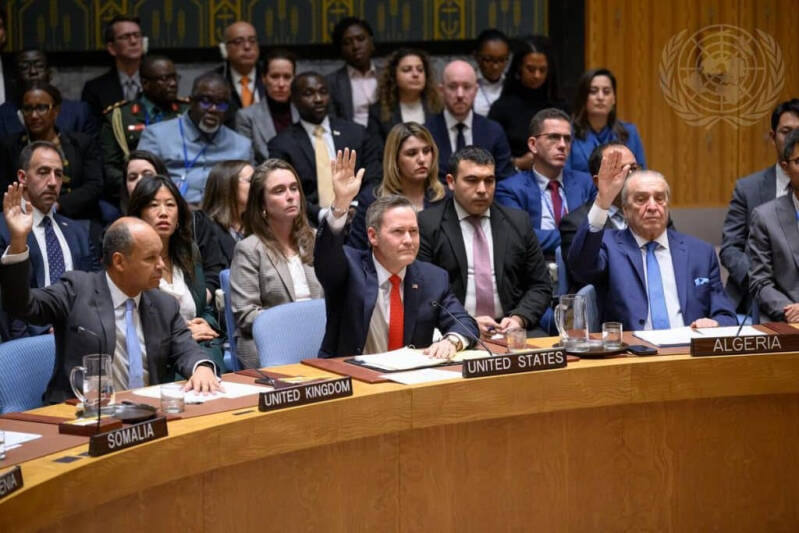
The Security Council's backing of the Trump plan for Gaza ignores international law, punishes the Palestinians, and rewards those responsible for genocide.
1979.

20 november 2025
In deze nieuwsbrief delen we de verklaring en actieoproep van de internationale BDS-beweging naar aanleiding van de beschamende aanname van de VN Veiligheidsraadresolutie over Gaza. Vervolgens hebben we een oproep tot actie voor as. zaterdag bij Chevrontankstations.
Ook schrijven we over een stevige overwinning in Engeland: de gemeente Nottingham wordt een Apartheidvrije Zone.
Tot slot delen we een stuk over de relatie tussen de militaire acties van Israel in Palestina en de klimaatgevolgen daarvan met de COP Bélem als context.
Een strijdbare groet van het docP team; blijf BDS-en!
Beschamende steun aan koloniaal Trump-Netanyahu plan door VN Veiligheidsraad

Verklaring van het BNC over de VN Veiligheidsraadsstemming van 17 november 2025 17 november 2025, de dag waarop de VN–Veiligheidsraad de resolutie van de VS en Israël aannam, zal de geschiedenis van de VN ingaan als een dag van schande. “Geen enkel lid van de Raad had de moed, het principe of het respect voor […]
Tank geen Chevron!
De door Palestijnen geleide BDS-beweging roept op tot een wereldwijde actiedag op 22 november, gericht tegen Chevron. De reden ligt in hets rol in de genocide en apartheid door Israël, naast zijn rol in de wereldwijde klimaatvernietiging. Via zijn gasvelden en pijpleidingen voorziet Chevron Israël volgens zijn eigen website van 70% van zijn energiebehoefte – en van honderden […]
Geen klimaatgerechtigheid zonder bevrijding van Palestina
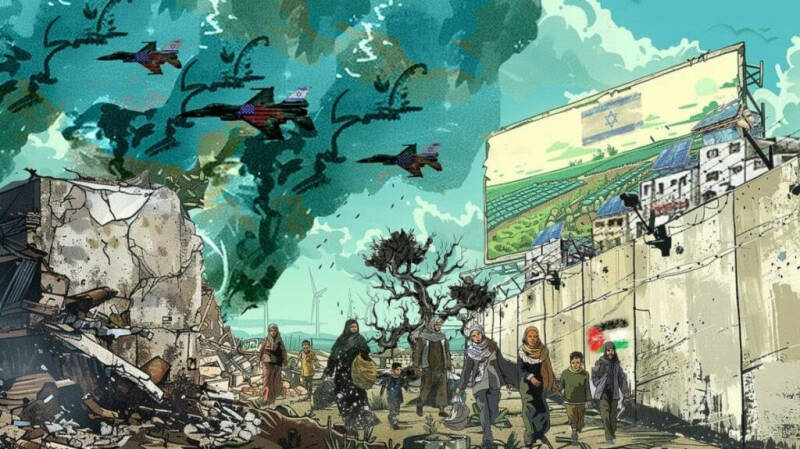
Oproep van het Palestijnse maatschappelijk middenveld aan COP30:
Al bijna twee jaar voert Israël een live gestreamde genocide uit tegen de inheemse Palestijnen in Gaza en in heel historisch Palestina, waarbij levens, land en ecosystemen worden verwoest. VN-deskundigen hebben de misdaden van Israël omschreven als onder meer domicide, urbicide, scholasticide, medicide, culturele genocide en ecocide. […]
BDS overwinning: Nottingham gemeenteraad zet in op boycot van Israël

Nottingham City Council (de gemeenteraad) heeft het pensioenfonds van Nottingham County opgeroepen om voor het Local Government Pension Scheme (LGPS) bedrijven te vermijden die in Israëls wapenindustrie investeren. Men wil dat pensioengelden ethisch belegd worden en niet meehelpen een-geoncide mogelijk te maken.
Na maanden campagne voeren door lokale Palestine Solidarity Campaign groepen, studenten, inwoners en vakbondsleden is de motie aangenomen. Verklaringen van de International Association of Genocide Scholars en het VN Onderzoekscomite waren van groot ondersteunend belang. Nottingham City is nu ook een Apartheid Free Zone aan het worden
1978.

19 november 2025
Gaza Humanitarian Response
Situation Report No. 25
19 November 2025
(As of 18:00 on 18 November 2025, unless otherwise noted)
HIGHLIGHTS
- On 17 November, more than 1.4 million meals were delivered by 27 partners through 199 kitchens: 181,000 in northern Gaza and about 1.22 million in Deir al Balah and Khan Younis governorates.
- In response to the needs of thousands of households affected during last week’s floodings, Shelter Cluster partners distributed more than 4,000 tents, 39,000 tarpaulins, 28,000 bedding items and 342 clothing items to the most vulnerable households.
- On 16 November, over 40,000 bags of Super Cereal Plus were distributed to partners to support the management of Moderate Acute Malnutrition (MAM) among children aged 5-17 years.
SITUATION OVERVIEW
Between 10 and 17 November, Site Management Cluster partners recorded more than 34,000 population movements from southern to northern Gaza, with 375 reverse movements also observed from north to south. Since the ceasefire began, nearly 741,700 movements of people were registered by the Cluster, of which more than 637,000 from south to north, primarily via the coastal Al Rasheed Road.
UNITED NATIONS-COORDINATED AID ENTRY*
On 18 November, 3,694 pallets of aid administered by the UN and its partners were offloaded at Gaza’s crossings, based on data retrieved from the UN 2720 Mechanism dashboard at 11:00 on 19 November. About 60 per cent of these pallets contained food supplies, followed by shelter (17 per cent), nutrition (13 per cent), water, hygiene and sanitation items (8 per cent), and health supplies (2 per cent). At least 112 truckloads were offloaded in Kerem Shalom and 52 truckloads in Zikim.
On 18 November, based on preliminary data, at least 172 pallets of diapers and blankets, 185 pallets of Ready-to-Use Therapeutic Food, and 310,650 litres of fuel were collected from the crossings under the United Nations-coordinated mechanism. This data excludes bilateral donations and the commercial sector.
As of 19 November, the Kerem Shalom, Zikim, and Kissufim crossings remained operational, with humanitarian cargo offloading and uplifting alternating days between Zikim and Kissufim.
HUMANITARIAN RESPONSE
Food Security
- On 17 November, more than 1.4 million meals were delivered by 27 partners through 199 kitchens: 181,000 in northern Gaza and about 1.22 million in the Deir al Balah and Khan Younis governorates.
Nutrition
- Outpatient therapeutic feeding for children with acute malnutrition is currently available at 146 sites across the Gaza Strip, including 19 in northern Gaza, compared to 7 before the ceasefire.
- On 16 November, more than 40,000 bags of Super Cereal Plus were distributed to partners to begin the management of Moderate Acute Malnutrition (MAM) among children aged from 5 to 17 years. Additionally, the cluster received more than 22,000 boxes of High Energy Biscuits, which can equally be used for managing MAM cases in older children.
Protection
- Child Protection
- Between 17 and 18 November, Child Protection (CP) partners reached more than 2,700 children and 1,700 caregivers with child protection and mental health and psychosocial support (MHPSS) services across displacement sites in Gaza city, Deir al Balah, and Khan Younis. Support included structured and semi-structured MHPSS sessions, child protection awareness, recreational activities, individual and group counseling, psychological first aid, community outreach, winterization assistance, and targeted follow up for vulnerable children.
- During the same period, 53 children at risk - including unaccompanied and separated children, children heading households, children injured during the war, children without parental care and children facing neglect - received case management services, including registration, follow up, referrals, tailored support, and access to essential services.
- Since October, CP partners have distributed about 48,000 winter clothing kits for children, and with Nutrition partners, eight child protection organizations received High Energy Biscuits to support children attending child-friendly spaces.
Shelter
- On 17 November, in response to the needs of thousands of households affected during last week’s floodings, Shelter Cluster partners distributed more than 4,000 tents, 39,000 tarpaulins, 28,000 bedding items and 342 clothing items to prioritized households. On the same day, Shelter partners received about 300 tents, 9,400 tarpaulins, and more than 51,000 bedding items into Gaza.
- Shelter and non-food item stocks available through the Cluster are currently limited and expected to deplete shortly without approval for entry of additional items.

Site Management Cluster
- Following the heavy rains witnessed last week in Gaza, almost 12,000 displaced families residing in 29 makeshift sites within the catchment areas of Designated Emergency Shelters (DESs) operated by a key Site Management Cluster partner were affected, with many moving from the makeshift sites to seek shelter at the DESs. Partners coordinated a swift response, conducting rapid assessments and mobilizing the DES residents to clean up blocked gullies and manholes to mitigate further flooding. Jointly with municipal winter emergency committees, additional capacity was deployed promptly to reopen blocked water channels and manholes and remove clogged surface water.
- Between 16 and 17 November, the Site Management Cluster (SMC) conducted a rapid intention survey among displaced families living along the shoreline in Khan Younis and the Mawasi area of Rafah, where more than 4,000 households are currently residing. Preliminary findings highlight dire conditions: rising sea levels are encroaching on tents and threaten to submerge the entire area, while strong winds have already caused multiple tent collapses. More than 4,000 households are currently sheltering along the shoreline, facing intense cold and struggling to secure adequate heating. In addition, the absence of proper fecal waste disposal is forcing many to use the sea as a toilet.
1977.

19 november 2025
HRF at Europol: A New Era of Cooperation in the Fight Against Israeli War Crimes
Brussels, 19 November 2025
On 22 October 2025 An HRF delegation, led by General Director Dyab Abou Jahjah and including Natacha Bracq, Karim Hassoun, and Haroon Raza, attended the annual Europol meeting in The Hague. HRF delivered presentations detailing its methodology in evidence-gathering and case-building. Delegations from multiple European countries participated, expressed strong interest in HRF’s work, and held bilateral discussions with the foundation — particularly regarding the sharing of HRF’s evidence on Israeli war criminals who travel to or hold nationality in these countries.
The invitation triggered hysteria from Israeli lobby groups and aligned media, but such reactions are unsurprising—those seeking to obstruct justice fear any effort to investigate or prosecute the genocide in Gaza. Alongside this institutional advance, HRF has launched several new legal actions in Cyprus, the Czech Republic and Denmark against Israeli soldiers accused of war crimes and genocide.
More info below
Statement on the Cooperation Between Europol and the Hind Rajab Foundation
Brussels, 19 November 2025 -
On 22 October 2025, Europol invited the Hind Rajab Foundation (HRF) to speak at its annual meeting in The Hague. This invitation forms part of a broader communication process and an exploration of possible cooperation between HRF and Europol. In the last two days, several Israeli lobby groups and media outlets have expressed consternation regarding this interaction.
It is not unusual for law enforcement to cooperate with civil-society organisations in the fight against impunity. In fact, during the Rwandan genocide and other mass-atrocity contexts, civil-society organisations played an instrumental role in identifying perpetrators and uncovering critical evidence. The pursuit of justice for the genocide in Gaza will be no different.
HRF Moves Against Israeli Soldier in Denmark for War Crimes and Genocide
17 November 2025 – Copenhagen
The Hind Rajab Foundation (HRF) has filed a criminal complaint in Denmark against Israeli soldier Sergeant Ohad Hillel, a member of the 846th Patrol Battalion “Samson’s Foxes” of the Givati Brigade, for his role in war crimes, crimes against humanity, and acts of genocide committed during Israel’s military campaign in the Gaza Strip.
Read the full article
HRF Files Criminal Complaint in Prague Against Israeli Rapper–Soldier Noam Tsuriely
14 November 2025 – Prague
The Hind Rajab Foundation (HRF) has filed a criminal complaint before the Supreme Public Prosecutor’s Office in Prague against Israeli reservist and rapper Noam Tsuriely, accusing him of war crimes, crimes against humanity, and acts of genocide committed during Israel’s military campaign in Gaza.
Read the full article
HRF Files for the Arrest of Israeli Soldier Sharon Dawit in Cyprus for Torture, War Crimes, and Genocide
11 November 2025 – Brussels / Nicosia
The Hind Rajab Foundation (HRF) has officially filed a legal complaint before Cypriot authorities demanding the arrest of Israeli soldier Sharon Dawit — a Sergeant in the 424th Infantry Battalion “Shaked/Almond” of the Givati Brigade.
Read the full article
1976.

19 november 2025
Today's headlines
Palestinians in Gaza reject UN Security Council approval of Trump’s plan: It’s a ‘new occupation’
Tareq S. Hajjaj
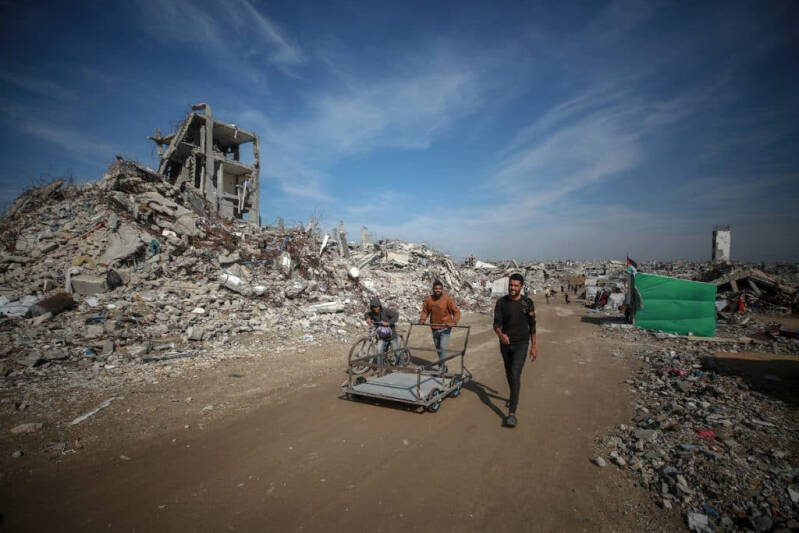
On Monday, the UN Security Council voted to endorse the Trump administration’s “International Stabilization Force” in Gaza. Palestinians in Gaza say it is just a new face of the same Israeli occupation.
Is a ‘post-Israel’ GOP on the horizon? Breaking down the battle over Israel on the U.S. Right
Michael Arria

Mondoweiss interviews Andrew Day, senior editor at American Conservative, about the fierce debate over Israel (and Epstein) happening on the right, neoconservatism’s role within the Trump administration, and what a “post-Israel” GOP might look like.
1975.

18 november 2025
Following a post-publication review, we have identified that one paragraph in Situation Report 23, regarding estimates of people staying in displacement sites, contained an inaccurate estimate and lacked clarity. It has been removed from the published report, with the omission marked by a double asterisk (**).
A revised and fully verified version is included in Situation Report No. 24 below.This report, issued daily from Monday to Saturday, outlines efforts and progress made by the UN and its partners to scale up humanitarian response across the Gaza Strip under the ceasefire that entered into effect on 10 October 2025. For all situation reports see here.
Gaza Humanitarian Response
Situation Report No. 24
18 November 2025
(As of 18:00 on 17 November 2025, unless otherwise noted)
HIGHLIGHTS
- On 15 November, more than 1.3 million meals were delivered by 26 partners through 195 kitchens: 181,000 in northern Gaza and about 1.2 million in Deir al Balah and Khan Younis governorates.
- As of 15 November, partners have delivered general food assistance to more than 64,000 households, reaching around 320,000 people, for the November distribution cycle.
- More than 7,000 children under age three were vaccinated in the first five days of the vaccination campaign, launched on 9 November.
SITUATION OVERVIEW
Since 10 October, the Site Management Cluster partners updated the status of 353 active displacement sites hosting some 621,000 displaced people: 275 sites are in the southern governorates hosting approximately 560,000 people, while 78 sites are in northern Gaza, hosting around 61,000 people.
It is estimated that more than 1 million people are still living in makeshift sites across the Strip with limited access to assistance and facing increasingly difficult conditions as winter approaches.
Cluster partners report that conditions are worsening as winter storms and flooding limit movement and access to services and sites and have resulted in cessation of many activities. Conditions are especially dangerous for children, older people, women, and persons with disabilities. The storms have also caused extensive damage to tents, facilities, and service points.
UNITED NATIONS-COORDINATED AID ENTRY*
On 17 November, 2,552 pallets of aid administered by the UN and its partners were offloaded at Gaza’s crossings, based on data retrieved from the UN 2720 Mechanism dashboard at 11:00 on 18 November. About 40 per cent of these pallets included food, followed by shelter supplies (35 per cent), nutrition supplies (11 per cent), health supplies (7 per cent), logistic and telecommunication materials (5 per cent), as well as other water, hygiene and sanitation (WASH) supplies and fuel (2 per cent).
As of 18 November, Kerem Shalom, Zikim, and Kissufim crossings are operational, with humanitarian cargo offloading and uploading alternating days between Zikim and Kissufim.
HUMANITARIAN RESPONSE
Food Security
- On 15 November, more than 1.3 million meals were delivered by 26 partners through 195 kitchens: 181,000 in northern Gaza and about 1.2 million in Deir al Balah and Khan Younis governorates.
- Partners are currently distributing daily about 160,000 bundles of 2 kilograms (kg) each that are produced by 18 UN-supported bakeries, eight of which are in northern Gaza. The bread is being distributed free of charge through partners at more than 400 distribution points, including community kitchens, while an additional network of 71 contracted retailers is selling it at a subsidized price.
- For the general food assistance monthly cycle of November, partners have assisted more than 64,000 households (320,000 people), as of 15 November. On 12 November, partners in northern Gaza have revised rations mid-cycle due to food parcel shortages, substituting contingency wheat flour and high energy biscuits in place of the two food parcels per family that previously met just 50 per cent of daily caloric requirements.
- Between 15 October and 16 November, about 712 metric tons of concentrated animal fodder was collected from the Kerem Shalom crossing. The second-round distribution of three 50-kg bags of fodder to around 1,700 herders in Deir al Balah started on 10 November.
- To support the ongoing joint flood mitigation efforts, partners continue to mobilize empty used flour/rice bags to donate for use as sandbags. More than 42,000 bags collected from partner-supported bakeries and kitchens have been delivered to site management partners to support the joint effort.
Health
- On 15 November, more than 1.3 million meals were delivered by 26 partners through 195 kitchens: 181,000 in northern Gaza and about 1.2 million in Deir al Balah and Khan Younis governorates.
- Partners are currently distributing daily about 160,000 bundles of 2 kilograms (kg) each that are produced by 18 UN-supported bakeries, eight of which are in northern Gaza. The bread is being distributed free of charge through partners at more than 400 distribution points, including community kitchens, while an additional network of 71 contracted retailers is selling it at a subsidized price.
- For the general food assistance monthly cycle of November, partners have assisted more than 64,000 households (320,000 people), as of 15 November. On 12 November, partners in northern Gaza have revised rations mid-cycle due to food parcel shortages, substituting contingency wheat flour and high energy biscuits in place of the two food parcels per family that previously met just 50 per cent of daily caloric requirements.
- Between 15 October and 16 November, about 712 metric tons of concentrated animal fodder was collected from the Kerem Shalom crossing. The second-round distribution of three 50-kg bags of fodder to around 1,700 herders in Deir al Balah started on 10 November.
- To support the ongoing joint flood mitigation efforts, partners continue to mobilize empty used flour/rice bags to donate for use as sandbags. More than 42,000 bags collected from partner-supported bakeries and kitchens have been delivered to site management partners to support the joint effort.

Protection
- On 16 November, partners delivered mental health and psychosocial support (MHPSS) to more than 60 people through dedicated sessions; 35 “Helping the Helpers” sessions for staff, Individual Protection Assistance /Protection Case Management support to 46 people; cash for protection for 10 high-risk cases; and referrals for assistive devices. The activities also include the provision of mattresses, sealing-off kits (SOKs), and tents, as well as protection-by-presence during the distributions. Additionally, during these activities, partners also monitor the conditions of existing shelters, winter-related risks, and high-priority protection cases.
- Child Protection
- Child Protection (CP) partners continue to deliver child protection services across the Gaza Strip through child-friendly spaces (CFSs) and service points. Since the ceasefire, 26 CFSs were re-established in Gaza city and northern Gaza, enabling partners to safely resume MHPSS, case management, and community awareness activities for children. As of 17 November, 177 child protection service points/safe spaces are established and functioning across the Strip. Of these, 94 are in Deir al Balah and 54 in Khan Younis, both supported by 20 active CP partners.
- On 16 November, partners distributed winter clothing to 3,200 children in northern Gaza.
- Fuel allocations bottlenecks limit partner capacity to conduct distribution of winter clothes for children, especially in hard-to-reach areas in northern Gaza.
- Gender-Based Violence
- On 16 November, the partners provided multisectoral services across the Strip to 780 women and girls, including case management, psychosocial support, and other essential assistance, addressing urgent needs exacerbated by the current humanitarian situation.
- On 16 November, partners provided tents to re-establish multisectoral GBV services that were disrupted in areas of northern Rafah that were flooded by heavy rains.
1974.
18 november 2025
The UNSC vote marks a dark day for Palestine but also a clear cut conclusion: the current multilateral institutions and power dynamics won’t stop Israeli genocide and the world powers are complicit in not adhering to international law. It is up to us, Palestinians, with our allies in solidarity, to continue advocating for accountability measures and flipping the tables and power structures, to build a path for Palestinian self-determination, justice and reparations.
Israel is still killing Palestinians, forcibly displacing them, conducting land theft, uprooting trees and torturing prisoners. The United States is presenting the world with a false dichotomy: either accept their plan with all its flaws and non guarantees or accept going back to a livestreamed genocide. Presenting a choice between two mutually exclusive options, with the implication that these are the only two available options, is what the Americans are notorious for.
At the PIPD, we are building alternatives. We are resourcing the movement towards more strategic accountability wins. We understand our power and responsibility in organizing to end Israeli impunity and know its impacts so far.
Our Global Accountability Map has been tracking the concrete ways various actors, from the tech sector to workers to academia, are weaving justice and isolating colonial and genocidal interests.
- The University of Amsterdam suspended all new collaborations with Israeli universities, October 2025.
- Microsoft ended a military unit’s access to its AI and data services, blocking Israel’s use of its technology for mass surveillance of Palestinians following mass and strategic pressure, October 2025.
- A major Danish pension fund is divesting from Israeli state assets and government-controlled companies, September 2025.
- Over 1200 leading actors and directors pledged to refuse collaboration with Israeli film organizations implicated in the genocide, September 2025.
Let’s not stop now and flood the map with more wins.
1973.

18 november 2025
Today's headlines
UN Security Council approves Trump’s Gaza”peace plan”, green-lighting U.S.-Israeli control of Gaza’s future
Michael Arria and Qassam Muaddi
The UN Security Council voted in favor of Trump’s “peace plan” for Gaza, effectively giving the U.S. and Israel the mandate to push forward their vision for Gaza's future - a future that, notably, features no consideration for what Palestinians want.
Understanding the mindset behind Israel’s usage of rape as a weapon of genocide
Jonathan Ofir

Recent testimonies from the Palestinian Center for Human Rights share shocking stories of Palestinian rape victims released from Israeli detention. The stories are horrifying to read but essential for understanding Zionism and Israeli apartheid.
1972.
Breaking the silence
18 november 2025
few weeks ago, a ceasefire agreement came into effect. It was a genuine moment of relief. The living hostages were reunited with their families, and while some deceased hostages are still held in Gaza, for a brief moment, it seemed like a shift might be possible.
The intensity of bombings and killings has significantly decreased. Nonetheless, one month into the ceasefire agreement, Gaza remains under severe strain: massive bombings resume whenever the agreement falters, essential supplies are still scarce due to ongoing Israeli-imposed restrictions on humanitarian aid, and navigating daily life amid the ruins is still a nearly impossible task. Furthermore, the IDF continues its deliberate destruction of civilian infrastructure, with more than 1,500 buildings destroyed since the ceasefire.
The violence continues. On 28 October in Gaza, the IDF responded to a Hamas attack that killed a soldier with a series of heavy bombardments. Of the 104 people killed, 46 were children, 20 were women. This happens as the IDF continues to enforce its policy of using live fire against anyone attempting to cross the new line of withdrawal, now referred to as the Yellow Line. Until very recently, this line was completely unmarked, as it largely remains today, and therefore, effectively invisible to the civilian population. The ceasefire conceals the real danger posed by the extremely lax rules of engagement still applied to anyone who happened to be in this barely demarcated area. This policy has contributed significantly to the high civilian death toll.
According to a BBC investigation, Israel fired at Palestinians who had not even crossed that line, and some of the attacks occurred hundreds of meters from where the line was supposed to be.
This pause didn’t really stop the death machine; it just slowed it down.
“It’s important to me that people understand the meaning of a “no-go zone,” what it means when you blockade an area as a closed military zone and that anyone who enters it is sentenced to death”
The Deal’s Shortcomings
Trump’s plan for Gaza promises a freeze in military operations until “conditions are met” for staged withdrawal. But what conditions? Who is to decide? Under what timeframe? Does it adequately address the question of Palestinian statehood or the rights of millions living under occupation?
These are massive gaps that will inevitably bring us back to October 6th and an even more violent version of the Israeli policy of “managing the conflict”, that is, abandoning any attempt to end the occupation and resolve the conflict, and instead, trying to make life beside it ‘manageable’. As long as Trump’s plan fails to offer a clear path toward changing this horrific reality, violence will continue to define every aspect of life between the river and the sea.
Photo: Doaa Albaz, Activestills.
The Story of Sde Teiman
The former chief military advocate of the IDF was arrested over a leaked video allegedly showing a Palestinian detainee being sexually abused at the Sde Teiman detention center. Her arrest has been accompanied by a campaign aimed at casting doubt on what the video reveals and at eroding accountability for the abuse taking place for nearly 2 years in Israeli detention facilities. Systematic torture at Sde Teiman is an undeniable fact. The leaked video is only the tip of the iceberg.
Since October 7, Palestinians have been tortured and starved in Israeli detention centers. It’s been confirmed by testimonies from detainees, soldiers, doctors who served there, and is evident from the unimaginable number of Palestinians who were detained alive and returned in body bags. How many? As of August 2025, our partners from Physicians for Human Right – Israel reported that over 90 detainees had died in custody. Since then, the numbers have grown.
“...most of the time, there were 10 people standing with their hands above their heads, handcuffed to the fence above the head, so that they physically wouldn’t be able to put them down. The zip ties would be tied to the fence. And it was clear that people (soldiers) were really looking for these kinds of things, to punish, yes, to yell at them too.”
First Sergeant | Israel | 2023
Joel Carmel, our Advocacy Director, talked about Sde Teiman to PBS.
When Harvest Season Becomes Terror Season
While Gaza rightly draws urgent attention, the situation in the West Bank cannot be overlooked. It is now the olive harvest season in the West Bank, the most critical time of year for the livelihoods of many Palestinian farmers. The harvest provides a major source of income for hundreds of thousands of families and plays a vital role in the local economy.
Every year during this period, there is a noticeable rise in settler terror targeting Palestinian farmers and their property, including attacks on people, destruction of olive trees, theft of crops, and blocking access to farmland. This year, however, the violence has reached unprecedented levels, both in frequency and in intensity. According to the UN, in October alone, settlers carried out at least 264 attacks against Palestinians in the West Bank, the highest monthly total since UN officials began tracking. In addition to inflicting extensive damage on Palestinian property, settlers injured more than 140 Palestinians and several Israelis, among them a 53-year-old Palestinian woman who was hospitalized with a brain hemorrhage, as well as numerous severely beaten solidarity activists in Beita, Burin and Mukhmas.
Such terror attacks would not be possible without the complicity of the IDF. In its recent report, Israeli security officials link the rise in settler attacks to the inaction of the police and Shin Bet as well as to political support from government ministers, MKs, and leading religious figures. Nonetheless, the IDF itself plays an essential role in the ongoing state-backed terror in the West Bank. Our testifiers have been indicating for years, long before October 7th, that during pogroms the army, at best, turns a blind eye to settler terror while protecting the attackers, and at worst takes an active part in the pogroms.
Photo: Beita, 10.10.2025, Avishay Mohar, Activestills,
A soldier testimony recently published in the Israeli news outlet Ynet confirms this reality and also highlights the growing role of the so-called regional defense units (“Hagmar”) in the current ongoing wave of terror. These units are generally composed of local settlers and armed by the IDF, to which they are formally subordinate. In practice, however, these units operate as this soldier defined them, as “armed militias with no oversight”, further blurring the line between the army and the settlers.
“The ‘Regional Defense Units’ decide what to do, and that’s it. You have no control. Our officers saw it and turned a blind eye. They had full backing from the brigade command.”
Settler terror, along with a surge in new outposts, demolitions, and draconian movement restrictions imposed by the IDF with increasing intensity since October 7th, constitute a policy aimed at ethnically cleansing as many areas of the West Bank as possible, and ultimately, establishing de facto annexation, despite Trump’s declarations to the contrary.
Who’s Scared of Solidarity?
Last Friday, we were barred from entering the West Bank, along with the other activists headed to the solidarity olive harvest organized by our partners from Peace Now. In addition, two of our own regular tours were denied entry to the West Bank that same day. The purpose of these tours was to expose Israelis to the reality of the occupation. Remarkably, the army once again chose to fight knowledge and solidarity, rather than settler terrorism. The order issued by the military stated that barring us from the West Bank had been “essential for maintaining public order”. This is hardly surprising: solidarity and knowledge are exactly what is necessary to end the occupation, and that is a ‘risk’ we pose indeed.
Photo: Last year’s solidarity harvest in the West Bank
An Invitation to Watch
Last Monday, the British public broadcaster ITV aired a documentary featuring testimonies from Israeli soldiers, many of whom are our testifiers. Those testimonies, like many others that we have collected, expose brutal policies underlying Israel’s warfare in Gaza. Among other things, the documentary shows the systematic use of Palestinians as human shields and the extremely lax rules of engagement that permitted and led to devastatingly disproportionate harm to civilians. This is an important and insightful watch.
Take Action
Join a tour: See the reality on the ground in Hebron and the South Hebron Hills.
Support our work: Your donation helps us continue collecting testimonies and bringing Israelis and internationals to witness the occupation firsthand.
Spread the word: Share our materials, testimonies, and reports. Help break the silence.
ADDITIONAL READING
Click on the images to read the full texts
HOW WE FIGHT IN GAZA
“The Perimeter:” our new collection of soldiers’ testimonies chronicles the systematic annihilation and expropriation of entire villages and agricultural zones - anything that lay in the newly created Gaza buffer zone, which the IDF “completed” last December.
Since Oct 2023, Israeli officials have been consistently saying that the 238,000 Palestinians who once lived in this zone will not be allowed to return. This collection details the ethnic cleansing of around 16% of the Gaza Strip.
At the time of writing, it seems the perimeter is being expanded further.
1971.

17 november 2025
Gaza Humanitarian Response
Situation Report No. 23
17 November 2025
(As of 18:00 on 15 November 2025, unless otherwise noted)
HIGHLIGHTS
- Health coverage is expanding. As of 16 November, the number of health service points rose to 219, compared to 197 in October.
- Between 14 and 16 November, cluster partners helped to distribute at least 83,000 tarpaulins, 59,000 blankets and 9,000 tents across the Strip.
SITUATION OVERVIEW
Heavy rain on 14 November caused severe flooding across Gaza, especially in Gaza city and northern Gaza, affecting over 13,000 families. The rain also further damaged drainage systems, destroyed thousands of tents, and disrupted humanitarian activities. Partners are providing emergency shelter and winterization support to the affected households with thousands of shelter items distributed in the past few days. OCHA and partners are prioritizing rapid assessments and urgent flood-mitigation efforts, though critical supplies are still awaiting entry.
The Site Management Cluster estimates the number of displaced people living in managed sites to be approximately 1.2 million with about 10 per cent in northern Gaza and 90 per cent in the rest of the Strip. Another 1 million people are estimated to live in informal makeshift sites with limited access to assistance and facing increasingly difficult conditions with the arrival of the winter season.
On 16 November, the Ministry of Health (MoH) in Gaza reported receiving 15 bodies of deceased Palestinian detainees, bringing the total since the start of the ceasefire to 330.
UNITED NATIONS-COORDINATED AID ENTRY*
Between 15 and 16 November, 3,670 pallets of aid administered by the UN and its partners were offloaded at Gaza’s crossings, based on data retrieved from the UN 2720 Mechanism dashboard at 12:00 on 17 November. About 58 per cent of these pallets included food, followed by shelter supplies (27 per cent), WASH supplies (12 per cent), and various other kinds of supplies (4 per cent).
Between 11 and 15 November, 842 truckloads were collected from Gaza’s crossings: 658 from Kerem Shalom, 61 from Kissufim and 123 from Zikim. These contained 9,553 pallets of food parcels, mixed food and water, 856 pallets of wheat flower and 75 mt of animal fodder; 3,447 pallets of winter clothes, tents, blankets, tarpaulins, kitchen sets, and mattresses; 938 pallets of dignity kits, hygiene kits, and diapers; 236 pallets of medical items and medicine; 6 pallets of generator oil; and 188,200 litres of fuel.
As of 17 November, Kerem Shalom, Zikim, and Kissufim crossings are operational, with humanitarian cargo offloading and uploading alternating days between Zikim and Kissufim.
HUMANITARIAN RESPONSE
Health
- Health partners continue to deliver routine services across the Strip and health coverage is expanding. As of 16 November, the number of health service points rose to 219, compared to 197 in October. The 22 new service points are 12 primary health care centres, six medical points across the Strip and in four hospitals: Rantissi, Haifa, Gaza Ophthalmic and St John’s Eye hospitals in Gaza city.
Water, Sanitation and Hygiene
- As of 16 November, WASH partners continued with the following activities:
- Repairs of critical water and wastewater infrastructure, including the South Well; resumption of pumping at Al-Amal Basin; continued installation of the additional Sheikh Radwan pipeline (600/1,000 m completed) and launch of wastewater network repairs at three priority locations.
- Intensification of stormwater and winterization preparedness with the Coastal Municipalities Water Utility (CMWU): opening and cleaning the blocked Salah Ad Din stormwater culvert, debris removal at Manara and Saftawi stations, and deployment of mobile pumps and vacuum trucks to manage flooding across northern Gaza.
- Partners strengthened power supply capacities by delivering 6,012 litres of generator oil to CMWU, and installing and operating generators. The Beit Lahia Municipality fabricated a mobile trailer to move generators between wells.
- Debris was removed from key sites, enabling maintenance at secondary wells in Sheikh Radwan, clearing access to Al-Quds Well in Jabalia, and accelerating cleanup at Al Shifa Hospital desalination plant site.
- Rain triggered widespread flooding, particularly in Gaza city and northern Gaza, with thousands of families affected and their tents damaged or destroyed. Sheikh Radwan Basin rose by 37 cm, prompting urgent field action and continuous vacuum truck operations. Various materials for winterization (flood mitigation) remain blocked from entering Gaza.
Protection
- Since 14 November, partners provided mental health and psychosocial support, psychosocial support, child protection, gender-based violence (GBV) prevention and response, explosive remnants of war/mine risk education and awareness activities to more than 28,000 people, including children, women, caregivers, frontline workers, people with disabilities, and displaced families. The services included 140 sessions of speech therapy, 27 sessions of physiotherapy, 260 case management of new and follow-up cases of people in need, and legal counselling to 15 people. In addition, partners provided dignity kits, menstrual hygiene management supplies, diapers, hygiene parcels, food parcels, water containers, cash, and winter clothing to almost 4,000 families.
- Child Protection
- On 15 and 16 November, partners distributed 3,000 winter kits across the Strip.
- During the same period, more than 4,400 winter clothing kits were distributed to maternity hospitals across the Strip. Another 6,300 winter clothing kits for children under 2 were received and are planned for distribution this week.
- Since the start of the ceasefire, the partners distributed about 33,000 winter clothing kits with more distributions planned in the near future.
- Gender-Based Violence
- GBV prevention and response activities continued across the 36 Women and Girls Safe Spaces across Gaza, reaching over 8,700 people last week with multisectoral services, including psychosocial support, case management, and dignity kit and menstrual hygiene material distribution.
- Mine Action
- Over 160 Unexploded Ordnance (UXO)-related cases have been referred to partners for follow up since the ceasefire, with no newly reported incidents in recent days. Teams continue assessments and inter-agency missions across Gaza.
Shelter
- On 15 and 16 November, more than 10,000 tents entered the Strip.
- Between 14 and 16 November, cluster partners helped to distribute at least 83,000 tarpaulins, 59,000 blankets and 9,000 tents across the Strip. Additional distributions are planned in the coming days.
Education
- Several temporary learning spaces were damaged by the rainstorms, and partners are now assessing repair needs and required materials.
- The Cluster is coordinating with partners to address challenges preventing students from accessing their exam results, including technical issues such as passwords used during exams not being linked to their registration IDs.
Site Management
- Partners are working to address flooding impact and prepare for worsening winter conditions by identifying high-risk sites, assessing alternative location options, and coordinating drainage works, despite severe constraints on supplies and capacity.
* All figures solely refer to UN and partner assistance dispatched through the UN-coordinated system. They are preliminary and will be reconciled in the course of the ceasefire. Supplies entering through bilateral donations and the commercial sector are not reflected.
1970.

17 november 2025
Today's headlines
From the Favelas to Gaza: How militarism and greenwashing shape Brazilian relations, resistance, and solidarity with Palestine
Andressa Oliveira Soares
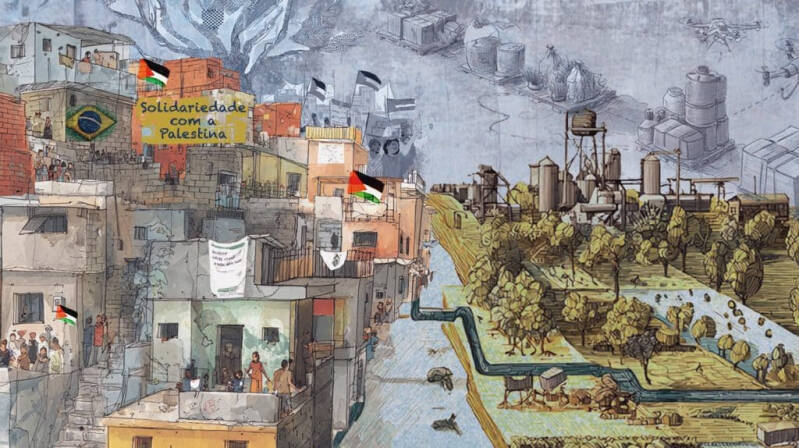
Brazilians have long supported Palestine, but the country's economic and military ties with Israel continue to deepen. As Israel's links to Brazil's domestic inequality, agribusiness, and state violence become clearer, Palestinian solidarity grows.
Book Review: Charting Judaism’s moral crossroads at the Gaza genocide
Mark Braverman
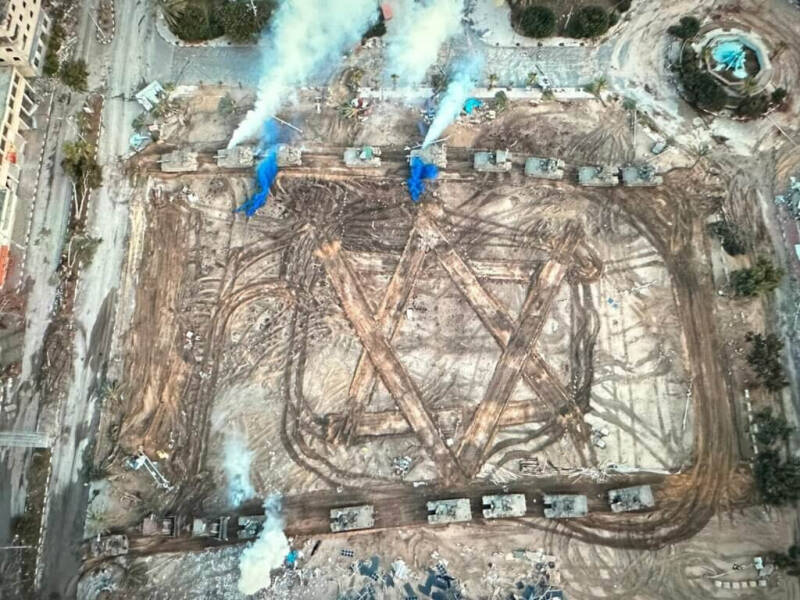
"Thou Shalt Not Stand Idly By: Jews of Conscience on Palestine" gathers over a century of Jewish voices opposing Zionism. The moral clarity of its contributors is more needed than ever as the self-proclaimed Jewish state commits a genocide in Gaza.
1969.

16 november 2025
The Gaza “ceasefire” that exists only on paper
One month into the so-called Gaza ceasefire, Noor Alyacoubi shows that very little has actually changed for Palestinians. Israel keeps bombing, the economy is shattered, and parents struggle to find enough food to keep their kids alive.
Israel has chopped Gaza in half with a “yellow line” that puts more than half the Strip under direct military control. Tareq Hajjaj reports that Palestinians are being shot and killed simply for trying to cross back to their homes or even approaching the boundary.
Qassam Muaddi tracks a new bill in the Israeli Knesset to impose the death penalty on Palestinian prisoners, a move that far-right leaders want to stretch into open permission for extrajudicial killings. Jonathan Ofir comments on a conference for Yitzhak Rabin that accidentally reveals how deeply the so-called Israeli peace camp helped pave the way for the Gaza genocide.
Donald Trump is pushing Israel–Saudi normalization to lock in U.S. weapons deals and regional dominance, Mitchell Plitnick explains, even if a formal agreement never appears. Back in U.S. politics, Michael Arria shows how AIPAC, once a gatekeeper to elected office, has started to look like a political hazard as more candidates decide Israel is now a liability, not an asset.
In Jenin, David Lombeida’s photo essay captures everyday life in the refugee camp before Israel emptied it out earlier this year in a brutal ethnic cleansing operation. Majd Awad follows the story of the Jenin Freedom Theater, a pillar of “cultural resistance” that has been forced to shut down and is now gathering stories of displacement instead of staging plays.
As Israel’s assault on Palestinian life grinds on and repression of global dissent intensifies, the stakes for honest reporting could not be higher. Mondoweiss is an independent source of news and analysis rooted in solidarity with Palestine, uncovering apartheid, displacement, and the organizing that pushes back against them. If you value this kind of unapologetic, movement-grounded journalism, please make a donation today so we can expand our coverage and deepen our impact.
David Reed, Publisher
Must read: One month in, the ‘ceasefire’ in Gaza exists only in name
Noor Alyacoubi: Palestinians hoped the Gaza ceasefire with Israel would offer a chance to recover from two years of genocide, but a month later, Israel continues to strike with impunity, the economic crisis remains, and nutritious food is nearly impossible to find.

Palestinian families returning to the Shuja'iyya neighborhood in eastern Gaza City, continue their lives with limited means among the buildings reduced to rubble by Israeli attacks, on November 4, 2025. (Photo: Omar Ashtawy/APA Images)
Genocide in Gaza
Tareq Hajjaj: As part of the ceasefire, Gaza has been split in half by the so-called 'yellow line,' where Israel's military controls just over 50% of the Strip. Palestinians are being killed for trying to cross or even get close to the line.
Qassam Muaddi: Israel is advancing a dangerous bill to impose the death penalty on Palestinian prisoners. Right-wing leaders want to go even further and use the bill to give Israeli forces the authority to carry out extrajudicial killings.
Jonathan Ofir: A conference commemorating Yitzhak Rabin unintentionally highlighted the Israeli left’s central role in laying the groundwork and carrying out the Gaza genocide.
Catch-up
Mitchell Plitnick: Donald Trump aims to push Israel-Saudi normalization next week during his meeting with Mohammed bin Salman. MBS favors a weapons deal and a defense pact, while Israel will be in the background, working to ensure its regional dominance remains intact.
Michael Arria: For years, AIPAC played a key role in U.S. politics as a campaign financing powerhouse, but now aspiring candidates are distancing themselves from the group. What lies ahead for the Lobby as the Gaza genocide has made Israel a political liability?
David Lombeida: Jenin refugee camp was completely emptied of its residents during Israel's ethnic cleansing operation earlier this year. These are photos of life in the camp before its most recent Nakba.
Felix Nobes: Inside one Palestinian family’s harrowing experience of having their son's dead body withheld by Israel as a bargaining chip. Israel has held the bodies of 726 Palestinians in refrigerators and the so-called "cemetery of numbers" for decades.
Andressa Oliveira Soares: Brazilians have long supported Palestine, but the country's economic and military ties with Israel continue to deepen. As Israel's links to Brazil's domestic inequality, agribusiness, and state violence become clearer, Palestinian solidarity grows.
Mark Braverman: "Thou Shalt Not Stand Idly By: Jews of Conscience on Palestine" gathers over a century of Jewish voices opposing Zionism. The moral clarity of its contributors is more needed than ever as the self-proclaimed Jewish state commits a genocide in Gaza.
Majd Awad: The Jenin Freedom Theater, an embodiment of the "cultural resistance" genre of committed art, ceased operations after the Israeli army ethnically cleansed the Jenin refugee camp's residents. The theater is now gathering stories of displacement.
1968.
16 november 2025
Did you see Mike’s update below? What he learned from our partners at the Palestine Fair Trade Association is worth your time.
Our 2025 Rooting Resistance campaign is almost over—read Mike’s update below, then join the 1244+ people who have chipped in toward our goal of planting over 4,000 olive trees in Palestine.
I spoke with our partners at the Palestine Fair Trade Association (PFTA) last week on our Rooting Resistance campaign, and I wanted to share with you what I heard directly.
The situation around Jenin—where their office is based—is slightly better than it was earlier this year. In January and February, it was often too dangerous to even reach their office. But as one of the PFTA staff members told me:
“We’re a little bit safer than at the beginning of the year. But we’re not safe at all.”
That sentence, and what she went on to share, has been sitting with me ever since.
The olive harvest has begun, but it’s far from normal. In many so-called “closed zones,” only one family member—often an elderly man—is granted a permit to harvest the family’s trees. Israeli settlers have attacked farmers, including at least one who received PFTA saplings from last year’s Rooting Resistance campaign.
And yet, Palestinian farming families persist. They keep applying for trees, keep tending their groves, and keep returning to the land.
With your help, they can keep planting new saplings too.
This year, after the Palestinian Ministry of Agriculture ended its tree distribution program, demand for trees to the PFTA has skyrocketed.
That’s why this year’s Rooting Resistance campaign is more critical than ever.
When you give before November 15, your donation ensures PFTA can confirm how many families they’ll be able to support—and place orders with local Palestinian-owned nurseries to grow the trees those farmers will plant early next spring.
Donate now to plant olive trees and sustain Palestinian farmers. And as always, part of your Rooting Resistance gift will also support USCPR’s organizing work in the U.S.
Nico, these aren’t just agricultural practices. They’re acts of survival—and of vision.
We have until mid-November to meet this moment and ensure PFTA can help every farmer who’s reached out.
Will you join me today in planting hope, protection, and resistance?
Thank you,
MIKE DALY
Development Director
USCPR
1967.

16 november 2025
My name is Didi Remez, and I am writing to you for the first time as the new Executive Director of Refuser Solidarity Network. More than twenty years ago, while serving as a commander in the Israeli army reserves during the Second Intifada, I reached a breaking point. I refused to serve in the occupied territories. It became clear to me that the missions we were carrying out had nothing to do with protecting anyone. They were about dispossessing Palestinians and enabling settlement expansion. Once I understood that, I could not continue. Since then, I have devoted my life to opposing the occupation and exposing the machinery that sustains it. As I enter my new role, I hope to get to know our global community of supporters better: who you are, and what fuels your support of the war refusers movement here in Israel-Palestine. I need you to fill out this form so that we can begin to build international connections of solidarity
Support War Refusers
For the past two years, I have led RSN’s work supporting reservists who refused service. In that time, we witnessed something historic. Refusal became visible, tangible, and contagious. People who never imagined refusing began to see it as a real option. Hundreds joined.
I step into this role at a complicated moment. Israel has agreed to a ceasefire, and many are eager to declare that the worst is over. The government presents the ceasefire as closure, as proof that its assault has ended. But anyone paying attention knows the truth. The fire has not ceased. Gaza is still in ruins. People are still dying from the collapse of basic infrastructure, from hunger, from the impossibility of rebuilding. Lebanon is under constant attack. Violence continues every day. A ceasefire on paper does not stop a war machine that has spent decades perfecting the logic of domination.
Support War Refusers
This moment presents a new challenge. The government hopes that the ceasefire will cool the public outrage that refusal helped ignite. It hopes to demobilize people, to return refusal to the margins. We cannot allow that to happen.
Refusal is not a reaction to one war. It is a strategy to dismantle the system that makes war inevitable. The long emergency continues. The occupation continues. The logic of annihilation continues. RSN will continue to grow a culture of refusal that undermines that system at its core. Thank you for walking with us into what comes next. Please introduce yourself by filling out our form so that we can continue to grow as an international movement.
n solidarity,
Didi Remez
Executive Director
Refuser Solidarity Network
1966.

15 november 2025
Gaza Humanitarian Response
Situation Report No. 22
15 November 2025
(As of 18:00 on 14 November 2025, unless otherwise noted)
HIGHLIGHTS
- On 14 November, more than 13,000 households were affected by rain and flooding across Gaza.
- As of 14 November, Kerem Shalom, Zikim and Kissufim crossings remain open and operational, with humanitarian cargo offloading and uploading alternating days between Zikim and Kissufim.
SITUATION OVERVIEW
On 14 November, more than 13,000 households were affected by rain across Gaza. Hundreds of tents and makeshift shelters across the Strip were reportedly flooded, leaving households exposed to harsh weather, loss of belongings, and heightened protection and health risks, particularly for people with disabilities, older persons, and other vulnerable groups. OCHA and partners are compiling information of the affected areas while response to affected households has started.
UNITED NATIONS-COORDINATED AID ENTRY*
As of 14 November, Kerem Shalom, Zikim and Kissufim crossings are operational, with humanitarian cargo offloading and uploading alternating days between Zikim and Kissufim.
On 14 November, based on preliminary data, 43 UN-coordinated trucks carrying food parcels were sent from Ashdod to Zikim crossing for offloading.
Aid crossings into Gaza will be closed for cargo offloading on 15 November due to Shabbat, though partners will be able to uplift aid from the crossings.
HUMANITARIAN RESPONSE
Food Security
- For monthly general food assistance, as of 12 November, partners have assisted more than 53,000 households, through 52 distribution points in the Gaza Strip, including 16 in northern Gaza since the start of the month. Although thousands of metric tons of food parcels are available in various corridors, scanning and prioritization issues continued to limit arrivals during the previous weeks.
- Starting on 12 November, in the north, due to food parcel shortages, partners altered rations mid-month. Contingency wheat flour and high energy biscuits were distributed, instead of each family receiving two food parcels to sustain distributions.
Health
- To enhance sexual and reproductive health services, including maternal and neonatal care, partners distributed 8 incubators, 17 delivery beds, 17 cardiotocography (CTG) devices for fetal monitoring, 22 examination tables, 10,263 postpartum kits, and 24,000 disposable gowns to four hospitals in Gaza city (Al Sahaba, Patient Friendly, Al Helou and Al Quds) and IMC Hospital in Deir al Balah.
- Partners also supplied a range of life-saving medicines, including five Inter-Agency Reproductive Health Kits designed to address the reproductive health needs of approximately 2,365 women and girls in Nasser Hospital, Al Aqsa Hospital, and primary health care centres in An Nuseirat and Az Zawaida. These kits include supplies for post-rape care, sexually transmitted infections, and intra-uterine devices, among others.
Water, Sanitation and Hygiene
- WASH Cluster partners are rehabilitating the Southern UN well in Khan Younis to restore water supply services for 30,000 people.
- A partner-supplied generator has been mounted on a two-wheel trailer for Beit Lahia to facilitate water production from multiple wells.
- Debris removal has been completed on Najy Al Ali Street near Sheikh Radwan pond allowing access for secondary water well repairs to serve returning populations.
- A partner has repurposed three roll-on/roll-off trucks for solid waste transfer.
- A partner distributed 166,220 towels, 325 buckets (18L) and 40 add-on kits, benefiting approximately 170,000 people across the Gaza Strip.
1965.

15 november 2025
Today's headlines
Why normalization between Israel and Saudi Arabia won’t happen now, regardless of what Trump wants
Mitchell Plitnick
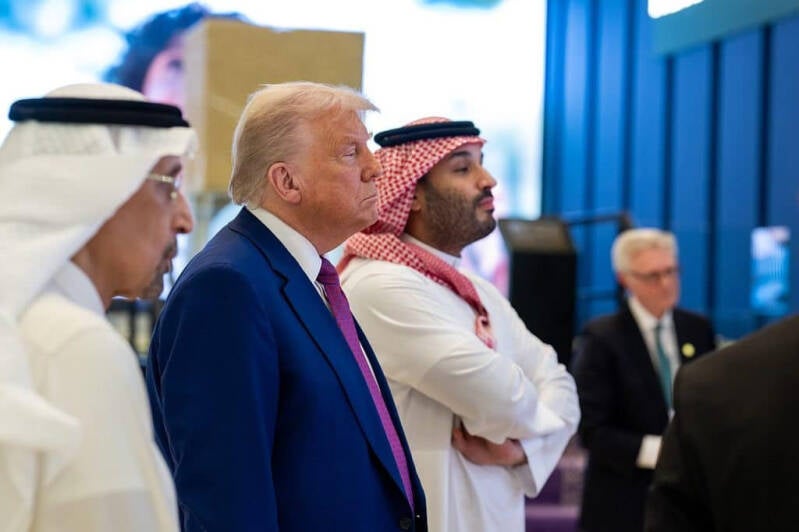
Donald Trump aims to push Israel-Saudi normalization next week during his meeting with Mohammed bin Salman. MBS favors a weapons deal and a defense pact, while Israel will be in the background, working to ensure its regional dominance remains intact.
1964.
15 november 2025
Join us for a discussion on an under-reported issue that continues to be a major obstacle to ending Israel's international impunity: Economic and Physical Coercion.
The United States has imposed unilateral sanctions on the International Criminal Court, UN rapporteurs, and Palestinian human rights groups, and has threatened aid freezes and tariffs on states like South Africa that pursue legal and policy action. Simultaneously, threats of continued or escalated violence have been wielded in ceasefire talks.
By revisiting anti‑colonial histories of sanctions and decolonization, the discussion seeks ways to counter state‑driven economic, diplomatic, and force‑based coercion, promote multilateral sanctions and accountability measures on Israel, and advance transitional justice in Gaza in line with international obligations.
DATE: Wednesday, 19 November
TIME:
11am Colorado
1pm New York
6pm GMT
8pm Cairo/Jerusalem
5am Sydney (20 Nov)
Speakers:
- Jessica Whyte - Associate Professor at the University of New South Wales, Australia
- Shahd Hammouri - Lecturer at the University of Kent, UK
- Maryam Jamshidi - Associate Professor of Law at the University of Colorado Law School, US
- Abdoulaye Ndiaye - Assistant Professor, New York University, Stern School of Business, US
- Abdelghany el Sayed - Associate Lecturer, American University of Cairo, Egypt

1963.

14 november 2025
Congresswoman Tlaib’s genocide resolution forces the U.S. to confront its role in genocide and demands immediate action and accountability
AJP Action is proud to endorse Congresswoman Rashida Tlaib’s historic resolution, H.Res. 876, which does what our government has shamefully refused to do: formally recognize the Israeli state’s deliberate and systematic destruction of the Palestinian people in Gaza for what it is.
This is not a matter of opinion or political debate. It is a legal and moral fact. The evidence is overwhelming and undeniable: the mass killing of at least 68,000 Palestinians (this number is a conservative estimate) in less than two years, the calculated obliteration of every university and hospital, the weaponization of starvation and manufacturing famine, and the explicit statements of intent by Israeli officials to erase Gaza from existence. This resolution forces Congress to look directly at the monstrous reality it has funded and armed.
“At this very moment, as Israel continues its atrocities under the cover of a false ceasefire, the need for this resolution is more critical than ever. For years, our tax dollars have funded this genocide, and our government's unwavering political and financial endorsement has enabled it. This resolution obliterates any pretense of neutrality. It is a line in the sand. To every member of Congress: you are either with the victims of this slaughter, or you are with the perpetrators. There is no middle ground. History will not forget your vote. History will not forgive your cowardice. The Palestinian people deserve more than our thoughts and prayers; they deserve our immediate and total action to end this nightmare,” said Dr. Osama Abu Irshaid, AJP Action’s Executive Director.

H.Res. 876 does more than just document Israel's atrocities; it forces a reckoning. It demands that the U.S. government stop being complicit and start honoring the Genocide Convention. This means taking concrete, immediate action such as:
- An immediate arms embargo: Halting all weapons transfers to Israel.
- Prosecuting complicity: Investigating and charging U.S. individuals and corporations who are abetting this genocide.
- Honoring international law: Fully complying with the International Court of Justice and supporting the International Criminal Court's investigations.
- Imposing severe consequences: Enacting lawful sanctions against Israel and all entities involved in or facilitating the genocide.
We extend our deepest gratitude to Rep. Tlaib for her moral courage in introducing this resolution, and to all the original co-sponsors for their leadership in this critical moment:
Reps. Becca Balint (VT-AL), André Carson (IN-07), Greg Casar (TX-35), Maxine Dexter (OR-03), Maxwell Alejandro Frost (FL-10), Jesús G. “Chuy” García (IL-04), Al Green (TX-09), Pramila Jayapal (WA-07), Henry “Hank” Johnson, Jr. (GA-04), Ro Khanna (CA-17), Summer Lee (PA-12), Jim McGovern (MA-02), Alexandria Ocasio-Cortez (NY-14), Ilhan Omar (MN-05), Mark Pocan (WI-02), Ayanna Pressley (MA-07), Delia C. Ramirez (IL-03), Lateefah Simon (CA-12), Nydia Velázquez (NY-07), and Bonnie Watson Coleman (NJ-12).
Don’t see your member on this list? Take action here. Flood their phone lines, pack their town halls, and demand they co-sponsor H.Res. 876. There can be no more excuses.
In solidarity,
Americans for Justice in Palestine Action
1962.

14 november 2025
Gaza Humanitarian Response
Situation Report No. 21
14 November 2025
(As of 18:00 on 13 November 2025, unless otherwise noted)
HIGHLIGHTS
- On 12 November, more than 1.3 million meals were delivered by 25 partners through 194 kitchens:143,000 in northern Gaza and more than 1.2 million in Deir al Balah and Khan Younis governorates.
- On 13 November, humanitarian partners distributed more than 6,500 tarpaulins, 229 blankets, and 996 tents in Deir al Balah and Khan Younis.
- Since the start of the ceasefire, partners installed 660 household latrines in Deir al Balah, benefiting 660 families.
SITUATION OVERVIEW
On the night of 12 November, the remains of an Israeli hostage was handed over to the Israeli authorities.
Partners continue to scale up response across Gaza in line with the 60-day Ceasefire Plan, but they are facing multiple impediments that impact speed and efficiency. After two years of war, the needs are immense. To reach more people faster, full and sustained opening of existing and additional crossings is required, bureaucratic and administrative bottlenecks must be removed, safety of convoys and humanitarian staff must be guaranteed, additional routes within Gaza must be opened, and the work of international non-governmental organizations must be facilitated.
UNITED NATIONS-COORDINATED HUMANITARIAN AID ENTRY*
On 13 November, 3,041 pallets of aid administered by the UN and its partners were offloaded at Gaza’s crossings, based on data retrieved from the UN 2720 Mechanism dashboard at 14:00 on 14 November. About 67 per cent of these pallets included food, followed by shelter supplies (27 per cent), agriculture and livestock supplies (4 per cent), and WASH supplies (2 per cent).
On 13 November, based on preliminary data, at least 1,539 pallets of blankets, high energy biscuits, winter clothes, diapers and medical supplies, as well as 209,000 litres of fuel were collected from the crossings under the United Nations coordinated mechanism. This data excludes bilateral donations and the commercial sector.
As of 14 November, Kerem Shalom and Kissufim crossings remain open and operational, with humanitarian cargo offload reportedly planned on 14 November at Zikim crossing.
Meanwhile, Government-to-Government convoys from Jordan remain suspended since 18 September and ongoing customs delays and stringent scanning procedures continue at Ashdod Port.
Within Gaza, the Salah ad Din Road remains closed for cargo. As a result, supply collection in the south remains limited to the narrow and highly congested Philadelphi Corridor/Al-Rasheed Road, exposing convoys to heightened risks of interception, particularly when loaded trucks are forced to hold in crowded areas.
HUMANITARIAN RESPONSE
Food Security
- On 12 November, more than 1.3 million meals were delivered by 25 partners through 194 kitchens:143,000 in northern Gaza and more than 1.2 million in Deir al Balah and Khan Younis governorates.
- Between 1-11 November, partners assisted around 53,000 families, through 47 distribution points in the Strip, including 10 in northern Gaza, with two food parcels per family, covering 50 per cent of their daily caloric needs.
Shelter
- On 13 November, more than 10,000 tarpaulins and 18,000 ropes entered the Strip.
- During the same period, cluster partners distributed emergency shelter materials and other essential items across Gaza as follows:
- About 6,500 tarpaulins to more than 2,000 households in Deir al Balah.
- Some 229 blankets and 996 tents in Deir al Balah and Khan Younis.
- A cluster partner has begun installing makeshift tents from tarpaulins and wood for 1,000 families in Deir al Balah, east of Salah ad Din Road. The planned target is to reach 3,000 families. The site selection was coordinated with the Ministry of Public Works in Ramallah.
Water, Sanitation and Hygiene
- The Coastal Municipalities Water Utility (CMWU), with their partners continue the maintenance work on water and sewage networks in Gaza city, with an increased number of field teams. On 13 November, six teams carried out repairs in accessible neighbourhoods.
- CMWU and partners are conducting repairs to damaged wastewater networks at key locations, including Ansar Junction – Al-Quds Street, Holy Family Church, and Hael Abdul Hamid Street in the Sheikh Radwan neighbourhood in Gaza city.
- Debris removal has commenced at the Al Shifa Hospital desalination plant site in preparation for maintenance works. Once operational, the plant will be able to treat 500 m³of water daily.
- A cluster partner continues to support the subsidized water project targeting 20 desalination units, with a combined production capacity of up to 4,200 m³/day across the Strip, with the potential to provide drinking water to 700,000 people.
- Cluster partners continue distributing infection prevention and control supplies to critical healthcare facilities to strengthen infection prevention and control measures. These joint efforts aim to reduce transmission risks and ensure safer service delivery in the current emergency context.
- Since the start of the ceasefire, 660 household latrines have been installed in Deir al Balah, benefiting 660 families.
- Between 12 and 13 November, a cluster partner distributed 40 add-on kits for people with specific needs and relocated household sanitation units to northern Gaza to install latrines for the most vulnerable families.
Protection
- On 12 November, partners reported reaching over 1,246 people through integrated protection, psychosocial and humanitarian assistance. This includes 141 people receiving Mental Health and Psychosocial Support and 142 people receiving Psychological First Aid. Partners also provided structured psychosocial support to 98 women and children, psychoeducation to 334 people; supported 16 vulnerable families with cash assistance and delivered multiple capacity-building sessions for 20 frontline workers and volunteers.
- Child Protection (CP):
- Between 12 and 13 November, cluster partners reached 1,000 children and 435 caregivers across the Strip, delivering critical services including case management, psychological first aid, group and individual counselling, speech therapy, life skills training and positive parenting support. Community based child protection activities were carried out in 13 locations, while over 500 children and adults were reached through child protection awareness sessions on abuse, risk mitigation and protection risks.
- Mine Action:
- Twenty-three explosive hazard assessment requests and one inter-agency request were received. Mine Action partners conducted one formal explosive ordnance risk education training for UNDP rubble removal workers.
Emergency Telecommunication Cluster
- The main internet optic fibre line entering Gaza through Erez was severed on 3 November in a militarized zone, where access for repairs has been denied by Israeli authorities. Subsequent cuts to the backup fibre line on 6 and 9 November highlight the fragility of the network. The internet service provider is seeking necessary approvals to access the area in order to restore the connection.
Fuel
- Between 10 and 12 November, the UN Office for Projects and Services (UNOPS) distributed 412,658 litres of diesel to partners – 350,989 litres in the south and 61,669 litres in the north - as well as 3,589 litres of petrol to support critical WASH, health, logistics, rubble removal, telecommunication, education, nutrition and protection operations.
1962.

14 november 2025
Today's headlines
Israel is killing Gazans trying to return to their homes beyond the ‘yellow line’
Tareq S. Hajjaj

As part of the ceasefire, Gaza has been split in half by the so-called ‘yellow line,’ where Israel’s military controls just over 50% of the Strip. Palestinians are being killed for trying to cross or even get close to the line.
One month in, the ‘ceasefire’ in Gaza exists only in name
Noor Alyacoubi

Palestinians hoped the Gaza ceasefire with Israel would offer a chance to recover from two years of genocide, but a month later, Israel continues to strike with impunity, the economic crisis remains, and nutritious food is nearly impossible to find.
1961.

14 november 2025
Op zaterdag 13 december organiseert The Rights Forum in Amsterdam een bijzondere middag met twee buitengewone sprekers: de Israëlische historicus Ilan Pappé en de Palestijnse journalist Mariam Barghouti. Tickets zijn nu verkrijgbaar.

Ilan Pappé, auteur van The Ethnic Cleansing of Palestine en andere invloedrijke werken, heeft een belangrijke rol gespeeld in het uitdagen van het heersende beeld over de ontstaansgeschiedenis van Israël. Zijn onderzoek bracht het fundamentele geweld en de verdrijving van Palestijnen aan het licht die aan het Israëlische staatsproject ten grondslag liggen.
Vanuit haar huis op de bezette Westelijke Jordaanoever documenteert de Palestijnse journalist Mariam Barghouti hoe dit proces van onteigening en uitwissing vandaag voortduurt — via militaire bezetting, segregatie en controle over vrijwel elk aspect van het Palestijnse leven.
Het evenement biedt ruimte om dominante verhalen over de ontstaansgeschiedenis van Israël kritisch te bevragen, koloniale structuren zichtbaar te maken en samen na te denken over mogelijkheden voor verandering en rechtvaardigheid in Palestina.Praktische informatie
Datum en tijd: zaterdag 13 december, 13.00 uur tot 15.30 uur
Locatie: Aula der Universiteit van Amsterdam, Singel 411, 1012 WN Amsterdam
Voertaal: Engels
Reportage | Illegale kolonisten eten Palestijns Hebron van binnenuit op
Het kolonistengeweld op de Westelijke Jordaanoever neemt hand over hand toe. Niet alleen op het Palestijnse platteland, maar ook in de steden. Journalist Fréderike Geerdink was in Hebron en doet verslag.
'Welkom in Hebron’, zegt de eigenaar van een winkeltje in de souk van Hebron op de Westelijke Jordaanoever, die zijn naam liever niet geeft. ‘We hopen dat de vrijheid snel komt.’ Het klinkt cynisch, maar zo bedoelt hij het niet. Hij is serieus, of uit misschien gewoon een diep verlangen, tegen beter weten in. De bezetting heeft zijn handel en zijn leven onmogelijk gemaakt. Er is geen beweging richting vrijheid. De kolonisten rukken op, ook hier in het hart van de stad. Het vreemde is: ze bepalen alles, maar je ziet ze niet.
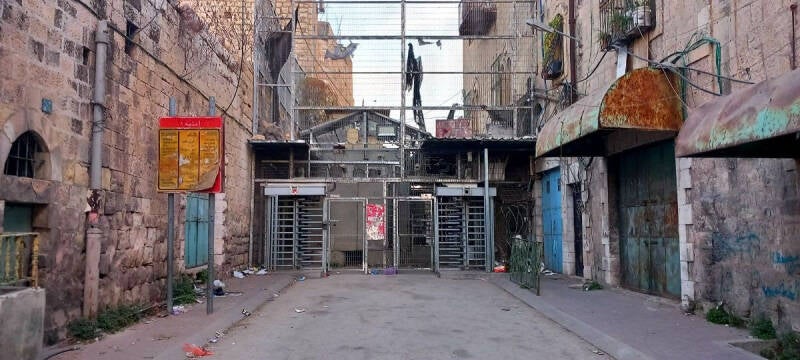
Een checkpoint in Hebron © Fréderike Geerdink
De ‘goede relatie’ met Israël drijft op onderdanigheid en gedogen
Demissionair minister van Buitenlandse Zaken David van Weel (VVD) bracht afgelopen week een bezoek aan Israël en Palestina. Ondanks mooie woorden over de Nederlandse relatie met Israël maakte het bezoek pijnlijk duidelijk hoe die relatie er écht uit ziet: Nederland laat zich slaafs koeioneren en gedoogt Israëls misdaden en inmenging in de Nederlandse politiek.
Dat bleek onder meer uit de afwikkeling van het gesprek dat Van Weel voerde met zijn Israëlische ambtgenoot Gideon Sa’ar. Na afloop vatte Van Weel het gesprek op X samen als een gedachtenwisseling over ‘het vredesplan en staakt-het-vuren, de urgentie van humanitaire actie in Gaza, de situatie op de Westelijke Jordaanoever en regionale ontwikkelingen’. Van Weel zag ‘een unieke kans voor vrede’.
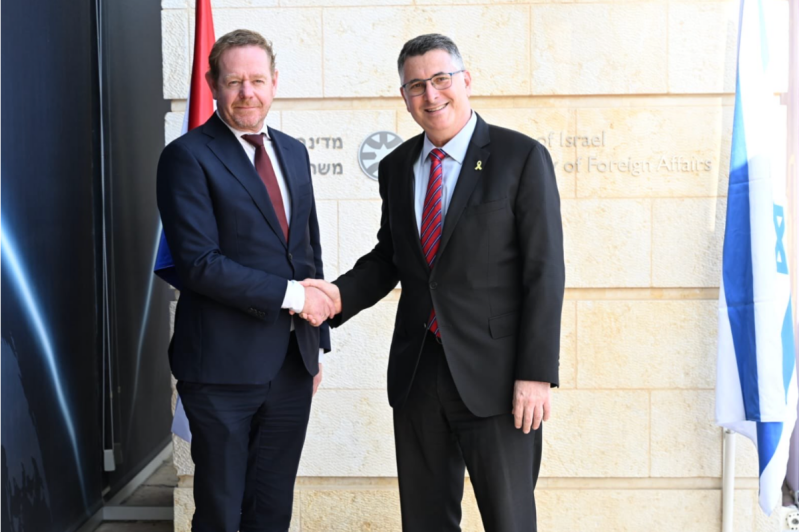
eruzalem, 6 november 2025. Demissionair minister van Buitenlandse Zaken David van Weel (links) schudt de hand van zijn Israëlische ambtgenoot Gideon Sa’ar. © X / David van WeelEven later postte ook Sa’ar zijn terugblik op het gesprek. Dat was volgens hem ook gegaan over ‘de wijdverbreide illegale Palestijnse constructie in Judea en Samaria’ die ‘moet worden veroordeeld’. Van de Israëlische bezetter mogen de Palestijnen namelijk niet bouwen op de Westelijke Jordaanoever – hun eigen land, door Israël herdoopt in ‘Judea en Samaria’. Zo werd de ‘unieke kans op vrede’ subiet de nek omgedraaid, maar Van Weel hield zich stil.
Een dag later postte Van Weel een bericht over zijn bezoek aan de door Israël bezette Westelijke Jordaanoever waarin hij schreef: ‘Palestijnen hebben hier te maken met geweld, intimidatie en onteigening. Uitbreiding van illegale nederzettingen en kolonistengeweld staan haaks op een tweestatenoplossing.’
Dat was aanleiding voor een frontale aanval op Van Weel door de Israëlische minister van Diasporazaken Amichai Chikli, die zoals gebruikelijk alle perken te buiten ging.

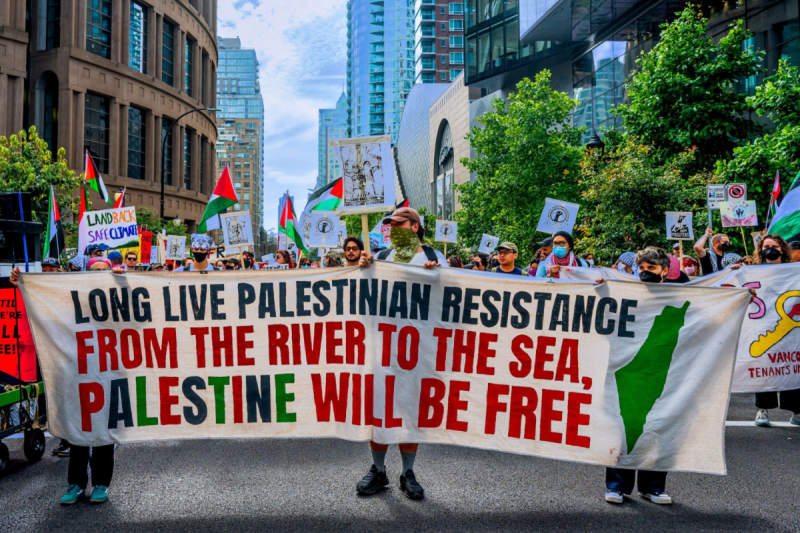
Palestijnen willen zelfbeschikking, geen nieuw dictaat van buitenaf
Voor het plan dat Trump de Palestijnen heeft opgelegd is nauwelijks draagvlak onder Palestijnen. Niet gek, omdat Palestijnen zelf niet aan tafel zaten bij het opstellen. Een nieuwe peiling laat zien wat Palestijnen wél willen: zelfbeschikking en een einde aan de bezetting.
Palestijns verzet mag, óók gewapend
Wat zegt het internationaal recht over de legitimiteit van gewapend verzet van de Palestijnen tegen de Israëlische bezetter? Aan welke regels is verzet gebonden? Onderzoeksjournalist Eline Derakhshan zocht het uit.
Uit onze agenda
zaterdag 15 november t/m zaterdag 22 november
DEMONSTRATIES EN WAKES
UTRECHT ELKE DOORDEWEEKSE OCHTEND (MA & VRIJ 08.00 - DI, WO, DO 08.30) | Doorlopend stilteprotest (Neude, Utrecht, langs het fietspad)
DEN BOSCH ZA 15 NOV 12.00 | Wake voor Palestina (Burgemeester Loeffplein)
HUIZEN WO 19 NOV 11.30 | Wekelijkse sit-in voor Gaza (Gemeentehuis)
DEN HAAG DO 20 NOV 12.00 | Sit-in van Rijksambtenaren bij het ministerie van Buitenlandse Zaken, Rijnstraat 8
STATIONS IN NEDERLAND DO 20 NOV 18.00 | Wekelijkse lawaaidemonstratie op stations in heel Nederland: Amersfoort, Amsterdam CS, Arnhem, Bergen op Zoom, Breda, Dieren, Doetinchem, Driebergen-Zeist, Ede/Wageningen, Enschede, Groningen, Heerlen, Hengelo, Hilversum, Leiden, Maastricht, Nijmegen, Purmerend, Regensburg DE, Sassenheim (17.00 uur), Sittard, Tiel, Tilburg, Utrecht, Veenendaal, Zaandam (17.30 uur), Zutphen
GRONINGEN ZA 22 NOV 13.00 | Tweewekelijkse wake van Vrouwen in het Zwart (Waagplein)
CULTURELE EN ANDERE EVENEMENTEN
AMSTERDAM DO 13 NOV - ZO 23 NOV | IDFA. Bekijk onze nieuwsbrief van vorige week voor een overzicht van Palestijnse films.
AMSTERDAM VR 21 NOV 19.30 | Protestmuziek voor Palestina (Pakhuis De Zwijger)
AMSTERDAM ZA 22 NOV 14.00 | Samen voor Gaza: een middag over rouw en verzet (Ru Paré)
Onze agenda wordt doorlopend aangevuld. Bekijk de hele agenda
1960.

13 november 2025
Gaza Humanitarian Response
Situation Report No. 20
13 November 2025
(As of 18:00 on 12 November 2025, unless otherwise noted)
HIGHLIGHTS
- On 12 November, WHO facilitated the medical evacuation of 19 critical patients, alongside 33 companions, from Gaza for specialized care abroad.
- The nutrition situation across the Gaza Strip showed improvement in October, with 110,000 children screened and 9,200 cases of acute malnutrition treated, down from 11,700 in September and 14,400 in August. Global and severe acute malnutrition rates dropped from 24 to 20 per cent.
- Some 44 partners continue water trucking and distribution across the Gaza Strip, including the repair of a well in Jabalya Camp and support to maintain generator access.
SITUATION OVERVIEW
According to the Site Management Cluster (SMC), movement of people across flow monitoring points from south to north of the Strip has remained steady, averaging approximately 4,000 movements per day over the past few days. Reverse movements from north to south have been minimal, averaging fewer than 100 per day.
UNITED NATIONS-COORDINATED HUMANITARIAN AID ENTRY*
On 12 November, 2,977 pallets of aid administered by the UN and its partners were offloaded at Gaza’s crossings, based on data retrieved from the UN 2720 Mechanism dashboard on 18:00 on 13 November. About 39 per cent of these pallets included food, followed by WASH supplies (29 per cent), shelter supplies (20 per cent), health supplies (8 per cent), and nutrition supplies (4 per cent).
On 12 November, based on preliminary data, at least 1,035 pallets of blankets, winter clothes, mattresses and hygiene kits, as well as 345,000 litres of fuel were collected from the crossings under the United Nations coordinated mechanism. This data excludes bilateral donations and the commercial sector.
As of 13 November, Kerem Shalom and Kissufim crossings remain open and operational. On 12 November, Zikim crossing reopened.
Meanwhile, Government-to-Government convoys from Jordan remain suspended since 18 September and ongoing customs delays and stringent scanning procedures continue at Ashdod Port.
Within Gaza, the Salah ad Din Road has not yet reopened. As a result, cargo collection in the south remains limited to the narrow and highly congested Philadelphi Corridor/Al-Rasheed Road, exposing convoys to heightened risks of interception, particularly when loaded trucks are forced to pause in crowded areas.
HUMANITARIAN RESPONSE
Health
- On 12 November, WHO facilitated the medical evacuation of 19 critical patients, alongside 33 companions, from Gaza to receive specialized care abroad.
Shelter
- From 9 to 12 November, more than 16,000 tents and 10,000 blankets entered the Strip.
- During the same period, cluster partners distributed emergency shelter materials and other essential items across Gaza as follows:
- Some 7,000 blankets to more than 1,800 households.
- About 15,000 tarpaulins to more than 3,700 households.
- Winter clothing to more than 500 households.
- Several partners started moving additional supplies to northern Gaza and have already identified specific neighbourhoods for targeted interventions. Partners continue to face significant challenges in access and implementation, largely due to extensive rubble, damaged infrastructure, and the limited space available for distributions or site setup.
Water, Sanitation and Hygiene
- Piles of solid waste at Firas market in Gaza city are now reaching up to six to eight metres high, creating hazardous conditions. Discussions with technical authorities are underway to identify solutions.
- Medical waste poses a serious risk, with no organized collection or disposal system in place; joint meetings are ongoing to address this issue and explore possible interventions.
- Joint visits to major hospitals are scheduled to investigate recent water contamination incidents and assess the functionality of water treatment systems.
- Some 44 partners continue water trucking and distribution across the Gaza Strip, repairing wells like one recently restored in Jabalya Camp and supporting access to generators to sustain operations.
- Progress has been made in repairing sewage pumping stations and improving water distribution, though further support and coordination are still needed.
Nutrition
- The nutrition situation in the Strip is starting to improve. In October, partners screened around 110,000 children, identifying 9,284 cases of acute malnutrition, who were subsequently admitted for treatment, compared with 11,747 cases in September and 14,436 in August. The global and severe acute malnutrition rate decreased from 24 to 20 per cent.
- Blanket Supplementary Feeding Programme continues to be delivered at scale, reaching 74,000 children and Pregnant and Breastfeeding Women since the beginning of November.

Protection
- From 9 to 11 November, partners provided mental health and psychosocial support interventions for 11,500 people, including 4,000 children and 300 caregivers. Eight thousand others were reached through awareness and risk education on Gender-Based Violence (GBV), Protection from Sexual Exploitation and Abuse, child protection, and crisis coping. Around 260 people received case management or specialized support, 2,400 received hygiene/dignity supplies, 1,500 households received from food or material assistance, and 140 people with disabilities accessed rehabilitation services.
- Child Protection (CP):
- Ongoing “Teaching Recovery Techniques” training is being conducted with four partners in northern Gaza to support children’s psychosocial recovery.
- A second round of training-of-trainers on supporting children with disabilities took place on 6 and 13 November, further strengthening technical capacity among partners in child protection service providers from Khan Younis, Deir al Balah and northern Gaza.
- Gender-Based Violence:
- GBV response has expanded, with two new partners establishing activities in northern Gaza, bringing the total number of women’s and girls’ centres active across the Gaza Strip to 236.
- Around 9,600 people received GBV response services in the past week across the Strip, including psychosocial support, case management, and the distribution of dignity kits.
- Mine Action:
- Additional Explosive Ordnance Training capacity is being deployed to enhance the speed and effectiveness of responses to Explosive Hazard Survey (EHS) requests, with two additional organizations.
- Three EHS incidents have been recorded and addressed since the start of the ceasefire.
Emergency Telecommunication Cluster
- The cluster is coordinating with partners to repair damaged internet fiber lines in the Strip, particularly near Erez Crossing, though access delays continue to risk communication blackouts.
- Repairs are challenged by a shortage of spare fiber, with previous fixes made possible through partner donation.
- Alternative solutions, including long-distance radio links, are being explored to maintain connectivity in case of further disruptions.
- Work is ongoing with partners to expand and strengthen secure communication systems for wider and more reliable coverage.
1959.

13 november 2025
5 reasons to keep our eyes on Palestine.
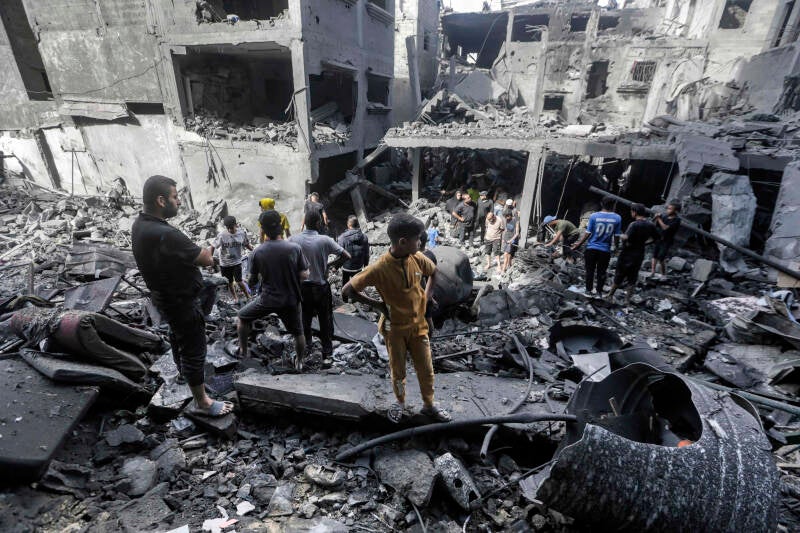
Palestinians inspect their destroyed homes following Israeli airstrikes targeted a residential block in Al Shati refugee camp in Gaza City, October 29, 2025. Yousef Zaanoun
A ceasefire went into effect in Gaza one month ago. A lot has happened in the four weeks since. Today, you'd be hard pressed to find Palestine in the news.
Zohran Mamdani electrified the country and made headlines with his election as mayor of New York City. Yesterday Trump signed a deal to end the longest federal government shutdown in US history that left tens of millions of people who rely on SNAP benefits in limbo. Access to healthcare for millions more remains uncertain.
While holding all of this — and more — it remains critical to keep our eyes on Palestine. Here are five reasons why.
1. Nearly 900 Palestinians have been killed or wounded since October 11, when the ceasefire went into effect.
The Israeli government has violated the ceasefire deal nearly 300 times since it went into effect in October…
Take action: Defend CU Boulder students.

At CU Boulder, students peacefully protesting weapons manufacturer Lockheed Martin's complicity in Israeli genocide were slapped with interim sanctions, including suspensions. Some lost their housing as a result.
Email CU Boulder administrators now to demand that these students be cleared of these trumped-up charges — and to call on them to uphold the rights to free speech and political protest.
Take action: Block the Bombs.

Using the action tool provided by our sister organization, JVP Action, we’ve already sent over 36,000 emails to our members of Congress demanding they support the historic Block the Bombs Act.
Let’s reach 50,000 emails this week. Write your member of Congress now and tell them to stop arming Israel’s ongoing genocide.
What we're reading: Discriminating against dissent.

The Middle East Studies Association and the American Association of University Professors have published a groundbreaking new report on the abuse of Title VI antisemitism complaints to attack the Palestine solidarity movement.
More Title VI “antisemitism” investigations were opened in the last two months of 2023 than in all previous years combined — and at least 79% of the complaints analyzed involve criticism of Israel or Zionism, not Jews or Judaism.
Ms. Rachel calls out anti-Palestinian bias at the NYT

Children's entertainer Ms. Rachel, who has over 4 million followers on Instagram, called out the New York Times for its biased coverage of the Gaza genocide.
She announced in a separate post that she was unsubscribing from the paper because of its "biased and dehumanizing coverage of Palestinians and Palestine."
1958.

13 november 2025
Today's headlines
Israel wants to implement the death penalty for Palestinian prisoners. Here’s what you need to know.
Qassam Muaddi

Israel is advancing a dangerous bill to impose the death penalty on Palestinian prisoners. Right-wing leaders want to go even further and use the bill to give Israeli forces the authority to carry out extrajudicial killings.
AIPAC is suddenly a political liability. Is the Israel lobby in trouble?
Michael Arria

For years, AIPAC played a key role in U.S. politics as a campaign financing powerhouse, but now aspiring candidates are distancing themselves from the group. What lies ahead for the Lobby as the Gaza genocide has made Israel a political liability?
1956.

13 november 2025
As headlines on Palestine fade, Israel’s colonial violence continues, from sexual torture to settler attacks. Meanwhile, limited media coverage, including with continued denied international media access to Gaza, often relies on harmful narratives, censorship, deliberate distractions and disinformation, thereby manufacturing consent for continued Israeli colonial domination over our land and lives.
That’s why we launched Communicating Palestine last month. Not just for journalists directly, but for all of you who would like to engage with the editors and journalists you follow and ensure you can hold them accountable.
You can help shift the narrative.
Share the tips below with journalists, editors, and media networks around you. Encourage them to adopt ethical reporting practices and to tell the story of Palestine with accuracy and responsibility.
view the checklist
5 Tips for Ethical Reporting on Palestine
- Provide Context
Expose structures of oppression: genocide, occupation, and settler colonialism beyond isolated incidents of colonial violence. - Don’t Take Information from Israeli Officials at Face Value
Always assume information coming from Israeli and Zionist lobby sources is in bad faith. Verify and cross-check independent sources. - Use Accurate Language
Always name the perpetrator. Call injustice what it is and avoid reductionist or sanitized terms that downplay systemic violence and international crimes. - Centre Palestinian Voices
Recognise that Palestinians are best positioned to narrate their realities from personal experiences to in-depth analysis. - Portray Palestinians in their Full Diversity
Reflect the full breadth of Palestinian society—survivors, organisers, experts, fighters, and people across political parties, geographies, generations and social classes. Reject token portrayals that highlight only certain groups that fit the ideal victim trope. Every Palestinian, regardless of their experience deserves coverage and representation.
Are you looking to challenge... go up a bit.
Are you looking to challenge misinformation and make ethical journalism the standard, not the exception? Help us transform Communicating Palestine into a book in 2026.
In solidarity,
Aseel, the PIPD
1955.

13 november 2025
Please disregard the previously shared version of Gaza Humanitarian Response | Situation Report No. 19 and refer to this updated version instead.
We apologize for any inconvenience and thank you for your understanding.
Best regards,
OCHA OPT team
Gaza Humanitarian Response
Situation Report No. 19
12 November 2025
(As of 18:00 on 11 November 2025)
HIGHLIGHTS
- On 10 November, over 1.2 million hot meals were delivered by 23 partners through 194 kitchens; 120,000 in northern Gaza and more than 1.1 million in Deir al Balah and Khan Younis.
- Critical water sanitation and hygiene facilities across the Gaza Strip are being repaired and maintained, restoring water supply through key reservoirs, wells, and pipelines.
- Rehabilitation of Al Shifa Hospital desalination plant has commenced, and other wastewater networks are already under rehabilitation.
- Some 19 classrooms in two governmental schools have been fully rehabilitated, while rehabilitation works on additional 18 classrooms in Deir al Balah are nearing completion.
SITUATION OVERVIEW
On 10 November, Site Management Cluster (SMC) partners recorded more than 4,000 movements of people across the Gaza Strip. This brings the total recorded movements of people since the ceasefire to more than 713,000, including more than 584,000 movements from southern to northern Gaza and more than 113,000 movements from western to eastern Khan Younis.
On 10 November 2025, an inter-cluster assessment mission was conducted in the newly accessible areas in east Khan Younis city, covering three locations: Al Ola PA School (city centre), Tareq Ben Ziad School (Batn As-Sameen), and Al Quds 4 site (As Sater), identifying over 670 households living in overcrowded classrooms, damaged buildings, or makeshift shelters, often with 10 people per room or tent.
Findings reveal severe shortages of shelter materials, water, hygiene, and food. Water is mainly trucked or comes from limited wells and networks but remains insufficient; hygiene access is extremely limited, with communal latrines and poor sanitation. Solid waste accumulation was observed, and while markets function, food availability and affordability are low, forcing reliance on irregular assistance. Needs include bedding, tarpaulins, washing kits, winter clothing for children, and protection services, as no malnutrition screening, education, or protection activities are in place. Priority needs include Shelter and NFIs, Food, Water and hygiene support, and Protection assistance.
UNITED NATIONS-COORDINATED HUMANITARIAN AID ENTRY*
According to the UN 2720 Mechanism dashboard, on 11** November, over 3,700 pallets of UN partner aid were offloaded at Gaza’s crossings. About 67 per cent of these pallets included food, followed by shelter materials (31 per cent), operational/telecommunication materials (1 per cent), and health supplies (1 per cent).
On 8 November, 181 partner trucks were collected from Gaza’s crossings, 148 from Kerem Shalom and 33 from Kissufim. These trucks contained 1,779 pallets of mixed food supplies; 456 pallets of wheat flour; 1,287 pallets of tarpaulins, blankets, winter clothes, mattresses, ropes, and tents; and 697 pallets of hygiene and dignity kits, diapers and towels.
On 11 November, based on preliminary data, at least 403 pallets of winter clothes and blankets, 110 pallets of medical supplies and 187,000 litres of fuel were collected from the crossings under the United Nations coordinated mechanism. This data excludes bilateral donations and the commercial sector.
As of 12 November, Kerem Shalom and Kissufim crossings remain open and operational. On the same day, the Israeli Authorities announced the reopening of Zikim crossing for the entry of humanitarian aid trucks into the Gaza Strip.
Meanwhile, Government-to-Government convoys from Jordan remain suspended since 18 September and ongoing customs delays and stringent scanning procedures continue at Ashdod Port.
Within Gaza, the Salah ad Din Road has not yet reopened. As a result, cargo collection in the south remains limited to the narrow and highly congested Philadelphi Corridor/Al-Rasheed Road, exposing convoys to heightened risks of interception, particularly when loaded trucks are forced to pause in crowded areas.
HUMANITARIAN RESPONSE
Health
- On 11 November, the Cluster visited the Rantisi and Shifa hospitals in Gaza city to assess progress in reactivating essential health service delivery; both hospitals remain partially functional:
- At Rantisi Hospital, partners are supporting ongoing refurbishment and clean up using materials retrieved from other facilities. Outpatient department (OPD) services and inpatient services, with a capacity of 80 beds, are now functional. Major reconstruction and restoration work, equipment, and supplies are still required to reach full operational capacity, including an additional 100 kVA generator, restoration of the oxygen plant, and distribution system, and enhanced capacity for critically ill patients.
- Service reactivation at the Shifa Hospital is underway. OPD services are already available; five operating rooms are operating, and 32 functional hemodialysis and 300 inpatient beds are also available.
Food Security
- On 10 November, more than 1.2 million hot meals were prepared and delivered by more than 23 partners through 194 kitchens. Of these, 120,000 meals were prepared by 25 kitchens in northern Gaza and more than 1.1 million meals by 169 kitchens in Deir al Balah and Khan Younis governorates.
Shelter
- On 10 November, Shelter Cluster partners distributed emergency shelter materials and other essential items as follows:
- More than 4,5000 tarpaulins to approximately 1,400 households across the Strip.
- More than 2,300 blankets to approximately 700 households across the Strip.
- More than 1,200 mattresses to more than 400 households in Al Shorouq and Al Arouba displacement sites in Deir al Balah.
- Clothing kits to more than 500 households in Deir al Balah.
Water, Sanitation and Hygiene
- With support from the cluster, local service providers and technical authorities continue repairing and maintaining critical WASH facilities. Key progress includes:
- The Palestinian Civil Defense reservoir in Gaza city is now fully operational, providing water to areas such as Tel al Hawa, Al Rasheed Street and Al 17 roundabout. Other wells are under rehabilitation.
- Several wells in Al Maghazi and Jabalya and other areas have been repaired and are functional, while additional wells are under rehabilitation.
- Wastewater networks in Gaza city, Al Nuseirat and other areas are being cleaned and repaired.
- The Israeli Mekorot pipeline is now operational and supplying water to western Al Nuseirat in Deir al Balah.
- Rehabilitation of the Shifa Hospital desalination plant, with a processing capacity of 500 m3/day has commenced.
- On 9 and 10 November, the cluster partners distributed more than 5,300 hygiene kits; 1,000 18-litre buckets; 4,900 tarpaulins; 10,600 dignity kits; 100 water tanks; and 48,500 towels.
- About 44 cluster partners are providing water trucking to over 2,000 points, though fuel shortages are becoming a major challenge.
- Solid waste management efforts are ongoing, with technical support from 1,500 workers provided by five cluster partners assisting local service providers in secondary waste collection operations.
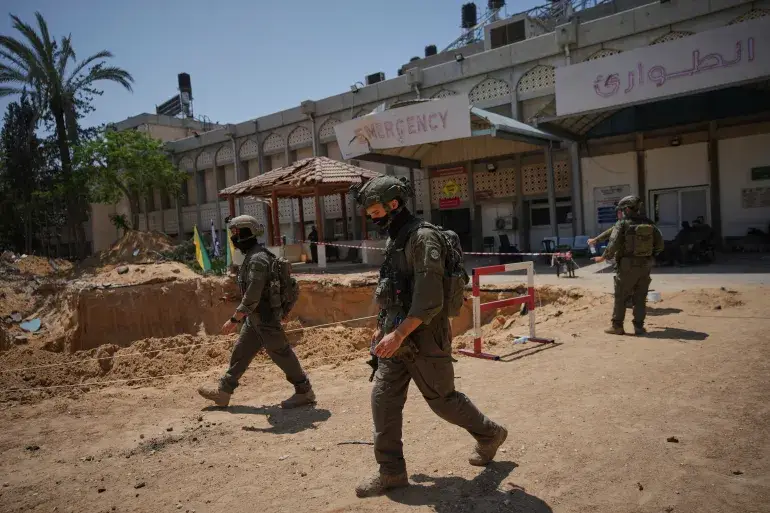
Education
- As part of the cluster scale-up plan since the ceasefire, 19 classrooms have been fully rehabilitated in two governmental schools, while rehabilitation works on 18 additional classrooms in another governmental school in the Deir al Balah governorate have reached 95 per cent completion. These classrooms will be used to resume learning activities, with rehabilitation of remaining classrooms ongoing.
- In northern Gaza, two partners are currently conducting assessments to identify suitable locations for the establishment of Temporary Learning Spaces (TLSs). These TLSs aim to provide access to learning opportunities, mental health and psychosocial support (MHPSS), and recreational activities for school-aged children affected by the ongoing crisis.
Protection
- Child Protection (CP):
- Between 10 and 11 November, over 1,500 children and caregivers participated in structured MHPSS sessions across Gaza city, Deir al Balah, and Khan Younis. These sessions promoted emotional expression, stress reduction, and resilience-building. In addition, around 200 caregivers – primarily mothers – engaged in group-based positive parenting and stress management sessions to strengthen family support structures.
- Between 10 and 11 November, Child Protection partners registered or followed up on 50 new or existing cases across the Strip. These services focused on children without parental care, those who are heading households, and other vulnerable groups. A total of 88 at-risk children received tailored support, including tents, hygiene kits, and tarpaulins, to ensure continuity of care and protection.
- As part of the winterization efforts, between 10 and 11 November, 538 winter clothing kits were distributed in Barbara camp in the Khan Younis governorate. During these distributions, protection awareness sessions reached 212 children and 181 caregivers, providing key messages on child protection risks and strategies to prevent family separation. Additionally, over 150 caregivers were reached with child protection messaging through sessions held in shelters and informal sites.
1957.

12 november 2025
Humanitarian Situation Update #340
Gaza Strip
12 November 2025
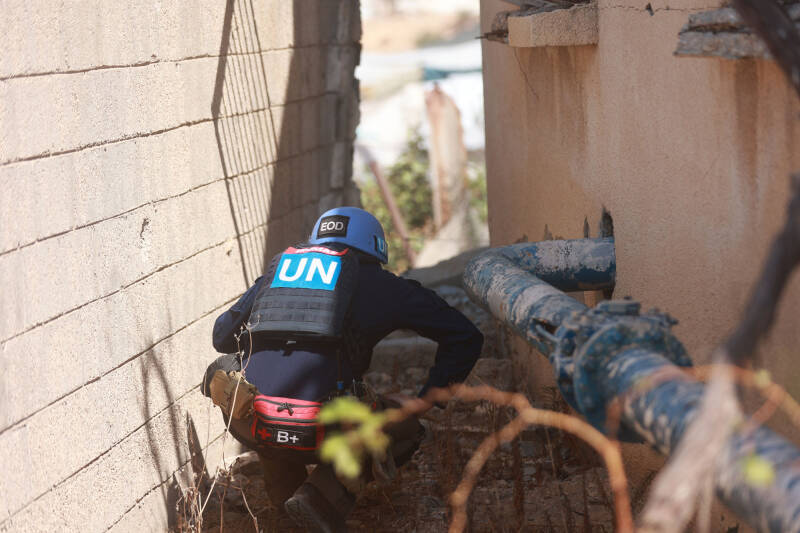
A Mine Action specialist inspects a water well compound in Khan Younis for potential explosive hazards following the ceasefire, in support of humanitarian and recovery efforts, 19 October 2025. Photo by UNMAS
Key Highlights
- Unexploded ordnance continues to pose a serious threat across the Gaza Strip, with injuries reported among people returning to devastated areas or searching for basic necessities, according to the UN Mine Action Service.
- In the first month of the ceasefire, 165 patients were medically evacuated from Gaza, compared with 146 patients in the previous month; more than 16,500 people still require urgent specialized medical care outside Gaza.
- Four hospitals and multiple other health facilities have resumed operations since the ceasefire, but more than 60 per cent of all facilities remain non-functional.
- More than 154,000 children – nearly a quarter of all school-aged children – are enrolled at over 300 temporary learning spaces.
- Israeli authorities announced the reopening of Zikim crossing for humanitarian cargo after a two-month closure.
Context Overview
- Following the withdrawal of Israeli forces from parts of the Gaza Strip under the ceasefire agreement, Israeli military strikes near or east of the so-called “Yellow Line” continue to be reported, resulting in casualties. Access to the sea remains prohibited and the detention of Palestinian fishers at sea by Israeli forces continues to be reported. In areas beyond the “Yellow Line,” where the Israeli military remains deployed (over 50 per cent of the Gaza Strip), daily detonations of residential buildings continue to be reported and access to humanitarian assets, public infrastructure and agricultural land remains restricted or altogether barred. Between 25 October and 4 November, Site Management Cluster (SMC) partners conducted a remote assessment via phone with focal points to survey identified displacement sites located in areas where the Israeli military remains deployed. The assessment identified 46 displacement sites, of which 18 are currently active. The active sites host more than 1,350 households comprising about 13,500 internally displaced people (IDPs). Having not been able yet to carry out physical assessments in the area given the security situation, SMC partners estimate that people in these areas are largely cut off from access to basic services.
- Between 5 and 11 November, according to official Israeli sources, the bodies of three deceased hostages were returned from Gaza to Israeli authorities, bringing the overall number of returned bodies of Israeli and other hostages since the ceasefire to 24. During the same period, according to the Ministry of Health (MoH) in Gaza, the bodies of 45 Palestinians were returned to the Gaza Strip, bringing the total number of released bodies since the ceasefire to 315, of which only 91 were identified.
- According to the MoH in Gaza, between 5 and 12 November, six Palestinians were killed, one died of wounds sustained earlier, 19 were injured and 19 bodies were recovered from under the rubble. This brings the casualty toll among Palestinians since 7 October 2023, as reported by MoH, to 69,185 fatalities and 170,698 injuries. According to the MoH, the total number includes 284 fatalities who were retroactively added between 31 October and 7 November after their identification details were approved by a ministerial committee. MoH reported that since the ceasefire, 245 Palestinians were killed, 627 were injured and 532 bodies were retrieved from under the rubble. These include 104 Palestinians killed between 28 and 29 October.
- According to the Israeli military, between 5 and 12 November, as of noon, no Israeli soldiers were killed in Gaza. The casualty toll among Israeli soldiers since the beginning of the Israeli ground operation in October 2023 stands at 471 fatalities and 2,978 injuries. According to Israeli forces and official Israeli sources cited in the media, more than 1,671 Israelis and foreign nationals have been killed, the majority on 7 October 2023 and its immediate aftermath. As of noon on 12 November 2025, it is estimated that the bodies of four deceased hostages remain in the Gaza Strip.
- As of 10 November, the SMC estimates that about one million people, out of a total population of 2.1 million, are residing in 862 displacement sites across the Gaza Strip, of which 180 sites are in Gaza and North Gaza governorates, 264 in Deir al Balah, 410 in Khan Younis and eight in Rafah. According to UNRWA, as of 2 November, about 75,000 people are estimated to reside in about 100 designated UNRWA shelters and surrounding areas. SMC reports that population movements across the Gaza Strip continue as people attempt to return to their hometowns when possible or move to areas with relatively better access to essential services. Between 10 October and 9 November, more than 709,000 movements of people were recorded by SMC partners, including more than 580,000 movements crossing from southern to northern Gaza, primarily through Al Rashid Road. Over 113,000 movements were observed from western to eastern Khan Younis.
- An increase in reverse movements from northern to southern Gaza has also been observed, the SMC reports. Between 2 and 9 November, more than 1,200 such movements were recorded, compared with 850 movements the previous week. While displaced families face precarious and overcrowded conditions across the Gaza Strip, including in the south, SMC partners attribute the relative increase in southward movements to the relatively more acute shortages of adequate shelters, basic services and safe heating options in northern Gaza, with many households residing in damaged homes and having limited prospects for repair before colder weather sets in.
- Education partners continue to support the learning process by operating additional spaces to provide in-person education, previously concentrated in Khan Younis and Deir al Balah, across the Gaza Strip. As of 11 November, 303 temporary learning spaces (TLS) are operational, including 16 in Gaza governorate, 140 in Deir al Balah, 147 in Khan Younis and none in North Gaza and Rafah. About 51 TLS have become operational since the ceasefire, allowing over 18,000 new children to enrol. More than 4,300 teachers at TLS are supporting a total of about 154,000 children, or some 24 per cent of Gaza’s school-aged population of about 637,000. The low coverage is attributed to extensive damage of school infrastructure, the continued use of schools as IDP shelters, and restrictions on the entry of educational and learning supplies.
- In addition to serving about 44,000 children at 46 of the TLS, UNRWA’s digital learning platform is providing Arabic and mathematics education to more than 294,000 children, facilitated by over 7,600 teachers. The Ministry of Education and Higher Education has also resumed in-person education in at least two universities, where hybrid learning is used. To reach all school-aged children, including the long waiting list of children trying to access learning centres, a spokesperson for the United Nations Children’s Fund (UNICEF), Tess Ingram, highlighted the need for additional learning spaces, rubble clearance, ensuing that explosive ordnance (EO) does not pose a risk, repair of damaged classrooms, and the establishment of temporary structures.
- According to the Food Security Cluster (FSS), in the first nine days of November, partners have assisted more than 255,000 people (51,000 households) with two food parcels per family through 47 distribution points across the Gaza Strip. As of 10 November, FSS partners are distributing every day about 160,000 bread bundles and 1.27 million meals. The bread bundles continue to be produced at 19 UN-supported bakeries and distributed free of charge through more than 400 sites, including more than 50 UNRWA shelters, community kitchens, and other local facilities. The bread is also sold at a subsidized price of 3 NIS (US$0.90) per bundle through 71 contracted retailers, up from 43 in October, to broaden coverage and help revive markets across the Gaza Strip.
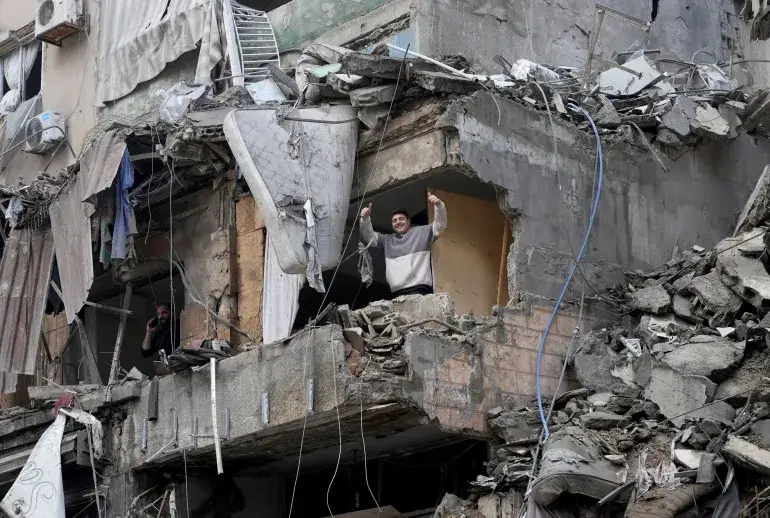
Humanitarian Access
- As of 10 November, about 227,000 metric tons (MT) of the aid positioned across the region were approved and cleared by Israeli authorities for transfer into Gaza, of which about 72 per cent are food supplies, according to the UN 2720 Mechanism. Between 10 October and 10 November, according to the UN 2720 Mechanism, about 47,000 MT of aid were collected by the UN and its partners from two operational crossings, including 14,200 MT between 4 and 10 November. On 12 November, Israeli authorities announced the reopening of Zikim crossing for humanitarian cargo following a two-month closure.
- Since 10 October, more than 6,480 MT of UN-coordinated relief materials have been denied entry into Gaza. Of these, over 3,550 MT were rejected on the grounds that the organizations were not authorized to bring relief items into Gaza. These include eight requests by two local and international NGOs for the entry of 507 MT of aid comprising shelter, water and sanitation supplies, which were rejected between 4 and 10 November. Many international NGO partners continue to face difficulties in being registered in Israel, preventing them from bringing supplies into Gaza and operating at scale, and UNRWA continues to be banned by Israeli authorities from bringing in food and other supplies into Gaza. Critical items also continue to be denied entry into Gaza. For example, UNICEF reported during a recent UN press briefing that denied items included spare parts for water trucks and vehicles, materials for water treatment and purification, high-power generators, and education and recreational kits for children, which they have not been permitted to bring into Gaza for several months.
- Coordination with Israeli authorities continues to be required for humanitarian convoy movements in Gaza, to crossings as well as in or near other areas where the Israeli military remains deployed. Between 4 and 10 November, humanitarian organizations coordinated 58 missions with the Israeli authorities, of which 30 were facilitated, eight were cancelled, 16 were impeded and four were denied. Movements included, among others, 31 movements to collect cargo from the two operational crossings (Kerem Shalom and Kissufim), two search-and-rescue missions, three road repair, assessment and clearing missions, and three movements related to the crossing of humanitarian personnel.
- On 5 November, the World Health Organization (WHO) facilitated the medical evacuation of 19 patients, including 17 children and two men, in addition to 93 companions. This brings the total number of patients evacuated in the month since the ceasefire to 165 patients, including 105 children, 32 men and 28 women, compared with 146 patients evacuated from Gaza in the month prior to the ceasefire. Over 16,500 patients still need urgent specialised care unavailable inside the Strip. WHO stated that the Rafah crossing is a vital exit for medical evacuations, through which WHO has transferred to date about 4,000 patients for treatment in Egypt and abroad. WHO added that the crossing is also key to the entry of health supplies into Gaza and called for the urgent and sustained opening of Rafah and all entry points into Gaza.
- In a statement issued one month into the ceasefire in Gaza, Tom Fletcher, Under-Secretary-General for Humanitarian Affairs and Emergency Relief Coordinator, said that humanitarians are continuing to seize every opportunity to save lives. He noted that the UN and its partners have provided food to over one million people, nutrition sites have been reopened, and hospital services are treating more patients. According to his statement, vital immunizations are also being resumed, while water lines have been repaired, winter supplies distributed, and mental health support provided. Despite that progress, Mr. Fletcher said that humanitarian operations in Gaza still face obstacles, including red tape and insecurity. He stressed that if these constraints are eased, humanitarians can do much more to reach more people in need with life-saving assistance.
Access to Health Care
- The functionality of health services across the Gaza Strip has improved since the ceasefire, with 18 hospitals currently partially functional, compared with 14 in September. One of the newly re-opened hospitals is Al Kheir Hospital, in Khan Younis. On 10 November, WHO reported that last week Al Kheir Hospital became functional again after it supported the rehabilitation of water, sanitation, and power systems in the facility and supplied it with medical equipment and medicines. The hospital had been forced out of service in February 2024. WHO also established a new 20-bed nutrition stabilization centre at the hospital to provide inpatient care for children with acute and severe malnutrition. In total, seven nutrition stabilization centres currently provide care to cases of severe acute malnutrition with complications, with a total of 90 inpatient beds, compared with four centres in September, according to Nutrition Cluster.
- Compared with the period prior to the ceasefire, the number of functional primary health centres (PHC) similarly increased from 62 to 76 PHCs as of 8 November. Nonetheless, the overall number of functional health services, including hospitals, field hospitals, medical points and PHCs, stands at only 36 per cent of the total number of facilities (213 out of 589). Another challenge is that large-scale displacement and the lack of available alterative shelters have led many IDPs to seek shelter in main health facilities, according to MoH, affecting the functionality of two hospitals and four health clinics across the Strip.
- With 12,000 staff on the ground in Gaza, UNRWA continues to run shelters, clinics, and essential services and has expanded service provision since the ceasefire, including in northern Gaza. The agency is now operating four medical points in Gaza city, reaching over 1,650 patients per day, compared with an average of only 50 consultations per day during military operations before the ceasefire. UNRWA provides primary health services through seven health centres and 102 mobile medical teams working at 31 health points inside and outside shelters in Deir al Balah, Khan Younis and Gaza city, with efforts underway to restore health services in North Gaza despite infrastructural and supply challenges. Furthermore, UNRWA reports that its work in safeguarding public health extends beyond medical consultations to include water, sanitation, hygiene, nutrition and protection services in an integrated manner.
- Current living conditions in the Gaza Strip, however, continue to raise serious concerns about public health risks. Describing these conditions as appalling, Médecins Sans Frontières (MSF) said: “After being forcibly displaced repeatedly, many Palestinians are still living in makeshift tents and without access to running water and electricity, surrounded by piles of rubbish and overflowing sewage.” The health impacts of these dire conditions, MSF added, are causing many cases of respiratory, skin, and gastrointestinal infections, warning that colder temperatures, heavy rains, and strong winds will soon only worsen the situation.
- According to MoH, 343 out of 622 essential drug items (55 per cent) are currently at zero-stock levels. This includes 74 per cent of chemotherapy and blood disease drugs, 64 per cent of primary healthcare drugs, 56 per cent of mothers and child health drugs and 50 per cent of kidney transplantation and haemodialysis drugs. In addition, 710 out of 1,006 medical consumables (71 per cent) were at zero-stock levels in October 2025; these include 100 per cent of open heart and catheterization consumables, 99 per cent of orthopaedic surgery consumables, and 91 per cent of ophthalmic surgery consumables.
- Critical medical shortages have especially affected the access of diabetic patients to adequate treatment, heightening the risk of complications and death. According to MoH, there are about 71,000 people living with diabetes in Gaza. These include about 20 to 30 per cent who require approximately 25,000 vials of insulin per month and related supplies, according to the Health Cluster, but only a small fraction of these supplies are regularly available. The last shipment of insulin was delivered to hospitals in the Gaza Strip by humanitarian partners between 19 and 23 October 2025, containing 22,991 vials, the Health Cluster reported. According to UNRWA, due to the limited availability of insulin, some patients have been forced to use expired doses, further jeopardizing their health, and the lack of adequate and timely screening increases the risk of undiagnosed cases. Shortages of oral hypoglycemic agents, essential for managing Type 2 diabetes, have further undermined treatment. Combined with limited access to nutritious food, the Health Cluster notes that these challenges can lead to the prevalence of severe complications, such as diabetic foot, poor glycemic control, kidney failure, and blindness.
- The lack of treatment and diagnostic services have additionally affected cancer patients who can only access limited treatment at three facilities, according to the Health Cluster, namely: Al Razi Hospital, Al Helou Hospital, and Nasser Medical Complex. According to MoH, there are currently over 11,000 cancer patients in the Gaza Strip who need medical evacuation outside due to the lack of needed treatments. Since January 2025, according to WHO data, 594 cancer patients, including 152 children, 219 women and 223 men, were evacuated outside Gaza while many others are awaiting approvals for their evacuation from Gaza.

Protection
- According to the Child Protection Area of Responsibility (CP AoR), following two years of escalated hostilities in Gaza, the collapse of education, health and social systems, compounded by displacement and repeated trauma, have eroded children’s sense of stability and safety; and they will require sustained, long-term efforts to recover. In a September 2025 CP AoR assessment, the most common symptoms reported among children were aggressive behaviour (93 per cent), violence toward younger children (90 per cent), sadness and withdrawal (86 per cent), sleep disturbances (79 per cent), and education avoidance (69 per cent). Caregivers also reported being overwhelmed and unable to provide adequate emotional support, while girls and children with disabilities were found to face heightened risks of violence, neglect, and unsafe access to water, sanitation and hygiene (WASH) facilities, particularly in overcrowded shelters and informal displacement sites.
- CP AoR partners continue to scale up the delivery of mental health and psychosocial support (MHPSS) services for children and caregivers across the Gaza Strip. During the first month following the ceasefire, partners provided child protection and MHPSS services to over 132,000 children across the Gaza Strip, including nearly 1,600 children with disabilities and 45,000 caregivers. Services included individual psychological counselling, structured group sessions, stress management activities, recreational psychosocial support, and referrals to multisectoral services. CP partners aim to reach over 100,000 children per month through various child protection services to help meet the needs of nearly one million children in the Gaza Strip.
- Since 10 October, nearly 59,000 out of 132,000 children reached by CP AoR partners, benefited from group and individual sessions, psychological first aid, and counselling, while over 17,000 caregivers (of whom 72 per cent were women) participated in parenting programmes aimed at promoting well-being and strengthening their capacity to support distressed children. According to partners, key issues observed during service provision included increased anxiety among children, behavioural changes, and concerns about the continued lack of safe spaces. In the same period, 2,500 highly vulnerable children were referred to multisectoral services, including shelter support, hygiene kits, and other basic assistance. Case management services reached 1,344 children, of whom 166 unaccompanied and separated children were reunified with their families and 215 children were placed in temporary alternative care. Furthermore, 350 children with conflict-related injuries or disabilities received assistive devices and rehabilitation support. According to recent data by the MoH in Gaza, amputations among children comprise about 25 per cent of 6,000 amputations recorded by the ministry during the war.
- Unexploded ordnance continues to pose a serious threat in the Gaza Strip, with injuries reported among people returning to devastated areas, the UN Mine Action Service (UNMAS) warns. In Gaza city, “unexploded shells and missiles are scattered across Al Rimal neighbourhood, visible among the rubble and along roadsides […] exposing civilians to the risk of detonation as they attempt to return to their homes or search for basic necessities,” UNMAS reported. Poor living conditions have also increased the exposure of people, including children, to EO, either while they are trying to collect firewood or upon being forced to set up tents near areas suspected of containing EO due to the lack of safe shelter options.
- Since 10 October, Mine Action (MA) partners have recorded three explosive incidents in Deir al Balah and Khan Younis, which resulted in 11 injuries, including three boys. To scale up operations and facilitate the safe repair of civilian infrastructure and the reopening of schools and health facilities, since 10 October, MA partners have responded to 71 requests for explosive hazard assessments, supported 32 inter-agency missions, and delivered risk education sessions to more than 49,000 people across the Gaza Strip. Moreover, between 15 and 22 October, UNMAS conducted a training of trainers on explosive ordnance risk education and conflict preparedness and protection targeting 31 frontline humanitarian aid workers to enable them to disseminate safe messaging alongside their activities.
- Amid massive challenges, communities in the Gaza Strip continue to demonstrate remarkable resilience and solidarity, a recent monitoring report by the Protection Cluster, covering the period between 10 October to 6 November, highlights. Grassroots coordination committees have re-emerged to manage disputes, organize aid distribution, and communicate needs to humanitarian actors. Youth volunteers actively support vulnerable groups and maintain site conditions, reflecting strong civic engagement. Mothers and youth have also created informal learning and support circles to provide children with basic education and emotional comfort. According to the monitoring report, enduring social cohesion and mutual assistance remain key coping mechanisms helping families navigate daily hardships.
Funding
- As of 12 November 2025, Member States have disbursed approximately $1.49 billion out of the $4 billion (37 per cent) requested to meet the most critical humanitarian needs of three million out of 3.3 million people identified as requiring assistance in Gaza and the West Bank, including East Jerusalem under the 2025 Flash Appeal for the OPT. Nearly 88 per cent of the requested funds is for the humanitarian response in Gaza, with just over 12 per cent for the West Bank. During October 2025, the oPt Humanitarian Fund managed 135 ongoing projects, totalling $77.7 million, to address urgent needs in the Gaza Strip (87 per cent) and the West Bank (13 per cent). Of these projects, 63 are being implemented by international NGOs, 56 by national NGOs and 16 by UN agencies. Notably, 69 out of the 79 projects implemented by international NGOs or the UN are being implemented in collaboration with national NGOs. For more information, please see OCHA’s Financial Tracking Service webpage and the oPt HF webpage.
1956.

12 november 2025
Humanitarian Situation Update #339
West Bank
12 November 2025
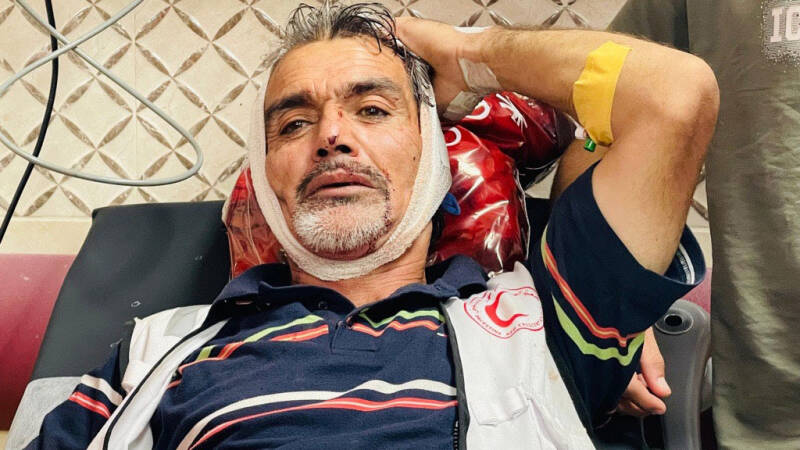
A volunteer with the Palestine Red Crescent Society receives medical treatment after being injured by Israeli settlers who attacked olive harvesters in Beita, Nablus, 8 November 2025. Photo by journalist Abdullah Bahesh
Key Highlights
- More than 1,500 Palestinians have been displaced by lack-of-permit demolitions so, far in 2025, including about 1,000 in Area C and 500 in East Jerusalem.
- A Palestinian family of six people, including three children, was temporarily displaced in Khirbet Abu Falah village, in Ramallah governorate, after their home was set on fire by Israeli settlers – one of 29 attacks documented by OCHA over the past week.
- Israeli forces forcibly evicted two Palestinian families from their residential building in Batn al Hawa area of Silwan, in East Jerusalem.
- About 1,460 structures were identified to be destroyed or severely or moderately damaged in Jenin, Nur Shams and Tulkarm camps; recent satellite imagery indicates.
- Since 1 October, OCHA has so far documented 167 settler attacks related to this year’s olive harvest season, affecting 87 Palestinian communities.
- Humanitarian partners expanded efforts during the olive harvest, providing protection, legal aid, and agricultural support to famers across the West Bank, to safeguard farmers’ access to their lands and mitigate risks associated with settler violence and movement restrictions.
Humanitarian Developments
- Between 4 and 10 November, Israeli forces killed four Palestinians, including three children, in the West Bank, including East Jerusalem. In total, since January 2025, 45 Palestinian children have been killed by Israeli forces, or about 23 per cent of Palestinians killed by Israeli forces in the West Bank so far this year. During the same period, about 45 Palestinians, including seven children, were injured – 30 by Israeli settlers and 15 by Israeli forces. No Israeli casualties were reported during the same period. The following are details of the incidents that resulted in fatalities:
- On 6 November, Israeli forces stationed at the military observation along the Barrier near Al Judeira village, in Jerusalem governorate, shot and killed two Palestinian boys near the Barrier and then withheld their bodies. According to an Israeli military statement, the boys were throwing Molotov cocktails at a main road.
- On 5 November, Israeli forces killed and withheld the body of a Palestinian boy during an operation in Al Yamun town, in Jenin governorate. According to a statement by the Israeli military, the child had thrown a Molotov cocktail. According to medical sources, Israeli forces prevented ambulance access to the boy for about 30 minutes.
- On 8 November, Israeli forces shot and killed a Palestinian man during a raid in Al Far’a refugee camp, in Tubas governorate. Palestinian residents reportedly threw stones at Israeli forces, who shot live ammunition.
- Moreover, during an Israeli forces’ raid in Al Mazra’a al Qibliya, in Ramallah governorate, on 6 November, an elderly woman lost her consciousness when Israeli forces broke into her house to arrest her grandson, where two family members were physically assaulted and injured by Israeli forces. The elderly woman, who had a pre-existing medical condition, was transferred to hospital, where she was pronounced dead (this death is not counted in the total figure above).
- In the northern West Bank, Israeli forces continued large-scale operations across cities, towns, and villages as part of the ongoing operation that began in early 2025. On 4 November, forces raided Qalqiliya city, and forcibly evacuated two residential units, converting them into military observation posts for about six hours. Two families comprising ten people were temporarily displaced before being allowed to return to their homes.
- Over the past week, Israeli forces’ bulldozers were observed operating along several sections of the main road in Tulkarm refugee camp, in Tulkarm city. Due to the continued lack of access to the camp, an accurate assessment of the extent of the damage could not be conducted. According to a recent comprehensive damage assessment by the United Nations Satellite Centre (UNOSAT), based on preliminary analysis of satellite imagery collected on 16 October that has not yet been validated in the field, new sections of widened roads were visible in Jenin, Nur Sham and Tulkarm refugee camps compared with 21 May 2025, and buildings appeared damaged or destroyed along these widened roads. In Jenin Camp, UNOSAT identified 29 berms (earth mounds) and two roadblocks, mainly on damaged road sections surrounding the camp, blocking vehicular access. Five military construction vehicles, such as bulldozers and excavators, seven military trucks and possibly one armoured vehicle were also observed outside Jenin Camp. Fewer such obstacles or visible military activities were identified around Nur Shams and Tulkarm camps.
- In the same preliminary analysis, UNOSAT evaluated the extent of visible damage observed on satellite imagery in all three refugee camps. In Jenin Camp, the assessment found that 201 structures were destroyed, 117 were severely damaged, and 358 were moderately damaged for a total of 676 structures, or about 52 per cent of all structures. In Nur Shams refugee camp, the assessment found that 147 structures were destroyed, 37 were severely damaged, and 198 were moderately damaged for a total of 382 structures, or about 48 per cent of all structures. In Tulkarm refugee camp, the assessment found that 254 structures were destroyed, 52 were severely damaged and 96 were moderately damaged for a total of 402 structures, or 36 per cent of all structures. In total, about 1,460 structures were identified to be destroyed or severely or moderately damaged in Jenin, Nur Shams and Tulkarm camps.
- Overall, since January 2025, the Israeli forces’ operation in refugee camps in the northern West Bank has generated what has become the longest and largest displacement crisis in the West Bank since 1967. As of September 2025, UNRWA-verified displacement figures, based on the self-registration of displaced families, indicate that at least 31,919 Palestine refugees have been displaced from Jenin, Tulkarm, and Nur Shams refugee camps and surrounding areas. This includes 11,765 people displaced from Jenin refugee camp due to operations by both Palestinian and Israeli forces, and 20,154 people displaced from Tulkarm and Nur Shams refugee camps as a result of Israeli forces’ operations.

Lack-of-Permit and Punitive Demolitions
- Between 4 and 10 November, OCHA documented the demolition of 25 Palestinian-owned structures, including 15 in Area C and 10 in East Jerusalem, for lacking Israeli-issued building permits, which are almost impossible for Palestinians to obtain. Demolished structures included eight residential structures and 12 agricultural and livelihood structures. The demolitions led to the displacement of 43 people, including 14 children, and affected the livelihoods of another 59 people. Out of 49 people displaced by demolitions, 34 were displaced in Area C of Jerusalem governorate and nine were displaced in East Jerusalem, as follows:
- In Qatanna village, the Israeli Civil Administration, accompanied by Israeli forces, demolished the upper floors of two, two-storey buildings constructed in the 1990s and two animal shelters. The two buildings were rendered uninhabitable and six households comprising 26 people, including nine children and one person with a disability, were displaced.
- In South Anata Bedouin community (Wa’ar al Beik), the Israeli Civil Administration, accompanied by Israeli forces, demolished a residential shelter, an external kitchen and two latrines, displacing a family of eight people, including four children. The family had rebuilt these structures following the demolition of their shelters on 2 September 2025. The community lies near the area designated for the E1 settlement expansion plan, a long-standing Israeli plan intended to connect Ma’ale Adumim settlement with East Jerusalem. Humanitarian partners have consistently raised concerns that the implementation of this plan would further fragment the Occupied Palestinian Territory and heighten the risk of forcible transfer for communities in the area, with severe humanitarian consequences.
- In East Jerusalem, owners of two homes in Beit Hanina and Silwan were forced to demolish their properties, following the receipt of demolition orders by Israeli authorities, to avoid the payment of additional fines and penalties. As a result, two households comprising nine people, including five children, were displaced.
- More than 1,500 Palestinians have been displaced by lack-of-permit demolitions so far in 2025, including about 1,000 in Area C and 500 in East Jerusalem. The number of Palestinians displaced after being forced to demolish their own homes in East Jerusalem, following the receipt of demolition orders by Israeli authorities, has increased significantly in recent years, reflecting growing pressure on residents. Between 1 January and 10 November 2025, OCHA documented the demolition of 208 structures, more than half of which were inhabited homes (105), in East Jerusalem for lacking Israeli-issued building permits, resulting in the displacement of 503 Palestinians, including 242 children. Of these structures, 143 (or 69 per cent) were demolished by their owners, including some cases where Israeli authorities were subsequently involved to complete the demolition of the same structures.
- On 9 November, in Salfit governorate, Israeli forces demolished one home on punitive grounds in Bruqin town. The house belonged to two brothers who are in Israeli custody and were accused of involvement in a shooting attack and killing an Israeli pregnant woman on 14 May 2025 near the town; her baby died two weeks later. This is the second punitive demolition targeting the family within less than a month. As a result, six people were displaced. Since 2009, OCHA has documented the displacement of over 1,000 Palestinians due to the demolition or sealing of 214 structures on punitive grounds across the West Bank, including East Jerusalem. About 40 per cent of these structures (86) have been demolished or sealed since 7 October 2023, displacing more than 400 Palestinians. So far in 2025, Israeli authorities punitively demolished or sealed 41 structures across the West Bank, displacing over 210 Palestinians. The International Court of Justice has determined that Israel's practice of punitive demolitions of Palestinian property is contrary to its obligations under international humanitarian law and amounts to prohibited discrimination under international human rights treaties.
Evictions in East Jerusalem
- On 9 November, the Israeli police forcibly evicted two Palestinian families from their three-storey building in the Batn Al Hawa area of Silwan, in East Jerusalem. As a result, an elderly woman and her son's family comprising eight people, including three children, who lived in the house for decades, were displaced. The families purchased and resided in these homes for over 50 years, but a lawsuit by an Israeli settler organization claiming that the land had been owned by Jews more than a hundred years ago was accepted by the court. According to Ir Amim, an Israeli NGO, the eviction was carried out several days before the eviction order officially took effect, raising concerns regarding its legal basis and procedural legitimacy. During the eviction, one family member was arrested, and another was hospitalized after collapsing from distress.
- Over the past two years, eight Palestinian families comprising 36 people, including 20 children, have been forcibly evicted from their homes in Batn al Hawa area of Silwan. In total, about 90 families (over 400 people, including about 200 children) remain at risk of forced displacement due to eviction lawsuits filed by the Ateret Cohanim settler organization in Batn al Hawa area of Silwan. Following earlier endorsements by the Israeli Supreme Court of the eviction of five Palestinian families in Batn al Hawa area of Silwan, the UN Human Rights Office (OHCHR) said in June 2025 that the “rulings were based on discriminatory laws that permit Jewish individuals to reclaim property lost in the 1948 war, while denying Palestinians the same rights.”
- In parallel, on 9 November, Israeli authorities delivered eviction orders to another family in Batn al Hawa area of Silwan, comprising 26 people from three households, giving them 21 days to evacuate their home following a recent Israeli Supreme Court decision that dismissed their final appeal. Days earlier, a similar appeal by another Palestinian family had also been rejected, with a 60-day notice to evacuate their home. These developments follow the Israeli Supreme Court final ruling in September 2025 in favour of settler organizations who have filed cases to evict, within a month, Palestinian families in five buildings, comprising at least 20 housing units, in Batn al Hawa. About 26 households reside in these buildings, of whom two have been evicted so far in November and the rest are at imminent risk of displacement.
- At least 243 Palestinian households in East Jerusalem have eviction cases filed against them in Israeli courts, the majority by settler organizations, placing more than 1,000 people, including over 460 children, at risk of forced displacement. Evictions have grave physical, social, economic and emotional impact on Palestinian families concerned. In addition to depriving the family of a home - its main asset and source of physical and economic security - evictions frequently result in disruption in livelihoods, increased poverty and a reduced standard of living.

Israeli Settler Attacks
- Between 4 and 10 November, OCHA documented about 29 Israeli settler attacks against Palestinians that resulted in casualties, property damage or both. These comprised at least nine attacks related to the olive harvest season. The attacks led to the injury of 30 Palestinians, including four children, all by Israeli settlers and damage to more than 650 Palestinian-owned (mainly olive) trees and saplings, five vehicles, at least eight homes, and other livelihood structures. According to Israeli media sources, Palestinians threw stones at Israeli-plated vehicles on at least one occasion in Ramallah governorate, resulting in damage to at least one vehicle but no reported injuries. The following are key Israeli settler attacks documented during the reporting period, excluding those related to the olive harvest season (which are detailed in the next section):
- In Ramallah governorate, the village of Khirbet Abu Falah has witnessed a sharp increase in settler-related violence following the establishment of a new Israeli settlement outpost in April 2024, southeast of the village. Since then, OCHA has documented 20 attacks resulting in casualties or property damage, compared with no attacks reported since OCHA started documenting settler attacks in 2006. On 7 November, settlers believed to be from this outpost launched a night-time attack on the town and set fire to a Palestinian house while the family was inside. As the flames spread, the family immediately evacuated while neighbours and civil defence teams rushed to the scene and managed to extinguish the fire. The mother sustained a leg fracture while running away from the settlers. The home sustained severe damage, temporarily displacing a family of six people, including three children.
- In Jerusalem governorate, the Bedouin community of Ma’azi Jaba’ has witnessed a sharp increase in settler-related violence following the establishment of a new Israeli settlement outpost in February 2025 near the community. Since then, OCHA has documented 22 attacks resulting in casualties or property damage, compared with no attacks reported since OCHA began documenting settler violence in 2006. On 9 November, a group of Israeli settlers carrying sticks raided the community in the early morning hours, set fire to a kitchen tent, and threw stones at Palestinians, injuring seven.
- In southern Hebron governorate, Israeli settlers carried out two attacks on 5 November targeting Palestinian homes and residents. In Khalet al Fara area in Yatta town, a group of armed settlers broke into the area, opened fire, physically assaulted three Palestinians, including a child, and threw stones at nearby houses, damaging windows. On the same day, in Mantiqat Shi'b al Butum, located within Firing Zone 918 in Masafer Yatta, settlers broke into a residential home, vandalized belongings, and physically assaulted and injured an elderly man and his wife.
- For key figures and additional breakdowns of casualties, displacement and settler violence between January 2005 and September 2025, please refer to the OCHA West Bank September 2025 Snapshot.
2025 Olive Harvest Season
- Between 1 October and 10 November 2025, OCHA documented 167 olive-harvest-related settler attacks against Palestinians, resulting in casualties, property damage, or both. Incidents included attacks on farmers inside or on their way to olive groves, theft of crops and harvesting equipment, and vandalism of olive and other trees and saplings. In total, 87 villages and towns have been affected by attacks that resulted in the injury of about 151 Palestinians (including 83 injured by Israeli settlers and the rest by Israeli forces). In addition, eight Israeli and international volunteers were injured by settlers while providing protective presence to Palestinians harvesting olive trees in two locations in Nablus governorate. Over 5,700 trees and saplings, mainly olive trees, were also reported vandalized by settlers during these attacks.
- During the 2025 olive harvest season, Palestinian access to agricultural lands located behind the West Bank Barrier remained highly restricted. Initial field information indicates that most agricultural gates and checkpoints were either closed or operated for a very limited number of days and hours, often without prior notice or under inconsistent coordination arrangements. Farmers continued to report facing long waiting times, extensive security checks, and access denial. In several areas, families found their olive trees vandalized, uprooted, or already harvested upon gaining access.
- For example, in Ramallah governorate, of the 18 access points used in previous seasons (15 agricultural gates and three checkpoints), access has so far been granted through three access points: Beituniya gate, Beituniya checkpoint, and Rantis checkpoint. In Rantis, access was granted to only one of two families owning land behind the Barrier, allowing them to access their land on 7 and 8 October via Rantis checkpoint. However, upon arrival on the first day, they found their olive groves burned. The access request by the second family was denied by Israeli authorities, according to the affected family. In Beituniya, access was permitted between 21 and 25 October, during which families faced long waiting hours and extensive searches, and only about 40 farmers reached their lands due to the low-yield season and uncertainty related to the access schedule.
- In Jerusalem governorate, only seven of 13 Barrier access points in Jerusalem were opened this season. Access was limited to four days in total, with some gates or checkpoints opened for agricultural access on 21 October and others on 22 October. Families reported lengthy waiting periods and repeated denial of access. For instance, families who managed to access their lands behind the Barrier through Al Jib checkpoint found that most of their olive trees near Giv’at Ze’ev settlement had already been harvested. Similarly, families who crossed to their land through Beit Ijza Barrier gate discovered that at least 10 of their olive trees near Giv’on Hadasha settlement had been uprooted or damaged.
- In the northern West Bank, including Qalqiliya and Tulkarm governorates, access to the ‘seam zone’ area behind the Barrier was granted only between 20 October and 6 November, excluding Fridays, Saturdays, and Sundays – significantly reducing available harvesting days. Gate openings were frequently delayed by up to 30 minutes, and permits were cancelled for farmers who failed to register biometric exits on scheduled days. In Akkaba village in Tulkarm governorate, access was further delayed until 20 November, raising concerns over fruit overripening and potential theft.
- To safeguard farmers’ access to their lands during the olive harvest and mitigate risks associated with settler violence and movement restrictions, Protection Cluster and Food Security Sector partners expanded protection services and the provision of humanitarian assistance and coordination services to communities across the West Bank. These included: protection by presence and accompaniment, legal aid, real-time access coordination, emergency preparedness sessions, agricultural support, first-aid kits, documentation, and referrals to mental health and psycho-social support and other services. In dozens of pre-identified high-risk locations, partners disseminated guidance to farmers on seeking assistance through emergency contact numbers. Moreover, partners deployed more than 500 volunteers to support farmers in olive picking and provided agricultural equipment to farmers in areas highly affected by attacks and access constraints. Distributed assistance included 221 ladders, 578 mats, 341 hand saws, 1,274 combs, and 30 scissors. In total, these efforts facilitated collective harvesting and supported the livelihoods of 249 farmers in 31 villages and towns across the West Bank.
Funding
- As of 12 November 2025, Member States have disbursed approximately $1.49 billion out of the $4 billion (37 per cent) requested to meet the most critical humanitarian needs of three million out of 3.3 million people identified as requiring assistance in Gaza and the West Bank, including East Jerusalem, under the 2025 Flash Appeal for the OPT. Nearly 88 per cent of the requested funds is for the humanitarian response in Gaza, with just over 12 per cent for the West Bank. During October 2025, the oPt Humanitarian Fund managed 135 ongoing projects, totalling $77.7 million, to address urgent needs in the Gaza Strip (87 per cent) and the West Bank (13 per cent). Of these projects, 63 are being implemented by international NGOs, 56 by national NGOs and 16 by UN agencies. Notably, 69 out of the 79 projects implemented by international NGOs or the UN are being implemented in collaboration with national NGOs. For more information, please see OCHA’s Financial Tracking Service webpage and the oPt HF webpage.
1955.

12 november 2025
Gaza Humanitarian Response
Situation Report No. 19
12 November 2025
(As of 18:00 on 11 November 2025)
HIGHLIGHTS
- On 10 November, over 1.2 million hot meals were delivered by 23 partners through 194 kitchens; 120,000 in northern Gaza and more than 1.1 million in Deir al Balah and Khan Younis.
- Critical water sanitation and hygiene facilities across the Gaza Strip are being repaired and maintained, restoring water supply through key reservoirs, wells, and pipelines.
- Rehabilitation of Al Shifa Hospital desalination plant has commenced, and other wastewater networks are already under rehabilitation.
- Some 19 classrooms in two governmental schools have been fully rehabilitated, while rehabilitation works on additional 18 classrooms in Deir al Balah are nearing completion.
SITUATION OVERVIEW
On 10 November, Site Management Cluster (SMC) partners recorded more than 4,000 movements of people across the Gaza Strip. This brings that total recorded movements of people since the ceasefire to more than 713,000, including more than 584,000 movements from southern to northern Gaza and more than 113,000 movements from western to eastern Khan Younis.
On 10 November 2025, an inter-cluster assessment mission was conducted in the newly accessible areas in east Khan Yunis city, covering three locations: Al Ola PA School (City Centre), Tareq Ben Ziad School (Batn As-Sameen), and Al Quds 4 site (As Sater), identifying over 670 households living in overcrowded classrooms, damaged buildings, or makeshift shelters, often with 10 people per room or tent. Findings reveal severe shortages of shelter materials, water, hygiene, and food. Water is mainly trucked or comes from limited wells and networks but remains insufficient; hygiene access is extremely limited, with communal latrines and poor sanitation. Solid waste accumulation was observed, and while markets function, food availability and affordability are low, forcing reliance on irregular assistance. Needs include bedding, tarpaulins, washing kits, winter clothing for children, and protection services, as no malnutrition screening, education, or protection activities are in place. Priority needs include Shelter and NFIs, Food, Water and hygiene support, and Protection assistance.
UNITED NATIONS-COORDINATED HUMANITARIAN AID ENTRY*
According to the UN 2720 Mechanism dashboard, on 10 November, over 3,700 pallets of UN partner aid were offloaded at Gaza’s crossings. About 67 per cent of these pallets included food, followed by shelter materials (31 per cent), operational/telecommunication materials (1 per cent), and health supplies (1 per cent).
On 8 November, 181 partner trucks were collected from Gaza’s crossings, 148 from Kerem Shalom and 33 from Kissufim. These trucks contained 1,779 pallets of mixed food supplies; 456 pallets of wheat flour; 1,287 pallets of tarpaulins, blankets, winter clothes, mattresses, ropes, and tents; and 697 pallets of hygiene and dignity kits, diapers and towels.
On 11 November, based on preliminary data, at least 403 pallets of winter clothes and blankets, 110 pallets of medical supplies and 187,000 litres of fuel were collected from the crossings under the United Nations coordinated mechanism. This data excludes bilateral donations and the commercial sector.
As of 12 November, Kerem Shalom and Kissufim crossings remain open and operational. On the same day, the Israeli Authorities announced the reopening of Zikim crossing for the entry of humanitarian aid trucks into the Gaza Strip.
Meanwhile, Government-to-Government convoys from Jordan remain suspended since 18 September and ongoing customs delays and stringent scanning procedures continue at Ashdod Port.
Within Gaza, the Salah ad Din Road has not yet reopened. As a result, cargo collection in the south remains limited to the narrow and highly congested Philadelphi Corridor/Al-Rasheed Road, exposing convoys to heightened risks of interception, particularly when loaded trucks are forced to pause in crowded areas.
HUMANITARIAN RESPONSE
Health
- On 11 November, the Cluster visited the Rantisi and Shifa hospitals in Gaza city to assess progress in reactivating essential health service delivery; both hospitals remain partially functional:
- At Rantisi Hospital, partners are supporting ongoing refurbishment and clean up using materials retrieved from other facilities. Outpatient department (OPD) services and inpatient services, with a capacity of 80 beds, are now functional. Major reconstruction and restoration work, equipment, and supplies are still required to reach full operational capacity, including an additional 100 kVA generator, restoration of the oxygen plant, and distribution system, and enhanced capacity for critically ill patients.
- Service reactivation at the Shifa Hospital is underway. OPD services are already available; five operating rooms are operating, and 32 functional hemodialysis and 300 inpatient beds are also available.
Food Security
- On 10 November, more than 1.2 million hot meals were prepared and delivered by more than 23 partners through 194 kitchens. Of these, 120,000 meals were prepared by 25 kitchens in northern Gaza and more than 1.1 million meals by 169 kitchens in Deir al Balah and Khan Younis governorates.
Shelter
- On 10 November, Shelter Cluster partners distributed emergency shelter materials and other essential items as follows:
- More than 4,5000 tarpaulins to approximately 1,400 households across the Strip.
- More than 2,300 blankets to approximately 700 households across the Strip.
- More than 1,200 mattresses to more than 400 households in Al Shorouq and Al Arouba displacement sites in Deir al Balah.
- Clothing kits to more than 500 households in Deir al Balah.
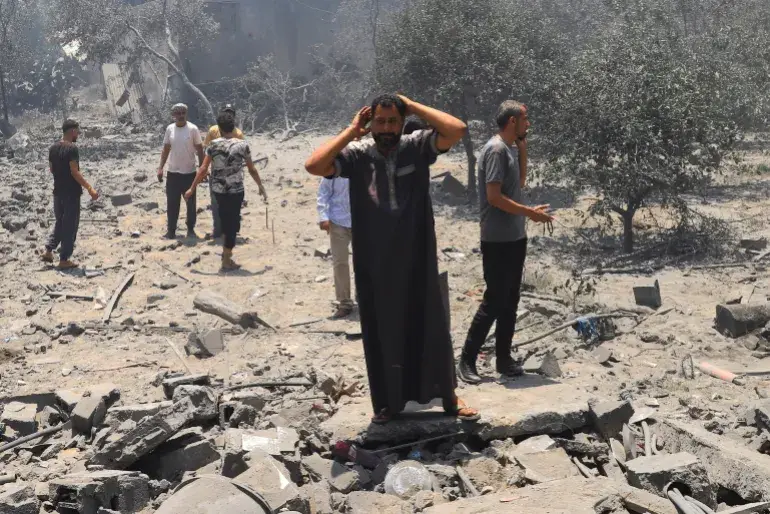
Water, Sanitation and Hygiene
- With support from the cluster, local service providers and technical authorities continue repairing and maintaining critical WASH facilities. Key progress includes:
- The Palestinian Civil Defense reservoir in Gaza city is now fully operational, providing water to areas such as Tel al Hawa, Al Rasheed Street and Al 17 roundabout. Other wells are under rehabilitation.
- Several wells in Al Maghazi and Jabalya and other areas have been repaired and are functional, while additional wells are under rehabilitation.
- Wastewater networks in Gaza city, Al Nuseirat and other areas are being cleaned and repaired.
- The Israeli Mekorot pipeline is now operational and supplying water to western Al Nuseirat in Deir al Balah.
- Rehabilitation of the Shifa Hospital desalination plant, with a processing capacity of 500 m3/day has commenced.
- On 9 and 10 November, the cluster partners distributed more than 5,300 hygiene kits; 1,000 18-litre buckets; 4,900 tarpaulins; 10,600 dignity kits; 100 water tanks; and 48,500 towels.
- About 44 cluster partners are providing water trucking to over 2,000 points, though fuel shortages are becoming a major challenge.
- Solid waste management efforts are ongoing, with technical support from 1,500 workers provided by five cluster partners assisting local service providers in secondary waste collection operations.
Education
- As part of the cluster scale-up plan since the ceasefire, 19 classrooms have been fully rehabilitated in two governmental schools, while rehabilitation works on 18 additional classrooms in another governmental school in the Deir al Balah governorate have reached 95 per cent completion. These classrooms will be used to resume learning activities, with rehabilitation of remaining classrooms ongoing.
- In northern Gaza, two partners are currently conducting assessments to identify suitable locations for the establishment of Temporary Learning Spaces (TLSs). These TLSs aim to provide access to learning opportunities, mental health and psychosocial support (MHPSS), and recreational activities for school-aged children affected by the ongoing crisis.
Protection
- Child Protection (CP):
- Between 10 and 11 November, over 1,500 children and caregivers participated in structured MHPSS sessions across Gaza city, Deir al Balah, and Khan Younis. These sessions promoted emotional expression, stress reduction, and resilience-building. In addition, around 200 caregivers – primarily mothers – engaged in group-based positive parenting and stress management sessions to strengthen family support structures.
- Between 10 and 11 November, Child Protection partners registered or followed up on 50 new or existing cases across the Strip. These services focused on children without parental care, those who are heading households, and other vulnerable groups. A total of 88 at-risk children received tailored support, including tents, hygiene kits, and tarpaulins, to ensure continuity of care and protection.
- As part of the winterization efforts, between 10 and 11 November, 538 winter clothing kits were distributed in Barbara camp in the Khan Younis governorate. During these distributions, protection awareness sessions reached 212 children and 181 caregivers, providing key messages on child protection risks and strategies to prevent family separation. Additionally, over 150 caregivers were reached with child protection messaging through sessions held in shelters and informal sites.
1954.

12 november 2025
Today's headlines
In photos: The ongoing Nakba of Jenin refugee camp
David Lombeida
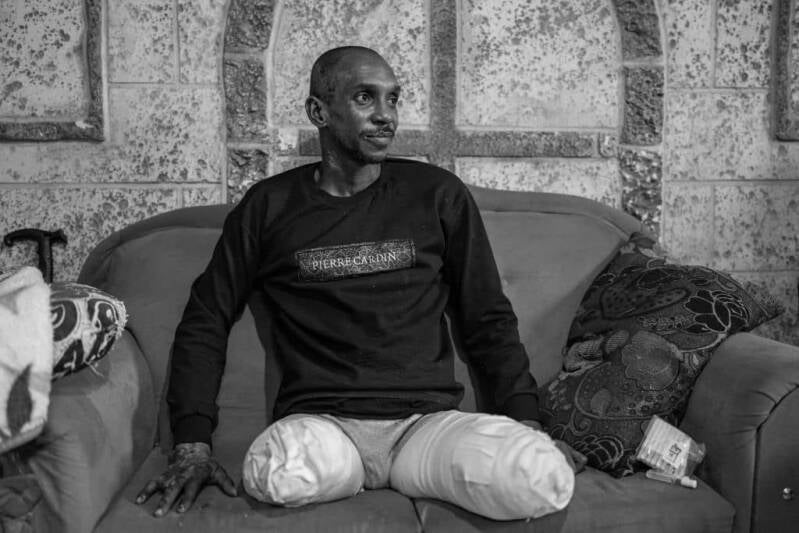
enin refugee camp was completely emptied of its residents during Israel's ethnic cleansing operation earlier this year. These are photos of life in the camp before its most recent Nakba.
1953.

12 november 2025
Gaza Humanitarian Response
Situation Report No. 18
10 November 2025
HIGHLIGHTS
- Since the ceasefire in October, health partners established six new primary healthcare centres (PHC) across the Gaza Strip, providing primary healthcare to approximately 180,000 people; another four partially functioning hospitals, six PHCs, and seven Medical Points resumed operation.
- As of 9 November, around 160,000 bread bundles have been produced daily at 19 UN-supported bakeries and are distributed across the Strip.
SITUATION OVERVIEW
On 10 November, the Ministry of Health (MoH) in Gaza reported receiving 15 bodies of deceased Palestinian detainees, bringing the total since the start of the ceasefire to 315. The MoH also announced that 91 out of the 315 bodies had been identified.
Between 2 and 9 November, the Site Management Cluster (SMC) recorded 1,217 movements of people from northern to southern Gaza. SMS partners also report that 121 households (615 people) crossing from northern Gaza arrived at communal shelters in An Nuseirat refugee camp in Deir al Balah.
Overall, since 10 October, and as of 9 November, SMC partners recorded more than 690,000 movements of people, including more than 580,000 crossings from southern to northern Gaza and more than 113,000 movements from western to eastern Khan Younis.
UNITED NATIONS-COORDINATED HUMANITARIAN AID ENTRY*
According to the UN 2720 Mechanism dashboard, , on 10 November, over 2,800 pallets of UN partner aid were offloaded at Gaza’s crossings. About 44 per cent of these pallets included shelter materials, followed by food (42 per cent), health supplies (5 per cent), water, sanitation and hygiene items (4 per cent), agriculture and livestock supplies (2 per cent), and operational/telecommunication materials (2 per cent).
On 6 and 7 November, 366 partner trucks were collected from Gaza’s crossings, 330 from Kerem Shalom and 36 from Kissufim. These contained 2,813 pallets of various food servings, mixed food, vegetables, ready to use therapeutic food and milk; 400 pallets of wheat flour and 75 metric tons (mt) of animal fodder; 2,614 pallets of winter clothes, blankets, mats and tents; 572 pallets of hygiene and dignity kits, baby diapers, towels and water tanks; and 238 pallets of medical supplies.
Between 9 and 10 November, based on preliminary data, at least 920 pallets of blankets, mattresses, family tents, winter clothes and dignity kits, 93 mt of animal fodder, and 462,200 litres of fuel were collected from the crossings under the United Nations coordinated mechanisms. This data excludes bilateral donations and the commercial sector.
Meanwhile, Government-to-Government convoys from Jordan remain suspended since 18 September and ongoing customs delays and stringent scanning procedures continue at Ashdod Port,
Within Gaza, the Salah ad Din Road has not yet reopened. As a result, cargo collection in the south remains limited to the narrow and highly congested Philadelphi Corridor/Al-Rasheed Road, exposing convoys to heightened risks of interception, particularly when loaded trucks are forced to pause in crowded areas.
At present, only the Kerem Shalom and Kissufim crossings in southern Gaza remain open and operational. It has been two months since the last aid convoy entered northern Gaza via Zikim Crossing, which was closed on 12 September.
HUMANITARIAN RESPONSE
Health
- Since the ceasefire and as of 9 November, health partners have established six new PHCs providing primary healthcare to approximately 180,000 people, and resumed operations in four hospitals, six PHCs, and seven Medical Points.
- A total of 69 healthcare providers from the MoH, and international and national partners, completed three cycles of family planning training this week to expand reproductive health services.
Food Security
- As of 9 November, partners have provided general food assistance to approximately 255,000 people for the November cycle, distributing two food parcels per household. However, these parcels cover only about 50 per cent of minimum daily caloric requirements.
- Partners are currently distributing daily about 160,000 bread bundles of 2 kilograms (kg) each that are produced by 19 UN-supported bakeries, nine of which are in northern Gaza. The bread is being distributed free of charge through partners at more than 400 distribution points, including community kitchens, while an additional network of 71 contracted retailers is selling it at a subsidized price. Partners have so far increased the number of contracted retailers from 43 to 71 retailers to expand coverage and facilitate market reopening across the Strip.
- Between 15 October and 9 November, over 430 metric tons (MT) of concentrated animal fodder was collected from the Kerem Shalom and the distribution of animal fodder to about 1,700 herders in Deir al Balah has been completed. Another round of distribution targeting the same group of herders will start this week.
Shelter
- In support of winterization efforts, a cluster partner is organizing Explosive Ordnance Risk Education (EORE) sessions to address the increased risk of explosive remnants being exposed by flooding during the winter months. One awareness session was held on 9 November, reaching 87 children residing at the Al Amal Preparatory Girls’ Designated Emergency Shelter in Al Nuseirat in Deir al Balah. These activities aim to reduce the risk of children encountering hazardous items while playing or moving around in the area.
Protection
- General Protection:
- On 8 and 9 November, partners reported holding EORE sessions and Conflict Preparedness and Protection (CPP) sessions in internally displaced persons (IDP) sites, covering three sites in Khan Younis and six sites in Deir al Balah, reaching more than 920 people.
- On the same days, Mental Health and Psychosocial Support (MHPSS) services relying on in-person provision and remote modalities were provided to a total of 105 people in different areas in Khan Younis and Deir al Balah. Beneficiaries who returned home were followed up by phone. High-risk cases were referred to service providers near their new areas of residence to ensure continued support. Partners also provided Helping the Helpers sessions for a total of 86 operational and frontline workers.
- Child Protection (CP):
- On 9 November, child protection partners reached 1,503 people, including 1,087 children and 416 caregivers, across northern and southern Gaza with critical child protection and MHPSS services. These included structured MHPSS sessions, recreational activities, positive parenting sessions, child protection messaging, and case management follow-ups. Additionally, 10 new high-risk child protection cases were registered and supported through case management, involving children heading households, children without parental care, and those injured during the conflict. Despite increasing needs and demand for child protection services, partners continue to face significant operational constraints, including staff shortages, fuel scarcity, and limited mobility due to ongoing security concerns. To maintain service delivery, partners are adapting through mobile teams, remote work arrangements, and community-based volunteer engagement.
- In preparation for winter, in northern Gaza, on 9 November, a total of 1,663 winter clothes kits, 28,500 blankets, and 41,010 pairs of shoes were distributed to vulnerable children aged 3 to 17 years old through five child protection partners.
Fuel
- Between 7 and 10 November, the UN Office for Projects and Services (UNOPS) distributed 619,649 litres of diesel to partners - 466,018 litres in the south and 153,631 litres in the north - to support critical WASH, health, logistics, rubble removal, education, nutrition and protection operations.
1952.

11 november 2025
As the Trump regime continues its crackdown on free speech, U.S. university administrators remain all too eager to take any opportunity to shut down political protest on their campuses.
At the University of Colorado-Boulder, students peacefully and mostly silently protesting Lockheed Martin’s complicity in Israeli genocide were slapped with interim sanctions, including suspensions, that even the university describes as “extraordinary.” Some lost their housing as a result.
Email CU Boulder administrators now to demand that students be cleared of these trumped-up charges — and to call on them to uphold, not dispose of, the rights to free speech and political protest.

Lockheed Martin is the largest weapons manufacturer in the world. But CU Boulder’s leadership has decided that the bigger threat to its values as an educational institution is not complicity in genocide, but its own students hoping to hold it to those very values.
The students’ protest was directed at Lockheed Martin’s presence at a campus career fair, calling out its support for the Israeli genocide in Gaza. Their protest was largely silent, and included around five minutes of chanting, none of which disturbed the rest of the career fair from taking place.
But it doesn’t matter how calmly and quietly students protest Israeli genocide. Despite the fact that U.S. universities frequently tout opportunities for activism and political engagement as selling points of their schools, university administrators have jumped at the chance to crush their students’ freedom to protest.
CU Boulder, like many other universities, has been systematically repressing students in solidarity with Palestine over the last two years. Two of its students are even suing over this conduct. This wave of repression on university campuses has served as the first line in the Trump administration’s overall fascist crackdown on free speech, but this hasn’t deterred university leadership.
Email now to demand students are fully cleared and CU Boulder end its repression of students protesting genocide.
In solidarity,
Jason Farbman
Digital Director
1951.
11 november 2025
Did you know that an American charity has just raised more than $1,000,000 for illegal Israeli settlements in Hebron? Help us fight back and support the local Palestinian community against oppression and settlement expansion!
$1.5 Million to Illegal Settlement Expansion
The American tax-exempt organization The Hebron Fund is collecting $1.5 million to support the expansion of Israeli settlements in Hebron, projects that are outlawed under international law in violation of the Fourth Geneva Convention. As Israel has expanded its settlement projects in the occupied city center, charities are raising money to fortify those settlements and provide surveillance equipment and "empower volunteer security personnel" — that is to say, to help arm Israeli settlers who guard the settlements and harass Palestinian residents. The money also support "care for IDF soldiers," which means supporting the Israeli forces that are violating the rights of Palestinian families in the city. The fundraiser directly states that donors can "provide homes for more families to move in," meaning directly contributing to a war crime in the form of settlement expansion.
We need to push back! Help us remain strong during this time and make your donation matter!
Support Us on Giving Tuesday!

Attacked by Israeli Settlers
In the middle of the night, our Executive Director Issa Amro was attacked by armed Israeli settlers who tried to break into his home. The settlers climbed on the fence, damaged a CCTV camera and hurled rocks at Issa. Israeli soldiers were present and supervised the attack before entering the private yard to attempt to arrest Issa. Earlier that day, Israeli soldiers abducted our team mate Mohammad Natsheh from Issa's yard, mistreated him for six hours before finally releasing him. Mohammad was hospitalized. Such attacks illustrate the precarious situation that Palestinian human rights defenders find themselves in with no one to guarantee their safety, security or basic human rights.
Welcoming Visitors in Hebron
Our team on the ground has continued to welcome visitors to Hebron and giving them tours of the humanitarian situation of the city.
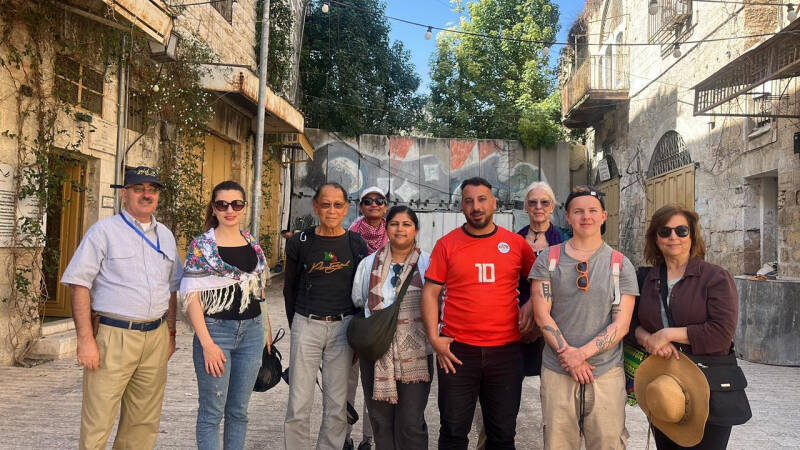
Tours give visitors a unique insight into Hebron's occupied Old City, and the military measures employed to subjugate the local Palestinian population.
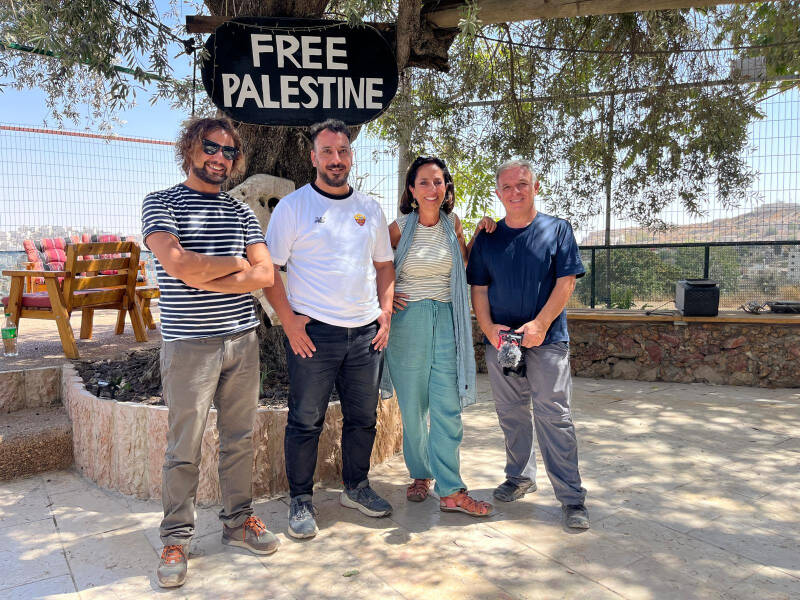
We welcome delegations from Breaking the Silence and other organizations in our community center.

We have also begun leading tours to Massafer Yatta in South Mount Hebron, the focus of the Oscar-winning documentary No Other Land.
With peace,
Friends of Hebron
Working for Peace and Justice
1950.

11 november 2025
Today's headlines
Israel killed her son and held his body. Her story is one of hundreds of Palestinian families.
Felix Nobes
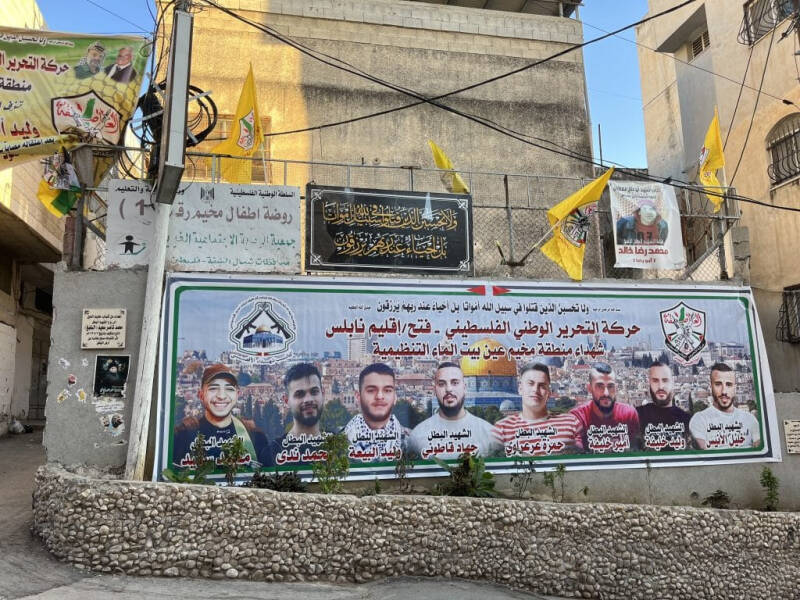
Inside one Palestinian family's harrowing experience of having their son's dead body withheld by Israel as a bargaining chip. Israel has held the bodies of 726 Palestinians in refrigerators and the so-called "cemetery of numbers" for decades.
1949.

10 november 2025
Trial is delayed again, and the Trump Administration continues to abandon a Florida teen in Israeli prison
For over nine months, Mohammed Ibrahim, a 16-year-old American citizen from Florida, has been illegally imprisoned and tortured by Israel. Now, his trial has been postponed to December 15th, a deliberate delay that will force him to spend one day shy of ten months behind bars for an accusation of throwing stones, a charge he only "confessed" to after being beaten and extorted.
TAKE ACTION: DEMAND THE U.S. ENFORCE MOHAMMED IBRAHIM'S IMMEDIATE RELEASE!
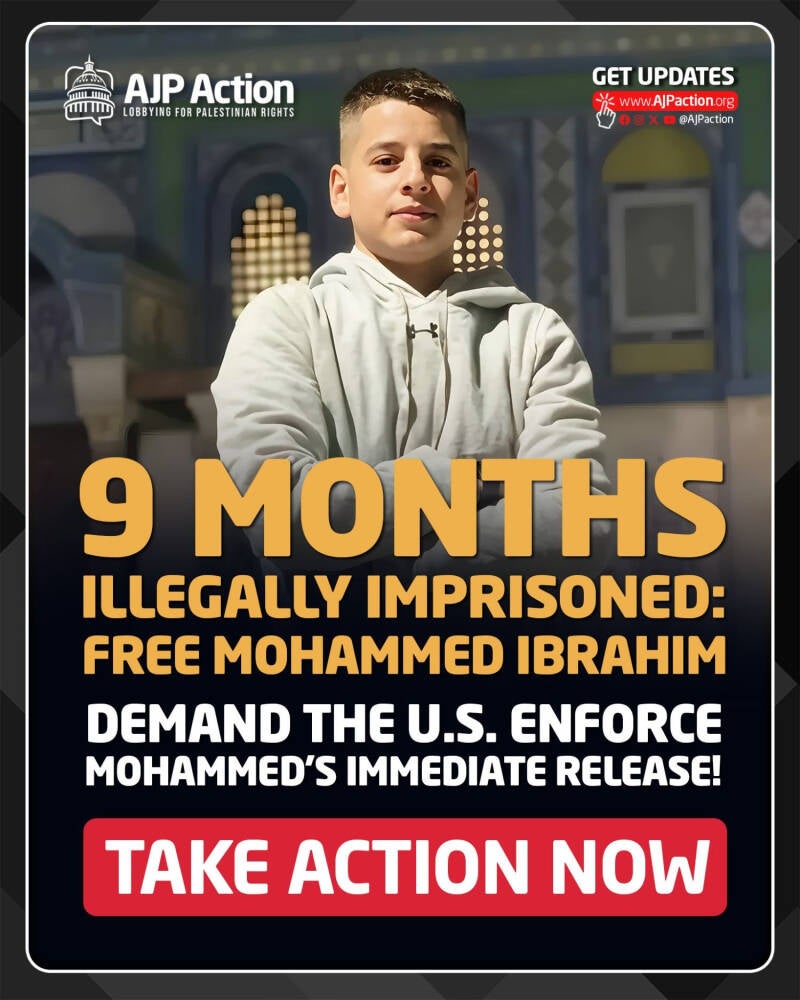
Mohammed was only 15 when he was blindfolded and taken by Israeli Occupation Forces (IOF) from his family's home in the occupied West Bank. According to Defense for Children International - Palestine, he has suffered “deplorable conditions,” including being “beaten with rifle butts” and subjected to “starvation” and medical neglect.
Israel’s systematic torture has had a devastating effect, causing him to lose one-third of his body weight. He also contracted scabies in prison and was then thrown into isolation. For the entire duration of his detainment, his family in Florida has been completely denied contact with him, unable to speak to or see their son outside of a courtroom camera.
Mohammed's case is a horrific injustice, but it is not an exception because of his American identity. Since October 7th, 2023, Israel has abducted over 18,500 Palestinians, including workers, doctors, journalists, and students. To date, at least 360 Palestinian children are detained without charge or trial in Israeli military prisons, facing the same system of torture and abuse. No child, Palestinian or American, should ever endure this.
While Mohammed suffers, elected officials have failed him. His own representative, Mike Haridopolos, has not met with the family or made a single public statement demanding his release. And after the brutal, settler-led killing of Mohammed’s cousin, another American citizen named Sayfollah, Mike Huckabee promised the family he would fight for Mohammed's freedom, yet he has done nothing.
Sayfollah is one of six U.S. citizens killed by Israeli forces or settlers since 2023. The State Department’s apathetic response to these cases is a glaring example of both the United States’ and Israel’s dehumanization of Palestinian life.
Last weekend, advocates held seven statewide protests across Florida, sending a clear message that we see this injustice and we will not be silent.
For every day Mohammed continues to be held in prison, we will apply more pressure. Take action now, and urge your loved ones to do the same.
In solidarity,
Americans for Justice in Palestine Action
1948.

10 november 2025
Gaza Humanitarian Response
Situation Report No. 17
8 and 9 November 2025
HIGHLIGHTS
- On 9 November, an integrated vaccination campaign began with the aim to target children aged from one to three years, who missed earlier doses. It’s being delivered via over 150 health facilities and community outreach, with nutrition screening included.
- Between 5 and 8 November, Shelter Cluster partners collected more than 20,000 tarpaulins, 47,000 blankets, 31,000 mats and 1,000 tents.
SITUATION OVERVIEW
On 5 November, the Ministry of Health in Gaza reported receiving 15 bodies of deceased Palestinian detainees, bringing the total since the start of the ceasefire to 300.
Between 7 and 8 November, the Site Management Cluster (SMC) recorded approximately 17,000 movements of people from southern to northern Gaza: 91 per cent of them towards Gaza city and the remainder towards North Gaza governorate. According to a SMC assessment, out of 46 sites hosting internally displaced persons (IDPs) east of the “Yellow Line”, 18 remain active, hosting approximately 10,000 people.
The quantity of food assistance brought into the Strip remains insufficient; partners need more access to multiple key roads inside Gaza in addition to more crossings to open. Partners continue to face administrative restrictions and access challenges across all corridors for delivering food to Gaza. Most international organizations are not given authorization to bring in food assistance.
UNITED NATIONS-COORDINATED HUMANITARIAN AID ENTRY*
According to the UN 2720 Mechanism dashboard, on 8 and 9 November, over 3,600 pallets of UN and partner aid were offloaded at Gaza’s crossings. About 50 per cent of these pallets included food, followed by shelter materials (42 per cent), health-related items (5 per cent), mixed supplies (2 per cent), water sanitation and hygiene items (1 per cent) and Nutrition supplies (less than 1 per cent).
Between 7 and 8 November, based on preliminary data, at least 2,894 pallets of dignity and hygiene kits, blankets, towels, winter clothes and tarpaulins, and 124 pallets of medical supplies, including seven pallets of insulin, were collected from the crossings under the United Nations coordinated mechanisms. This data excludes bilateral donations and the commercial sector.
Meanwhile, Government-to-Government convoys from Jordan remain suspended since 18 September and ongoing customs delays and stringent scanning procedures continue at Ashdod Port,
Within Gaza, the Salah ad Din Road has not yet reopened. As a result, cargo collection in the south remains limited to the narrow and highly congested Philadelphi Corridor/Al-Rasheed Road, exposing convoys to heightened risks of interception, particularly when loaded trucks are forced to pause in crowded areas.
At present, only the Kerem Shalom and Kissufim crossings in southern Gaza remain open and operational. It has been 59 days since the last aid convoy entered northern Gaza via Zikim Crossing, which was closed on 12 September.
HUMANITARIAN RESPONSE
Health
- On 9 November, an integrated catch-up vaccination campaign was launched, with the aim to target thousands of children aged from one to three years. The current focus is on children who missed previous vaccination campaigns. The teams are administering these vaccines in 149 health facilities and 10 mobile units across the Gaza Strip. In addition, malnutrition screening and referral treatment are being carried out for children in these facilities.
Water, Sanitation and Hygiene
- Since the beginning of the ceasefire, 44 partners have been providing water trucking services through 2,000 points across Strip. Partners also managed to distribute 15,000 hygiene kits targeting the most vulnerable households.
- A critical water line in Az Zaytoun neighbourhood in Gaza city was repaired, restoring partial domestic water supply.
Shelter
- Between 5 and 8 November, the Shelter Cluster collected more than 20,000 tarpaulins, 47,000 blankets, 31,000 mats and 1,000 tents.
- Between 5 and 8 November, 436 households in North Gaza governorate received cash vouchers for clothes.
- Partners distributed 11,000 tarpaulins and 10,000 blankets to approximately 25,000 vulnerable households.
- Overall, as of 8 November, partners have collected from Gaza’s crossings more than 180,000 tarpaulins, 60,000 blankets
Protection
- Child Protection (CP):
- In North Gaza, 20 Child Friendly Spaces/child protection service points are operational, supported by 10 child protection partners delivering critical child protection services, including Mental Health and Psychosocial Support (MHPSS), case management, and awareness-raising activities.
- Between 5 and 7 November, Child Protection partners provided community based MHPSS services to 1,500 children and 500 caregivers in Khan Younis, Al Mawasi area, and the Deir al Balah camps. Sessions focused on emotional expression, coping strategies, and stress reduction, with messaging on the prevention of child abuse integrated throughout activities.
- The Child Protection winterization response is underway across multiple locations. Over the past two days, 38,185 winter clothing kits and pairs of shoes have been distributed, targeting children under the age of 10, with distributions tailored by age and gender and implemented through nine partners. In parallel, as part of the broader winterization effort, over 160,000 blankets have been dispatched to partners, including 62,000 for hospitals and 20,000 for primary health care centres supporting children under two years old.
- Gender-Based Violence (GBV):
- GBV partners continue to deliver multisectoral services addressing GBV through 33 Women and Girls Safe Spaces (WGSSs) across Gaza, providing case management, psychosocial support, legal counselling, and life-skills activities.
- During the week, partners reached 456 women and girls with menstrual hygiene management kits in Khan Younis and Deir al Balah, addressing immediate protection and health needs. Psychosocial support activities across WGSSs reached 2,570 women and girls, including group counselling and other therapeutic sessions promoting emotional well-being.
- In addition, the GBV AoR participated in a rapid needs assessment in northern Gaza city and Jabalya, where several urgent needs were identified. A coordinated mobile response across clusters is being considered to enhance service delivery and ensure more effective support to affected communities.
- Mine Action:
- Explosive hazards assessments continue and expansion of Explosive Ordnance Disposal specialists on the ground is being planned for next week.
Emergency Telecommunication Cluster
- Following the late last week's internet outage and a main fiber break north of Jabalya, Paltel engineers were denied access to the area to carry out repairs. The Internet across Gaza Strip is currently running on a backup line, which has reduced the capacity to 50 per cent, though service remains stable. Discussion and advocacy to obtain authorization for repair is ongoing.
1947.
9 november 2025
Ziv here. Over the past two years, alongside hundreds of activists, I’ve taken part in dozens of direct actions from blocking roads to occupying government offices. The peak came last March, when we blocked an Israeli parliament vote during a budget vote in order to send a clear message: no more funding for the endless expansion of settlements! Ministers and Members of Parliament had to leave their cars and walk through a crowd of determined activists. We acted against the extreme right-wing Israeli government that dragged us through two years of bloody war. Again and again, our actions succeeded in drawing public attention and reigniting debate about the legitimacy of the war and the government itself. Many of these actions were led by Changing Direction, the movement I co-founded. In just two years, it has become one of Israel’s most influential protest movements: not only leading nonviolent resistance, but also expanding it. We recruit new activists, and we train them in the practice and spirit of nonviolent struggle. The ceasefire deal and returning of the hostages have ushered in a new phase. Now we need to utilize the momentum to grow our numbers, organize and strategize around bolder direct actions aimed at justice from the river to the sea. Please support us: your donation will help subsidize nonviolent direct action trainings. Even a small donation will help fund training for a potential activist.

During the action in March, my friends and I were repeatedly and violently dragged by police officers. Many were arrested, and some were injured. And yet, we all remained calm, prepared, and committed to nonviolence. The action drew wide political attention. Parliament Speaker Amir Ohana publicly called to “prosecute the offenders to the fullest extent of the law, and not to settle for arrests and vehicle towing, but to bring them to trial.” But despite this political backlash, all the arrested activists were released the same day, and all charges were dropped, simply because we had remained radically nonviolent.
That experience taught me two things: first, that widespread nonviolent direct action is one of the most powerful ways to influence public discourse. We changed public discourse and ignited debate in forums across the country. And second, that preparation is everything. Without the discipline to stay calm, determined, and nonviolent under pressure, it would have been easy for the authorities to portray us as violent and illegitimate. That’s why I’ve made it my mission to prepare others for nonviolent direct action. Over the past two years, I’ve personally led dozens of trainings for hundreds of people, many of whom never imagined themselves as “activists.” After these trainings, they joined acts of civil disobedience and faced arrests with courage and dignity while standing up to Israel’s far-right government.
Yet we know this is just the beginning. To truly shift the balance in this land, we must grow the movement of people willing to take part in nonviolent civil resistance, from bystanders to independent anti-war organizers who dream of a more just future. That’s why we’re launching a new partnership with Refuser Solidarity Network, to create an institute that will spread the tools, knowledge, and spirit of nonviolent resistance to new circles of activists, who will fight to maintain the current ceasefire and oppose endless wars at all costs. Through trainings, skills building and partnerships, we can bring everyday people into our movement. Your support makes this possible. Donate now to help us provide mass training and carry out more direct actions. With your help, we can seize this momentum for a more effective movement for peace and justice.
In solidarity,
Ziv Roi-Cohen
Changing Direction
1946.

9 november 2025
I spoke with our partners at the Palestine Fair Trade Association (PFTA) last week on our Rooting Resistance campaign, and I wanted to share with you what I heard directly.
The situation around Jenin—where their office is based—is slightly better than it was earlier this year. In January and February, it was often too dangerous to even reach their office. But as one of the PFTA staff members told me:
“We’re a little bit safer than at the beginning of the year. But we’re not safe at all.”
That sentence, and what she went on to share, has been sitting with me ever since.
The olive harvest has begun, but it’s far from normal. In many so-called “closed zones,” only one family member—often an elderly man—is granted a permit to harvest the family’s trees. Israeli settlers have attacked farmers, including at least one who received PFTA saplings from last year’s Rooting Resistance campaign.
And yet, Palestinian farming families persist. They keep applying for trees, keep tending their groves, and keep returning to the land.
With your help, they can keep planting new saplings too.
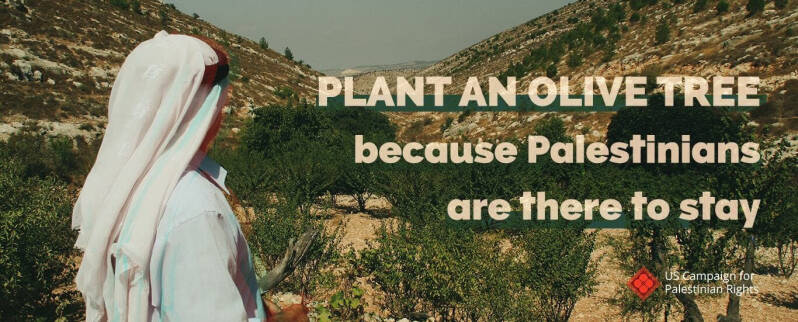
This year, after the Palestinian Ministry of Agriculture ended its tree distribution program, demand for trees to the PFTA has skyrocketed.
That’s why this year’s Rooting Resistance campaign is more critical than ever.
When you give before November 15, your donation ensures PFTA can confirm how many families they’ll be able to support—and place orders with local Palestinian-owned nurseries to grow the trees those farmers will plant early next spring.
Donate now to plant olive trees and sustain Palestinian farmers. And as always, part of your Rooting Resistance gift will also support USCPR’s organizing work in the U.S.
Nico, these aren’t just agricultural practices. They’re acts of survival—and of vision.
We have until mid-November to meet this moment and ensure PFTA can help every farmer who’s reached out.
Will you join me today in planting hope, protection, and resistance?
Thank you,
MIKE DALY
Development Director
USCPR
1945.


9 november 2025
Today's headlines
Why writers must boycott the New York Times
Writers Against the War on Gaza

The New York Times is the paper of record and has played a key role in enabling the Gaza genocide. To hold the newspaper accountable, we must sever our ties —not only as subscribers or advertisers, but also as writers who lend the paper legitimacy.
1944.

9 november 2025
Mamdani’s landslide victory signals a new political era in the United States
What a week. Zohran Mamdani won the New York City mayor’s race in a landslide that could reshape U.S. politics for generations. Michael Arria calls it a real loss for Zionism. It is that, and also a signal that the generational shift inside the Democratic Party has truly begun. His campaign has already inspired many young people who lean democratic socialist to consider running for office across the country. His victory will accelerate that movement. A few days later, Nancy Pelosi announced her retirement, a decision many expect will prompt other elderly leaders to follow.
Mamdani won by a wide margin without compromising his position on Palestine. He did not run from his record opposing Israel’s occupation, apartheid, and genocide. He owned it, and he explained it with patience in terms that younger voters understood. At the same time, he centered affordability, the core theme of his campaign, and it resonated with voters who may have disagreed with him on Palestine. That is the lesson for Democrats who want to win. Focus on improving the material conditions of people’s lives, and maintain your integrity by standing firm on human rights and democratic values.
Elsewhere in our coverage, Writers Against the War on Gaza argue for a boycott of the New York Times, naming the paper’s role in laundering a genocide. Trump’s team is now hunting for a UN fig leaf to cover its “20-point plan” for Gaza, but Mitchell Plitnick shows why the Security Council is unlikely to bless a blueprint built on coercion and fantasy. Michael Arria tracks how Trump’s widening crackdown on the left took shape by first criminalizing Palestine solidarity. Abdalrahim Abuwarda writes from Wyoming about living in two worlds at once, studying for a degree while his home is unraveling. On the ground, a “Yellow Line” cutting Gaza in two is being sold as temporary but is designed to make partition feel inevitable. Jonathan Ofir’s piece on Israeli soldiers’ rape video points to a moral rot in Israeli society.
Lastly, please do me a favor. Forward this email to someone who would value our reporting and invite them to subscribe. We have about 6,200 readers on this list today. Help us reach 6,500!
David Reed, Publisher
Must read: Trump looks to the UN to bail out his ’20-point plan’ for Gaza
Mitchell Plitnick: As Trump’s administration struggles to find ways to implement its fatally flawed "20-Point Plan" for Gaza, it has taken the surprising step of trying to obtain the approval of the United Nations Security Council. Here’s why that’s unlikely to work.
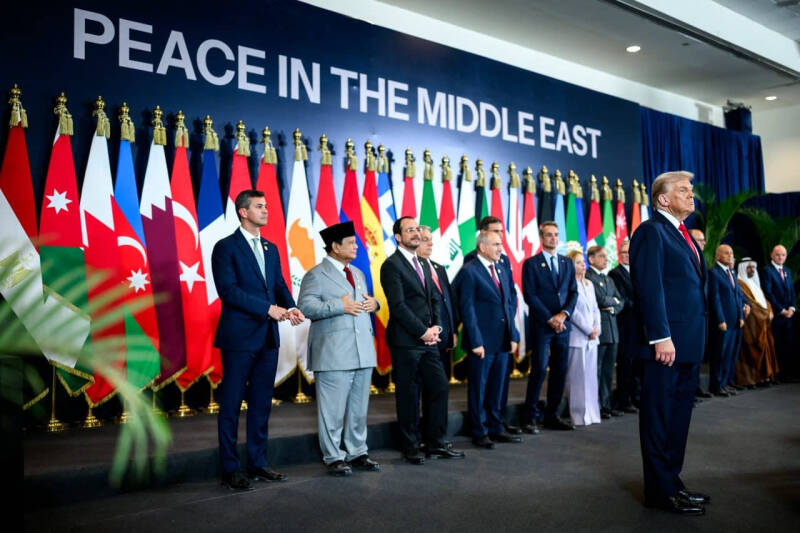
President Donald Trump is introduced by Egyptian President Abdel Fattah el-Sisi before delivering remarks at the Tonino Lamborghini International Convention Center in Sharm El Sheikh, Egypt, Monday, October 13, 2025, during a summit of world leaders on ending the war between Israel and Hamas in Gaza. (Official White House Photo by Daniel Torok)
Genocide in Gaza
Mondoweiss Palestine Bureau and Qassam Muaddi: The “Yellow Line” splitting Gaza in two is meant to be temporary according to Trump’s "peace" plan. However, the fact that those terms were intentionally left vague suggests that the partition of Gaza was the real goal all along.
Abdalrahim Abuwarda: As a graduate student from Gaza studying in Wyoming, I live in two dimensions: one where life moves peacefully forward, and another where everything I love is collapsing. I live in both worlds at once, holding grief and strength in the same breath.
Catch-up
Writers Against the War on Gaza: The New York Times is the paper of record and has played a key role in enabling the Gaza genocide. To hold the newspaper accountable, we must sever our ties —not only as subscribers or advertisers, but also as writers who lend the paper legitimacy.
Nihad Awad: For American Muslims, November 4, 2025, was a long time coming. Zohran Mamdani’s victory serves as a rebuke to those who claim American Muslims have no place in their own country and to those standing in the way of Palestinian freedom.
Michael Arria: Zohran Mamdani’s historic victory in New York City shows that the Gaza genocide has permanently shifted Israel’s role in U.S. politics.
Jonathan Ofir: There’s outrage in Israel over the leaked video of Israeli soldiers gang-raping a Palestinian prisoner. However, the outrage isn’t about the rape itself but the fact that the video was leaked in the first place.
SALAM: South Asian Left: By sportswashing its reputation through events like the New York City Marathon, the Indian conglomerate Tata Group has built a multi-billion-dollar brand name as it directly profits from Israel’s occupation and genocide.
Michael Arria: The Trump administration’s recent efforts to target left-wing groups started with attacks on the Palestine movement, following the strategy established by pro-Israel organizations that worked for decades to pave the way for such repression.
1943.

8 november 2025
Gaza Humanitarian Response
Situation Report No. 16
7 November 2025
HIGHLIGHTS
- Inter-agency assessments in northern Gaza continue to highlight critical humanitarian needs. For 57 days, no aid has directly entered northern Gaza via any northern crossing.
- Hot meal, bread, and food parcel distributions have been gradually increasing since the start of the ceasefire. Yet, safe access to the sea for fishing remains interdicted, and the entry of agricultural inputs continues to face constraints.
- Since the onset of the ceasefire, 23 requests from nine aid agencies to bring in nearly 4,000 pallets of urgently needed shelter supplies into Gaza were rejected by the Israeli authorities.
- Sixty-four Temporary Learning Spaces across Deir Al Balah and Khan Younis have been expanded to be able to enroll an additional 9,400 school-aged children.
SITUATION OVERVIEW
On 6 November, the Site Management Cluster observed 5,852 population movements from south to north, 91 per cent of them towards Gaza city and the reminder towards the North Gaza governorate. Most families travelled by light vehicles. At least 150 reverse movements from north to south were also recorded, predominantly towards Deir al Balah. This uptick in southward movement may be attributed to the approaching winter season, as families living in makeshift sites seek access to better shelter and essential services further south.
On 6 November, OCHA coordinated an intercluster assessment mission to six sites in northern Gaza, including Jabalia, Al Shati Camp, and the Al Karama neighborhood in western Gaza city. The teams met with families who returned after the ceasefire one month ago, assessing overall living conditions and urgent needs. Approximately 1,300 households were covered, the majority residing in damaged or makeshift shelters. Water for drinking and domestic use remains insufficient to meet basic needs, and hygiene conditions are poor. Shelter materials are limited, and winter clothing is needed, particularly for children. Food assistance is irregular, with some sites receiving bread or rice occasionally and only a few receiving food parcels. Female-headed households face increased vulnerability, and mothers highlighted the lack of nutritious food for children. The key priorities are hygiene and dignity items, regular food assistance, adequate shelter and winter clothing, and access to basic health services and medication for chronic diseases.
UNITED NATIONS-COORDINATED HUMANITARIAN AID ENTRY*
According to the UN 2720 Mechanism dashboard, on 6 November, 3,627 pallets of UN and partner aid were offloaded at Gaza’s crossings. Nearly 65 per cent of pallets carried food assistance, with shelter constituting another 29 per cent.
On the same day, based on preliminary data, at least 2,065 mt of food supplies, 93 mt of animal fodder, 536 pallets of winter clothes, tarps, blankets and hygiene kits, 149 pallets of medical supplies, 413 pallets of other aid cargo, alongside 320,250 litres of diesel fuel, were uplifted from the crossings under the United Nations-coordinated mechanism.
Humanitarian partners continue to face administrative restrictions across all corridors for delivering aid to Gaza. On 6 November, Israeli authorities announced that the quota for all UN and INGO trucks entering Gaza from Egypt via Nitzana would be reduced from 100 to 40 per day. For the past week, out of 180 trucks with ready-to-eat rations manifested for entry via the Egypt corridor, only five offloaded at Kerem Shalom. On 6 November, out of 115 UN and partner trucks manifested via the corridor, only 52 offloaded.
From the West Bank, for the second consecutive day on 6 November, the Israeli authorities closed the crossings prior to submission of the manifest, cancelling 29 UN and partner trucks at short notice.
Meanwhile, Government-to-Government convoys from Jordan remain suspended.
Within Gaza, the Salah ad-Deen Road has not yet reopened. As a result, cargo collection in the south remains limited to the narrow and highly congested Philadelphi Corridor/Al-Rasheed Road, exposing convoys to heightened looting risks when loaded trucks are forced to pause in crowded areas.
At present, only the Kerem Shalom and Kissufim crossings in southern Gaza remain functional. It has been 57 days since the last aid convoy entered the north via the Zikim Crossing, which was sealed on 12 September.
HUMANITARIAN RESPONSE
Food Security
- Between 1 and 6 November, approximately 40,000 households (estimated 200,000 people) were assisted with two food parcels per family, covering 50 per cent of daily caloric needs, through 46 distribution points across the Gaza Strip, including 10 in northern Gaza.
- Two further UN-supported bakeries have reopened across Gaza, including one in the north. From having no operational bakeries at the beginning of October, as of 7 November, around 160,000 two-kilogram bread bundles were produced daily at 19 UN-supported bakeries, nine of which are in the north. The bread is distributed either for free through partners across more than 400 sites, including community kitchens, shelters and community sites, or sold via 71 contracted retailers at a subsidized price of 3 NIS per bundle. Partners have increased the number of contracted retailers from 43 to 71 to expand bread coverage and support the resumption of markets across the Strip.
- Hot meal production remained steady, with 1,297,000 cooked meals prepared and delivered daily by 23 partners through 189 kitchens as of 5 November – 126,000 meals by 23 kitchens in the north and 1,171,000 by 166 kitchens in south-central Gaza.
- The Food Security Sector continues to advocate for safe access of fishers to the sea, as it remains prohibited, and the entry of agricultural supplies – including seed kits, organic fertilizers, and nylon sheets for greenhouses – through both humanitarian and private sector channels, as imports continue to face constraints and challenges. These are vital to restore livelihoods.
Nutrition
- On 5 November, the Nutrition Cluster began a five-day Training of Trainers on Infant and Young Child Feeding (IYCF) and Community Management of Acute Malnutrition in children aged 6-59 months (CMAM) for 20 partner organizations. Six of these organizations were also trained in the management of malnutrition in children above the age of five.

Water, Sanitation and Hygiene
- On 6 November, the Cluster completed an assessment of eight water wells in the Beit Lahia area of North Gaza to inform necessary repairs.
- Chlorination monitoring campaigns are ongoing in Khan Younis and Deir al Balah to assess free residual chlorine levels at the point of consumption.
- One WASH partner has launched a voucher assistance program, allowing 450 vulnerable households in Gaza city to purchase hygiene items. This initiative highlights the potential of cash-based interventions, particularly if the private sector can bring additional hygiene supplies into the Strip.
Shelter
- On 5 November, the Shelter Cluster distributed blankets to 60 households in Deir al Balah and 903 tarpaulins to families in Khan Younis. A total of 18,720 blankets and 21,060 mattresses entered the Strip and were received by Shelter partners on the same day.
- The Shelter Cluster reports that millions of shelter and non-food items are blocked in Jordan, Egypt, and Israel awaiting approvals, while nearly 1.5 million people remain in urgent need of emergency shelter assistance and the window to scale up winterization support is closing rapidly. Since the ceasefire took effect on 10 October, Israeli authorities have rejected 23 requests from nine aid agencies to bring in nearly 4,000 pallets of urgently needed tents, sealing and framing kits, bedding, kitchen sets and blankets. In 21 of the 23 cases, the rejections were on the basis that the organisations submitting them were “not authorised to deliver humanitarian aid to Gaza”.
Site Management
- The Site Management Cluster conducted a remote analysis of displacement sites located east of the Yellow Line, identifying a total of 46 sites, of which 18 are currently active and 28 are inactive. The active sites host approximately 13,573 people across 1,352 households. While no physical assessments have been conducted, Site Management partners have been updating population data through phone calls with site focal points.
Protection
- Child Protection: Child Protection AoR partners continue to deliver Mental Health and Psychosocial Support (MHPSS) to children and caregivers and critical case management for at-risk children.
- As part of the winterization response, more than 160,000 blankets have been dispatched to partners over the past two days; of these, 62,000 have been allocated to hospitals, 20,000 to primary healthcare centers, targeting children under the age of two along with winter clothing, and 40,000 have been designated as case management supplies.
Education
- Twelve Education Cluster partners have expanded their 64 TLS across Deir al Balah and Khan Younis, increasing the overall learning provision capacity to reach an additional 9,400 school-aged children. Partners are also working to improve the quality of learning in these spaces through the provision of essential learning materials, and teacher support.
- Throughout October, Education Cluster partners scaled up their MHPSS interventions, reaching an additional 2,000 children with structured psychosocial support activities. In parallel, over 11,000 children participated in recreational and wellbeing sessions designed to restore a sense of normalcy, reduce stress, and promote emotional resilience. These activities were implemented in collaboration with community facilitators and school staff, with a focus on integrating psychosocial support within learning environments to better address children’s holistic needs.
Fuel
- Between 5 and 6 November, UNOPS collected 639,000 litres of diesel from Kerem Shalom and distributed approximately 175,000 litres in the south and 49,600 litres in the north to support critical logistics, health, WASH, food, education and rubble removal operations.
1942.
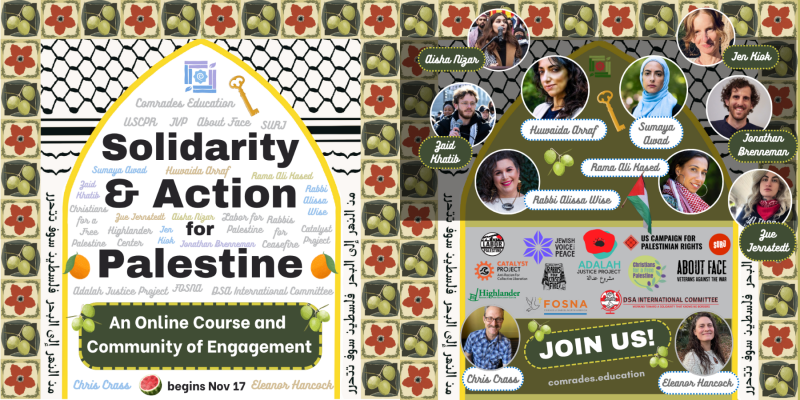
8 november 2025
Right now, Palestine sits at the heart of global struggle. People everywhere are continuing to take action by filling the streets, shutting down ports, organizing flotillas to deliver aid to Gaza, and refusing to let this genocide be normalized.
At the same time, repression is getting sharper, governments are trying to criminalize solidarity, and our opponents are coordinating across sectors. That means we have to be just as coordinated, just as disciplined, and just as rooted in political education.
That is why I'm happy to be teaching once again with Comrades Education in their new five-part course, Solidarity & Action for Palestine. This will be my third time teaching in this series, and every round has shown me how eager people are for space to learn together, ask hard questions, and plug into campaigns.
This course is meant for this exact moment. It is a space to move from grief to strategy, from isolation to movement, and from general solidarity to specific, winnable work.
Facilitated by Eleanor Hancock, Comrades Education’s Director, and Chris Crass, longtime anti-racist educator and author, the course will bring together organizers who are doing the work right now, including:
- Huwaida Arraf, veteran civil rights activist and Gaza flotilla leader
- Rabbi Alissa Wise, co-author of Solidarity is the Political Version of Love and longtime Jewish Voice for Peace staff leader
- Dr. Rama Ali Kased, scholar and grassroots organizer in Oakland
- Aisha Nizar, organizer with the Palestinian Youth Movement leading the Mask Off Maersk and Oakland People’s Arms Embargo campaigns
Together, we will look at what it takes to build power in the U.S. context, how to connect local campaigns to the broader movement for Palestinian liberation, and how to sustain ourselves while we do it.
The course includes four Monday evening sessions focused on action, connection, and campaign work, and one longer Sunday session that will ground us in the political and historical context of the Palestinian struggle.
This round is also co-sponsored by Democratic Socialists of America International Committee and About Face: Veterans Against the War, which speaks to how wide and intersectional this movement has become.
If you are asking what to do next, how to stay involved, or how to make your organizing count right now, I hope you will join us.
With love and solidarity,
Sumaya Awad
Adalah Justice Project
1941.

8 november 2025
Today's headlines
Trump looks to the UN to bail out his ’20-point plan’ for Gaza
Mitchell Plitnick
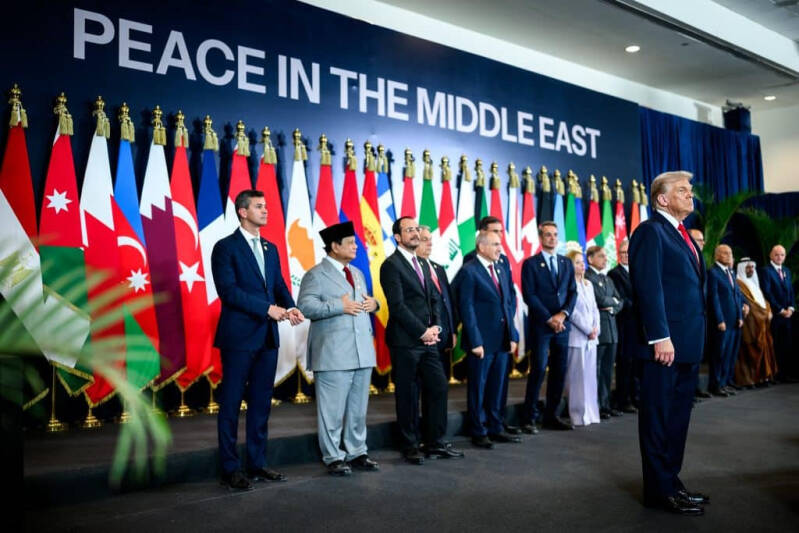
As Trump’s administration struggles to find ways to implement its fatally flawed “20-Point Plan” for Gaza, it has taken the surprising step of trying to obtain the approval of the United Nations Security Council. Here's why that's unlikely to work.
1940.

7 november 2025
write to you today with incredible news from my city of St. Louis.
In a huge win for the Palestine movement and working class people, St. Louis City just became the largest city in the U.S. to pass a resolution to divest from corporations complicit in genocide and human rights violations.
In March, St. Louis residents came together to launch Not Another Nickel, a campaign to divest the city from militarism and genocide profiteering. The campaign quickly gained momentum among St. Louisans who have been suffering after decades of neglect and disinvestment from community infrastructure and services. Together, they demanded transparency, accountability, and a budget that serves people, not profiteers.
Their organizing paid off - this morning, the Board of Aldermen in St. Louis took a historic step and passed the Not Another Nickel resolution in a 10-1-3 vote.
The measure calls on the Board of Trustees of the Employees Retirement System of the City of St. Louis to divest from any companies that are complicit in or profit from human rights abuses, including genocide, occupation, apartheid, and systemic racism. It also directs the city to ensure all investments meet the ethical guidelines established by the American Friends Service Committee (AFSC), extending the same standards to city pension and retirement funds, where 17 companies have been found to be complicit.
Now, we must keep up the pressure to make sure that the Board follows through and adopts the resolution's ethical investment guidelines.
Earlier this week, over 50 people packed the room at City Hall to testify in support of the resolution as it was heard in committee. Not a single person spoke against it.

With this vote, St. Louis establishes itself as a national leader in ethical investment rooted in human rights. The city reaffirms its legacy of global solidarity and justice, following in the footsteps of local anti-apartheid pioneers like Ora Lee Malone and Kenny Jones, who in the 1980s led the charge to divest St. Louis’ pension funds from companies doing business in apartheid South Africa.
St. Louis is just the beginning. Across the country, people are sick of their hard-earned money going to genocide and militarism at home and abroad, lining the pockets of billionaires who are actively profiting off death and destruction.
The people are ready. We have the momentum, and now we must use it to shut down the pipeline funneling our communities' resources to Israel’s genocide and occupation in Palestine.
Make no mistake: This historic victory is the result of more than a year of relentless organizing and community power from folks on the ground in St. Louis - and the unwavering support of people like you who continue to fuel this movement for justice.
We asked you to invest in local organizing, and it worked. Now we’re asking you to keep the momentum going.
Adalah Justice Project has been proud to stand alongside and support St. Louis organizers with the Not Another Nickel Campaign.
In solidarity,
Sandra Tamari
Executive Director
Adalah Justice Project
1939.

7 november 2025
Gaza Humanitarian Response
Situation Report No. 15
6 November 2025
HIGHLIGHTS
- Nine partners have resumed learning activities in Gaza city as part of efforts to scale up the education response through the establishment of temporary learning spaces (TLSs) for school-aged children.
- The total estimated population movement in the Gaza Strip since 10 October rose to 687,593 with more than 80 per cent of these movements from south to north.
SITUATION OVERVIEW
On 5 November, the Site Management Cluster observed 5,653 new population movements across Gaza, bringing the total recorded since 10 October to 687,593. Of these, 559,247 were from southern to northern Gaza (67 per cent through Al-Rasheed Road and the rest through Salah al Deen Road), while another 113,260 people moved from western to eastern Khan Younis. At the same time, partner Designated Emergency Shelters (DES) in Al Nuseirat and Deir al Balah have been receiving an average of 30 new families arriving from the north daily.
Between 21 and 30 October 2025, inter-agency field assessments were conducted across ten sites in Gaza, including Jabalya al Balad in North Gaza, Gaza city and Khan Younis. The missions covered over 2,780 households (HHs), with sites such as Halawa Camp (900 HHs) and Batn As-Sameen (500 HHs) among the largest. These areas had been evacuated during recent hostilities, with populations now gradually returning to damaged or makeshift shelters. The assessment aimed to identify urgent humanitarian needs and inform winterization and the wider response.
Across all locations, top needs identified included safe drinking water, sanitation facilities, shelter repair materials, bedding, access to healthcare and medicines, regular food distributions, and protection measures such as lighting and safe spaces. Common observations highlighted severe overcrowding, poor hygiene, lack of privacy, and heightened protection risks—especially for women and children. Most households rely on irregular humanitarian aid and face barriers to accessing health services and markets. Female-headed households, which make up a significant portion (up to 60 per cent in some sites), are particularly vulnerable.
UNITED NATIONS-COORDINATED HUMANITARIAN AID ENTRY*
According to the Logistics Cluster, on 5 November, 163 UN and partner trucks were offloaded at Gaza’s crossings, of which at least 41 per cent carried 1,353 metric tons (mt) of food assistance. Via the Egypt corridor, out of 103 trucks that had been manifested for entry, only 71 offloaded.
Based on preliminary data, more than 2,600 pallets of aid, along with 318,800 litres of fuel, were collected into Gaza on the same day. Food supplies represented over 70 per cent of all collected cargo, followed by water, sanitation and hygiene (WASH) items - including dignity and hygiene kits, water tanks and containers; winter clothes and tarps; medical items; and infant formula.
HUMANITARIAN RESPONSE
Site Management
- As part of the winterization initiative and to promote a clean and dignified living environment through community engagement, a cluster partner mobilized DES’ residents to participate in a community-led clean-up exercise. This activity focused on managing garbage and maintaining hygienic conditions at the site, ensuring that displaced persons could reside in a healthier and safer environment. In collaboration with WASH promoters, several awareness sessions were also conducted to enhance displaced persons’ understanding of essential hygiene practices, further supporting the effort to sustain improved living standards at the DES.
Protection
- General Protection:
- On 6 November, partners reported reaching a total of 200 people in northern Gaza, and approximately 417 in Khan Younis and Deir al Balah over the last two days. One partner provided documentation training for 17 participants, alternative dispute resolution workshops for 160 people, produced 155 materials of media and awareness content, conducted protection interviews with 120 women, and referred 90 people for Multi-Purpose Cash Assistance.
- Child Protection:
- On 5 November, a total of 929 children and 405 caregivers were reached with Mental Health and Psychosocial Support Services (MHPSS) across various locations in southern Gaza. These included structured group sessions, individual psychological counselling, stress management interventions, and recreational psychosocial activities designed to support emotional well-being, strengthen parent–child communication, and promote resilience in displacement contexts.
- Gender-Based Violence (GBV):
- On 5 November, GBV partners distributed dignity and menstrual health management kits to 109 women and girls to help meet basic protection and health needs.
- A total of 214 women and girls participated in life skills, psychosocial relief and social cohesion sessions provided by GBV partners. Eleven women also received individualized Psychological First Aid support, while 58 joined group therapy sessions designed to build emotional strength, self-awareness, and coping skills.
- In Khan Younis, GBV partners conducted two awareness sessions reaching 535 women, alongside a psychosocial resilience activity titled “Letter to Myself” with 16 women heads of households at Al-Amal Prep Girls School, a community-based intervention linking MHPSS with GBV risk reduction.
Education
- Nine partners have resumed learning activities in Gaza city as part of efforts to scale up the education response through the establishment of TLSs for school-aged children.
- Damaged school assessments led by partners and the Ministry of Education in Gaza are ongoing by Explosive Ordnance Risk Education-trained teams. The cluster assessment team will be deployed also to visit a sample of damaged schools to verify and validate the findings.
1939.

7 november 2025
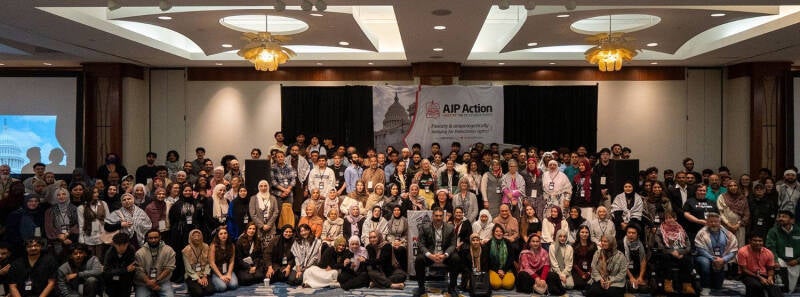
Support the movement they’re afraid of
Just a few weeks ago, hundreds of Americans from across the country joined us for our most successful Annual Palestine Advocacy Days yet. Together, over 700 advocates met with lawmakers from both sides of the aisle on Capitol Hill to demand justice and accountability.
Our efforts on Capitol Hill were met with bad-faith attacks aimed at derailing our work. Figures like Laura Loomer and Senator Tommy Tuberville may continue to spread Islamophobic, anti-Palestinian hate in an attempt to intimidate our community, but they will fail.
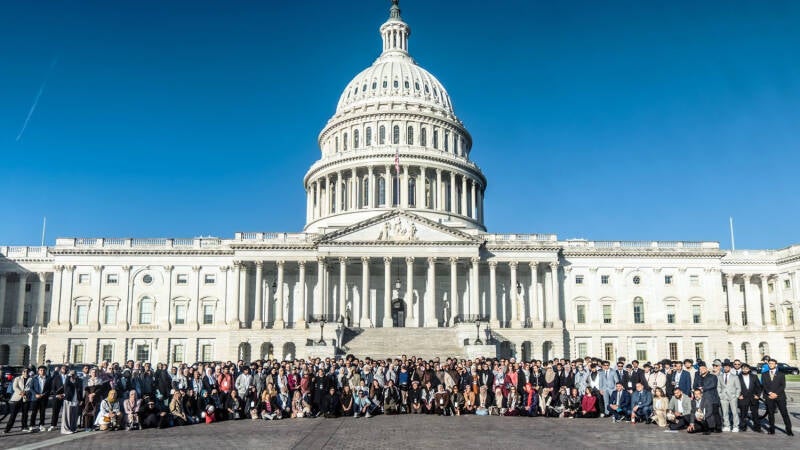
While far-right agitators mocked our faith and our presence in the halls of power, their attacks only revealed what our movement already knows: we are growing, organized, and impossible to silence.
AJP Action is leading the charge to challenge Islamophobia and anti-Palestinian hate wherever it appears through advocacy, policy work, and people power. But we can’t do it without you.
In solidarity,
Americans for Justice in Palestine Action
1939.

7 november 2025
Today's headlines
Israel is trying to divide Gaza in half along the ‘Yellow Line.’ What is it, and is it here to stay?
Mondoweiss Palestine Bureau and Qassam Muaddi
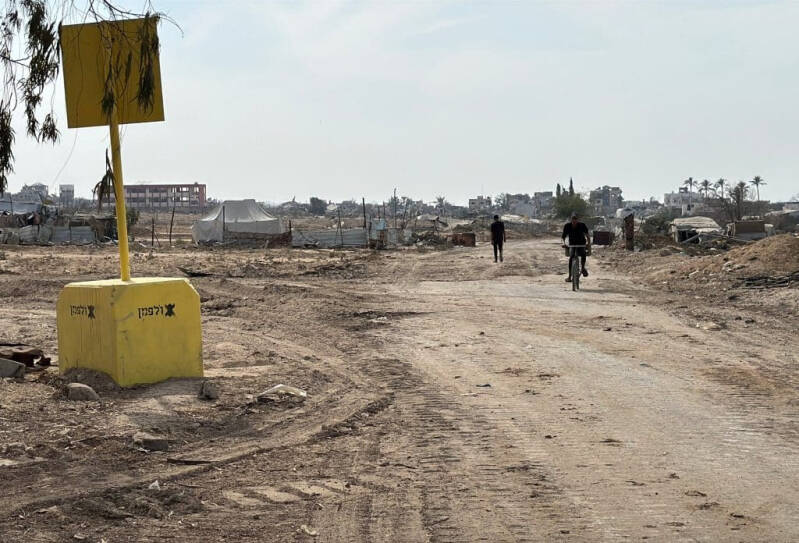
The “Yellow Line” splitting Gaza in two is meant to be temporary according to Trump’s “peace” plan. However, the fact that those terms were intentionally left vague suggests that the partition of Gaza was the real goal all along.
1938.

7 november 2025
Mannen met zwarte bivakmutsen, zwarte T-shirts en stokken rennen een dorp binnen. Ze gooien stenen, slaan een auto aan diggelen, steken een andere in de fik en vernielen een moskee.
Zomaar een vrijdagochtend in het dorp Deir Dibwan, in de buurt van Ramallah op de bezette Westelijke Jordaanoever.
De daders? Een groep extremistische Israëlische kolonisten, die door de Britse journalist Peter Oborne onlangs werd beschreven als een ‘fascistische militie’. Vaak worden ze beschermd of ondersteund door het Israëlische leger.
Scherpe toename
De aanvallen van Israëlische kolonisten op Palestijnen op de Westoever zijn de laatste weken scherp toegenomen, zowel in aantal als in hevigheid. Dat het geweld tijdens de olijvenoogst in oktober en november piekt is ‘normaal’, maar dit jaar is het ongekend.
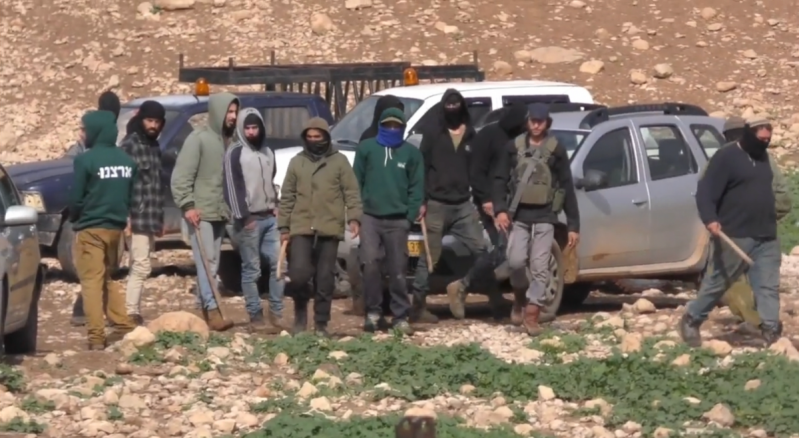
Screenshot uit een video van gewapende kolonisten, onderdeel van de reportage van de Israëlische krant Haaretz getiteld 'Erased'.
VN-organisatie OCHA telde in de week van 21 oktober zestig aanvallen van kolonisten die resulteerden in Palestijnse slachtoffers en de beschadiging van Palestijnse eigendommen. Meer dan de helft van deze aanvallen had betrekking op de olijvenoogst.
Olijvenoogst als doelwit
Olijfgaarden zijn een belangrijke bron van inkomsten voor Palestijnen, en onderwerp van nationale trots. Zij symboliseren de verbondenheid van de Palestijnen met hun land, en de standvastigheid waarmee ze de Israëlische bezetter weerstaan. In de literatuur en kunst staat de olijfboom symbool voor de Palestijnse identiteit.
De economische en culturele waarde van de olijvenoogst zijn voor de kolonisten reden om juist deze te terroriseren. Sinds het begin van oktober hebben kolonisten meer dan 4.000 olijfbomen verbrand, omgehakt of ontworteld. Dat is aanzienlijk meer dan in dezelfde periode vorig jaar en een veelvoud van de jaren daarvoor. Nooit was het geweld zo wijdverbreid als dit jaar.
In dit dorp kunnen de Israëlische bulldozers elk moment binnenrollen.
Eén van de gebieden op de bezette Westelijke Jordaanoever die zwaar lijden onder de kolonistenterreur, is Masafir Yatta. Het gebied, bestaande uit ruim twintig dorpen, werd vorig jaar wereldberoemd door de Oscar-winnende documentaire ‘No Other Land’.
Militair terrein schuift verder op
De kolonistenterreur is echter niet het enige gevaar voor de Palestijnse inwoners van Masafir Yatta. Het gebied ligt in het uiterste zuiden van de Westelijke Jordaanoever, waar een Israëlisch militair terrein geleidelijk wordt uitgebreid. De Palestijnse inwoners leven al generaties op hun grond, maar worden huis voor huis, dorp voor dorp, door de bezetter verdreven.
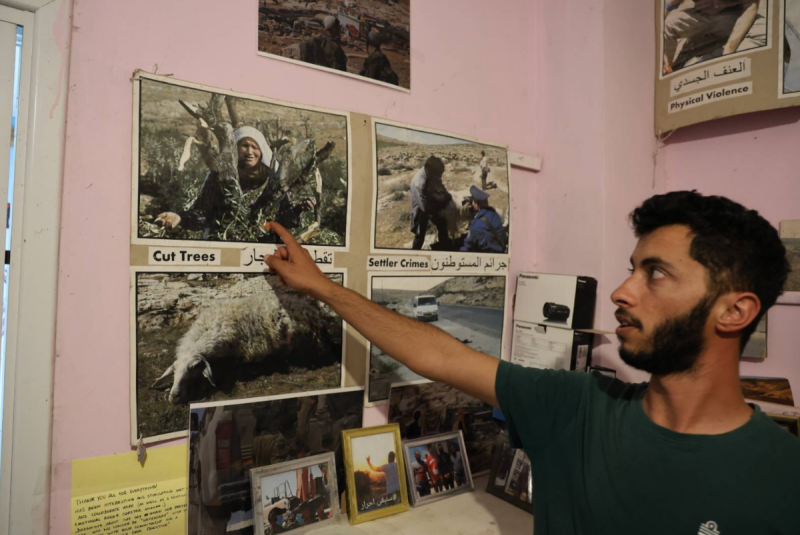
Basel Adra, één van de regisseurs van No Other Land. © Jack_perspective
Het Israëlische leger kan elk moment met een stel bulldozers het gehucht Umm al-Khair binnenvallen om het gemeenschapscentrum en meer dan tien andere gebouwen te slopen. Het sloopbevel kwam vorige maand. De dorpelingen hebben bezwaar aangetekend, maar de kans op succes is nihil.
Herdenkingsplek
Als het gemeenschapscentrum tegen de vlakte gaat, verdwijnt ook de herdenkingsplek voor Awdah Hathaleen, de dorpsgenoot en activist die meewerkte aan de Oscar-winnende film ‘No Other Land’. Awdah werd deze zomer door een kolonist vermoord.
Journalist Fréderike Geerdink reisde naar het gebied en deed daar verslag. Klik hier om haar reportage te lezen.

IDFA | Palestijnse films op het filmfestival
Van 13 tot en met 23 november vindt het International Documentary Filmfestival Amsterdam (IDFA) plaats. Ook dit jaar wordt weer een aantal documentaires vertoond over Palestina of van Palestijnse filmmakers. Hieronder vindt u een kort overzicht. Klik hier om het hele programma te bekijken.
House of Hope
In al-Eizariya, een stad op de bezette Westelijke Jordaanoever in de buurt van Jeruzalem, heeft de Palestijnse Manar samen met haar man Milad een Waldorfschool opgericht: House of Hope. Een basisschool gebaseerd op de vrijeschoolpedagogie, die geweldloos verzet omarmt en kinderen helpt bij het helen van trauma’s. Daarmee probeert Manar de jonge Palestijnse scholieren een veilige haven te bieden, maar dat valt haar steeds zwaarder.
draaitijden en kaartverkoop
Gaza’s Twins, Come Back to Me
Rania is acht maanden zwanger wanneer het Israëlische leger in 2023 de Gazastrook binnenvalt. Ze bevalt van een drieling, precies op het moment dat haar geboorteplaats in Noord-Gaza wordt gebombardeerd. Eén meisje overlijdt bij de geboorte. De andere twee baby's, Jowan en haar broertje Hamoud, zijn zo zwak dat ze in een couveuse moeten worden gelegd. Wanneer het ziekenhuis wordt ontruimd, wordt de tweeling overgebracht naar Zuid-Gaza, waar Rania's zus Nisreen de zorg voor hen overneemt. Een reisverbod verhindert dat de baby's naar hun moeder terugkeren.
draaitijden en kaartverkoop
Palestine Comedy Club
De Palestijnse komiek Alaa Shehada, succesvol in het buitenland, begint een stand-upcomedy-gezelschap met plaatselijke artiesten. De groep bestaat uit Palestijnse mannen en vrouwen van verschillende leeftijden en uit alle hoeken van het land: de Golanhoogvlakte, Hebron, Ramallah, Jenin, Haifa. Met aanstekelijk enthousiasme en zelfspot creëren de zes komieken een theatershow waarmee ze langs Palestijnse en Israëlische steden trekken.

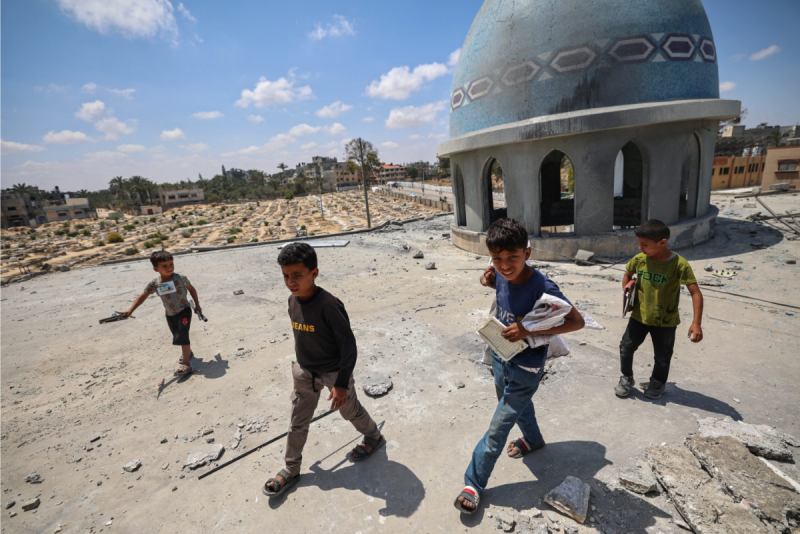
Dertig jaar na moord op Rabin heeft kolonistenbeweging in Israël nauwelijks tegenkracht
Yitzhak Rabin werd dertig jaar geleden vermoord, omdat hij als de eerste premier in de geschiedenis van Israël met de Palestijnse bevrijdingsbeweging sprak. Bij de herdenking van de moord sprak niemand over de Palestijnen.
Archieven op de vlucht
Het werk van de Palestijnse dichter Muin Bseiso (1926-1984) heeft nooit het westers publiek bereikt. En dat is jammer, omdat hij bij uitstek het verhaal van Gaza vertelt, schrijft onderzoeker Joost Vintges. Hij kwam in contact met de zoon van Bseiso, die zijn archief tijdens de genocide ternauwernood uit Gaza heeft weten te redden.

Censuur | YouTube verwijdert 700 video’s met documentatie van Israëlische misdaden
YouTube heeft vorige maand stilletjes meer dan 700 video’s van drie Palestijnse mensenrechtenorganisaties verwijderd. Dat heeft het nieuwsplatform The Intercept naar buiten gebracht, en is bevestigd door de organisaties en YouTube zelf.
Het gaat om de accounts van Al-Haq, Al-Mezan Centrum en het Palestijnse Centrum voor Mensenrechten (PCHR), drie organisaties waar The Rights Forum mee samenwerkt.
De verwijderde video’s documenteren Israëlische oorlogsmisdaden en mensenrechtenschendingen, zoals de moord op journalist Shireen Abu Akleh in 2022, de vernietiging van Palestijnse huizen op de bezette Westelijke Jordaanoever of getuigenissen van gemartelde Palestijnen in Israëlische gevangenissen.
Uit onze agenda
zaterdag 8 november t/m zaterdag 15 november
DEMONSTRATIES EN WAKES
UTRECHT ELKE DOORDEWEEKSE OCHTEND (MA & VRIJ 08.00 - DI, WO, DO 08.30) | Doorlopend stilteprotest (Neude, Utrecht, langs het fietspad)
GRONINGEN ZA 8 NOV 13.00 | Tweewekelijkse wake van Vrouwen in het Zwart (Waagplein)
HUIZEN WO 12 NOV 11.30 | Wekelijkse sit-in voor Gaza (Gemeentehuis)
DEN HAAG DO 13 NOV 12.00 | Sit-in van Rijksambtenaren bij het ministerie van Buitenlandse Zaken, Rijnstraat 8
STATIONS IN NEDERLAND DO 13 NOV 18.00 | Wekelijkse lawaaidemonstratie op stations in heel Nederland: Amersfoort, Amsterdam CS, Arnhem, Bergen op Zoom, Breda, Dieren, Doetinchem, Driebergen-Zeist, Ede/Wageningen, Enschede, Groningen, Heerlen, Hengelo, Hilversum, Leiden, Maastricht, Nijmegen, Purmerend, Regensburg DE, Sassenheim (17.00 uur), Sittard, Tiel, Tilburg, Utrecht, Veenendaal, Zaandam (17.30 uur), Zutphen
DEN BOSCH ZA 15 NOV 12.00 | Wake voor Palestina (Burgemeester Loeffplein)
CULTURELE EN ANDERE EVENEMENTEN
BUSSUM ZA 8 NOV 14.00 - 17.00 | Opening van de tentoonstelling Documenting Genocide met werken van het Palestijnse fotografencollectief Active Stills (GRRU de Groene Ruijter)
AMSTERDAM MA 10 NOV 20.00 | Panelgesprek over de verslaggeving over Israël en Palestina (Pakhuis de Zwijger)
HAARLEM WO 12 NOV 20.00 | Benefietavond voor Palestina, met sprekers, muziek, dans en gesproken woord (Theater de Liefde)
LEIDEN DO 13 NOV 20.15 | Concert Amsterdam Sinfonietta en Nai Barghouti (Stadsgehoorzaal)
AMSTERDAM VRIJ 14 NOV 20.15 | Concert Amsterdam Sinfonietta en Nai Barghouti (Muziekgebouw)
Onze agenda wordt doorlopend aangevuld.
1937.

7 november 2025
Humanitarian Situation Update #338
Gaza Strip
6 November 2025

A bakery supported by the World Food Programme in Gaza. Humanitarian organizations are distributing about 150,000 bread bundles and 1.2 million meals every day across the Gaza Strip. Photo by WFP
Key Highlights
- Hundreds of thousands of families face the onset of winter without essential protection from the elements, the Shelter Cluster warns.
- Only four per cent of Gaza’s cropland is undamaged and accessible, recent geospatial analysis indicates.
- Relief items rejected for entry into Gaza include educational supplies and fresh meat, which Israeli authorities deem to fall outside the scope of humanitarian aid.
- UN agencies and partners, in collaboration with the Ministry of Health in Gaza, are launching an integrated catch-up campaign for routine immunization, nutrition and growth monitoring, targeting 44,000 children.
- Since 10 October, Cash Working Group partners distributed Multi-Purpose Cash Assistance to over 55,000 households.
Context Overview
- Over the past week, daily detonations of residential buildings were reported in multiple areas where the Israeli military remains deployed, especially in eastern Khan Younis and eastern Gaza city. Israeli military strikes near or east of the so-called “Yellow Line” under the ceasefire agreement continue to be reported, resulting in casualties, especially in Gaza city, Deir al Balah and Khan Younis governorates. Access to humanitarian assets and agricultural land beyond the “Yellow Line” remains barred. The installation of yellow-painted concrete blocks to demarcate the “Yellow Line” have been reported in different parts of Strip, as ordered by the Israeli Minister of Defence. Access to the sea remains prohibited and the detention of Palestinian fishers at sea continues to be reported, including the reported detention of five fishers by Israeli forces on 4 November.
- In a media interview on 5 November, the UN Secretary-General said that the UN is still facing obstacles in delivering humanitarian aid. He noted that “humanitarian aid has improved and increased significantly but [the UN is] far from [having] what is necessary to eliminate famine quickly and to create the conditions for the people in Gaza to have the very, very minimum that is necessary for dignity in life.”
- Between 29 October and 4 November, according to official Israeli sources, the bodies of six deceased hostages were returned from Gaza to Israeli authorities, bringing the overall number of returned bodies of Israeli hostages to 21. According to the Ministry of Health (MoH) in Gaza, on 1 November and 5 November, the bodies of 90 Palestinians were returned to the Gaza Strip, bringing the total number of released bodies to 285, of which only 84 were identified.
- According to the MoH in Gaza, between 29 October and 5 November, 14 Palestinians were killed, one died of wounds sustained earlier, 24 were injured and 31 bodies were recovered from under the rubble. This brings the casualty toll among Palestinians since 7 October 2023, as reported by MoH, to 68,875 fatalities and 170,679 injuries. According to the MoH, the total number includes 193 fatalities who were retroactively added between 24 and 31 October after their identification details were approved by a ministerial committee. MoH reported that since the ceasefire, 241 Palestinians were killed, 609 were injured and 513 bodies were retrieved from under the rubble.
- According to the Israeli military, between 29 October and 5 November, as of noon, no Israeli soldiers were killed in Gaza. The casualty toll among Israeli soldiers since the beginning of the Israeli ground operation in October 2023 stands at 471 fatalities and 2,978 injuries. According to Israeli forces and official Israeli sources cited in the media, more than 1,671 Israelis and foreign nationals have been killed, the majority on 7 October 2023 and its immediate aftermath. As of noon on 5 November 2025, it is estimated that the bodies of seven deceased hostages remain in the Gaza Strip.
- Between 10 October and 4 November, more than 680,000 movements of people were recorded by the Site Management Cluster (SMC) partners, including more than 553,000 movements crossing from southern to northern Gaza, primarily through Ar Rashid Road (67 per cent). During the same period, more than 113,000 movements of people were recorded from western to eastern Khan Younis. While most movements immediately following the ceasefire were undertaken by individuals to assess conditions in return locations, this was followed by a notable increase in families returning to their communities in search of safety and stability. Through SMC population monitoring, available updates indicate that about 39,000 people are present in 60 displacement sites in Gaza city and North Gaza while over one million IDPs are estimated to be present in Khan Younis and Deir al Balah governorates, mainly in makeshift sites. Between 20 and 23 October, 84 per cent of 703 randomly selected IDP households in Deir al Balah and Khan Younis reported that they intend to stay in their current displacement sites while 16 per cent expressed an intention to leave. According to SMC, these figures reflect a strong preference among IDPs to remain in place due to widespread destruction, lack of alternatives, and continued uncertainty about safety and services in areas of origin.
Humanitarian Access
- According to the UN2720 Mechanism, between 10 October and 3 November, the UN and its partners collected from Gaza’s crossings more than 32,500 metric tons (MT) of aid. The entry of humanitarian aid continues to be limited to only two crossings (Kerem Shalom/Karem Abu Salem and Kissufim), with no direct access from Israel to northern Gaza since 12 September. Pipeline supplies approved and cleared by the Israeli authorities (217,000 MT) are positioned across the region, including Jordan, Egypt, Israel, Cyprus, and the West Bank, and include 50,000 MT of aid that are part of the Jordan direct route corridor (Government-to-Government), which has not restarted since 18 September, when two Israeli soldiers were killed at Allenby Bridge by a Jordanian truck driver transporting cargo for the Gaza Strip.
- According to the UN2720 Mechanism, pipeline supplies that are not cleared for entry by Israeli authorities mainly include those submitted by local and international NGOs on the grounds that the organizations were not authorized to bring relief items into Gaza or those that are rejected by Israeli authorities based on the type of item. For example, some supplies, such as fresh meat or educational supplies, are considered to fall outside the “humanitarian” category, while others are classified as “dual-use” items – goods that are considered useable for either civilian or military purposes – ranging from vehicles and their spare parts to solar panels, some types of mobile latrines, x-ray machines, and generators. Since 10 October 2025, 107 requests for the entry of relief materials were rejected by Israeli authorities, including 11 requests between 29 October and 3 November. These include 54 requests that were denied entry by Israeli authorities on the grounds that the organizations were not authorized to bring relief items into Gaza.
- Coordination with Israeli authorities continues to be required for humanitarian convoy movements in Gaza, to crossings as well as in or near other areas where the Israeli military remains deployed. Between 29 October and 3 November, humanitarian organizations coordinated 48 missions with the Israeli authorities, of which 26 were facilitated, four were cancelled, 13 were impeded and five were denied. Movements included, among others, 29 movements to collect cargo from the two operational crossings, one search-and-rescue mission, three road repair, assessment and clearing missions, and four movements related to the crossing of humanitarian personnel.
- Since 27 October, Israeli authorities have routed collected aid movements through the Philadelphi Corridor and Ar Rasheed Road. According to the Logistics Cluster, this congested route has exposed trucks to operational challenges, such as extended convoy durations and heightened risk of opportunistic looting, while limiting the size of the convoys. Combined, the challenges meant that the daily necessary volume of aid could not be collected from the crossings. Between 11 October and 3 November (following the ceasefire), only four per cent of aid supplies collected from Gaza’s crossings were intercepted, compared with about 80 per cent between 19 May and 9 October.
- Sufficient and strategically located warehouse capacity is vital to sustain the 60-day response plan and maintain supply chain continuity. According to a recent Logistics Cluster Gaza Partners Warehouse Mapping Survey covering October, 25 organizations reported on 70 warehouses across all five governorates of the Gaza Strip. Of these, 55 warehouses are operational and comprise 40 per cent of the total reported area capacity, while 15 warehouses that comprise 60 per cent of the total area capacity are non-operational due to access restrictions and/or infrastructure damage. Geographically, Deir Al Balah holds the largest share of operational space (28,634 square metres), followed by Khan Younis (16,200 square metres) and Gaza city (11,018 square metres). Partners in North Gaza and Rafah report severely limited or no functional warehouse capacity, reflecting the heavy toll of access challenges and physical damage on storage infrastructure. The mapping survey revealed that 52 per cent of humanitarian partners who participated in the survey are currently in need of more storage capacity, including 10 partners in northern Gaza, seven in central Gaza, and six in southern Gaza.
- On 5 November, the Norwegian Refugee Council (NRC) highlighted that only a fraction of needed shelter materials has entered Gaza, warning that aid actors “have a very short chance to protect families from the winter rains and cold.” Calling for swift and unimpeded access, NRC noted the urgency to bring into Gaza heavy machinery to clear rubble and explosive remnants of war to facilitate even temporary shelter installations and ensure that people can safely return to their communities. According to the UN Environmental Programme (UNEP), satellite imagery from 8 July indicates that debris generated by the conflict increased to more than 61 million metric tonnes. According to the Gaza Debris Management Working Group, debris removal necessitates the sustained entry of heavy machinery, spare parts, reliable and stable supplies of fuel, and access to land appropriate for debris storage and processing.
- As winter approaches, the SMC estimates that majority of displaced people remain in overcrowded, makeshift sites, many of which were established spontaneously in open or unsafe areas. Three weeks into the ceasefire, the UN-coordinated entry of shelter materials, particularly tents, into Gaza continues to face major limitations. These include a restricted number of authorized shelter partners and limited approvals for shelter items. According to the Shelter Cluster, the limited entry of shelter supplies is undermining the implementation of the winterization plan developed by the Cluster and its partners. If facilitated, the entry of all shelter materials currently in the pipeline would enable partners to meet most of the needs of the 1.45 million people requiring emergency shelter assistance. While some shelter materials have entered through bilateral donations and the commercial sector, as of 5 November, only 5,400 tents, 160,000 tarpaulins and 17,000 blankets have entered through UN coordination. Shelter operations are gradually resuming in northern Gaza, where six partners have re-established presence and began distributing tents and tarpaulins. So far, Shelter Cluster partners have distributed more than 3,700 tents, covering the needs of over 30,000 people across the Gaza Strip. Similarly, distribution of 120,000 tarpaulins is ongoing, with 16,000 already distributed. This is far from sufficient, the Shelter Cluster reports, warning that hundreds of thousands of families face the coming winter without desperately needed protection from the elements.

Access to Water and Sanitation Services
- Efforts to improve access to water across the Gaza Strip continue to face major obstacles. Service provision remains critically disrupted due to extensive damage to water infrastructure, limited incoming supplies, and persistent shortages of spare parts required to operate generators and desalination units. According to the Palestinian Water Authority, more than 85 per cent of vital water facilities have been damaged since October 2023, while groundwater well production stands at only 25 per cent of its previous capacity due to extensive damage and limited accessibility. According to the Water, Sanitation and Hygiene (WASH) Cluster, Gaza’s seven wastewater treatment plants are currently out of service and out of 73 sewage pumping stations, 20 have been destroyed and 27 have sustained partial damage. Moreover, efforts to repair and maintain drainage networks ahead of the winter season, particularly in flood-prone areas near displacement sites, are hampered by a lack of essential materials to conduct the necessary repairs.
- To improve water accessibility, the WASH Cluster indicated that 44 partners are currently distributing drinking water, mainly through water trucking, via approximately 1,900 water points across the Gaza Strip. Distribution efforts have been scaled up in North Gaza governorate, where six partners are supplying water at 100 points, and in Gaza governorate, where 23 partners are supplying water at more than 658 points.
- According to the United Nations Relief and Works Agency for Palestine Refugees in the Near East (UNRWA), severe restrictions on the entry of spare parts, tools, and maintenance equipment, including generators, batteries and lubricants, have significantly hindered their ability to repair WASH facilities in the Gaza Strip. Dozens of UNRWA vehicles and equipment units, including water tankers and jetting vehicles, remain uncleared for entry into Gaza by Israeli authorities, and the limited availability of related supplies on local markets constrains maintenance capacity. Coupled with destruction of UNRWA water wells, including in emergency displacement shelters, water production remains relatively limited and has increased dependence on emergency water trucking. UNRWA provides about 1,400 cubic metres of water daily in Gaza city and North Gaza. It warns that the continued provision of minimal WASH services is becoming increasingly unsustainable due to critical shortages of fuel and spare parts for fleet operations and limited capacity to repair and maintain WASH infrastructure.
- On 2 November, the public health laboratory at Al Shifa Medical Complex in Gaza city resumed water testing activities, partially restoring water quality monitoring in the area. Overall, according to the WASH Cluster, six field laboratories are currently functional, including three in Gaza city and three in Deir al Balah and Khan Younis, conducting basic parameter testing. Water quality monitoring remains severely limited due to extensive damage to testing facilities and restricted access to essential equipment and consumables entering the Gaza Strip. According to the WASH Cluster, the loss of this capacity has significantly limited the ability to monitor and manage water safety.
Access to Health Care
- According to a joint press release published by the World Health Organization (WHO) on 5 November, the United Nations Children's Fund (UNICEF), UNRWA, WHO and partners, in collaboration with the MoH in Gaza, are launching an integrated catch-up campaign for routine immunization, nutrition, and growth monitoring in the Gaza Strip to reach 44,000 children cut off from essential life-saving services. An estimated one in five children under three years of age are either zero-dose or have missed vaccinations, putting them at risk of vaccine-preventable disease outbreaks. The campaign will be implemented in three rounds to provide three doses of Pentavalent, Polio, Rota, and Pneumococcal Conjugate Vaccines, and two doses of the Measles, Mumps, and Rubella vaccine, with the first round scheduled to take place from 9 to 18 November. Vaccinations will take place at 149 health facilities and 10 mobile units across the Gaza Strip, with rehabilitation work ongoing for another 35 points by UNICEF and WHO. In addition, UNICEF and partners will screen children for malnutrition and refer identified cases for treatment.
- According to WHO, prior to October 2023, Gaza had 54 immunization facilities and a 98 per cent vaccination coverage rate. Today, 31 facilities are no longer operational due to damage or destruction, and routine vaccination coverage has dropped below 70 per cent. The onset of harsh winter conditions makes the vaccination campaign even more urgent, as preventable childhood diseases spread across the Gaza Strip, WHO noted. Phase two and three, providing second and third doses of vaccines, are planned for December 2025 and January 2026. “After two years of relentless violence that claimed the lives of more than 20,000 children in the Gaza Strip, we finally have an opportunity to protect those who survived,” said Jonathan Veitch, UNICEF Special Representative in the State of Palestine.
- On 3 November, MoH in Gaza announced the inauguration of the Hind Al Daghma Specialized Kidney Center at Nasser Medical Complex in Khan Younis, which had sustained severe damage. According to Dr. Marwan Abu Sa’da, MoH Director General of International Cooperation and Projects, patients with kidney failure are among the most affected groups due to the destruction of specialized centres, such as Noura Al Kaabi Dialysis Center in North Gaza and the dialysis department at Al Shifa Medical Complex in Gaza city, noting that kidney patients have faced serious challenges in accessing treatment and that 40 per cent of kidney failure patients since October 2023 have died. According to WHO data, since the beginning of 2025, 59 patients with renal disorder were medically evacuated from the Gaza Strip, including 31 children, 20 men and eight women.
- Screening and imaging services in Gaza continue to be compromised due to the lack of machines and equipment critical for the diagnosis of serious illness and acute trauma cases. Currently, there are no functioning magnetic resonance imaging (MRI) machines in the Gaza Strip. In addition, only four out of 18 computed tomography (CT) scanners are functional, according to UNRWA. At UNRWA health centres, only one x-ray machine, located at An Nuseirat Health Centre in Deir al Balah, remains functional, out of seven X-ray machines that were functional before the war. As a result, many diseases cannot be accurately diagnosed, leaving patients undiagnosed and untreated. According to UNRWA, the limited screening and imaging capacity triggered a dramatic increase in referrals and excessive workload on the few functional machines, causing frequent breakdowns and maintenance issues. In addition, patients face long waiting times, delaying disease diagnoses.
- Over the past week, 50 patients were medically evacuated from the Gaza Strip. On 29 October, WHO facilitated the medical evacuation of 30 patients, including 17 children, nine women and four men, in addition to 60 companions. On 30 October, WHO completed another medical evacuation of 19 children and one adult patient from Gaza, of whom four children will receive cancer treatment at the St. Jude Research programme. This brings the total number of patients evacuated since 1 October 2025 to 146 patients, including 88 children, 30 men and 28 women. However, over 16,500 patients still need urgent specialised care unavailable inside the Strip.

Access to Emergency Food Aid, Agricultural Assets and Markets
- Three weeks into the ceasefire, Food Security Sector (FSS) partners are distributing every day about 150,000 bread bundles and 1.2 million meals. With the resumption of food parcel distributions on 13 October for the first time since April, the World Food Programme (WFP) has distributed food parcels to one million people in October, with one food parcel distributed per family. In the first three days of November, according to FSS, approximately 66,000 people (13,200 households) have been assisted with two food parcels per family through 46 distribution points across the Gaza Strip, including 10 in northern Gaza. Still, the quantity of food assistance brought into Gaza remains insufficient, WFP warns, calling for the opening of all crossings, especially those in northern Gaza, and for more access to key roads inside Gaza to push back hunger and expand operations to the required level.
- Combined with additional improvements in access to emergency food aid, there is an urgent need to rehabilitate local food systems, including vegetable and fruit production and animal rearing, to reduce food gaps in Gaza and enhance dietary diversity, FSS emphasizes. To support the resumption of agricultural activities, the entry of agricultural inputs, such as seed kits, organic fertilizers and nylon sheets, through both humanitarian and private sector channels and safe access of fishers to the sea are critically required, but many agricultural inputs continue to be denied entry into Gaza by Israeli authorities and access to the sea remains prohibited, according to FSS. Since 15 October, FSS partners have supplied about 1,700 animal herders in Deir al Balah with fodder to sustain surviving livestock and enable the resumption of local production of milk and dairy products.
- One of the main challenges facing local food systems is the widespread damage to agricultural land, alongside severe soil contamination with war remnants. Two years of war have damaged most of the agricultural resources in the Gaza Strip, where, according to the UN Food and Agriculture Organization (FAO), agriculture accounted for about 10 per cent of Gaza’s economy prior to October 2023 and over 560,000 people depended in whole or in part on crop production, herding, or fishing for their livelihoods. Recent geospatial analysis by FAO and the UN Satellite Centre (UNOSAT) indicates that only 13 per cent of cropland in the Gaza Strip has not been damaged, of which the majority remains inaccessible in areas where the Israeli military remains deployed (over 50 per cent of the Gaza Strip). In addition, about 79 per cent of greenhouse areas, 87 per cent of agricultural wells, and 86 per cent of agricultural infrastructure have been damaged. Nearly 89 per cent of orchard trees (especially olive trees) have been damaged, of which 75 per cent have been destroyed, particularly in the North Gaza, Gaza and Khan Younis governorates. Between April and September 2025, the highest increase in damage to agricultural infrastructure was observed in poultry farms, followed by home barns, sheep farms and agricultural warehouses. Among the five governorates, Rafah shows the highest level of inaccessibility of agricultural infrastructure and the northern governorates are the most severely damaged. At present, out of more than 2,200 agricultural wells, less than nine per cent are not damaged and accessible, which negatively impacts Gaza’s capacity to sustain crop and livestock production.
- Following the ceasefire, access to undamaged land that is available for cultivation has improved: Of the estimated 15 square kilometres of cropland, four per cent is now not damaged and accessible (about six out of 15 square kilometres), compared with 1.5 per cent prior to the ceasefire. Overall, 37 per cent of Gaza’s cropland (both damaged and undamaged) is now accessible, compared with 8.6 per cent prior to the ceasefire, and can potentially be rehabilitated. According to FAO, this offers an opportunity to restore local food production and strengthen livelihoods. “As satellite imagery shows, the scale of agricultural land destruction in Gaza has severely undermined the area’s ability to produce food,” said FAO Deputy Director-General Beth Bechdol. “However, the ceasefire has opened a window of opportunity. Urgent support is needed to rehabilitate agricultural land and infrastructure, enable farmers to resume fresh food production, and rebuild the fisheries and livestock sectors, as restoring these systems is essential to protecting livelihoods and ensuring families can feed themselves,” she added.
- Access to markets and food consumption have slightly improved, according to WFP’s monthly market monitoring report for October, and further improvements are anticipated if the inflow of food aid and commercial trucks continues. Half of surveyed households reported improved physical access to food in the first two weeks of October, 27 per cent reported no changes, and 23 per cent reported having worse access (mainly in the north). With the ceasefire announcement, a drop in prices of most food items was already observed in the second week October. Moreover, during the first half of October, households consumed an average of two meals per day, up from one meal in July, although one in five households still ate only one meal daily. Compared with pre-October 2023, food consumption has remained poor, especially in relation to protein sources, vegetables and fruits.
- A REACH assessment conducted between 20 and 27 October found that markets across the Gaza Strip continue to operate under strained conditions, constrained by damage, overcrowding, and low purchasing power. According to the Cash Working Group (CWG), cash circulation and financial access have witnessed a slight improvement since the ceasefire, with an improved security environment and expanded coverage of cash-out agents. As of early November, about 155 cash-out agents were operational across the Gaza Strip, compared with 95 in September, including 65 in Khan Younis, 40 in Deir al Balah, 35 in Gaza city, and 15 in North Gaza. This wider coverage has eased congestion and facilitated smoother access to transfers. On average, physical cash-out commission rates are at 18–22 per cent while digital withdrawal and payment fees are at 20–24 per cent down from 35–45 per cent prior to the ceasefire, reflecting improved cash circulation and expanding financial service capacity.
- Between 10 October and 3 November, CWG partners distributed Multi-Purpose Cash Assistance (MPCA) to over 55,000 households, compared with 40,000 in September. Each household received 1,250 NIS (approximately US$378) in digital payments, in line with the Minimum Expenditure Basket (MEB) transfer value. Cumulatively, over 270,000 households in the Gaza Strip have received at least one MPCA transfer in 2025, and more than 403,000 households since October 2023. According to post-distribution monitoring conducted by CWG partners between 10 and 24 October, households continue to spend MPCA primarily on food (grains, vegetables, pulses), followed by debt repayment, hygiene items, and medicines.
- According to the Protection Cluster, cash programming is a response modality that enables people in Gaza to meet their specific needs with dignity and choice. In addition to strengthening households’ ability to access basic goods, cash programming helps reduce reliance on negative coping mechanisms, such as debt, child labour, or early marriage. During Israeli military operations in North Gaza, vulnerable community members and households faced increased risks due to the high cost of safe and accessible transport, particularly affecting persons with disabilities and older people with mobility challenges. Cash for protection interventions enabled families to flee insecurity and to meet their basic needs in their displacement areas. Based on this intervention, an inter-cluster referral pathway was established for vulnerable protection cases to receive cash assistance.
Funding
- As of 5 November 2025, Member States have disbursed approximately $1.46 billion out of the $4 billion (36 per cent) requested to meet the most critical humanitarian needs of three million out of 3.3 million people identified as requiring assistance in Gaza and the West Bank, including East Jerusalem under the 2025 Flash Appeal for the OPT. Nearly 88 per cent of the requested funds is for the humanitarian response in Gaza, with just over 12 per cent for the West Bank. During October 2025, the oPt Humanitarian Fund managed 135 ongoing projects, totalling $77.7 million, to address urgent needs in the Gaza Strip (87 per cent) and the West Bank (13 per cent). Of these projects, 63 are being implemented by international NGOs, 56 by national NGOs and 16 by UN agencies. Notably, 69 out of the 79 projects implemented by international NGOs or the UN are being implemented in collaboration with national NGOs. For more information, please see OCHA’s Financial Tracking Service webpage and the oPt HF webpage.
1936.

7 november 2025
Humanitarian Situation Update #337
West Bank
6 November 2025
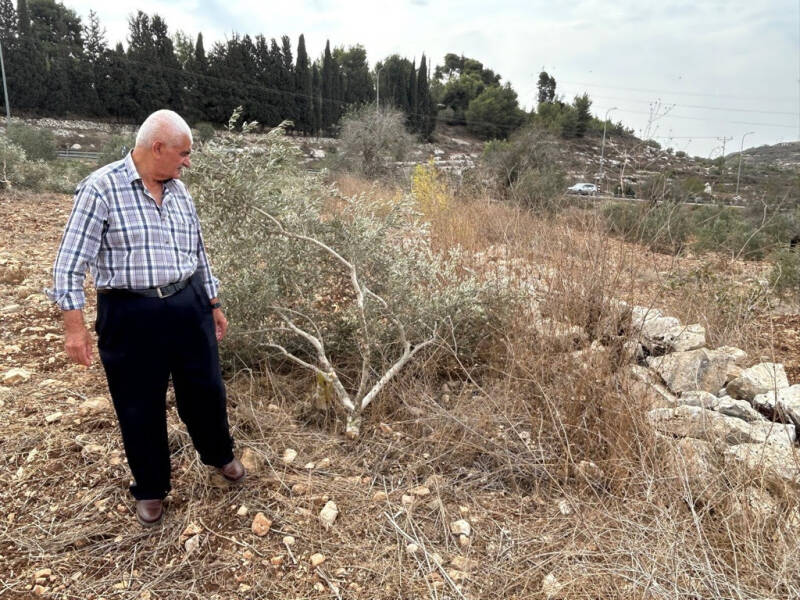
A Palestinian farmer next to an olive tree cut by Israeli settlers in Jinsafut, in the northern West Bank. Photo by OCHA
Key Highlights
- October 2025 recorded the highest monthly number of Israeli settler attacks since OCHA began documenting such incidents in 2006, with more than 260 attacks resulting in casualties, property damage or both – an average of eight incidents per day.
- Settler violence during this olive harvest season has reached the highest level recorded in recent years, with about 150 attacks documented so far, resulting in the injury of more than 140 Palestinians and the vandalism of over 4,200 trees and saplings across 77 villages.
- The UN Emergency Relief Coordinator called for the protection of Palestinians in the West Bank amid the rise in attacks by Israeli settlers on Palestinians and their property.
- One in every five Palestinians killed by Israeli forces so far in 2025 across the West Bank, including East Jerusalem, was a child.
- Israeli authorities issued 14 demolition or stop-work orders against approximately one third of structures in Umm al Kheir Bedouin community in the southern Hebron governorate, placing about 70 people, including 30 children, at risk of displacement.
Humanitarian Developments
- Between 28 October and 3 November, six Palestinians were killed across the West Bank: five, including two children, by Israeli forces, and one by an Israeli settler. In addition, one Palestinian died in an Israeli prison. In total, since January 2025, 42 Palestinian children have been killed by Israeli forces, or one in every five Palestinians killed by Israeli forces in the West Bank so far this year. Below are details of the incidents that resulted in fatalities during the period:
- On 28 October, three Palestinians were killed and had their bodies withheld by Israeli forces, after the latter reportedly surrounded a cave on the outskirts of Kafr Qud village, in Jenin governorate. An exchange of fire reportedly took place between Israeli forces and the Palestinian men, and an Israeli airstrike hit the area.
- On 30 October, a 15-year-old boy was shot by Israeli forces during a raid in Silwad village, in Ramallah governorate. According to the Israeli media citing the Israeli military, troops shot a child who set a suspected explosive device on fire. Medical teams reported that Israeli forces delayed ambulance access to the boy for about 20 minutes.
- On 3 November, a 17-year-old boy was shot by Israeli forces in a raid in Beit Furik, in Nablus governorate, during which Palestinian residents threw stones at Israeli forces, who shot live ammunition. The boy was first taken to the village’s medical centre and then transported to hospital in Nablus city, where he was pronounced dead.
- On 3 November, a Palestinian man was killed by an Israeli settler on Road 35 near the Ras al Jora entrance to Hebron city. According to the Israeli media citing the Israeli police, the settler shot the man after he allegedly tried to steal his vehicle. Medical sources indicated that Israeli forces prevented a Palestine Red Crescent Society (PRCS) ambulance team from reaching him. The body was returned to the family for burial on 4 November.
- On 2 November, according to the Palestinian Commission of Detainees Affairs and the Palestinian Prisoner’s Society, a Palestinian man from Jenin who had been under administrative detention since 6 August 2024 died in Israeli custody in unclear circumstances. According to the UN Human Rights Office (OHCHR), between 7 October 2023 and 5 November 2025, at least 80 Palestinians, including a 17-year-old child, died in Israeli detention, including 51 from the Gaza Strip, 27 from the West Bank and two Palestinian citizens of Israel. As of November 2025, according to data provided by the Israel Prison Service (IPS) to Hamoked, an Israeli human rights NGO, there are 9,204 Palestinians in Israeli custody, including 1,242 sentenced prisoners, 3,389 remand detainees, 3,368 administrative detainees held without charge or trial, and 1,205 people held as “unlawful combatants.”
- Between 28 October and 3 November, OCHA documented the Israeli authorities’ demolition of 11 Palestinian-owned structures, including six in Area C and five in East Jerusalem, due to the lack of Israeli-issued building permits, which are almost impossible for Palestinians to obtain. Demolished structures included three inhabited houses, two uninhabited houses, five agricultural structures and a water pipeline. The demolished inhabited houses were in Al Walaja and At Tur, in East Jerusalem, and in Shuqba village, in Ramallah governorate, displacing 13 people, including nine children. In one incident that had a direct impact on water supply, on 29 October, Israeli authorities bulldozed a donor-funded 250-metre-long water pipeline in Area C of Zif village, in southern Hebron, affecting 150 families comprising about 1,000 people, including over 500 children.
Demolition Orders and Settler Incidents in Umm al Kheir
- On 28 October, Israeli authorities delivered some 13 demolition orders and one stop-work order in Umm al Kheir Bedouin community, in southern Hebron governorate, due to the lack of Israeli-issued building permits. The structures include residential shelters, kitchens, a fodder storage unit, a greenhouse, the community centre that houses the village council office, a kindergarten and a health clinic, and other structures. Together, they represent approximately one third of all structures in the community. The demolition orders place 13 families comprising about 70 people, including 30 children, at risk of displacement. The potential demolition of the community centre would impact the community’s 35 families, comprising about 200 people, including more than 100 children. Since 2009, OCHA documented the demolition of 56 structures in Umm al Kheir, of which 23 were provided as humanitarian assistance and 14 were demolished over the past two years.
- The recently issued demolition orders in Umm al Kheir come against the background of heightened settler harassment associated with the establishment of a settlement outpost near the community in mid-2025. In October, residents of Umm al Kheir village filed a petition against the establishment of a new settlement outpost adjacent to the community that has effectively divided the village and restricted residents’ movement. Although an Israeli court issued a temporary injunction on 12 October barring settlers from inhabiting caravans or carrying out construction in the newly established settlement outpost, settlers moved into the caravans the following day and continued construction work, according to Peace Now, an Israeli NGO. Residents later submitted an affidavit documenting multiple breaches of the court order.
- Since the beginning of 2025, settlers, often armed and accompanied by Israeli forces have repeatedly raided Umm al Kheir, harassed residents, and carried out attacks that resulted in casualties or property damage. In one fatal incident on 28 July, Israeli settlers shot and killed a Palestinian man and injured another while operating a bulldozer to level Palestinian-owned land near the community’s main water network. In the following days, settlers repeatedly returned, bulldozing the area and damaging large sections of the community’s main water connection. When residents attempted to repair the line, settlers cut it again, disrupting the community’s access to water and temporarily forcing them to rely on water trucking, which, according to local sources, is at least 10 times the cost of obtaining water through the network.

Operations in the Northern West Bank
- On 28 October, Israeli forces ordered approximately 12 Palestinian families to evacuate their homes in the Jabriyat neighbourhood, south of Jenin Camp, giving only a two-hour notice before bulldozing nearby roads and parts of the adjacent area, citing the presence of explosive devices. According to the Palestinian District Coordination and Liaison Office (DCL), the families were subsequently allowed to return to their homes.
- In Tulkarm governorate, on 3 November, Israeli forces issued new military orders with maps, extending until January 2026 previous military orders that prohibit entry into and exit from large parts of Tulkarm and Nur Shams refugee camps and surrounding neighbourhoods except with authorization by Israeli authorities. Since the same orders were initially issued on 31 August and 1 September, Israeli forces have repeatedly conducted operations in the affected areas and ordered dozens of families to vacate their homes, including in Al Hadayda and Rabay’a in northern Tulkarm Camp and Jabal an Naser area in Nur Shams Camp, sometimes giving families notices to vacate within as little as two hours. Many of these families have faced multiple cycles of displacement and return over recent months, heightening their vulnerability and disrupting their access to basic services.
- According to UNRWA, their teams continue to deliver multi-sectoral support to address the evolving needs of internally displaced persons (IDPs) in the northern West Bank. As of September 2025, UNRWA-verified displacement figures, based on self-registration of displaced families, indicate that at least 31,919 Palestine Refugees have been displaced from Jenin, Tulkarm and Nur Shams refugee camps – the largest displacement crisis in the West Bank since 1967. In the education sector, UNRWA has maintained continuity of learning for about 4,000 affected students through the distribution of self-learning materials, online sessions, and the temporary use of governmental schools. In the health sector, UNRWA has established alternative health facilities across Jenin and Tulkarm governorates, complemented by two emergency mobile medical teams to reach areas hosting high concentrations of displaced people. About 94,000 medical consultations have been provided to IDPs in Jenin and Tulkarm governorates to date, out of nearly 800,000 consultations delivered by UNRWA across the West Bank since the beginning of 2025. In the sanitation sector, UNRWA and municipal partners are coordinating waste collection in host communities, where IDPs are currently residing, collecting an average of 13 tons of waste per day.
Israeli Settler Attacks
- In October 2025, which coincides with the olive harvest, OCHA documented 264 Israeli settler attacks resulting in casualties, property damage or both across the West Bank, marking the highest monthly total since OCHA began recording such incidents in 2006 (see chart below). This represents an average of eight incidents per day and reflects a sharp escalation in both the frequency and severity of settler violence, with about 18 per cent of this year’s total incidents documented in October alone. The surge in October continues a steady upward trend observed throughout the year, with approximately 1,485 settler attacks documented since January 2025, including 172 incidents resulting in casualties, 1,129 causing property damage, and 184 involving both casualties and property damage.
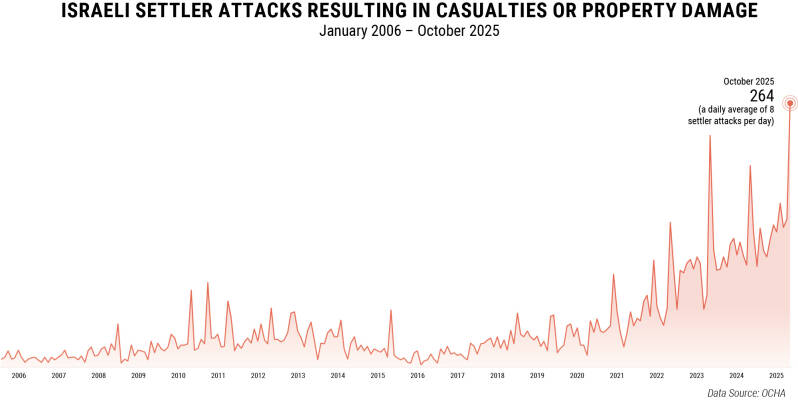
- Between 28 October and 3 November, OCHA documented about 44 Israeli settler attacks against Palestinians that resulted in casualties, property damage or both. These comprised 20 attacks related to the olive harvest. The attacks led to the injury of 18 Palestinians (13 by Israeli settlers and five by Israeli forces). In addition, about 280 Palestinian-owned olive trees and saplings and 30 vehicles were vandalized.
- Eight out of the 44 settler attacks reported over the past week resulted in damage to five residential structures, a school and a mosque and took place across five different governorates. The attacks involved night raids, arson, theft and property destruction. For example, in Ma‘azi Jaba’ Bedouin community, in Jerusalem governorate, about 20 settlers raided the area in the early morning hours and set fire to a house and a fodder storage structure. In Khallet an Nahla community, in Bethlehem governorate, settlers physically assaulted and injured a 60-year-old man after storming his home, damaged an agricultural terrace, and threw stones at nearby houses. In Madama village, in Nablus governorate, settlers threw stones at seven homes and parked vehicles near the main street, broke sewage pipes, and set one car on fire. In Ibziq, in Tubas governorate, settlers from a newly established outpost raided the community’s school, damaging chairs, boards, screens, electronic equipment and water tanks, disrupting the next school day for 25 pupils between 1st and 6th grade and six teachers. In Deir Dibwan village, in Ramallah governorate, Israeli settlers broke into the village during Friday prayers, threw stones at a mosque and nearby houses, and set fire to two vehicles parked outside a mosque, causing damage to windows and other property while worshippers were inside.
2025 Olive Harvest Season
- The UN Emergency Relief Coordinator, Tom Fletcher, called for the protection of Palestinians in the West Bank amid the rise in attacks by Israeli settlers on Palestinians and their property, including during the olive harvest season. He stressed that more trees and communities have been affected this year than in the past six years and urged accountability, emphasizing that impunity cannot prevail.
- Between 1 October and 3 November 2025, OCHA documented 150 olive-harvest-related settler attacks against Palestinians resulting in casualties, property damage or both. Incidents included attacks on farmers inside or on their way to olive groves, theft of crops and harvesting equipment, and vandalism of olive and other trees and saplings. In total so far, 77 villages and towns have been affected by a range of attacks that resulted in the injury of about 140 Palestinians (including 73 by Israeli settlers and the rest by Israeli forces) and vandalism of over 4,200 trees and saplings, mainly olives. This is compared with about 145 attacks documented during the corresponding period in 2024.
- During the 2025 olive harvest season, Palestinian access to agricultural land near Israeli settlements and newly established settlement outposts remained severely restricted across the West Bank. In the northern West Bank, access to agricultural land near settlements was repeatedly disrupted or cancelled. For instance, in Burin village, in Nablus governorate, despite ‘prior coordination’ with Israeli authorities, harvesting was halted, leaving some 300 dunums of olive groves unharvested when the Yitzhar settlement guard prevented Palestinians from harvesting olives along Road 60, fired shots into the air to force them away, and claimed authority over access decisions.
- Moreover, for the third consecutive year, Palestinian farmers from multiple villages have been completely denied access to their olive groves located inside Israeli settlements. This was the case, for example, for: farmers from Salfit city as well as Marda, Kifl Haris and Iskaka villages who have been denied access to their olive groves inside Ariel settlement, in Salfit governorate; farmers from Isla, An Nabi Elyas, Azzun, and Kafr Thulth villages who have been denied access to their olive groves in Alfe Menashe settlement, in Qalqiliya governorate; and farmers from Huwwara, Burin, Einabus, Urif, Asira al Qibliya, Madama, ‘An Naqura, and Deir Sharaf villages who have been denied access to their olive groves in Yitzhar and Shavei Shomron settlements, in Nablus governorate.
- In Ramallah governorate, according to the Palestinian DCL, Israeli authorities required farmers from 11 villages to coordinate their access to olive groves in 14 areas located near settlements and settlement outposts, including one area that was accessed during the last season without ‘prior coordination’ in Al Mughayyir village. Of these, seven areas had ‘prior coordination’ arrangements approved by Israeli authorities, three were denied due to claimed land destruction, and four remain pending. However, in some cases, farmers with approved coordination arrangements with Israeli authorities refrained from accessing their lands in fear of settler violence and low olive yields this year. In other cases, the designated access period was very limited, such as in Ein Yabrud village, where families were able to access their land for only three days and, when they were attacked by Israeli settlers, decided not to return.
- In Hebron governorate, coordination arrangements for Palestinians to access their land near settlements have come to apply to less productive or smaller agricultural areas that are farther away from Israeli settlements. For example, in Tarqumiya town, coordination was granted for a single day to farmers above 40 years of age covering only 500 dunums (123 acres) out of over 5,000 previously accessible lands. In Bani Na’im town, access dropped from about 150 dunums (37 acres) in previous years to just 12 dunums (three acres) this season, while no ‘prior coordination’ requests were approved for 250 dunums (62 acres) in Masafer Yatta that were accessible before October 2023. In Beit Awwa village, farmers were allowed entry for only six hours before being ordered to leave their land near Negohot settlement, which has remained inaccessible since last year.
For key figures and additional breakdowns of casualties, displacement and settler violence between January 2005 and September 2025, please refer to the OCHA West Bank September 2025 Snapshot.
Funding
- As of 6 November 2025, Member States have disbursed approximately $1.46 billion out of the $4 billion (36 per cent) requested to meet the most critical humanitarian needs of three million out of 3.3 million people identified as requiring assistance in Gaza and the West Bank, including East Jerusalem, under the 2025 Flash Appeal for the OPT. Nearly 88 per cent of the requested funds is for the humanitarian response in Gaza, with just over 12 per cent for the West Bank. During October 2025, the oPt Humanitarian Fund managed 135 ongoing projects, totalling $77.7 million, to address urgent needs in the Gaza Strip (87 per cent) and the West Bank (13 per cent). Of these projects, 63 are being implemented by international NGOs, 56 by national NGOs and 16 by UN agencies. Notably, 69 out of the 79 projects implemented by international NGOs or the UN are being implemented in collaboration with national NGOs. For more information, please see OCHA’s Financial Tracking Service webpage and the oPt HF area webpage.
1935.

6 november 2025
Gaza Humanitarian Response
Situation Report No. 14
5 November 2025
HIGHLIGHTS
- As of 4 November, 301 Temporary Learning Spaces are operational in the Gaza Strip, supporting 154,000 learners or 24 per cent of the school-aged population.
- The Kamal Adwan Hospital in North Gaza governorate is scheduled to resume the provision of primary healthcare services next week.
- WHO facilitated the fifth medical evacuation operation since the start of the ceasefire for 19 patients.
SITUATION OVERVIEW
On 5 November, the Ministry of Health in Gaza reported receiving 15 bodies of deceased Palestinian detainees, bringing the total since the start of the ceasefire to 285. Eight-four bodies have thus far been identified by the Ministry’s medical teams.
On the night of 5 November, the body of a deceased hostage of Tanzanian nationality was handed over to the Israeli authorities. The remains of another six hostages from Israel are believed to be still in the Gaza Strip.
UNITED NATIONS-COORDINATED HUMANITARIAN AID ENTRY*
According to the Logistics Cluster, on 4 November, 154 UN and partner trucks were offloaded at Gaza’s crossings, of which at least 54 per cent carried 1,568 metric tons (mt) of food assistance. Via the Egypt corridor, out of 78 trucks that had been manifested for entry, only 59 offloaded.
Based on preliminary and partial data, at least 130 truckloads of humanitarian assistance were collected into Gaza on the same day. Of those, at least 108 contained 1,515 mt of food aid.
HUMANITARIAN RESPONSE
Food Security
- Between 15 October and 3 November, over 300 mt of concentrated animal fodder was collected from the crossings and distributed to around 1,700 herders in Deir al Balah. Each herder received two 50-kilogram bags. Another round of distribution targeting the same group of herders is planned to start next week.
- In collaboration with the Health and WASH Clusters, Food Security Sector partners are promoting hygiene and safe food handling to prevent disease transmission, including hepatitis A. This includes training food handlers - particularly staff in community kitchens and cooked meal distribution teams - and improving coordination to monitor foodborne and waterborne diseases at site level.
Nutrition
- Quantities of ready-to-use therapeutic food already available in Gaza and in the pipeline are expected to sustain acute malnutrition treatment programming for the next six months.
- To support malnutrition prevention, about 200 mt of lipid-based nutrient supplements are currently available in Gaza, with another 1,100 mt in the pipeline. These quantities are sufficient to support the Blanket Supplementary Feeding Programme for the next three months.
Health
- Kamal Adwan Hospital in North Gaza is scheduled to resume operations next week. It will start as a primary healthcare center and will then expand.
- On 5 November, WHO facilitated the medical evacuation of 19 patients, alongside their 93 companions, from the Gaza Strip to receive necessary treatment abroad.
- Three workers in different community kitchens tested positive for Hepatitis A, triggering a multi-sectoral investigation involving Health, WASH, and Food Security partners. Surveillance outbreak and rapid response teams are expected to conclude their work by 6 November.
Water, Sanitation and Hygiene
- Water distribution in the North Gaza governorate has increased with six partners currently supplying 100 water points with up to 1,000 cubic metres of water per day. In the Gaza governorate, 23 partners cover more than 658 water points.
- The Sheikh Radwan stormwater basin pipeline and pumping stations have been successfully repaired. Following multiple pipeline repairs and rapid pump fixes, sewage is now being discharged into the sea, preventing further overflow.
- Explosive ordnance contamination was identified in several areas during WASH infrastructure repairs; coordination is ongoing with partners to ensure safe access.
- Joint field investigations were conducted with the Health Cluster in the north following a death linked to acute watery diarrhea.
Shelter
- About 1,000 tents and around 10,000 additional NFIs like blankets, mats and kitchen sets have entered the Gaza Strip in the last days. However, there remains a critical need for tents. While approximately 190,000 are urgently required, only 5,420 have entered via the Shelter Cluster since the ceasefire began.
Site Management
- About 1,000 tents and around 10,000 additional NFIs like blankets, mats and kitchen sets have entered the Gaza Strip in the last days. However, there remains a critical need for tents. While approximately 190,000 are urgently required, only 5,420 have entered via the Shelter Cluster since the ceasefire began.

Protection
- Child Protection:
- Child Protection (CP) assisted 1,500 children and 400 caregivers in the past two days across Khan Younis and Gaza city. The response included structured Mental Health and Psychosocial Support for more than 1,200 children and 180 caregivers, as well as case management for at least 130 children, including individual support and home visits. Additionally, over 300 children and caregivers participated in community awareness sessions focused on addressing high risk behaviours, caregivers’ responsibilities, preventing family separation, and safe coping strategies during displacement.
- In North Gaza, Child Protection services remain limited, with distributions of winter clothing ongoing, although some partners plan to resume activities as soon as access and funding permits.
- Six thousand tarpaulins have been distributed to partners to support the most vulnerable children and their families living in damaged or makeshift shelters.
- In addition, the AoR is conducting a Training of Trainers on disability inclusion for child protection staff, with support from partners.
- Gender-Based Violence (GBV):
- GBV partners continue to provide multisectoral GBV services across Women and Girls Safe Spaces (WGSSs), including seven in Gaza city, 12 in Deir al Balah and 14 in Khan Younis. Services include case management, psychosocial support, and referrals to health, protection, and legal assistance.
- The GBV AoR is trained the first cohort of 300 providers on clinical management of rape with MoH and partner agencies. The training aims to improve the quality, survivor-centered approach, and coordination of GBV response within health facilities.
Education
- As of 4 November, there were 301 operational TLSs, accommodating 154,000 school-aged children, representing 24 per cent of the school-aged population.
- The distribution of fortified snacks is increasing, with 86 TLSs supported, benefiting about 70,000 learners who receive snacks three days a week.
Emergency Telecommunication Cluster (ETC)
- Ongoing improvements to the very high frequency (VHF) security communication system, now covering Gaza city and expanding to North Gaza (Jabalya, Beit Lahia) and Deir al Balah.
- The cluster is conducting rapid assessments with inter-cluster teams to evaluate cell network and Wi-Fi coverage in North Gaza and coordinate restoration efforts with telecom operators.
Fuel
- On 4 November, UNOPS distributed 47,444 litres of diesel to partners - 34,513 litres in the south and 12,931 litres in the north - to support critical WASH, health, logistics, rubble removal, education, and protection operations.
* All figures solely refer to UN and partner assistance dispatched through the UN-coordinated system, are preliminary and will be reconciled in the course of the ceasefire. Trucks entering through bilateral donations and the commercial sector are not reflected.
1935A.
6 november 2025
As expected, the so-called ceasefire did not hold, a painful reminder that without accountability and justice, there can be no lasting peace. This is precisely why our work has never stopped and why your continued solidarity is so vital.
In the last quarter, we have strengthened our organized movement, expanded strategic alliances, and launched key resources for the movement, ensuring that Palestinians build influence, even in the face of attempts to silence them. Together, we are not just reacting to the moment, we are shaping the future.
If you would like to be an active member of PIPD and help us reach our $50,000 gap to ensure the following programs reach their full potential: Communicating Palestine, Visit Palestine - VR Edition, Diplomacy Bootcamp, please consider becoming a regular supporter under our new Partnership Programme.
Below you'll find a glimpse on some of our recent work. Thank you for your continued interest and solidarity.
Organizing for Collective Liberation
Our investment to strengthen the Palestinian movement
- In August, we successfully launched our first Public Diplomacy Bootcamp, empowering 33 Palestinian advocates with 360° skills in media, lobbying, strategic communication, and digital campaigning to amplify their impact. We are expanding the model to empower more young Palestinians to lead global advocacy with confidence and strategy.
- In September, we launched Communicating Palestine – the go-to guide to narrate for liberation and engage with dignity. We are expanding its reach in the coming year by turning it into a book in 2026 and adapting it in Portuguese, French and Spanish.
Building Alliances in the New World Order
Our advocacy efforts to challenge international complicity
- In Brazil, we helped establish the São Paulo State Assembly Friendship Group Brazil–Palestine, supporting the MP behind this milestone for parliamentary solidarity. We also delivered concrete policy recommendations during our intervention in Congress on Brazil’s cutting diplomatic and economic ties with Israel.
- In Colombia, we helped the grassroots groups stage a protest at the National Mining Agency that forced a meeting with its vice president to push for a stronger implementation of the Coal Ban Decree 949. Our efforts made waves across radio, local media, and the political arena with now a draft legislation being further advances for energy embargo.
- At the multilateral level and following the postponement of the NY Conference on the “two-state solution” during the UNGA, we built consensus and worked on a endorsed by the Palestinian civic movement globally and with international endorsements reiterating our clear demands that remain more relevant today than ever in the face of the so-called Trump’s “peace plan”.
Visit Palestine - VR Edition
We continue raising awareness on the colonial context of Palestine through digital tools
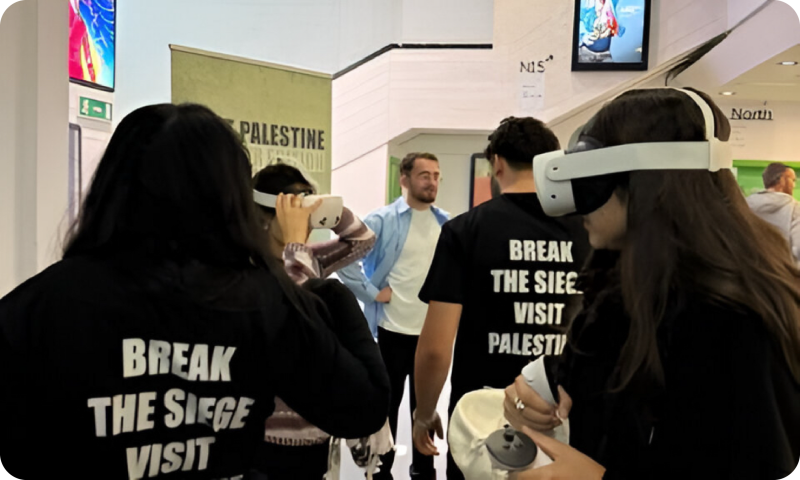
Our Visit Palestine – VR Edition programme reached 5000 people in Toronto, Amman, Ramallah, Detroit, London and Dubai in the last quarter. We have partnered with the People's Conference, Together4Palestine concert, Canadian Journalists for Justice in Palestine at the Toronto Palestine Film Festival, the Royal Commission of Jordan and NorthStar startups to deliver. We thank our brilliant partners that helped us reach a global audience.
The programme has become a powerful tool to witness the Palestinian struggle up close and visit landmark sites such as the Al Aqsa Mosque and the Holy Sepulchre Church.
Host Your VR Event
You can be one of us
On October 13, we launched our new Partnership Programme and expanded our list of partners to 102+ since then. Please join us and share this opportunity with a friend so they can learn more about how partners can support our collective rights, and benefit from a network of community leaders, journalists, and advocates from our networks.
PIPD press room
We continue pushing a paradigm shift in the media, sharing Palestinian narratives and defending the rights of our people, on top of facilitating interviews of many Palestinian voices to the media, particularly Europe and the Global South

- We were on Spain’s most-watched evening program on the two-year genocide mark, Watch here.
- In Al Jazeera Inside Story alongside Ilan Pappe and Ghada Karmi we reflected on the ceasefire announcement.
- As part of our work to deconstruct myths around the “recognition”of Palestine, we contributed Al-Shabaka Podcast Re-Thinking Palestine with Diana Buttu and Yara Hawari.
- We organized an urgent press conference for 45+ international journalists on the US sanctions targeting Palestinian human rights organizations. It was covered by dozens of journalists and the statement was later featured in The Washington Post.
1934.
AVAAZ
6 november 2025
De media hebben het misschien vooral over de rol van Donald Trump in het fragiele staakt-het-vuren dat er nu is. Maar het waren gewone burgers, journalisten, groepen uit het maatschappelijk middenveld, en artsen in en buiten Gaza die zich dag en nacht hebben ingezet om dit mogelijk te maken!
Ik schrijf deze e-mail met een gevoel van trots, maar ook omdat de Israëlische aanvallen en bezetting verre van voorbij zijn. Als we de Palestijnen willen steunen in hun strijd voor vrijheid en waardigheid, dan mogen we nu niet opgeven!
Lees hieronder meer over het werk dat Avaazers wereldwijd hebben geleverd.

We moesten politici in het hart raken en deze boodschap overbrengen: de kinderen in Gaza zijn maar kinderen. Maar ze worden gebombardeerd, uitgehongerd en neergeschoten.
Iedere dag weer.
Dus hebben Avaaz-leden geholpen om enorme billboards met portretten van dappere, gewonde kinderen neer te zetten, voor het Brusselse gebouw waar een belangrijke EU-top plaatsvond. Foto’s die gemaakt werden door moedige journalisten in Gaza.
Honderden Avaazers kwamen opdagen, en de regeringsleiders konden niet anders dan langs de kinderen van Gaza te rijden op weg naar de meeting.
Het was ontroerend. Deze video, die al meer dan een miljoen keer bekeken is, geeft een goed beeld van hoe het was om erbij te zijn:
2. We hebben Europese leiders tot tranen toe ontroerd en aangezet tot actie.
In de ruim tien jaar dat ik voor Avaaz werk, heb ik nog nooit in een politiek overleg gezeten waarin bijna iedereen in tranen uitbarstte.
Dat gebeurde toen we artsen die levens hadden gered in Gaza naar Brussel brachten om hun ervaringen te delen met Europese beleidsmakers.
Hun namen zijn Graeme, Ana, James en Thaer.
De artsen lieten de diplomaten achter in tranen en met direct bewijs van Israëls overtredingen, maar ze hebben ieder van hen vooral gedwongen zich af te vragen: ‘Heb ik echt alles gedaan wat ik kon om de impasse te doorbreken en levens te redden?’
In dit filmpje zie je een van hen, dr. Thaer, die vertelt wat hij in Gaza heeft gezien -- toen veel van zijn collega’s in Gaza hun leven op het spel zetten om dat van anderen te redden:
3. Frankrijk en Spanje kwamen in actie.
Door aanhoudende maatschappelijke druk en de beelden van uitgehongerde kinderen die in de media verschenen, begonnen enkele invloedrijke Europese landen hun standpunt te veranderen. Maar afkeuring was niet genoeg. Om Israël echt onder druk te zetten, moesten ze in actie komen.
Daarom zijn we met Ana, Graeme en James naar Parijs en Madrid afgereisd.
Het was hartverscheurend om te horen hoe erg de situatie was verslechterd sinds ze in Brussel hadden gepleit voor hun patiënten. Nu moesten ze opstaan voor hun collega’s, die in elkaar zakten van de honger terwijl ze in platgebombardeerde ziekenhuizen hun werk probeerden te doen.
Hun verhalen waren overal in Spanje te horen, in alle grote kranten en tv-programma’s! En toen, na maanden van publieke druk, kondigde Spanje een enorm sanctiepakket aan tegen de Israëlische regering.
4. En dan Duitsland!

We wisten van tevoren dat we alles op alles moesten zetten om Duitsland zover te krijgen dat ze in actie zouden komen. Dus op naar Berlijn met Graeme en Tanya, nog een arts die net was teruggekeerd uit Gaza. We namen de billboards met kinderfoto’s mee en zetten die voor de ingang van het parlement.
Tanya en Graeme hebben aangrijpende verhalen gedeeld met de Duitse topambtenaren, en iedereen die we daar hebben ontmoet beloofde er alles aan te doen om een einde te helpen maken aan deze nachtmerrie en onze oproep over te brengen aan de allerhoogste rangen van de Duitse regering.
Maar we waren nog niet klaar! We hebben samengewerkt met geweldige filmmakers en acteurs, en een open brief aan de Duitse bondskanselier gestuurd, waarin we hem opriepen de wapenverkoop stop te zetten en Israël flink onder druk te zetten om de oorlog te beëindigen.
Binnen enkele uren ondertekenden ruim tweehonderd bekende Duitsers de brief, waaronder een aantal grote acteurs en muzikanten. Echt alle Duitse media besteedden er aandacht aan, en de woordvoerder van de bondskanselier liet ons vrijwel meteen weten dat ze de brief hadden gelezen.
Een week later maakte de bondskanselier een gedeeltelijk wapenembargo bekend voor Israëls oorlog tegen Gaza. Dit kwam natuurlijk veel te laat, maar werd wel mogelijk gemaakt door al die moedige mensen die telkens weer in actie kwamen.
5. Van adviseurs tot presidenten
Aanvankelijk hadden de artsen vooral meetings met adviseurs in kleine Brusselse kantoortjes, maar al snel konden we hen begeleiden bij ontmoetingen met ministers van het VK, Italië en Duitsland.
Hier zie je een foto van onze afspraak met de Italiaanse minister van Buitenlandse Zaken, die bijna anderhalf uur naar de artsen heeft geluisterd.

Toen was het tijd voor de Algemene Vergadering van de Verenigde Naties in New York -- en daar wisten we zelfs Emmanuel Macron te strikken voor een meeting. Hij luisterde heel aandachtig naar de verhalen van een andere arts, dr. Nada, en beloofde toen te doen wat hij kon om een einde te maken aan de oorlog.
En wat zo ongelooflijk is: al dit werk, elk treinkaartje en vliegticket voor de artsen -- niet alleen Ana, Graeme, James en Thaer, maar ook Tanya, Nada, Ambereen, Nick, Deirdre, Ayesha en Nahreen -- elke banner die we lieten drukken… ALLES is volledig gefinancierd door Avaaz-leden. Geweldig, toch? We leggen allemaal een klein beetje bij en dan kunnen we samen deze geweldige dingen bereiken!
Het getuigt van de kracht en de moed van gewone mensen die weigerden op te geven, ook niet toen er niks leek te veranderen.
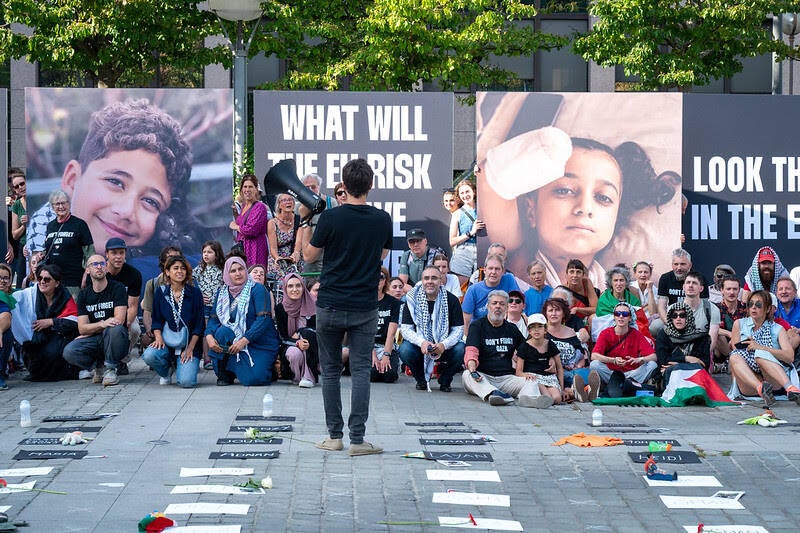
6. Steun aan de moedige journalisten van Gaza
Maar dit is nog niet alles. Toen de Palestijnse journalisten Anas al-Sharif, Mohammed Qreiqeh, Ibrahim Zaher, Mohammed Noufal en Moamen Aliwa omkwamen door Israëlische bommen, hebben we de handen ineen geslagen met Reporters Without Borders. In een ongekende solidariteitsactie werden de meer dan 200 vermoorde journalisten herdacht en vroegen we aandacht voor het feit dat de media niet worden toegelaten in Gaza.
Meer dan 270 media uit 70 verschillende landen deden mee aan deze eerste internationale mediablack-out in de geschiedenis. Kranten en nieuwssites maakten hun voorpagina zwart. Omroepen gingen op stil. De black-out zelf werd wereldnieuws, met honderden artikelen van de New York Times en de Washington Post, tot The Guardian, NRC, De Volkskrant en de RTBF.

Bedankt aan iedereen die onze petities heeft getekend, heeft gedoneerd, gedemonstreerd en meer. Bedankt aan alle mensen en organisaties, zowel binnen als buiten Gaza, die niet opgaven. Jullie herinneren ons eraan dat verandering mogelijk is, zelfs als bijna niemand er nog in gelooft.
Laten we het niet vergeten: de situatie in Gaza is nog steeds ondraaglijk en het staakt-het-vuren betekent absoluut niet dat de Palestijnen vrij zijn.
Dus dit is nog maar het begin. We moeten de druk blijven opvoeren om dit staakt-het-vuren uit te bouwen tot echte vrede en een einde te maken aan de bezetting van het Palestijnse volk.
Wil je nu meteen iets doen? Hier zijn een paar ideeën:
- Stuur deze mail door naar iemand die ook erg betrokken is bij Gaza en die interesse heeft in het werk dat wij allemaal samen mogelijk hebben gemaakt.
- Volg ons op Instagram of TikTok als je sneller op de hoogte wilt worden gebracht van wat we doen.
- Geef een kleine eenmalige of doorlopende donatie zodat we dit werk kunnen blijven doen, voor Gaza en vele andere dringende kwesties -- samen met andere organisaties en mensen ter plaatse. Maar voel je zeker niet verplicht ;)
Op de kracht van mensen, op jou en op ons allemaal,
Christoph, samen met Marie, John, Patri, Nax, Nell, Fadi, Sarah, Luis, Nick, Nils, Joana, Julian, Andy, Laure, Ben, Francesco, Jon, Barbara, Mario, Muriel, Bert en het hele Avaaz-team
1933.

5 november 2025
Gaza Humanitarian Response
Situation Report No. 13
4 November 2025
HIGHLIGHTS
- Since the start of November, 13,200 households have received food parcel distributions through 46 distribution points in the Gaza Strip. Each family received two parcels.
- Between 2 and 4 November, Shelter Cluster partners provided 650 households with tents and 347 households with cash and voucher assistance for winter clothing.
- A total of 290 handwashing stations were established across 16 child safe spaces in northern and southern Gaza. The distribution of 25,000 child winter clothing kits has commenced.
SITUATION OVERVIEW
On the night of 4 November, the body of a deceased hostage from Israel was handed over to the Israeli authorities. The remains of another seven hostages are believed to be still in the Gaza Strip.
On 3 November, the Site Management Cluster observed 7,620 new population movements across Gaza, bringing the total recorded since 10 October to 674,296. Of these, 547,301 were from southern to northern Gaza, while another 112,360 people moved from western to eastern Khan Younis, underscoring the urgent need to scale up shelter and water, sanitation, and hygiene (WASH) assistance in returnee locations. Partners have also observed an increase in reverse movements from north to south; at least 82 people from 33 families relocated to shelters in An Nuseirat and Al Bureij in Deir al Balah due to the lack of essential services and scale of destruction in the north.
UNITED NATIONS-COORDINATED HUMANITARIAN AID ENTRY*
According to the Logistics Cluster, on 3 November, 182 UN and partner trucks were offloaded at Gaza’s crossings, of which at least 48 per cent carried 1,573 metric tons of food assistance. Via the Egypt corridor, out of 193 trucks that had been manifested for entry, only 95 offloaded.
On 4 November, 119 truckloads were collected from Gaza’s crossings. Among them, at least 20 uplifted from Kerem Shalom carried 581 pallets of blankets, family tents, winter clothes, hygiene and dignity kits. A total of 152,400 litres of fuel and 93 metric tons of animal fodder were also collected from Kerem Shalom.
HUMANITARIAN RESPONSE
Food Security
- On 3 November, more than 1.2 million meals were prepared and delivered by more than 23 partners through 183 kitchens - 117,000 meals by 21 kitchens in northern Gaza, and 1,101,000 by 162 kitchens in Khan Younis and Deir al Balah. Meal production has increased by over 82 per cent compared to late September, and 139 per cent in the north.
- Nearly one million people were assisted with general food parcel distributions between 13 and 31 October. So far in November, 13,200 households (approximately 66,000 people) have already been assisted with two food parcels per family, covering 50 per cent of daily caloric needs, through 46 distribution points across the Gaza Strip, including 10 in northern Gaza.
Health
- The Health Cluster distributed 2,750 postpartum kits to the As-Sahaba, Patient’s Friends Benevolent Society, Al Helou and Al Quds hospitals in Gaza city, and the IMC Field Hospital in Deir al Balah, to support delivering mothers. The Cluster also distributed pharmaceuticals such as 4 milligram (mg) Dexamethasone, 600 mg Calcium tablets, 250 mg Metronidazole tablets along with essential consumables like gloves and sutures for health partners’ medical points.
- One Cluster partner reports that 47 per cent of the 92 items on its essential medicines list are out of stock, and eight per cent have less than one month’s supply remaining. Out-of-stock items include non-communicable disease medications, antibiotics, and dermatological preparations.
Water, Sanitation and Hygiene
-
-
- On 3 November, WASH Cluster partners distributed 4,400 hygiene kits, 2,900 18 litre buckets, and 3,700 18 litre jerrycans.
- The Al-Muntazah water facility in Al Musaddar, Deir Al Balah, has been repaired and reactivated, improving water services in the area.
- Maintenance works were completed on water distribution and wastewater networks in Al-Shati Camp, west of Gaza city, as part of ongoing efforts to restore essential services.
- Ten generators of 17 kilovolt-amperes each were collected and deployed to designated locations in Gaza city, Jabalya, and Beit Lahia in the north. These are now supporting the operation of secondary water wells and desludging activities.
- Water distribution continues across all governorates, with 43 WASH Cluster partners operating at 1,885 water points. Daily delivery volumes reach up to 17,000 cubic meters.
-
Shelter
-
-
- On 3 and 4 November, Cluster partners distributed 418 tarpaulins to households in Khan Younis and supported 650 households with tents across Gaza city, Deir al Balah, and Khan Younis, targeting displaced families with the most urgent emergency shelter needs. Between 2 and 3 November, partners also provided cash-voucher assistance for clothing to 347 households in northern Gaza, supporting families to meet essential winter needs.
- On the supply side, partners reported the entry of 10,289 tarpaulins, strengthening the Cluster’s overall stock available for upcoming distributions.
-
Protection
-
- General Protection:
- Protection teams maintained regular field presence across Deir al Balah, specifically along Al Rasheed Road, Al-Nuseirat, Al-Bureij, and Al-Nuwiri, monitoring ongoing displacement movements. Protection teams also conducted explosive ordnance risk education, protection from sexual exploitation and abuse, gender-based violence, and child protection (CP) awareness sessions, and provided psychosocial support and referrals for newly arrived and vulnerable individuals across monitored sites. These activities directly supported at least 82 newly displaced individuals arriving in Deir al Balah shelters.
- Child Protection:
- The Child Protection Area of Responsibility has mapped the capacity of partners able to rapidly distribute winter clothing and establish child-friendly spaces for children in need. Supplies are being dispatched based on each partner’s capacity.
- As part of the ongoing winterization response, approximately 25,000 winter clothing kits have been collected and are being distributed by partners. These include 13,000 winter clothing kits for children under two years of age, which are being delivered via primary healthcare centers and clinics, and 10,000 kits for children aged 3-10 already dispatched to partners, with community-level distribution expected to begin next week.
- 6,000 tarpaulins have been distributed to CP partners to support case management. These supplies are reaching the most vulnerable families, particularly those in damaged or makeshift shelters.
- A total of 290 handwashing stations were established across 16 locations in northern and southern Gaza to promote hygiene among children in Child-Friendly Spaces. Hygiene promotion efforts are ongoing, jointly with WASH partners, to raise awareness and reinforce good hygiene practices among children and caregivers.
- General Protection:

- Gender-Based Violence (GBV):
- One hundred twenty-five dignity kits were distributed to women and girls in Khan Younis; eight GBV awareness sessions were also held, reaching 112 women and 30 men.
- Across Gaza, 542 women accessed psychosocial support through Women and Girls Safe Spaces, including therapeutic and peer-to-peer activities promoting healing and resilience.
Education
- Another 22 learning spaces have been equipped with chalkboards, bringing the total to 132 installed across Khan Younis and Deir al Balah.
- In coordination with the WASH Cluster, the distribution of handwashing stands is underway. As of 3 November, 90 learning spaces in Deir al Balah, Khan Younis and Gaza city had started to receive the units, with additional distributions planned for the coming days. In total, 270 learning spaces are expected to receive these handwashing stands, helping to promote a safe and healthy learning environment ahead of the approaching winter season.
1932.
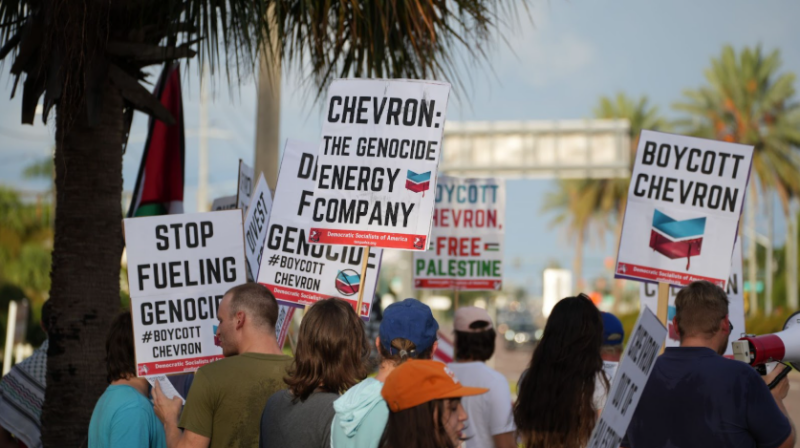
5 november 2025
Join the global day of action on November 22, targeting Chevron for its role in Israel’s genocide and apartheid, in addition to its role in climate destruction globally. Through its gas fields and pipeline, Chevron supplies Israel with 70% of its energy needs according to Chevron’s own website - and hundreds of millions of dollars in tax revenue annually. Chevron entered the Israeli market in 2020, and it can just as easily exit.
Since launching the Boycott Chevron campaign, activists worldwide have picketed gas stations, pressured sponsors to cut ties, and pushed cities to divest. Franchise owners are urging Chevron to quit Israel, sponsorships are being dropped, and drivers are steering clear of Chevron pumps.
Now is the time to escalate!
Share our call to join the #BoycottChevron global day of action!
Israel would not be able to maintain its genocide, apartheid, and military occupation without the support of international corporations like Chevron.
Every time Chevron loses out on profit or sustains reputational damage due to its complicity, pressure builds on the company to end its business in Israel. Every car that doesn’t fill gas at a Chevron station due to a picket or sit-in is a grain of sand disrupting the gears of Israel’s genocide.
Organize peaceful disruptions and pickets on November 22.
Picket or sit in at Chevron stations and locations, including Chevron-owned brands Caltex and Texaco; participate in a banner drop in a highly visible area; host an educational event or an event to mobilize your community around a sponsorship or divestment campaign.
1931.

5 november 2025
Did you hear about the massive #BoycottChevron banner drop over at least 21 freeway overpasses up and down the West Coast in August? Drivers all along this 1,300-mile-long stretch, from Bellingham, WA to San Diego, CA, learned about the boycott for the first time because of activists’ friendly banner drops.
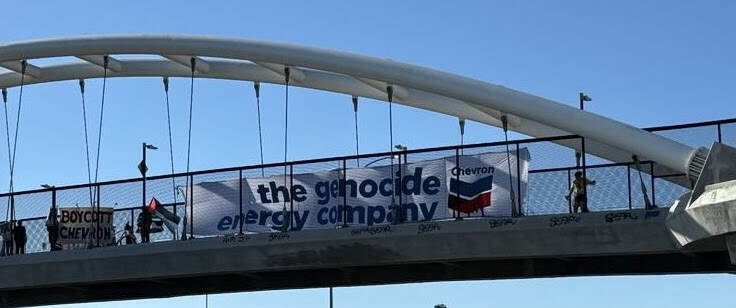
Credit T.Franklin
The West Coast Boycott Chevron coalition is going even bigger on Saturday, November 22, and we’re calling on the rest of the world to create pressure for an economic slowdown on Israel’s ongoing genocide. Despite the so-called “ceasefire,” Israel has continued to freely murder over 200 Palestinians¹ while its coffers are flooded with American taxpayer dollars, and Chevron’s hundreds of millions of dollars in tax revenue.²
Meanwhile, as drivers prepare to fuel up their cars for Thanksgiving travel, we must remind them that genocide is this country’s past and present, but it doesn’t have to be our future. So long as we allow genocide profiteers to continue business as usual, we’re cementing their success. On November 22, join us in throwing sand in the gears of genocide.
Sign the pledge to boycott Chevron now!
PLEDGE TO BOYCOTT CHEVRON!
Why boycott Chevron?
Boycott complicity in genocide: The Palestinian-led BDS movement has called for a consumer boycott of Chevron since 2022. Chevron gas quite literally fuels almost half of the electricity grid of Israel, a settler colonial state that is trying to exterminate my people.
That includes powering Israeli military bases, prisons, police stations, and illegal settlements on native Palestinian land.³
Boycott for our collective future: We’ve arrived at a crossroads for the future of life on Earth. Climate collapse is accelerating. Wildfires are out of control. The deadly bombs Israel has been constantly dropping on Gaza for the last two years—the equivalent of nearly seven Hiroshima nuclear bombs—have intensified this catastrophe.⁴
Boycott in solidarity: Indigenous liberation, including Palestinian liberation, is deeply intertwined with the fight for environmental justice. While Indigenous people have long tended to their ancestral lands with the deepest care, colonizers pollute and destroy for profit. Chevron is one of the worst corporate offenders, with a long history of harming people and the planet.
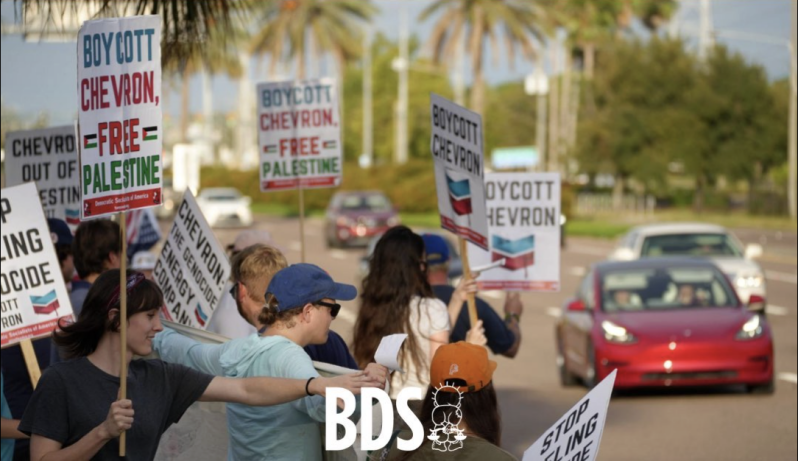
How you can join the fight:
We all belong to this planet, and to each other. On Saturday, November 22, find your people and take action.
- Join a demonstration near you. You can organize a banner drop over a nearby highway, or picket outside of a local Chevron gas station.
- Call a friend and invite them to boycott Chevron.
- Chalk paint “Boycott Chevron” on your car windows.
- Spread Boycott Chevron stickers around your neighborhood.
- Make a meme to share online. (Tag @boycott_chevron)
- Leave a negative review for a corporate-owned Chevron gas station. Find gas stations near you.
- Get creative! Let us know if Chevron is sponsoring an event near you.
Wherever you are, you can help popularize this campaign. Boycotting worked to help bring about the end of apartheid in South Africa, when UK activists picketed Shell gas stations among many other actions around the world, and it can work again—one day of action at a time.
As a consumer, you have the right to reject corporations that profit from genocide and environmental destruction. Sign the pledge to boycott Chevron now.
PLEDGE TO BOYCOTT CHEVRON!
Don’t miss BDS Movement’s global call for a November 22 Day of Action!
Onward to liberation,
DANI MARZOUCA
Digital Organizing Manager
1930.

4 november 2025
Gaza Humanitarian Response
Situation Report No. 12
3 November 2025
HIGHLIGHTS
- On 2 November, more than 1.2 million meals were prepared and delivered through over 180 kitchens across the Strip.
- Over two days, the WASH Cluster distributed 2,401 hygiene kits, 907 dignity kits, 2,800 water buckets, 5,000 jerrycans, and 5,000 soap bars to displaced populations to address urgent sanitation and hygiene needs.
- Seven Temporary Learning Spaces (TLSs) reopened in Gaza city over the past four days, with 294 TLSs now operational across the Strip.
SITUATION OVERVIEW
On 3 November, the Gaza Ministry of Health reported receiving 45 bodies of deceased Palestinian detainees, bringing the total since the start of the ceasefire to 270.
According to a rapid intentions survey conducted by a Site Management Cluster partner between 20–23 October, most displaced families in southern Gaza have not moved since the ceasefire, with only 7 per cent returning to pre-displacement areas—mainly to partially habitable homes due to access to services and family reunification. The majority remain in displacement sites due to destroyed homes and lack of alternatives, with urgent needs focused on food, shelter, water, and WASH support. Living conditions remain fragile, with limited access to life-saving humanitarian services.
UNITED NATIONS-COORDINATED HUMANITARIAN AID ENTRY*
According to the Logistics Cluster, between 31 October and 2 November, 189 UN and partner trucks were offloaded at Gaza’s grossing, of which at least 44 per cent carried food assistance. On 31 October and 1 November, no dispatches took place from the Egypt corridor as the crossings were closed due to Shabbat. On 2 November, trucks offloaded included only 96 of 182 trucks that had been manifested for entry via the Egypt corridor.
On 2 November, 82 UN and partner trucks were collected from Gaza’s crossings, 67 from Kerem Shalom and 15 from Kissufim. These contained 353 pallets of bulk, canned vegetables, food servings and wheat flour, as well as 25 MT of animal fodder. They also contained 537 pallets of kitchen sets, blankets, mattresses, winter clothes, family tents, and tarpaulins; 643 pallets of jerrycans, water tanks, buckets, hygiene kits and baby diapers; and 88 pallets of wheelchairs.
On 3 November, based on initial and partial data, 22 trucks containing 749 pallets of blankets, family tents, hygiene and dignity kits were collected from Kerem Shalom and transported to Gaza city. Four truckloads of medicine and medical supplies were also collected from Kerem Shalom. Details about food aid cargo collected from Kerem Shalom and Zikim are not available yet. Congestion and heavy traffic along the route continue to limit collections.
HUMANITARIAN RESPONSE
Food Security
- As of 2 November, around 150,000 bread bundles (2kg) were produced at 17 UN-supported bakeries (nine in the south and eight in the north) and distributed for free through over 400 distribution points across the Gaza Strip – including more than 50 designated emergency shelters - and some being sold at subsidized price at 43 retailers.
- On 2 November, more than 1.2 million meals were prepared and delivered by over 20 partners through more than 180 kitchens.
- General food assistance resumed on 13 October for the first time since mid-April and continues to expand, with 46 distributions points now operational and nearly one million people assisted as of 2 November. With more supplies safely reaching the warehouses during the ceasefire period, the assistance provided to each family in November will be two food parcels per family instead of one parcel in October.
- Since 15 October, over 210 MT of concentrated animal fodder has been collected from the crossing as of 02 November, and the distribution to around 1,700 herders (two 50-kg bags of fodder for each) in Deir al Balah is almost completed. Another round of distribution targeting the same group of herders is planned to start next week.
Nutrition
- On 2 November, the Nutrition Cluster collected over 120,000 packs of 1.5kg Super Cereal Plus — a vital nutritional supplement used to prevent acute malnutrition in children. This supply is sufficient to support a significant number of children for one month and helps to fill the gap caused by the current shortage of Lipid-based Nutrient Supplements.

Health
- A partner resumed comprehensive eye care services at the Gaza Specialized Eye Hospital, including outpatient consultations, inpatient care, and surgical interventions.
- A partner agency has 7 Primary Health Care Centers (PHCC) and 31 Medical Points (MP) currently functioning across the Gaza Strip and delivering PHC services in two shifts per day. The partner agency has also been providing telemedicine services since the beginning of the war, currently serving around 2,500 patients per day. These services include non-communicable diseases management, general medical consultations, and specialized care, delivered by a team of 60 medical staff.
- An integrated vaccination and nutrition catch-up campaign is scheduled to start on 9 November 2025 under the leadership of the Ministry of Health, in collaboration with Health Cluster partners.
Water, Sanitation and Hygiene
- The WASH needs in partner agency-designated emergency shelters have been finalized and shared with the WASH Cluster to guide the response in these locations. Key priorities include the provision of power sources and electrical components to repair and operate on-site water wells, safe drinking water, rehabilitation of bathroom blocks, support for cleaning services, and the distribution of WASH non-food items (NFIs). There is a specific request for cleaning supplies and hygiene kits to ensure adequate sanitation and hygiene conditions for displaced populations.
- On 1 and 2 November, WASH Cluster partners carried out distributions to enhance hygiene practices in emergency shelters. A total of 2,401 hygiene kits, 907 dignity kits, 2,800 plastic buckets (18L), 5,000 jerrycans (10L), and 5,000 soap bars were provided to displaced populations, addressing urgent sanitation and hygiene needs.
- Additionally, 10 rigid tanks (2,000L) were installed as community water points, aimed at improving water delivery and encouraging better community engagement and ownership.
- The Coast Municipalities Water Utility, with support from humanitarian actors, has initiated rehabilitation works on three water wells in Al-Safa, with a combined capacity of 500 m3 per hour. Located along the Yellow Line, these wells supply water to the Al-Daraj, Al-Tuffah, and Al-Zaytoun neighborhoods within accessible areas, in Gaza governorate.
- In parallel, testing resumed at the Sheikh Radwan Pumping Station following repairs to the pipeline. However, an additional break was detected and as a result, pumping has been halted, and repair works are scheduled to begin today. Once completed, a new pressure test will be conducted to ensure the system is fully operational.
Shelter
- Cluster partners reported that additional tarpaulins entered Gaza last week, bringing the total number of tarpaulins reportedly entered under the Shelter Cluster framework since the start of the ceasefire to approximately 160,000. Distributions are ongoing throughout the Gaza Strip.
Site Management
- Most displaced families remain in southern Gaza, waiting for improved safety and restored services before considering return. Movement decisions are driven by access to services, habitable homes, and proximity to family, rather than confidence in security. With limited housing, many expect to stay in displacement sites. As returns increase, families are occupying damaged homes, leading to fatal accidents. The Site Management Cluster strongly advocates for mandatory professional structural assessments before reoccupation and urges authorities to enforce safety guidelines and provide support for repairs or alternative shelter.
Protection
- Child Protection:
- Child protection services in Gaza remain under severe strain due to displacement, infrastructure damage, and insecurity, with significant service gaps—particularly in the north. On 3 November, over 300 children participated in protection and rights awareness sessions, and more than 100 adolescents and caregivers accessed mental health and psychosocial support services. More than 300 children engaged in structural education activities while children with disabilities received tailored rehabilitation support, and 260 people engaged with caregiver outreach activities.
- 775 children at risk and their families were referred for assistance, including tarpaulins, hygiene kits, and dignity kits.
- Gender-Based Violence (GBV): On 3 November, 728 women and girls participated in group and individual psychosocial support and psychological first aid sessions across Women and Girls Safe Spaces in Khan Younis and Deir al-Balah. Further dignity kits and menstrual health management materials were distributed to a total of 500 women in the Deir Al Balah and the Mawasi area of Khan Younis, helping to mitigate health and dignity-related protection risks.
Education
- As of 2 November, two additional Temporary Learning Spaces (TLS) have reopened in Gaza city, bringing the total number of operational TLSs to 11 out of the 105 that were functional before the escalation in the north in September. In total, 294 TLSs were functional as of 2 November (136 in Deir al Balah, 146 in Khan Younis, 11 in Gaza city and 1 in Rafah), with approximately 148,000 school-aged children enrolled. The scale of reopening remains limited due to extensive destruction affecting both TLS sites and previously operational school buildings. Partners continue to expedite efforts despite ongoing restrictions on education supplies. The need to expand learning spaces is increasingly urgent, as they not only support children’s learning and wellbeing but also enable families to focus on livelihood recovery and debris clearance.
- To strengthen hygiene and sanitation practices, 10 public schools (four in Deir Al Balah and six in Khan Younis) received cleaning materials. This support is particularly critical with the onset of the winter season, when rainfall increases health risks. The cleaning materials, accompanied by hygiene promotion messages disseminated through schools and communities, are expected to help prevent communicable diseases and position learning spaces as key entry points for community health interventions.
Multi-purpose Cash Assistance (MPCA)
- Since the start of the ceasefire and as of 3 November, partners have reached 55,753 families with MPCA, prioritizing newly displaced households.
- According to the Gaza Chamber of Commerce, based on monitoring of 34 key items, the discrepancy between digital and physical payments is improving and continues to narrow, now averaging 0–45 per cent, compared to 0-50 per cent last week, and 21–61 per the week before. This indicates increased acceptance and use of digital payments in the markets.
Fuel
- On 2 and 3 November, UNOPS distributed 133,420 liters of fuel to partners, of which 116,796 was in the south and 16,624 in the north to support critical WASH, health, food security, logistics, rubble removal, education, protection, nutrition, and site management operations.
1929.

3 november 2025
U.S. voters are flipping the litmus test on Israel
In the United States, the political landscape is finally shifting. Donald Trump’s assault on basic constitutional order has driven his approval into the gutter, and it is easy to forget we are still within the first year of his second term. As millions lost SNAP benefits this weekend, Trump hosted a “Great Gatsby” Halloween party at a partially demolished White House. The disconnect is staggering. Last month, more than seven million people joined the No Kings protests. In New York City, a generational shakeup is underway, with Zohran Mamdani likely to become mayor. Politicians are beginning to step away from the Israel lobby. In one vivid moment, activists in Netanyahu masks showered Cory Booker with fake cash to thank him for backing Israel’s war on Gaza. We are living through an organized attempt to replace democratic norms with authoritarian rule. That outcome is not inevitable. Many more people oppose these retrograde and cruel policies than support them, and our task is to hold the line and widen it without trading away core principles.
One of those principles, solidarity with Palestine and opposition to Israeli occupation, apartheid, and genocide, is no longer a fringe position; it is now mainstream. In New York, Mamdani’s long record on Palestine was supposed to be a wedge. It is not working. Across the country, candidates who assumed automatic political gain from supporting Israel are finding the ground has moved. The test is flipping. Support for Palestine is becoming a deciding factor for voters. It is very possible that the current wave of authoritarianism in the United States and beyond will meet its defeat in part because people refuse to abandon Palestinian freedom.
This week, Amy Hagopian describes how a public health association punished her for protesting genocide, a sign that authoritarian habits are spreading inside civic institutions that should be defending dissent. Adrienne Lynett and Mira Nabulsi show that public opinion has shifted after two years of genocide in Gaza, and that Palestine now carries real electoral weight in the United States. Phil Weiss sees Zohran Mamdani’s mayoral bid as a turning point in U.S. politics and in Jewish life. He argues that more Jews are rejecting Zionism, and this realignment opens new space for pro-Palestine politics.
Tareq Hajjaj details a pattern in which Israeli forces break the ceasefire in Gaza, claim a flimsy pretext, halt for a moment, then repeat the cycle. Majd Jawad gathers testimony that Israeli forces used Palestinian women as human shields and shows this was a pattern well known to military commanders. Louis Allday’s conversation with Sabri Jiryis situates the genocide in a longer history of Zionism. Hassan El-Nabih adds the human texture of survival, a meeting with a former student that holds both relief and sorrow at once. Abdaljawad Omar explains how even the debate over the name of the war reveals a deeper commitment to colonial violence.
David Reed, Publisher
Must read: Zohran Mamdani’s historic run will also help free Jews, and U.S. politics, from Zionism
Phil Weiss: Zohran Mamdani’s historic campaign for New York mayor marks a significant moment for Jewish identity as more Jews distance themselves from Zionism. This will be a fierce generational fight with wide-reaching effects on American politics.

Zohran Mamdani seen on stage at a campaign event. (Photo: Zohran Mamdani campaign)
Genocide in Gaza
Tareq Hajjaj: Here’s Israel’s strategy to continue the war on Gaza: find a pretext, no matter how baseless, use it to kill dozens of civilians and fighters, stop fire, and claim you’re honoring the ceasefire. Then do it again.
Louis Allday: Mondoweiss speaks to celebrated Palestinian scholar Sabri Jiryis about his life, Zionism, the genocide in Gaza, and the judgments of history.
Abdaljawad Omar: Throughout the Gaza war, Israel has debated what to call it. The military says “October 7 War,” while Netanyahu wants “War of Redemption.” What’s clear is that Israel believes it can only resolve its ongoing cycle of crisis through genocidal violence.
Majd Jawad: Throughout the Gaza genocide, testimonies have documented the Israeli army’s use of Palestinian women as human shields. These are not isolated acts by rogue soldiers but a systematic practice known to Israeli commanders and acknowledged by soldiers.
Hassan El-Nabih: A chance encounter with one of my past students at the Islamic University of Gaza highlighted the paradox of surviving the Gaza genocide: feeling joy in surviving the war and sorrow in witnessing what our survival has cost us.
Catch-up
Amy Hagopian: My American Public Health Association membership was revoked after over 20 years because I protested for Palestine. As authoritarian norms spread in government, they are metastasizing into civil society institutions that should be resisting them.
Adrienne Lynett and Mira Nabulsi: Two years into the Gaza genocide, public opinion on Israel, Palestine, and U.S. policy has undergone a profound shift. A close examination of poll data shows Palestine is no longer a niche issue but one with real electoral consequences.
1928.

3 november 2025
Gaza Humanitarian Response
Situation Report No. 11
1 and 2 November 2025
HIGHLIGHTS
- Household physical access to food improved in early October, especially in southern governorates, with 50 per cent of surveyed households reporting better access due to commercial and aid deliveries. However, no food aid convoy has entered the north since 12 September.
- Two field hospitals are being established in Gaza city by International Medical Corps (IMC) and the Palestine Red Crescent Society (PRCS).
- Five Temporary Learning Spaces reopened in Gaza city over the past three days.
SITUATION OVERVIEW
On the night of 2 November, the remains of three Israeli hostages were transferred to the Israeli authorities, bringing the number of deceased hostages from Israel believed to remain in the Gaza Strip to eight.
Over the weekend, an estimated 29,000 population movements were observed in the Gaza Strip, 90 per cent of them from south to north, and the remaining from west to east Khan Younis.
According to the United Nations Satellite Centre (UNOSAT), approximately 81 per cent of all structures in the Gaza Strip are damaged. The governorates of Gaza and North Gaza experienced the largest increases in damage compared to July 2025, with approximately 4,243 newly affected structures in Gaza and 1,442 in North Gaza.
UNITED NATIONS-COORDINATED HUMANITARIAN AID ENTRY*
On 1 November, 197 UN and partner trucks were collected from Gaza’s crossings, 184 from Kerem Shalom and 13 from Kissufim. These contained 1,706 MT of mixed food, 181 MT of wheat flour and 104 pallets of food boxes. They also contained 1,073 pallets of mattresses, blankets, small and high-performance tents, tarpaulins, and winter clothes; 298 pallets of hygiene kits, buckets, water containers, squatting plates, and jerry cans; 50 pallets of super cereals; and 201 pallets of dignity kits, menstrual health kits, and midwifery supplies.
On 2 November, based on initial and partial data, 37 trucks containing 976 pallets of blankets, family tents, hygiene kits, water tanks, mats, winter clothes, tarpaulins, and jerry cans were collected from Kerem Shalom, alongside one truck of animal fodder.
HUMANITARIAN RESPONSE
Food Security
- According to the latest market monitoring and food security analysis for October 2025, household physical access to food improved in early October, especially in southern governorates, driven by commercial and aid deliveries. Fifty per cent of households surveyed reported better access, 27 per cent no change, and 23 per cent worse access, mainly in the north where no food aid convoy has entered the north since 12 September.
- On average, households consumed two meals per day in October, up from one meal in July. However, 1 in 5 households still reported eating only one meal. Additionally, 43 per reduced meal portions, 79 per cent decreased daily meals, and 42 per cent limited adult intake to prioritize children.
- By mid-October, food consumption slightly improved, likely due to the increase of humanitarian and commercial trucks entering the Strip.
- Only 31 trucks carrying cooking gas reportedly entered between 10–31 October. Over 60 per cent of the population relies on waste burning for cooking, which poses significant health risks.
- As of 30 October, 150,000 2-kg bread bundles were produced daily at 17 UN-supported bakeries (eight in the north) and distributed via more than 400 points across Gaza.
- As of 1 November, 1,159,000 meals were delivered daily by 22 partners through 180 kitchens—110,000 meals from 20 kitchens in the north and 1,049,000 from 160 kitchens in the south/central.
- On 13 October, general food assistance resumed for the first time since mid-April, reaching 187,000 households (approx. 935,000 people) via 44 distribution points, including more than 43,000 households in Gaza city. October rations were reduced to one food parcel and one bag of wheat flour per family; future rations depend on stock availability.
Nutrition
- Following the ceasefire, partners have resumed and scaled up nutrition services in the North, including reopening sites that were previously closed. Currently, 20 malnutrition treatment sites are operational in Gaza city, bringing the total number of active sites across the Strip to 133. The geographic distribution is as follows: 45 per cent in the Middle area, 40 per cent in the South, and 15 per cent in the North.
- Nutrition Cluster partners are facing challenges due to limited space, which is hindering the ability to erect additional tents and further expand services.
- Coverage of preventive nutrition services, including blanket supplementary feeding, is improving thanks to better access and supply availability.
Health
- During October and after the ceasefire announcement, eight Health Service Points (HSPs) resumed operations across Gaza Strip. New HSPs are also being established, including two field hospitals in Gaza city by International Medical Corps (IMC) and the Palestine Red Crescent Society (PRCS).
- The renovation of Rantisi hospital, in Gaza city, has commenced and is planned to include pediatric intensive care services.
- The reactivation of European Gaza Hospital (EGH) continues to be challenged by access issues. Missions to complete the assessments and retrieve critical items are still ongoing but encounter impediments.
Water, Sanitation and Hygiene
- Continuous generator operation has created an urgent need for oil and filters; oil shortages have halted maintenance in several areas, risking generator failure and service disruption. Immediate provision of 10,000 liters of oil and necessary filters is required.
- Final repairs on the Sheikh Radwan pumping station pipeline are nearly complete, with a trial pumping test scheduled; this will help resume normal water flow and lower basin levels.
- Major repairs were completed on Sheikh Radwan Wells No. 10 and 11, now being connected to the Al Yarmouk reservoir; seven wells in Jabalia cleaned and reopened, along with ten secondary wells prepared for maintenance.
- United Arab Emirates (UAE)-funded water trucking has begun in Gaza city and the north, while Water, Sanitation and Hygiene (WASH).
- A cluster-funded flood mitigation project will start this week to clean drainage networks and prevent flooding. About 4,500 manhole covers and frames are missing, creating serious safety risks.
- WASH partners-funded generators delivered for two wells in North and Khan Younis; second-hand generators procured locally due to import restrictions. Other partner-supported WASH facilities assessment and repair for destroyed facilities is ongoing to sustain critical operations.
- The Public Health Laboratory for water testing at the Ministry of Health in Gaza Governorate, located at Al-Shifa Hospital, will be ready to receive samples starting today.

Shelter
- One thousand of the 11,000 tarpaulin available were distributed by the Shelter Cluster between 1 and 2 November, as well as 2,500 blankets. Since the ceasefire, more than 5,000 tents and 85,000 tarpaulins entered Gaza.
Protection
- General Protection:
- Approximately 725 people in northern Gaza received protection assistance and distributions (diapers and dignity kits). In central and southern Gaza, around 2,000 individuals received integrated protection, gender-based violence (GBV), child protection (CP), mental health and psychosocial support (MHPSS), sexual and reproductive health (SRH), legal, awareness, rehabilitation, and non-food item (NFI) activities delivered by protection partners.
- Key activities included GBV case management, individual and group psychosocial support (PSS) sessions, legal and psychosocial consultations, SRH and awareness sessions, community workshops, rehabilitation therapy, NFI distributions including adult diapers, and explosive ordnance risk education (EORE) awareness.
- Protection monitoring was active across the Gaza Strip. Partners conducted protection and disability inclusion monitoring in displacement centers, referring at-risk cases to specialized services, reported acute psychosocial distress, unsafe infrastructure, and urgent protection needs across displacement and return sites. They also monitored population movements along Al Rasheed Road, identifying critical protection risks such as unsafe transport, dehydration, poor sanitation, GBV and child protection concerns.
- Together with the Prevention of Sexual Exploitation and Abuse (PSEA) Network, Cluster partners continue to provide refresher sessions to the 150 volunteers and emergency protection responders (EPRs) forming the mobile protection monitoring teams that will be deployed in different distribution points.
- Child Protection:
- Five child protection mobile teams are currently delivering services in North Gaza, including MHPSS, case management, and community awareness on child protection issues.
- Twelve caseworkers have been deployed to provide hospital-based social work support to children hospitalized due to conflict-related injuries, with continued follow-up care after discharge.
- Following reports of child injuries caused by unsafe behavior such as children climbing onto moving vehicles/trucks, the CP Area of Responsibility is launching a safety awareness campaign. This initiative aims to reduce high-risk activities among children and promote stronger caregiver supervision. These behaviors are largely driven by children spending unsupervised time on the streets due to limited access to schools, safe spaces/child-friendly spaces, or structured activities.
- Partners are conducting a five-day Play-Based Recovery Training for psychosocial support facilitators and counsellors supporting children affected by conflict.
- Partners have referred over 750 children with protection concerns for multisectoral support, including the provision of tarpaulins, hygiene kits, and non-food items (NFIs).
- Partners have also mobilized 28 child protection partners to support the winterization response, including the distribution of blankets and clothing for vulnerable children.
- Mine Action: Three incidents involving unexploded ordnance have occurred since the ceasefire, resulting in 11 victims (including 3 children); explosive ordnance risk education (EORE) sessions are ongoing, with additional support requested to manage the rising caseload.
- Gender-Based Violence (GBV): More than 1,000 dignity kits have been distributed. GBV partners assessments have highlighted concerns over the lack of hygiene items, forced/early marriages due to economic hardship, and increased domestic and community violence

Education
- In Gaza city, five Temporary Learning Spaces (TLS) reopened over the past three days, bringing the total to nine TLS enrolling 2,200 learners. Efforts to reopen, expand, and establish new spaces are ongoing, but debris remains a block.
- One partner dispatched and supported the installation of two High Performance Tents in public schools in Deir Al Balah, providing safe spaces for Social Emotional Learning activities for 3,725 students.
- Renovation works are ongoing in four schools, with 21 of 41 classrooms completed, enabling access for over 2,000 learners. Shortages of furniture and learning materials remain a challenge. The Cluster encourages partners to donate wooden pallets for furniture before winter.
Emergeny Telecommunication
- Security communications training (radios, satellite phones) is available for all agencies; 3–4-hour practical sessions are offered.
- Field teams are asked to collect connectivity information from communities during missions.
- Focus remains on restoring and maintaining cell towers in underserved areas.
1927.

3 november 2025
Today's headlines
Like Gaza, Israel is threatening to destroy the Lebanon ceasefire
Mitchell Plitnick

A year-old “ceasefire” is being upheld in Lebanon despite almost daily Israeli military strikes. The Trump administration can still prevent the fragile truce from falling apart, but only if it forces Israel to follow the agreement.
1926.

1 november 2025
Gaza Humanitarian Response
Situation Report No. 10
31 October 2025
HIGHLIGHTS
- Between 28 and 30 October, daily cooked meal production increased by over 40 per cent in Gaza city as more community kitchens resumed functionality and production capacity increased at existing ones.
- While adequate therapeutic supplies for the treatment of malnourished children have entered Gaza, stocks for malnutrition prevention programming are facing severe shortages.
- Fifty critical pediatric and adult patients were medically evacuated from Gaza between 29 and 30 October. Over 16,500 patients in urgent need of specialized treatment, however, remain blocked in the Strip.
SITUATION OVERVIEW
On 31 October, the Gaza Ministry of Health reported receiving 30 bodies of deceased Palestinian detainees, bringing the total since the start of the ceasefire to 225. As of 28 October, the remains of 75 of the 195 bodies hitherto received had been identified by the Ministry’s medical teams.
On the night between 31 October and 1 November, the remains of three bodies were transferred to the Israeli authorities. According to forensic tests, they do not belong to any of the 11 deceased Israeli hostages believed to remain in the Gaza Strip.
UNITED NATIONS-COORDINATED HUMANITARIAN AID ENTRY*
According to the Logistics Cluster, on 30 October, 149 UN and partner trucks were offloaded at Gaza’s crossings, of which at least 55 per cent carried food assistance. Trucks offloaded include only 60 of 123 trucks that had been manifested for entry via the Egypt corridor.
On the same day, at least 122 United Nations-coordinated trucks were collected from Kerem Shalom. These contained 899 pallets of ready-to-eat rations, bulk and canned vegetables, and food servings; 519 pallets of tarps, tents and fittings; 262 of hygiene kits; 180 of medical supplies; 154 of baby milk; 125 of winter clothes; and 25 metric tons of animal fodder.
On 31 October, based on initial and partial data, at least five double trucks with approximately 2,500 post-partum kits were uploaded from Kissufim. Though the mission was accomplished, it faced protracted delays and took more than seven hours. Two other missions to collect food aid from Kerem Shalom and Kissufim were facilitated, but details remain pending.
Cargo entry remains constrained by the requirement for use of the highly congested and narrow Philadelphi Corridor/Coastal Road which is unsuitable for large convoys, the continued denial of other routes for use by humanitarian and commercial truck movements to and from Kerem Shalom, de-prioritization of UN cargo at crossings in favour of other actors, and persistent delays in customs clearance.
HUMANITARIAN RESPONSE
Food Security
- On 30 October, 1,148,000 hot meals were prepared and delivered by 22 Food Security Sector partners through 178 kitchens – 110,000 meals by 20 kitchens in the north, and 1,038,000 meals by 158 kitchens in south-central Gaza. Compared to just two days earlier, this reflects a notable surge in the number of meals, including an increase of more than 30,000 daily meals in Gaza city as more community kitchens resumed functionality and production increased at several existing ones.
Nutrition
- UNICEF distributed 320 cartons of Ready-to-Use Therapeutic Food (RUTF) to partners to support the treatment of children with wasting.
- Nutrition partners in the Gaza and North Gaza governorates are facing challenges in re-establishing further services due to limited available and secure spaces to erect tents. Materials to rehabilitate damaged facilities are also in short supply and the cost of renting additional space is prohibitive. Although 20 nutrition sites are now functional in Gaza city – with 13 re-established since the onset of the ceasefire - this falls short of the more than 50 nutrition sites operational in August 2025.
- While the malnutrition treatment supply pipeline is secure inside Gaza, a lack of prevention supplies is impacting programme quality and increasing the risk of healthy children becoming malnourished.
Health
- Between 29 and 30 October, WHO facilitated two medical evacuation operations from Gaza. The first for 30 critical patients, who were transferred with 60 companions to the UAE, Romania, and the Netherlands, conducted jointly with the EU Civil Protection Mechanism. The second for 19 children and one adult patient, four pediatric cancer patients that will be treated by the St Jude Research Programme, and the rest to Jordan.
- Since October 2023, WHO has supported the medical evacuation of almost 8,000 patients, of whom over 5,500 were children. More than 16,500 patients remain in need of specialized treatment unavailable in Gaza. WHO continues to appeal for more countries to welcome these patients and for access to all evacuation corridors, notably the West Bank, including East Jerusalem.

Water, Sanitation and Hygiene
- Between 30 and 31 October, WASH partners distributed 80,000 baby diapers, 530 household-level hygiene kits, 500 sanitary pad kits, 319 disability kits, and 30 dignity kits, reaching approximately 15,000 people in southern Gaza.
- In Gaza city, maintenance on the final damaged section of the pipeline connected to the Sheikh Radwan Stormwater Basin pumping station was completed. A trial pumping operation is scheduled to begin on 1 November.
- Thirty water bladders with capacities of 5 and 10 cubic meters and equipped with tap stands were transferred from storage facilities in Khan Younis to Gaza city for installation in the Gaza and North Gaza governorates.
- Between 22 and 29 October, seven water wells in the Jabalya Municipality were cleaned and prepared for maintenance.
- Water distribution continues across all governorates, with operations ongoing at 1,885 water points and a daily delivery volume of up to 17,000 cubic meters.
Shelter
- The Shelter Cluster has started distributing 3,500 tarpaulins to families living along the beach in Khan Younis, targeting households in deteriorated tents. Another 5,100 tarpaulins will be distributed in Gaza city on 1 and 2 November.
Protection
- Child Protection: On 30 October, Child Protection partners reached 500 people through community awareness sessions on child protection risks and forms of exploitation affecting children. Additionally, 500 children, including some with disabilities, and 200 caregivers in Deir al-Balah and southern Gaza were provided with psychosocial support sessions, focused on positive parenting, child protection, and emotional recovery through structured play-based activities.
1925.

1 november 2025
Today's headlines
Zohran Mamdani’s historic run will also help free Jews, and U.S. politics, from Zionism
Philip Weiss
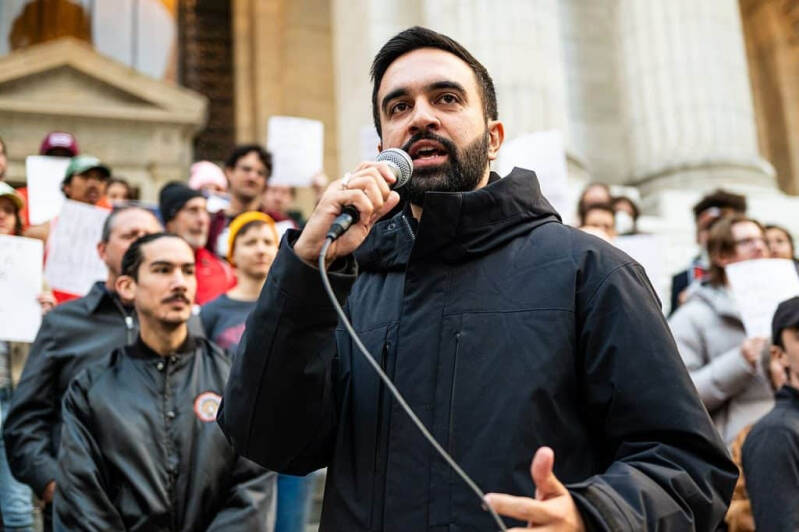
Zohran Mamdani’s historic campaign for New York mayor marks a significant moment for Jewish identity as more Jews distance themselves from Zionism. This will be a fierce generational fight with wide-reaching effects on American politics.
1924.