LUISTER NAAR DE JOODSE STEMMEN OVER
DE ISRAELISCHE MEGA-MISDRIJVEN TEGEN
HET INTERNATIONAAL HUMANITAIR RECHT
JEGENS DE PALESTIJNEN !
THE JEWISH VOICE FOR PEACE - JVP
LEES "THE WIRE" !
PALESTINA BERICHTEN NA 31 JANUARI 2026 staan hier

28 februari 2026
Another illegal war: the U.S. further entrenches itself in service of a foreign government that acts with impunity
American Muslims for Palestine unequivocally condemns the joint military attack being carried out by the United States and Israel on Iran.
Launching unprovoked, coordinated strikes at any time is reckless but doing so during Ramadan, the holiest month for Muslims around the world, signifies a profound disregard for both regional stability and the sanctity of a month rooted in reflection, mercy, and restraint. From Palestine to Iran and across the global Muslim community, this escalation is a grave moral violation layered onto ongoing violence, loss, and collective grief.
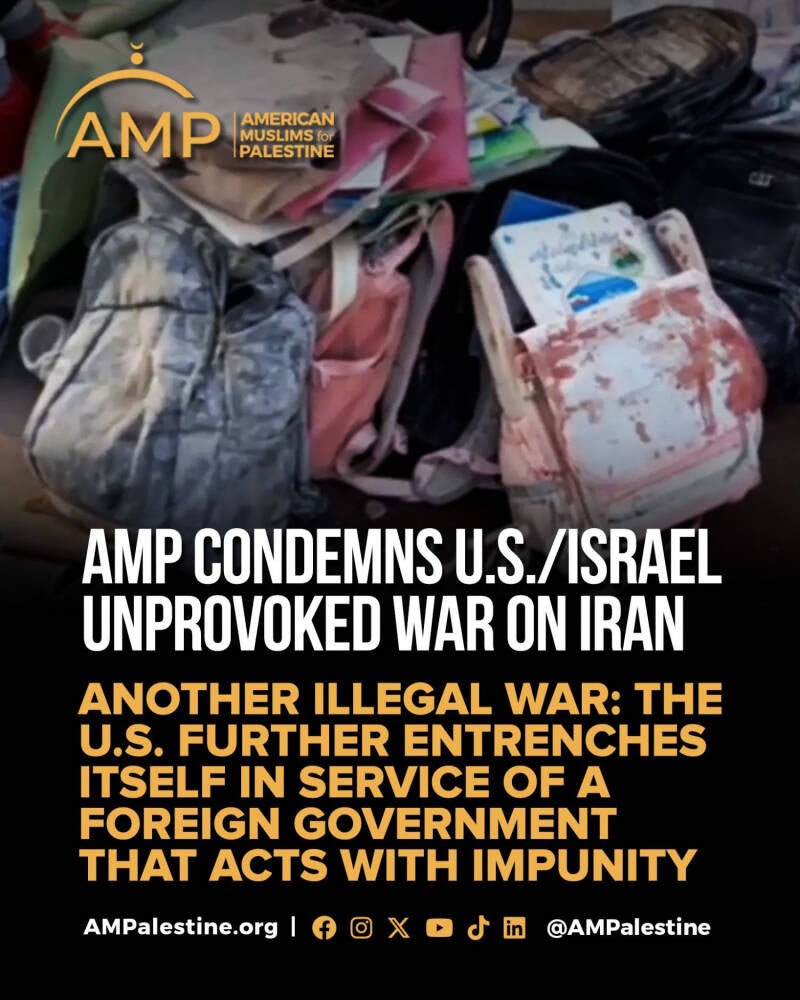
It hasn’t even been 24 hours and the human cost is already devastating. The joint U.S.–Israeli strikes have hit civilian targets, including a girls’ school in Minab where dozens of children and civilians have been killed and many more wounded.
Yet again, the U.S. is entangling itself in another war in the Middle East, not for itself but in service of a foreign entity that has repeatedly acted with impunity. Just last week, Israeli forces were responsible for the killing of yet another American. At the same time, the Israeli government continues its assault on Palestinians in Gaza, advances annexation efforts in the occupied West Bank, and enables escalating settler violence; all while facing accusations of war crimes and crimes against humanity. Despite a so-called “peace plan,” led by President Trump, there has been no accountability, no meaningful restraint, and no justice.
It is not up to Israel or the United States to impose regime change on the Iranian people. The future of Iran belongs to Iranians, not to foreign governments seeking to reshape the region to fit their needs. We have seen, time and time again, the devastation that follows U.S. and Israeli interference under the banner of “regime change.” From prolonged instability to civilian suffering and regional collapse, these interventions have rarely, if ever, delivered freedom or safety for people.
To be clear, this war was undertaken without congressional authorization and without popular approval. The power to declare war rests with the legislative branch for a reason, to prevent exactly this kind of unilateral, executive-driven escalation. Yet once again, this administration has sidestepped constitutional limits and disregarded Congress’s authority.
To take it a step further, this is happening in direct opposition to popular approval. At a time when Americans are struggling under mounting economic pressure, political instability, and attacks on basic rights, this administration has chosen to drag the country into another foreign conflict that the American people did not ask for and do not support. Americans do not want more war.
By starting another illegal war under the guise of “diplomacy,” the administration has once again damaged U.S. credibility on the world stage. You cannot claim to pursue peace while initiating an illegal war and supporting a government notorious for committing crimes against humanity on a regular basis.
Congress has both the constitutional authority and the moral obligation to act. Every single lawmaker must use every lever available to them, from war powers resolutions to funding restrictions, to hold this administration accountable and bring this unlawful expansion of war to an immediate halt.
The Israeli government should be under rigorous international scrutiny and accountability for its ongoing violations, not emboldened with expanded military coordination to carry out additional strikes that threaten the entire region.
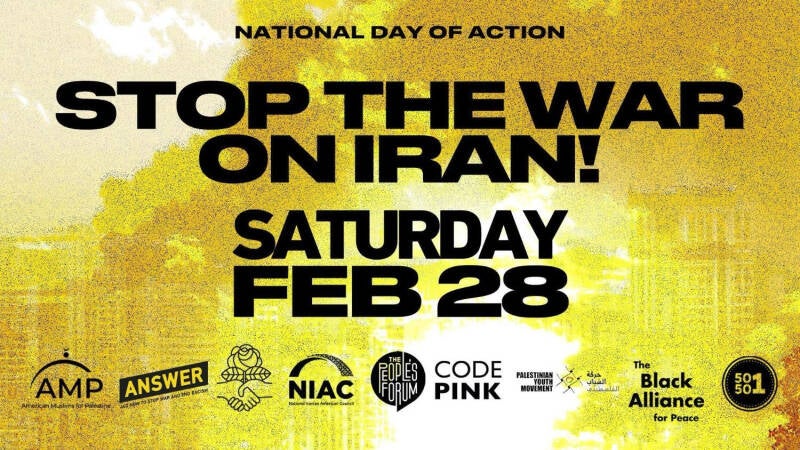
Join us, in coalition with grassroots organizations, for emergency protests in scores of cities around the country today to oppose the Trump administration’s attack against Iran. A full list of demonstrations can be found here.
In solidarity,
American Muslims for Palestine (AMP)
2111.

28 februari 2026
Gaza Humanitarian Response
Situation Report No. 69
27 February 2026
(As of 18:00 on 25 February 2026, unless otherwise noted)
HIGHLIGHTS
- A total of 260 out of 619 health service points (42 per cent) across the Gaza Strip are functioning, 90 per cent of them partially. All hospitals in Gaza remain fully dependent on back-up generators, with delays in the entry of related spare parts, uninterruptible power supply (UPS) systems, transformers and critical electrical components impacting Intensive Care Unit, dialysis, operating theatre and laboratory functionality.
- Between 11 and 23 February, around 2,500 cubic metres of accumulated waste had been relocated from Firas Market to the newly identified temporary dump site in Abu Jarad. Newly generated waste from Gaza city and North Gaza is now being sent directly to Abu Jarad.
- Nine more Women and Girls’ Safe Spaces were established in Gaza city, Deir al Balah and Khan Younis during the reporting period, bringing the total to 68 across the Strip.
- Between 18 and 24 February, Cash Working Group partners distributed multi purpose cash assistance to more than 3,500 households across the Gaza Strip through digital payment modalities.
SITUATION OVERVIEW
Between 20 and 25 February, airstrikes, shelling and gunfire continued across the Gaza Strip, reportedly resulting in civilian casualties and damage to civilian infrastructure. According to the Ministry of Health in Gaza (MoH), seven Palestinians were killed, and 33 others injured during this period, bringing the total casualty toll reported by MoH since the ceasefire came into effect on 10 October 2025 to 618 killed and 1,663 injured.
Throughout the reporting period, the Rafah Crossing remained open for limited movement of people. Overall, since the crossing reopened in early February, WHO has facilitated the medical evacuation of 289 patients, alongside 521 caregivers. During the same time frame, the UN and humanitarian partners have also supported 804 returnees, providing them with protection, medical assistance, and transportation as well as basic supplies.
Efforts to address immediate weather‑ and accident‑related needs and provide critical services to underserved communities through joint humanitarian aid distributions continued during the reporting period. On 25 February, joint teams began distributing multi-sectoral assistance packages, comprising mostly shelter and hygiene items, to over 240 families affected by a rainstorm that struck Gaza between 23 and 24 February.
On 26 February, partners also distributed food assistance as well as shelter and hygiene items to over 400 families in the Bani Suhaila area of Khan Younis. The targeted families are residing in a hard-to-reach and underserved area and have experienced repeated displacement in recent months due to shifts of the “Yellow Line”.
According to the latest WFP Market Monitor, food consumption in Gaza continued to show encouraging signs of improvement in the first eleven days of February, sustaining the gains observed in January. While more accessible market prices and increased food availability have driven a noticeable recovery in food consumption patterns compared to pre‑ceasefire levels, significant gaps persist. Vegetables are still consumed on average two days per week, down from six before October 2023, while fruits are consumed just half a day per week, compared to three prior to October 2023. Protein (meat, poultry, eggs) consumption equally remains limited at one day per week, compared to three. Access to energy sources represents a persisting challenge, with over 50 per cent of the population still reporting relying on waste burning as an alternative to cooking gas in February. Encouragingly, however, in the northern governorates, the share of households able to use cooking gas reached 10 per cent, signaling gradual improvement.
On 11 February, OCHA, in coordination with operational partners, conducted a needs assessment of more than 1,800 families living in areas of Deir al Balah adjacent to the “Orange Line” where Israeli authorities recommend prior coordination for humanitarian movements. Field engagement with camp focal points from particularly underserved areas evidenced severely limited access to essential services. Priority needs include drinking water, food assistance, functioning water pumps, and emergency shelter solutions, such as dome tents, alongside key essential items like tarpaulins, kitchen kits, hygiene kits, and winter clothing. In response, a shelter partner is preparing targeted shelter materials and other essential items for these families. Additional underserved locations across the Strip will be also assessed.
HUMANITARIAN AID*
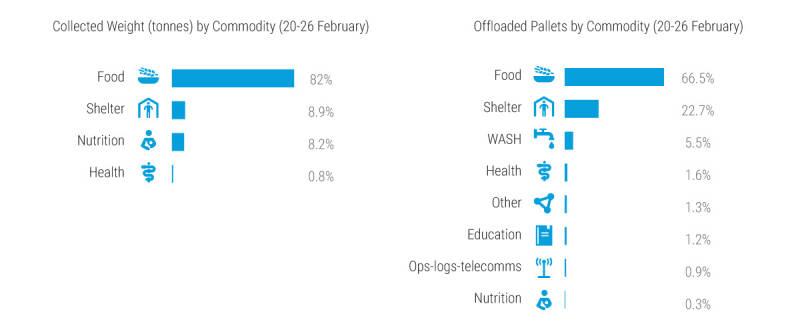
Between 20 and 26 February, based on data retrieved from the UN2720 Mechanism dashboard at 16:00 on 27 February, nearly 7,500 pallets of aid administered by the UN and partners were offloaded at Gaza’s crossings. About 66.5 per cent of these pallets contained food supplies, followed by shelter items (23 per cent), water, sanitation and hygiene (WASH) assistance (5.5 per cent), health items (2 per cent), as well as operations, logistics and telecommunication material, nutrition and other items (less than 3 per cent cumulatively).
During the same period, just above 7,200 pallets of aid were collected at Gaza’s crossing. About 82 per cent of these pallets contained food supplies, followed by shelter items (9 per cent), nutrition supplies (8 per cent), and health (less than one percent).
Overall, between the announcement of the ceasefire on 10 October 2025 and 26 February 2026, at least 309,428 pallets of humanitarian cargo were offloaded, and nearly 312,00 pallets were collected from the operating crossings. Some 1,532 pallets, less than one per cent of all collected aid, were intercepted during transit within Gaza.
The above data does not include bilateral donations and the commercial sector.
Between 20 and 26 February, the United Nations coordinated 55 humanitarian missions with the Israeli authorities inside Gaza. Of these, seven (13 per cent) were denied outright. Of the remaining missions, 32 (58 per cent) were facilitated, and 15 (27 per cent) were approved but faced impediments, including long delays. Of these, 11 missions were eventually fully accomplished, two only partially and another two failed. One mission was also cancelled by the organizers.
UN and international NGO trucks manifested through the Egypt Corridor continued to face low offload rates during the reporting period. Overall, between 18 and 24 February, out of 244 trucks manifested by the Logistics Cluster, only 72 -- 30 per cent -- offloaded at Kerem Shalom. Since the start of the month, only 34 per cent of all 1,098 trucks manifested by the Logistics Cluster through the Egypt Corridor have been offloaded.
HUMANITARIAN RESPONSE
Food Security
- As of 23 February, Food Security Sector (FSS) partners had reached approximately 200,000 families (about one million people) with household-level general food assistance as part of the monthly distribution cycle. Since 5 February, ration sizes have been covering half of the minimum caloric needs.
- As of 21 February, almost 1.73 million meals continued to be prepared and delivered daily by partners through 182 kitchens across Gaza - 565,000 meals through 54 kitchens in the northern governorates and 1.164 million meals through 128 kitchens in southern and central Gaza. Since the start of Ramadan, partners have adjusted cooked meal preparation and distribution timings to align with fasting hours. Partners also continue to enhance meal quality with additional fresh produce and/or protein products.
- As of 25 February, approximately 160,000 two-kilogram (kg) bread bundles were produced daily through 19 UN-supported bakeries. One third of this bread is distributed for free, along with cooked meals, to more than 400 shelters and community sites, while two thirds are sold through 143 retailers at a subsidized price of 3 NIS ($0.95) per bundle.
- If the current humanitarian aid truck offloading rates through the Egypt corridor continue to be low, the daily production of nearly one million meals, representing 55 per cent of all meals produced by humanitarian partners, as well as 300,000 loaves of bread, including the 13,000 meals and 32,000 loaves of bread delivered each day to health facilities across the Strip, is at risk of coming to a pause by early March. Humanitarian partners are working hard to bring in additional supplies during the last week of February to prevent any shutdown. For the March general food distribution cycle, partners may not have sufficient stock to sustain even the half-rations distributed since 5 February throughout the month.
Health
- As of 23 February, 260 of 619 health service points were functioning across the Gaza Strip, 90 per cent of them only partially. These include 19 out of 37 hospitals, 12 field hospitals, 106 primary health care centers, and 123 medical points. Geographically, the largest concentration of services is in Deir al Balah (91), followed by Khan Younis (77), Gaza governorate (79) and North Gaza (7). Additionally, 22 ambulance centers are partially functioning with 10 in Deir al Balah, nine in Khan Younis, two in Gaza city, and one in Rafah.
- All hospitals in Gaza remain fully dependent on emergency back-up generators. Dual-use restrictions continue to delay entry of generators/spare parts, uninterruptible power supply systems, transformers and critical electrical components, impacting Intensive Care Unit, dialysis, operating theatre and laboratory functionality.
- Between 18 and 24 February, seven medical evacuation missions were conducted, enabling 123 patients, along with 201 companions, to leave Gaza to receive urgent medical treatment unavailable in the Strip. Of all patients, 72 were trauma cases, 26 were affected by ophthalmological disorders, three had cancer, nine had cardiovascular diseases, and the remainder were orthopedic, gastrointestinal, neurological, urological, congenital, and transplant cases. A total of 94 patients were evacuated to Egypt through the Rafah Crossing, while another 29 reached Jordan through the Kerem Shalom Crossing. Men represented 71 per cent of all evacuees, followed by children (32 per cent) and women (29 per cent).
- Since the ceasefire in October 2025 and up to 16 February 2026, an additional 853 people have reportedly acquired new disabilities. This includes 496 new amputations, 186 spinal cord injuries, and 171 traumatic brain injuries. Despite rising needs, assistive products, including prosthetics, continue to be classified by the Israeli authorities as “dual-use” items, which severely restricts their entry into the Gaza Strip. During this period, only 300 artificial limbs were allowed to enter Gaza under the Health Cluster framework, while the cumulative number of amputations since October 2023 now exceeds 5,000, in addition to the 496 new amputations recorded since the ceasefire.
Water, Sanitation and Hygiene
- Drinking water availability in Gaza city remains severely restricted and well below WASH emergency standards of 6 litres per person per day for thousands of vulnerable families. The principal water supply line, Mekorot north, has been damaged since middle of January, though several repair interventions have taken place, by both Palestinian and Mekorot contractors, there are still issues and currently the control valve is turned off. The next largest fresh water supply for Gaza city, the Safa well field, remains non-operational and WASH actors are requesting access to repair. In the meantime, WASH agencies have increased water trucking from private desalination sources and increased production from groundwater wells, but this does still not meet the needs.
- The relocation of waste from Firas Market in Gaza city to the newly identified temporary dump site in Abu Jarad has resumed after a four-day suspension last week due to security concerns. As of 23 February, approximately 2,500 cubic metres of solid waste had been removed to this temporary dumping site. In addition, the new solid waste generated daily in Gaza city and North Gaza governorates is now being transferred directly to Abu Jarad to prevent further accumulation at Firas Market.
- Between 19 and 24 February, WASH partners distributed 20,000 bars of soap, 11,280 jerrycans, 30,000 bars of soap, 3,850 hygiene kits, and 500 handwashing stations to approximately 3,500 households across the Gaza Strip.
Shelter
- Between 18 and 24 February, Shelter Cluster partners reached 8,836 households with shelter assistance through in-kind and voucher-based modalities. In-kind distributions included 105 tents, 2,439 tarpaulins, 3,905 sealing-off kits, 1,995 bedding kits (each comprising four mattresses, four blankets, six mats and six pillows), 2,000 bedding items, 457 kitchen sets and 1,052 clothing kits and vouchers.
- Some partners reported receiving limited new stock last week, including 31,700 tarpaulins, 16,375 bedding items, and 850 sealing-off kits; however, these quantities remain far below the overall level of need.
- Rejections of timber and plywood sheets continue to hinder the scale‑up of the shelter response and are limiting progress toward transitional and more durable solutions.
Site Management
- Over the past two weeks, Site Management Cluster partners continued the rapid displacement site review that started on 3 February, surveying a total of 900 sites or, 95 per cent of all active ones, to acquire a more in-depth understanding of living conditions and critical sectoral gaps. Findings show:
- Approximately 539 sites (57 per cent) have drainage channels or water paths, while about 606 sites (64 percent) report rainwater accumulation.
- Fire risk remains acute, with 57 per cent of the displaced people living in sites where visible fire hazards are present.
- Shelter conditions are also concerning, with an estimated 2,927 people sleeping outdoors without any form of shelter across roughly 209 sites (22 per cent of those assessed). The sweep highlights critical service shortfalls affecting daily living conditions and dignity.
- In about 199 sites (21 per cent), fewer than half of residents had sufficient drinking water in the last 30 days, and in approximately 227 sites (24 per cent), fewer than half of households had adequate soap to meet basic hygiene needs.
- Access to safe and appropriate energy also remains limited: only 25 sites rely primarily on gas or diesel for cooking, whereas 39 sites primarily burn garbage or plastic, and five sites report no main power source at all, with most others dependent on firewood or agricultural residues.[1]
Protection
- General Protection
- Between 19 and 25 February, 14 partners reached nearly 18,000 people – children, caregivers, women, persons injured and with disabilities, frontline workers, and communities in displacement sites and shelters – with protection related services across Gaza. Mental Health and Psychosocial Support (MHPSS), including Psychological First Aid (PFA), individual and group counselling, and emotional decompression, reached about 9,850 people, while specialized case management and follow‑up reached almost 800 people. More than 130 other people received legal counselling and assistance, while more than 600 people benefitted from 24 protection awareness sessions, and 40 protection committees received capacity-building by cluster partners. During the reporting period, partners also distributed cash-for-protection assistance to 299 households and distributed 2,000 winter clothing kits.
- Protection monitoring was conducted in 24 different neighbourhoods, with 44 focus group discussions and 809 key informant interviews carried out with community members in accessible locations across all governorates. The Protection Cluster also conducted rapid field assessments in two displacement camps in Gaza city and Deir al Balah.
- Child Protection
- Between 19 and 25 February, Child Protection (CP) partners reached approximately 4,700 children and 2,500 caregivers with MHPSS interventions, individual and group psychological counselling, and psychological first aid for children experiencing acute distress.
- Within the above activities, 1,857 caregivers participated in structured parenting and psychosocial support sessions, and an additional 20 caregivers engaged in Teaching Recovery Techniques interventions alongside their children.
- Case management services reached at least 88 children, providing in‑depth assessments, follow‑up, referrals, and home visits for high‑risk cases. A further 150 children received physiotherapy, occupational therapy, speech therapy, medications, and assistive devices based on assessed needs.
- As part of the winter-response effort, 700 children in Khan Younis and Deir al Balah received blankets and clothing kits.
- Capacity‑strengthening efforts continued, with 160 case workers and psychologists completing a four‑day Child Protection Case Management training.
- Throughout the reporting period, CP partners also implemented Ramadan sports and play‑based psychosocial support activities in at least 17 locations across the Gaza Strip. These included football sessions and mini‑leagues, basketball and volleyball for girls, chess competitions, and traditional games. These sports activities were integrated with child protection messaging and psychosocial support, targeting children and adolescents in displacement sites and community spaces. Coordination for league‑style competitions and additional activities is ongoing, with further scale‑up planned throughout Ramadan.
- Addressing Gender-Based Violence (GBV)
- Between 19 and 25 February, partners addressing Gender-Based Violence (GBV) continued providing essential services to more than 18,000 people, primarily through Women and Girls’ Safe Spaces (WGSSs), safe shelters, and Designated Emergency Shelters. The number of WGSS increased from 59 to 68, with newly established locations in Gaza city, Deir al Balah, and Khan Younis. Overall, a total of 24 safe spaces are in Deir al Balah, 22 in Khan Younis, 20 in Gaza city and one in North Gaza and Rafah, respectively. Key services offered include group psychosocial support for women and girls, individual GBV case management with referrals, mental health care provided by psychiatrists, distribution of dignity kits and menstrual hygiene supplies, provision of winter items such as blankets, awareness-raising on GBV risks, and legal aid services.
- Partners are currently reviewing the WGSS guidelines to ensure they reflect the local context as well as global minimum standards for GBV prevention and response. In addition, partners are participating in a capacity‑needs assessment survey that will inform training sessions planned for the next quarter.
- During the reporting period, a GBV Officer participated in a mission to the Rafah Crossing to assess the needs of women and girls. Meanwhile, a GBV partner continued providing psychosocial support and referrals to returnees at the Nasser Hospital protection desk.
- Mine Action
- Between 18 and 24 February, partners conducted seven explosive hazard assessments (EHAs) in support of debris removal activities, including an assessment of a damaged mosque in Deir al Balah on 19 February. Of the assessed locations, only one site was categorized as low risk. UNMAS also carried out independent quality assurance (QA) visits to verify compliance with Standard Operating Procedures (SOPs) and ensure operational standards are consistently upheld, which is an essential component of Mine Action interventions.
- Explosive Ordnance Risk Education (EORE) sessions for civilians continued throughout the reporting period. UNMAS also delivered one EORE training session to eight UN personnel, strengthening their capacity to safely conduct humanitarian operations in high‑risk environments.
- No new explosive ordnance (EO) incidents were recorded during this reporting period. However, backdated data received since the start of the ceasefire indicates 34 EO-related incidents, resulting in 76 victims, including 18 children. Of these casualties, 67 were injured and nine were killed.
Multi-Purpose Cash Assistance (MPCA)
- Between 18 and 24 February, Cash Working Group partners distributed Multi‑Purpose Cash Assistance (MPCA) to more than 3,500 households across the Gaza Strip. Each household received 1,250 Israeli Shekels (US$378) through digital payment modalities in line with the agreed Minimum Expenditure Basket transfer value. In total, more than 165,000 households in Gaza have received at least one MPCA transfer in 2026.
- Market monitoring by the Gaza Market Monitoring Committee indicates continued, although uneven, improvements in commodity inflows. Food markets were generally supplied, and prices for several staple items showed signs of stabilization compared with earlier peaks. However, short‑term price fluctuations continue. The Gaza Consumer Price Index for February, measured up to 22 February, reached approximately 146 per cent of the pre‑October 2023 baseline, showing that overall prices remain significantly elevated despite recent moderation. Availability of non‑food and winter‑related items, such as shelter materials and heating supplies, remains limited and costly, particularly in northern areas.
- Household access to essential goods continues to be constrained primarily by reduced income and purchasing power rather than market availability. Cash‑out services remain functional, with commission fees fluctuating between 12 and 14 percent during the reporting period. Digital payments are the predominant transfer modality, supported by increasing vendor acceptance of e‑wallet transactions. The Cash Working Group continues to monitor financial access conditions closely.
Logistics
- The Logistics Cluster continues to facilitate aid collection and transport services from the platforms of the Kerem Shalom and Zikim crossings. The volume of aid at Gaza crossings has been declining. Over the past week, the Cluster supported partners with the collection and transport of 1,430 pallets from both crossings, representing a 30 per cent decrease compared to the previous reporting period.
- Between 18 and 24 February, Cluster common warehouses across Gaza received 1,414 pallets of aid for storage on behalf of four partners.
- Through Jordan, the Logistics Cluster continues with Back-to-Back (B2B) convoys via both the King Hussein-Allenby and Sheikh Hussein Bridge-Jordan River crossings. Between 18 and 24 February, the Cluster facilitated access to four B2B convoys for three partners with 80 trucks offloaded at Gaza crossings.
- Through Egypt, between 18 and 24 February, only 72 of 244 manifested trucks were offloaded (30 per cent). Return rates have remained high since the closure of Nitzana on 1 January, with recent figures showing persistently low levels of cargo being offloaded at the Gaza crossing.
Emergency Telecommunications
- Since 19 February, the Emergency Telecommunications Cluster (ETC) is deploying technical specialists to Jerusalem to reinforce the secure communications infrastructure supporting the humanitarian response. During the mission, the team has also met with partners to advance planned technical upgrades and ensure alignment with UN telecommunications and information security standards.
- In parallel, the ETC is facilitating pre‑clearance, installation, and deployment of a data‑connectivity solution aimed at providing reliable, shared internet services for humanitarian responders operating in Gaza.
* All figures solely refer to UN and partner assistance dispatched through the UN-coordinated system and are preliminary. Supplies entering through bilateral donations and the commercial sector are not reflected.
[1]Figures should be treated as indicative estimates of conditions across the sites assessed to date, rather than finalized results.
2110.
28 februari 2026
Statement by the Humanitarian Country Team of the Occupied Palestinian Territory*
East Jerusalem, 28 February 2026
The United Nations and humanitarian partners take note of the temporary injunction issued yesterday by the Israeli High Court of Justice, which prohibits any alteration of the existing situation concerning the registration status of several international non-governmental organizations operating in the Occupied Palestinian Territory and prevents any action to register rights, until further notice.
These humanitarian organizations, in close coordination with UN agencies and national partners, provide a wide range of essential services - food, water, medical care, shelter, nutrition, education, and protection - particularly in the Gaza Strip, where needs persist at critical levels. Enabling INGOs to continue their operations is essential to reaching the most vulnerable groups, particularly women, children, persons with disabilities, and displaced communities.
Once again, we urge the Government of Israel to lift restrictions that impede humanitarian operations. We also call on the international community to support efforts aimed at ensuring the continuity of principled humanitarian assistance in accordance with international humanitarian law.
*The Humanitarian Country Team is a strategic decision-making forum led by the Humanitarian Coordinator for the Occupied Palestinian Territory. It brings together heads of UN entities and over 200 NGOs – both international and local – all working on humanitarian affairs in the West Bank and the Gaza Strip under internationally agreed humanitarian principles.
For media enquiries, please contact Ilona Gaudin, at +972 54 33 11 835 or gaudin2@un.org
2109.

27 februari 2026
We did it again.
By now, you have seen that we have defeated the fifth lawsuit against us after years of attacks meant to exhaust us and silence our work for justice through vexatious and malicious lawsuits.
They tried to weaponize the courts to chill constitutionally protected speech. They tried to drain our resources. They tried to make an example out of us simply because we dared to stand up for Palestinian rights and speak to their suffering.
But we did not back down.
We kept showing up, prepared, principled, and unshaken. And by the will of Allah, we continue to prevail in the courts.
Make a Zakah-eligible donation to help protect our work
Here is the truth. These attacks happen because our voices are making an impact.
Every victory protects more than AMP. It protects the right of every student, organizer, community leader, and person of conscience to speak for Palestine and to speak for justice without fear.
But while justice prevails in the courtroom, these attacks are intended to distract us, drain our resources, intimidate us, and deter us from continuing our work for justice in Palestine and everywhere. They know we are achieving historic gains and that the momentum has turned against their oppression, so they target the messenger in the hope of weakening the message itself. They aim to cripple our efforts to continue raising awareness, organizing, and engaging in effective advocacy. They are delusional. They are wrong.
We will not be afraid. We will not retreat. And we will not surrender the field to them. Instead, we will redouble our efforts—certain of Allah’s support and confident that the future belongs to us, and to justice in Palestine and beyond.
2108.

27 februari 2026
De eerste week van het nieuwe kabinet zit er op, maar er is weinig veranderd. Waar de politiek het laat afweten zal de samenleving voor verandering moeten zorgen.
Geen erkenning van Palestina, geen wapenembargo, geen diplomatieke maatregelen, geen economische sancties. Zodra het pluche lonkte en de rode loper uitging, vergat Rob Jetten de rode lijn. Ook de nieuwe Nederlandse regering respecteert de Palestijnse rechten niet.
De Palestijnen en hun medestanders blijven op zichzelf aangewezen. En precies daarom is BDS noodzakelijker dan ooit. Politieke druk is belangrijk, massale demonstraties zijn belangrijk, maar bieden geen garanties. Rechtstreekse actie heeft rechtstreekse invloed en kan Palestijnse levens redden die mede door de voortdurende Nederlandse steun aan Israël in gevaar zijn.
Kleine handelingen zoals het laten liggen van een pak bloeddadels in het supermarktschap, het wisselen van bank of gewoon niet boeken bij Booking kunnen grote impact hebben. Maar daar houdt het niet op.
Acties tegen pensioenfondsen en lokale overheden die samenwerken met Israëlische bedrijven of investeren in bezetting, apartheid en genocide. Het zijn handelingen die minder tijd en moeite kosten dan een middag samenkomen op het Malieveld of het Museumplein. Mits goed gecoördineerd en doordacht, kunnen deze vele praktische acties resultaten opleveren die het Israëlische regime onder druk zetten. En de felheid waarmee lobbyisten voor de belangen van het Israëlische regime op BDS reageren alleen al toont aan dat BDS werkt.
BDS Nederland steunt de Palestijnse zaak concreet en direct vanuit de Nederlandse samenleving. De internationale BDS beweging is een Palestijns initiatief met internationale impact. BDS Nederland informeert, coördineert en initieert de acties die onze regering nalaat.
Red Palestina, boycot Israel, steun BDS.
Het Europees burgerinitiatief voor volledige opschorting van de associatieovereenkomst tussen de EU en Israël is bijna op de helft van het benodigde aantal handtekeningen.
Nog niet getekend? Doe het nu via deze link.
Tijdens het eerste debat van het nieuwe kabinet vormden vertegenwoordigers van onder andere BDS Nederland, PAX, The Rights Forum, Oxfam Novib, Save the Children en Een Ander Joods Geluid een Rode Lijn op de publieke tribune.
Wij zullen Rob Jetten aan zijn beloftes helpen herinneren, en blijven ons onvermoeibaar inzetten totdat Nederland ervoor kiest om aan de juiste kant van de geschiedenis te staan.
2107.

27 februari 2026
Deze week debatteerde de Tweede Kamer over de regeringsverklaring van het gloednieuwe Kabinet-Jetten. Tijdens het debat werd pijnlijk duidelijk dat de nieuwe regering ten aanzien van Palestina enkele mini-stapjes zet, maar ver onder de maat blijft.
Mini-stapjes
Het herstellen van de relatie met UNRWA en het weer vrijmaken van budget daarvoor zijn nodig en welkom. Juist nu honger, ziekte en ontwrichting dagelijks levens kosten in Gaza. Ook heeft de coalitie het over het einde van ‘(de uitbreiding van) illegale nederzettingen’, het beëindigen van het belemmeren van noodhulp en het in stand houden van nationale en Europese sancties ‘jegens (leden van) de regering-Netanyahu’.
Dat klinkt allemaal principieel, maar de praktijk die in het debat zichtbaar werd is er vooral een van compromissen: net genoeg om te kunnen zeggen dat de coalitie ‘iets’ doet, maar veel te weinig om de druk op te bouwen die de misdaden doet stoppen.
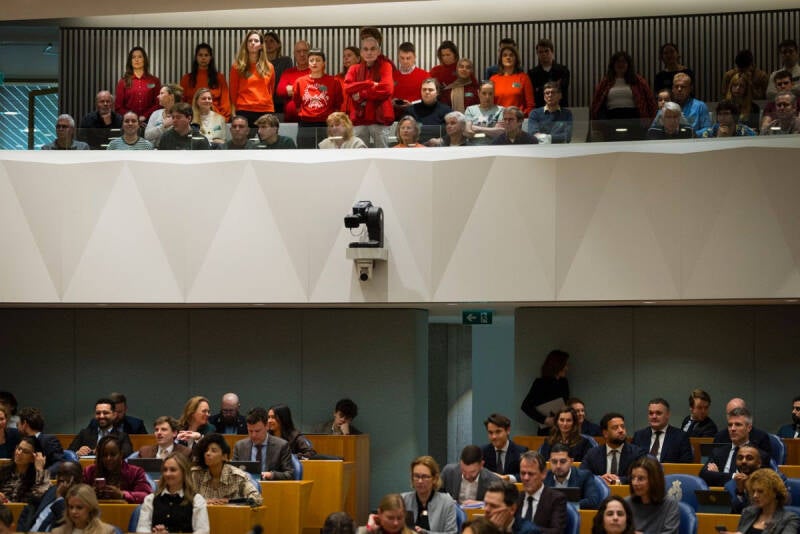
Samen met onze partners vormden wij tijdens het debat een Rode Lijn op de publieke tribune. Zo lieten we aan de start van de nieuwe kabinetsperiode zien dat wij het Palestinabeleid van deze regering nauwgezet zullen blijven volgen.
Geen échte maatregelen
De VVD en het CDA trappen namelijk stevig op de rem. Er komt geen erkenning van Palestina, geen volledig wapenembargo, geen einde aan militaire samenwerking en geen echte, stevige sancties tegen de verantwoordelijken voor de genocide. Ook blijft Nederland de handel met illegale nederzettingen gedogen en de economische relatie met Israël stimuleren.
Morele ondergrens
Al met al belooft dit kabinet meer dan de vorige kabinetten. Dat kon ook moeilijk anders: de werkelijkheid heeft de oude praatlijnen ingehaald. De vraag is of het kabinet nu eindelijk kiest voor rechtvaardigheid, of opnieuw voor pappen-en-nathouden, met VVD en CDA op de rem en D66 dat ‘het maximaal haalbare’ verkoopt als moreel succes.
Broodkruimels zijn niet genoeg voor een bevolking die doelbewust wordt uitgehongerd. En ‘foei zeggen’ helpt niet tegen een regime dat zich al decennia schuldig maakt aan oorlogsmisdaden en misdaden tegen de menselijkheid. Op dit dossier bestaat geen middenweg. Wie met compromissen reageert op onrecht, kiest in de praktijk de kant van het onrecht.
Kabinet-Jetten: kies vóór rechtvaardigheid, tégen medeplichtigheid
Eerder deze week schreven wij, nog vóór de debatten en op basis van de regeringsverklaring, al een uitgebreid advies aan het nieuwe kabinet. Dat moet 'radicaal breken met decennia van medeplichtig beleid en dubbele maatstaven', en daarmee gehoor geven aan waar een meerderheid van de Nederlandse bevolking om vraagt: rechtvaardigheid voor de Palestijnen.
Israël wil doodstraf invoeren, maar alleen voor Palestijnen
Israël is op weg om twee wetten in te voeren die de doodstraf mogelijk maken voor Palestijnen. Daarmee breidt het land het apartheidssysteem uit dat op allerlei manieren onderscheid maakt tussen Palestijnen en Israëliërs.
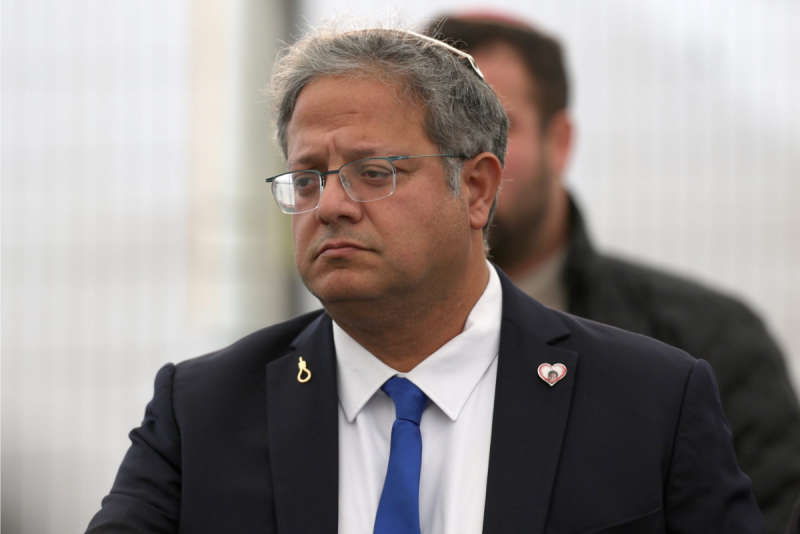
De Israëlische minister Itamar Ben-Gvir draagt een speldje van een strop op zijn revers. Hij geldt als drijvende kracht achter de invoering van de doodstraf voor Palestijnen. © EPA via ANP / Atef Safadi
De eerste wet moet gaan gelden op de bezette Westoever, waar militaire gelegenheidsrechtbanken de plicht krijgen om op grond van het militair recht de doodstraf op te leggen voor ‘terroristische daden die de dood van een persoon veroorzaken, ook als dat niet de bedoeling was’. Wat ‘terroristische daden’ zijn, wordt niet gedefinieerd.
De tweede wet moet gaan gelden in Israël en bezet Oost-Jeruzalem, en verplicht de doodstraf voor het ‘opzettelijk doden van Israëlische burgers of inwoners’. Rechters zouden zo dus geen andere keus hebben dan bij bepaalde misdrijven de doodstraf op te leggen. Een pardon wordt ook uitgesloten, net als omzetting van de doodstraf in een andere straf.
Apartheidssysteem uitgebreid
‘Als deze wetsvoorstellen worden aangenomen, zullen zij Israëls wrede apartheidssysteem tegen alle Palestijnen van wie Israël de rechten controleert, verder verankeren’, schreef Amnesty International deze maand in een uitgebreide analyse. De mensenrechtenorganisatie roept Israël met klem op de discriminerende wetten te laten vallen.
Interviews | Dr. Naledi Pandor & professor Noura Erakat
Met veel trots delen wij de opnames van twee bijzondere interviews, afgenomen door Berber van der Woude, bestuursvoorzitter van The Rights Forum. Zij sprak met Naledi Pandor en Noura Erakat, die in Nederland waren vanwege de Dries van Agt-lezing.
Naledi Pandor gaat in op de beslissing van Zuid-Afrika om een genocidezaak tegen Israël aan te spannen bij het Internationaal Gerechtshof. Zij legt uit hoe de strijd tegen apartheid, het Freedom Charter en de blijvende inzet van Zuid-Afrika voor mensenrechten aan deze keuze ten grondslag liggen
Noura Erakat laat zien dat rechtvaardigheid niet alleen via de rechtszaal tot stand komt. Op basis van antikoloniale strijd wereldwijd betoogt zij dat wetgeving pas echt verschil maakt wanneer die wordt gedragen door georganiseerde volksmacht, en dat momenten van massale mobilisatie nieuwe politieke en juridische mogelijkheden kunnen creëren – ook bij internationale gerechtshoven.
Aantal Palestijnse doden in Gaza ver boven 100.000
Met duizenden Palestijnen nog onder het puin of door bommen tot stof gereduceerd, en anderen onherkenbaar verminkt of in verregaande staat van ontbinding, is het een hels karwei om de werkelijke tol van Israëls genocide in Gaza te bepalen. Een karwei dat ook nog eens onder vrijwel onmogelijke omstandigheden moet worden geklaard.
Het officiële door het ministerie van Gezondheid in Gaza gerapporteerde aantal doden bedraagt ruim 72.000. Iedereen is het er echter over eens dat het werkelijke aantal veel hoger ligt. Maar hoe hoog?
Nieuw onderzoek wijst uit dat het aantal ‘directe’ Palestijnse doden anderhalf maal hoger ligt dan het officiële cijfer, op ruim 100.000. Het totaal aantal doden zal zelfs nog verder oplopen.
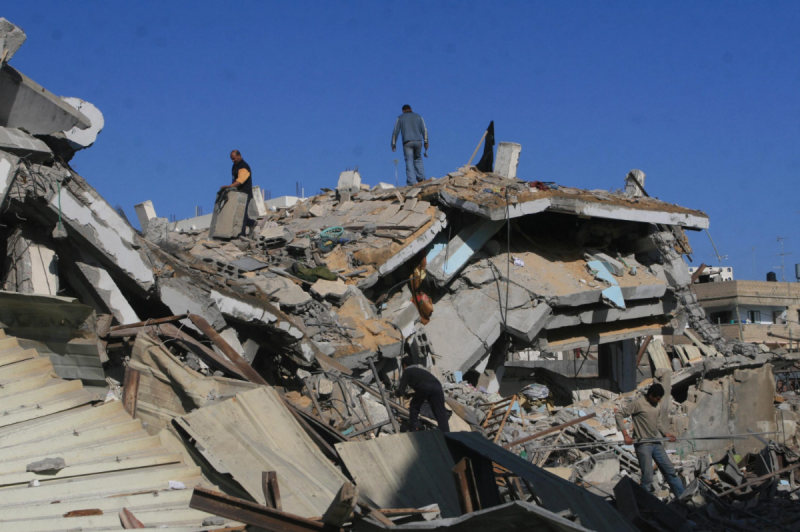
Het zoeken naar lichamen tussen de ruïnes van Gaza is een schier onmogelijke opgave. © ArabianEye via Alamy / Khaled Hasan
Amerikaanse ambassadeur flirt met een Groot-Israël van de Nijl tot de Eufraat
In een veelbesproken interview liet de Amerikaanse ambassadeur in Israël, Mike Huckabee, zich opvallend expliciet uit over wat hij ziet als het bijbelse 'land van Israël' — dat zich volgens hem uitstrekt van de Nijl tot de Eufraat. Hij stelde dat het 'prima zou zijn' als Israël dit volledige gebied in handen zou krijgen. Een uitspraak die raakt aan religieus-ideologische overtuigingen én met explosieve geopolitieke implicaties.
In een artikel op onze website plaatsen wij de uitspraken van Huckabee in de context van het christenzionisme, de historische betekenis van het idee van een ‘Groot-Israël’ en de mogelijke gevolgen voor het Amerikaanse beleid en de regio. Wat betekenen zulke woorden uit de mond van een diplomaat — en waarom zorgen ze voor zoveel onrust?
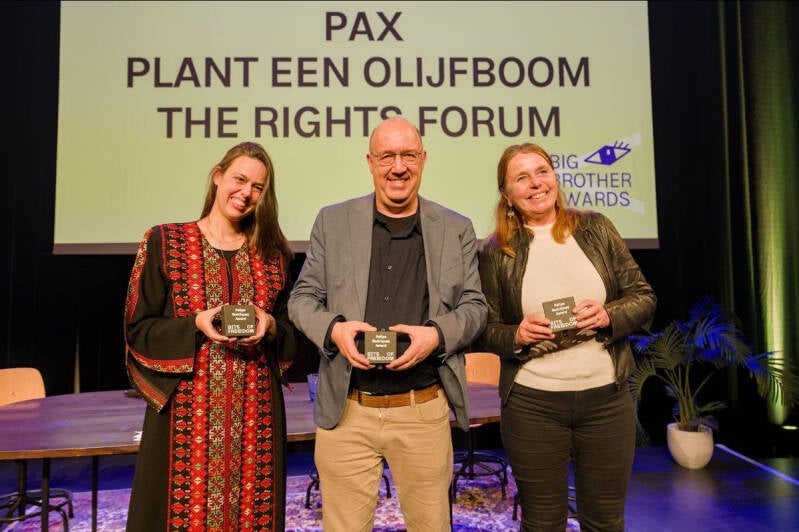
The Rights Forum, PAX en Plant een Olijfboom krijgen prijs voor campagne
Digitale privacy-waakhond Bits of Freedom heeft de jaarlijkse Felipe Rodriquez Award uitgereikt aan The Rights Forum, PAX en Plant een Olijfboom vanwege hun werk om het wetsvoorstel voor het strafbaar stellen van ‘verheerlijking van terrorisme’ onder de aandacht van het publiek te brengen.
Dit wetsvoorstel werd afgelopen zomer besproken door het demissionair kabinet-Schoof en ligt op het moment ter beoordeling bij de Raad van State. In een uitgebreide analyse verschafte The Rights Forum inzicht in de problemen en gevaren van het wetsvoorstel.
De wet is vaag en kan gebruikt worden om vormen van vreedzaam verzet, zoals demonstreren tegen genocide in Gaza, te criminaliseren. Zo zou zelfs het dragen van een watermeloen-symbool in solidariteit met Palestijnen onder de wet strafbaar kunnen worden.
The Rights Forum bracht via de website, nieuwsbrief en sociale media de internetconsultatie over het wetsvoorstel onder de aandacht. In totaal hebben 11560 mensen op de internetconsultatie gereageerd.
Bits of Freedom prijst de winnende organisaties voor het creëren van ‘bewustwording over de gevaren van dit wetsvoorstel voor individuen en onze maatschappij’ en noemt hun bijdrage ‘inspirerend en belangrijk’.
Uit onze agenda
zaterdag 28 februari t/m zaterdag 7 maart
DEMONSTRATIES EN WAKES
UTRECHT DOORDEWEEKSE DAGEN 08.30 - 09.30 | Dagelijks stilteprotest voor Palestina, tegen genocide en bezetting (Neude, langs het fietspad)
GRONINGEN ZA 28 FEB 13.00 | Tweewekelijkse wake van Vrouwen in het Zwart (Waagplein)
NIJMEGEN ZA 28 FEB 14.00 | Maandelijkse wake van Mensen in het Zwart (Koningsplein - Marienburg)
ENSCHEDE ZA 28 FEB 14.00 | Wekelijkse lawaaidemonstratie (Station Enschede)
HAARLEM ZO 1 MAA 14.00 | Maandelijks wake van Vrouwen in het Zwart (Grote Markt)
ALKMAAR MA 2 MAA 11.45 | Stil protest, voorafgegaan door het lied over Hind Rajab van Pieter Derks (bij het beeld van Truus Wijsmuller)
HUIZEN WO 4 MAA 11.30 | Wekelijkse sit-in voor Gaza (Gemeentehuis)
DEN HAAG DO 5 MAA 12.00 | Sit-in van Rijksambtenaren bij het ministerie van Buitenlandse Zaken, Rijnstraat 8
STATIONS IN NEDERLAND DO 5 MAA 18.00 | Wekelijkse lawaaidemonstratie op stations in heel Nederland: Stations Alkmaar (17.30 uur), Amersfoort, Arnhem, Assen, Dordrecht, Driebergen-Zeist, Ede-Wageningen, Groningen (mars vanaf Grote Markt 17.30 uur, sit-in station 18.30 uur), Hilversum (17.30 uur), Leiden, Nijmegen, Tiel, Tilburg, Zaandam (17.00 uur), Zutphen
Let op: The Rights Forum probeert de verschillende stationsacties in Nederland zo goed mogelijk bij te houden, maar dat is niet altijd goed mogelijk. Houd de sociale media-pagina's van de plaatselijke solidariteitsorganisaties in de gaten voor de meest actuele informatie.
AMSTERDAM VRI 6 MAA 12.45 | Maandelijkse wake van Mensen in het Zwart (Spui)
AMERSFOORT VRI 6 MAA 09.30 | Wekelijks stilteprotest tegen genocide (Varkensmarkt)
MAASTRICHT ZA 7 MAA 12.45 | Maandelijkse wake van Mensen in het Zwart (Markt, bij het standbeeld van J.P. Minckelers)
ENSCHEDE ZA 7 MAA 14.00 | Wekelijkse lawaaidemonstratie (Station Enschede)
CULTURELE EN ANDERE EVENEMENTEN
UTRECHT ZA 28 FEB 20.00 | Olga Vocal ensemble – FRAGMENTS – Echos of a Father, met poëzie van Maureen Ghazal (Pieterskerk, Pieterskerkhof 3)
ALKMAAR ZO 1 MAA 15.00 | Muziek voor Gaza: een concert op elke eerste zondag van de maand, de opbrengsten gaan naar de kinderen in Gaza. Met deze keer muziek van Murat Mestan - Turkse Saz, Perzische Setar, zang. Toegang: € 25 + vrijwillige donatie, reserveren kan door een mail te sturen naar heiligland@protonmail.com (Heiligland 7)
RUINERWOLD ZO 1 MAA 15.30 | Olga Vocal ensemble – FRAGMENTS – Echos of a Father, met poëzie van Maureen Ghazal (NH Kerk op Blijdenstein)
UTRECHT ZO 1 MAA 15.30 | Palestine Café Utrecht, een ontmoetingsplek om de solidariteit met Palestina in Utrecht te versterken (Moira Expo, Wolvenstraat 10)
CULEMBORG ZO 1 MAA 14.00 | Culemborg voor Gaza organiseert een wandeling en Gaza Café met deze keer aandacht voor Kunst uit Gaza. Wandeling start om 14 uur, Gaza Café om 16 uur (Kattenstraat 12)
AMSTERDAM DI 3 MAA 17.30 | Lezing 'Against Exclusion: Palestinian Citizens in Israel and the Struggle for a Shared Moral and Political Future’ (Aula der Universiteit van Amsterdam, Singel 4110)
UTRECHT DO 5 MAA 19.30 | Lezing en boekpresentatie: Gaza, een geschiedenis van Jan-Auwke Diepenhorst (Gebouw Volksuniversiteit, Nieuwegracht 41)
Onze agenda wordt doorlopend aangevuld. Bekijk de hele agenda
2106.
26 februari 2026
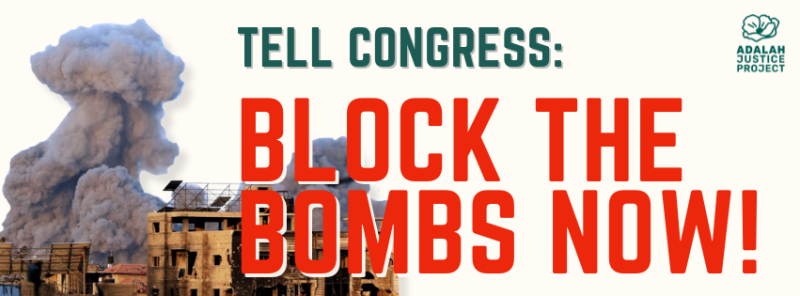
Right now, Zionist lobby groups are attempting to stall the Block the Bombs Act, the only bill in Congress that would proactively stop the flow of weapons to Israel as it commits genocide against the Palestinian people. We must not let them.
Take 3 minutes now to call your Representative in Congress and ask them to support the Block the Bombs Act. Every call is counted.
This week, a new bill titled the “Ceasefire Compliance Act of 2026” was introduced into the House by Rep. Sean Casten. Instead of ending weapons deliveries to Israel, the new bill would keep the bombs flowing and only impose certain restrictions on weapons AFTER they are already delivered to Israel and deployed against Palestinians—and even that limited step would only take place if the Trump administration certifies that Israel is failing to meet certain conditions.
The new bill also contains a national security waiver, providing the Trump administration with the authority to continue delivering weapons to Israel even if it finds that Israel continues to bomb Gaza, continues to block humanitarian aid to Palestinians in Gaza, or takes additional steps towards annexation of the West Bank.
To be clear: Casten’s bill does nothing to actually stop Israel’s attacks against Palestinians, and undercuts the only legislation currently moving in Congress that would hold Israel accountable and block weapons deliveries.
We don’t need new reporting requirements or certifications as proposed by Casten’s bill. Israel is already in blatant violation of existing U.S. laws which mandate that weapons be cut off.
Tell your Representatives to support the Block the Bombs Act
Since its introduction, more than 60 Members of Congress have signed onto the Block the Bombs Act in support of stopping weapons to Israel. Momentum to end U.S. complicity in the genocide in Gaza has grown exponentially. We cannot allow them to derail our progress.
We know that Israel will use more weapons to kill more Palestinians and reduce more neighborhoods to rubble. Anything less than stopping the flow of U.S. weapons to Israel is not enough.
Casten’s bill gives the Trump administration full discretion over all future weapons deliveries to Israel, and embraces Trump’s corporate takeover of Gaza that undermines any real possibility of freedom and self-determination for Palestinians.
Members of Congress must reject any legislation that allows Israel to continue its violence against Palestinians. Block the Bombs is the only bill in Congress right now that will actually stop weapons to Israel. There is no substitute.
Call Congress now
In solidarity,
Alia E.
Adalah Justice Project
2105.

26 februari 2026
The reality in Gaza.
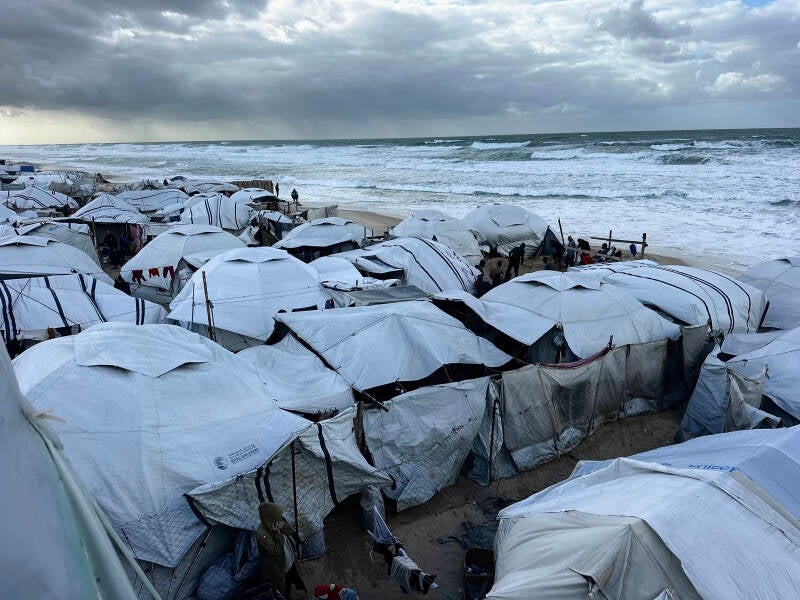
The reality for millions of Palestinians in Gaza is one of decimated homes and unlivable conditions, trapped between a militarized border and open gunfire. Despite the so-called “ceasefire” and during the holy month of Ramadan, the Israeli military is forcing Palestinians to remain in limbo, unable to rebuild or return to their homes or secure medical treatment for the sick and wounded.
The bombs and bullets haven’t stopped, either. The Israeli military has created a zone of death around the “yellow line,” its partitioning of Gaza, shooting anyone who crosses it and continuing airstrikes on tents and shelters inside of the supposed “safe zone.”
And still, the Israeli state is restricting thousands of people in dire need of medical evacuation from leaving Gaza. Israel claimed it reopened the Rafah crossing, a critical entry to Gaza, weeks ago — but out of the 22,000 people on the medical evacuation list, only around two hundred have been allowed to leave…
Tell Congress: Free Leqaa from ICE detention!
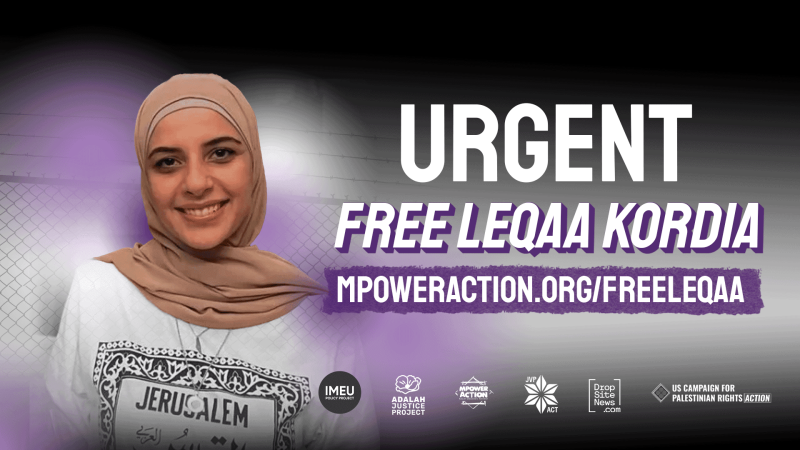
Palestinian Columbia University student Leqaa Kordia has been held in horrible conditions in ICE detention for 11 months, most recently having to be hospitalized following a seizure. She has never been charged with anything — but is being punished for speaking against Israel’s genocide against her family in Gaza.
Use this tool from our partners to email your members of Congress now and demand they call for Leqaa’s immediate release.
From Minneapolis to Gaza, Purge Palantir!
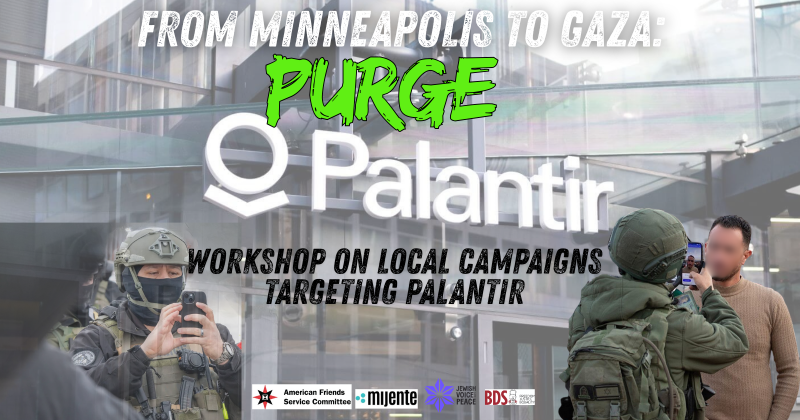
Palantir, the tech giant which powers ICE surveillance and kidnappings as well as the Israeli military’s genocide, has been expanding its contracts in communities across the US.
Join JVP and our partners on March 5 for a workshop to learn more about local divestment and boycott campaigns targeting Palantir contracts across the country.
Tell Congress: Call it a genocide.
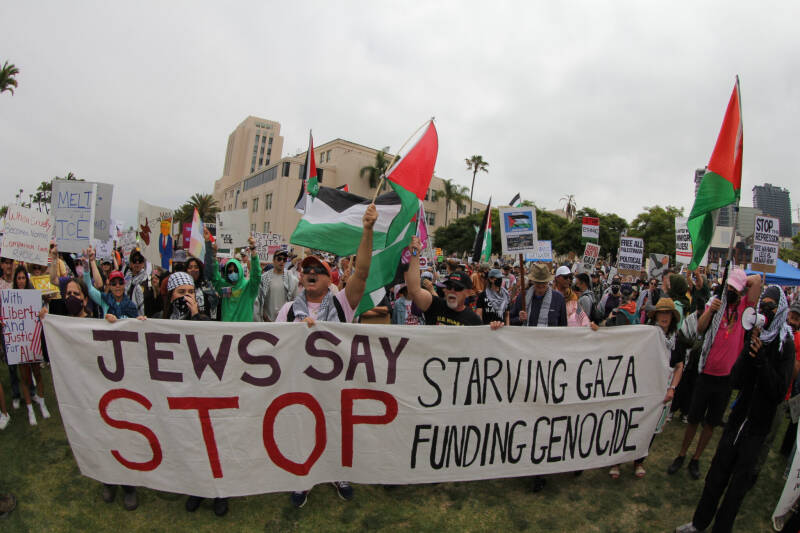
During the supposed ceasefire, the Israeli military has continued to kill Palestinians in Gaza and the occupied West Bank.
Use this tool from JVP Action to email Congress now and demand they support Congresswoman Rashida Tlaib's legislation to recognize Israel’s genocide in Gaza, end U.S. complicity in these atrocities, and demand accountability.
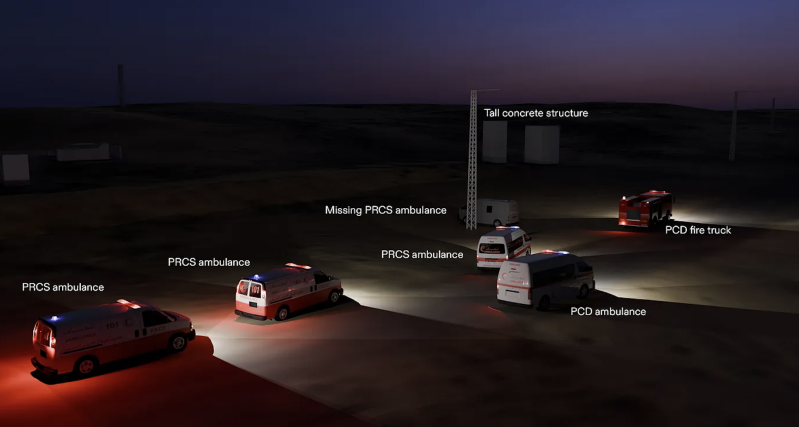
In March 2025, Israeli soldiers massacred 15 Palestinian medical aid workers and first responders, firing nearly 1,000 bullets at the rescue workers and executing multiple workers at point-blank range.
A new investigation by Earshot and Forensic Architecture, reported in Drop Site, breaks down the horrific massacre minute-by-minute.
2104.
26 februari 2026
Yesterday, Rep. Sean Casten (D-IL-06) introduced the “Ceasefire Compliance Act,” a harmful bill that provides cover for the Trump administration and Congress to continue sending weapons to arm the Israeli military in violation of U.S. and international law.1
Let me be blunt: this is a bad bill meant to undermine the Block the Bombs Act (H.R. 3565) led by Rep. Delia Ramirez.
Rep. Casten represents one of the largest Palestinian constituencies in the nation. He has voted to send about $18 billion in U.S. tax dollars to Israel to commit genocide against the Palestinian people. 2
Today, I’m asking you: Please tell your representative to condemn Rep. Casten’s bill and instead cosponsor the Block the Bombs Act, legislation that can actually end U.S. military funding for Israel’s genocide against the Palestinian people.
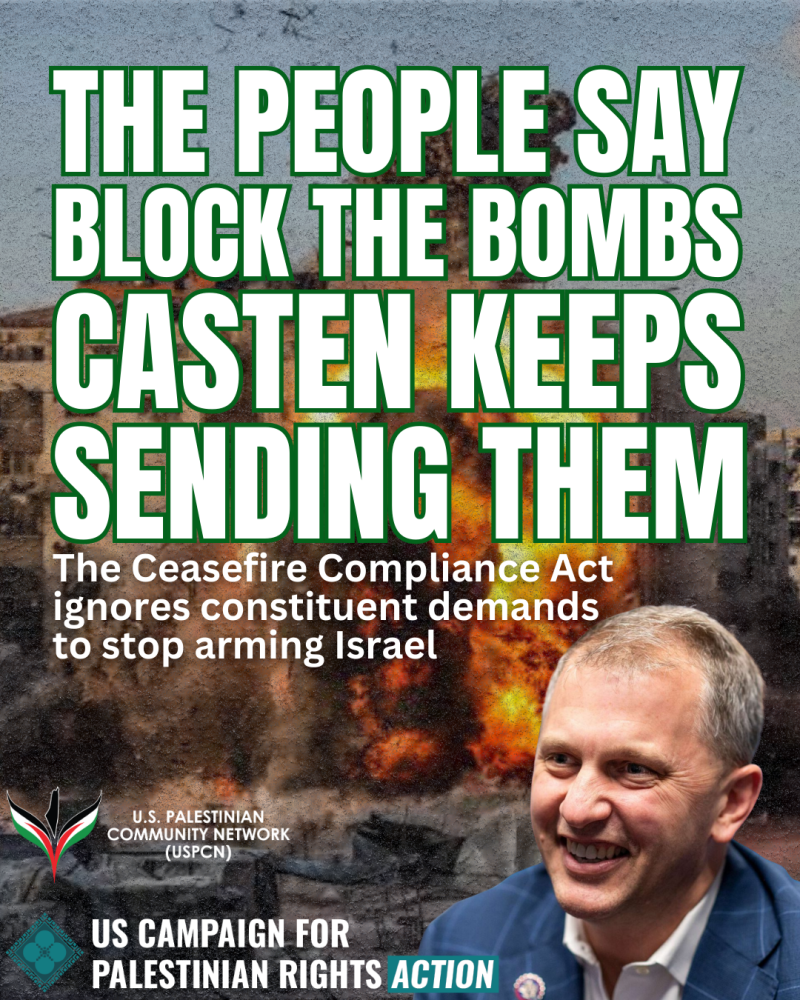
TELL YOUR REP: BLOCK THE BOMBS
For years, Rep. Casten’s constituents have continuously demanded that he stop arming Israel and sign on to the Block the Bombs Act, which has already been cosponsored by 63 of his colleagues and endorsed by the Congressional Progressive Caucus.3
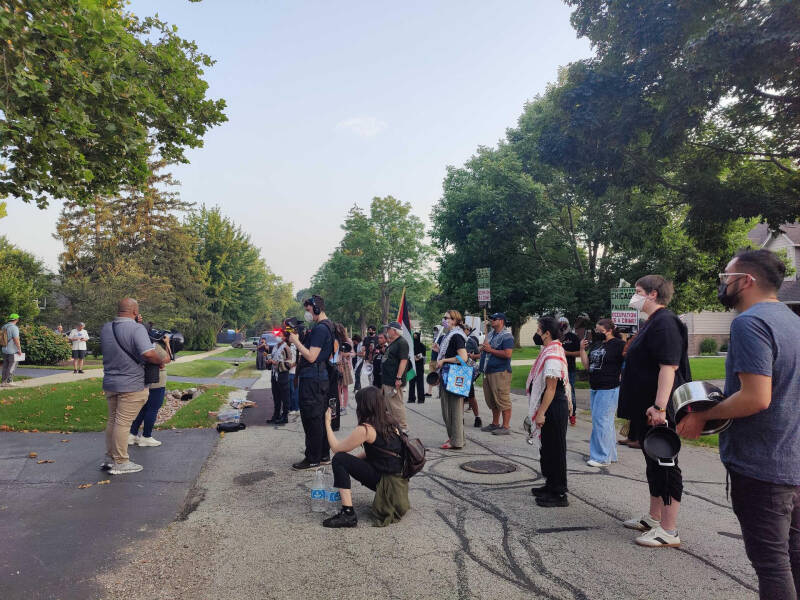
Constituents have pressured him through town hall and fundraiser disruptions, calls, emails, and even a protest outside of his home as part of a grassroots campaign led by the US Palestinian Community Network (USPCN) Chicago.
Instead of listening to his constituents, Rep. Casten decided to introduce a bill that runs counter to everything we are fighting for.
Despite being called the “Ceasefire Compliance Act,” Rep. Casten’s deceptive bill will in reality:
Keep weapons flowing to Israel. The Act merely calls for the State Department to assess Israel’s violations with the possibility of conditioning weapons. After two and a half years of genocide against the Palestinian people, and at a time when Congress did nothing to intervene, this is unacceptable.
Perpetuates genocidal propaganda. This bill paints the aggressor, the Israeli apartheid state and its massive army, as a victim that needs to be defended, in order to manufacture consent for the mass murder of Palestinians.
Uplifts and normalizes Trump’s colonial plan for Gaza. No one should be supporting this “plan”—which is an outrageous blueprint for land theft.
We know we ask you to contact Congress regularly. We know their lack of action can feel demoralizing. That is their intent.
But the truth is, no one expected the Block the Bombs Act to get 60+ cosponsors. Your previous efforts have helped us build this momentum. With the midterms on the horizon, and Palestine in the conversation of every Democratic primary, our movement has never been more powerful. Now is the time to double our efforts.
Keep the pressure on Rep. Sean Casten and every member of Congress to stop arming the Israeli military now:
TELL CONGRESS: BLOCK THE BOMBS
Onward to liberation,
IMAN ABID
Campaigns and Advocacy Director
P.S. If you’ve already contacted your Representative in support of the Block the Bombs Act, you can help keep up the pressure on Rep. Casten by commenting on his Instagram. Voice your outrage and and call out Casten’s complicity in genocide on his post.
2103.

25 februari 2026
Israeli occupation forces continue their relentless land grab, demolitions, and destruction across Palestine. The colonial mechanisms under Trump supervision are in full force.
Yet, we keep building infrastructure towards the only political development that can change things for the better: ending impunity.
So, who has taken concrete actions recently to walk the talk for justice?
Check the latest updates in our Global Accountability Map. We keep documenting the concrete measures being taken internationally to hold Israel accountable and fight repression of the movement. Here’s just a few to get inspired:
- Betar US, a far-right US Zionist organisation, ceased operations in New York State after an investigation by the state Attorney General.
- The Canadian Revenue Authority removed the charity status of two zionist organizations.
- Belgium set partial arms embargo on Israel, suspending exports of weapons and military equipment.
- Spain’s Ministry of Consumer Affairs forced Spanish booking websites to reme 100+ short-term rental in Israeli-occupied Palestinian territories as breaching international and local laws.
Explore the map for more
Let us know if we are missing any actions from where you stand, and we will add them to the map.
With determination,
Inès
Co-Director
2102.
24 februari 2026
Upcoming Events You Want to Be a Part Of
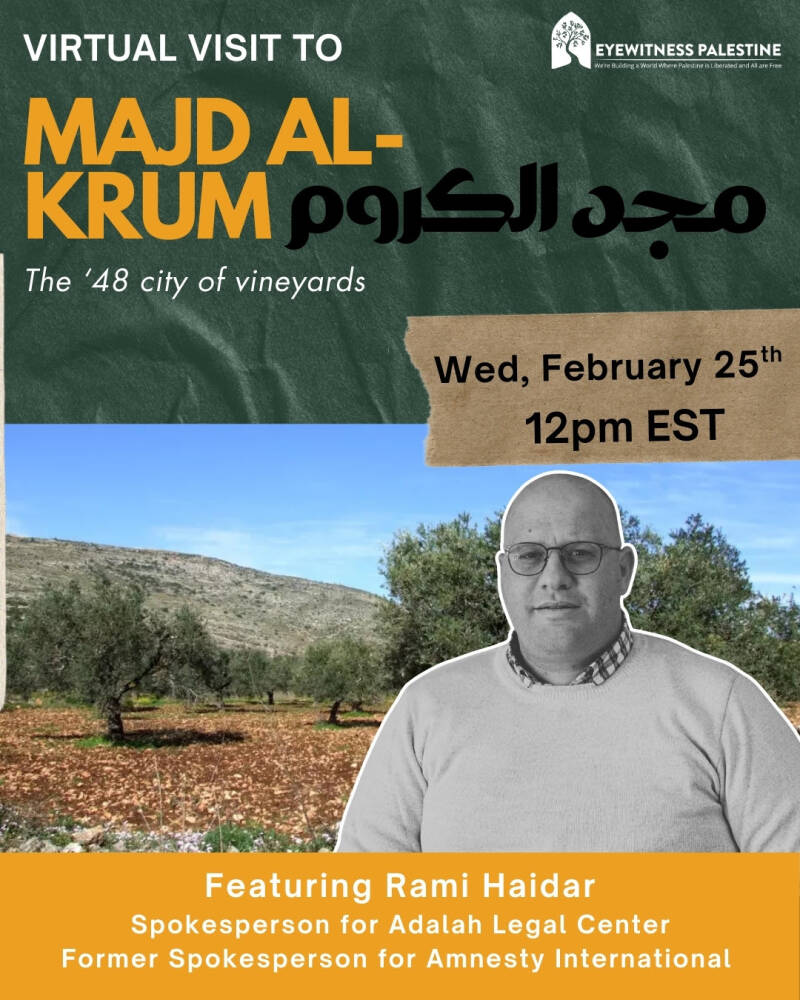
Majd al-Krum is a Palestinian village in the Galilee, northern '48 lands facing mounting obstacles. Dozens of families are dealing with demolition and hearing notices linked to restrictive zoning and the near-impossibility of obtaining building permits. At the same time, residents confront land loss, underinvestment in basic infrastructure, and growing concerns around safety and justice.
Despite these challenges, the community’s resilience remains strong.
Join us for this month’s Virtual Visit to Majd al-Krum with our guide Rami Haidar, spokesperson for Adalah, The Legal Center for Arab Minority Rights in Israel and former spokesperson for Amnesty International.
Register to learn directly from the people living this reality and be part of the conversation.


2101.

24 februari 2026
Since the launch of our No Room for Genocide campaign, ethical hospitality businesses, grassroots organizations and conscientious individuals across the world have joined us. They are pressuring their respective governments to meet their legal obligations and ensure those who have been implicated in the commission of genocide, apartheid and war crimes against Palestinians are not provided safe haven in their territories.
The BDS movement has just launched two new tools to amplify this campaign.
Are you running a hotel or a B&B, a trek or a café, etc.?
You can do your part now, joining businesses, communities, and neighbourhoods to ensure they don’t host war criminals and genocidaires: Sign the pledge to be a Sanctuary of Peace and join a growing number of businesses that are taking a stand worldwide.
Sign the Sanctuary of Peace pledge.
Are you using Booking.com and Airbnb?
They list illegal settlement properties built on stolen Palestinian land, a war crime under international law, as Israeli rentals on their sites. Escalate our BDS campaign to pressure both companies to end their complicity by signing the pledge as an ethical traveller.
Sign the pledge to drop Airbnb and Booking.com now.
Palestinians are calling on hospitality and tourism-affiliated businesses as well as tourists around the world to ensure accountability for Israel’s genocide in Gaza.
Share our two new tools for ethical tourism.
2100.
23 februari 2026
Mattan here. I am excited to share that last month, 18-year-old refuser Yuval Peleg was released from Israeli military prison after serving 5 stints in military prison for his refusal to serve the Israeli occupation army’s genocide in Gaza. Yuval declared his refusal last summer amid Israel’s genocide in a brave public act with a clear message: this is not normal. He is among a growing group of young Israelis waking up to the fact that there is no future where there is genocide and occupation. While Yuval is free, two refusers, known to the public as R. and Y., are still in prison. We are gathering letters of support: write a letter of support to R. and Y. today, and let them know you stand behind their brave choice to go to prison instead of partake in genocide, even at the cost of their own freedom.
"After 5 times being imprisoned and a total of 130 days spent in military prison for refusing to enlist in the IDF, I have finally been released and exempt from army service. I am incredibly happy to be out of prison. It was a difficult experience, and lasted longer than I had hoped.” In a video message released to the world, Yuval challenged the army’s assumption that through repeated imprisonment, it will be able to break refusers and force them to enlist. “As long as there is oppression, occupation and apartheid in the West Bank, and genocide in Gaza, we will keep refusing.
"For everyone that is supposed to be drafted, I’ll tell you: stand up for your beliefs and refuse to take part in the crimes.”
Yuval also added that “as difficult as this was, I do not regret refusing the draft and would do so again. The IDF has proven itself to be a despicable, criminal organization, and there is no excuse for joining it. I, and many others, will continue to fight and oppose it as long as necessary. I would like to remind everyone that while I have finally been freed, there are still 2 other conscientious objectors in prison currently and another that might be sent back. I hope they all get released as soon as possible, and support them throughout their incarceration.
"Most importantly, the criminal actions of the IDF and State of Israel have not ceased. The genocide in Gaza is ongoing despite the facetious ‘ceasefire’ and the now almost 60 year occupation of the West Bank keeps accelerating, to add to the campaign of ethnic cleansing carried out by the Zionists since even before 1948. This is what truly must be fought against, and as long as it continues, so will the resistance to it - both from within and from without."
Resistance from within is costly: refusers and activists face prison time, social isolation and government persecution. That is why we are asking you to write a letter of support for refusers R. and Y., who are still serving prison sentences for their courageous choice to refuser genocide and occupation. Write a letter of support today.
In solidarity,
Mattan Helman
Refuser Solidarity Network
2100.
23 februari 2026
2099.

20 februari 2026
Per 28 februari dreigt Artsen zonder Grenzen (AzG) onder Israëlische dwang uit Gaza te worden gezet. En ze staan niet alleen: in totaal lopen 37 ngo’s het risico te worden verbannen. Als Israël dit daadwerkelijk doorzet, zijn de gevolgen voor de Palestijnse bevolking niet te overzien.
Dit is het moment voor politieke moed. ‘Rodelijner’ en aanstaand premier Rob Jetten moet op dag één laten zien waar hij voor staat. Niet afwachten en geen diplomatieke omwegen — maar alles op alles zetten om Israël met diplomatieke én economische druk tot de orde te roepen.
Dat is precies wat AzG eist in een oproep die inmiddels door bijna 50.000 Nederlanders is ondertekend.
The Rights Forum steunt die oproep van harte. Hulp ontzeggen aan een opgesloten en uitgeputte bevolking is geen bijzaak — het is een bewuste, gecalculeerde stap in de genocide die Israël in Gaza pleegt. En zonder ngo’s zijn er nóg minder getuigen van wat daar gebeurt.
Dat mogen we niet laten gebeuren. Spreek je uit. Oefen druk uit. En eis dat Nederland niet wegkijkt.Onderteken de oproep!
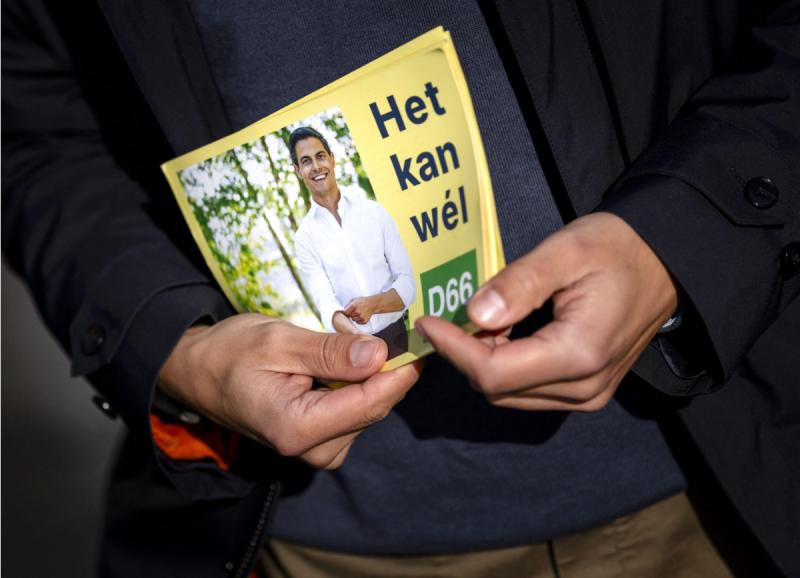
Amsterdam, oktober 2025. Rob Jetten voert campagne voor zichzelf met de boodschap ‘Het kan wél’. Dat moet hij nu laten zien. © Alamy / ANP
Opdracht voor D66
Volgende week wordt het nieuwe kabinet beëdigd. Daarom is dit hét moment voor D66 om zijn verklaarde inzet voor de Palestijnen waar te maken. De opdracht is simpel: vind een meerderheid in de Tweede Kamer voor een motie die het kabinet opdraagt om gehoor te geven aan de oproep van AzG en tienduizenden Nederlanders.
Kabinet-Jetten moet inzetten op breed handelsverbod met illegale nederzettingen
‘Wij roepen de nieuwe regering op een ondubbelzinnig verbod in te stellen op alle handel en investeringen die bijdragen aan bezetting, genocide en apartheid,’ schrijven de directeuren van Amnesty International, Oxfam Novib, PAX, Somo en The Rights Forum in een opiniestuk dat op 17 februari verscheen in Het Parool.
De oproep aan de nieuwe regering is nu ook in zijn volledigheid op onze website te lezen.
Haatcampagne tegen VN-rapporteur Albanese bereikt nieuw dieptepunt
Francesca Albanese, Speciaal VN-Rapporteur voor de mensenrechten in de bezette Palestijnse gebieden, is opnieuw doelwit geworden van een lastercampagne. Aanleiding is haar bijdrage aan het recente Al-Jazeera Forum, waarin ze kritiek uitte op het financiële en politieke systeem dat de genocide in Gaza mede mogelijk maakt.
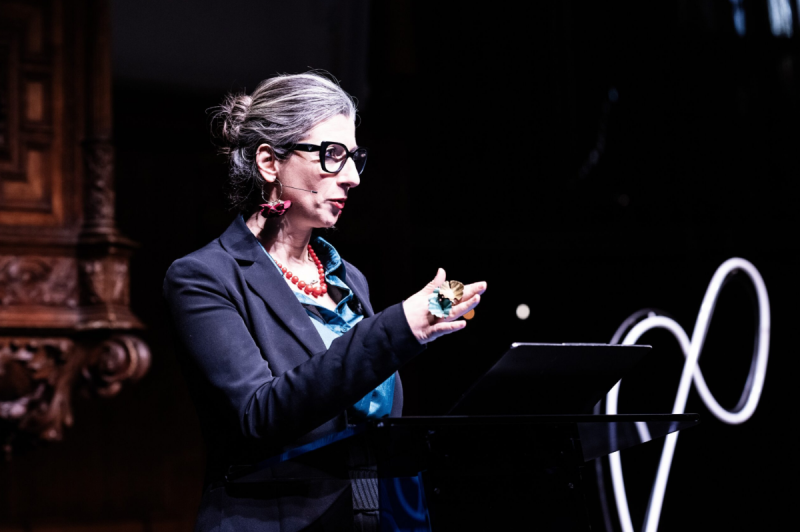
Francesca Albanese tijdens de Dries van Agt-lezing op 12 februari 2025. © The Rights Forum / Mona van den Berg
Gemanipuleerde video
De video van Albaneses betoog werd gemanipuleerd door UN Watch, de pro-Israëlorganisatie die in de vorm van ‘rapporten’ en op sociale media ’belastende informatie’ produceert over personen en organisaties die zich inzetten voor de rechten van de Palestijnen. Het ruim vier minuten durende betoog van Albanese is daarin teruggebracht tot 22 seconden. Met dat knipwerk wordt Albanese in de mond gelegd dat Israël ‘de vijand van de mensheid’ zou zijn.
Talloze politieke leiders, waaronder de ministers van Buitenlandse Zaken van Frankrijk, Duitsland, Tsjechië, Oostenrijk en Italië, evenals de SGP en media als de Telegraaf, sloegen daarop aan. Op basis van de gemanipuleerde video werd Albanese beschuldigd van antisemitisme, nazipraktijken en het steunen van Hamas, en werd haar aftreden geëist.
Albaneses gelijk
Deze dynamiek bewijst Albaneses gelijk: dit is precies het door haar beschreven systeem dat zich nu opnieuw tegen haarzelf keert, en zo Israël beschermt en de genocide laat voortduren. Maar ditmaal is de laster zo doorzichtig dat die bezig is zich tegen de lasteraars te keren.
Open brief | Trek valse beschuldigingen richting Francesca Albanese in en respecteer VN-mandaat
Het Franse ministerie van Buitenlandse Zaken moet de verspreide desinformatie over VN-rapporteur Francesca Albanese intrekken en de onafhankelijkheid van haar mandaat respecteren. Dat schrijven ruim 150 oud-ministers, -diplomaten en politici, onder wie Jan Pronk, Naledi Pandor en Yannis Varoufakis, in een open brief.
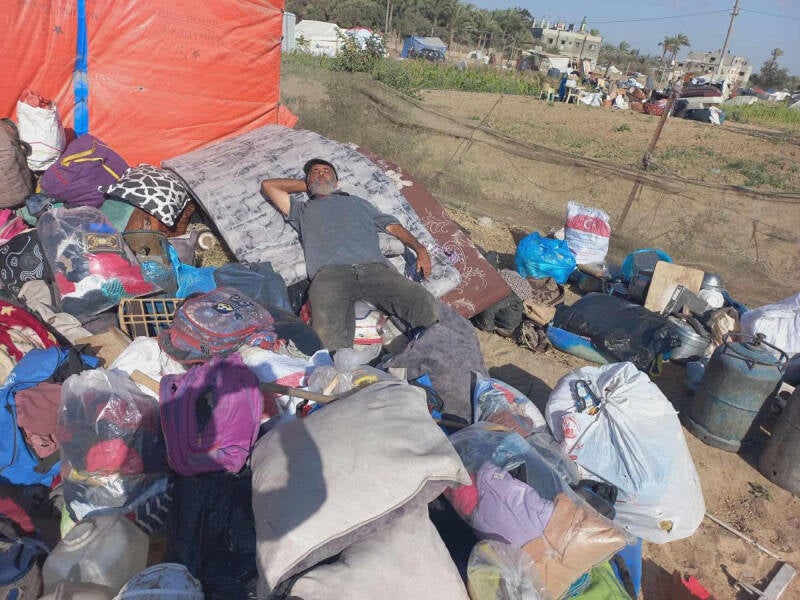
Tentoonstelling | Where is your humanity?
Where is your humanity? is een multidisciplinaire tentoonstelling met installaties, fotografie, schilderkunst, sculptuur, video, geluid en poëzie. De werken maken verlies en vernietiging tastbaar, maar tonen ook verzet, overleving en veerkracht. Geluidsruimtes confronteren de bezoeker met de voortdurende aanwezigheid van de genocide in Gaza, beelden tonen de ruïnes van het dagelijks leven en persoonlijke stemmen breken door statistieken en nieuwsberichten heen.
Lees hier meer over de tentoonstelling.
De expositie toont werken van kunstenaars Diana Roig, Anas Qadamani, Dina Naser en Randa Nassar.
Elke zaterdag en zondag t/m 1 maart 2026
Openingstijden 13.00 - 17.00
Het Archief Artspace, Robert Fruinstraat 52, Rotterdam
Gazanen met Nederlands visum kunnen consulaire hulp niet bij bestuursrechter afdwingen
De bestuursrechter van de Rechtbank Den Haag heeft maandag de zaak van drie Palestijnen in Gaza met een Nederlandse verblijfsvergunning afgewezen. De Palestijnen hadden bezwaar gemaakt tegen de weigering van het ministerie van Buitenlandse Zaken om hen consulaire bijstand te verlenen om Gaza te verlaten.
De rechter stelt hier niet over te kunnen oordelen omdat de zaak buiten het bestuursrecht valt en zegt dat de Palestijnen zich via een kort geding tot de civiele rechter kunnen wenden.
Vast in Gaza
Zonder consulaire bijstand is het voor de Palestijnen onmogelijk om Gaza te verlaten en naar Nederland af te reizen. Dit omdat Israël volledige controle uitoefent over wie er de enclave in en uit mag en het grensverkeer tot een absoluut minimum beperkt.
De advocaat van de Palestijnen beraadt zich over een hoger beroep tegen de uitspraak, of inderdaad een gang naar de civiele rechter. Hoe dan ook, de Palestijnen met Nederlandse visa in Gaza blijven langer in onzekerheid.
Lezing | Humanitaire hulp in Gaza
De humanitaire hulp in Gaza staat zwaar onder druk. Hulporganisaties wordt de toegang ontzegd en ze krijgen te maken met onwerkbare voorwaarden. Op dinsdagavond 24 februari spreken Deniz Dönmez (CARE Nederland) en Dana Mustafa (Artsen voor Gaza) in het Vrijheidsmuseum over de toekomst van humanitaire hulp in Gaza en blikken ze terug op de afgelopen twee jaar.
Dinsdag 24 februari 2026
Deuren open 19.00 | Aanvang 19.30
Vrijheidsmuseum, Wylerbaan 4, 6561 KR Groesbeek
Reserveren is noodzakelijk en kan via deze link. De entree voor de avond is €9,00 per persoon, studenten en scholieren hebben toegang voor €5,00.
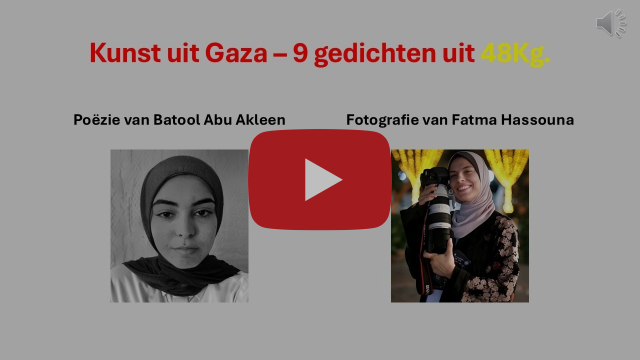
KUNST UIT GAZA | Poëzie van Batool Abu Akleen met foto’s van Fatma Hassouna
Tijdens de poëzieweek van 29 januari t/m 6 februari vond in de Bibliotheek van Utrecht de presentatie plaats van de nieuwe video KUNST UIT GAZA. Doel van deze video is om het werk te eren van twee jonge Palestijnse kunstenaars uit Gaza: dichter Batool Abu Akleen (2005) en fotograaf Fatma Hassouna (1999-2025). De video bevat negen gedichten uit Batool’s bundel 48 Kg, voorgedragen in het Arabisch met Nederlandse vertaling, gecombineerd met negen foto’s van Fatma Hassouna. Deze video laat zien dat uit de verwoesting in Gaza kunst opbloeit en dat deze jonge vrouwen uit Gaza schoonheid weten te creëren uit pijn.
De video is een productie van Podium voor Palestina en is nu te bekijken op YouTube.Uit onze agenda
zaterdag 21 februari t/m zaterdag 28 februari
DEMONSTRATIES EN WAKES
UTRECHT DOORDEWEEKSE DAGEN 08.30 - 09.30 | Dagelijks stilteprotest voor Palestina, tegen genocide en bezetting (Neude, langs het fietspad)
DEN BOSCH ZA 21 FEB 12.00 - 14.00 | NEVER AGAIN IS NOW! Wake voor Palestina (Burgemeester Loeffplein)
HEERLEN ZA 21 FEB 16.45 | Protestmars voor Palestina (Start vanaf Station Heerlen)
ENSCHEDE ZA 21 FEB 14.00 | Wekelijkse lawaaidemonstratie (Station Enschede)
AMSTERDAM ZO 22 FEB 17.00 | Stil protest tegen de onderdrukking van de Palestijnen (Spui, bij ‘t Lieverdje)
TILBURG WO 25 FEB 19.15 | Demonstratie – Tilburg, geef genocide geen plaats op het podium (Schouwburg Concertzaal Tilburg)
HUIZEN WO 25 FEB 11.30 | Wekelijkse sit-in voor Gaza (Gemeentehuis)
DEN HAAG DO 26 FEB 12.00 | Sit-in van Rijksambtenaren bij het ministerie van Buitenlandse Zaken, Rijnstraat 8
STATIONS IN NEDERLAND DO 26 FEB 18.00 | Wekelijkse lawaaidemonstratie op stations in heel Nederland: Stations Alkmaar (17.30 uur), Amersfoort, Arnhem, Assen, Dordrecht, Driebergen-Zeist, Ede-Wageningen, Groningen (mars vanaf Grote Markt 17.30 uur, sit-in station 18.30 uur), Hilversum (17.30 uur), Leiden, Nijmegen, Tiel, Tilburg, Zaandam (17.00 uur), Zutphen
Let op: The Rights Forum probeert de verschillende stationsacties in Nederland zo goed mogelijk bij te houden, maar dat is niet altijd goed mogelijk. Houd de sociale media-pagina's van de plaatselijke solidariteitsorganisaties in de gaten voor de meest actuele informatie.
AMERSFOORT 27 13 FEB 09.30 | Wekelijks stilteprotest tegen genocide (Varkensmarkt)
GRONINGEN ZA 28 FEB 13.00 | Tweewekelijkse wake van Vrouwen in het Zwart (Waagplein)
NIJMEGEN ZA 28 FEB 14.00 | Maandelijkse wake van Mensen in het Zwart (Koningsplein - Marienburg)
CULTURELE EN ANDERE EVENEMENTEN
BERGEN OP ZOOM 22 & 23 FEB | Vertoning van de film The voice of Hind Rajab (C-Cinema, Burgemeester van de Laarstraat 25)
UTRECHT ZO 22 FEB 15.30 | Palestine Café Utrecht, een ontmoetingsplek om de solidariteit met Palestina in Utrecht te versterken (Moira Expo, Wolvenstraat 10)
UTRECHT MA 23 FEB 19.30 | The Palestine Book Club, met deze keer: Daybreak in Gaza (De Bibliotheek Utrecht, Neude 11)
AMSTERDAM MA 23 FEB 17.00 | Boekpresentatie ‘Geen mens meer in Gaza’ (Athenaeum Boekhandel Spui)
GROESBEEK DI 24 FEB 19.30 | Lezing Humanitaire hulp Gaza (Vrijheidsmuseum)
ROOSENDAAL 25 FEB 20.00 | Vertoning van de film The voice of Hind Rajab (C-Cinema, Nieuwstraat 2)
NUENEN DO 26 FEB 20.00 | Olga Vocal ensemble – FRAGMENTS – Echos of a Father, met poëzie van Maureen Ghazal (Het Van Gogh Kerkje, Papenvoort 2a)
LEIDEN VR 27 FEB 20.00 | Luisteren naar Palestijnse stemmen: Palestijnse literatuur in Arabisch, Engels en NL door Marianne Dagevos; Palestijnse literatuur in Hebreeuws door Ruben Verhasselt (Marnixstraat 18)
DEN HAAG VR 27 FEB 20.00 | ‘Geen mens meer in Gaza’ – gesprekken en voordrachten (Grand Café Utopie, Waldeck Pyrmontkade 116)
HAARLEM VR 27 FEB 20.00 | Olga Vocal ensemble – FRAGMENTS – Echos of a Father, met poëzie van Maureen Ghazal (Verhalenhuis Haarlem, van Egmondstraat 7)
UTRECHT ZA 28 FEB 20.00 | Olga Vocal ensemble – FRAGMENTS – Echos of a Father, met poëzie van Maureen Ghazal (Pieterskerk, Pieterskerkhof 3)
Onze agenda wordt doorlopend aangevuld. Bekijk de hele agenda
2098.

20 februari 2026
Ondanks gesprekken die Apartheidvrij Groningen heeft gevoerd met SPOT, de organisatie achter enkele belangrijke Groningse podia, gaat het Jerusalem Quartet toch optreden. Samen met Apartheid Vrij Groningen roepen wij op tot actie.
ACTIE
Groningen, geef geen podium aan genocide!
Het klinkt niet logisch, maar zondagmiddag speelt in de Oosterpoort in Groningen het Jerusalem Quartet, een ensemble dat hun kunst in dienst stelt van het Israëlische overheidsbeleid van illegale bezetting, apartheid en genocide.
De actiegroep Apartheid Vrij Groningen heeft met steun van BDS Nederland de organisatoren gevraagd het concert te annuleren, maar de Groningse concertzaal weigert dat verzoek. De concertzaal laat daarbij helaas een gebrek aan inzicht blijken in waar artistieke vrijheid ophoudt en staatspropaganda begint.
Daarom roepen BDS Nederland en Apartheid Vrij Groningen op tot protest bij de Oosterpoort zondag. Als je er niet bij kunt zijn, verspreid dan de boodschap dat het Jerusalem Quartet zich medeplichtig maakt aan steun aan de misdaden tegen de menselijkheid die Israël pleegt.
Dus kom zondag 22 februari om 13 uur naar de Oosterpoort in Groningen, Trompsingel 27
2097.

20 februari 2026
Help Sustain AMP’s Work this Ramadan
As-salamu alaykum, and Ramadan Mubarak!
Throughout history, we have seen that when those rooted in falsehood cannot confront the truth, they resort to attacking the character of those who carry it. This was the tactic used by polytheists against Prophet Muhammad (PBUH), and it is the same tactic oppressors continue to use today. When they can't defeat the message, they attempt to distort the messenger, distract from the core issue, and shift the debate to topics they believe they can win.
Israel and its lobbies are notorious for following the same pattern. Over the past two and a half years, Israel’s global image has collapsed, even among its traditional allies. Its name is now widely associated with genocide, apartheid, and war crimes. A leaked report for Israel’s Foreign Ministry admits its image is collapsing and urges shifting focus away from Gaza by fueling Islamophobia.
Israel and its lobbies are acting on this playbook: demonize Muslims and target our institutions to divert attention from what’s happening in Palestine. Our task is clear: we must not allow them to divert attention away from their actions.
Make a Zakah eligible donation to help us keep this work going
Polling shows that half of Americans recognize Israel’s actions in Gaza as genocide, and 60% oppose additional U.S. military aid to Israel. For the first time since 1948, Americans are now more sympathetic to Palestinians than to Israel, with even stronger support among Democrats and younger Americans. Israel feels threatened because the numbers are undeniable and for the first time in decades, the propaganda it has relied on to obscure its crimes is failing, not just in the United States, but worldwide.
This shift is already reshaping U.S. politics, from major changes within the Democratic Party to fractures inside the MAGA movement over unconditional support for Israel. The pro-Israel lobby will continue its attempts to distort and distract. However, following the example of our Prophet Muhammad (PBUH), we remain steadfast; focused on the truth, anchored in evidence, and unmoved by attempts at distraction. By Allah’s grace, we have already defeated four frivolous federal lawsuits aimed at silencing us. But we need your support to continue. Donate today, and help ensure the pro-Israel lobby’s distractions never slow our momentum or weaken our resolve.
We pray that you will join us in the honor of serving the blessed cause of Palestine. May Allah accept your fasting and worship.
Peace be upon you,
Dr. Osama Abu Irshaid
Executive Director, AMP
2096.

20 februari 2026
Gaza Humanitarian Response
Situation Report No. 68
20 February 2026
(As of 18:00 on 18 February 2026, unless otherwise noted)
HIGHLIGHTS
- The Gaza city Mekorot supply line from Israel, which had been operating at reduced flow due to two identified leaks, has been fully shut down since 10 February. Water, health and sanitation partners have increased water trucking in affected neighborhoods to mitigate gaps in drinking water.
- Services to address non‑communicable diseases continue to be affected by critical shortages of medicines and laboratory reagents, impacting the quality of care and delaying full-service resumption.
- At least 12 fires in displacement sites have been recorded since November 2025, causing injuries and destroying shelters. Overcrowded makeshift sites continue to pose severe fire risks; displaced families cook, sleep and store belongings in small, flammable shelters, with congestion limiting emergency access and civil defense teams lacking equipment.
- Between 16 and 19 February, 146 tents were installed to create new or expand existing Temporary Learning Spaces for 19,000 school-aged children.
SITUATION OVERVIEW
Between 11 and 19 February, airstrikes, shelling and gunfire continued across the Gaza Strip, reportedly resulting in civilian casualties and damage to civilian infrastructure. According to the Ministry of Health in Gaza (MoH), 20 Palestinians were killed, and 52 others injured during this period, bringing the total casualty toll reported by MoH since the ceasefire came into effect on 10 October 2025 to 611 killed and 1,630 injured.
Between 1 and 14 February, the Site Management Cluster recorded approximately 6,450 population movements within the Gaza Strip. Since the ceasefire agreement, nearly 833,000 population movements have been observed, of which more than 694,000 were from southern to northern Gaza. Most were returns to areas of origin, largely driven by a desire for family reunification. Some movements were also reportedly driven by inadequate shelter conditions and overcrowding in displacement sites, prompting some households to seek alternative locations. Military activity in or near residential areas was also cited as a trigger for new displacement.
Between 11 and 18 February, WHO supported the medical evacuation of 118 patients and their 179 caregivers outside of Gaza through the Rafah Crossing. Overall, since the reopening of the Rafah Crossing in early February for the limited movement of people, a total of 211 patients have been medically evacuated alongside 359 companions.
The UN and partners also supported 296 returnees during the same period, and a total of 564 since the re-opening of the Rafah Crossing to limited movement. In addition to transportation, the UN and partners continue to provide protection and medical assistance, as well as basic supplies.
Humanitarian partners have visited the re-opened crossing and have noted gaps in basic facilities, including limited availability of latrines and handwashing stations, raising concerns for hygiene. People are experiencing prolonged waiting periods, often in areas with limited shade, with insufficient seating and a lack of wheelchairs. The access road to and from Rafah is also in disrepair, affecting patients during medical evacuations. Engagement is ongoing with relevant authorities to ensure that conditions are safe and dignified.
Efforts to address immediate weather‑ and accident‑related needs through joint humanitarian aid distributions continue. Between 11 and 17 February, aid workers in Deir al Balah and Khan Younis provided tents, tarpaulins, bedding and blankets, hygiene products, plastic sheeting, and clothing to 85 displaced families whose shelters and belongings were damaged by a recent fire that broke out in a nearby warehouse in Gaza city. On 14 February, six additional households received a multisectoral package, including families affected by flooding during the last rains and those affected by accidental fires in the Al Mawasi area of Khan Younis and Deir al Balah. On 15 February, a further 582 households - mainly affected by rains - were supported with essential items, such as plastic sheeting, blankets, and clothing kits. In total, 673 households received assistance during the reporting period.
Overcrowding in displacement sites remains a major contributor to fire risks, as shelters - 80 per cent of which are makeshift - are packed closely together with little to no space for safety purposes. Families often live in small structures, typically around 20 square metres (for six people, where cooking, sleeping and storage all take place in the same confined area. During winter and rainy periods, many families are forced to cook inside their highly flammable shelters. Damaged infrastructure and extreme congestion also make it difficult for ambulances, water trucks, and emergency responders to reach affected sites, with civil defense units overstretched and lacking essential equipment, including fire trucks, protective gear, and reliable access to water. Basic fire safety items, such as fire extinguishers and fire blankets, remain largely unavailable. Since November 2025, at least 12 fire incidents have been recorded by the Site Management Cluster, resulting in dozens of shelters being damaged or destroyed and several injuries. Cluster partners continue to provide fire safety awareness to displaced communities and to implement limited fire hazard mitigation measures as much as possible.
HUMANITARIAN AID*
Between 12 and 19 February, at least 13,000 pallets of aid administered by the UN and its partners were offloaded at Gaza’s crossings, based on data retrieved from the UN2720 Mechanism dashboard at 17:00 on 20 February. About 71 per cent of these pallets contained food supplies, followed by shelter items (17 per cent), water, sanitation and hygiene (WASH) assistance (5 per cent), education supplies (3 per cent), operations, logistics and telecommunication material (2 per cent), nutrition and health items (over one per cent each, respectively).
During the same period, international monitors with the UN Office for Project Services (UNOPS) deployed at Gaza’s crossings verified the collection of 8,381 pallets of aid – 6,432 through Kerem Shalom Crossing and 1,949 through Zikim Crossing. These included 5,365 pallets of food assistance, 1,339 pallets of shelter items including tents, tarpaulins, mattresses, and kitchenware, 457 pallets of WASH items, 349 pallets of medical items, 275 pallets of nutrition supplies, some fuel containers and some solid fuel supplies.
Overall, between the announcement of the ceasefire on 10 October 2025 and 19 February 2026, at least 308,098 pallets of humanitarian cargo were offloaded, and 303,134 pallets were collected from the operating crossings. Some 1,532 pallets, less than one per cent of all collected aid, were intercepted during transit within Gaza.
The above data does not include bilateral donations and the commercial sector.
Between 12 and 19 February, the United Nations coordinated 67 humanitarian missions with the Israeli authorities inside Gaza. Of these, nine (13 per cent) were denied outright. Of the remaining missions, 42 (64 per cent) were facilitated, and nine (13 per cent) were approved but faced impediments, such as long delays – including seven that were fully accomplished despite the impediments and two that were only partially accomplished. Another seven missions (10 per cent) were cancelled by the organizers due to operational, logistical, or security reasons.
UN and international NGO trucks manifested through the Egypt Corridor continued to face high return rates throughout the reporting period. Overall, between 1 and 17 February, out of 854 trucks manifested by the Logistics Cluster, only 296 -- or 35 per cent -- offloaded at Kerem Shalom.
HUMANITARIAN RESPONSE
Food Security
- As of 16 February, Food Security Sector (FSS) partners had provided approximately 134,000 families (670,000 people) with household-level general food assistance as part of the monthly distribution cycle. Since 5 February, ration sizes have been covering half of the minimum caloric needs. Current stocks of humanitarian food supplies in Gaza are insufficient to sustain even these reduced ration distributions for the rest of the month.
- As of 15 February, FSS partners continued to prepare and deliver almost 1.75 million hot meals daily through 18 kitchens across the Strip - 555,000 meals through 49 kitchens in the northern governorates and almost 1.2 million meals through 131 kitchens in southern and central Gaza. Since the start of Ramadan, partners have adjusted cooked meal preparation and distribution timings to align with fasting hours. Partners also continue to enhance meal quality with additional fresh produces and/or protein products.
- Over the past four months, the Food and Agriculture Organization (FAO) has distributed more than 1,800 metric tons of animal feed and provided veterinary kits to 2,000 holders of small ruminants and around 250 owners of working animals, along with emergency cash assistance to herders and farmers to safeguard their remaining assets and reactivate production. Between October 2023 and November 2026, livestock survival rates dropped to 33 per cent for goats, 20 per cent for sheep, and 11 per cent for poultry. In addition, only 37 per cent of cropland is currently accessible for cultivation, with just 4 per cent being both accessible and not damaged, and thus immediately cultivable.
Health
- As of 18 February, 252 of 611 health service points were functioning across the Gaza Strip, the vast majority only partially. These include 19 out of 37 hospitals, 12 field hospitals, 105 primary health care centers, and 116 medical points. Most service points (108) are run by national non-governmental organizations (NNGOs), followed by international NGOs (78), the United Nations (38), government providers (23), and a small number of other and private partners. Geographically, the largest concentration of services is in Deir al Balah (76), followed by Khan Younis (76), Gaza governorate (77) and North Gaza (7). Additionally, 22 ambulance centers are partially functioning with 10 in Deir al Balah, nine in Khan Younis, two in Gaza city, and one in Rafah.
- Between 11 and 18 February, six medical evacuation missions were conducted, enabling 136 patients, along with 212 caregivers, to leave Gaza to receive urgent medical treatment presently not available in the Strip. Of all patients, 97 were trauma cases; 17 were affected by ophthalmological disorders, six had cancer, five had cardiovascular diseases, and the remainder were orthopedic, gastrointestinal, neurological, urological, congenital, and transplant cases. A total of 118 patients were evacuated to Egypt through the Rafah Crossing, while another 18 reached Jordan through Kerem Shalom Crossing. Men represented 68 per cent of all evacuees, followed by children (24 per cent) and women (19 per cent).
- During the first two weeks of February, health partners reached approximately 15,000 people through the distribution of Inter‑Agency Reproductive Health Kits, contraceptives, midwifery kits, essential consumables, pharmaceuticals, and cardiotocography (CTG) devices. Additionally, 16,000 flyers and 144 posters for maternal health awareness have been finalized and are currently being printed. One partner also conducted the first clinical management of rape training of 2026 for 15 providers, with a second round planned.
- Non‑Communicable Disease (NCD) services continued to be affected by critical shortages of medicines and laboratory reagents, impacting the quality of care and delaying full-service resumption. During the reporting period, the Health Cluster distributed emergency hemodialysis supplies (5,600 gallons of acid concentrate and 1,680 bicarbonate cartridges), levothyroxine following a prolonged stockout, and additional antidiabetic and antihypertensive medicines. Two new NCD screening clinics have become operational, one is operated by the Palestinian Medical Relief Society as a specialized clinic and the other through UNRWA’s resumption of services at the Bureij Health Centre, supported by laboratory preparations in North Gaza. Partners also agreed to update NCD service mapping, and service restoration efforts are continuing with phased expansion planned.
Water, Sanitation and Hygiene
- The Mekorot water pipeline from Israel supplying northern Gaza, which was previously operating at reduced flow due to two identified leaks, has been fully shut down since 10 February. Repairs have reportedly begun near the reservoir, and WASH partners will assess the second leak once the first repairs are completed. To meet household needs, WASH partners are increasing water trucking in affected neighborhoods and continue to advocate for a full assessment of the entire line to identify issues and develop a comprehensive repair plan.
- Removal of solid waste from the Firas Market in downtown Gaza city to the newly identified temporary dump site in Abu Jarad is ongoing and is expected to help address major environmental health risks faced by the population returning to Gaza city. Over the past week, UNDP transferred 700 cubic metres (m3) of solid waste over four days of operations. Waste transfer activities are expected to scale up by late February or early March.
- Between 11 and 18 February, WASH partners distributed 94,000 jerrycans, 30,000 bars of soap, 9,500 hygiene kits, and 732 Safe Toilet (SATO) latrine kits (including a self‑closing flap, installation frame, and basic fittings) to 9,500 households across the Gaza Strip.
- In designated shelters, over the past week, water wells provided 15,500 cubic metres (m3), with an additional 2,700 m3 delivered by trucks, with about 450,000 people benefitting from drinking water and 800,000 from domestic water. A total of 1,500 tons of solid waste has been transferred to temporary dump sites, 500 hygiene promotion sessions have been conducted to approximately 3,000 people, and maintenance and unblocking of stormwater drains has continued, including the cleaning of more than 200 manholes.
Shelter
- Between 11 and 17 February, Shelter Cluster partners reached 11,759 households with emergency shelter and non-food items (NFI) assistance through in-kind and voucher-based modalities. In-kind distributions included 3,083 tents, 740 tarpaulins, 8,900 bedding items, 1,293 bedding kits (comprising four mattresses, four blankets, six mats and six pillows), and 975 clothing kits.
- Since January 2026, partners have taken into Gaza 872 durable flat-pack shelters – commonly referred to as Refugee Housing Units (RHUs). So far, 70 have been already installed: 16 in health facilities across the Strip and 54 in the Al Zaytoun displacement site, in Gaza city.
- The Shelter Cluster has published the Shelter Damage Overview – Multisource Damage Mapping for Gaza, which provides a municipality‑level analysis of structural damage and affected populations to support evidence‑based planning and prioritization.
- The Cluster technical team is rolling out several tools to support partners, including a unified needs assessment tool, a rapid assessment tool for verifying minor damage to facilitate emergency repairs, social vulnerability criteria and scoring to strengthen prioritization, and an Information, Education, and Communication (IEC) package to guide the upgrading of makeshift shelters.
Site Management
- Over the past two weeks, Site Management Cluster partners continued the rapid displacement site review that started on 3 February, with a total of 613 sites surveyed to date. Of these, 447 sites have been identified as active, collectively sheltering more than 500,000 people who are enduring extremely difficult living conditions. An additional 77 sites were found to be inactive or uninhabited. The coverage spans all governorates, with Deir al Balah accounting for 253 surveyed sites, followed by Khan Younis with 152, Gaza city with 135, North Gaza with 44, and Rafah with 11. More than 80 per cent of the identified sites are makeshift settlements, while the remaining 20 per cent are collective centers, including Designated Emergency Shelters.
Protection
- General Protection
- Between 11 and 18 February, partners reached nearly 5,300 people – children, caregivers, women, persons injured and with disabilities, frontline workers, and communities in displacement sites and shelters – with protection related services across Gaza. Mental Health and Psychosocial Support (MHPSS), including Psychological First Aid (PFA), individual and group counselling, and emotional decompression, reached 3,100 people, while specialized case management and follow‑up supported 500 people, and more than 100 other people received legal counselling and assistance.
- Protection monitoring was conducted in seven different sites, with 11 focus group discussions and 110 key informant interviews carried out with community members in accessible locations across all governorates.
- As part of intersectoral and interagency efforts to support returnees, the Protection Cluster continued coordinating the Protection Desk, which assisted 463 returnees through the mobilization of partners providing PFA, emergency assistance and referral services.
- Child Protection
- Between 11 and 18 February, Child Protection (CP) partners continued delivering integrated child protection and MHPSS services across Gaza, reaching approximately 3,200 children and 1,150 caregivers through structured and community‑based MHPSS interventions, individual and group psychological counselling, and psychological first aid for children experiencing acute distress.
- Case management services also continued, with 170 children receiving individual social work support and follow‑up. In addition, 78 children received speech and language therapy, and 11 children received physiotherapy to address developmental, disability‑related and health needs.
- Child protection awareness‑raising activities constituted a significant part of the response, reaching approximately 2,500 children and 1,000 caregivers through structured sessions focused on child protection risks, preventing family separation during displacement, violence prevention and stress management.
- Parenting support sessions reached additional 200 caregivers through structured programmes designed to strengthen their ability to support children living under prolonged crisis conditions.
- Community‑based child protection activities were integrated into special events, including recreational gatherings and seasonal celebrations, reaching around 2,000 children and caregivers. These events provided safe opportunities for engagement while reinforcing key protection messages and promoting family cohesion and well‑being.
- From 16 to 19 February, partners conducted a four‑day case management training targeting approximately 90 Child Protection case workers from at least 15 organizations across the Strip. The training was developed in response to identified capacity gaps and partner requests to strengthen caseworkers’ ability to manage complex child protection cases. Sessions covered core interagency case management principles, risk assessment, case planning, safe referrals, documentation and supervision. Preliminary feedback indicates improved understanding of case management concepts and enhanced practical skills among participants.
- Addressing Gender-Based Violence (GBV)
- A total of 59 Women and Girls Safe Spaces provided multisectoral services addressing GBV between 11 and 18 February. Partners conducted monitoring and provided technical support to two of these spaces, including a newly established space in Gaza city supported by the Humanitarian Fund.
- In collaboration with the Sexual and Reproductive Health (SRH) Technical Working Group, GBV partners supported 19 women in fixing the lights in their tents to help mitigate GBV risks.
- Partners also provided support to women and girls arriving from the Rafah Crossing and to those seeking assistance at the protection desk in Nasser Hospital.
- Mine Action
- Between 12 and 18 February, partners conducted 22 explosive hazard assessments (EHAs) in support of debris removal activities, bringing the total EHAs conducted in Gaza since the start of the ceasefire to 1,333, amounting to 5.4 million m2 of land assessed.
- Explosive ordnance risk education (EORE) sessions to civilians have continued, reaching almost 12,500 people across Gaza city, Deir al Balah, and Khan Younis between 15 and 19 February.
Education
- Between 16 and 19 February, a total of 146 tents were allocated and distributed across the Strip to support both the expansion of existing Temporary Learning Spaces (TLSs) and the establishment of new ones. Installation is currently underway across 82 TLSs, and enrolment capacity is expected to increase significantly, accommodating 19,000 additional students, once all sites are fully operational.
Logistics
- Between 11 and 16 February, the Logistics Cluster facilitated the transport of 2,071 pallets of aid inside Gaza from Kerem Shalom and Zikim crossings on behalf of six partners.
- During the same period, the cluster’s common warehouses across Gaza received 2,068 pallets of aid for storage on behalf of six partners. The common storage capacity has increased to seven warehouses, totaling more than 9,000 m2. A new facility was secured in Deir al Balah and has been operational since 21 February.
* All figures solely refer to UN and partner assistance dispatched through the UN-coordinated system and are preliminary. Supplies entering through bilateral donations and the commercial sector are not reflected.
2095.

20 februari 2026
AMP is heartbroken and enraged by the murder of Nasrallah Abu Siyam, a 19-year-old Palestinian American and a relative of two members of our New Jersey chapter, who was killed yesterday, February 19, by Israeli settlers in the occupied West Bank.
Nasrallah was born in Philadelphia and has family in New Jersey. Despite living most of his life in Mukhmas in the West Bank, he was an American citizen. And he is now the second Palestinian American killed by Israeli settlers in less than a year.
TAKE ACTION NOW: CALL AND EMAIL YOUR REPS AND SENATORS
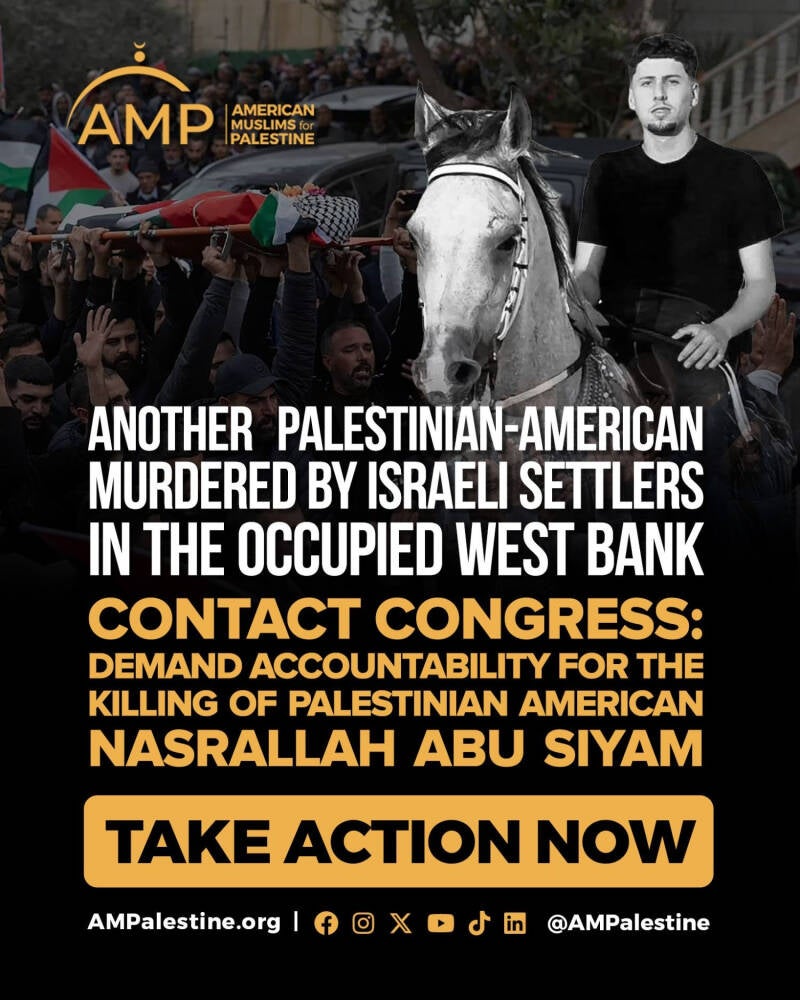
On the second day of the holy month of Ramadan, 50 armed settlers stormed the village of Mukhmas from nearby grazing land where they keep their sheep. When they realized what was happening, a small group of unarmed Palestinian men tried to push them back. Five Palestinians were shot. Nasrallah Abu Siyam was killed. Settlers raided Palestinian barns and stole approximately 200 livestock (sheep).
No Palestinian, U.S.-born or not, should be hunted down and killed by settlers in the West Bank. Not for their lawfully protected right to defending their land. Not for protecting their animals and livelihood. Not for simply existing.
The occupied West Bank as a whole has been under the oppressive thumb of Israel’s military occupation and increasing settler violence, especially since October 2023. Armed settler groups, often operating in broad daylight, have torched homes and farmland, uprooted olive trees, attacked shepherds, blocked access to water, and forced entire communities to flee. Villages like Wadi al-Seeq and Ein Samiya have been emptied after repeated attacks. In some cases, settlers arrive masked and armed; in others, they act openly and without fear of consequence. Collectively, Israeli forces and settlers killed 240 Palestinians last year, according to the United Nations Office for the Coordination of Humanitarian Affairs and well over 1,000 Palestinians since October 2023. Since January of this year, Israeli settler violence and harassment have displaced a record breaking nearly 700 Palestinians in January.
While our communities mourn Nasrallah’s death, Israel is advancing policies that deepen its control over the West Bank and further erode Palestinian rights and livelihoods, accelerating a long-standing agenda to entrench Israeli sovereignty over occupied territory.
Congress cannot continue to send weapons and diplomatic cover while Palestinians are buried and entire communities are terrorized off their land. We demand a full U.S. investigation, public accountability, and immediate action to end the impunity that makes these attacks possible.
In solidarity,
American Muslims for Palestine (AMP)
2094.

20 februari 2026
2093.

19 februari 2026
Humanitarian Situation Update #358
West Bank
19 February 2026
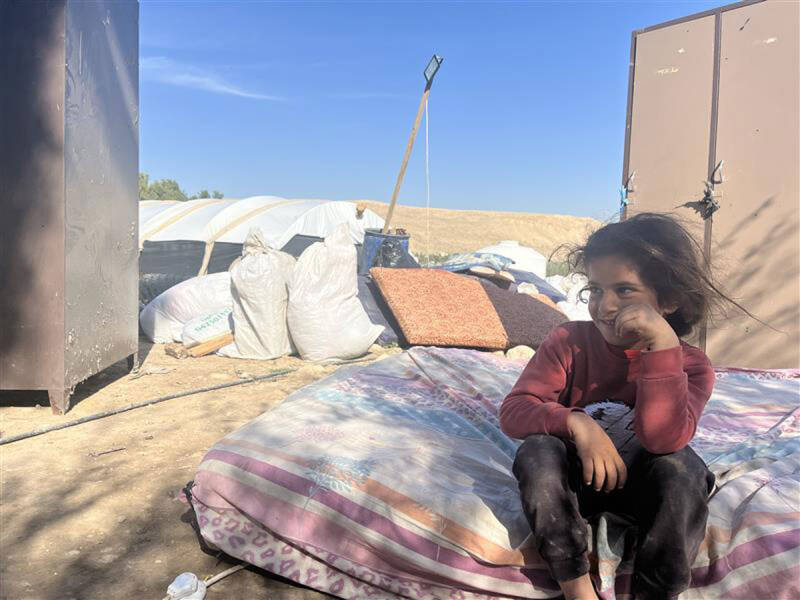
A Palestinian girl sits on a mattress in the open in the Jordan Valley in early February, as her family dismantles their belongings during displacement following repeated settler attacks, which forced nearly 60 community members to flee. Photo by OCHA
Key Highlights
- Between 3 and 16 February, Israeli forces killed three Palestinians in Qalqiliya and Jericho and Palestinian forces killed one Palestinian child in Tubas.
- Over 90 per cent of Palestinians displaced due to settler attacks and access restrictions in 2026 to date have been in the Jordan Valley area, which also accounts for more than one third of such displacement since January 2023.
- The UN Secretary-General warned that recent Israeli land-related measures in the West Bank erode prospects for a two-State solution and risk the dispossession and displacement of Palestinians, following Israeli cabinet decisions to expand administrative control and resume land registration in Area C.
- Boys and men face severe protection risks in the West Bank, including East Jerusalem, experiencing disproportionate levels of killing and injury, detention, and exposure to exploitation and harmful coping mechanisms such as child labour, a Protection Cluster analysis finds.
Humanitarian Developments
- Between 3 and 16 February 2026, Israeli forces killed three Palestinians in the West Bank, including East Jerusalem. This brings the total number of Palestinians killed by Israeli forces between 1 January and 16 February 2026 to nine (all male), including two children. Palestinian security forces killed one Palestinian child and injured his sister while attempting to arrest their father, who was shot and injured. Another 137 Palestinians, including 11 children, were injured, of whom 78 were injured by Israeli forces and 59 by Israeli settlers. Casualties included one person killed and eight injured by Israeli forces while attempting to cross the Barrier to reach East Jerusalem and Israel. During the same period, no Israelis were reported injured. The following are details of the incidents that resulted in fatalities during the reporting period:
- On 3 February, Israeli forces shot and killed a Palestinian man near Ras at Tira village, in Qalqiliya governorate, while he was attempting to cross the Barrier into Israel. Since 7 October 2023, OCHA has documented the killing of 17 Palestinians and the injury of 262 others while attempting to cross the Barrier, after Israeli authorities revoked or suspended most permits to access East Jerusalem and Israel. Many of those attempting to cross reportedly did so in search of employment opportunities amid a severe economic downturn in the West Bank.
- On 3 February, Israeli forces shot and killed a Palestinian man during a raid in Jericho city. According to the Israeli military, Israeli forces opened gunfire at Palestinians who threw stones at the forces.
- On 15 February 2026, Palestinian forces shot and killed a 15-year-old Palestinian boy and injured his sister and father after opening fire at a vehicle in Tammun town, Tubas governorate. The five-year-old girl was later declared clinically dead. According to Palestinian forces, the operation aimed at arresting the father pursuant to a judicial warrant; the circumstances of the incident remain under review and an investigation was immediately launched. In a statement, the UN Human Rights Office (OHCHR) in the Occupied Palestinian Territory (OPT) called on the Palestinian authorities to conduct a prompt, thorough and transparent investigation, noting that the incident raises concerns about the unnecessary use of lethal force and may amount to an unlawful killing.
- On 16 February, Israeli forces shot and killed a Palestinian man in Qalqiliya city, reportedly while he was on his way to his family’s farm near the Barrier. According to two human rights organizations, there were no reports of stone-throwing or attempts to cross the Barrier at the time of the incident.
- An analysis issued by the Protection Cluster in January 2026 highlights the disproportionate exposure of boys and men to various protection risks in the West Bank, including arbitrary arrest and detention, excessive and sometimes lethal use of force, and ill-treatment, including torture and sexual violence. Since October 2023, 97 per cent of Palestinians injured or killed in incidents involving excessive use of force by Israeli forces were men or boys, and 99 per cent of detainees were also men or boys.
- The analysis notes that adolescent boys and young men are particularly vulnerable during raids, at checkpoints, and in confrontations, where they are often treated as adults and profiled as security threats based on gender. Widespread movement restrictions, home incursions, and repeated exposure to violence contribute to psychological distress, while livelihood losses, permit revocations, and displacement undermine traditional provider roles and increase exposure to exploitation, recruitment into armed roles, and harmful coping mechanisms, including child labour. Risks are compounded for boys and men with disabilities and those in rural, Bedouin, and refugee communities, who face greater isolation, service barriers, and exposure to violence and neglect. Overall, the cumulative impact points to a coercive protection environment characterized by pervasive insecurity, dignity-related harm, and long-term psychosocial consequences for boys, men, and their families. The report offers inclusive analysis, while also highlighting that women and girls continue to face severe protection risks.
- On 8 February 2026, the Israeli Security Cabinet approved a series of measures altering administrative and legal arrangements in the West Bank that further deepen Israeli control over land, including in areas administered by the Palestinian Authority (Areas A and B). According to official summaries, these include de-classifying West Bank land registries, removing certain restrictions on land transactions, and renewing a land acquisition committee to enable state purchases. They also entail expanding Israeli supervisory and law-enforcement authorities in Areas A and B, transferring selected planning and building-permit powers from Palestinian municipal bodies to the Israeli Civil Administration (ICA), and establishing municipal frameworks linked to specific religious sites, such as Al Ibrahim Mosque/Cave of the Patriarchs in Hebron and Rachel’s Tomb in Bethlehem. On 15 February, the Government of Israel approved the allocation of about NIS 244 million (approximately US$79 million) to resume land registration and settlement procedures in Area C, following a May 2025 decision to initiate these processes.
- On 9 February 2026, the UN Secretary-General warned that recent measures authorized by the Israeli security cabinet in the West Bank further erode prospects for a two-State solution, reiterating that Israeli settlements have no legal validity under international law, and calling for the measures to be reversed. On 16 February, the Secretary-General also condemned the Israeli decision to resume land registration in Area C, warning that it “could lead to the dispossession of Palestinians of their property and risks expanding Israeli control over land in the area.” The resumption of land registration is expected to accelerate the formalization of state land claims, increase the risk of dispossession of Palestinian landowners, and heighten the risk of evictions and displacement, while further constraining Palestinian development in Area C.
Israeli Settler Attacks
- Between 3 and 16 February, OCHA documented at least 86 Israeli settler attacks against Palestinians across 60 communities that resulted in casualties, property damage, or both. These incidents led to the displacement of 146 people (see section below for details) and the injury of 64 Palestinians, including one child. Of those wounded, 59 were injured by settlers and five by Israeli forces. Most incidents were recorded in Nablus governorate (23), particularly in Qusra and Talfit villages, followed by Ramallah governorate (19), mainly in Al Mughayyir and Birzeit, and Hebron governorate (19), mainly in Halhul and Susiya. Overall, more than 800 olive trees and saplings and 39 vehicles were vandalized, water pipes and networks were damaged, and dozens of Palestinian-owned livestock were reportedly stolen. Settler attacks, threats and harassment predominantly affected communities near settlement outposts, involving repeated raids, assaults, damage to homes and denial of access to agricultural land.
- In Ibziq, in Tubas governorate in the northern Jordan Valley, Israeli settlers carried out three attacks, including against the village’s school. On 4 February, Israeli settlers from a newly established settlement outpost near Ibziq broke into the village’s school, smashed doors, windows and classroom contents, damaged solar panels and water tanks, confiscated solar batteries and water tanks, as well as dug a trench and placed an earth mound on the road leading to the school, which serves approximately 30 students. On 5 February, settlers dressed in what appeared to be military uniforms physically assaulted and injured seven Palestinian men, when a delegation from the Ministry of Education and the Tubas Governor’s Office visited the school to assess the damage caused the previous day. According to the village council, the settlers handcuffed the men, confiscated their phones and identification documents, and detained them for approximately three hours before Israeli forces arrived, released them, and returned their belongings. On 7 February, settlers believed to be from the same settlement outpost assaulted three Palestinian herders near Ibziq, beat them with stones, injured them, and temporarily seized their sheep.
- Incidents included attacks that targeted critical water, sanitation and hygiene (WASH) facilities and infrastructure, causing damage and undermining access to water for Palestinian communities across three governorates.
- In Ramallah governorate, Israeli settlers carried out repeated attacks on water infrastructure in the Ein Samiya area, the main water source for about 20 villages and additional communities in eastern Ramallah, serving an estimated 100,000 Palestinians. On 7 February, dozens of settlers raided a water well site managed by the Jerusalem Water Undertaking (JWU), cutting fences, vandalizing key equipment, and assaulting a worker. On 15 February, masked and armed settlers again raided the site, pepper-sprayed and injured five JWU workers, and forced the suspension of maintenance works. According to JWU, these attacks resulted in intermittent water cuts and the partial suspension of pumping from the Ein Samiya wells, with three wells reportedly ceasing operation. JWU reported that repair crews are working to restore pumping capacity and called for water conservation in the most affected towns pending full restoration. OCHA documented 10 settler attacks in the Ein Samiya spring area in 2025 and six such incidents so far in 2026.
- In Hebron governorate, in Masafer Yatta area, on 11 February, Israeli settlers cut the water network supplying the Palestinian community of Jinba, after previously severing the main water connection serving 10 communities located within Firing Zone 918. As a result, approximately 300 residents are currently relying solely on stored water in household cisterns. This incident follows a similar attack on 28 January 2026, when settlers from a newly established outpost cut the main pipeline supplying water from the village of At Tuwani to about 10 Palestinian communities in this firing zone, leading to the complete disruption of water supply to approximately 190 households. At that time, affected residents were forced to depend on limited winter-stored water, raising urgent humanitarian concerns as supplies diminished.
- In Nablus governorate, on 8 February, Israeli forces, accompanied by settlers, bulldozed an agricultural road west of Sabastiya village, damaging sections of the water network and temporarily disconnecting water supply to about four Palestinian households; works, reportedly linked to a road connecting nearby settlements to Road 60, were ongoing at the time of reporting. On the same day, settlers and Israeli forces prevented Palestinian local council and Ministry of Agriculture staff from installing a water tank between the villages of Beit Dajan and Beit Furik, detained six staff members for about five hours, and obstructed a project intended to supply about 400 agricultural greenhouses and nearby households, undermining agricultural livelihoods.
- For key figures and additional breakdowns of casualties, displacement and settler violence between January 2005 and December 2025, please refer to the OCHA West Bank December 2025 Snapshot.
Displacement due to Demolitions and Settler Attacks
- Between 3 and 16 February, OCHA documented the demolition of 108 Palestinian-owned structures for lacking Israeli-issued building permits, which are almost impossible for Palestinians to obtain, including 89 in Area C of the West Bank, 17 in East Jerusalem and two in Area B. Demolished structures included 29 residences (of which 25 were inhabited), 55 agricultural and livelihood structures, and 24 water and sanitation and other structures. Six of the demolished structures had been provided as humanitarian assistance. In total, 114 Palestinians, including 59 children, were displaced, of whom 48 were in East Jerusalem and 66 in Area C. The highest levels of displacement were recorded in Jayyus town in Qalqiliya governorate (five households, comprising 22 people), followed by Beit Hanina in East Jerusalem (three households, comprising 18 people), and Hammamat al Malih – Al Meiteh community in the northern Jordan Valley in Tubas governorate (four households, comprising 16 people).
- In Al Bustan area of Silwan, in East Jerusalem, Israeli authorities carried out a large-scale demolition operation on 10 February, during which they demolished six structures, forced a family to demolish a house extension, and restricted the movement of residents after sealing the area’s main entrances. Among the demolished structures was a 700-square-metre construction materials facility, with losses estimated at over NIS 150,000 ($48,440). In total, seven households comprising 37 people, including 15 children, were affected. During the demolition, four men were physically assaulted and injured with bruises as confrontations between the residents and Israeli forces broke out. Since the beginning of 2026, at least 14 households in Al Bustan have received demolition notices, placing over 80 residents at imminent risk of displacement. According to the Norwegian Refugee Council (NRC), who is representing 85 demolition cases in the community, all structures in Al Bustan, home to about 1,550 Palestinians and 150 housing units, are at risk of demolition.
- Between 3 and 16 February, 29 Palestinian herding households comprising 146 people, including 77 children, were displaced due to settler attacks and access restrictions, over 90 per cent of whom were in the Jordan Valley area, as follows:
- In the Northern Jordan Valley in Tubas governorate, at least 11 households were displaced or began relocating during the reporting period. This includes four households (20 people) from Hammamat al Maleh – Al Meiteh following a settler arson attack on 13 February, and seven households (34 people) from Humsa al Bqaia on 8 February amid repeated settler harassment, threats and restrictions on access to grazing land and water. Displaced families cited recurrent settler attacks, including arson, intimidation and denial of access to livelihoods, alongside demolitions and detentions, as key drivers of displacement.
- In Jericho governorate, on 5 February, seven refugee households (26 people) were displaced from Al ‘Auja, and 10 Bedouin households (57 people) began relocating from Al Jiftlik–Abu al ‘Ajaj due to escalating settler violence, including night-time incursions, stone-throwing, arson, livestock theft and direct threats, leaving many families without adequate shelter and access to basic services.
- In Masafer Yatta in southern Hebron governorate, on 11 February, one household of nine people, including six children, was displaced from Mirkez community located in Firing Zone 918 following repeated settler harassment and threats, including attempts to damage approximately 120 beehives that constituted the family’s primary source of income.
- Palestinian Bedouin and herding communities in Area C continue to face a heightened risk of forced displacement driven by recurrent settler attacks and access restrictions, particularly in the Jordan Valley area. Between January 2023, when OCHA began systematically documenting displacement linked to specific incidents of settler violence, and 16 February 2026, 883 Palestinian households – comprising 4,765 people – have been displaced across 97 communities and areas, the majority of them Bedouin and herding communities. In the Jordan Valley area, which extends across parts of Tubas, Nablus, Jericho and Ramallah governorates, displacement has steadily increased over the past three years in connection with settler attacks on families, livestock and property, as well as restrictions on access to grazing land, with 1,656 people displaced, accounting for 35 per cent of people displaced within this context (see graph below). In January 2026, 600 Palestinians were displaced from Ras Ein al ‘Auja Bedouin community in the central Jordan Valley, marking the highest single-community displacement due to settler attacks and access restrictions over the past three years.

Operations by Israeli Forces in the Northern West Bank
- Between 3 and 16 February, OCHA documented at least 48 raids and search-and-arrest operations by Israeli forces across Nablus, Jenin, Qalqilya, Tulkarm and Salfit governorates. These entailed mass detentions, temporary home evacuations and movement restrictions. In total, Israeli forces took over at least five Palestinian homes for military use, temporarily evacuated eight families, and detained at least 84 Palestinians, alongside extensive house searches, property damage and widespread disruption to access to basic services. Among the incidents were four large-scale operations, as detailed below by governorate:
- In Qalqiliya governorate, Israeli forces raided Azzun town on 6 and 7 February, searched approximately 14 houses, detained about 17 men for around 20 hours before releasing them, ordered dozens of shops to close, and converted a residential rooftop into a temporary military post for several hours, disrupting commercial activity and restricting residents’ movement.
- In Nablus governorate, Israeli forces raided Nablus city on 8 February and Balata refugee camp on 14 February; operations included the firing of tear gas cannisters, physical assault and arrest of residents, the detonation of an explosive device inside a previously damaged structure, and the temporary evacuation of at least four homes in the camp.
- In Salfit governorate, on 16 February, Israeli forces closed four entrances to Salfit city with earth mounds while keeping the main gate open, searched houses, detained and interrogated residents, and took over four houses as military observation points. Two Palestinian men were physically assaulted and transferred to hospital, while government offices, private shops and schools were closed, significantly disrupting education, livelihoods and access to services.
- On 9 February, Israeli forces re-established a previously evacuated military post in Arraba town, in Jenin governorate, resulting in the forcible displacement of five Palestinian herding families. After issuing prior verbal orders and subsequent warnings to evacuate, Israeli forces compelled the families to dismantle their residential and livestock structures and relocate to a nearby area to avoid forcible removal. The displaced families, who had lived in the area since 2013 and rely primarily on livestock herding as their main source of livelihood, have lost their habitual place of residence and now face heightened protection risks and increased vulnerability.
Funding
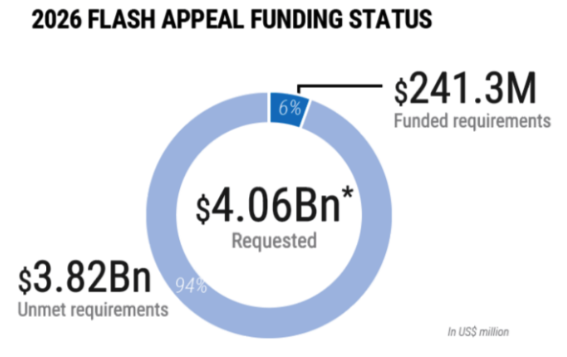
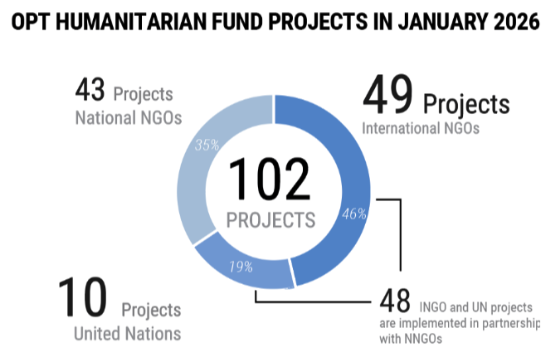
Recent publications
- Reported impact snapshot | Gaza Strip (18 February 2026)
- Gaza Humanitarian Response | Situation Report No. 67
- Humanitarian Situation Update #357 | Gaza Strip
- Humanitarian Situation Update #356 | West Bank
- Humanitarian Situation Update #355 | Gaza Strip
- West Bank Monthly Snapshot - Casualties, Property Damage and Displacement | December 2025
2092.

19 februari 2026
BSD Nederland roept gemeentes en semioverheidsinstellingen die een iftar organiseren op om Israëlische dadels te laten staan en liefst Palestijnse daarvoor in de plaats te nemen. Help op te roepen, zeker als je lid bent van een politieke partij.
Vandaag vindt in de VS de eerste bijeenkomst van president Trumps zogenaamde Vredesberaad plaats. Wij schrijven een stuk over het gevaar ervan.
Tot slot roept Tilburg4Palestine op om 25 februari naar Tilburg te komen om daar ’s avonds te protesteren tegen het concert van het infame Jerusalem Quartet.
Blijf BDS-en!
Het verbreken van het vasten met een dadel is geen willekeurige gewoonte, maar een diepgewortelde religieuze handeling. Juist daarom is het voor veel moslims pijnlijk en wrang om het vasten te moeten verbreken met dadels die bijdragen aan de onderdrukking en onteigening van Palestijnen. Wat bedoeld is als een moment van verbinding, wordt zo onvermijdelijk beladen met onrecht.
In september 2025 heeft de Tweede Kamer een motie aangenomen die de regering oproept om zo spoedig mogelijk een nationaal verbod op handel met illegale nederzettingen in te voeren. Tot op heden heeft de regering nagelaten deze motie uit te voeren. Juist daarom rust er extra verantwoordelijkheid op decentrale overheden en publieke instellingen om deze duidelijke parlementaire uitspraak te respecteren en in de praktijk te brengen.
BDS Nederland roept gemeenten en (semi-) overheidsinstellingen die tijdens de ramadan een iftar organiseren ter bevordering van verbinding tussen moslims en niet-moslims op om geen Israëlische dadels te gebruiken.
Deze oproep doen wij niet alleen. Wij nodigen alle lokale en nationale partijen en fracties uit om deze oproep te steunen door hem mede te ondertekenen. Op deze manier laten wij zien dat wij de motie onverkort blijven ondersteunen, óók als de regering zijn verantwoordelijkheid niet neemt.
Help ons mee!
De lijst van fracties die onze oproep al steunen staat onderaan de volledige oproep. Staat jouw partij of fractie er nog niet bij? Laat ze weten dat je wil dat ook zij deze oproep ondertekenen. Dit kan door te mailen naar info@bdsnederland.nl.
Help ons onze dadels flyer te verspreiden. Ga naar onze website om deze en andere flyer te bestellen.
Flyers en Stickers
Nadat ze de apartheid en genocide eerst goedkeuren en financieel en militair steunen en allerlei eisen opleggen aan de Palestijnen, wil de VS ook nog bepalen hoe ‘Nieuw Gaza’ eruit moet zien. Alles voor hen, niets voor de Palestijnen.
We roepen op tot het opvoeren van alle vormen van BDS-druk en tot het vormen van de breedst mogelijke intersectionele coalities om dat te realiseren en te handhaven. Juist ook in Nederland.
Demonstratie bij concertzaal Tilburg op 25 februari om 19.15 uur
Op 25 februari treedt het Jerusalem Quartet op in Tilburg. Dit orkest is onderdeel van de ‘Brand Israël Campagne’. Dat is in het leven geroepen door het Israëlische ministerie van Buitenlandse Zaken om het imago van Israël op te poetsen en oorlogsmisdaden te verdoezelen. Het Jerusalem Quartet heeft aangegeven trots te zijn op de status ‘culturele ambassadeur van Israël’ en ‘distinguished IDF musicians’.
Tilburg4Palestine kan dit niet aanzien, laat staan aanhoren!
Daarom houdt Tilburg4Palestine een stil protest bij de ingang van de concertzaal. Kom en neem vrienden en bekenden mee.
Kleed je liefst in het zwart en speld een grote rode strik op. Dit staat voor #FreePalHostages.
2091.

18 februari 2026
The JVP family of organizations has restructured. But the overall work and missions of the family of organizations will not change. We’re Jews organizing towards Palestinian liberation and Judaism beyond Zionism.
JVP Action is now doing business as Jewish Voice for Peace (JVP), a 501(c)(4) organization, allowing us to engage in advocacy and some electoral-related work, within the limits that apply to 501(c)(4) organizations. Our 501(c)(3) organization, JVP Leadership and Culture Lab (JVP Lab), continues separately with nonpartisan educational and cultural activities.
The 501(c)(3) organization has been around for nearly 30 years, and its new name and more focused scope of work will best position it to continue pursuing its charitable purpose. The c3 has long been developing effective educational and leadership trainings, and offering religious and cultural work, and this new name is meant to reflect that work more clearly.
A 501(c)(4) organization has an expanded menu of strategies it can use, including work in the formal political arena. This includes engaging around elections (supporting or opposing candidates in a limited way), and focusing on legislative work (supporting or defeating bills). By allowing each organization to focus on its unique structure, the c4 can use expanded advocacy strategies, while the 501(c)(3) continues to engage in education and nonpartisan advocacy in parallel.
Donations to the 501(c)(3) organization remain tax deductible, while donations to the 501(c)(4) organization are not tax-deductible.
Onwards,
Stefanie Fox
Executive Director
Jewish Voice for Peace
Jewish Voice for Peace is an independent, nonpartisan, 501(c)(4) national membership organization inspired by Jewish tradition, organizing toward Palestinian liberation and Judaism beyond Zionism. Become a JVP Member today.
Contributions to JVP and JVP chapters are not tax-deductible. If you wish to make a tax-deductible contribution, you can do so to our sibling organization, the JVP Leadership & Culture Lab.
To view or update your contributions, visit our self-service portal. Fill out this form to change your contact information and preferences.
2090.

18 februari 2026

17 februari 2026
This Ramadan, there is no turning back
Ramadan Mubarak from the AMP family.
As we enter Ramadan, we are facing a painful reality. This is the third Ramadan Gaza has endured amid genocide, while Palestinians across the homeland continue to live under occupation. Families are fasting under siege, grieving loved ones, and doing their best to survive the unimaginable.
In this sacred month, we return to what is true and what is right. We keep praying, we keep showing up for justice, and we keep standing with Palestine. There is no turning back.

Stay connected with us throughout this blessed month for programs and updates, so we can stand with Palestine together.
May Allah accept your fasting, your prayers, and all the good you do this month.
In solidarity,
The AMP Family
2089.
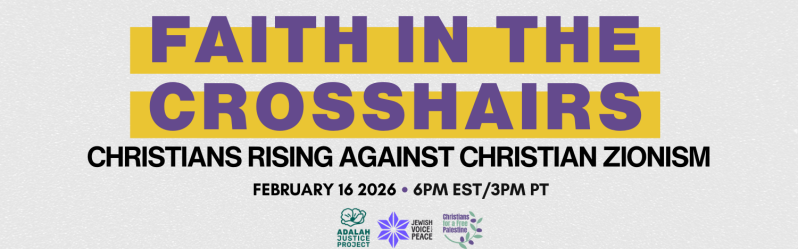
16 februari 2026
At a moment when religion is increasingly being used to justify war, occupation, and state violence, many Christians across the country are asking a different question: what would it look like to practice faith rooted in collective liberation instead of empire and reject the growing threat of Christian Zionism?
Join Adalah Justice Project, Jewish Voice for Peace, and Christians for a Free Palestine on Monday, February 16 at 6 pm ET/3 pm PT for a timely conversation with Christian leaders organizing for Palestinian freedom from within their own communities to answer these questions.
Across the U.S., we’re witnessing a renewed push by those in power to expand Christian Zionism. Israeli and U.S. state actors, including the Trump administration, have invested heavily in church partnerships, media campaigns, and political organizing designed to deepen unconditional Christian support for Israel. Churches are being targeted through digital outreach and geofencing campaigns, and pastors are being recruited and trained as ambassadors for Israel. These efforts are shaping policy, elections, and public opinion in real time.
Despite their efforts, many Christians rooted in values of collective liberation are pushing back and charting a different path.
This webinar will feature Rev. Dr. Crystal Silva-McCormick, Rev. Naomi Washington-Leapheart, and Jonathan Brenneman, all leaders with Christians for a Free Palestine. Together, they’ll share reflections on how faith communities can resist Christian Zionism and stand in solidarity with Palestinians.
If you care about faith, justice, and the future of our movements, we hope you’ll join us for this thoughtful and timely conversation.
Encourage your friends and community members to join us by sharing this email with them. Even if you're unable to join us live, all registrants will receive a recording of the webinar so they too can be a part of the fight against Christian Zionism.
In solidarity,
Sandra Tamari
Adalah Justice Project
2088.
AVAAZ
16 februari 2026

We schrijven met geweldig nieuws. Het voetbalveld van de kinderen in Bethlehem is niet gesloopt door Israëlische bulldozers!
Dit is gelukt dankzij de onvermoeibare strijd van de kinderen, maar ook dankzij jou, Nico, en dankzij de kracht van deze gemeenschap.
Wil je weten hoe we handtekeningen hebben omgezet in een succesverhaal? Lees dan verder. Onze grafisch ontwerper Zarpa heeft een storyboard gemaakt om te laten zien hoe we het Aida voetbalveld hebben helpen beschermen:

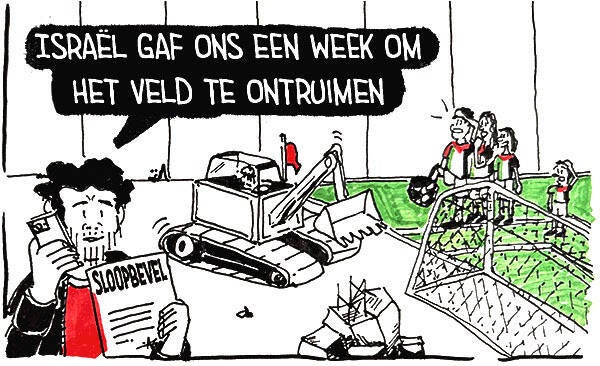


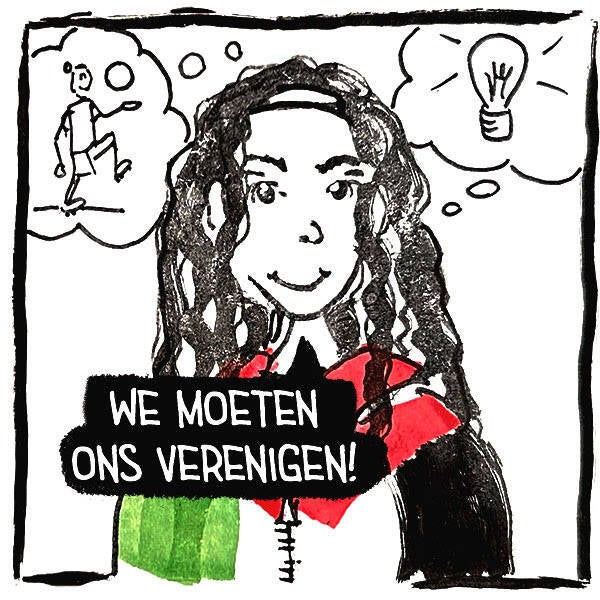
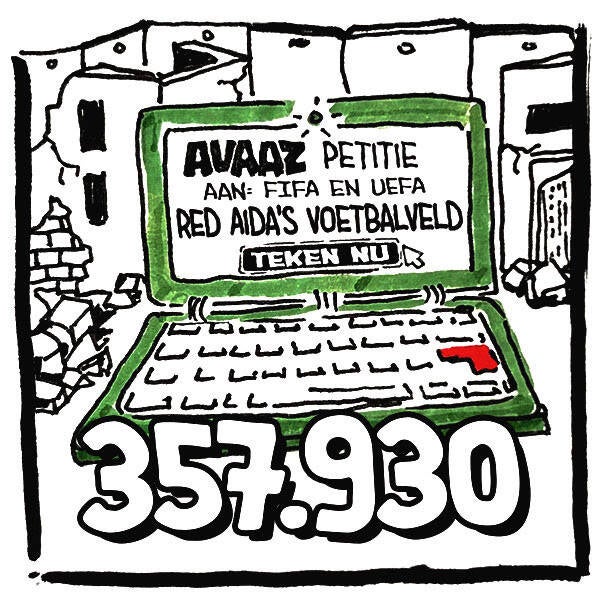
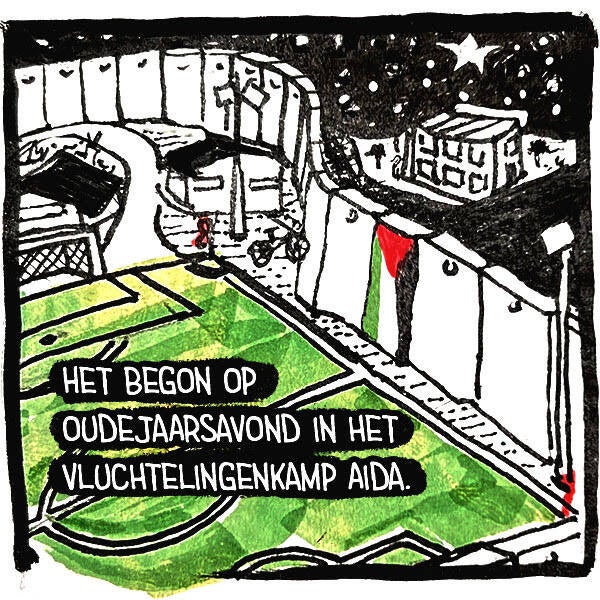
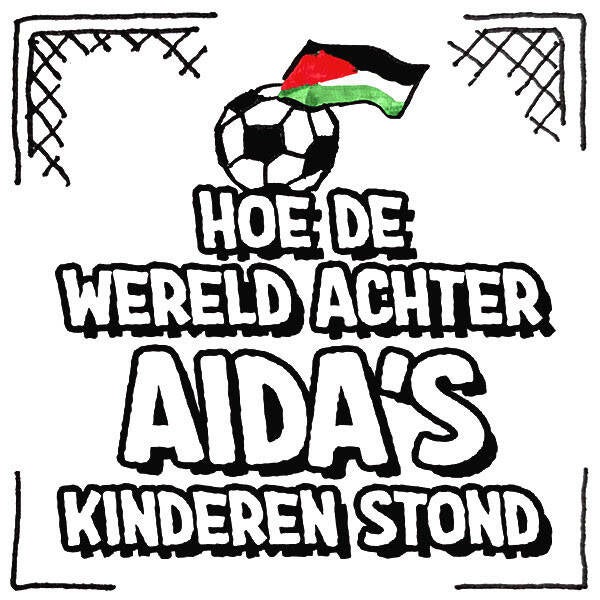

We zijn ontzettend blij met wat we samen hebben bereikt. Dit gaat om meer dan alleen het voetbalveld. Het staat symbool voor hoop en verzet voor Palestijnen, die dagelijks het hoofd moeten bieden aan vreselijk geweld. Het bewijst dat we samen echt een verschil kunnen maken.
2087.

16 februari 2026
Gaza Humanitarian Response
Situation Report No. 67
13 February 2026
(As of 18:00 on 11 February 2026, unless otherwise noted)
HIGHLIGHTS
- The UN has begun removing solid waste from the Firas Market dumping site in Gaza city, where more than 300,000 cubic metres had accumulated; teams are disposing of it at a temporary site that meets environmental standards.
- At least 48,000 children have benefited from learning materials that humanitarian partners took into Gaza for the first time in two years.
- Between 4 and 10 February, the Shelter Cluster reached almost 5,500 households with 1,730 tents, 1,420 tarpaulins, and thousands of bedding and kitchen items; however, distributions have decreased significantly because of lengthy approval processes and restrictions on partners’ operations.
SITUATION OVERVIEW
Between 6 and 11 February, airstrikes, shelling and gunfire continued across the Gaza Strip, reportedly resulting in civilian casualties and damage to civilian objects. According to the Ministry of Health in Gaza (MoH), 20 Palestinians were killed, and 80 others injured during this period, bringing the total casualty toll reported by MoH since the ceasefire came into effect on 10 October 2025 to 1,591 killed and 1,578 injured. On 10 February, an UNRWA staff member was killed in an airstrike while walking on the street east of Deir al Balah.
Since the reopening of Rafah Crossing in early February for the limited movement of people, the UN and partners have supported the medical evacuation of 108 patients and 165 companions through this route.
Separately, 269 people returned to Gaza. Returnees were provided with a range of services at a reception area by the UN and partners, including medical care, protection support and information, psychosocial services, food, water and other basic items, as well as transportation assistance.
The UN continues to engage with all relevant stakeholders to ensure that movements are safe and dignified and calls for the freedom of movement for more people to voluntarily exit and enter Gaza.
Efforts to address immediate weather-related and conflict-related needs through joint distributions continue. Between 5 and 11 February, aid workers in Deir al Balah and Khan Younis provided tents, tarpaulins, bedding and blankets, hygiene products, cereals, plastic sheeting, and clothes to 289 displaced families whose shelters and belongings were damaged by heavy rains. In Khan Younis, a humanitarian team is supporting five families whose shelters and belongings were destroyed by an accidental fire with joint distributions.
Between 18 and 31 January, the Site Management Cluster recorded nearly 6,500 population movements within the Gaza Strip. Some displacement is believed to have been caused by military activity in or near residential areas. Since the ceasefire agreement, nearly 827,000 population movements have been observed, including some 690,000 from southern to northern Gaza. OCHA assesses that the population in northern Gaza has increased by over 10 per cent since late December, likely as people from Deir al Balah moved towards the north.
HUMANITARIAN AID ENTRY*
Between 6 and 11 February, at least 9,784 pallets of aid administered by the UN and its partners were offloaded at Gaza’s crossings, based on data retrieved from the UN2720 Mechanism dashboard at 11:00 on 12 February. About 65 per cent of these pallets contained food supplies, with other categories being shelter items (13 per cent), nutrition supplies (9.5 per cent), water, sanitation and hygiene (WASH) assistance (7 per cent), health items (2.5 per cent), and education materials (1 per cent).
During the same period, international monitors with the UN Office for Project Services (UNOPS) deployed at Gaza’s crossings verified the collection of 10,338 pallets of aid – 7,115 through Kerem Shalom Crossing and 3,223 through Zikim Crossing. These included 5,726 pallets of food assistance, more than 2,802 pallets of shelter items including tents, blankets, tarpaulins and kitchenware, 818 pallets of WASH items, 644 pallets of education materials, 190 pallets of solid fuel and firewood, 136 pallets of nutrition supplies, and some medical items and fuel tank sensors.
Overall, between the announcement of the ceasefire on 10 October 2025 and 11 February 2026, at least 293,188 pallets of humanitarian cargo were offloaded, and 295,505 pallets were collected from the various crossings. Some 1,532 pallets, less than one per cent of all collected aid, were intercepted during transit within Gaza.
The above data does not include bilateral donations and the commercial sector.
Between 5 and 10 February, UNOPS distributed 738,466 litres of diesel to partners – 462,820 litres in the south and 275,646 litres in the north – to support critical water and sanitation, health, logistics, rubble removal, shelter, site management, telecommunications, education, nutrition, cash assistance and protection operations. More than 768,000 litres of fuel were collected into the Gaza Strip during the same period.
Between 6 and 11 February, the UN attempted to coordinate 48 humanitarian missions with the Israeli authorities inside Gaza. Of these, five were denied outright. Of the remaining attempts, 25 missions (52 per cent) were facilitated, and 11 (23 per cent) were approved but faced impediments – including 9 that were fully accomplished despite the impediments and two that were only partially accomplished. Another seven missions (15 per cent) had to be cancelled by the organizers due to operational, logistical, or security reasons.
With Rafah closed for cargo and Nitzana closed to UN and international NGOs since 1 January, truck movements from Egypt continue to be routed from Egyptian Rafah to Kerem Shalom. However, humanitarian partners have continued to face high return rates through this route. Of the 211 aid trucks manifested between 5 and 10 February, only 59 per cent could be offloaded at Gaza’s crossings. This is an increase from 39 per cent between 12 January and 5 February.
HUMANITARIAN RESPONSE
Food Security
- As of 8 February, Food Security Sector (FSS) partners had reached almost 70,000 families (350,000 people) with household‑level general food assistance as part of the monthly distribution cycle. Throughout January, rations covered 100 per cent of minimum daily caloric need. However, since 1 February the ration size has been progressively adjusted: between 1 and 4 February, partners provided two food parcels and one 25‑kg bag of flour per family, covering approximately 75 per cent of minimum caloric needs; it was rations were further reduced from 5 February to one food parcel, one bag of flour, and 2.5 kg of high-energy biscuits, covering about 50 per cent of minimum caloric needs. Current stocks in the Strip are insufficient to sustain even the reduced rations for the rest of the month, requiring an increase in aid flows. In recent weeks, upstream humanitarian supply entry from Egypt has remained critically low, significantly constraining partners’ response capacities. The Food Security Sector also continues to advocate for the resumption of the Government‑to‑Government (G2G) direct convoy modality from Jordan to enable the delivery of larger humanitarian volumes.
- As of 7 February, FSS partners continued to prepare and deliver 1.8 million hot meals every day through 180 kitchens across the Strip, including 560,000 meals through 46 kitchens in northern Gaza and 1.2 million meals through 134 kitchens in southern and central Gaza.
- As of 11 February, FSS partners supported the production and distribution of over 160,000 two-kilogram bread bundles every day through 19 subsidized bakeries. Of these, 70 per cent are sold at subsidized prices through 147 retailers, while the remaining bread is distributed together with cooked meals. FSS partners also conducted food safety and quality control training for all participating bakeries last week.
Health
- As of 9 February, 246 health service points were functioning across the Gaza Strip, 234 of them only partially, including 19 hospitals, 12 field hospitals, 102 primary health centres, and 113 medical points. On 5 February, one hospital resumed operations in Gaza city, bringing the total number of hospitals in the Gaza governorate to 13, while no hospitals are operational in North Gaza.
- The World Health Organization (WHO) has begun deploying prefabricated modular PHC recovery units (two 250-square-metre units per site), with the first installation underway in Gaza city.
- From 5 to 9 February, WHO and partners facilitated the medical evacuation of 86 patients alongside companions from Gaza based on patient lists established by the Ministry of Health in Gaza: 63 patients through three movements via the Rafah Crossing to Egypt, and 26 patients via Kerem Shalom to Italy.
- A total of 35 emergency medical teams, including two national teams (305 personnel) and 91 international staff, were present in Gaza as of 9 February.
- The health response continues to face major constraints, with key medical items deemed dual-use, including laboratory and imaging equipment, still not cleared and access restrictions on national and international NGOs limiting health service point functionality, referral pathways, and essential services such as trauma care, sexual and reproductive health, mental health and psycho-social support (MHPSS), child care, and rehabilitation.
- Disease surveillance also remains severely constrained: although during the first five weeks of 2026 an average of 145 facilities continued reporting through WHO’s Early Warning, Alert and Response System – designed to improve disease outbreak detection – the entry of basic equipment, including tablets and laboratory supplies, remains restricted, and the Outbreak Response Assessment (OBRA) team cannot rule out low‑level residual poliovirus transmission due to insufficient immunization coverage. High surveillance sensitivity must be maintained for 12 consecutive months with no detections before the next OBRA can take place.
- Access to assistive devices and rehabilitation services is similarly limited. The UN and partners could only take into Gaza some 300 prostheses since December 2025, despite more than 6,000 amputation cases reported, and existing stocks at the Artificial Limbs and Polio Center (ALPC) and ICRC facilities are expected to last just three months. The UN and partners have not been able to take in any new prosthetics or orthotics materials since the ceasefire entered into effect.
Water, Sanitation and Hygiene
- For the first time since October 2023, UNDP has been approved to and has begun to remove solid waste from the Firas Market improvised dumping site in Gaza city, where over 300,000 cubic metres have accumulated since municipal crews lost access to Gaza’s main landfill in Juhr ad Dik, near the Israeli perimeter fence. This process is expected to take six months and is part of ongoing efforts to improve environmental conditions and public health. Teams are moving the waste to a newly identified temporary dump site that meets environmental standards. Located in Abu Jarad, south of Gaza city, it covers roughly 75,000 square metres and is designed to receive both accumulated and daily waste flows.
- The valve on the Gaza city Mekorot supply line from Israel was reopened on 2 February following repairs facilitated by the Israeli authorities. The current flow is approximately 7,000 cubic metres per day, up from the 6,000 cubic metres estimated last week, but still well below pre‑damage levels of 14,000 cubic metres per day. Two leak points have now been identified and coordination for repairs is ongoing.
Shelter
- Between 4 and 10 February, the Shelter Cluster reached over 5,463 households with emergency shelter and non-food items (NFI) assistance through in-kind and voucher-based modalities. In-kind distributions included 1,730 tents, 1,420 tarpaulins, 2,292 bedding items, 775 bedding kits (comprising four mattresses, four blankets, six mats and six pillows), and 2,393 kitchen kits. However, restrictions on the operations of certain organizations and a slow approval process have led to a reduction in available stocks. As a result, distributions have decreased significantly compared with January and December, when 20,000 households were reached every week.
- Joint emergency distributions to families whose shelter and belongings were damaged by heavy rains was very timely, as indicated by post‑distribution monitoring in Gaza city: 96 per cent of the 540 households surveyed (about 14 per cent of the 3,984 households supported) received assistance within 48 hours of the event. However, only 48 per cent of respondents rated tents as effective during heavy rainfall, mainly because waterproofing was insufficient, though 99 per cent of respondents reported that tarpaulins significantly enhanced shelter protection, reducing flooding, limiting exposure to rain and cold, and compensating for the limitations of tents. While these findings highlight the strength of combining tents with tarpaulins in winter response, the Shelter Cluster still calls for more durable solutions that require equipment and materials that are currently difficult to bring into Gaza.
- In a positive development, since January 2026, partners have taken into Gaza 864 durable flat-pack shelters – commonly referred to as Refugee Housing Units (RSUs) – including 264 on 10 February.
- Based on the latest reports by Shelter Cluster partners, the current aid pipeline includes about 14,000 tents, 110,000 tarpaulins, and 1.5 million NFIs. However, pipeline bottlenecks – including customs and donation‑number requirements, long advance notifications for items deemed “dual-use,” repackaging rules, repeated re‑submissions, and registration issues affecting international NGOs continue to delay or block the movement of relief items, limiting both planning and response capacity. As a result, shelter materials inside Gaza, especially tents and tarpaulins, have nearly depleted.
Nutrition
- In January, 89,855 children under five were screened for malnutrition. Of these, 4,435 received treatment, including the 3,565 diagnosed with moderate acute malnutrition and the 870 diagnosed with sever acute malnutrition.
- Nutrition partners provided counselling on optimal infant feeding and caring practices to 57,128 pregnant and breastfeeding women (PBW) and offered blanket supplementary feeding services to 231,883 children under five and 88,103 PBW.
- Partners are planning a SMART survey to verify and validate the nutrition situation across Gaza; however, it cannot be carried out accurately because the entry of anthropometric equipment is still pending Israeli customs clearance at Ashdod Port. This limits the ability to inform effective, life‑saving nutrition services. The scale and quality of nutrition services is also limited by the deregistration of international NGOs.
Site Management
- Over the past week, Site Management Cluster partners continued the rapid displacement site review that started on 3 February. In each location, they verify the site’s status, what services are available, and assess living conditions. Initial findings from the 224 sites assessed to date point to dire living conditions, marked by severe overcrowding and inadequate shelter. The high population density within limited spaces continues to exacerbate protection, health, and safety risks, significantly undermining dignity and well‑being. Fire incidents remain a recurring concern: with no access to safe cooking facilities, many families cook over open fires, leading to repeated tent fires and loss of already scarce shelter materials and household items.
Protection
- General Protection
- Between 5 and 10 February, partners working on child protection (CP) provided 5,500 children and caregivers with community-based mental health and psychosocial support (MHPSS) sessions. They also distributed 466 winterization kits to vulnerable families, supplied clothes to 1,905 children, and provided blankets to 3,810 girls and boys.
- During that period, partners provided 60 high‑risk children with individualized case management support – including identification, assessment, case planning, follow‑up, and referrals to specialized services; they focused on girls and boys affected by violence, neglect, family separation, and other protection risks. Across Gaza, partners delivered mind-body psychosocial workshops to 3,250 children and adolescents. They also provided targeted MHPSS to nearly 100 frontline workers, to enhance their resilience and coping capacity.
- Partners identified 11 locations in Rafah and Khan Younis where children climb onto moving trucks to obtain supplies, leading to injuries and reported fatalities. This behaviour is driven by poverty, food insecurity, trauma, limited access to education, and gaps in aid distribution. These factors place children at high risk of accidents, exploitation, and harmful coping mechanisms. In response, partners launched a campaign on child safety across all identified locations. They are using interactive awareness sessions, puppet theatre, art activities, public murals, and street outreach. The campaign has so far reached more than 7,000 children and community members. More generally, CP partners are working to scale up multi‑sectoral interventions, strengthen road‑safety measures, expand child‑friendly and MHPSS services, and improve access to education to reduce life‑threatening street risks.
- Addressing Gender-Based Violence (GBV)
- Between 5 and 10 February, partners addressing GBV assisted 2,590 women and girls, including those with disabilities, across northern Gaza, Deir al Balah and Khan Younis through psychosocial support, psychological first aid, and mental health awareness activities.
- Hotline services remained active, with 329 calls received during that period. GBV case workers conducted family mediation interventions and provided case management support to survivors and complex protection cases.
- Partners established two more safe spaces for women and girls, one in Gaza city and the other in Al Maghazi Camp, in Deir al Balah. This has brought to 56 the overall number of such spaces across Gaza.
- Awareness‑raising on GBV and available services continued, with 17 awareness sessions conducted on GBV concepts, reaching 579 people. Some 200 frontline staff providing direct services benefitted from four recreational days.
- A total of 1,222 dignity kits and 491 menstrual hygiene management kits were provided to women and girls at risk.
- Mine Action
- Between 5 and 10 February, partners conducted 87 explosive hazard assessments in support of debris removal activities, covering more than 32,000 square metres. Just over half of this area was assessed as low risk and thus safe for rubble removal and other humanitarian uses, including schools, hospitals, and public facilities. As part of these activities, mine action teams also supported UNDP’s physical damage assessment project by evaluating building structures and marking confirmed explosive ordnance (EO) items.
- Partners continue to lack authorization to conduct explosive ordnance disposal (EOD) activities in Gaza and bringing in EOD-related equipment remains banned. As a result, partners are only able to conduct threat assessments and mark at-risk sites but cannot neutralize threats.
- Explosive ordnance risk education (EORE) sessions to civilians continued, reaching over 10,900 people across Gaza city, Deir al Balah, and Khan Younis between 8 and 12 February. Since the reopening of the Rafah Crossing, mine action partners distributed EORE pamphlets to people crossing, raising awareness about EO-related risks.
- During the same period, one incident where explosive ordnance detonated was recorded in Gaza city, injuring three people. Overall, 34 explosive ordnance incidents have been reported since October 2025, resulting in nine deaths and 68 injuries.
Education
- Between 27 January and 9 February, the UN and partners took into Gaza 2,264 school-in-a-carton kits (including mostly stationary) and 872 early childhood development kits (including mostly toys), adding to the 3,725 recreational kits (including items for individual and team sports) and 250 school-in-a-box kits taken in during the previous two weeks. These are the first school supplies that partners have been able to take into Gaza for the past two years. Distribution of the kits is ongoing, with at least 48,000 children having thus far benefited from these learning materials in the 459 temporary learning spaces currently functional across Gaza.
Emergency Telecommunications
- On 9 February, the Emergency Telecommunications Cluster (ETC) and partners reconfigured and successfully connected the secure Very High Frequency (VHF) radio link from the Khan Younis Training Centre (KYTC) repeater to the Jerusalem Security Operations Centre (JSOC), following its relocation and installation. This has improved coverage across southern Gaza. ETC also assessed the security communications system installation and advanced efforts to standardize radio configurations in line with UN requirements.
- Recurring fibre breaks continue to underscore the extreme vulnerability of Gaza’s connectivity infrastructure. A major fiber cut occurred along the Erez Crossing route in northern Gaza on 31 January, and while it remained unresolved, another temporary break occurred on 2 February along the Gaza city to Khan Younis route, causing a four‑hour communications blackout affecting the Gaza city and North Gaza governorates. The initial 31 January cut was later restored by the internet service provider’s technical team on 4 February.
Logistics
- Between 5 and 10 February, the Logistics Cluster facilitated the transport of 1,880 pallets of aid inside Gaza from Kerem Shalom and Zikim on behalf of four partners. These movements included shelter, WASH, food assistance, and health items.
- At the Kerem Shalom platform inside Gaza, the cluster continues to conduct twice-weekly physical counts, depending on access and security conditions. The most recent count was completed on 7 February.
- During the same period, the cluster’s common warehouses across Gaza received 34,694 cubic metres of aid for storage on behalf of three partners.
- The cluster has increased its common storage capacity to seven warehouses, totaling more than 9,000 square metres.
- Through Jordan, the cluster continues to coordinate Back-to-Back (B2B) convoys via both the King Hussein / Allenby Bridge and the Sheikh Hussein Bridge / Jordan River crossing. Between 5 and 10 February, the cluster facilitated five B2B convoys for two partners, with 111 trucks offloaded at Gaza crossings.
2086.
15 februari 2026
This is why we are now investing deeply in developing workshops and trainings designed to equip activists and movement partners with the tools they need to sustain and expand opposition from within. These trainings focus on the fundamentals of movement building: how to organize under repression, effective tactics for change, how to build collective resilience, and how to transform individual acts of refusal into broader social and political force.
This work is already underway. We are building relationships with partners across civil society who understand that opposing genocide and occupation requires long-term coordination and shared capacity. We are creating spaces where activists can learn from one another, strengthen their networks, and develop strategies that allow resistance to persist and grow even in increasingly hostile conditions.
What makes this moment particularly urgent is the attempt to normalize what has taken place. As the genocide in Gaza is reframed through the language of “stability” and “post-war order,” there is enormous pressure for dissent to disappear, for people to accept these outcomes as inevitable. Our role is to ensure that resistance does not recede, but instead becomes more organized, more connected, and more capable of challenging the systems responsible for this violence.
Building this kind of infrastructure is slow, deliberate work. It does not produce headlines overnight. But it is essential. History has demonstrated this. From Extinction Rebellion to countless national uprisings, an infrastructural backbone is often what holds these movements together. Every training strengthens the capacity of activists to continue. Every connection built between organizers makes resistance less isolating and more sustainable. Every investment in movement infrastructure helps ensure that opposition to genocide and occupation remains a material force within Israeli society.
This work is only possible because of your support. Your support helps us provide the trainings, coordination, and care that make sustained resistance possible. Thank you for standing with us. Please, help us to reach more people and make more change by forwarding this email to 3 people in your network.
Didi Remez
Executive Director
Refuser Solidarity Network
2085.
15 februari 2026
Israel legalizes annexation while governments crack down on solidarity
This week, Israel moved further toward formalizing annexation in the West Bank through a mix of settler violence, tightening administrative restrictions, and legal changes designed to make permanent control look routine. In the United States and Europe, governments continued to escalate efforts to criminalize Palestine solidarity, from court battles in the UK to the ongoing detention and mistreatment of Leqaa Kordia in the United States. Netanyahu's trip to Washington showed how hard Israel is still working to pull the United States into a war with Iran, even as AIPAC's election strategy runs into a Democratic base that is shifting faster than party leadership is willing to admit. And across our commentary and reporting, a central thread holds that solidarity depends on centering Palestinian experience, whether that means defending the Right of Return, confronting the limits of liberal institutions, or listening to what it means to write about Gaza from exile.
David Reed, Publisher
📹 Video
Leila Warah takes a satirical look at how Israeli settlers steal land from Palestinians with a tongue-in-cheek real estate advertisement.
🇵🇸 West Bank annexation
Israel's project in the West Bank is advancing on multiple tracks, including settler terror on the ground, financial and administrative restrictions, and legal attacks on the distinction between "occupation" and annexation.
READ MORE → How Israel is eroding life for Palestinians in the West Bank — Abdaljawad Omar
READ MORE → Israel just started legalizing its annexation of the West Bank. Here's what that means. — Qassam Muaddi
READ MORE → The hollowing out of Palestine's most important university — Abdaljawad Omar
🚨 Criminalizing solidarity
Across the U.S. and Europe, governments are trying to turn Palestine solidarity into something that can be policed, prosecuted, and deterred. In the U.K., Palestine Action wins a major court victory.
READ MORE → UK court rules that the government ban on Palestine Action is unlawful — Michael Arria
READ MORE → The government-sanctioned persecution of Leqaa Kordia — Sam Judy
READ MORE → Power & Pushback: Leqaa Kordia is back in ICE detention after being hospitalized and disappeared by DHS — Michael Arria
🇮🇱 Israel, Washington, and U.S. politics
Netanyahu's trip to Washington was about pulling the U.S. deeper into Israel's regional agenda, and toward confrontation with Iran. AIPAC's efforts at electioneering keep colliding with a Democratic base that is shifting faster than the party's leadership wants to admit.
READ MORE → Netanyahu strikes out in Washington — Mitchell Plitnick
READ MORE → The Shift: AIPAC's own goal in New Jersey — Michael Arria
🇵🇸 Centering the Palestinian experience
Israel and its supporters spend enormous energy on obscuring the Palestinian experience, reframing Israelis as the victims, and painting rightful Palestinian demands as unrealistic. This is a key area of global struggle in solidarity with Palestinians.
READ MORE → Why the Palestinian Right of Return is still the issue — Ahmad Ibsais
READ MORE → Liberal institutions are designed to acknowledge Palestinian oppression but not end it — A. Kayum Ahmed
READ MORE → Palestine Letter: To write about Gaza in exile, you must be there — Tareq S. Hajjaj
2084.

13 februari 2026
Thermobarische bommen. Zegt u dat iets?
Dat is munitie die mensen verpulvert tot enkel ‘bloedspatten en stukjes vlees’.
Bommen die mensen letterlijk verdampen.
Israël bombardeerde Gaza met deze munitie, zo blijkt uit onderzoek van Al-Jazeera.
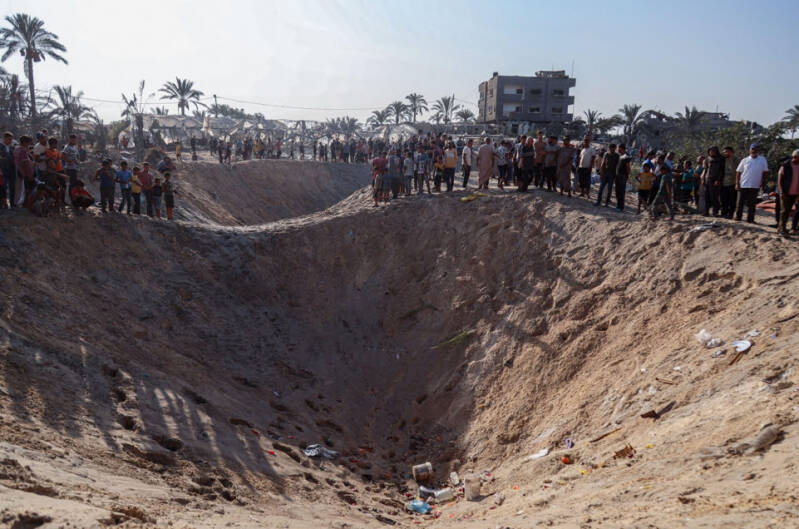
Enorme bomkraters tonen de impact van een Israëlisch bombardement op Al-Mawasi op 10 september 2024. De lichamen van 19 Palestijnen konden worden geborgen. 22 mensen ‘verdampten’.
Dit soort wapens, die van nature geen onderscheid kunnen maken tussen burgers en strijders, zijn verboden onder internationaal humanitair recht. Toch gebruikt Israël ze.
Verdampte lichamen
Wanneer zo’n bom ontploft gaat dat gepaard met temperaturen van meer dan 3.500 graden Celsius, zeggen experts. Lichamen van mensen, die voor circa 80 procent uit water bestaan, kunnen zo’n temperatuur niet weerstaan en verdampen.
Wat overblijft is niets meer dan bloedspatten of kleine stukjes vlees.
De Burgerbescherming in Gaza, die vaak als eerste ter plekke is na een Israëlisch bombardement, heeft in totaal 2.842 Palestijnen gedocumenteerd die op deze manier zijn ‘verdampt’.
Wapenleveranties gaan door
Zoals bekend is de levering van dergelijke zware munitie van de VS aan Israël onverminderd doorgegaan tijdens de genocide.
In juni 2024 meldde persbureau Reuters dat de VS – toen nog onder president Joe Biden – na 7 oktober 2023 zeker 14.000 MK-84 bommen en 1.000 bunkerbommen aan Israël had geleverd. Onder president Donald Trump zijn de leveringen doorgegaan.
Lees het hele artikel
Dadels - vijf vragen en antwoorden
Op 17 februari begint de ramadan. Het dagelijkse vasten tussen het eerste ochtendgloren en zonsondergang wordt traditioneel ‘gebroken’ met melk en dadels. Vandaar dat de verkoop van dadels in deze periode records breekt.
Veel van de dadels die in Nederland worden verkocht zijn door Israëlische bedrijven illegaal geteeld in bezet Palestijns gebied. Op land waarvan de Palestijnse eigenaren zijn verdreven.
Hoe weet je nou zeker dat je een goede dadel te pakken hebt? En als je Palestijnse dadels wilt kopen, waar moet je dan op letten?

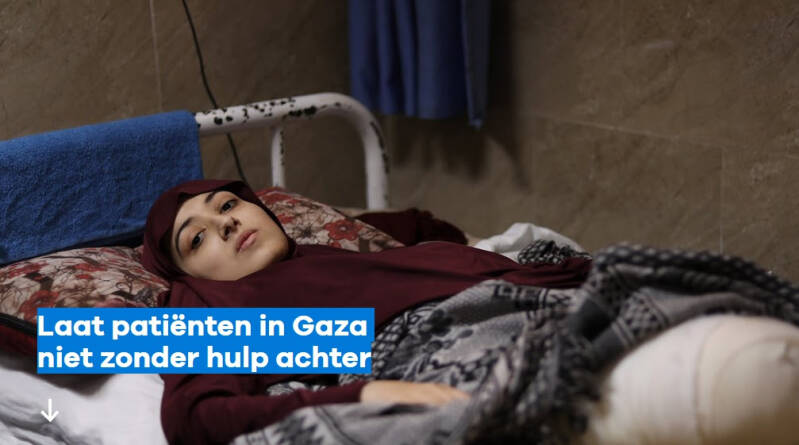
Petitie | Laat patiënten in Gaza niet zonder hulp achter
Artsen zonder Grenzen dreigt per 28 februari onder dwang te moeten vertrekken uit Gaza. Als dat gebeurt, heeft dat rampzalige gevolgen.
Laat patiënten in Gaza niet achter zonder hulp. Roep Rob Jetten op om op zijn eerste werkdag hulp aan patiënten in Gaza bovenaan zijn to-do-lijst te zetten. Onderteken deze oproep van onze collega's van Artsen zonder Grenzen.
Onderteken de oproep
Interview | Journalist Nadia Moussaid: ‘Onze ogen moeten nu op de Westoever gericht zijn’
Afgelopen donderdag was de documentaire ‘Gevangen in Palestina’ te zien op NPO. De docu brengt de Israëlische bezetting en het extreme geweld dat daarbij wordt gebruikt indringend in beeld.
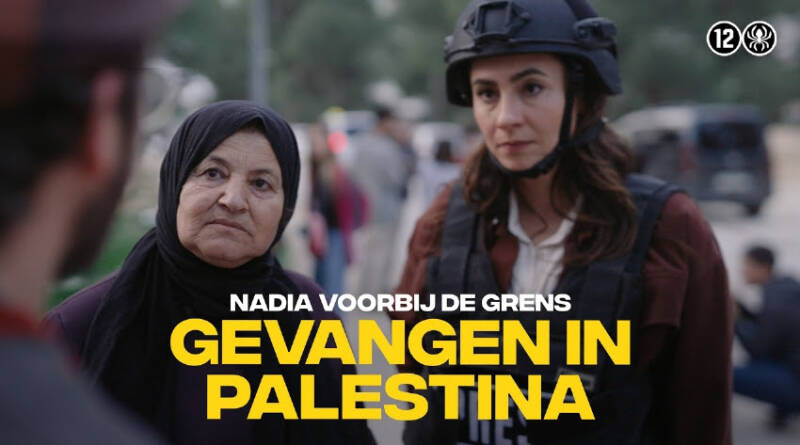
Wij spraken met de maker van de documentaire, Nadia Moussaid.
In ons interview vertelt ze over de verhalen die zij hoorde: over mishandeling, seksueel geweld, uithongering en vernedering in gevangenissen.
'Journalist Sami al-Saei vertelt hoe hij is verkracht. Dat is afschuwelijk, als zo iemand tegenover je zit en over zo’n ervaring vertelt… Het is sadisme, puur sadisme.
Daar zit een commandostructuur achter, het is beleid. Eerder waren er toch beelden gelekt van een Palestijn die in de gevangenis werd verkracht? De vrouw die de beelden lekte, zit nu in huisarrest.
In de Knesset werd erover gezegd dat verkrachtingen in gevangenissen toegestaan zijn. De daders worden niet gestraft maar zijn eerder helden.
We spraken ook twee klokkenluiders die diensten draaiden in gevangenissen. Ze vertelden over uithongering.
Er was een jongen doodgehongerd, en sindsdien werden gevangenen nét voor ze zouden sterven weer wat opgelapt, om daarna weer te worden uitgehongerd.
Er wordt ook bewust schurft verspreid via dekens. Als er cellen zijn waar geen schurft is, wordt een gevangene die het wel heeft, in zo’n cel gezet, zodat het zich verder verspreidt. Je mag niet krabben en als je dat wel doet, word je weer gemarteld.'
Lees het hele interview
Bekijk de uitzending terug

Ophef | Stemt D66 voor of tegen directe erkenning van Palestina?
Ophef deze week naar aanleiding van ons artikel over het stemgedrag van D66 tijdens het formatiedebat. De partij verwierp een motie voor erkenning van de Palestijnse staat.
Dat, terwijl de partij in het afgelopen verkiezingsprogramma nog schreef:
‘Nederland moet nu de Palestijnse staat erkennen en het Palestijnse recht op zelfbeschikking bevestigen’.
D66 verklaarde dat ze bij het formatiedebat tegen alle moties gestemd die buiten de orde vielen van het besluit over de aanstelling van de formateur, ook tegen moties waar de fractie het wel mee eens is. Tegenstemmen waren daarmee procedureel van aard en niet inhoudelijk.
Wij stellen echter vast dat D66 tegen erkenning van Palestina heeft gestemd en tijdens het debat geen stemverklaring heeft afgelegd, waarin de partij deze tegenstem als procedureel had kunnen toelichten.
Wij kijken met belangstelling uit naar de stem van D66, wanneer hierover binnenkort in een inhoudelijk debat wordt gestemd.
Hieronder: een fragment van de podcast Mannen zonder Macht over de kwestie.

Uit onze agenda
zaterdag 14 februari t/m zaterdag 21 februari
DEMONSTRATIES EN WAKES
UTRECHT DOORDEWEEKSE DAGEN 08.30 - 09.30 | Dagelijks stilteprotest voor Palestina, tegen genocide en bezetting (Neude, langs het fietspad)
ARNHEM ZA 14 FEB 15.00 | Mars voor Palestina (start bij stadhuis)
GRONINGEN ZA 14 FEB 13.00 | Wake van Vrouwen in het Zwart (Waagplein)
ROTTERDAM ZA 14 FEB 11.00 | Actiemiddag tegen bloeddadels (Visserijplein)
AMSTERDAM ZO 15 FEB 17.00 | Stil protest tegen de onderdrukking van de Palestijnen (Spui, bij ‘t Lieverdje)
ENSCHEDE ZO 15 FEB 14.00 | Demonstratie voor Palestina (Oude Markt)
HUIZEN WO 18 FEB 11.30 | Wekelijkse sit-in voor Gaza (Gemeentehuis)
DEN HAAG DO 19 FEB 12.00 | 107e sit-in van Rijksambtenaren bij het ministerie van Buitenlandse Zaken, Rijnstraat 8
TREINSTATIONS DO 19 FEB 18.00 | Wekelijkse lawaaidemonstratie op stations in heel Nederland: Stations Alkmaar (17.30 uur), Almelo, Almere Centrum, Amersfoort, Arnhem, Assen, Ede-Wageningen, Enschede, Groningen (mars vanaf Grote Markt 17.30 uur, sit-in station 18.30 uur), Hengelo, Hilversum (17.30 uur), Leiden, Nijmegen, Tiel, Tilburg, Utrecht, Zaandam (17.00 uur), Zutphen
Let op: The Rights Forum probeert de verschillende stationsacties in Nederland zo goed mogelijk bij te houden, maar dat is niet altijd goed mogelijk. Houd de sociale media-pagina's van de plaatselijke solidariteitsorganisaties in de gaten voor de meest actuele informatie.
AMERSFOORT VR 20 FEB 09.30 | Wekelijks stilteprotest tegen genocide (Varkensmarkt)
DEN BOSCH ZA 21 FEB 12.00 | NEVER AGAIN IS NOW! Wake voor Palestina (Burgemeester Loeffplein)
CULTURELE EN ANDERE EVENEMENTEN
PERSINGEN ZA 14 - ZO 15 FEB | Fototentoonstelling Palestijnse vissers met foto's uit 1987 (Persingensestraat 7)
HAARLEM ZO 15 FEB 13.00 - 00.00 | Mars Attacks - Benefitfestival voor Palestina, Slachthuis Haarlem
UTRECHT ZO 15 FEB 15.30 - 17.30 | Tatreez – Palestijnse borduurworkshop (Moira Expo)
ROOSENDAAL VR 20 FEB 16:00 | Film: The Voice of Hind Rajab (C-Cinema, Nieuwstraat 2)
Onze agenda wordt doorlopend aangevuld. Bekijk de hele agenda
2084.
Joep van de goede zaak
13 februari 2026
Op dit moment zitten 42 Gazanen met een geldige Nederlandse verblijfstitel voor studie, onderzoek of werk vast. De Nederlandse overheid kán ze evacueren. Ze hebben een beurs, fellowship of contract. [1,2] Vanaf 1 februari 2026 mochten zij starten bij universiteiten, kennisinstellingen en werkgevers in Nederland. Maar ze zitten nog vast in Gaza, in een situatie van voortdurende bombardementen, honger en blokkade.
Hun recht is verleend, maar het wordt waardeloos gemaakt. Omdat vertrek zonder actieve ondersteuning van de Nederlandse overheid praktisch onmogelijk is.
Israël houdt onrechtmatig volledige controle over wie Gaza in en uit mag. In zo’n situatie is consulaire bijstand (hulp van een ambassade of consulaat aan burgers in het buitenland) geen luxe, maar een levenslijn.
Het Ministerie van Buitenlandse Zaken weigert hulp te verlenen. Dat betekent: mensen met geldige Nederlandse documenten blijven vastzitten in een verwoest gebied, terwijl instellingen hier klaarstaan om hen op te vangen.
TEKEN DE PETITIE
Nederland hééft eerder laten zien dat het kan. Het kan dus wél! In augustus 2025 werden 10 Gazanen met Nederlandse documenten geëvacueerd met consulaire ondersteuning. In september konden mensen nog vertrekken, waaronder studenten die hun studie bij Maastricht University voortzetten, en journalist Abu Ahmed Artema verbonden aan het Netherlands Institute for Advanced Study, die nu schrijft voor De Correspondent. [3] Het is dus geen kwestie van mogelijkheid, maar van politieke wil.
Op 16 februari 2026 volgt een uitspraak in een spoedzaak over drie van de 42. Maar de andere 39 zitten in exact dezelfde nood. Wachten op procedures is niet neutraal: het is een keuze met reëel levensgevaar als gevolg.
Daarom roepen Dutch Scholars for Palestine en DeGoedeZaak op: teken de petitie en deel haar vandaag nog. Vraag je universiteit, onderzoeksgroep, werkgever of studievereniging om de oproep te verspreiden. Spreek je netwerk aan: één share kan nét het verschil maken tussen stilte en druk.
TEKEN DE PETITIE
Deze 42 mensen vragen geen gunst. Ze vragen dat Nederland uitvoert wat het al heeft toegezegd. Teken nu, en maak handelen onontkoombaar voor Rob Jetten en zijn kabinet.
Met strijdbare groet,
Abdelkader van Dutch Scholars for Palestine
Joep van DeGoedeZaak
2082.

13 februari 2026
Drie keer BDS-actie. We hebben onze stem laten horen bij de Cisco Live! conventie in Amsterdam. Met de Ramadan in aantocht vestigen we weer de aandacht op foute, Israëlische dadels en hoe ze te vermijden. En ondanks eerdere protesten en verstoringen laten twee theaters de IDF-muzikanten van het Jerusalem Quartet weer optreden. Dat gaat uiteraard niet zonder protest.
Op 22 februari treedt het Jerusalem Quartet op in Groningen en op 25 februari in Tilburg. De mooie klanken van hun muziek kunnen niet verhullen dat zij onderdeel zijn van de Brand Israel Campagne, in het leven geroepen door het Israëlische ministerie van Buitenlandse Zaken om het imago van Israël op te poetsen en zijn oorlogsmisdaden wit te wassen.
Tilburg4Palestine en ApartheidVrij Groningen organiseren daarom acties. Groningen heeft een brief gestuurd naar de organiserende theaterorganisatie SPOT met de oproep "net als honderden andere Nederlandse en Belgische culturele instellingen en culturele werkers, aan te sluiten bij de culturele boycot van de Israëlische staat en alle direct of indirect medeplichtige instellingen en bedrijven."
Als je in de buurt bent, sluit je aan bij het protest!
Het beëindigen van alle staats-, bedrijfs- en institutionele medeplichtigheid aan Israëls genocidale regime is urgenter dan ooit. Laten we campagnes voor biologische dadels intensiveren en ons bewust inzetten om de wereldwijde boycotcampagnes van producten van medeplichtige bedrijven (Israëlisch en internationaal) te versterken
Boycot Israëlische dadels: Verbreek je vasten tijdens de Ramadan niet met Israëlische dadels - geteeld op gestolen Palestijns land en met gestolen water. Controleer altijd zorgvuldig het etiket en koop geen dadels die geproduceerd of verpakt zijn in Israël of de nederzettingen op de Westelijke Jordaanoever. Als er geen land van herkomst op de doos te vinden is, scan dan de barcode met de Boycat app.
Download hier onze flyer!
Download
Opnieuw was IT-gigant Cisco aanwezig in Amsterdam met hun "Cisco Live!" evenement..
Cisco levert onder meer telefoontapdiensten met behulp van biometrische stemgegevens van Palestijnse gevangenen, van wie velen zonder aanklacht of proces worden vastgehouden in onmenselijke omstandigheden die door de toonaangevende Israëlische mensenrechtenorganisatie B´Tselem worden omschreven als “menselijke kippenhokken”.
Cisco beweert een 'bewuste cultuur' te hebben van 'waardigheid, respect, eerlijkheid en gelijkheid', terwijl het Israël in staat stelt oorlogsmisdaden tegen Palestijnen te plegen. Cisco heeft een morele en wettelijke verplichting om een einde te maken aan zijn medeplichtigheid aan het regime van apartheid, genocide en mensenrechtenschendingen van Israël. Dus protesteerden wij bij de RAI en informeerden daar het publiek over Cisco's medeplichtigheid aan bezetting, apartheid in genocide.
2081.

12 februari 2026
Humanitarian Situation Update #357
Gaza Strip
12 February 2026
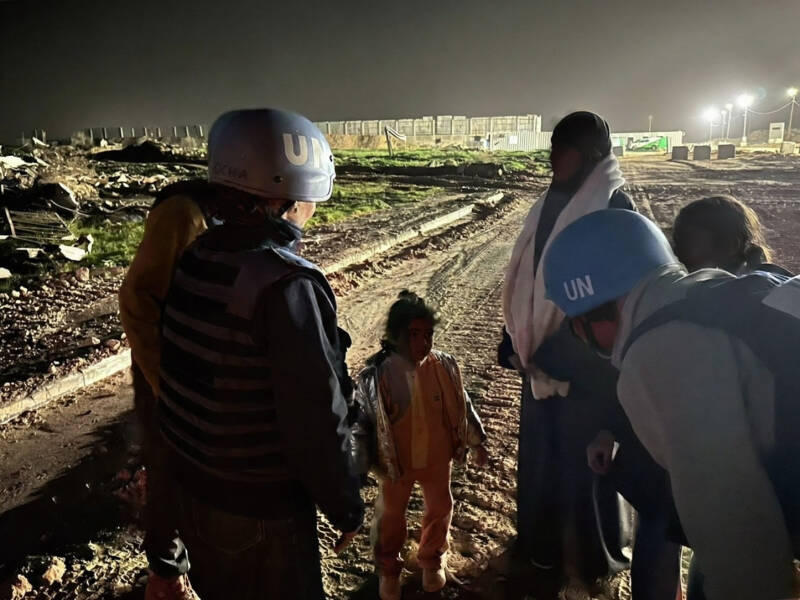
Palestinian returnees received by a UN team after entering through the newly reopened Rafah crossing and passing through a military facility (seen in the background) where Israeli forces operate an internal checkpoint. Photo by OCHA/Zein Tayyeb
Key Highlights
- Airstrikes, shelling and gunfire continue across Gaza, causing casualties and exposing civilians, including aid workers and medical teams, to deadly risks.
- Rafah Crossing reopened for limited movement of people for the first time in nearly 11 months, enabling further medical evacuations and returns to Gaza, amid reports of ill-treatment of returnees during transit.
- Shelter conditions remain dire for most displaced people, pushing some to stay in unsafe locations or search rubble for essentials, while children remain exposed to explosive ordnance and older people face heightened health risks and challenges accessing care and assistance.
- Access to water and sanitation facilities has improved since the ceasefire agreement, but water quality remains unsafe, contributing to rising cases of diarrhoea and hepatitis A, particularly among children.
- Winter weather and transit delays have led to significant spoilage of food commodities before and during entry into Gaza, while partners work to safely dispose of damaged goods amid constrained storage and landfill capacity in the Strip.
Context Overview
- Airstrikes, shelling and gunfire continue to be reported across the Gaza Strip, resulting in casualties. The Israeli military remains deployed in over 50 per cent of the Gaza Strip north, west and south of the “Yellow Line,” where access to humanitarian facilities and assets, public infrastructure, and agricultural land is either restricted or prohibited. Access for Palestinians to the sea remains prohibited. Detonations of residential buildings and bulldozing activities continue to be reported, including near and east of the “Yellow Line.”
- Over the past two weeks, strikes were reported on both sides of the “Yellow Line,” including in densely populated areas, heightening risks to civilians. Médecins Sans Frontières (MSF) reported that its teams across Gaza treated seven patients, including two children, injured in incidents attributed to Israeli attacks between 31 January and 2 February. On 5 February, Israeli forces reportedly demolished an UNRWA school that was the last remaining structure within a compound of six schools. Highlighting the extremely precarious situation for many children in Gaza, UNICEF noted that children continue to be affected by airstrikes and the disruption of essential services, with 37 children reported killed since the beginning of the year.
- According to the Ministry of Health (MoH) in Gaza, between 28 January and 11 February 2026, 109 Palestinians were killed, 252 were injured, and 10 bodies were recovered from under the rubble. This brings the casualty toll among Palestinians since 7 October 2023, as reported by the MoH, to 72,045 fatalities and 171,686 injuries. According to the MoH, the total number includes 259 fatalities who were retroactively added between 23 January and 6 February after their identification details were approved by a ministerial committee. The MoH reported that since the ceasefire agreement, 591 Palestinians have been killed, 1,591 injured, and 720 bodies retrieved from under the rubble. On 4 February, the MoH stated that 54 bodies and 66 boxes containing human remains and body parts were released by the Israeli authorities and transferred to Al Shifa Hospital via the International Committee of the Red Cross (ICRC).
- On 4 February, an MSF health worker was hit by a stray bullet inside a health-care facility in Al Mawasi and is in stable condition. On the same day, a Palestine Red Crescent Society (PRCS) paramedic was killed while providing emergency medical services in Khan Younis during an attack in the Al Mawasi area, according to the International Federation of Red Cross and Red Crescent Societies (IFRC). Between 7 October 2023 and 9 February 2026, at least 588 aid workers (189 women and 399 men) have been killed in the Gaza Strip, including 396 UN staff and team members, 133 NGO workers, 55 PRCS staff and volunteers, and four ICRC staff.
- According to the Israeli military, between 28 January and 11 February 2026, no Israeli soldiers were killed in the Gaza Strip. The casualty toll among Israeli soldiers since the beginning of the Israeli ground operation in October 2023 stands at 471 fatalities and 3,004 injuries. According to Israeli forces and official Israeli sources cited in the media, more than 1,671 Israelis and foreign nationals have been killed, most of them on 7 October 2023 and its immediate aftermath.
- According to the UN 2720 Mechanism, between 26 January and 9 February, more than 19,000 metric tons (MT) of humanitarian aid were collected by the United Nations (UN) and partners from Gaza’s crossings, compared with nearly 21,000 MT of aid collected in the preceding two-week period (11-25 January). Most of the aid (66 per cent) continued to be collected from Kerem Shalom Crossing, while the remaining 34 per cent was collected from Zikim Crossing.
- Food Security Sector (FSS) partners report that food safety during transit, storage and meal preparation remains a major concern. Adverse winter weather has led to significant spoilage before commodities enter Gaza as cargo has been exposed to rain at crossings and during transportation. Additional challenges include access constraints and prolonged inspection procedures. Some shipments, including food aid, spend several days or even weeks at crossings, further contributing to increased losses.
- About 1,500 MT of spoiled commodities already inside Gaza have been segregated in dedicated warehouses to prevent cross-contamination. At community kitchens, limited electricity supply and lack of refrigeration equipment increase the risk of spoilage of perishable foods. To mitigate health and protection risks related to damages, FSS partners are exploring options for the safe disposal of damaged food outside populated areas in consultation with water, sanitation and hygiene (WASH) and solid waste management partners. Identifying additional disposal sites remains challenging, as three of the 10 temporary dumping sites currently receiving waste are at capacity, with three other sites expected to reach full capacity in the coming months. The two main landfills in areas east of the “Yellow Line” remain inaccessible.
- Humanitarian movements inside Gaza continue to require coordination with Israeli authorities to and from crossings and in or near other areas where Israeli forces remain deployed. Between 26 January and 9 February, 120 humanitarian missions were coordinated with the Israeli authorities, of which 61 were facilitated, 24 were impeded, 20 were denied and 15 were cancelled by the requesting organizations due to operational, logistical or security reasons. The 61 facilitated missions included 23 missions to collect humanitarian cargo from the Kerem Shalom and Zikim crossings, 10 missions related to the movement of humanitarian personnel, and 12 monitoring missions. They also included eight medical evacuation missions conducted via Kerem Shalom and Rafah crossings, as well as two life-saving missions, among other activities.
Rafah Crossing, Medical Evacuations and Access to Health Care
- On 2 February, Palestinian patients were evacuated through Rafah Crossing between the Gaza Strip and Egypt for the first time since March 2025 and, for the first time since October 2023, a limited number of Palestinian returnees were allowed entry into Gaza. Between 2 and 10 February, the UN and partners supported the medical evacuation of 142 patients, alongside companions, including 91 patients (64 per cent) via Rafah Crossing and 51 patients (36 per cent) via Kerem Shalom Crossing. During the same period, UN teams in Gaza received 223 Palestinian returnees. The UN and partners provide all returnees with transportation to Nasser Hospital, in Khan Younis, where a reception area has been established to provide access to protection officers, psychologists, medical staff, emergency assistance and other resources, ensuring a safe and dignified reception process and timely response for urgent concerns. According to Israeli authorities, the return of people from Egypt to the Gaza Strip will be permitted, in coordination with Egypt, for people who left Gaza during the course of the war only and after a security clearance by Israel. Rafah Crossing was closed on Friday and Saturday.
- According to the World Health Organization (WHO), between October 2023 and January 2026, 10,762 patients and over 12,000 companions were medically evacuated outside Gaza, about 70 per cent of them in the first seven months. Following the closure of Rafah Crossing on 7 May 2024, 3,218 patients were evacuated, including 1,702 between 19 January and 17 March 2025 and 377 patients between 13 October and 26 January 2026 (see chart below). At the current pace, Save the Children estimates that evacuating those in need could take over a year. Thousands of patients remain without access to specialized treatment unavailable in Gaza, and more than 18,500 people, including 4,000 children, remain in urgent need of medical evacuation.
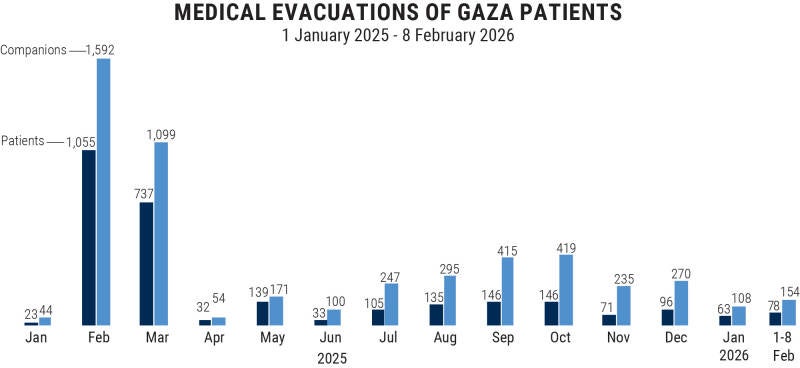
Source: The World Health Organization and the Health Cluster’s Unified Dashboard
- On 5 February, the UN Human Rights Office (OHCHR) in the Occupied Palestinian Territory (OPT) reported patterns of ill-treatment and humiliation of Palestinians returning to Gaza via Rafah Crossing. Reported practices include coercive interrogations, degrading treatment and confiscation of personal belongings. Some returnees also reported being denied access to medical care and basic facilities and facing intimidation, including pressure to discourage their return. OHCHR expressed concern that such practices may violate international human rights law and undermine safe and dignified returns.
- Gaza’s health system continues to face significant pressure due to staff shortages and damaged infrastructure. Many urgently needed professionals, including doctors, nurses, physiotherapists, and mental health professionals, have been unable to complete their studies or obtain certification because of financial constraints. The UNDP Programme of Assistance to the Palestinian People, the Ministry of Education and Higher Education, and local universities are supporting 470 final-year health students to overcome these barriers, complete their training, and fast-track certification. The addition of these health workers is expected to strengthen the provision of essential services, support livelihoods, and contribute to a more resilient Gaza health sector. In parallel, humanitarian partners report ongoing efforts to strengthen local health services, including rehabilitating damaged facilities and expanding critical care capacity, which require additional medical supplies and equipment, some of which face approval constraints.
Displacement, Shelter Conditions and Protection Risks
- Most people in Gaza continue to be displaced with many living in extremely harsh conditions. As of 11 February, at least two thirds of the population (1.4 million of 2.1 million people) are estimated to reside in about 1,000 displacement sites, often in overcrowded settings and in tents that offer limited privacy and protection from the elements, according to the Site Management and Protection clusters. These include more than 800 makeshift sites (informal groupings of tents on open land), in addition to collective centres and scattered sites (small clusters of displaced households dispersed within communities).
- In January, over 85,000 households received shelter assistance, including about 5,500 households reached through inter-cluster distributions targeting people most affected by flooding. However, according to the Shelter Cluster, the response remains heavily reliant on tents despite their short lifespan and limited protection, as current access conditions continue to prevent the entry of materials needed for more durable solutions. People sheltering in damaged buildings face additional safety risks, with 230 families reported to be living in structures at high risk of collapse, the Shelter Cluster reports, noting that it is working with affected families to assess their needs and survey intentions, including assistance on shelter options for households that choose to move.
- According to the Protection Cluster, precarious living conditions are pushing some people to adopt high-risk coping strategies, including sheltering in areas potentially contaminated with explosive ordnance (EO) or searching through rubble for firewood and other essential materials. Since the October 2025 ceasefire agreement, Mine Action (MA) partners have documented 33 EO incidents, resulting in nine fatalities and 65 injuries, including children. Since October 2023, more than 700 EO items have been identified as posing threats to civilians and recovery efforts. MA partners continue to support debris removal and humanitarian operations through explosive hazard assessments, inter-agency missions and EO risk education. Since the latest ceasefire agreement, they have conducted a monthly average of 320 assessments and reached more than 600,000 people (including children) through explosive ordnance risk education sessions.
- Prolonged displacement and deteriorating living conditions are increasing psychological stress and protection risks, including gender-based violence (GBV) and community tensions, with increased vulnerability reported among widows, female-headed households, large families with children, and persons with disabilities. Protection partners continue to provide community-based protection, psychosocial support, case management, cash and voucher assistance, and disability-inclusive services. Since the ceasefire agreement, partners have reached an average of 37,000 people per month with direct general protection services, in addition to those reached with specialized services addressing GBV, child protection, mine action, and legal support.
- In January, 46 unaccompanied or separated children were reunited with caregivers, while 74 were placed in alternative care pending family tracing. Partners currently operate 217 child-friendly spaces that also provide psychosocial support and referral services. The feasibility of mobile child protection teams is under review to reach underserved locations, particularly after 11 high-risk communities in Rafah and Khan Younis governorates were recently identified as distant from existing services.
- A recent HelpAge International assessment highlights the particular challenges faced by older people in displacement, many of whom live with chronic illness, disability and reduced mobility. More than three quarters are living in overcrowded tents, and many report difficulties accessing food, medicines and health care, increasing the risk of rapid health deterioration. Repeated displacement, limited privacy and reliance on assistance further undermine their wellbeing. The Protection Cluster continues to strengthen protection mainstreaming by promoting age-, gender- and disability-inclusive assistance across sectors.
Access to Water
- Partners continue to expand efforts to enhance water availability by operating more water points, including wells and small-scale desalination plants (56 vs. 38 in September), activating four desalination plants, and rehabilitating 40 water wells. Emergency maintenance by local municipal actors has further supported service continuity, with five wells restored by the Coastal Municipal Water Utility in January, and 12 main wells repaired by the Palestinian Water Authority (PWA) in northern Gaza, including six in Jabalya. Debris removal to reopen roads continues despite shortages in heavy equipment.
- Many people continue to rely on water trucking and emergency distributions. According to the WASH cluster, as of 11 February 2026, partners are delivering 19,969 cubic metres of drinking water per day across the Strip, through 126 distribution points in North Gaza, 728 in Gaza city, 453 in Deir al-Balah, and 839 in Khan Younis. Of 723 water-related appeals received by partners between early November and early February; 45 per cent were addressed, while the remainder are under review as partners mobilize resources based on capacity. Partner observations indicate that water shortages are particularly severe in high-density areas, such as Al Mawasi in Khan Younis.
- The three Mekorot lines currently supply about 42 per cent of the water they used to provide prior to October 2023 and the flow is unreliable, the WASH Cluster reports. In mid-January, the Mekorot pipeline serving Gaza city, which reportedly supplied 70 per cent of the city’s needs, was damaged, significantly reducing people’s access to drinking water until repairs were completed in early February following coordination with Israeli authorities. Disrupted access to water is exacerbated by irregular fuel deliveries, as reported by the Union of Gaza Strip Municipalities, and shortages of spare parts and consumables needed for repairs.
- According to WHO, analysis of 4,978 drinking and domestic water samples collected in 2025 across the Gaza Strip shows that over 77 per cent do not meet health standards. Microbiological contamination remains widespread, with approximately 16 per cent of samples contaminated with fecal coliforms and over eight per cent with E. coli. For drinking water specifically, over 67 per cent of the 4,978 samples did not meet health standards. Unsafe samples were most prevalent in Gaza city (83 per cent), Deir al-Balah (50.5 per cent), Khan Younis (54 per cent), North Gaza (85 per cent); there were no samples from Rafah. According to the Health Cluster, approximately 5,800 cases of acute jaundice syndrome (hepatitis A) were reported in 2025, with a marked increase observed in November and December 2025. In addition, over 496,000 cases of acute watery diarrhoea were reported, of which about 47 per cent were among children under five. This represents a significant increase compared with over 206,000 cases reported in 2024, half among children.
Funding
- As of 11 February, Member States disbursed approximately US$212 million of the $4 billion (5 per cent) requested to meet the most critical humanitarian needs of nearly 3 million out of 3.6 million people identified as requiring assistance in Gaza and the West Bank, including East Jerusalem, under the 2026 Flash Appeal for the OPT. Nearly 92 per cent of required funds are for the humanitarian response in Gaza, with over eight per cent for the West Bank. In January, the oPt Humanitarian Fund (HF) managed 102 projects, totaling $56.4 million, to address urgent needs in the Gaza Strip (89 per cent) and the West Bank (11 per cent). Of these projects, 49 are being implemented by international NGOs, 43 by national NGOs and 10 by UN agencies. Notably, 48 out of the 59 projects implemented by international NGOs or the UN are being implemented in collaboration with national NGOs. For more information, please see OCHA’s Financial Tracking Service webpage and the oPt HF webpage.
2080.

12 februari 2026
What 120 million people were just told about antisemitism.
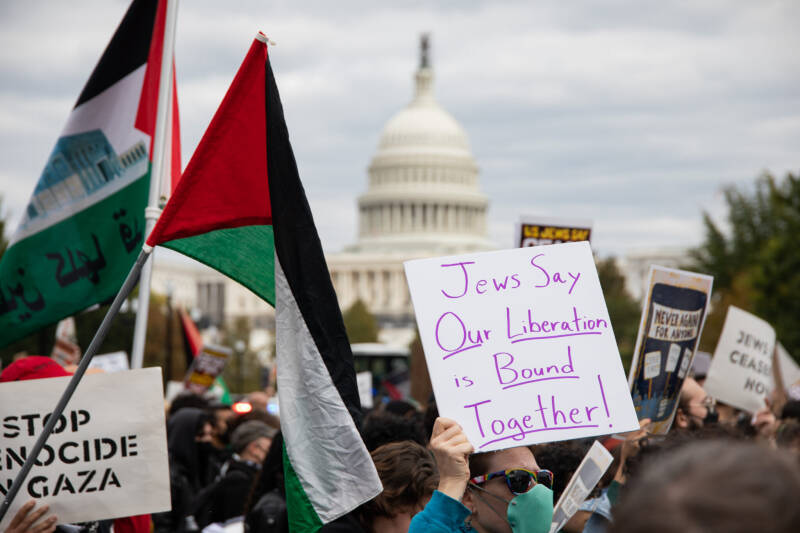
On the ground in Gaza: a snapshot
- “No one inside Gaza is calling this a ceasefire, not even the children.” The Israeli military has killed more than 500 Palestinians in Gaza since the ceasefire was declared in October.
- Exacerbated by the Israeli government’s near-total destruction of infrastructure, including homes, hospitals, and basic sanitation, winter conditions in Gaza have been brutal. Hundreds of tents have flooded and collapsed in heavy rains, killing dozens and endangering hundreds of thousands. At least nine people, including infants, have frozen to death in Gaza this winter.
- The supposed “reopening” of the Rafah crossing last week has been a disaster, with Israel continuing to severely restrict medical evacuations. More than 20,000 Palestinians urgently require medical evacuations, but the Israeli government is allowing fewer than a dozen evacuations per day, while continuing to restrict the influx of critical aid into Gaza.
Act now: Demand the U.S. stop arming Israel
Meanwhile, the right weaponizes accusations of antisemitism
There was no mention of Gaza on Sunday night, when more than 120 million people tuned into the Super Bowl, but billionaire interests still managed to push an anti-Palestine narrative.
A 30-second ad spot claiming to fight antisemitism ran midway through the game. The $15 million ad was paid for by the “Blue Square Alliance Against Hate” (BSA), an organization explicitly launched in 2019 to counter the success of growing calls to divest from Israeli apartheid and occupation. BSA was founded by Patriots’ billionaire owner Robert Kraft, friend to Trump and million-dollar donor to the racist, war-mongering, anti-Palestinian lobby group AIPAC.
The use of false and dangerous antisemitism data
The ad showed a Jewish teenager walking down a school hallway while the surrounding students stare and laugh at him. When he gets to his locker, he sees that someone has placed a sticky note reading “Dirty Jew” on his bag, until a Black classmate comes over and covers it up with the BSA’s signature “blue square” sticky note. He tells the Jewish student “I know how it feels.” A statistic onscreen informs the viewer that “2 out of 3 Jewish teens have experienced antisemitism.”
Unsurprisingly, this stat is credited to the Anti-Defamation League (ADL), a pro-Israel lobby group that is at the forefront of the effort to push a false narrative conflating antisemitism with criticism of the Israeli government. ADL data on antisemitism has come under consistent fire for its inaccuracy, particularly its practice of counting any “anti-Israel or anti-Zionist” speech or actions in its data as “antisemitic acts,” including instances of anti-Zionist Jews speaking out for Palestine.
Kraft’s ad suggests that the antisemitism that “2 out of 3 Jewish teens” experience is flat-out hate speech and clearly equates it to anti-Black racism. But since the ad uses ADL data, we have no way of knowing that these statistics about Jewish teenagers experiencing antisemitism don’t include every time someone said “Free Palestine” in the lunchroom. This false definition of Palestine advocacy as antisemitic is wholly baked into the numbers.
Join the Power-Half Hour against ICE.
Join JVP's Power Half-Hour today at 3pm ET, when a special guest from the Detention Watch Network will share about their immigrant defense work and lead us in taking action to cut funding for ICE.
Register now
Of course, the ADL’s intentional misrepresentation of antisemitism data makes it harder to actually identify and address antisemitism when it does show up. As the extreme right wing rises in power, explicit antisemitism has become widespread in certain corners of social media, common with popular right-wing media personalities, and espoused by a laundry list of Trump administration officials. This normalization of antisemitism at the highest levels of government is horrifying, and its spread on social media directly impacts what teenagers hear from their peers.
But groups like the ADL and Kraft’s BSA aren’t actually concerned with reducing bigotry. Their goal is instead to use accusations of antisemitism to crush criticism of the Israeli government and smear advocates for Palestinian freedom as anti-Jewish racists. In fact, they’re more than happy to ignore antisemitism when it comes from Israel’s defenders.
A report in Jewish Currents found evidence that ADL data may “significantly undercount right-wing antisemitic incidents,” despite the ADL’s own data collection showing white nationalist groups being the most frequent perpetrators of clear-cut antisemitism. In one of the most egregious recent examples of this pattern, ADL head Jonathan Greenblatt defended Elon Musk’s Nazi salute as “awkward.” Only months before, he had compared the Palestinian keffiyeh to a Nazi swastika.
Hear from Christian leaders challenging Zionism.
Join Adalah Justice Project, Jewish Voice for Peace, and Christians for a Free Palestine on Monday, February 16 for a conversation with Christian leaders organizing for Palestinian freedom and a faith rooted in collective liberation.
Register now
Deploying the re-definition of antisemitism
The cost of this intentional misrepresentation is thousands upon thousands of Palestinian lives, as this narrative is used as a bludgeon to suppress and criminalize Palestinians and the solidarity movement across the globe. We’ve seen this false definition of antisemitism used against anti-genocide advocates everywhere over the last few years, from universities censoring and expelling students and firing faculty for their supposed “antisemitism” in standing up for Palestine, to kidnapping and deporting student activists, to Congresspeople dismissing calls to end U.S. funding of Israel’s genocide as unfairly biased against Israel.
Israeli government propaganda has used this strategy of calling something one thing while it’s clearly another for decades, and not only with false allegations of antisemitism. The splashy declaration of a so-called “ceasefire” deal in October 2025 is yet another example.
While it’s pulled media attention away from Gaza and slowed the tide of international advocacy, the “ceasefire” period has not meant an end to the genocide in Gaza. The Israeli military has killed more than 500 Palestinians in Gaza since October, and alongside Trump, recently unveiled plans to ethnically cleanse and resettle Gaza and force the Palestinians that remain into dystopian, hyper-surveilled concentration camps.
What we're reading: A Day for Gaza.
Last week, the Nation dedicated one day on its website to stories and photos directly from Gaza and its people. Read their forceful records of what's been lost and life in Gaza right now.
Read more
The fearmongering is the point
The BSA's Super Bowl ad was so absurd that even Israel’s defenders didn’t buy it. Zionist Jewish social media and news outlets lit up early this week, lambasting the ad for portraying the Jewish student as weak and unable to stand up for himself, and for not being explicit enough about the idea that most “antisemitic” incidents in schools are not anti-Jewish hate speech, but of course, criticism of Israel.
But even the ADL knows that the Israeli government is more unpopular than ever, and that claiming outright that opposing a genocide is antisemitic is an increasingly losing argument. In response to Zionist outcry that the ad didn’t say the quiet part out loud, the ADL responded that they’d tested the ad and “it worked” — viewers of the ad were slightly more likely to “fight antisemitism” after watching.
The ADL weathered the anger over the ad’s portrayal of the Jewish student as vulnerable and almost everyone around him as complicit in antisemitism because this narrative is crucial for the ADL and its allies. Their hope is to foster a culture of fear and confusion, one which does nothing to identify and confront real antisemitism, but instead works to shut down free speech and defend Israeli impunity. For Jews, this fearmongering is intended to stoke a constant fear of the world around us and legitimize anti-Palestinian racism; for others, it’s meant to create an immediate association between criticizing Israel and being racist towards Jewish people.
Groups like the BSA and ADL desperately want us to believe that it’s us or them. But we reject this fearmongering entirely. We will always choose solidarity with each other.
Tell Congress: Stop arming Israel NOW.
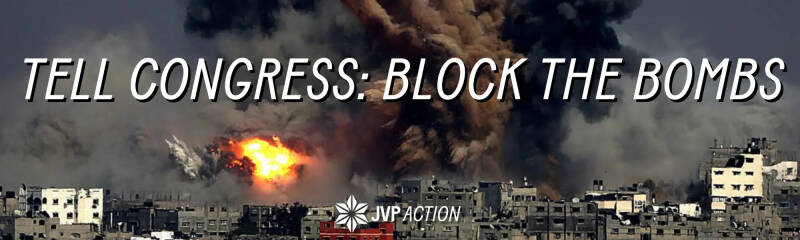
Zionist narratives are trying desperately to erase the truth: The U.S. has spent billions funding Israel's unspeakable genocide of Palestinians.
Use this tool from our sibling organization JVP Action to demand your Congressperson commit to stop arming Israel now.
Email Congress now
2079.

11 februari 2026
The Hind Rajab Foundation has supported a landmark private prosecution in Australia against Israeli President Isaac Herzog on charges including genocide and crimes against humanity.
In parallel, HRF has filed a legal complaint in the United States against Israeli soldier Adi Karni.
The U.S. complaint invokes federal statutes criminalising war crimes and genocide.
More details below.
SUPPORT OUR WORK
Australia: Private Prosecution Filed Against Herzog
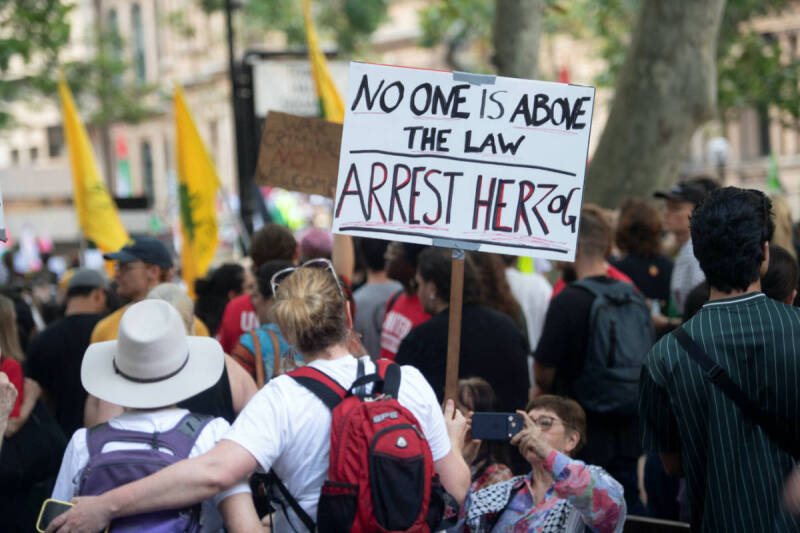
Sydney/ Australia
A landmark private prosecution has commenced in Australia against Israeli President Isaac Herzog, following a joint complaint submitted by the Hind Rajab Foundation (HRF), the Jewish Council of Australia, and the Australian National Imams Council (ANIC).
Lawyers representing Melbourne academic Tasnim Sammak have filed a charge sheet in the Magistrates' Court of Victoria alleging eight serious offences, including genocide and crimes against humanity, under Australian federal law.
The genocide charge is brought under Section 268.5 of the Commonwealth Criminal Code, which grants extended geographical jurisdiction over international crimes. The filing alleges that President Herzog, through acts and public statements, aided and abetted the deliberate infliction of conditions of life calculated to bring about the destruction of the Palestinian people in Gaza.
HRF has announced that it will seek leave to intervene as amicus curiae should proceedings advance.
"International criminal law exists precisely to address situations where state power is used to destroy a protected population. If domestic courts have jurisdiction, they must act. Immunity cannot become impunity," said Dyab Abou Jahjah, General Director of HRF.
This case represents a significant step in activating domestic courts where international mechanisms remain slow or constrained.
United States: Legal Complaint Filed Against Adi Karni
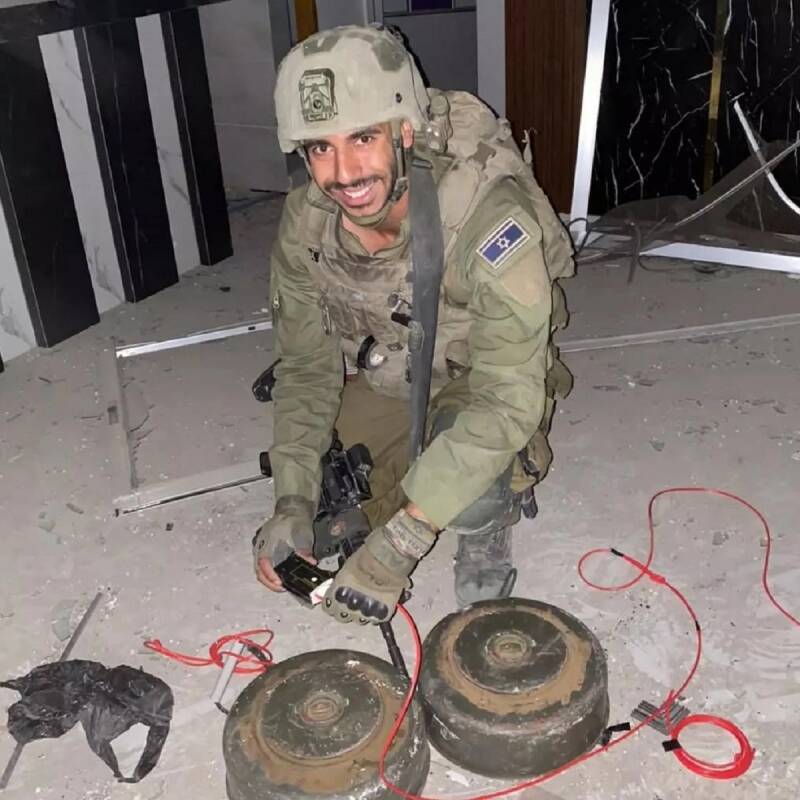
New York / United States
In parallel, HRF has filed a legal complaint in the United States against Adi Karni, a former sergeant in the 603rd Combat Engineering Battalion, currently present in the U.S. and recently invited to speak at Boston University.
The filing is grounded in U.S. federal statutes, including:
18 U.S.C. §2441 (War Crimes Act)
18 U.S.C. §1091 (Genocide Statute)
HRF's investigative report documents Karni's alleged participation in the destruction of civilian and religious structures in Gaza and highlights public statements denying the existence of civilians in Gaza — rhetoric legally relevant to establishing genocidal intent.
Notably, HRF has already filed against Karni in Peru, where a criminal investigation is open for genocidal crimes. Additional filings have been made in other jurisdictions as part of a coordinated legal strategy.
Karni's current presence in the United States activates U.S. jurisdiction.
"Presence triggers responsibility. When individuals credibly implicated in international crimes are found on U.S. soil, investigation is not discretionary — it is required," said Jake Romm, HRF's U.S. representative.
2078.
11 februari 2026
Trump Administration must end all aid to Israel, enforce accountability, and reject Israel’s annexation
American Muslims for Palestine (AMP) condemns Israel for granting itself and settlers new “authorities,” further entrenching the occupation and making it easier to steal Palestinian land. These measures, which ease the sale of Palestinian land to Israeli settlers and extend Israeli administrative and enforcement into areas nominally under Palestinian control, constitute a grave escalation of Israel’s apartheid regime and amount to de facto annexation of occupied Palestinian territory.
Israel’s new policies are deliberate steps to accelerate Israel’s land theft, ethnic cleansing, and permanent domination of Palestinians. Under international law, Israel is illegally occupying the West Bank, and neither the Israeli government nor Israeli settlers have any legal right to Palestinian land. Yet the Israeli security cabinet has removed internal prohibitions that blocked settlers from purchasing land in the occupied West Bank. This change now allows for private settler land seizures without the state first formally expropriating the Palestinian’s land, accelerating the pace at which Israelis steal the land from Palestinians.
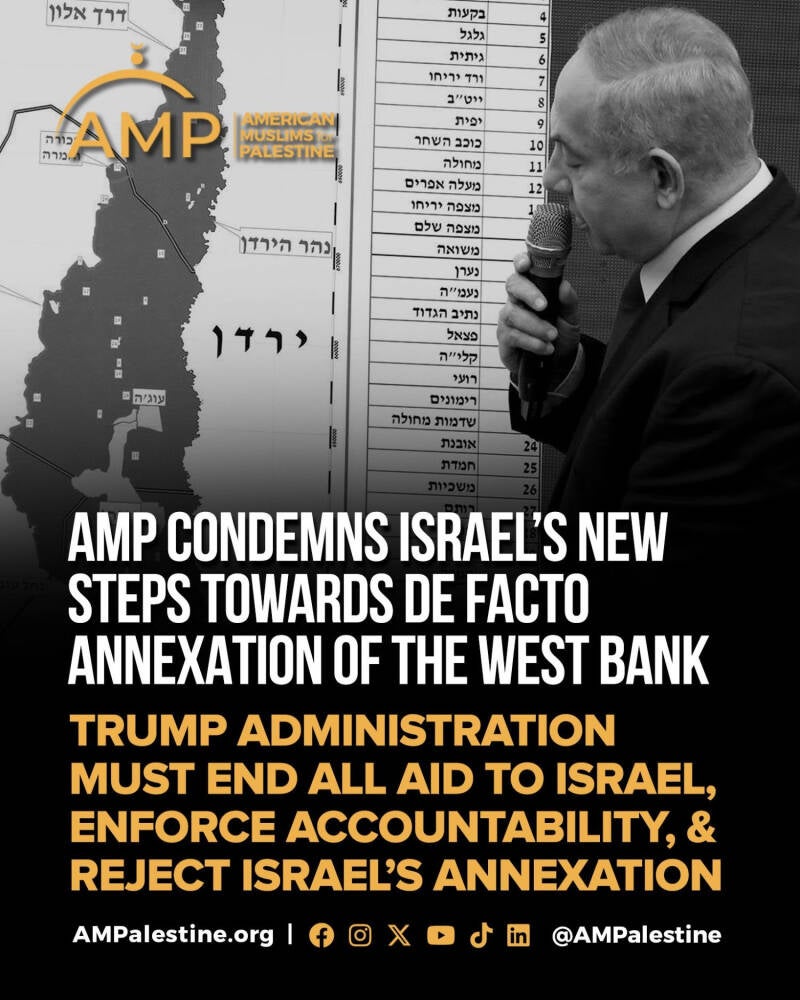
Netanyahu’s administration also effectively erased the remaining distinctions between Areas A, B, and C, making it easier to impose Israeli administrative and security control over Palestinians, including in the West Bank’s largest cities. These measures directly empower settlers to steal Palestinian land and, in practice, carry out full annexation of the West Bank, even without a formal declaration.
Israel’s decision also represents open defiance of the Trump administration. After symbolic annexation votes in the Israeli Knesset in summer of 2025, President Donald Trump publicly stated that annexation of the West Bank would not be allowed. Vice President JD Vance dismissed those votes as reckless, and Secretary of State Marco Rubio warned that annexation would not receive U.S. support. Israel has now openly ignored those warnings, treating them as mere suggestions and moving forward with policies that achieve annexation in all but name. Netanyahu’s government has done so while the Trump administration continues to push for $3.8 billion in military aid to Israel.
“These measures are another shameful step toward Israel’s complete annexation of the West Bank,” said Dr. Abu Irshaid. “But what’s even more shameful is that Israel is openly implementing annexation while the Trump administration responds with empty rhetoric and even rushes to provide Israel billions more in aid.”
AMP calls on the Trump administration to stop being walked on by the Israeli government and to move beyond statements and take concrete action against Israel. First and foremost, the United States must name these measures for what they are: de facto annexation and a violation of international law. It must end its complicity by ending all aid to Israel, enforcing accountability, and rejecting Israel’s occupation and apartheid whole stop.
Israel’s occupation is illegal. Its settlements are illegal. Its annexation project is illegal. Continued U.S. tolerance and enablement of these crimes is complicity, and history will judge it as such.
In solidarity,
American Muslims for Palestine (AMP)
2077.

10 februari 2026
Leqaa has been detained for nearly a year. Every elected official should hear from us every single day until she is free.
We’re launching an urgent campaign today to free Leqaa Kordia from ICE detention, and the timing could not be more critical.
Leqaa is a Palestinian Muslim woman from Paterson, New Jersey, who has been detained by ICE for over 300 days. She was targeted because she exercised her constitutionally protected right to protest Israel’s genocide in Gaza. Her protest arrest was dismissed. DHS still locked her up.
This past weekend, Leqaa was hospitalized while in ICE custody following a medical episode. This underscores the harsh and dangerous conditions of her confinement and raises serious concerns about her health and safety while detained.

We need every single person in our community to act now.
Here’s what we’re asking you to do today, and every day, until Leqaa is released:
- Call and email your Members of Congress and demand they publicly pressure DHS to release Leqaa
- Amplify Leqaa’s experience on social media; do not let her story be buried.
- Join our Free Leqaa Power Hour on Wednesday, February 18th, at 1 pm EST to hear from speakers and collectively make calls for Leqaa.
Public pressure works but only if it’s loud, sustained, and impossible to ignore. Members of Congress and the DHS need to be hearing from us every single day. Leqaa has already paid an unacceptable price for exercising her constitutional rights. Her hospitalization makes clear that waiting is not an option.
Advocacy is not a crime. Protest is not grounds for detention. Leqaa must be released immediately.
History shows that pressure works only when people refuse to let up, and that’s what this moment demands from all of us.
In solidarity,
Americans for Justice in Palestine Action
2076.
10 februari 2026
“The wall exists as a reminder that you’re not free to move as you please. This barrier forces us
to take hours-long detours. This is how they take control of our time.”
Imprisonment profoundly reshaped Fayrouz’ notions of space and time. Her experience shared in this episode of Freedom Breakers, speaks to how Zionist colonial violence seeps into the most intimate aspects of daily life, fracturing the body and spirit.
Whether resisting military occupation, ICE deportations, defending protest rights in the UK, or protecting human rights defenders in Europe, we are all fighting against violent and repressive captivity.
Let Fayrouz’ clarity inspire our collective action across borders and boundaries.
With perseverance,
Sarah
Communications Officer
2075.
9 februari 2026
At a moment when religion is increasingly being used to justify war, occupation, and state violence, many Christians across the country are asking a different question: what would it look like to practice faith rooted in collective liberation instead of empire and reject the growing threat of Christian Zionism?
Join Adalah Justice Project, Jewish Voice for Peace, and Christians for a Free Palestine on Monday, February 16 at 6 pm ET/3 pm PT for a timely conversation with Christian leaders organizing for Palestinian freedom from within their own communities to answer these questions.
RSVP here
Across the U.S., we’re witnessing a renewed push by those in power to expand Christian Zionism. Israeli and U.S. state actors, including the Trump administration, have invested heavily in church partnerships, media campaigns, and political organizing designed to deepen unconditional Christian support for Israel. Churches are being targeted through digital outreach and geofencing campaigns, and pastors are being recruited and trained as ambassadors for Israel. These efforts are shaping policy, elections, and public opinion in real time.
Despite their efforts, many Christians rooted in values of collective liberation are pushing back and charting a different path.
This webinar will feature Rev. Dr. Crystal Silva-McCormick, Rev. Naomi Washington-Leapheart, and Jonathan Brenneman, all leaders with Christians for a Free Palestine. Together, they’ll share reflections on how faith communities can resist Christian Zionism and stand in solidarity with Palestinians.
If you care about faith, justice, and the future of our movements, we hope you’ll join us for this thoughtful and timely conversation.
RSVP to join the conversation
Encourage your friends and community members to join us by sharing this email with them. Even if you're unable to join us live, all registrants will receive a recording of the webinar so they too can be a part of the fight against Christian Zionism.
In solidarity,
Sandra Tamari
Adalah Justice Project
Adalah Justice Project is a Palestinian-led advocacy organization based in the U.S. that builds cross-movement coalitions to achieve collective liberation. Our work is rooted in the conviction that drawing the linkages between US policy abroad and repressive state practices at home is crucial to shifting the balance of power.
2074.

9 februari 2026
Gaza Humanitarian Response
Situation Report No. 66
6 February 2026
(As of 18:00 on 5 February 2026, unless otherwise noted)
HIGHLIGHTS
- Although the valve on the Gaza city Mekorot supply line from Israel was reopened on 2 February, Gaza city continues to face a severe shortage of drinking and domestic water.
- Since the reopening of the Rafah crossing for the limited movement of people in early February, the UN and its partners supported the medical evacuation of 36 patients and their 62 companions through this route.
- The UN and partners are also supporting those returning to Gaza via Rafah. The United Nations Development Programme (UNDP) provided transportation to to 98 retournees from the Israeli checkpoint to Nasser Hospital in Khan Younis, where OCHA and partners are operating a reception area area with protection specialists, psychologists, medical personnel and others provided critical services and guidance tailored to people’s individual needs.
- In January, Food Security Sector partners reached approximately 1.6 million people with household‑level general food assistance, which provided them with full monthly rations, ensuring they received complete caloric coverage for the month. Additional families benefited from other food support modalities.
- Four new temporary learning spaces and five more child-friendly spaces were established by education and child protection partners in North Gaza, Khan Younis and accessible areas of Rafah.
SITUATION OVERVIEW
Between 30 January and 5 February, reports of airstrikes, shelling and gunfire continued across the Gaza Strip, with a reported increase in strikes and fatalities compared with previous weeks. Strikes reportedly resulted in civilian casualties – including children and one health worker – and damage to civilian objects. According to the Ministry of Health in Gaza (MoH), 82 Palestinians were killed, and 162 others injured during the reporting period, bringing the total casualty toll reported by MoH since the ceasefire came into effect to 574 killed and 1,518 injured.
On 3 February, about 40 families were reportedly displaced from the vicinity of Al Mahatta and Sanafour, east of At Tuffah neighbourhood of Gaza city. The families headed westwards, seeking refuge in schools in Gaza city. By the morning of 4 February, calm had reportedly resumed, with 10 families returning.
Efforts to address immediate weather-related and conflict-related needs through joint distributions continued during the reporting period. Between 29 January and 4 February, 455 displaced families sheltering in Gaza city, Deir al Balah and the Mawasi area of Khan Younis received multisectoral assistance packages, including tents, tarpaulins, bedding and blankets, hygiene kits, cereals, plastic sheeting, and clothing kits. Beneficiaries included 65 families displaced from At Tuffah neighbourhood, 22 families in Khan Younis affected by military escalation on 31 January, and one family in Gaza city affected by an accidental tent fire. The remaining 367 families were affected by flooding and heavy rains.
On 4 February, the International Federation of Red Cross and Red Crescent Societies (IFRC) reported that a Palestine Red Crescent Society paramedic was killed while carrying out humanitarian duties during an attack in the Mawasi area. That day, OCHA reiterated that civilians and civilian infrastructure must always be protected. “They must never be targeted or used to shield military activities. Children and medical personnel are afforded additional protection under international humanitarian law.”
In early February, the Rafah Crossing re‑opened, allowing limited movement of people for the first time since March 2025. The reopening has allowed the World Health Organization and partners to support the medical evacuation of 36 patients and 62 companions through that route, in addition to the medical evacuation of other critical patients through Kerem Shalom. It also allowed the return to Gaza of another 98 Palestinians, who were then offered support by the UN and its partners, including through the installation of a reception area at the Nasser Hospital in Khan Younis, where returnees can meet protection officers, psychologists and medical staff, and receive water, basic nutrition items, and information on humanitarian services.
On 5 February, the UN Human Rights office (OHCHR) warned of a pattern reported by returnees of ill-treatment, abuse and humiliation by Israeli forces and armed Palestinians allegedly backed by the Israeli military. Consistent accounts indicate that some of those armed Palestinians handcuffed and blindfolded returnees, conducted searches, threatened and intimidated, and stole personal belongings and money. Upon arrival at the Israeli checkpoint, returnees described a pattern of violence, degrading interrogations, and invasive body searches, in some cases while blindfolded and handcuffed. OHCHR said that taken together, these accounts point to a pattern of conduct that violates Palestinians’ rights to personal security, dignity, and freedom from torture, ill-treatment, and other cruel, inhuman, or degrading treatment.
The UN is following up on these reports, including by offering support to individuals and engaging with relevant stakeholders to ensure that any future movement is safe and dignified.
While the reopening of the Rafah Crossing represents an important milestone, movement remains highly restricted, requires multiple layers of security checks, and is limited exclusively to pedestrians, with the UN and its partners not allowed to channel any goods or humanitarian supplies through that route.
UNITED NATIONS-COORDINATED AID ENTRY*
Between 30 January and 5 February, at least 12,452 pallets of aid administered by the UN and its partners were offloaded at Gaza’s crossings, based on data retrieved from the UN2720 Mechanism dashboard at 18:00 on 6 February. About 52 per cent of these pallets contained food supplies, with other key categories being shelter items (27 per cent), water, sanitation and hygiene (WASH) assistance (7 per cent), nutrition supplies (5 per cent), education materials (2.5 per cent), and health items (1 per cent).
During the same reporting period, international monitors with the UN Office for Project Services (UNOPS) deployed at Gaza’s crossings verified the collection of at least 13,313 pallets of aid – 10,727 through Kerem Shalom Crossing and 2,586 through Zikim Crossing. These comprised inter alia over 7,895 pallets of food assistance, more than 3,585 pallets of shelter items including tents, blankets, tarpaulins and kitchenware, 656 pallets of nutrition supplies such as lipid-based nutritional supplements, 576 pallets of WASH items, 137 pallets of health supplies such as medicine and medical supplies, 371 pallets of solid fuel and wood pellets, and 93 pallets, additionally to an estimated 60 tonnes of animal feed.
Overall, between the announcement of the ceasefire on 10 October 2025 and 5 February 2026, at least 283,133 pallets of humanitarian cargo were offloaded, and 285,425 pallets were collected from the various crossings. Some 1,532 pallets, less than one per cent of all uplifted aid, were intercepted during transit within Gaza.
The above data does not include bilateral donations and the commercial sector.
Between 28 January and 4 February, UNOPS distributed 1,033,180 litres of diesel to partners – 721,917 litres in the south and 311,263 litres in the north – to support critical water and sanitation, health, logistics, rubble removal, shelter, site management, telecommunication, education, nutrition and protection operations. More than 806,430 litres of fuel were collected into the Gaza Strip during the same period.
Between 30 January and 5 February, the UN attempted to coordinate with the Israeli authorities 58 humanitarian missions inside Gaza. Of these, 23 (40 per cent) were facilitated, and 11 (19 per cent) – mostly to Rafah – were denied by the Israeli authorities due to reported security and operational reasons. Sixteen other missions (27 per cent) were approved but faced impediments; of these, 11 were eventually fully accomplished despite the impediments and five were only partially accomplished. Another eight missions (14 per cent) were cancelled by the organizers due to operational, logistical, or security reasons.
Since the closure of Nitzana to aid trucks sent by the UN and international NGOs from Egypt, humanitarian partners have faced high return rates through the Karem Shalom Crossing. Since 12 January, only 34 per cent of all trucks manifested through the United Nations-coordinated system were able to offload at Gaza’s crossings.
HUMANITARIAN RESPONSE
Food Security
- In January, Food Security Sector (FSS) partners reached nearly 320,000 families (approximately 1.6 million people) with household-level general food assistance. The February distribution cycle is currently underway with 3,000 families – or about 15,000 people – reached on the first day with an adjusted ration size covering 75 per cent of the minimum caloric needs, down from 100 per cent in January, due to limited stock availability. Partners continue to provide in-kind and digital cash assistance.
- The distribution of three 50‑kg bags of animal feed to approximately 2,050 herders and 200 working‑animal owners, which began on 27 January, was completed on 4 February.
- Partners are working to scale up livelihood interventions, such as cash-for-work activities, to generate temporary income opportunities for crisis-affected people.
- Stock losses due to spoilage and damage, resulting from exposure to rain while entering the Strip, have been increasing and are expected to continue throughout the winter in the absence of improved access conditions. This has added pressure on partners’ already limited warehouse capacity and has further challenged the constrained disposal mechanisms in the Strip. Food Security partners are working with the WASH Cluster and solid waste management actors to ensure that environmental standards and safety requirements are upheld during the disposal of damaged food, given past incidents in which communities scavenged spoiled products for consumption or resale. FSS partners are developing joint community messaging on the necessity for proper disposal.
Health
- In January, health partners resumed operations at two health service points (HSPs), one in Gaza city and the other in Deir al Balah, and established four new HSPs across the Gaza Strip, including two primary health-care centres in Gaza city. Throughout the month, health partners provided an average of 164,400 consultations per week, 28 per cent in northern Gaza.
- On 28 January, health partners concluded the second round of the catch‑up immunization campaign, which started on 18 January, for children under three years of age. A total of 15,678 children were reached, including 58 zero‑dose children (those who had not received any recommended immunization doses) and 2,878 defaulters (children who had started but were not up to date with their immunization schedule). A third round is set to start in February.
- On 29 January, the cluster began a Polio outbreak response assessment, which is expected to conclude on 5 February. It independently evaluates whether vaccination efforts and surveillance systems have been sufficiently robust to interrupt transmission and provides evidence‑based recommendations for the steps towards potential outbreak closure.
- Since 1 January 2026, 124 patients and 235 companions have been evacuated outside Gaza. This includes 61 patients and 127 companions evacuated between 28 January and 5 February, of whom 36 patients were evacuated through the Rafah crossing into Egypt and 25 through the Kerem Shalom crossing and taken to Jordan. More than 18,500 patients (including 4,000 children) in Gaza still require specialised medical care that is not available in the Strip, including people suffering from heavy trauma wounds, cancer and chronic diseases.
Water, Sanitation and Hygiene
- The valve on the Gaza city Mekorot supply line from Israel was reopened on 2 February following repairs conducted with access facilitation by the Israeli authorities. However, out of the 14,000 cubic metres reportedly being supplied, only 6,000 cubic metres are arriving, reflecting a significant water loss; the missing 8,000 cubic metres would be sufficient to support over 500,000 people, based on the recommended minimum standard of 15 litres per person per day. The Palestinian Water Authority is planning to conduct a technical assessment as soon as access is granted. The scale of the current loss highlights how fragile water supply services in Gaza are. To compensate for the Mekorot line disruption, WASH agencies have increased both water production and trucked deliveries from groundwater wells and private sector desalination plants. Despite these efforts, however, Gaza city continues to face a severe shortage of drinking water and domestic (non‑potable) water.
- The UAE drinking water pipeline from Egypt has been damaged in the overland section that runs through the Rafah governorate. Temporary repairs were completed last week using the last two available pipe clamps. Two additional leaks were fixed with plywood and bolts, a less robust solution. The production and supply of water in Gaza remains highly vulnerable to disruptions, with WASH partners continuing to advocate for the authorities to approve the entry of appropriate spare parts for both the Mekorot and Egypt lines.
- The amount of solid waste generated in Gaza has risen in 2026 due to the increase in commodity flows, with collection capacity at approximately 86 per cent. Temporary dump sites located south of Wadi Gaza have only four- to six weeks of remaining storage capacity, with partners requesting to “decongest” to the Sufa landfill site located in the inaccessible Al Fukhari area of Khan Younis, to the east of the “Yellow Line.” In the north, the storage capacity has already been exhausted; a new temporary dump site is expected to start receiving solid waste by mid-February.
- Since 22 January, WASH partners have distributed 112,000 water jerry cans, 717,000 bars of soap, 26,000 hygiene kits, 429 household latrines, and 250 anti-lice kits to vulnerable families.
Shelter
- Between 28 January and 4 February, Shelter Cluster partners reached over 5,648 households with emergency shelter and non-food items (NFI) assistance through in-kind and voucher-based modalities. In-kind distributions included 4,889 tarpaulins, 12,249 bedding items, 617 bedding kits (pre-packaged sets), and 220 clothing kits.
- According to the Gaza January Snapshot on Shelter and NFIs, in January, more than 85,850 households were reached with 7,919 tents, 40,343 tarpaulins, 163,487 bedding kits and items, 16,488 kitchen sets and vouchers, 4,994 clothing kits and vouchers, and 1,862 sealing-off kits, while the intersectoral joint response to storm-related incidents reached 5,549 households affected by heavy rainfalls.
- The Arab and International Organization to Construct in Palestine (AIOCP) is implementing an integrated damage assessment across all areas of the Gaza Strip. The project aims to establish a precise and reliable digital database to support the planning of reconstruction programmes and to enable relevant authorities to direct assistance to the most affected families and areas. Out of 226,817 buildings identified across the Gaza Strip through high‑resolution aerial imagery, 2,452 buildings have been assessed so far, comprising 11,465 housing units. Of these, 5,050 (44 per cent) were classified as destroyed and 6,415 (56 per cent) as damaged, including 2,031 houses that are deemed uninhabitable. The assessment focused on areas prioritized due to the high prevalence of buildings that are damaged but not destroyed.
Site Management
- As of 1 February, Site Management Cluster (SMC) partners recorded 1,004 active displacement sites across Gaza, of which only 399 or 40 per cent are reported to have a SMC partner presence, reflecting a high coverage gap that continues to present challenges for coordination and service delivery. Geographically, most sites remain concentrated in central and southern Gaza; of the 1,004, 46 per cent are in Khan Younis, 29 per cent in Deir al Balah, 16 per cent in the Gaza governorate, 7 per cent in North Gaza and only 2 per cent in Rafah. Makeshift sites account for 81 per cent of all registered sites, underscoring the predominance of spontaneous, sub-standard shelter types. The rest are divided between collective centres (15 per cent) and scattered sites (just above 1 per cent).
- Between 19 December and 4 February, partners reported the establishment of 47 new sites: 31 in the Gaza governorate, nine in Khan Younis, five in Rafah and one each in Deir al Balah and North Gaza. Strengthening site monitoring systems, improving population data completeness, and expanding site coverage by SMC partners remain critical priorities for the cluster.
- On 3 February, the SMC launched a site assessment sweep aimed at systematically verifying site status and improving the accuracy of population data across all reported locations. This initiative, which relies on more than 200 trained enumerators and is expected to conclude on 25 February, will strengthen the cluster’s capacity to monitor displacement dynamics and address most urgent needs.
Protection
- General Protection
- Between 29 January and 4 February, partners reached more than 14,700 people across Gaza, including children, caregivers, women, people injured or living with disabilities, frontline workers, and communities in displacement sites and shelters, with protection‑related services. This includes 8,790 people reached with mental health and psychosocial support (MHPSS), psychological first aid, and individual counseling; 2,300 people supported with winterization items, assistive devices, food parcels or cash-based assistance, either directly or through referrals; 675 people reached with specialized case management and follow‑up; 2,260 people assisted through protection and explosive ordnance risk education awareness activities, and 700 persons with disabilities who received targeted psychosocial and rehabilitation services. In addition, 14 site‑level protection monitoring and safeguarding visits were conducted, during which 380 community members were interviewed to assess and inform response to protection needs. Across all governorates, protection service demand continues to outpace available capacity, especially for individual MHPSS, specialized psychosocial care, and sustained case management. Overcrowding in displacement sites, loss or damage of tents, and lack of private spaces, pose challenges to service delivery and confidentiality.
- Child Protection
- Between 29 January and 4 February, child protection partners delivered child protection and MHPSS services to more than 6,900 children and caregivers through child‑friendly safe spaces, structured activities, psychosocial support, parenting sessions, awareness‑raising, case management, referrals, and winter assistance, with 3,816 vulnerable children in total receiving clothing. In Khan Younis, five new child‑friendly spaces were established in Al Karama, Al Amin, Al Mughni, Al Midan Al Filastini, and Al Burasi sites, providing structured recreational, psychosocial, and guidance activities for children and caregivers.
- Monitoring visits to childcare institutions and children’s homes also continued during the reporting period.
- Gender-Based Violence
- Between 29 January and 4 February, partners addressing gender-based violence (GBV) assisted 5,333 women, girls, including those with disabilities across Gaza city, Deir al Balah, and Khan Younis through psychosocial support, case management, individual counseling, GBV prevention and awareness activities, hotline services, and the distribution of nearly 670 dignity and menstrual hygiene management kits and additional relief items, including blankets and mattresses. Niney-four members of organizations that do not specialize in GBV also participated in sessions about GBV in emergencies to strengthen their rapid response capacity, including training of field monitors on GBV-response guiding principles and safe referrals.
- Mine Action
- Between 29 January and 4 February, mine action partners conducted 209 explosive hazard assessments in support of debris removal activities and provided ordnance-related expertise during three inter-agency missions to Rafah, Gaza city and the Zikim Crossing.
- Explosive ordnance risk education sessions continued, reaching more than 10,800 people across Gaza city, Deir al Balah, and Khan Younis between 1 and 5 February.
- During the same period, one incident where explosive ordnance detonated was recorded in Gaza city, injuring three people. Overall, 33 explosive ordnance incidents have been reported since October 2025, resulting in nine deaths and 65 injuries.
Education
- A total of 2,500 students benefited from 240 school-in-a-carton kits that entered Gaza at the end of January. On 5 February, partners also distributed 56 recreation kits and a further 121 school-in-a-carton kits to four schools in western Gaza city, reaching an additional 4,845 students (50 per cent girls). Further staggered distributions are planned for next assuming the arrival of additional supplies. However, projected entries remain inconsistent due to the continued return of humanitarian aid trucks to Egypt (see above in the “humanitarian aid entry” section), delaying offloading.
- Four new temporary learning spaces (TLSs) were established through the installation of 25 high performance tents with an area of 48 square metres each, targeting more than 5,500 students. Three of these TLSs were established in accessible areas of Rafah and in North Gaza, where education facilities remain extremely limited. Overall, 450 TLSs are operational. Seven additional sites have been identified for the establishment of new learning spaces. In addition, the cluster is expanding existing facilities and supporting community-led initiatives. The gradual arrival of supplies is expected to reinforce these efforts. One learning space has been provided with furniture produced from recycled wooden pallets, now serving 540 school-aged children. This intervention has substantially improved classroom conditions, but remains limited to one site, with hundreds more students in the surrounding area still requiring similar support.
- Since the October 2025 ceasefire, 101 classrooms have benefited from light rehabilitation works, with efforts continuing in eight additional classrooms across 11 schools in Deir al Balah and Khan Younis. About 140 classrooms are planned for renovation by the end of March. However, the continued use of many of these schools as shelters remains a significant constraint, slowing rehabilitation activities and limiting their overall scale.
Multi-Purpose Cash Assistance (MPCA)
- In January, Cash Working Group (CWG) partners reached 133,462 households – or almost 750,000 people - with multi‑purpose cash assistance (MPCA). This reflects a consistent capacity to scale up cash assistance, aligned with the new target of 100,000 households per month throughout 2026. As of 3 February, 2,318 households had been placed in the payment pipeline through internal systems for this month, with numbers expected to increase significantly by the end of the week.
- Increased commercial truck entries into Gaza and measures to address severe liquidity shortages are needed. Commercial goods remain essential for sustaining the scale‑up of cash assistance over the longer term, while the shortage of hard currency is being addressed through efforts to expand digital payment systems, with the goal of ensuring that all vendors accept digital transfers.
- An analysis of the Minimum Expenditure Basket (MEB) and the prices of core commodities is ongoing to assess whether current transfer values remain appropriate across the Gaza Strip. At present, cash assistance is set at 1,250 NIS (approximately US$402) per household to cover the most urgent and basic needs.
* All figures solely refer to UN and partner assistance dispatched through the UN-coordinated system. They are preliminary and will be reconciled in the course of the ceasefire. Supplies entering through bilateral donations and the commercial sector are not reflected.
2073.

8 februari 2026
Support War Refusers
Refusing to serve in the military, publicly opposing the genocide in Gaza, and organizing against settler violence all come with real consequences inside Israel. Activists face arrests, legal persecution, job loss, social isolation, and in many cases violence. Yet these acts force Israeli society to confront what is being done in its name. They make denial harder. They interrupt the narrative that there is no alternative and no opposition. Over the past two years, we have seen how even small cracks in consensus can widen when people refuse to cooperate with systems of violence and insist on naming what is happening as genocide, apartheid and occupation.
At Refuser Solidarity Network, our role is to support this kind of resistance so it can be sustained over time and continue to grow. That means backing refusers, organizers, and activists with legal support, coordination, and care. It means helping to build infrastructure. Movements that rely only on moments of outrage burn out quickly. What we are building is long term opposition rooted in responsibility and persistence.
Support War Refusers
We are operating in the midst of an emerging regional order where the United States installs a “Board of Peace” to manage occupied Gaza, which has been totally normalized. We cannot allow the momentum we’ve built over the last two years, supporting resistance groups from within at the peak of the genocide in Gaza, give way to the facade of a “ceasefire”. That is exactly why we are working to develop a platform to support groups resisting from within who are aligned with us, a platform focused on the basics of organizing and movement building through workshops and trainings. This is long-term movement-building, rather than reactionary organizing. This is how we produce the necessary cracks to put a stop to the ongoing genocide and reoccupation of Gaza, and the ongoing displacement in the West Bank.
Resistance from within Israel will not end genocide or occupation alone. International movements are necessary. But without it, there is no internal pressure, no disruption, and no meaningful challenge to the systems carrying out this violence. Supporting this work is a way of insisting that another future is possible, even under conditions designed to crush dissent. Support the resistance today. Your donation will help us train activists to challange the Israeli occupation and genocide.
Support War Refusers
In solidarity,
Didi Remez
Executive Director
Refuser Solidarity Network
2072.
8 februari 2026
Gaza outbreak spreads as settlement expansion advances
This week, U.S. threats toward Iran ramped up, Biden officials' internal warnings about Gaza are exposed, and new Epstein documents add more detail to networks of influence related to Israel. Palestinians describe intimidation at the Rafah crossing, Gaza faces a deadly health outbreak under siege conditions, and West Bank communities continue to be targeted by settlement expansion. In the UK, Palestine Action wins an important court decision over their protest campaign targeting weapons manufacturer Elbit.
David Reed, Publisher
📹 Video
We've also launched a new monthly video companion to Michael Arria's politics newsletter, The Shift! Each month, Michael and Mondoweiss Managing Editor Adam Horowitz break down Palestine politics across the U.S. This month: polling showing support for Israel falling across the spectrum, AIPAC's increasingly evasive messaging, what the Epstein files suggest about elite networks, and the Biden administration cables on Gaza that were suppressed. Check it out below and let us know what you think!
🇺🇸 United States
The U.S. is escalating threats against Iran as part of a broader effort to maintain regional control. New reporting shows how the Biden administration suppressed internal warnings about Gaza while continuing to support Israel. Newly released Epstein files also add more detail to the networks of influence connecting powerful figures to Israel.
READ MORE → Trump is not threatening war on Iran over its nuclear program, but because it challenges U.S. dominance — Mitchell Plitnick
READ MORE → The Shift: Biden officials blocked early warning describing Gaza as 'apocalyptic wasteland' — Michael Arria
READ MORE → Newly released Epstein files reveal further ties to Israel — Michael Arria
🇵🇸 Gaza & West Bank
Palestinians described harsh treatment and intimidation at the Rafah crossing as some returned to Gaza after years in exile. Gaza's health crisis is deepening, with a meningitis outbreak spreading and Israel restricting medication. In the West Bank, settlement expansion continues to target communities like Umm al-Khair, even as residents refuse to leave.
READ MORE → Handcuffs, interrogation, humiliation: Palestinians describe Israeli treatment at Rafah crossing — Tareq S. Hajjaj
READ MORE → A deadly meningitis outbreak is threatening Gaza's children — Tareq S. Hajjaj
READ MORE → Life and loss in Umm al-Khair, an island within a settlement — Ali Awad, Rafaela Cortez, and Ricardo Esteves Ribeiro
🇮🇱 Israel
Israel's war economy and political leadership are driving an explicit push for regional expansion and long-term dominance. A former defense minister's warning about the rise of Jewish supremacist ideology points to how openly this worldview is now shaping Israeli politics.
READ MORE → The new era of Israeli expansionism and the war economy that fuels it — Ahmed Alqarout
READ MORE → Former Israeli Defense Minister: Israel's ideology of 'Jewish supremacy' resembles Nazi race theory — Jonathan Ofir
🇬🇧 United Kingdom
A UK court acquitted six Palestine Action activists connected to a protest at an Elbit site, a significant outcome as authorities continue to target Palestine solidarity organizing.
READ MORE → Palestine Action activists acquitted over Elbit action — Michael Arria
2071.

6 februari 2026

The “ceasefire” is a lie. The “peace plan” is a lie. You’re watching the Trump administration’s propaganda manufactured to distract the U.S. public from the horrific reality that our tax dollars continue to fund atrocities.
The reality? Trump just sent Israel another $6.67 billion in U.S. weapons.1 Israel is still bombing Gaza, killing at least 574 Palestinians in the past 119 days of this so-called “ceasefire,” while Israeli settlers rampage through Masafer Yatta in occupied Palestine.2 Not to mention that the explosive release of the Epstein files revealed a multitude of disturbing connections to Israel.
There’s a lot happening right now, Nico. The most important thing is that we all keep up the fight for collective liberation. Read the latest updates below.
Your Activist Scoop
OUR GOVERNMENT'S GUILT
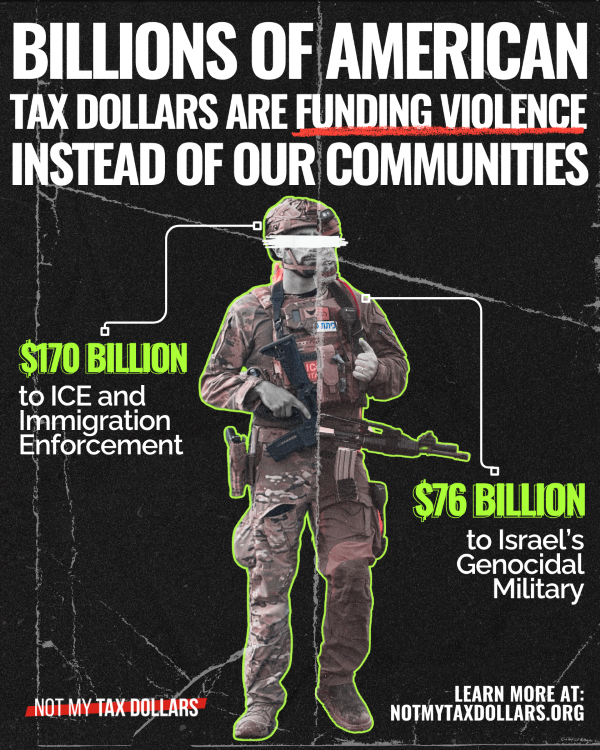
-
Billions of our U.S. tax dollars are funding militarized state violence, from ICE’s abductions to Israel’s genocide against the Palestinian people. Share this post and read more at NotMyTaxDollars.org.
-
As Israel claims to reopen the Rafah crossing, only 30 out of 22,000 critically injured or ill Palestinian patients have been allowed to evacuate so far.
-
Reuters reports the Biden administration blocked an early warning memo describing northern Gaza as an “apocalyptic wasteland.”
-
Trump just fast-tracked another $6.67 billion worth of weapons to Israel.
-
Read more about Trump’s disturbing colonization plan to build luxury skyscrapers on top of mass graves in Gaza.
VISIT THE "NOT MY TAX DOLLARS" MAP
YOUR IMPACT
Snapshots from our recent “Campaigns Camp” convening to train 100 grassroots organizers.
-
You’ve collectively sent 119,000+ emails to Congress in support of the Block the Bombs Act (H.R. 3565), moving 62 representatives to sponsor the bill.
-
In a significant win, New York Attorney General Letitia James announced the anti-Palestinian hate group Betar will be shutting down after an investigation.
-
Belgium has placed a on Israel. All countries are required to cut off weapons to Israel under international law.
-
Watch the on Youth Fellow Eq, highlighting how he’s used his skills to grow the San Diego 4 Palestine coalition. Our sister organization USCPR runs the Youth Fellowship to equip organizers with the skills to build and sustain their own local community-based campaigns.
WATCH THIS REEL
WHAT YOU CAN DO NEXT
-
Spread the word about where our tax dollars are going using these Not My Tax Dollars resources.
-
Watch The Voice of Hind Rajab at a theater near you. This film tells the story of 5-year-old Hind, as she called for help while trapped in a car with her martyred family under Israeli attack.
-
Boycott and divest from complicit companies, like Chevron, HP, Microsoft’s Xbox, Palantir, and Disney+ streaming, as well as the 2026 FIFA World Cup.
-
Call Congress now to demand an immediate, full reopening of Rafah crossing and an end to arming Israel with your tax dollars.
CLICK TO CALL CONGRESS NOW
Thank you for taking action with us.
Onward to liberation,
AHMAD ABUZNAID
Executive Director
USCPR Action
2070.
6 februari 2026
Welcome to “Ya’tik Al-’Afiyah” (May God give you health and strength), our monthly newsletter! We hope you enjoy the read.
"Glory of the Vineyard" : Majd al-Krum
Majd al-Krum is a Palestinian town in the Galilee region of the north, known for its vineyards, olive groves, rich cultural traditions, and deep connection to the land. Its name, translated as “Glory of the Vineyard,” reflects both its agricultural heritage and the deep roots of its families in the region. During the late stages of the Nakba in the Galilee, Palestinians from nearby villages that were attacked, depopulated, or destroyed fled to places that were still standing and relatively safer. Majd al-Krum was one of those places.
Majd al-Krum’s community has preserved a strong sense of identity and resilience, even as it navigates the complexities of life as Palestinian second-class citizens in "Israel." Today, many families in Majd al-Krum are dealing with significant housing and land pressures. In parts of the town, dozens of Palestinian families have received demolition or hearing notices related to unlicensed construction, a situation tied to difficulties obtaining building permits and restrictive zoning laws. Many people risk losing their homes, an issue that stands alongside broader patterns of land seizures to expand Israeli roads and settlements and underinvestment in infrastructure like water and electricity. Residents see these as part of systemic obstacles that make everyday life harder and threaten community stability.
Alongside these structural challenges, there are social pressures and concerns around safety and crime that have drawn public attention. In recent years, communities in and around Majd al-Krum have experienced spikes in violent incidents and protest movements calling for changes in policing and the (in)justice system. Some families and youth feel caught between limited economic opportunities and rising crime, pressing local leaders and civil society organizations to seek solutions.
Despite these difficulties, Majd al-Krum remains a place of collective determination and activism. Local councils and popular committees continue to organize and mobilize residents around civic causes, including participation in regional demonstrations and efforts to raise awareness of Palestinian rights in broader public life. This spirit of steadfastness reflects the community’s longstanding commitment to preserving its heritage and advocating for justice and equality in the face of ongoing occupation and oppression.
For our Virtual Visit this month, we will be going to Majd al-Krum with our tour guide Rami Haidar. Rami is a spokesperson for the Adalah Legal Center for Arab Minority Rights in Israel and former spokesperson for Amnesty International.
Save the Date for our 25th Anniversary Benefit in Chicago on May 17th!
2069.
Breaking the silence
6 februari 2026
January marked the official beginning of Phase 2 in Trump’s plan, which includes the beginning of Gaza’s reconstruction, the establishment of a technocratic government, and the disarmament of Hamas. Practical enforcement of these objectives remains unclear. And unfortunately, very little has changed on the ground: the IDF continues its attacks in Gaza, killing children, men, and women; thousands of buildings are being demolished along the constantly shifting Yellow Line; and severe restrictions on humanitarian aid remain in place. In the West Bank, the ongoing ethnic cleansing has intensified and expanded into new territories. These are not pompous statements; they reflect the horrific reality on the ground for millions of Palestinians. Here is what you need to know:
In Gaza: Hundreds Killed During the “Ceasefire”
The main objectives of Phase 2 in Trump’s plan are the disarmament of Hamas and the establishment of a technocratic government. The mechanism for enforcing these goals remains unclear. What is clear, however, is that under the “ceasefire”, the death toll in Gaza still runs into the hundreds: since it came into effect in October, more than 526 Gazans have been killed, and more than 1,447 have been injured. Last Wednesday, the IDF carried out one of its deadliest airstrikes since the ceasefire, which killed at least 21 people.
Collecting Firewood May Get You Killed
Two weeks ago, two children, cousins Mohammad and Suleiman Al Zawaraa, were killed while collecting firewood to prepare food and get warm. They were 13 and 14 years old and were reportedly killed far from the Yellow Line. Roughly two months ago, two brothers, aged 10 and 9, were similarly killed while collecting firewood near the Yellow Line. Under the IDF’s rules of engagement, picking something up off the ground is regarded as a potential threat. “Messing with the ground”, as our testifiers described it, permits the use of live fire:
“‘Messing with the ground’ [...] could be a million things. Think of yourself as a civilian: you mess with the ground to tie your shoelaces, pick something up, throw away garbage; you might be looking for something; you might be picking a flower. [But in Gaza,] messing with the ground is a code name for planting an explosive device, always.”
Rank: Captain | Period: 2024 | Area: Gaza Strip
Photo: Doaa Albaz, Activestills
As demolitions continue and most buildings in Gaza remain severely damaged, Gazans are confined to overcrowded tent camps, where winter rains have proven lethal, especially for children. This winter, at least ten infants have died of hypothermia. Meanwhile, Israel continues imposing restrictions on humanitarian aid, including a de facto ban on 37 humanitarian INGOs that provided essential aid to Gaza.
Along with 17 Israel-based human rights organizations, we issued a statement calling on our government to immediately halt deregistration proceedings, remove barriers to humanitarian and human rights action, and allow international organizations to operate safely and effectively. Read the full statement here:
Last week, Israel marked the return of the last hostage from Gaza as the body of Ran Gvili was found and returned. Even though the families of the Israeli hostages were finally able to close this terrible chapter, for Palestinians, the terrible reality of the past two years is far from over. While Israel holds great respect for its deceased citizens, over the past two years, the IDF has destroyed Palestinian cemeteries in Gaza, exhumed, and sometimes seized the bodies of many deceased Palestinians. According to Haaretz, Israel is holding the bodies of 766 identified Palestinians, including dozens of minors and of those who died in its detention centres.
Photo: Oren Ziv, Activestills, Ras Ein Al-Auja
The West Bank
Over the past two years, violent settlers have dramatically intensified their efforts to ethnically cleanse the West Bank. Two weeks ago, the entire community of Ras Ein al-Auja was expelled from their homes in the Jordan Valley. We took part in a solidarity rally with the community of Ras Ein al-Auja just a week before they were expelled. At the rally, we encountered Israeli far-right government member Zvi Sukkot, who attempted to visit the illegal outpost. His presence underscored the state’s complicity in the ongoing violence.
Photo: Avishay Mohar, Activestills, Ras Ein Al-Auja
Ras Ein al-Auja is part of a broader project of mass expulsion targeting dozens of communities across the West Bank. This project is now moving toward its next milestone. For many years, the coordinated efforts of violent settlers, the state, and the IDF were directed at Area C of the West Bank. Recently, however, these efforts have expanded into Area B, administered by the Palestinian Authority. This expansion represents another stage in Bezalel Smotrich’s “Decisive Plan,” aimed at concentrating Palestinians in overcrowded urban centres. As Haaretz reported, by the end of January, there were nine settler outposts in Area B, one of them established deep inside territory under Palestinian jurisdiction, near Nablus. This is a troubling glimpse of what lies ahead should the trend persist.
Since October 2023, at least 45 Palestinian communities have been expelled across the West Bank, leaving more than 2,700 people deprived of their homes and land. This result could not have been achieved without the active involvement of the state and the IDF. The IDF coordinates the establishment of illegal outposts, the vanguard of Israel’s ethnic cleansing, at the highest level. Eyal Zamir, the IDF’s Chief of the General Staff, has personally encouraged the erection of new outposts at his meeting with Orit Strook, Israel’s Minister for Settlements and National Missions. This approval from above is then actively implemented on the ground. In some cases, the IDF directly arms violent settlers through the regional defence units program, as explained in a recent The Guardian article in that featured our testifiers and us. In other cases, the IDF turns a blind eye to settler terror, protects the perpetrators during pogroms, and sometimes takes an active part in the violence. This video is among many examples illustrating the settler-IDF symbiosis, in which settlers stole a flock of sheep from Palestinians while the IDF protected their theft.
Limmud Festival 2025
At the beginning of December, we delivered a series of lectures at Limmud, one of the most significant annual events for the Jewish community in the UK. With over 2,000 people in attendance, the conference was an extremely powerful experience. Soldiers who speak out against the occupation are a rare presence in many Jewish communities around the world, which is why we so deeply appreciated the opportunity to be there.
We spoke about our military service in the oPt and the dual legal systems in the West Bank: one for Jewish people and one for Palestinians. We also engaged in a tense discussion about the situation in Gaza and the IDF’s policy of disproportionate destruction called “Dahyia doctrine”. Additionally, together with our partners from Standing Together, we discussed Israeli-Palestinian solidarity and activism on university campuses.
When New Israel Fund UK and Yachad invited us to Limmud this year, we knew we could not miss the opportunity. Thanks to our partners, we were able to take part in political-educational work, a core element of our activities. We were especially glad to speak with Jewish people living outside Israel. As the Jewish diaspora plays a significant role in shaping Israeli politics, it was essential for us to convey a sharp and clear message: we must all oppose our government’s disastrous and deadly policies in the occupied territories, both from within and from afar. Not only is it possible, but it is the only way to ensure a prosperous future for all of us here between the river and the sea. The occupation must be abolished.
We know so much is happening all the time, and everything is competing for our attention. But as ethnic cleansing accelerates in the West Bank, and Palestinians in Gaza die every day from cold, disease, and Israeli airstrikes, we cannot afford to look away. This is a critical moment, and we must do everything we can to change this horrific reality.
TAKE ACTION
Join a tour: See the reality on the ground in Hebron and the South Hebron Hills.
Support our work: Your donation helps us continue collecting testimonies and bringing Israelis and internationals to witness the occupation firsthand.
Spread the word: Share our materials, testimonies, and reports. Help break the silence.
BREAKING THE SILENCE IN THE MEDIA
-
Settler-Only IDF Units Functioning as ‘Vigilante Militias’ in West Bank - The Guardian Investigation
-
Israelske Soldater: Vi Manglede Hunde. Vi Brugte Palæstinensiske Fanger i Stedet - Politiken Article
-
En Israelsk Soldat Fortæller, Hvordan Hans Enhed i Gaza Fangede en Palæstinenser og Brugte Ham Som Bombehund - Jyllands-Posten Article
-
Brukte Palestinere til Livsfarlige Operasjoner på Gaza - NRK Article
ADDITIONAL READING
Click on the images to read the full texts
HOW WE FIGHT IN GAZA
“The Perimeter:” our new collection of soldiers’ testimonies chronicles the systematic annihilation and expropriation of entire villages and agricultural zones - anything that lay in the newly created Gaza buffer zone, which the IDF “completed” last December.
Since Oct 2023, Israeli officials have been consistently saying that the 238,000 Palestinians who once lived in this zone will not be allowed to return. This collection details the ethnic cleansing of around 16% of the Gaza Strip.
At the time of writing, it seems the perimeter is being expanded further.
2068.

6 februari 2026
‘Ik hoop ten diepste dat het Palestijnse volk binnenkort hun 2 februari-moment zal beleven en de kans krijgt om te werken aan de totstandkoming van het vrije Palestina van hun dromen.’
Naledi Pandor, voormalig minister van Internationale Betrekkingen van Zuid-Afrika, sprak deze woorden als hoofdspreker op de Dries van Agt-lezing afgelopen maandag. Ze sprak over hoop en strijd voor een met 800 mensen gevulde zaal in het Amare theater in Den Haag, de ‘stad van internationaal recht’.
Haar vuur en vastberadenheid sloegen aan bij het publiek, dat haar woorden regelmatig ontving met applaus, en haar een staande ovatie gaf aan zowel het begin van de lezing als aan het eind.
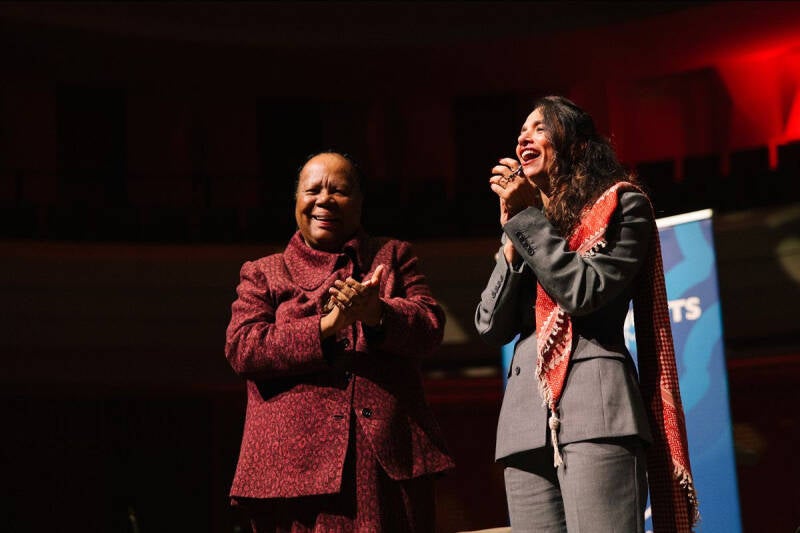
Dr. Naledi Pandor en professor Noura Erakat. [c] Hanneke Vollbehr @ohbeautifulworld
Zuid-Afrikaanse lens
De 2 februari waar Pandor de zaal mee naartoe nam, was die van 1990. Op die dag kondigde de toenmalige leider van Zuid-Afrika, Frederik Willem de Klerk, in een beroemde toespraak in het parlement het einde van het apartheidsregime aan.
Vanuit deze Zuid-Afrikaanse lens kijkt Pandor naar Israël: een staat gesticht door Europese kolonisten die de oorspronkelijke Palestijnse bevolking onderdrukken en van rechten onthouden. En zoals in Zuid-Afrika is er in Palestina een strijd gaande om het apartheidssysteem te ontmantelen en de oorspronkelijke bevolking te bevrijden van onderdrukking.
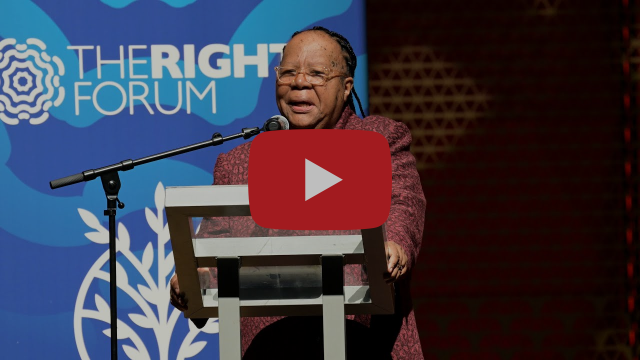
De volledige avond, inclusief het vlammende betoog van professor Noura Erakat en het nagesprek met moderator Nadia Bouras, is hierboven terug te kijken.
Burgerbewegingen cruciaal
Pandor stelde vast dat, net als ten tijde van het Zuid-Afrikaanse apartheidsregime, veel nationale regeringen nalaten het internationaal recht te doen gelden en tegen het enorme onrecht in Palestina in actie te komen. Ook in het geval van Zuid-Afrika kwam de meeste internationale steun voor de strijd tegen apartheid ‘van gewone mannen en vrouwen, georganiseerd in diverse belangengroepen’, aldus Pandor. Laat het een inspiratie zijn en geef niet op, was de boodschap van Pandor.
‘Ik spoor u aan om door te gaan en u aan te sluiten bij de inspanningen over de hele wereld. Post-apartheid Zuid-Afrika is het bewijs dat het kwaad overwonnen kan worden.’
Lees hier ons hele verslag van de Dries van Agt-lezing 2026.
Palestina in doodsnood
Voorafgaand aan de lezing kreeg Frans van Agt, de zoon van Dries van Agt, de door Allard de Rooi geactualiseerde versie van Dries’ boek Palestina in Doodsnood in ontvangst. Het boek is nu hier te bestellen.
In een begeleidend opiniestuk blikt Allard de Rooi terug op zijn vriendschap en samenwerking met Dries van Agt.
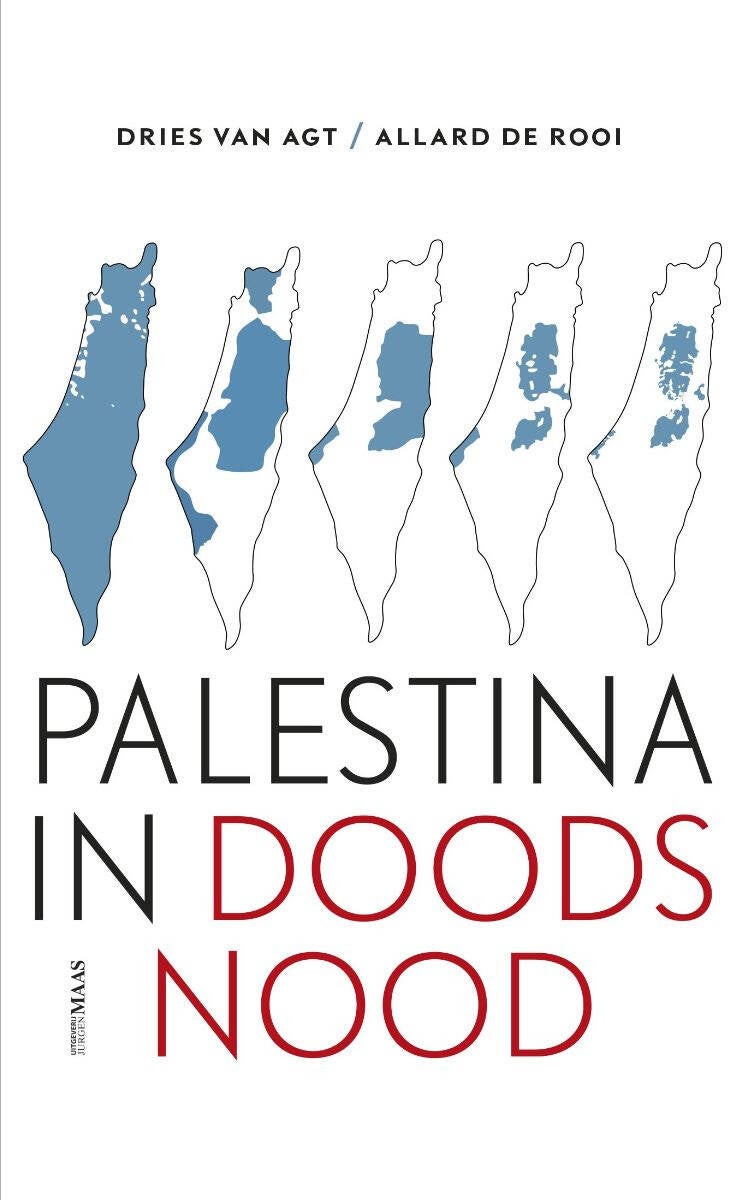
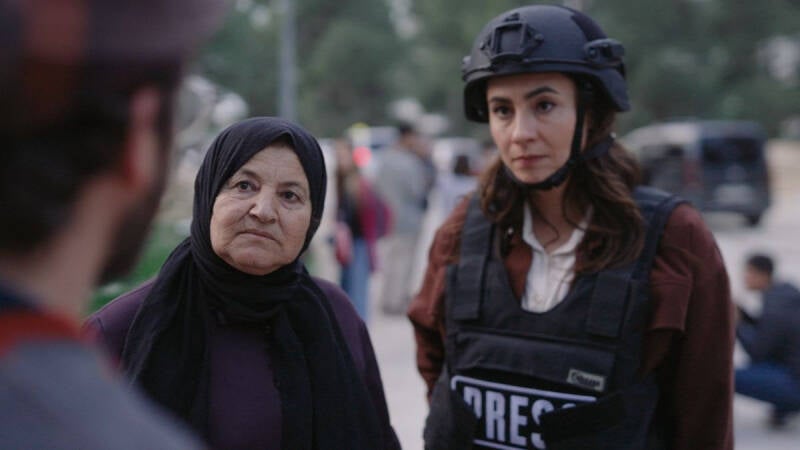
Documentaire | Gevangen in Palestina
In de nieuwe documentaire Gevangen in Palestina gaat journalist Nadia Moussaid naar de bezette Palestijnse gebieden. Moussaid richt zich op de dagelijkse realiteit van Palestijnen die leven onder de Israëlische bezetting die gepaard gaat met veel geweld en discriminatie. Hun leven wordt steeds verder ingeperkt en onveiliger, door checkpoints en de uitbreiding van illegale nederzettingen van Israëlische kolonisten - en door acties van het Israëlische leger.
Gevangen in Palestina is te zien op donderdag 12 februari om 20.30 uur bij de NTR op NPO 2.
Paneldiscussie in de Rode Hoed
Op 24 februari organiseert de Rode Hoed een paneldiscussie rondom Gevangen in Palestina. Aan de hand van fragmenten uit de documentaire gaan o.a. Ammar Hijazi (ambassadeur van de Palestijnse Missie in Den Haag ), Michael Servaes (directeur van Oxfam Novib), Berber van der Woude (bestuursvoorzitter van The Rights Forum) en Nadia Moussaid met elkaar in gesprek.
Koop hier uw tickets
Gaza | Israël richt nieuw bloedbad aan: 23 doden
Israël heeft bij verschillende aanvallen op de Gazastrook afgelopen woensdag zeker 23 Palestijnen gedood. Het jongste slachtoffer is een baby van tien dagen oud, Wateen Khabaz. Zij werd gedood door tankgranaten op haar huis in Gaza-stad, net als tien andere familieleden, onder wie haar beide ouders, haar vijf maanden oude nichtje Mira, en hun grootmoeder.
Israël beschouwt het vermoorden van de ruim twintig mannen, vrouwen en kinderen als vergelding voor één militair die in het noorden Gaza bij een schietpartij gewond zou zijn geraakt.
Zelf schendt Israël het in oktober overeengekomen staakt-het-vuren met Hamas en andere Palestijnse groepen non-stop. Het heeft volgens de laatste cijfers van het ministerie van Gezondheid in Gaza sinds de start van het bestand zeker 556 Palestijnen gedood.

Het lichaam van de driejarige Iyad Ahmed Naeem Al-Raba’i wordt door nabestaande wegedragen. Hij werd gedood dood Israëlische vuur vanaf een marineschip op maandag. © Abed Rahim Khatib / DPA / Alamy
Weinig aandacht voor Palestijnse doden
Commentatoren bekritiseren de magere media-aandacht die Palestijnse doden en Israëlische misdaden kregen. ‘Zeker 25 mensen gedood door Israël sinds vanochtend in Gaza, veel kinderen. Dat is het staakt-het-vuren. Wat ergens anders als een massale terroristische aanslag zou worden beschreven, haalt het nieuws niet eens’, schreef politicoloog Bruno Maçães zaterdagochtend op X.
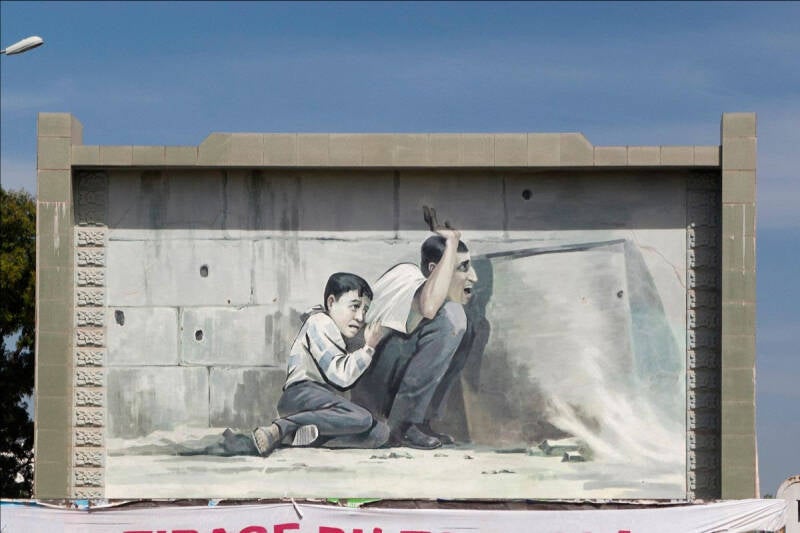
Opinie | Van Muhammad al-Durrah naar Hind Rajab: Een verhaal van twee moorden
Nu een film over de gruwelijke moord op het vijf-jarige meisje Hind Rajab – The Voice of Hind Rajab – is genomineerd voor een Oscar, draait de Israëlische propagandamachine op volle toeren om de feiten de verdraaien, ziet politiek analist en lid van de Raad van Advies van The Rights Forum, Mouin Rabbani.
Rabbani ziet parallellen met de moord op de twaalfjarige jongen Muhammad al-Durrah, aan het begin van de Tweede Intifada: 'Toen, net als nu, kwam het Hasbara Symfonieorkest [aanduiding voor Israël-propagandisten] onmiddellijk in actie, geïnspireerd door de officiële Israëlische staatspropaganda.'
Podcast | Een unieke demonstratie tegen een huichelachtig Israël-beleid
Al twee jaar lang demonstreren ambtenaren iedere donderdag voor het ministerie van Buitenlandse Zaken tegen het beleid van Nederland omtrent de genocide in Gaza. Deze demonstratie gaat gepaard met zowel bijval als tegenstand. Wat is hun eis? Nederland moet de internationale rechtsorde naleven. Deze week verschijnt in De Groene Amsterdammer een portret over de ambtenaren-sit-in, geschreven door Tjitske Lingsma.
Lingsma ging er in de podcast van De Groene over in gesprek met Kees van den Bosch. Ook bespreken zij de film The Voice of Hind Rajab en de documentaire The Disappearance of Dr. Abu Safiya.
Uit onze agenda
zaterdag 7 februari t/m zaterdag 14 februari
DEMONSTRATIES EN WAKES
UTRECHT DOORDEWEEKSE DAGEN 08.30 - 09.30 | Dagelijks stilteprotest voor Palestina, tegen genocide en bezetting (Neude, langs het fietspad)
MAASTRICHT ZA 7 FEB 16.00 | Maandelijkse publieke wake uit protest tegen Israëls voortdurende misdaden tegen de Palestijnen (Markt, bij het standbeeld van J.P. Minckelers)
HAARLEM ZO 8 FEB 14.00 | Wekelijks protest tegen de onderdrukking van de Palestijnen (Grote Markt)
AMSTERDAM ZO 8 FEB 17.00 | Stil protest tegen de onderdrukking van de Palestijnen (Spui, bij ‘t Lieverdje)
HUIZEN WO 11 FEB 11.30 | Wekelijkse sit-in voor Gaza (Gemeentehuis)
DEN HAAG DO 12 FEB 12.00 | Sit-in van Rijksambtenaren bij het ministerie van Buitenlandse Zaken, Rijnstraat 8
STATIONS IN NEDERLAND DO 12 FEB 18.00 | Wekelijkse lawaaidemonstratie op stations in heel Nederland: Stations Alkmaar (17.30 uur), Almelo, Almere Centrum, Amersfoort, Arnhem, Assen, Ede-Wageningen, Enschede, Groningen (mars vanaf Grote Markt 17.30 uur, sit-in station 18.30 uur), Hengelo, Hilversum (17.30 uur), Leiden, Nijmegen, Tiel, Tilburg, Utrecht, Zaandam (17.00 uur), Zutphen
Let op: The Rights Forum probeert de verschillende stationsacties in Nederland zo goed mogelijk bij te houden, maar dat is niet altijd goed mogelijk. Houd de sociale media-pagina's van de plaatselijke solidariteitsorganisaties in de gaten voor de meest actuele informatie.
AMERSFOORT VR 13 FEB 09.30 | Wekelijks stilteprotest tegen genocide (Varkensmarkt)
DOETINCHEM VR 13 FEB 10.00 | Lawaaidemo en speech (op het plein voor het gemeentehuis)
GRONINGEN ZA 14 FEB 13.00 | Tweewekelijkse wake van Vrouwen in het Zwart (Waagplein)
CULTURELE EN ANDERE EVENEMENTEN
AMSTERDAM, DRIEBERGEN & ZWOLLE 6 - 8 FEB | Ontmoetingen met Daoud Nassar van Tent of Nations in Bethlehem. Klik op deze link voor meer informatie over alle bijeenkomsten.
NPO 2 12 FEB 20.30 | Uitzending ‘Gevangen in Palestina’
ROTTERDAM VR 13 FEB 09.00 - 17.00 | Conferentie ‘Realising Palestinian Self-Determination and State Sovereignty: What next?’ (Erasmus Universiteit)
ROTTERDAM VR 13 FEB 22.00 | RAISER, clubnight fundraiser for Palestine (Club 160K)
2067.
5 februari 2026
As the Trump administration escalates deportations and Congress debates aid packages to Israel, two advocacy movements are facing unprecedented repression. The Intercept has been documenting how Palestine solidarity activists and anti-ICE organizers are being targeted with similar tactics — from campus crackdowns to federal prosecutions — while the Democratic Party has failed to defend either cause.
With midterm elections approaching, what do these failures mean for the future of progressive organizing? And how are these two movements strengthening each other in the face of repression?
Join The Intercept columnist Natasha Lennard in conversation with Akela Lacy, senior politics reporter at The Intercept; Morriah Kaplan, interim executive director at IfNotNow; and Dr. Osama Abu Irshaid, executive director of American Muslims for Palestine, on Tuesday, February 10 at 5 p.m. ET/2 p.m. PT. RSVP here.
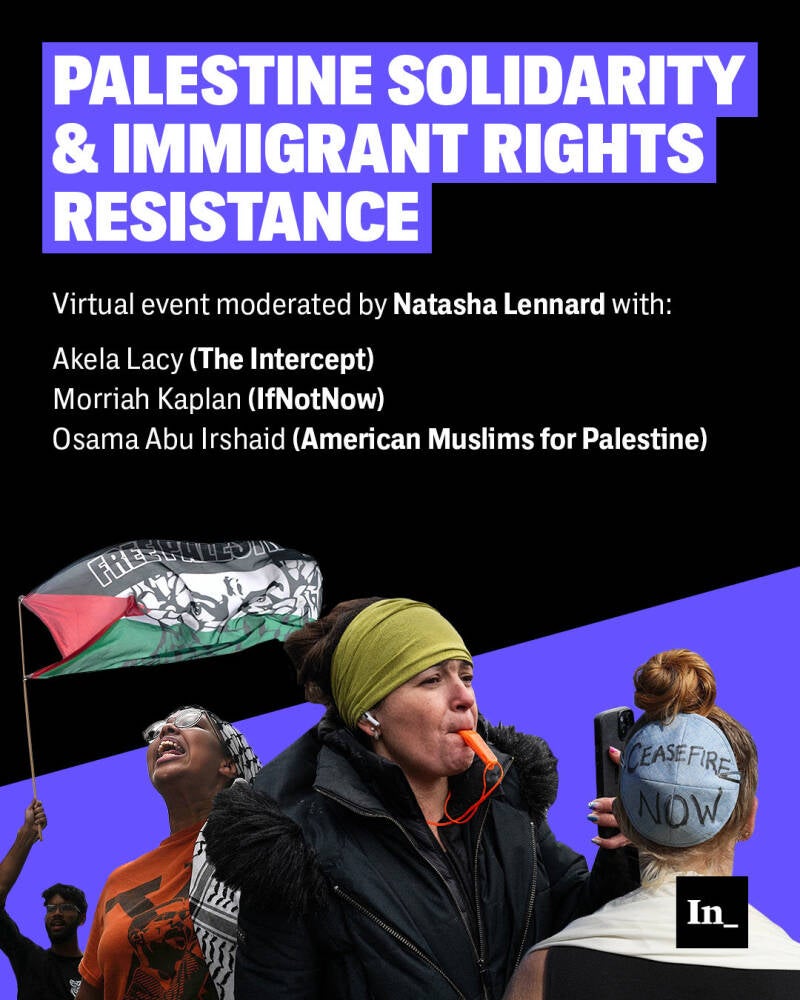
Across the country, activists are drawing connections between the fight for Palestinian liberation and the struggle for immigrant justice — two movements facing coordinated attacks from law enforcement, university administrations, and political leaders from both parties. As Democratic leadership continues to fund Israel’s military operations while failing to defend immigrant communities, organizers are building new coalitions and asking urgent questions about the party’s direction ahead of the midterms.
We encourage you to participate by submitting your questions in advance. The conversation will include a Q&A session, providing an opportunity for you to engage with our panelists. To submit a question, RSVP today.
Thank you for your continued support and readership. We are excited to connect with you at this exclusive virtual event.
In solidarity,
American Muslims for Palestine (AMP)
2066.

5 februari 2026
The 1967 Naksa: Zionist Expansionism & Domination
Last month, AMP launched a special 5-week teach-in series titled “Contextualizing The Palestinian Relationship With Zionism,” live on Zoom with our education coordinator, Tarek Khalil, where each session will have a particular focus.
Join us tonight, February 5th @ 7:30 PM EST, for our 4th episode “The 1967 Naksa: Zionist Expansionism & Domination."
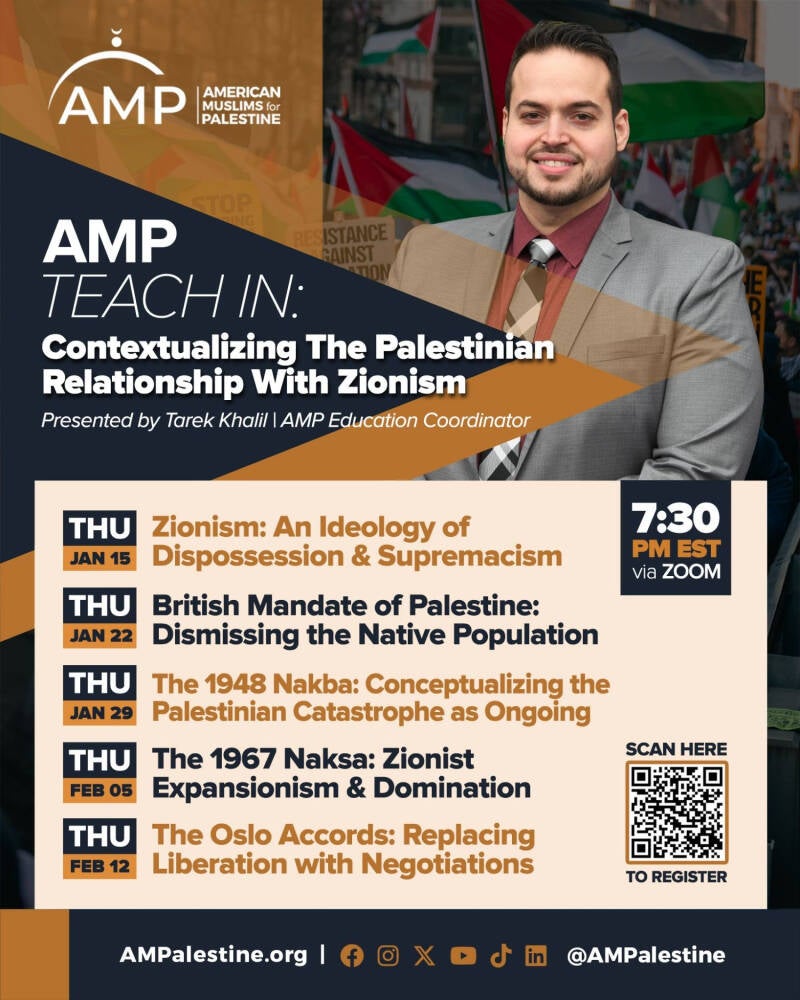
Zionist logic is premised on conquest, but in 1948 the Zionist project did not achieve the complete takeover of historic Palestine. In 1967, an opportunity was present for Israel to launch a preemptive strike against Egypt and spark a 6 Day War that heavily increased its territorial takings. The Palestinian quest for liberation took on a new diplomatic framework while Israel consolidated its land grab and entrenched its occupation. This session is a great segway to our last session dealing with the Oslo period.
Please register here to get access to the teach-in link.
In solidarity,
American Muslims for Palestine (AMP)
2065.

5 februari 2026
Last week, the Israeli regime suddenly admitted to the conservative death toll estimates of the Gaza Ministry of Health. This comes after more than two years of using every opportunity they got to undermine, discredit, dismiss, and disparage Palestinian data, facts and testimonies. Such a pattern has unfortunately been followed by most mainstream media outlets.
This acknowledgement is not a sudden act of good faith. It is part and parcel of the disinformation playbook.
The harm caused by widespread Palestinians' invalidation has already been done: it has manufactured consent for genocide. Israel is choosing to acknowledge this conservatively estimated death toll, fully aware that the real figures are far higher.
These are the patterns we are helping to fight and reframe through Communicating Palestine.
From the “Hamas-run” qualifier to the “Pallywood” trope, what harmful narratives and tactics are being used, and how can they be effectively countered?
2064.

5 februari 2026
Humanitarian Situation Update #356
West Bank
5 February 2026
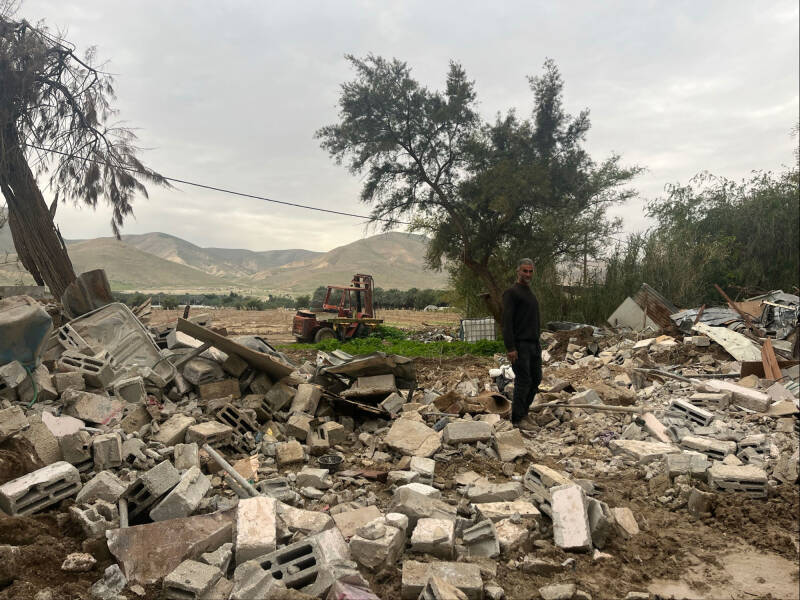
A Palestinian resident of Al Jiftlik-Abu al 'Ajaj, in Jericho governorate, following the demolition of his home for lacking building permits that are nearly impossible for Palestinians to obtain, 21 January 2025. Photo by OCHA
Key Highlights
- Nearly 700 Palestinians in nine communities have been displaced due to settler attacks so far in 2026, including 600 displaced from Ras Ein Al Auja Bedouin community in Jericho governorate.
- Large-scale operations by Israeli forces have significantly expanded beyond the northern West Bank to include the central and southern governorates, including in Qalandiya refugee camp and Kafr Aqab in Jerusalem governorate.
- Repeated Israeli settler attacks on the Ein Samiya wells east of Ramallah damaged critical infrastructure and blocked repairs, cutting the main water supply intermittently for three days and affecting an estimated 100,000 Palestinians across eastern Ramallah governorate.
- About 170 Palestinians have been displaced since the beginning of 2026 by the demolition of homes for lack of Israeli-issued building permits, following a record year in 2025 when more than 1,700 Palestinians were displaced due to lack-of-permit demolitions in Area C and East Jerusalem.
Humanitarian Developments
- Between 20 January and 2 February 2026, Israeli forces killed three Palestinians, including a child, in the West Bank, including East Jerusalem. Another 111 Palestinians, including 12 children, were injured, including 78 by Israeli forces and 33 by Israeli settlers. These include four Palestinians shot with live ammunition by Israeli forces while they attempted to cross the Barrier to reach East Jerusalem and Israel. During the same period, three Israelis were injured, including one by Palestinians and two by settlers. The following are details of the incidents that resulted in fatalities during the reporting period:
- On 23 January, Israeli forces shot, killed and withheld the body of a Palestinian farmer while he was reportedly working his land in Madama village, in Nablus governorate. The exact circumstances of the incident remain unclear. The Palestine Red Crescent Society (PRCS) reported that Israeli forces obstructed medical access.
- On 27 January, Israeli forces shot and killed a 17-year-old Palestinian child and injured another during a raid in Adh Dhahiriya town, south of Hebron city. According to the Israeli military, the boy had thrown a Molotov cocktail at the soldiers and another threw stones and was shot. No injuries among Israeli forces were reported. According to eyewitnesses, there were no clashes at the time of the incident and the child was walking with his friend when Israeli forces opened fire.
- On 28 January, Israeli forces killed and withheld the body of a Palestinian man at the Tunnels checkpoint on Road 60, near Beit Jala, in Bethlehem governorate, who was reportedly attempting to carry out a stabbing attack against Israeli soldiers. The man’s family reports that he had special needs.
- On 3 February, outside the above reporting period, Israeli forces shot and killed a Palestinian man near Ras at Tira village in Qalqiliya, reportedly after he crossed the Barrier towards Israel. On 3 February, Israeli forces shot and killed a Palestinian man during a raid in Jericho city. This brings the total number of Palestinians killed by Israeli forces between 1 January and 3 February to eight.
- Between 20 January and 2 February, OCHA documented the demolition of 69 Palestinian-owned structures for lacking Israeli-issued building permits, which are almost impossible for Palestinians to obtain, including 63 in Area C of the West Bank and six in East Jerusalem. Demolished structures included 22 residences (of which 21 were inhabited), 32 agricultural and livelihood structures, and 15 water and sanitation and other structures. Ten of the demolished structures had been provided as humanitarian assistance. In addition, Israeli forces demolished at least 35 (mainly livelihood) structures in Kafr Aqab on the West Bank side of the Barrier on 26 February (please see below). In total, 131 Palestinians, including 74 children, were displaced, of whom 32 were in East Jerusalem and 99 in Area C. The highest levels of displacement were in Shuqba village in Ramallah (24 people), Silwan in East Jerusalem (15 people), Khashem ad Daraj and Mirkez in Hebron (15 and 10 people, respectively), Tell al Khashaba in Nablus (11 people), and Al Khader in Bethlehem (10 people). Since 1 January, Israeli authorities demolished or forced owners to demolish 101 structures, including 33 homes, across the West Bank for lacking building permits, resulting in the displacement of 184 people, 98 of whom were children. In 2025, more than 1,700 Palestinians were displaced by lack-of-permit demolitions – the highest annual total on record since OCHA began to systematically document demolitions in 2009.
- On 2 February, Israeli authorities demolished with explosives on punitive grounds a residential apartment in a four-storey building in Area A of Halhul town near Hebron city. The apartment belongs to the family of a Palestinian man who carried out a stabbing and shooting attack with another Palestinian in Gush Etzion settlement block on 10 July 2025, killing an Israeli security guard. Both Palestinians were killed by Israeli forces on the spot. As a result, six people, including two children, were displaced.
- On 27 and 28 January, electricity and water were cut from a number of UNRWA facilities across East Jerusalem including Shu’fat refugee camp, as provisions of the Israeli legislation amended in December 2025 targeting UNRWA came into effect. The cuts affect UNRWA schools, health centres, and other vital service provision points for Palestine refugees. In the previous week, a fire broke out in the UNRWA headquarters in East Jerusalem, which was demolished by Israeli authorities on 20 January.
- On 1 February, Israeli forces extended a military order titled “Restriction of Movement and Traffic” for Tulkarm, Nur Shams and Jenin refugee camps and areas within the surrounding neighbourhoods until 31 March 2026. The order designates “closure areas,” as delineated on annexed maps, where entry and exit are prohibited without a permit issued by the Israeli military commander or an authorized official; such permits may be personal or general and limited by area, time, purpose, or route.
- In the context of these restrictions, for over two months, Israeli forces have repeatedly and temporarily displaced 11 Palestinian refugee families comprising 41 people from the Az Zahra neighbourhood, adjacent to Jenin refugee camp. According to local community sources, these families have been forced to leave their homes almost daily, typically between 06:00 and 20:00, severely disrupting their daily life and access to basic services. During these periods, the families have relied primarily on relatives and friends for shelter while Israeli forces reportedly occupied their homes and consumed food, health and hygiene supplies. Ongoing daily raids, repeated displacement and uncertainty have also heightened psychosocial distress, underscoring the need for psychological support for affected residents.
Raids and Operations by Israeli Forces
- Large-scale Israeli operations observed throughout 2025 continued into early 2026, with an expanded geographic spread beyond the northern West Bank to include the central and southern areas. Between 20 January and 2 February, OCHA documented at least 130 raids as well as search and other operations by Israeli forces across the West Bank, which entailed mass detentions, temporary home evacuations, and movement restrictions, including a large-scale operation in Qalandiya refugee camp and Kafr Aqab.
- In the northern West Bank, between 20 January and 2 February, Israeli forces took over at least 16 Palestinian homes for military use and temporarily evacuated at least 100 Palestinian families, alongside mass detentions, house searches, and widespread disruption of access to basic services in at least five communities, as follows:
- On 20 and 21 January, Israeli forces carried out operations in Ajja and Ya’bad towns, in Jenin governorate. In Ajja, the forces searched about 40 houses, detained about 30 Palestinians, and took over a two-storey residential building, using it for several hours as an interrogation site. In Ya’bad, Israeli forces evacuated eight residential houses after nearly two and a half months of military use and simultaneously occupied a new three-storey residential building, forcibly displacing three families of eight people and leaving extensive damage in the vacated homes.
- On 26 January, during operations in Tulkarm governorate, Israeli forces took over one house in Seida village and four houses in Illar town, using them as interrogation sites. In Illar, five families were evacuated, about 70 Palestinians were detained, and seven men were injured, while schools and municipal services were suspended in both communities for one day, affecting about 1,900 students.
- On 27 January, in Madama village, south of Nablus, Israeli forces carried out an overnight operation that lasted eight hours, taking over an uninhabited residential house to interrogate dozens of detained Palestinians.
- On 29 January, Israeli forces raided Nablus city ahead of an Israeli settler visit to Joseph’s Tomb, temporarily evacuating about a dozen Palestinian families from their homes for approximately four hours, before allowing them to return following the withdrawal of forces and settlers.
- On 30 January and again on 2 February, in Tulkarm city, Israeli forces ordered large-scale evacuations of residential areas near Nur Shams refugee camp ahead of planned detonations of explosive devices reportedly present in the streets, temporarily displacing nearly 30 families in the first incident and over 50 families in the second. Most families were allowed to return the same day.
- Since 26 January, Israeli forced have carried out an operation in Qalandiya refugee camp and Kafr Aqab, dubbed operation “Capital Shield,” aimed to reinforce control over the “seam line” areas, strengthen the Barrier and increase security measures. OCHA documented the demolition of at least 35 Palestinian-owned (mainly livelihood) structures in the area. Daily life has been severely disrupted, particularly on the first two days, with schools suspended and restrictions imposed on residents’ movements and access to livelihoods and basic services.
- Also in Jerusalem governorate, Israeli forces carried out an operation in Hizma village for three days, between 27 and 29 January, closed the town’s two main entrances, blocked alternative roads, and imposed restrictions on the movement of the town’s 8,000 residents. The operation included dozens of home raids, during which numerous residents were subjected to field interrogations. As a result, daily life was paralysed, all schools serving hundreds of students were closed, and residents faced restricted access to livelihoods, services, and essential goods. Although forces withdrew after two days, they re-entered the town shortly thereafter and reportedly fired stun grenades near commercial shops, forcing businesses to close temporarily.
- On 27 January, Israeli forces raided a residential building in Jabal Johar, in the H2 area of Hebron city, and issued a military order authorizing its use as a military post. As a result, three of the building’s 10 apartments were forcibly evacuated, and the affected families, comprising 17 people, temporarily relocated to other apartments belonging to extended family members within the same building. As of the time of reporting, Israeli forces continue to control the building’s main entrance, restricting residents’ movement and allowing exits only intermittently for essential needs, such as food purchases or medical care, affecting a total of 47 people, including 23 children. OCHA is working with humanitarian partners to identify priority needs of the families and ensure they receive the needed support.
Israeli Settler Attacks
- Between 20 January and 2 February, OCHA documented at least 52 Israeli settler attacks against Palestinians that resulted in casualties, property damage, or both. The attacks led to the displacement of 134 people (see the below section for additional details), the injury of 42 Palestinians, including four children. Of the wounded Palestinians, 33 were injured by Israeli settlers and nine by Israeli forces. In addition, three Israelis were injured, including a settler by Palestinians and two Israeli activists who were pepper-sprayed by Israeli settlers. Most incidents (33 out of 50 incidents) occurred in Nablus and Ramallah governorates. Settler attacks, threats, and harassment predominantly affected communities located near old or newly established settlement outposts and involved repeated assaults, raids and damage to residential structures and denied access to agricultural areas.
- During the reporting period, almost half of Palestinian injuries (15 out of 33) were recorded in communities in southern Hebron governorate, particularly in Masafer Yatta, reflecting a sustained escalation in settler-related violence in the area. Since early 2023, Masafer Yatta has witnessed a sharp increase in the frequency and severity of settler attacks, resulting in casualties, widespread damage to homes, livestock and agricultural assets, and growing displacement risks for affected communities. Only 18 settler incidents were documented in the area between 2006 and 2020, compared with 318 incidents between 2021 and 2025, and the monthly average of settler attacks rose from about three between 2021 and 2022 to about seven between 2023 and 2025, reflecting a sustained deterioration in the protection environment.
- Key settler incidents resulting in casualties during the reporting period include:
- In Nablus governorate, on 24 January, Israeli settlers reportedly from a newly established outpost broke into Palestinian homes in Qusra village, triggering confrontations with residents. Settlers allegedly opened fire, while Palestinians threw stones. Israeli forces subsequently raided the village, fired tear gas, searched several houses, and physically assaulted and injured one Palestinian. On the same day, in Beit Furik town, armed Israeli settlers broke into a Palestinian home and physically assaulted six Palestinians, including a woman. Israeli forces later raided the town and fired tear gas canisters. Six Palestinians were treated for tear gas inhalation. According to local sources, the same family has been repeatedly threatened by Israeli settlers to leave their home in the area.
- In Ramallah governorate, on 24 January, in one of four settler attacks in Birzeit town, four Palestinians, including an elderly woman, were injured and hospitalized, and a residential structure was damaged. According to local sources, settlers grazed livestock adjacent to the home, and when the elderly woman asked them to leave, settlers pushed her and threw stones, causing a head injury. Her son intervened and threw stones at the settlers, injuring one. The settlers then physically assaulted him and both he and his mother were subsequently transported to hospital. Israeli forces and settlers later raided the home, damaged doors and windows, and detained and assaulted male family members; two were hospitalized with fractures and bruises after their release. Following the incident, the affected family, including the elderly woman, temporarily relocated to relatives’ homes, citing fear of further settler attacks.
- This attack reflects a broader pattern observed since the establishment of a new Israeli settlement outpost in Area B on the eastern outskirts of Atara village in Ramallah governorate in August 2025. Since then, settler attacks resulting in casualties, forced displacement, and extensive property damage have sharply increased, with at least 30 such attacks documented by OCHA between August 2025 and January 2026, compared with only one incident recorded between January 2020 and July 2025. During this period, 12 Palestinians were injured, and 31 Palestinian herders across Atara, Birzeit and Ein Siniya were forcibly displaced, following sustained threats, trespassing and violence. Property damage has been widespread, including the vandalism of at least 15 vehicles, racist graffiti, damage to surveillance camera systems, theft of water tanks and agricultural equipment, and systematic grazing of livestock on cultivated lands, resulting in damage to hundreds of olive and fruit trees, as well as agricultural structures, fodder and fencing. Over time, attacks expanded from surrounding agricultural and grazing areas into residential spaces, cutting off farmers and herders from their livelihoods and triggering displacement from more densely populated village areas, as illustrated by the incident above.
- In Hebron governorate, on 24 January, Israeli settlers raided a Palestinian home in Masafer Bani Na’im, physically assaulting residents and injuring three Palestinians, including a woman. The settlers vandalized the house, breaking windows and damaging kitchen furniture. On 25 January, armed Israeli settlers attacked Palestinian herders grazing sheep in an area near Khallet al Maiyya, injuring three Palestinian children, including a 17-year-old girl. The settlers ran over two children with a vehicle, pepper-sprayed the girl, and threatened the group with weapons. On 27 January, about 100 Israeli settlers raided four communities in Masafer Yatta located in Firing Zone 918, namely: Khirbet al Fakhiet, Halaweh, Mirkez and At Taban. Settlers attacked residents with sticks fitted with knives, stole about 300 sheep, burned approximately three tons of firewood, and vandalized two homes and two vehicles. Six Palestinians were physically assaulted and injured, including one child and two women.
- On 25 and 26 January 2026, Israeli settlers carried out repeated attacks on water infrastructure in the Ein Samiya area, which serves as the main water supply to communities in the eastern Ramallah governorate, and assaulted water maintenance staff. On 25 January, for the third time in one month, settlers broke into the Ein Samiya wells site and destroyed key components of the water network, including the control panel and connecting cables belonging to the Jerusalem Water Undertaking (JWU), forcing maintenance staff who attempted to carry out repairs to leave the site following threats and intimidation; as a result, the water supply was cut at around 16:00 on 25 January. On 26 January, following coordination with the Palestinian DCL, a repair team returned to the site, but Israeli settlers again approached the staff and attacked them with a weapon, physically assaulting and injuring one worker, who was subsequently transferred to a clinic for treatment; settlers also erected metal fences, blocking the road leading to the wells. According to JWU, the water supply was cut intermittently for at least three days between 25 and 27 January, affecting the primary water source for about 20 villages and a partial source for additional communities, impacting an estimated 100,000 Palestinians in eastern Ramallah governorate.
Displacement due to Settler Violence
- Between 20 January and 2 February, 24 herding families comprising 134 people, including 76 children, were displaced due to settler attacks and access restrictions, all in the Jordan Valley area.
- On 26 January, following repeated attacks and threats by Israeli settlers from four surrounding settlement outposts, the remaining 100 residents of Ras Ein al ‘Auja Bedouin community were forced to leave their community. This follows the displacement of 98 Palestinian households comprising 485 people on 8 and 19 January. The community, one of the largest Bedouin communities in the West Bank with a total population of about 600, has now become fully displaced. Over the past two years, settlers repeatedly trespassed into the community, grazed livestock among residential shelters, intimidated residents, damaged or blocked herders’ access to surrounding pastures, and prevented them from using the nearby Al ‘Auja Spring, severely undermining their livelihoods. This was in addition to incidents of livestock theft and frequent attacks resulting in injuries and property damage.
- On 24 January, 19 people, including 17 children, were forced to leave Al Hadidiya herding community, in Tubas governorate, following repeated settler attacks that escalated following the establishment of an outpost near the community in late November 2025. Since then, four attacks that resulted in damage to property in the community have been recorded. These included cutting off electric cables and stealing water tanks. In addition, settlers forced shepherds out of grazing areas and broke into houses on several occasions.
- Since the beginning of the year, 694 Palestinian, including about 350 children, were displaced, affecting nine villages and herding communities. These include 600 displaced from Ras Ein al ‘Auja Bedouin community, marking the highest single-community displacement due to settler attacks and access restrictions over the past three years (see chart below). January 2026 marks the second highest single‑month displacement since the October 2023 peak, with displacement due to settler attacks exceeding the total for all of 2024 (621) and comprising over 40 per cent of the 2025 total (1,658).
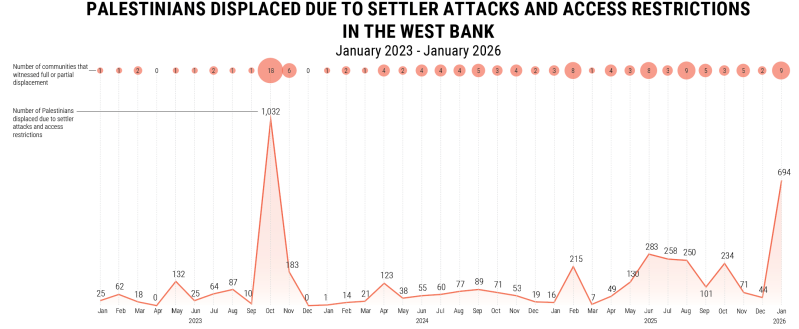
- In a statement on 28 January, the UN Human Rights Office (OHCHR) stated that settler violence has become a key driver of forced displacement in the West Bank, particularly in Area C and parts of Area B, including the Jordan Valley. OHCHR noted that recurrent settler attacks, intimidation, destruction of property, and restrictions on access to land, water and grazing areas, often in the vicinity of newly established settlement outposts, have created a coercive environment that compels Palestinian Bedouin and herding communities to leave their homes and emphasized that the “[f]orcible transfer of Palestinians within the occupied West Bank is a war crime and may amount to a crime against humanity.”
- For key figures and additional breakdowns of casualties, displacement and settler violence between January 2005 and December 2025, please refer to the OCHA West Bank December 2025 Snapshot.
Funding
- As of 30 January 2026, Member States disbursed approximately US$211 million out of the $4 billion (5 per cent) requested to meet the most critical humanitarian needs of nearly 3 million out of 3.6 million people identified as requiring assistance in Gaza and the West Bank, including East Jerusalem, under the 2026 Flash Appeal for the OPT. Nearly 92 per cent of those required funds are for the humanitarian response in Gaza, with just over eight per cent for the West Bank. In January, the oPt Humanitarian Fund managed 102 ongoing projects, totalling $56.4 million, to address urgent needs in the Gaza Strip (89 per cent) and the West Bank (11 per cent). Of these projects, 49 are being implemented by international NGOs, 43 by national NGOs and 10 by UN agencies. Notably, 48 out of the 59 projects implemented by international NGOs or the UN are being implemented in collaboration with national NGOs. For more information, please see OCHA’s Financial Tracking Service webpage and the oPt HF webpage.
2063.
AVAAZ
5 februari 2026

Precies twee jaar na haar moord stonden we zij aan zij met Hinds moeder en onthulden we een portret van haar dochter ter grootte van 1.000 m². Daarmee stuurden we een boodschap die ver voorbij de oevers van de Middellandse Zee reikte: “Vergeet Gaza niet. Laat de kinderen van Gaza niet in de steek.”
Terwijl Hinds moeder sprak, waren de emoties zichtbaar. Er waren 350 Avaazers nodig om het portret van Hind omhoog te houden, en een helikopter om dit beeld vanuit de lucht vast te leggen.
Te midden van een tragisch verlies hebben we samen ruimte gemaakt voor hoop en lieten we Hinds moeder zien dat zij er niet alleen voor staat.
Hier een video van hoe de actie eruit zag:
Maar het was niet eenvoudig. Achter de schermen ging er een maandenlange organisatie aan vooraf. In de laatste fase kregen we te maken met een reeks tegenslagen: last-minute wijzigingen in het helikopterschema, logistieke uitdagingen rondom het gigantische portret en een harde wind die elk onderdeel van deze operatie op de proef stelde.
Maar het ging door. Dankzij jou. Zonder deze gemeenschap was deze actie, een van onze moedigste ooit, niet mogelijk geweest. Jullie doneerden, stuurden boodschappen om jullie solidariteit te tonen aan Hinds moeder, en stonden op dat strand om Hinds portret, tegen de wind in, omhoog te houden.
Ons doel was om een moment te creëren dat krachtig genoeg was om het stilzwijgen te doorbreken -- en dat is gelukt.
Jullie lieten de wereld zien dat Palestina niet is vergeten. Zelfs nu Gaza van de voorpagina’s verdwijnt, zullen wij altijd gerechtigheid blijven eisen voor Gaza’s kinderen.
Ontdek hoe we samen dit moment tot stand brachten – neem een kijkje achter de schermen:
Hinds verhaal inspireerde een voor een Oscar genomineerde film, maar het onrecht gaat door. Sinds 2023 zijn minstens 20.000 kinderen zoals Hind gedood door Israël. Het zorgsysteem in Gaza is ingestort onder de aanhoudende aanvallen, en kinderen sterven nog steeds aan vermijdbare verwondingen en ziektes, omdat de toegang tot levensreddende zorg wordt geweigerd.
Daarom stonden we Hinds moeder bij tijdens haar ontmoetingen met ministers en riepen we overheden op om te handelen – voor Gaza’s kinderen.. In haar toespraak zei Hinds moeder:
“De kinderen van Gaza vragen niet om medelijden.
Ze vragen om hun recht om te leven,
om te slapen zonder angst,
om te spelen zonder bommen.
Om op te groeien – simpelweg op te groeien.
Vergeet Gaza niet.
Laat haar kinderen niet in de steek.”
Zonder jou zouden we niets van dit alles kunnen doen.
Met verdriet, en met trots,
Het hele Avaaz-team
2062.
4 februari 2026
AMP calls on the Trump administration to immediately restrain Israel and hold it to its obligations
Over the last week, Israel has killed dozens of Palestinians in Gaza. Since early this morning, Israeli attacks have claimed the lives of at least 23 more people, including two children.
The Trump administration claims it brokered a ceasefire and a so-called “peace plan.” That claim collapses the moment you look at the facts. Israel has continued bombing, killing, and collectively punishing Palestinians without interruption. There has been no enforcement, no restraint, and no accountability. What the administration has actually imposed is political cover, allowing genocide to continue under the empty label of a ceasefire that the entire world can see through. What is being sold as “peace” bears no resemblance to the reality Palestinians are living through.
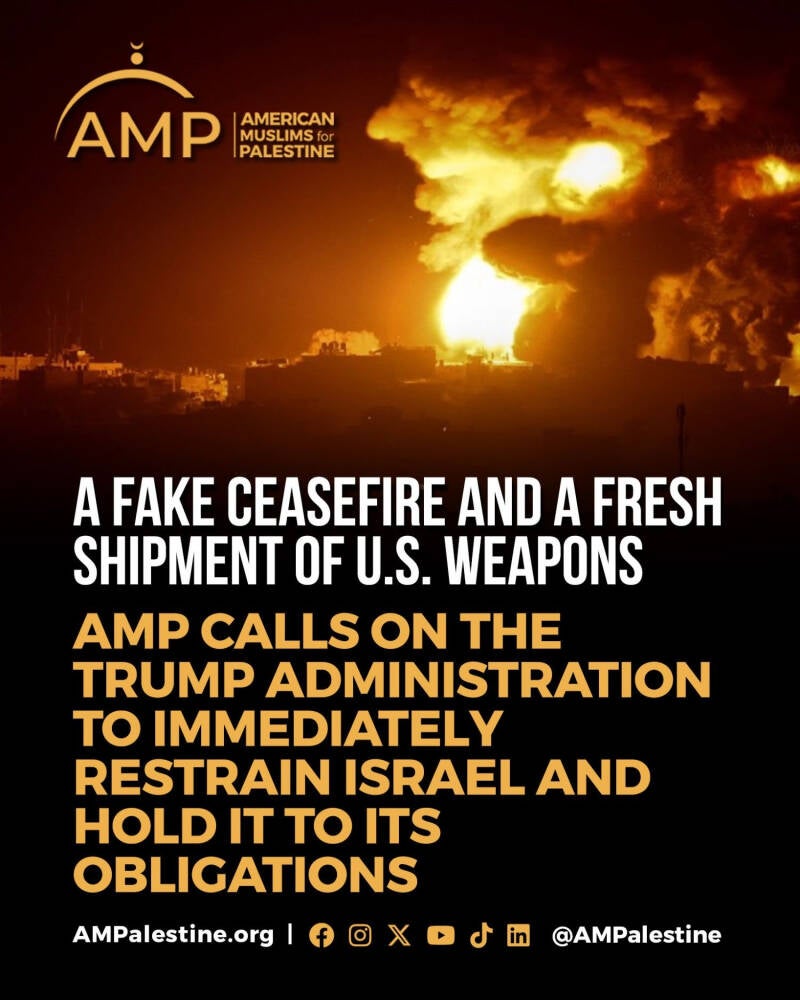
More than 550 Palestinians have been killed in Israeli attacks since the U.S.-brokered “ceasefire” came into effect in October. Israel has not fulfilled a single obligation under the so-called peace plan the administration brokered. There has been no sustained halt to attacks, no protection for civilians, no lifting of the siege, and no guarantee of humanitarian access.
Instead, Israel’s blockade of Gaza remains fully in place, in direct violation of its obligations under the so-called peace plan. Humanitarian aid is still being obstructed, delayed, and deliberately restricted. Food, fuel, medical supplies, and basic necessities remain subject to Israeli control and denial. The reopening of the Rafah crossing was presented as relief after 18 months of complete siege, but in reality, it has only further exposed how calculated, cruel, and dehumanizing Israel’s policy toward Palestinians truly is.
Movement through Rafah remains tightly controlled by Israel, even for medical evacuations. Only a small number of patients have been allowed to leave, while thousands are still trapped. Even cases classified by the World Health Organization as urgent and life-saving are subjected to a slow, invasive Israeli military screening process that routinely delays or blocks care altogether. Patients are notified, canceled, re-notified, and left in limbo while their conditions worsen.
Deliberate suffering continues to be imposed on Palestinians, while the world watches and Trump continues to boast about brokering peace. Under both U.S. and international law, continued violations of this scale should trigger accountability and the withholding of military aid. Instead of doing that, the United States approved yet another ($6.7 billion) weapons deal for Israel just last week, once again making clear how little Palestinian life is valued by this administration.
AMP calls on the Trump administration to immediately restrain Israel and hold it to its obligations. That means withholding military aid to Israel, enforcing a real ceasefire, lifting the blockade, guaranteeing full and unhindered humanitarian access, and allowing urgent medical evacuations without delay or political interference. Anything less is continued U.S. complicity and a deliberate choice to enable ongoing atrocities.
In solidarity,
American Muslims for Palestine (AMP)
2061.

3 februari 2026
How the NYT manufactured consent for genocide.

Displaced Palestinians sit in a camp in the Al-Raqab neighbourhood, east of Khan Yunis, Gaza Strip, as they just received evacuation orders for the area, 19 January 2026. Photo: Doaa Albaz
On Saturday, Israeli military airstrikes across Gaza killed at least 32 Palestinians, adding to the at least 509 killed during the so-called ceasefire. On Monday, the Rafah crossing to Egypt was partially opened, but Israel will only allow 150 Palestinians to leave Gaza each day. “At this rate, it would take over a year for the 20,000 awaiting evacuation to leave,” observed an emergency medic.
As Israel’s genocide drags on into its 28th month, Western media has been central to maintaining U.S. political and military support for these atrocities. Nowhere is that complicity more apparent than in the New York Times’ now thoroughly-debunked story “Screams Without Words.”
The false claims made in this story were parroted by top U.S. officials and used to justify U.S. government support for the slaughter of tens of thousands of Palestinian men, women, and children.
In this Wire, we’ll break down how “Screams Without Words” has been debunked and take action together to demand that the New York Times retract it.
Email the NYT: Retract “Screams Without Words”
What is “Screams Without Words”?
On December 28, 2023, the New York Times published “'Screams Without Words’: How Hamas Weaponized Sexual Violence on Oct. 7.” The investigation claimed to document a deliberately deployed and systematic pattern of widespread sexual violence against Israeli women on October 7. No such evidence existed.
The story has since been thoroughly debunked by its own sources, medical professionals, and independent journalists. But that didn’t stop Western media outlets, members of Congress, and even President Biden from parroting the NYT’s unverified claims, further fueling the Israeli government’s genocidal war on Palestinians in Gaza.
Email the NYT: Retract “Screams Without Words”
How has “Screams Without Words” been debunked?
In its investigation into the reporting behind “Screams Without Words,” the Intercept raises questions about witness testimonies central to the story. These now-debunked testimonies were attributed to members of the widely discredited ZAKA group, other individuals with “track records of making unreliable claims,” and Israeli officials and soldiers with a vested interest in painting Israel’s genocidal war on Gaza as a fight against supposed “barbarism.”
It was ZAKA that originated the racist and Islamophobic lie about “beheaded babies.” A second source for the story, American architect and IDF reservist Shari Mendes, had claimed that a “baby was cut out of a pregnant woman and beheaded and then the mother was beheaded," yet another sensationalist claim that had already been proven false by the time Mendes was interviewed for the article. “Screams Without Words” opens with the story of Gal Abdush, but two of her family members have since come forward to say that they were pressured to participate in the story and adamantly refuted the claim that Abdush was raped.
One of the story’s co-authors, former Israeli intelligence officer Anat Schwartz, has admitted openly that she had no reporting experience. Yet at the behest of the NYT, Schwartz was “convinced” — in her own words — to write the story with her partner’s nephew, freelancer Adam Sella. Schwartz has since come under fire for liking an explicitly genocidal tweet that called to “turn the [Gaza] strip into a slaughterhouse.”
The third co-author, longtime NYT reporter Jeffrey Gettleman, stated publicly after the story was published that he did not feel confident using the word “evidence” to describe what the story contained. The story set off an internal “firestorm” at the NYT, and even their own podcast, The Daily, declined to platform “Screams Without Words” for failing to meet its editorial standards — though the NYT has since claimed that isn’t the case.
“Screams Without Words” relies on sparse, unverified testimonies because no forensic evidence of systematic sexual violence during October 7 exists — a fact even the story’s co-authors admitted. In a podcast interview with Israel’s Channel 12, Schwartz says she spoke with Israeli hospitals and sexual assault hotlines, tracked down survivors of the attacks, and contacted Kibbutzim that had been targeted. None could produce evidence of widespread sexual assault. Though Israeli investigators claimed to have been gathering “tens of thousands” of witness testimonies to sexual violence in December 2023, this evidence “never materialized,” according to the Intercept’s investigation.
Email the NYT: Retract “Screams Without Words”
“A predetermined narrative”
For generations, the New York Times has borne a reputation as the nation’s paper of record: a standard-bearer for rigorous, verified journalism that shapes public understanding of world events. When the NYT speaks, policymakers listen, other media outlets follow, and public opinion crystallizes around the narratives it presents.
This has happened before. After its falsified reporting of “weapons of mass destruction” helped spur on the 2003 U.S. invasion of Iraq, the NYT catalogued the many unverified claims it repeated and apologized for printing biased commentary as fact. “The failure was not individual,” the NYT’s former public editor wrote, “but institutional.”
Today, history repeats itself. In commissioning a former Israeli intelligence official and her nephew to write one of the most consequential stories of this century, editors at the NYT weren’t just being irresponsible; instead, the botched reporting process suggests that the NYT sought to “bolster a predetermined narrative,” describes the Intercept.
Despite the clear lack of evidence that widespread sexual violence had taken place, the claims at the center of “Screams Without Words” had far-reaching consequences.
In the weeks immediately after the article appeared, Biden, Blinken, and other officials escalated references to sexual violence in public messaging as they defended continued military aid “without conditions.” Shortly after the article was released, Congress passed a resolution echoing its conclusions, which directly cited the story as evidence. And major outlets amplified the NYT's unverified claims, creating a narrative that portrayed any criticism of Israel's military campaign as minimizing sexual violence. All of this reinforced U.S. material support for Israel’s genocide and, by extension, resulted in the deaths of untold numbers of Palestinians.
2060.

3 februari 2026
Americans don’t want our tax dollars funding genocide - Tell Congress to Block the Bombs
Last week, the United States approved a $6.6 billion weapons deal to Israel.
This decision was made while Israel continues to bomb Gaza, despite repeated claims that a “ceasefire” is in place. We all know the ceasefire is little more than a talking point, a rhetorical shield meant to distract from the continued reality of genocide.
Tell your members of Congress to Block the Bombs
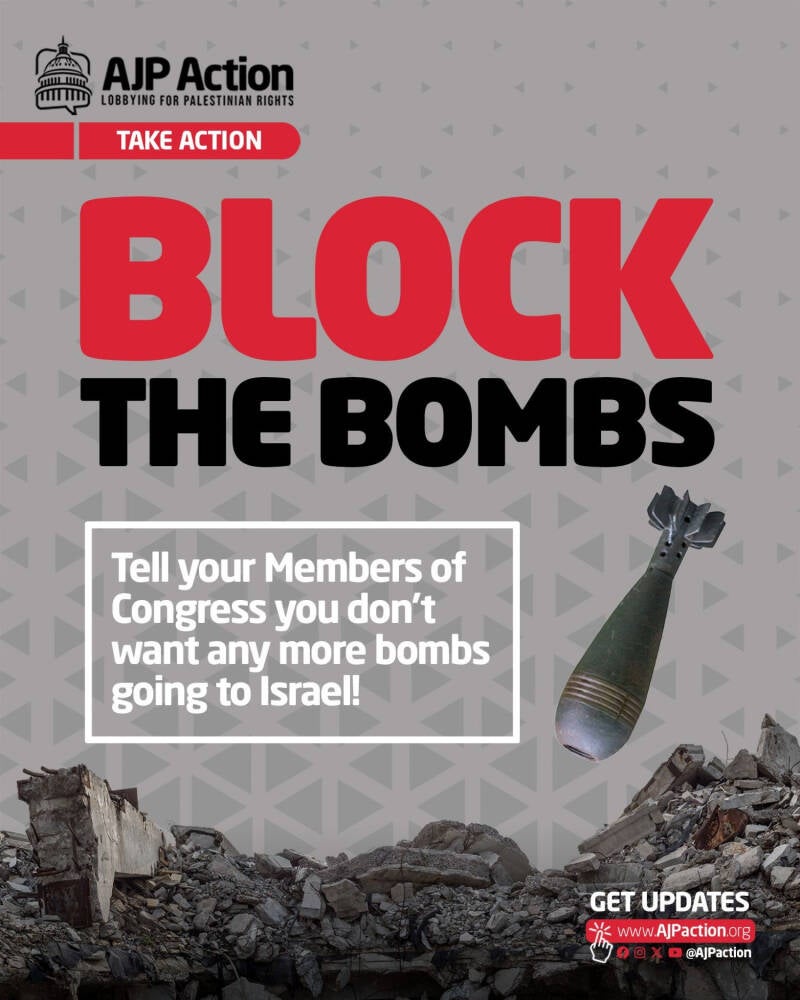
Over this past weekend alone, at least 31 Palestinians were killed by Israeli bombardment across Gaza, including attacks in Rafah.
Earlier last week, the Israeli Occupation Force (IOF) publicly acknowledged that Gaza’s death toll has, in fact, reached at least 70,000 Palestinians killed over the past two and a half years, a figure long reported by Gaza’s Health Ministry and previously dismissed and denied. Palestinians have documented this genocide in real time for over two and a half years. They did not need the IOF to validate their deaths. But even with that admission, Israel continues to carry out strikes, enforce collective punishment, and entrench mass death under the cover of a so-called ceasefire. Since the ceasefire agreement on October 11, 2025, Israel has violated it over 1,400 times, killing 526 Palestinians and injuring at least 1,447. Israel also continues to refuse to implement many of its obligations under the agreement, most notably allowing the agreed‑upon levels of humanitarian aid and the entry of mobile housing units.
As if that wasn’t enough, Israel is accelerating land theft and forced displacement across the occupied West Bank. Settlements are expanding at record speed. Armed settlers are burning Palestinian farmland, attacking villages, destroying olive groves, and driving families off their land. Entire communities are being erased through organized terror and state-backed impunity.
And the U.S. response? More weapons. More money. More political cover.
The weapons being sent, including Apache attack helicopters, are the same types of arms used repeatedly in attacks on Palestinian civilians, residential areas, hospitals, and refugee camps. Sending them now is yet another explicit endorsement of continued violence.
U.S. law is clear: weapons cannot be transferred when there is a credible risk they will be used to commit human rights abuses or war crimes. International law is clear: collective punishment, targeting civilians, and indiscriminate bombardment are crimes. And morally, this could not be clearer. Yet Congress and the Trump administration continue to act as though Palestinian lives are disposable.
We refuse to accept that. Take action now and tell your members of Congress to Block the Bombs and stop arming genocide.
In solidarity,
Americans for Justice in Palestine Action
2059.
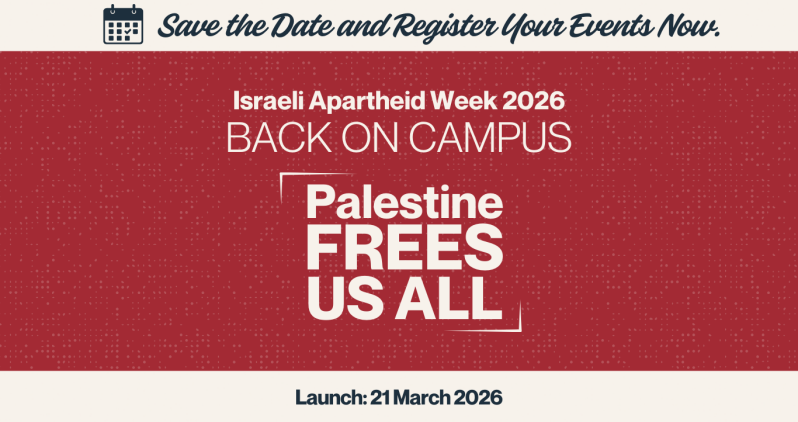
3 februari 2026
This year, Israeli Apartheid Week (IAW) is returning to its roots on campuses around the world. IAW will launch on the International Day for the Elimination of Racial Discrimination on March 21st, 2026 and will include Palestinian Land Day on March 30th, continuing into April in different parts of the world.
This year’s theme is “Palestine Frees Us All.” In the face of Israel’s ongoing genocide, illegal occupation, settler colonialism, and apartheid against the Indigenous Palestinian people, this IAW is more important than ever.
Register your IAW event now.
The US imperialist aggression in Venezuela and globally shows that the ongoing US-Israeli livestreamed genocide in Gaza is only the first “experiment” of a horrific might-makes-right order. Building a global, intersectional wave of resistance to all forms of oppression, racism, colonialism, and apartheid has therefore become an existential need, not just a moral duty, for the global majority.
For this IAW, we are counting on the campus movement, which has played a vital role in our struggle, as the global campus mobilizations calling for boycotting and divesting from Israel have shown. Anti-war campus actions were instrumental in the struggles against the US genocidal wars in Vietnam and Iraq, as well as against the apartheid regime in South Africa, among others.
For 21 years, IAW has been crucial for amplifying and enhancing grassroots BDS campaigning thanks to the inspiring solidarity of many, mainly students, academics and trade unions. We encourage you all to organize IAW activities to amplify the call for Palestinian liberation in your communities.
Share our "Save the Date" message now.
2058.

2 februari 2026
We're excited to see the growing use of UpScrolled, a new social media founded by a Palestinian and incubated at Tech4Palestine, as social media communities seek platforms built on people's power and organizing rather than Bigtech and imperialist interests. When targeted censorship continues to silence the oppressed through malicious algorithms and bias, the most powerful response isn't just to protest within those spaces, but to build an alternative infrastructure.
With that, it is also essential to reflect on how we fill these new spaces with ethical conversations and engagement, on Palestine and on issues affecting oppressed and marginalized people everywhere.
This is where Communicating Palestine (CP) comes in! Your essential communications guide on how to engage in conversations about Palestine and with Palestinians, with tools and tips to debunk tropes, propaganda and harmful practices.
Whether you're discussing online or face-to-face, CP empowers every person to speak up and engage collectively responsibly and with dignity.
Our path forward requires both the right spaces and the right tools. Join us in building a future where Palestinian voices are understood, respected, and valued.
2056.

2 februari 2026
OCHA OPT Product Survey
Dear partners,
Please take a moment to provide feedback on OCHA's regular publications covering the humanitarian situation in Gaza and the West Bank. You can access the survey at https://surveys-kobo.unocha.org/single/fdgdeISC. The survey is anonymous and available in three languages.
Your feedback will help us better understand your perspectives, assess the quality, clarity, timeliness and usefulness of our updates, and inform improvements to the content, format and periodicity of our regular products.
Kindly note that the deadline for sharing your feedback has been extended to 6 February 2026.
Best,OCHA oPT Team
2055.
1 februari 2026
The U.S. reconstruction plan leaves Palestinian rights off the table
The Rafah crossing from Egypt into Gaza may reopen within days, albeit with tight restrictions from Israel on what and who can pass through it. At the same time, Israel has carried out expanded attacks within Gaza, despite the ceasefire still being in place. The remains of the final Israeli held captive in Gaza from the October 7, 2023, attack were recovered after a similar violation of the ceasefire. There was a lot to cover this week.
Mitchell Plitnick wrote about the Trump administration's plans for the so-called Board of Peace and what they imply for Gaza. He argues that the proposed structure is not a transition plan but a framework for permanent American control.
Qassam Muaddi broke down the U.S. reconstruction plan and what it is designed to produce on the ground. He shows how the plan treats Palestinians as a population to be managed while leaving basic political rights off the table.
Tareq S. Hajjaj reported on reactions from Gazans to the announcement of the Palestinian technocratic committee that is supposed to oversee Gaza under Donald Trump and the Board of Peace.
Michael Arria reported on Mahmoud Khalil and the Trump administration's effort to deport him to Algeria over a pro-Palestine speech. Immigration enforcement is being used to punish political activity and send a chilling message to the wider movement.
Rafaela Cortez and Ricardo Esteves Ribeiro accompanied Palestinians during the 2025 olive harvest in the West Bank. Their reporting shows how settler violence and military protection work together to make ordinary life and work on the land dangerous.
Mondoweiss is a founding member of the Movement Media Alliance. That organization released a statement about the arrest of journalists Georgia Fort and Don Lemon in Minnesota after they reported on the anti-ICE protests there.
David Reed, Publisher
📹 Video
Israel's military chief just declared the "Yellow Line" will become Israel's new border—cutting Gaza in half. But this isn't a new idea. It's a decades-old colonial strategy. Featuring Bisan Owda reporting from Gaza.
🫅 The Board of Peace and the new imperial court
Trump formally announced the "Board of Peace" at Davos, pitching it as a path to stability while critics describe it as a direct attempt to undermine the U.N. and replace international law with a pay-to-play club of vassals, billionaires, and strongmen.
READ MORE → Trump unveils so-called "Board of Peace"
READ MORE → A world on its knees: Trump's "Board of Peace" and the darkness it promises
READ MORE → The Middle East is at a tipping point as the U.S. fuels crisis across the region
🇵🇸 Gaza and the Board of Peace
The Trump administration is moving to formalize U.S. control over Gaza's political and economic future while keeping Palestinians outside the decision-making.
READ MORE → As Trump's Board of Peace presses forward, Palestinians in Gaza fear what lies ahead, Tareq S. Hajjaj
READ MORE → The U.S. plan for Gaza has nothing in it for Palestinians, Qassam Muaddi
READ MORE → The U.S. occupation of Gaza has begun, Mitchell Plitnick
🇮🇱 Jerusalem and the West Bank
Israel continues to use settler organizations, courts, and military force to drive Palestinians off their land. Settler expansion advances through law and violence, and Palestinian life is treated as an obstacle to be cleared.
READ MORE → A Palestinian neighborhood's last stand against Israeli settler takeover in Jerusalem, Qassam Muaddi
READ MORE → A bloody season the olive harvest in the West Bank, Rafaela Cortez and Ricardo Esteves Ribeiro
🚨 U.S. Crackdown on dissent
The U.S. state is expanding its use of immigration enforcement and detention while targeting Palestine solidarity. Punishment for dissent is being normalized, whether it is deportation threats for political speech or family detention and intimidation under the banner of security.
READ MORE → Mahmoud Khalil vows to oppose Trump efforts to deport him to Algeria over pro-Palestine speech, Michael Arria
READ MORE → Power and Pushback: Soliman family members recount harsh details of being held in ICE detention for 8 months, Michael Arria
READ MORE → 'We cannot separate imperialism from domestic militarization': Understanding the links between ICE, Gaza, and U.S. foreign policy, Michael Arria
🇺🇸 U.S. politics and the pro-Israel lobby
AIPAC and the Israel Lobby are adjusting to a political environment where unconditional support for Israel is increasingly unpopular with Democratic voters. The New Jersey race shows how the lobby is trying to enforce discipline while disguising its actions.
READ MORE → The Shift: AIPAC targets former ally in New Jersey, Michael Arria
✝️ Palestinian Christians and Christian Zionism
Church leaders in Jerusalem issued a rare and direct rejection of Christian Zionism, drawing a backlash from U.S. Ambassador Mike Huckabee. This is about political control and representation, and about silencing Palestinian Christian voices that refuse Zionist theology.
READ MORE → Mike Huckabee is interfering with the work and witness of churches in the Holy Land with a goal of silencing Palestinian Christians, Rifat Kassis
🇵🇸 Palestine 36
This week's Palestine Letter newsletter looks at Annemarie Jacir's film Palestine 36 and what it reveals about the continuity between the past and the present under colonial rule.
READ MORE → Palestine Letter: Palestine 36 is a movie about the Palestinian past that tells the story of today, Qassam Muaddi
2055.